


![The State of Conversational AI in Finance: What Our Survey of 200 Execs Revealed [Proprietary Research]](https://masterofcode.com/wp-content/uploads/2025/12/Cover_financial-services.jpg)
You can’t scroll through a tech feed without hitting a wall of AI predictions. But predictions aren’t a strategy. This year, Master of Code Global and Infobip decided to evaluate broader conversational AI trends through a practical lens and ask a harder question. We wanted to cut through the noise and see what is actually happening inside the boardroom.
Together, we surveyed 200 senior decision-makers from global banks to fast-moving fintechs across Europe and North America. Our teams complemented the data with in-depth interviews to understand not just what leaders are investing in, but why certain initiatives survive scrutiny while others stall. We dug into their budgets, their blockers, and their brutally honest lessons learned to compile our report.
What about the findings? The real focus today is far more pragmatic:
- How do we scale Conversational AI without increasing regulatory risk?
- Where does ROI actually come from: cost savings, competitive edge, or something else?
- And what separates controlled, trusted AI systems from those that quietly create exposure?
This article breaks down what your peers are doing right now and what’s guiding their decisions as Conversational AI in finance enters its next phase.
Table of Contents
Key Takeaways
- Adoption is Mature: 89% of financial firms now use RPA and Chatbots, moving beyond “experimental” phases.
- Investment is Heavy: 89% of organizations allocate over $1M annually to AI, with 33% spending over $5M.
- The Next Frontier: 97% of leaders plan to expand Agent Assist tools in the next 12-24 months.
- The “Steering Wheel”: Conversation Design is rated “critical” by 44% of leaders, acting as the primary safeguard for compliance and user trust.
Learn from 200+ finance executives about working AI solutions, risk management, and ROI they’re seeing.
The Real Benefits of Conversational AI in Finance
For a long time, the argument for innovation was purely about the bottom line: install a bot — save money. But today, that logic doesn’t hold up. Industry leaders are adopting AI not only to spend less but to win more business.
In our research, 56% of leaders named competitive advantage as their primary driver, while only 22% pointed to cost reduction. And that change matters. Executives are using Conversational AI in financial services to shape brand perception, reduce friction in complex journeys, and deliver experiences competitors struggle to match.
Here is where the actual value sits today.
Competitive Advantage is the New Driver
In a market where every fintech app offers similar rates and features, the experience is the only thing that sets you apart. Executives are deploying finance chatbots to create a service that feels faster and smarter than the competition, which keeps customers from looking elsewhere.
Real-World Illustration: RCS for Fintech
A global payment processor had a messy communication setup. They sent alerts via email, SMS, and portals, forcing clients to jump between apps to get anything done. It was frustrating, and satisfaction scores dropped 18% in one year.
Master of Code Global built a unified RCS Business Messaging platform. Instead of scattered alerts, everything moved into a single, rich conversation thread. Clients could check transaction details, verify payments, and fix issues without leaving their messaging app.
As a result, the friction disappeared. The firm saw a 42% drop in customer service calls and satisfaction scores jumped 27% in six months. By turning messaging into a better experience, they also happened to save $1.2M annually.
Risk Mitigation & Fraud Prevention
Trust is hard to build and easy to lose. That is why 78% of the surveyed organizations have already put AI-powered fraud detection in place. In finance, a single breach can do more damage than any marketing campaign can fix.
Interviews reinforced why these initiatives receive fast approval. As the Head of Strategic Risk Management at a Malaysian Financial Institution put it:
“The strongest validation comes when benefits can be quantified in financial terms. Fraud models stand out here, since savings are visible in the amount of money prevented from being lost. Projects that protect external customers carry more weight than those that only streamline internal workflows, because client safety and trust translate directly into business value.”
Conversational AI for finance plays a growing role here, guiding customers through secure verification flows, spotting suspicious behavior in real time, and escalating high-risk cases before losses occur. Unlike internal automation, these systems visibly defend trust, which makes ROI easier to justify.
Scaling “Human” Capacity
There is a clear split in why companies need AI. Startups use it because they can’t hire fast enough — 81% cite a lack of skilled talent as a major blocker. Enterprises have the people, but they have too much data and volume for manual teams to handle.
It’s not about replacing staff. It’s about keeping the system running when volume spikes would otherwise crash your support lines.
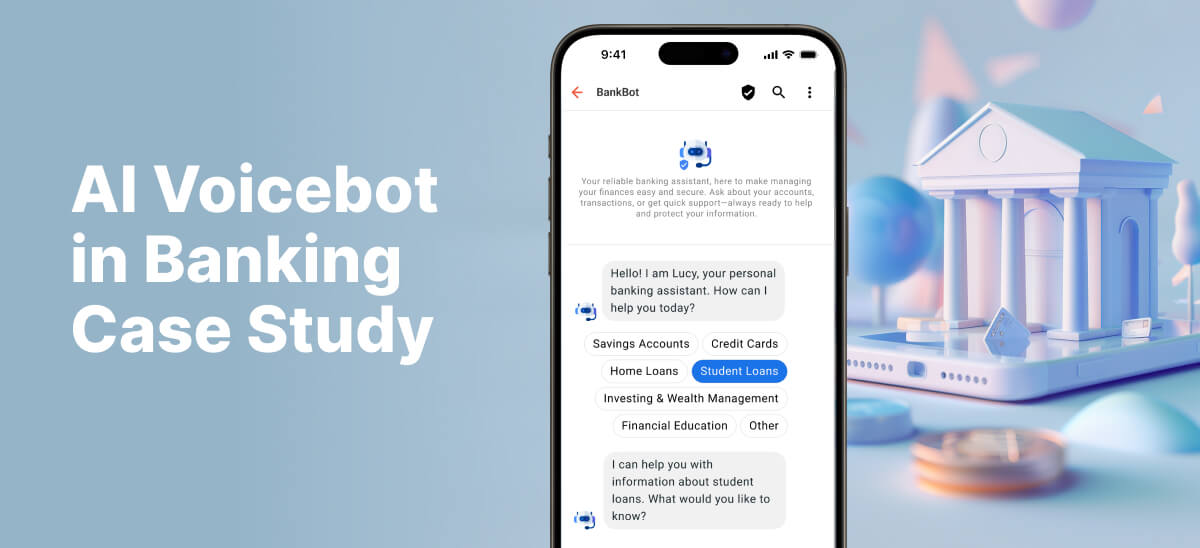
Real-World Illustration: AI Voicebot for Banking
A mid-sized retail bank was growing fast, but its call center couldn’t keep up. Wait times increased, service quality slipped, and scaling headcount wasn’t sustainable.
We delivered an AI-powered FAQ voicebot integrated with the bank’s CRM and core systems. It handled routine inquiries, authenticated users securely, supported multiple languages, and escalated sensitive cases to human agents when sentiment turned negative.
The results showed how AI extends human capacity rather than replacing it:
- 26% reduction in call center volume;
- 94% accuracy answering FAQs;
- 79% first-call resolution for common requests.
The takeaway is simple: the technology succeeds when it handles volume humans were never meant to manage, freeing people to focus where judgment, empathy, and accountability still matter most.
The “Steering Wheel” of Safety: Conversational AI Design in Finance
Conversation Design (CD) is often misunderstood as just “writing scripts” for a chatbot. In financial services, that view is dangerous. Design is not about copywriting; it is about risk management.
The Missing Link in Strategy
Despite the AI boom, our report exposes a worrying gap: only 44% of organizations currently rate Conversation Design as a “critical component” of their strategy. This suggests many firms are building powerful engines without installing a guidance system.
Without rigorous design, Large Language Models (LLMs) are prone to hallucinating facts, giving verbose answers, or skipping mandatory compliance disclosures. As our report puts it: if the LLM is the engine driving the car, Conversation Design is the steering wheel. It is the only thing ensuring the vehicle stays on the road.
Compliance by Design
The biggest fear for 67% of leaders is regulatory hurdles. The fear is that a “black box” AI will say something it shouldn’t.
Good design solves this by acting as a guardrail. It forces your virtual assistant for financial services to follow strict logic flows before it is allowed to generate a creative response. For example, completing identity verification or reading a mandatory disclaimer. This also applies to inclusivity. With the European Accessibility Act (EAA) approaching, only 22% of EU-operating firms feel fully confident they are compliant. Designing for accessibility isn’t just an ethical choice but a regulatory requirement.
Real-World Illustration: Voice AI Agent Built for Safety and Scale
These principles came into sharp focus when a large EU financial institution set out to rethink how it handled credit account inquiries. With more than 600 agents and close to 300,000 calls a month, routine requests were draining time, money, and morale. Balance checks, payment confirmations, due dates — important, but repetitive.
The custom Voice AI agent developed by Master of Code Global was designed around conversation structure first, technology second. Every interaction followed a clear path: authenticate, confirm intent, retrieve data, respond, and decide whether the case should stay automated or move to a human specialist.
As Henrique Gomes, our Head of Conversational AI Design & Strategy, explained during delivery:
“The success of this project relied on a strong connection between the conversational finance experience and the client’s APIs. This allowed customers to self-serve in real time without human intervention. When you enable the right use cases in the right channel, you not only improve containment but also boost customer satisfaction by giving people faster, more reliable answers.”
Design choices shaped everything. Voice biometrics, layered verification, and automatic redaction of sensitive data were embedded directly into flows. The system knows when to slow down, when to clarify intent, and when to stop and hand off. It recognizes frustration, ambiguity, and risk as signals not edge cases.
The results were impressive:
- Over 156,000 calls handled autonomously each month;
- 94% first-call resolution for routine credit inquiries;
- $7.7M in annual operational savings;
- 88% customer satisfaction, with nearly three-quarters choosing the Voice AI again for similar needs.
From Chatbots to Intelligence: Conversational Analytics for Corporate Finance
“Analytics” in the context of Conversational AI often gets reduced to simple metrics like “deflection rates.” But for corporate finance, it is more about business intelligence. For example, taking the massive amount of unstructured data from customer chats and turning it into revenue, compliance, and efficiency.
The Rise of Agent Assist
According to our report, 97% of organizations plan to expand such tools in the next 12-24 months. It is the single highest priority across the industry.
Why the rush? Because fully autonomous bots can be risky, but an AI-assisted human is a superpower. Agent Assist combines the efficiency of technology with the judgment of a human. Crucially, it allows banks to monitor 100% of interactions for compliance and quality, rather than just spot-checking a random 5%.
Real-World Illustration: Agent Assist for Internal Knowledge
A member-owned credit union with over 45,000 members was struggling with a classic knowledge problem. Staff wasted hours digging through scattered SharePoint libraries and policy manuals to find compliance answers. It was slow, frustrating, and prone to error. They needed an AI assistant, but it had to be 100% secure — no data could leave their protected Microsoft environment.
Master of Code Global built a Microsoft-native AI knowledge assistant. Instead of using external public models, we engineered a secure solution within their existing Power Automate and Teams infrastructure. The bot connects directly to their internal repositories, understanding natural language queries about complex regulations and policies while ensuring total data sovereignty.
The impact was immediate. Staff reduced the time spent searching for policies by 85%. Internal support tickets dropped by 42% because employees could find their own answers instantly. Most importantly, 93% of the AI’s responses were rated as accurate and helpful by the staff using it.
Measuring What Matters
The industry is shifting its KPIs. Leaders are moving away from vanity metrics like “number of users” and towards hard financial metrics like “Time to Insight” and “Cost per Case.”
The Chief AI & Innovation Officer at Large Middle Eastern Bank noted for our report:
“Delivery is only the beginning. A project is considered successful once it generates tangible returns, not when a model is simply deployed. A behavioral segmentation engine, for example, only counts if it drives real income for the bank.”
Whether that’s millions in fraud losses prevented or a 33% improvement in developer efficiency — if you can’t measure the dollar value, you can’t scale the budget.
The Move Toward Agentic AI
While chatbots wait for you to ask a question, AI agents in finance (rated a high priority by 67% of leaders) goes a step further: it acts. These solutions can not only retrieve information but perform tasks, like resolving claims, optimizing ad spend, or processing invoices. This is where “analytics” turns into “action.”
Real-World Illustration: Agentic AI-Powered Revenue Engine
A mid-sized B2B lending company knew they had a data problem. Their marketing spend, CRM leads, and final transaction values lived in three different silos. They were spending big on growth, but they couldn’t calculate their true Return on Marketing Investment (ROMI) or Customer Acquisition Cost (CPA) without hours of manual spreadsheet work.
To resolve their challenge, our team conducted in-depth finance AI consulting and came up with the right solution. This was an Agentic solution embedded into a custom analytics platform. This tool unifies the fragmented data streams and proactively analyzes them. It shows a chart and surfaces anomalies, answers natural language questions about performance, and even provides data-driven recommendations on where to cut or increase spend.
By incorporating Generative AI in finance and turning static data into active intelligence, the firm saw a 35% increase in marketing ROI within six months. They reduced their effective CPA by 22% and freed up 15+ hours a week that teams previously wasted on manual reporting.
Where the Budget Goes: Strategic Investment Trends
The money tells a clear story. One-third of organizations now spend more than $5M per year on AI, placing them firmly in what many leaders jokingly call the “$5M club.” This isn’t experimental funding but more like a signal that Conversational AI in finance has moved into the core technology stack.
What’s more revealing is how those budgets are used. 67% of spend goes toward building new features, not maintaining existing systems. Institutions are prioritizing expansion: smarter agent assist, deeper analytics, and more advanced use cases like financial reporting AI bots that turn raw data into decision-ready insights. Of course, maintenance matters, but growth clearly wins budget approval.
There’s a practical takeaway here. The most successful teams aren’t spending aggressively just to match competitors. They’re deliberate. Instead of unlocking the full budget upfront, they start with a Proof of Concept (PoC) to validate architecture, security, and ROI. Once value is proven, scaling becomes a confident decision — not a leap of faith.
Conclusion
What we’re seeing across the industry is a quiet but important change. Finance teams aren’t chasing chatbots anymore, they’re building systems that do real work. Agentic AI is stepping in to support decisions, execute tasks, and turn conversations into outcomes. That’s where the most practical use cases of conversational AI in finance are emerging today.
The message from leaders is refreshingly grounded. The winners won’t be the ones who rush or overspend. They’ll be the teams that move fast with focused PoCs, while putting strong Conversation Design in place to keep systems safe, predictable, and compliant. Speed without control creates risk. Control without speed kills momentum.
As a specialized finance chatbot development company, Master of Code Global has seen firsthand that this pragmatic, safety-first approach is what separates lasting innovation from failed experiments.
Download the full report to see how 200 executives are approaching this shift, or contact us for a PoC consultation and explore what AI could look like in your organization.
FAQ
How do companies use Conversational voice AI in finance?
While this technology is currently a lower priority compared to text (rated 2.2/5), it is critical for specific high-volume tasks. Leading firms use it for conversational AI in debt collection, account reactivation, and qualifying leads at scale, as these are too expensive tasks for human agents to handle manually. It’s about “human-quality engagement at a fraction of the cost”.
What is the biggest barrier to scaling Conversational AI in banks vs. startups?
It depends on your size. For Large Banks, the #1 barrier is Regulation (75%) and Legacy Systems. For Startups, the #1 barrier is the Lack of Skilled Talent (81%). Your strategy must account for these specific bottlenecks.
How should we budget for a Conversational AI project?
Our research revealed that the best approach is a “Zero Sprint” or PoC to begin with. Instead of committing a massive CAPEX upfront, invest in a smaller scope to test analytics, ROI, and security. Once the value of your future Conversational AI in finance is proven (e.g., reducing call center volume by 26%), scaling the budget becomes a data-backed decision.