






Education today operates under the same pressures as any experience-driven business. Prospective students expect instant, relevant answers. Current students judge institutions by how easy it is to get help when it matters. Alumni engagement increasingly influences funding, reputation, and long-term growth. In this environment, slow or fragmented communication directly impacts enrollment, retention, and satisfaction.
Conversational AI in education addresses these challenges not as a standalone feature, but as frontline digital infrastructure. It enables context-aware conversations across chat, voice, and messaging, connects directly with CRMs, learning management systems (LMS) integration, and call systems. It also supports teams with real-time intelligence rather than static scripts.
With over 47% of education leaders using AI daily to transform learning and engagement, institutions are rapidly adopting intelligent solutions that do more than automate simple tasks – these platforms are becoming core to how communication and assistance scale institution-wide. Unlike basic chatbots, such tools learn from real interactions, continuously improving how inquiries are handled and escalated.
Equally important, effective Conversational AI keeps humans in the loop where trust, judgment, and nuance are critical, augmenting staff instead of replacing them. The result is scalable, personalized communication that supports institutional goals without sacrificing experience or control. Let’s explore the real power of technology for studying and teaching.
Table of Contents
Key Takeaways
- Conversational AI in education is infrastructure, not a feature. It underpins how institutions communicate, scale, and compete.
- Enrollment, retention, and satisfaction depend on fast, personalized communication. Delays and fragmented experiences directly impact outcomes.
- The strongest results come from a unified AI foundation. Life-event guidance, student services, and enrollment optimization work best when built on one integrated system.
- Human-in-the-loop design matters. Conversational AI should augment staff, not replace them, preserving trust and decision quality.
- Conversation analytics enable smarter decisions. Real insights from calls and chats replace guesswork with data-driven optimization.
- Custom solutions outperform generic tools in education. They scale better, integrate deeper, and meet security and governance requirements.
High-Impact Use Cases of Conversational AI in Education
Academic organizations rarely suffer from a lack of communication. They struggle with fragmented, reactive, and unscalable communication: in fact, a 2024 survey found that 82% of higher-education participants reported that finding accurate information across systems was the most difficult part of managing digital tools, and 63% said they couldn’t trust the information they found, highlighting how disjointed systems create daily operational drag.
Conversational AI in education addresses this by providing a single, intelligent foundation that supports very different use cases – across life events, higher education operations, student help, and enrollment optimization – without creating disconnected tools for each team.
Below are the use cases where intelligent automation delivers the strongest, most measurable impact.
Conversational AI for Life Events in the Education Sector
Education is not a linear funnel. It is a sequence of high-stakes life moments – each one carrying emotional weight, operational complexity, and a real risk of disengagement. Admissions decisions, onboarding, program changes, exam periods, graduation, and post-graduation transitions all create spikes in questions, anxiety, and demand for guidance.
Conversational AI supports these moments by providing continuous, personalized assistance throughout the student lifecycle. During admissions and onboarding, AI agents guide applicants step by step, answering questions about requirements, deadlines, documentation, and next actions without forcing them to navigate multiple portals or wait for callbacks. This creates a strong foundation for admissions and enrollment automation that reduces friction precisely when drop-off risk is highest.
As students progress, Conversational AI adapts to new contexts. It can support program changes, exam preparation, or graduation logistics by proactively delivering relevant information based on where the student is in their journey. Instead of reactive help, institutions move to anticipatory communication, reaching students before confusion turns into frustration or attrition.
Critically, this level of personalization does not require linear headcount growth. AI scales guidance while preserving consistency and institutional tone. The outcome is higher retention, smoother transitions between life stages, and stronger trust built through reliable, timely interaction.
Conversational AI for Higher Education
Higher education institutions introduce additional complexity: volume, diversity, and decentralization. Universities and colleges must support thousands – or tens of thousands – of concurrent inquiries across admissions, faculties, student services, and international offices, often with limited coordination between departments. This complexity is further underscored by the fact that 91% of students believe their university’s digital services should be as strong as face-to-face experiences on campus, meaning institutions must scale digital communication in step with demand rather than rely on siloed, inconsistent channels.
Conversational AI provides a unifying layer across this complexity. During peak admission cycles, it handles high inquiry volumes without delays, ensuring no prospective student is lost due to slow response times. For international applicants, artificial intelligence delivers 24/7 multilingual student support, eliminating time-zone constraints and reducing reliance on regional staffing.
Beyond external communication, artificial intelligence increasingly functions as a copilot for internal teams. Advisors and administrative staff can rely on AI-assisted responses, context-aware recommendations, and instant access to relevant student data. This supports structured academic advising workflows and reduces cognitive load caused by manual searching.
Equally important is consistency. Conversational AI enforces a shared source of truth across faculties and departments, preventing contradictory answers that erode credibility. Policies, deadlines, and procedures are communicated uniformly, regardless of channel or office.
The result is scalable personalization: institutions maintain a human-centered experience while operating at enterprise scale without overwhelming staff or compromising quality.
AI for Customer Support in Education
For many organizations, client help has quietly become a bottleneck. Call centers and help desks absorb massive volumes of repetitive inquiries, leaving little time for complex or sensitive cases that require human judgment.
No wonder Conversational AI transforms this dynamic by enabling student support automation across the most common inquiry types. Routine questions – about schedules, documentation, portals, payments, financial aid support, or policies – are handled automatically, with intelligent escalation when complexity or emotion is detected. This guarantees students and applicants are never trapped in rigid automation while freeing staff from constant interruption.
A unified conversational layer across voice, chat, and messaging channels further simplifies operations. Students engage through their preferred channel, while institutions manage interactions through a single system. Answers remain consistent, response times drop, and first-contact resolution improves significantly.
The operational impact is immediate. Support teams shift from firefighting to focused problem-solving. Costs stabilize as volume grows. Staff satisfaction improves because work becomes more meaningful. For leadership, support becomes predictable, measurable, and aligned with broader experience goals.
Conversation Analytics for Enrollment Calls in Education
This is where artificial intelligence evolves from automation into intelligence.
Enrollment teams conduct thousands of calls and chats every year, yet most institutions analyze only surface-level metrics: call duration, volume, or conversion rate. The real insight – why prospects hesitate, what objections recur, where conversations break down – often remains invisible.
Modern conversation analytics solutions change that. By automatically analyzing enrollment calls and chat transcripts, AI identifies patterns that human review cannot scale to detect. It reveals which messages resonate, which scripts underperform, and which moments cause prospects to disengage.
These insights extend beyond admissions teams. Marketing gains clarity on messaging gaps. Leadership sees early signals of enrollment risk. Training programs become data-driven rather than anecdotal. Over time, institutions shift from intuition-based enrollment strategy to evidence-based decision-making.
Most importantly, insights loop back into the Conversational AI system itself, continuously improving how future dialogues are handled. Enrollment becomes not just faster, but smarter.
One Foundation, Multiple Outcomes
While these use cases differ in scope and audience, they all rely on the same core capability: a unified Conversational AI foundation that integrates with existing systems, learns from real interactions, and supports humans rather than replacing them. This includes deep student information systems (SIS) integration, which guarantees chats are grounded in accurate, up-to-date academic and administrative data.
In our portfolio, this approach has been proven across very different education contexts. From GTO LAB, where an early conversational Proof of Concept evolved into a full educational platform supporting 14,000+ advanced poker strategy solutions used by professional players and coaches worldwide, to YouVersion, where we helped standardize and structure more than 3,500 Bible versions across 2,300 languages to deliver consistent, accessible reading experiences for a global audience of 700M+ users. In both cases, success depended on scalable architecture, deep data structuring, and systems designed to perform reliably at scale.
Master of Code is a skilled and reliable team. Working with them has been a smooth experience, and their quality consistently meets high standards.
For education leaders, the question is no longer whether Conversational AI can improve operations. It is whether their institution is building it as fragmented tools – or as a scalable, intelligent infrastructure that enables growth, retention, and experience at every stage.
Why Generic AI Solutions Fail in Education Environments
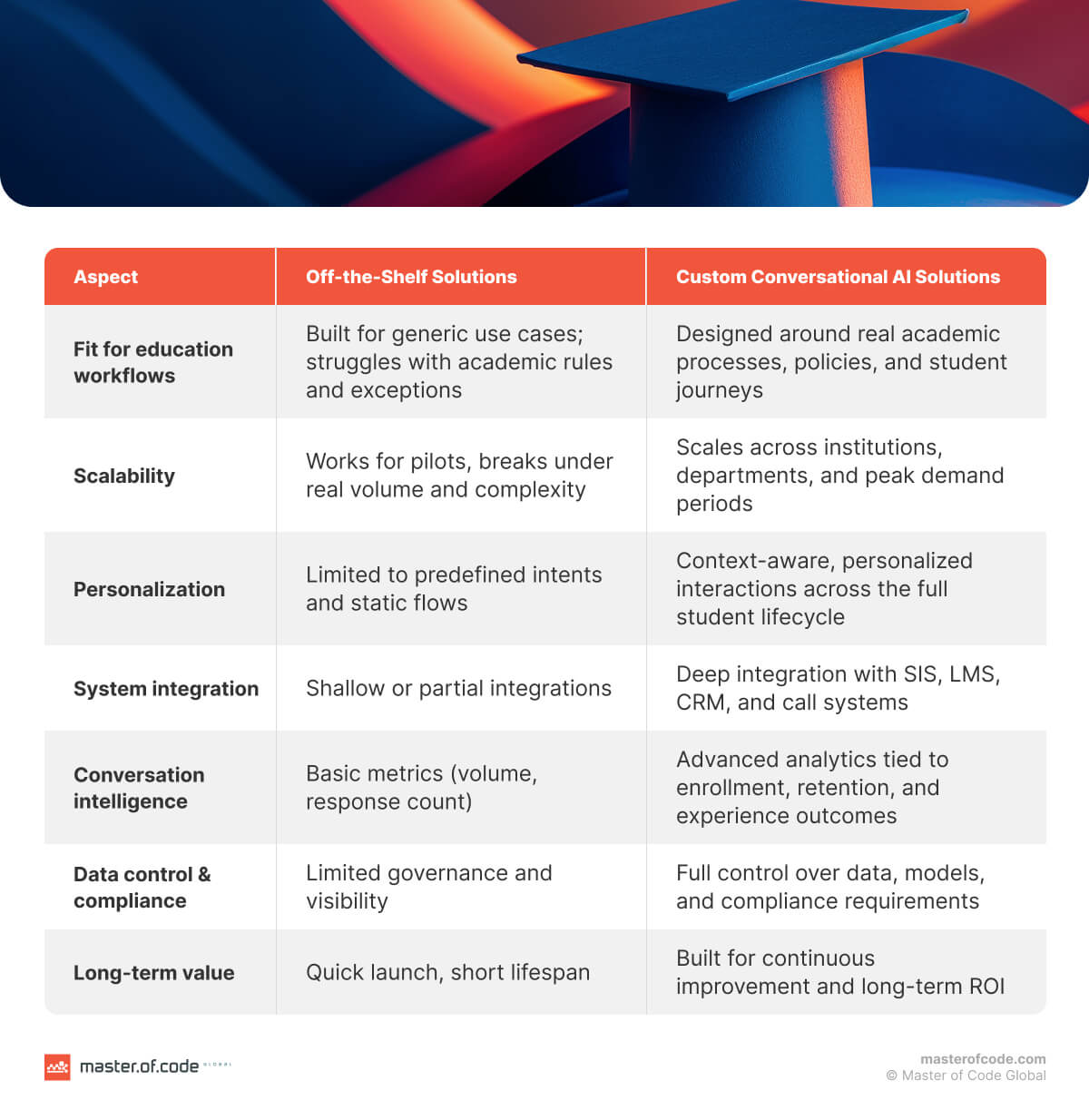
Off-the-shelf tools often look attractive because they promise fast deployment and minimal effort. For education organizations, however, speed to launch rarely translates into long-term value. When evaluating the education AI companies on the market, institutions quickly find that most basic solutions fail once they encounter real academic complexity: research from MIT’s AI initiative shows that about 95% of generic AI pilot programs across sectors fail to deliver measurable impact or sustainable performance when pushed into real workflows, largely due to poor integration and lack of contextual adaptation.
The core limitations are structural:
- One-size-fits-all logic
Generic bots struggle with complex academic workflows: program-specific rules, multi-step admissions, faculty-level variations, and constantly changing policies. Static flows break quickly when real-life scenarios diverge from predefined paths. - Poor connectivity with education systems
Without deep integration with CRMs, SIS, LMS platforms, and call systems, AI cannot access real-time data or maintain context. Conversations become disconnected, repetitive, and ultimately unhelpful. - No visibility into conversation quality or outcomes
Many tools report volumes and response counts, but fail to show why prospects drop off, where students get stuck, or which interactions drive enrollment and retention. - Limited control over data, security, and compliance
In this sector, companies handle sensitive personal data, which makes data privacy in education a critical operational and regulatory concern. Generic platforms often restrict control over data flows, governance, and model behavior, introducing long-term risk that institutions cannot afford.
The key issue is not technology maturity, but fit. Speed to launch means little if the system cannot scale, adapt, and evolve with institutional needs.
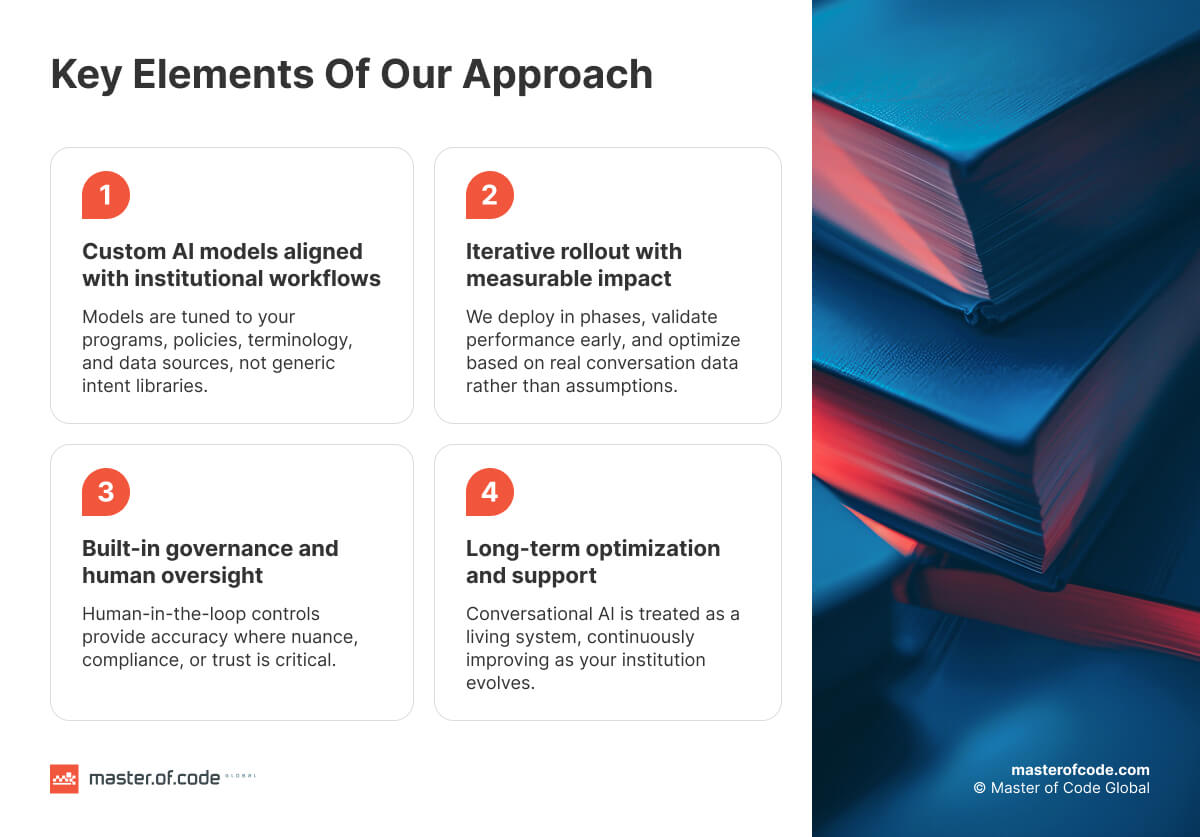
How We Build Conversational AI for Education Organizations
Successful Conversational AI for education is not the result of tooling choices, but of disciplined execution. Our approach is designed to reduce risk, accelerate value, and offer long-term scalability.
We start with business-first discovery, not feature selection. Before any model is trained or flow is designed, we align with leadership on concrete outcomes: enrollment growth, retention improvement, support cost reduction, or advisor productivity. This strategic foundation is a core part of our Conversational AI consulting approach.
From there, we apply domain-aware conversation design. Education has its own language, rules, and sensitivities. We design dialogues that reflect institutional logic, academic structures, and student expectations, so interactions feel natural, accurate, and trustworthy.
Conclusion
Academic institutions that succeed in the coming years will not be those with the most tools, but those that communicate faster, smarter, and consistently at scale. As expectations rise across every touchpoint, Conversational AI for education becomes a foundation for resilience – supporting enrollment growth, operational efficiency, and stronger student experiences without linear increases in cost or complexity.
More importantly, Conversational AI is about enabling teams to focus where expertise, judgment, and empathy matter most, while intelligent systems handle volume, context, and continuity.
For leaders planning the next stage of digital transformation, the right starting point is not a chatbot, but a roadmap. One that reflects institutional goals, integrates with existing systems, and evolves over time.
Education is built on dialogue. The question is whether yours is scalable, intelligent, and future-ready.

![The State of Conversational AI in Finance: What Our Survey of 200 Execs Revealed [Proprietary Research]](https://masterofcode.com/wp-content/uploads/2025/12/Cover_financial-services-640x400.jpg)