Global supply chains are under constant pressure. Disruptions spread across regions within hours. Fuel prices shift unexpectedly. Skilled labor is limited. At the same time, customers demand faster delivery, full transparency, and zero mistakes. For logistics leaders, there is almost no room left for inefficiency.
Traditional methods — static planning, manual dispatching, spreadsheet forecasting — can’t keep up with this level of volatility. Today, real-time insights and full supply chain visibility are not competitive advantages; they are basic requirements. Leaders need live data across fleets, warehouses, and supplier networks to solve issues before they turn into costly disruptions.
That’s why the move from reactive to predictive logistics is essential. AI is reshaping how goods move. Smart route optimization lowers fuel use and speeds up deliveries. Warehouse automation improves picking accuracy and increases throughput. Machine learning–based forecasting reduces stockouts and excess inventory. At the same time, Generative AI for logistics helps teams simulate scenarios, generate operational insights, and support faster executive decisions.
But technology alone isn’t enough. Choosing the right AI development partner – one that understands operational complexity, integrates seamlessly with legacy systems, and delivers measurable ROI – has become a strategic decision.
In this guide, we’ve curated top AI supply chain companies – from optimization platforms to robotics innovators.
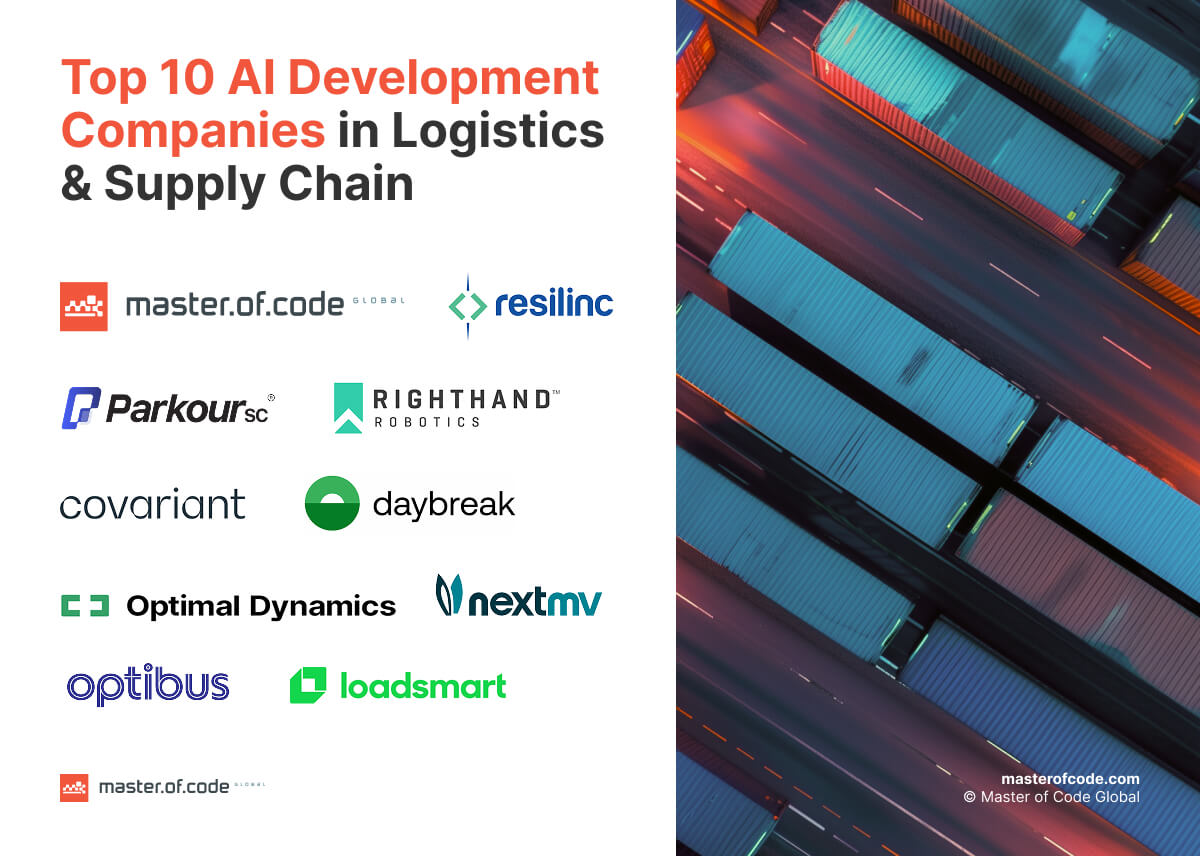
Table of Contents
Our Methodology: How We Selected the Top AI Logistics Companies
The AI market is crowded. New vendors emerge every quarter, each promising faster deliveries, smarter routing, or “end-to-end visibility.” But in enterprise supply chains, ambition means little without execution. That’s why our selection process focused on substance over marketing claims.
First, we prioritized AI supply chain companies with proven deployments in logistics or supply chain environments – not experimental pilots, but real-world implementations across fleets, warehouses, distribution networks, or procurement ecosystems. Tangible experience matters when operations run 24/7.
Second, we evaluated the strength of each provider’s proprietary AI and machine learning technology. True innovation goes beyond rule-based automation; it involves advanced optimization engines, predictive analytics models, computer vision systems, or autonomous decision frameworks.
Operational impact was another critical filter. We looked for measurable results: reduced fuel consumption, improved on-time delivery rates, higher warehouse throughput, minimized disruption risks, or optimized inventory levels.
We also considered industry specialization – whether the company excels in routing optimization, robotics, supply chain risk intelligence, orchestration platforms, or fleet management.
Finally, we assessed enterprise readiness and scalability, alongside forward-looking innovation in agentic AI, advanced forecasting, and intelligent automation. In a sector defined by complexity, only scalable, resilient solutions truly make the cut.
Top AI Development Companies in Logistics & Supply Chain
1. Master of Code Global
Headquarters: United States and Canada
Specialization: Custom AI development, enterprise logistics intelligence and supply chain AI consulting
Core AI Capabilities:
Master of Code Global designs and implements fully customized AI solutions for complex enterprise ecosystems. From AI-driven forecasting and route optimization to AI agents in supply chain, decision intelligence platforms, warehouse automation, and LLM-powered operational copilots – every system is engineered for measurable ROI. The team integrates the tools seamlessly with ERP, TMS, WMS, CRM, and legacy infrastructure, providing scalability and long-term sustainability.
Notable Impact / Differentiator:
With 20+ years of experience and 1,000+ successful AI projects delivered, Master of Code Global is a trusted partner for enterprise innovation. Its solutions have reached over one billion users worldwide, generating results such as 15× revenue growth from AI recommendations, 3× higher conversion rates, and up to 80% improvement in customer satisfaction. Recognized among the Top AI Consulting Companies globally by Clutch (4.7-star rating), ISO 27001 certified, and named Infobip’s Technology Partner of the Year – Americas 2025, the company ensures stability, security, and consistent expert involvement throughout the entire project lifecycle.
Powered by its proprietary LOFT framework — reducing initial setup effort by 43% and scaling costs by up to 20% — Master of Code Global delivers advanced AI systems faster and more efficiently than traditional vendors.
Best For:
Mid-size, big and enterprise logistics organizations seeking a long-term strategic AI partner to build, integrate, and scale custom intelligent systems – not just implement another tool.
2. ParkourSC
Headquarters: United States
Specialization: AI-powered supply chain orchestration
Core AI Capabilities:
ParkourSC delivers a decision intelligence platform designed to orchestrate complex, multi-tier supply chains in real time. By combining predictive analytics, scenario modeling, and continuous data ingestion, the system provides end-to-end supply chain visibility across suppliers, production facilities, and distribution networks. Its AI analyzes dependencies across nodes and simulates disruptions before they materialize.
Notable Impact / Differentiator:
The company differentiates itself through network-wide orchestration rather than siloed optimization. It enables enterprises to shift from reactive firefighting to proactive supply chain resilience.
Best For:
Large global organizations managing interconnected, multi-regional supply ecosystems.
3. Optimal Dynamics
Headquarters: United States
Specialization: AI-driven trucking optimization
Core AI Capabilities:
Optimal Dynamics applies advanced operations research and mathematical optimization to automate dispatching, routing, and fleet planning. Its AI continuously evaluates driver availability, load constraints, equipment compatibility, and regulatory compliance to generate profit-maximizing schedules. The system adapts dynamically as new variables enter the network.
Notable Impact / Differentiator:
Unlike conventional rule-based dispatch systems, Optimal Dynamics is rooted in deep scientific optimization models, enabling carriers to significantly improve asset utilization and margin performance.
Best For:
Trucking companies and freight carriers seeking algorithmic decision automation at scale.
4. Daybreak
Headquarters: United States
Specialization: AI-native logistics orchestration
Core AI Capabilities:
Daybreak delivers AI-first supply chain planning, replacing manual spreadsheets and fragmented systems with predictive, automated workflows. Its platform integrates AI-driven forecasting, inventory management, and operational adjustments into a single intelligent layer. Machine learning models continuously refine forecasts and planning decisions based on real-time performance signals.
Notable Impact / Differentiator:
Built natively around AI architecture, Daybreak embeds predictive intelligence directly into operations rather than layering it onto legacy tools.
Best For:
Organizations modernizing planning infrastructure and eliminating manual, reactive decision-making.
5. Covariant
Headquarters: United States
Specialization: AI-powered warehouse robotics
Core AI Capabilities:
Covariant develops foundation models for physical AI, enabling warehouse robots to perceive, learn, and generalize across picking tasks. Its systems combine computer vision, reinforcement learning, and adaptive grasping to handle diverse SKUs in dynamic environments. The AI improves over time through real-world interaction data.
Notable Impact / Differentiator:
By applying large-scale AI models to robotics, Covariant moves beyond rigid automation and enables adaptable warehouse intelligence capable of handling variability without constant reprogramming.
Best For:
High-volume fulfillment centers scaling advanced robotic automation.
6. Nextmv
Headquarters: United States
Specialization: Optimization infrastructure and decision APIs
Core AI Capabilities:
Nextmv provides programmable optimization engines for routing, scheduling, dispatching, and marketplace coordination. Its developer-first infrastructure allows teams to build customized decision models tailored to operational constraints. The platform supports real-time scenario testing and scalable API-based integration.
Notable Impact / Differentiator:
Nextmv stands out for flexibility. Instead of a fixed SaaS model, it empowers engineering teams to embed decision intelligence directly into proprietary logistics platforms.
Best For:
Technology-driven AI logistics companies building custom decision systems.
7. Resilinc
Headquarters: United States
Specialization: Supply chain risk intelligence
Core AI Capabilities:
Resilinc leverages predictive analytics, supplier mapping, and real-time tracking to identify vulnerabilities across global supply networks. Its AI continuously scans geopolitical, environmental, and operational events, correlating them with potential supplier disruptions.
Notable Impact / Differentiator:
The platform emphasizes proactive resilience, enabling enterprises to quantify risk exposure and respond before operational impact occurs.
Best For:
Manufacturers and multinational enterprises prioritizing risk management and business continuity.
8. RightHand Robotics
Headquarters: United States
Specialization: Autonomous piece-picking robotics
Core AI Capabilities:
RightHand Robotics combines machine learning, 3D vision systems, and adaptive gripping technologies to automate high-variability item picking. Its robots identify object geometry, adjust grip strength, and improve performance through continuous learning.
Notable Impact / Differentiator:
Designed specifically for eCommerce and omnichannel fulfillment, the system balances precision and speed in environments where product variety is constantly evolving.
Best For:
Retailers and third-party logistics providers, increasing warehouse throughput while reducing labor dependency.
9. Optibus
Headquarters: Israel
Specialization: Transportation management and fleet optimization
Core AI Capabilities:
Optibus applies advanced optimization algorithms to public transit scheduling, driver assignments, and fleet electrification planning. Its AI models balance operational constraints, labor agreements, service reliability, and environmental goals.
Notable Impact / Differentiator:
Operating at city-wide scale, Optibus helps transportation authorities reduce operational costs while improving route efficiency and sustainability outcomes.
Best For:
Public transit agencies and large transportation networks seeking intelligent scheduling modernization.
10. Loadsmart
Headquarters: United States
Specialization: AI-powered freight matching and digital brokerage
Core AI Capabilities:
Loadsmart uses machine learning to automate freight pricing, capacity matching, and carrier selection. Its predictive pricing models analyze market conditions in real time, improving speed-to-quote and reducing manual brokerage intervention.
Notable Impact / Differentiator:
The company accelerates freight transactions through data-driven automation, improving transparency and efficiency in digital marketplaces.
Best For:
Shippers and carriers seeking scalable, automated brokerage processes.
The Future of AI in Logistics & Supply Chain (2026–2030 Outlook)
The next four years will redefine how supply chains operate – not through incremental automation, but through autonomous intelligence.
At the forefront is agentic AI for autonomous planning. Unlike traditional systems that require human-triggered inputs, agentic models observe, decide, and act independently across logistics workflows. They dynamically reallocate inventory, reroute shipments, and adjust procurement strategies based on real-time insights. Planning will no longer be periodic. It will be continuous.
This shift enables the rise of self-healing supply chains – networks capable of detecting disruptions, simulating response scenarios, and executing corrective actions without waiting for executive intervention. Weather event? Supplier delay? Port congestion? The system adapts instantly.
Even more powerful is multi-agent orchestration. Imagine digital agents specializing in routing, warehouse operations, procurement, and risk management – collaborating in real time to optimize the entire ecosystem. Instead of siloed automation, enterprises will operate synchronized AI-driven networks.
Meanwhile, Generative AI in supply chain operations will transform how leaders consume and interpret data. Rather than reviewing static dashboards, executives will interact with AI copilots that summarize bottlenecks, simulate outcomes, generate scenario-based action plans, and recommend high-impact decisions in plain language. Instead of waiting for analysts to compile reports, leadership teams will receive instant, context-aware insights tailored to real-time operational dynamics.
On the ground, autonomous warehouses will expand beyond robotic picking. Intelligent coordination between robots, sensors, and predictive inventory systems will create fluid, adaptive fulfillment environments.
Finally, AI-driven sustainability optimization will become a strategic priority. Algorithms will minimize fuel consumption, reduce waste, optimize packaging, and align logistics with ESG targets – without compromising profitability.
The transformation is already underway. The question is whether your organization leads or follows.
Whether you’re optimizing routes, automating warehouses, or building predictive supply chain intelligence, partnering with the right AI development company determines your competitive edge.
Talk to AI logistics experts.
Get an AI strategy consultation.
Build a custom AI supply chain solution.