



Ten years ago, a chatbot was a clunky pop-up that offered a handful of scripted replies. Fast-forward to 2026, and that same interface can now troubleshoot issues, track orders, make appointments, and even show a bit of personality—without involving a single human.
Customer expectations have shifted just as fast. Whether it’s asking about a delayed delivery, refilling a prescription, or managing finances, people want fast, clear, and helpful answers—on their terms, in their language, and without the friction.
That’s where artificial intelligence is making a real difference. Not by replacing people, but by making digital interactions smarter, smoother, and more human.
Read on to discover the top Conversational AI trends shaping business today — and what you can do now to stay ahead of the curve.

Table of Contents
Key Takeaways
- The conversational AI market is projected to grow from $17.05 billion in 2025 to $49.80 billion by 2031, according to MarketsandMarkets.
- Agentic AI moves conversational interfaces from answering questions to resolving issues end to end and reaching out before customers ask. Gartner expects agentic AI to resolve 80% of common customer service issues on its own by 2029.
- Real-time voice, persistent memory, and multimodal inputs make conversations continuous across channels, so customers no longer have to repeat themselves.
- Customers increasingly reach brands through ChatGPT, Gemini, and Perplexity, where shopping agents compare products and complete purchases.
- Support is becoming a human-AI team: agent assist is growing into AI coworkers, and real-time conversational analytics shows leaders why customers get in touch.
- AgentOps, guardrails, and human oversight decide which pilots reach production, and since August 2, 2026, EU AI Act Article 50 has required companies to tell people when they are talking to AI.
- By 2030, conversational AI will work as core infrastructure for how people interact with businesses.
The State of Conversational AI in 2026
Conversational AI has moved from experiment to expectation in customer-facing work. According to McKinsey’s State of AI 2025, 88% of organizations now use AI in at least one business function, up from 78% a year earlier. Yet only 39% report any impact on enterprise-wide EBIT, which shows how wide the gap still is between using AI and getting value from it.
Technology maturity. In 2026, maturity means more than having a chatbot. Leading teams connect large language models to live data, central knowledge bases, and business systems, so every channel gives the same accurate answer. They also keep humans in the loop to review edge cases and keep conversations helpful and compliant.
Enterprise adoption and pressure. Leadership expectations are rising fast. A Gartner survey of 321 service leaders found that 91% face pressure from executives to implement AI in 2026. Budgets follow: AI spending by customer service leaders rose 38% while overall service budgets grew just 2%.
Customer expectations. The Zendesk CX Trends 2026 report shows that 74% of consumers expect service to be available around the clock, and 85% of CX leaders say customers will leave a brand if their issue isn’t solved on first contact.
Why 2026 is a turning point. With more money flowing into AI, scrutiny is growing too. Gartner found that only 24% of service leaders show positive financial returns across their AI use cases. That makes 2026 the year companies move from scattered pilots to measurable results.
Business benefits. Teams that get it right see faster resolution, lower cost per conversation, 24/7 multilingual service, and higher customer satisfaction. A conversation analytics solution adds another layer of value by turning every interaction into data on intent, friction, and escalation drivers. These gains explain why Conversational AI for enterprises is shaping the new CX baseline.
8 Conversational AI Trends for 2026
The eight trends below build on each other. AI agents that take action need memory, voice, and visual context to understand customers, and they need governance to run safely at scale. Here is what is shaping customer interactions this year.
1. From Reactive Support to Proactive, Autonomous Resolution
Agentic AI is shifting conversational interfaces from deflection to resolution. A deflection bot answers a question and hopes the customer leaves. An AI agent completes the task in connected systems and confirms the outcome. Gartner predicts that by 2029, agentic AI will autonomously resolve 80% of common customer service issues without human intervention, leading to a 30% reduction in operational costs.
Autonomous End-to-End Resolution
Autonomous resolution means the AI agent understands the request, checks it against policy, takes the action, and confirms the result, all within one conversation. For a return, the agent verifies the order, creates the return label, books the pickup, and issues the refund in the order system.
Generative models handle language: understanding messy requests, asking follow-up questions, and explaining outcomes. Tool calls to CRM, ERP, and support platforms do the actual work. Organizations already run these agents in claims processing, customer onboarding, and order management.
Customers are ready for it. Gartner found that 58% of customers who use GenAI have already used it to complete a task on their behalf, and the share rises to 74% among B2B customers.
Proactive and Predictive Outreach
Proactive AI starts the conversation when data signals a likely need. A delayed shipment triggers a message with the new delivery date and a one-tap option to reroute. A failed payment prompts a reminder with a secure link to update the card before service stops. A drop in product usage triggers a short check-in with setup tips.
Behind each message, predictive models score churn risk, usage patterns, and journey friction. The conversational layer then turns those signals into timely, personal outreach. Done well, proactive outreach prevents tickets before they’re created and makes customers feel looked after. The key is restraint: every message should solve a problem the customer would otherwise have to report.
2. Real-Time Voice AI Moves Beyond Legacy IVR
Real-time voice AI lets callers speak naturally and get a spoken answer in about the time a person would take to respond. Legacy conversational IVR works differently: it converts speech to text, matches it to a fixed menu of intents, and reads back a scripted reply.
Speech-to-speech models process audio directly in a single model. As a result, they respond with low latency, handle interruptions, and keep the tone and emphasis that text pipelines lose. OpenAI’s gpt-realtime model, released in August 2025, added SIP phone calling, image input, and remote MCP tool support to the Realtime API, so voice agents can take actions during the call.
Four capabilities separate modern voice AI from IVR:
- Speech-to-speech interaction: natural turn-taking, barge-in, and expressive replies.
- Context: the agent remembers what the caller said earlier in the call and pulls account history before answering.
- Action execution: function calls rebook appointments, reset passwords, or update addresses while the caller is still on the line.
- Human handoff: when the caller needs a person, the agent transfers the call with a summary, so the customer doesn’t repeat the story.
Most enterprises combine both architectures. They use speech-to-speech where natural conversation matters most and keep cascaded pipelines (speech-to-text, a language model, then text-to-speech) where they need full transcripts, deterministic checks, PII redaction, and tighter control over what the agent says. Banks, insurers, and healthcare providers often run both side by side. Explore more voice assistant use cases.
3. Persistent Memory & Cross-Session Context Enable Deeper Personalization
Persistent memory lets a conversational agent recall preferences, past issues, and open cases across sessions and channels. A customer who reported a billing error in chat on Monday doesn’t need to explain it again when they call on Thursday. The agent already knows the case, the steps taken, and what’s still pending.
This solves one of the most common complaints in customer service. In the Zendesk CX Trends 2026 report, 74% of consumers said repeating themselves is a significant frustration, and 85% of CX leaders believe memory-rich AI will be essential to personalized experiences.
Memory also makes personalization more useful. With context from past conversations, purchase history, and stated preferences, the agent can recommend the right plan, skip questions it already knows the answers to, and adjust its tone to the customer. Continuous learning adds another layer: feedback from resolved and escalated conversations shows teams which answers work, so prompts, knowledge sources, and flows improve over time.
Emotion-aware AI helps when it changes the outcome. Sentiment detection can spot rising frustration and route the customer to a person before they give up, or soften the tone when someone reports a lost card.
Memory needs clear rules. Teams should decide what the agent stores, how long it keeps it, and how customers can view or delete it. Consent and data retention policies belong in the design from day one.
4. Multimodal Conversations Combine Voice, Text, Vision and Screen Context
Multimodal conversational agents understand more than words. Customers can show the problem: a photo of a damaged parcel, a screenshot of an error message, or a short video of a noisy appliance. The agent reads the image, asks a follow-up question by voice or text, and moves to a fix.
Screen context takes this further. With the customer’s permission, an agent can see the page or app screen the customer is on and guide them step by step, highlighting the exact button to tap. In live interactions, voice and vision work together: a customer talks through a setup problem while pointing the phone camera at the device.
Customers want this flexibility. According to Zendesk, 76% of consumers would choose a company that lets them share text, images, and video in one conversation thread, and 86% of CX leaders believe multimodal agents will define the next wave of AI in service.
Connected devices and immersive tech add supporting use cases. A smart thermostat can send its error code straight into the chat, and an AR overlay can show a customer where to plug in a replacement part. Learn more about multimodal conversational AI assistants.
5. AI-Mediated Discovery and Agentic Commerce
A growing share of customers now start their search inside an AI assistant. They ask ChatGPT, Gemini, or Perplexity to compare products, summarize reviews, or solve a service problem, and they reach the brand through that assistant.
The data shows how quickly this is happening. Gartner found that customers are about three times more likely to use third-party GenAI tools than a company’s own chatbot to resolve service issues. Use of these tools nearly doubled in a year, while use of company chatbots has stayed flat since 2022. In retail, Adobe recorded a 693.4% year-over-year increase in traffic from generative AI tools to US retail sites during the 2025 holiday season.
Shopping agents are also learning to buy. In September 2025, OpenAI and Stripe released the open Agentic Commerce Protocol (ACP) alongside Instant Checkout in ChatGPT. In March 2026, OpenAI scaled back Instant Checkout and shifted purchases to merchants’ own apps and sites while keeping product discovery in ChatGPT. In January 2026, Google introduced the Universal Commerce Protocol (UCP), co-developed with Shopify, Etsy, Wayfair, Target, and Walmart, which lets shoppers buy from eligible merchants inside AI Mode in Search and the Gemini app. PayPal and Perplexity launched Instant Buy in late 2025.
For brands, this changes what “being found” means:
- Keep product feeds structured and accurate, with matching prices and stock across feed, site, and checkout.
- Publish clear answers to common product and service questions, so assistants can cite them.
- Expose key actions (order status, returns, bookings) through APIs that agents can call.
- Track AI referral traffic and conversions as a separate channel.
Explore how conversational commerce and conversational shopping fit into this shift.
6. Human-AI Teams: From Agent Assist to AI Coworkers
Enterprises are combining human agents, AI copilots, and autonomous AI coworkers into one support team. The role of AI in that team has grown in three steps:
- Agent assist: AI listens to the conversation, surfaces knowledge articles, suggests replies, and summarizes the case for the human agent.
- Copilot: AI drafts responses, fills in forms, and completes after-call work when the agent asks.
- AI coworker: AI owns whole tasks or queues end to end, such as refunds or address changes, and passes cases to people when judgment or empathy is needed.
Escalation is where human-AI teams succeed or fail. A good handoff includes the full transcript, detected intent, steps already tried, data collected, and customer sentiment, so the person picks up where the AI left off. Customers expect that option: Gartner reports that 87% of customers say it’s essential for companies using GenAI to offer a way to reach a human agent.
The human role is changing too. Gartner found that 84% of service leaders plan to add new skills to the agent role, and 58% aim to upskill agents into knowledge management specialists who curate the content AI relies on.
The impact shows up in day-to-day metrics. In Master of Code Global’s Zipify agent assist project, the team achieved 65% faster response times, 2x faster ticket closure, and 30% lower operating costs.
7. Real-Time Conversational Intelligence: From Reports to Promptable CX Analytics
Conversational intelligence used to mean monthly reports built from a sample of transcripts. In 2026, analytics runs on every conversation as it happens, and leaders can ask it questions in plain language.
Real-time conversational intelligence tracks five types of signals:
- Intent: what customers want, including new reasons for contact that didn’t exist last month.
- Friction: loops, repeated questions, failed tool calls, and drop-off points in a flow.
- Sentiment: how customer mood changes during the conversation.
- Escalation reasons: why the AI handed off, and whether the handoff was needed.
- Business outcomes: resolutions, refunds, saved accounts, and conversions linked to each conversation.
Promptable analytics lets a CX leader ask, “Why did refund requests rise in Texas this week?” and get an answer with examples in minutes. According to Zendesk, 81% of CX leaders believe promptable analytics will change how they make decisions. The result is a faster loop between what customers say and what teams fix.
Turn every conversation into a decision signal. Master of Code Global’s Conversational Analytics Services track intent, friction, sentiment, and outcomes in real time. Explore Conversational Analytics
8. AgentOps, Guardrails and Governance
Enterprise conversational AI needs the same operating discipline as any production system. AgentOps brings together four controls:
- Observability: tracing every step, tool call, cost, and response time, so teams can see what the agent did and why.
- Continuous evaluation: test sets and regression checks on every prompt, model, or knowledge change, with automated scoring calibrated against human review.
- Guardrails: input and output filters, PII redaction, scoped permissions for each tool, and approval steps for high-risk actions such as refunds above a set amount.
- Human oversight: review queues, sampling of live conversations, and a clear way to pause the agent when something goes wrong.
Regulation now makes some of these controls mandatory. Since August 2, 2026, Article 50 of the EU AI Act has required that people be informed when they are interacting with an AI system, unless this is obvious from the context. The EU’s Digital Omnibus moved high-risk obligations for Annex III systems to December 2, 2027, but it left this chatbot disclosure duty in place.
Governance also decides whether projects survive. Gartner predicts that over 40% of agentic AI projects will be canceled by the end of 2027 due to escalating costs, unclear business value, or inadequate risk controls. Transparency is part of the answer: Zendesk found that only 37% of organizations currently explain automated decisions to customers or agents.
Evolving Conversations: The Journey of Conversational AI
From FAQs, to transactional experiences
Conversational interface projects often start with a proof of concept involving launching a virtual assistant that can automate responses to frequently asked questions (FAQs) via chat or voice.
Organizations that want to increase customer satisfaction and achieve business goals need to start looking beyond just FAQs to reap the actual benefits of conversational AI.
Today’s advanced Conversational AI systems that utilize NLU can automate many complex transactions to make life easier for client and internal teams. For example, banks could enable bill payments via virtual assistants instead of just navigating customers to a ‘how to pay’ webpage. A food retailer could allow buyers to order food using a virtual agent rather than just navigating to a ‘menu’ page on their website.
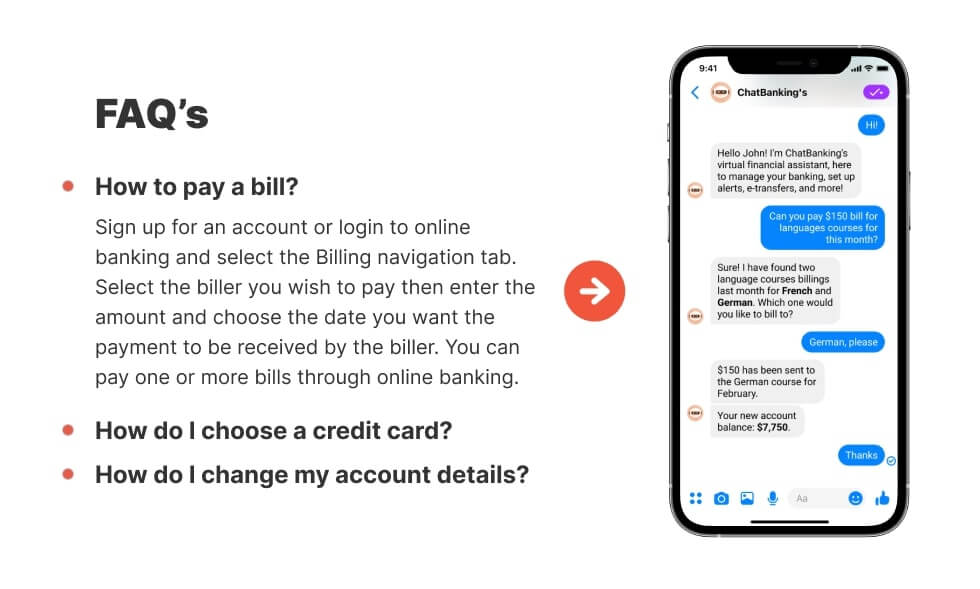
Building a transactional virtual assistant does not necessarily mean total call center automation with all possible transactions. Organizations need to take a structured approach and use data to prioritize key transactions that are high-volume and high-impact. This will help them deliver more value to their customers and move them closer to meeting their business objectives.
From linear, to flexible and cyclic conversations
Organizations need to be mindful that they are creating experiences for real people who are on the other end of the virtual assistants. Therefore, it is paramount to keep clients in mind during the entire process. This shift is profound and places the onus on organizations to deliver a seamless user experience to lessen the user’s cognitive burden.
To continue providing a fluid customer experience, organizations need to anticipate and map out every possible scenario, query, and response. They need to design flexible conversations so that person can converse using their own words in addition to picking from pre-defined menus. They should also be able to change the direction of dialogue or request additional information along the conversation’s path. Lastly, the Conversation Design needs to be cyclical so customers can pivot and circle back to the conversation as per their preference without starting over. Human to human conversations themselves are not linear and neither should conversational interfaces.
From release and forget, to iterating and tuning
Many organizations that build virtual assistants invest in upfront research and design to understand the customer journey and context. They sometimes, however, drop the ball on iterating and fine-tuning the experience after releasing the virtual assistants to actual customers.
It is crucial for organizations to monitor and evaluate actual conversations to really understand what is working and what isn’t. Reviewing user sessions to investigate errors and determine how to improve the experience should be an integral part of an ongoing sustainment plan.
Continuous iteration or ‘bot tuning’ is another critical practice for maintaining a balance of necessary intents and their training data. Tuning could involve various activities like adding, removing, or modifying utterances. Removing intents that don’t add value is just as important as creating new ones.
This results in customer journeys that are as seamless and as simple to navigate as possible. It also increases engagement and containment within the conversational experience.
From pre-defined answers, to Natural Language Understanding and Conversation Design
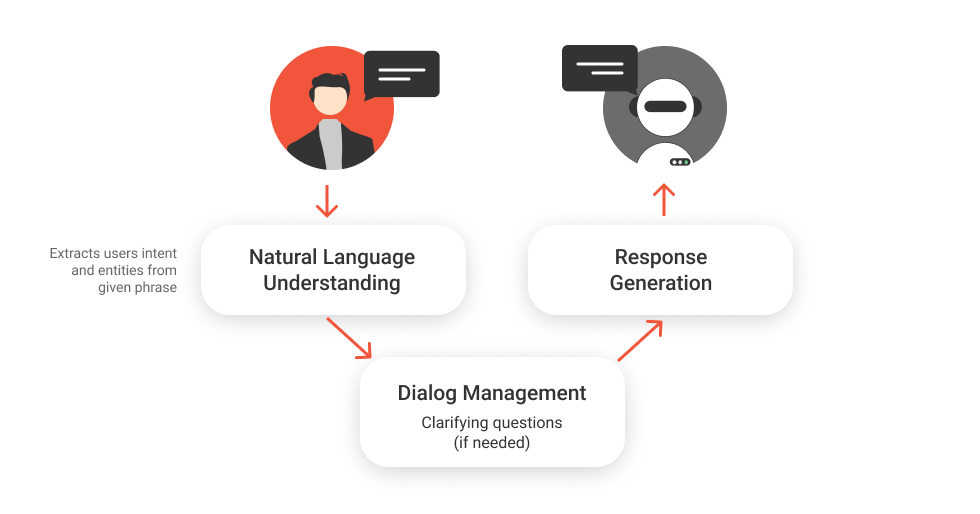
At its core, conversation design aims to mimic human conversations to make digital systems like virtual assistants easy and intuitive to use. The challenge is to make interactions with these systems feel less robotic by understanding the context and purpose of the customer in order to direct them to relevant solutions.
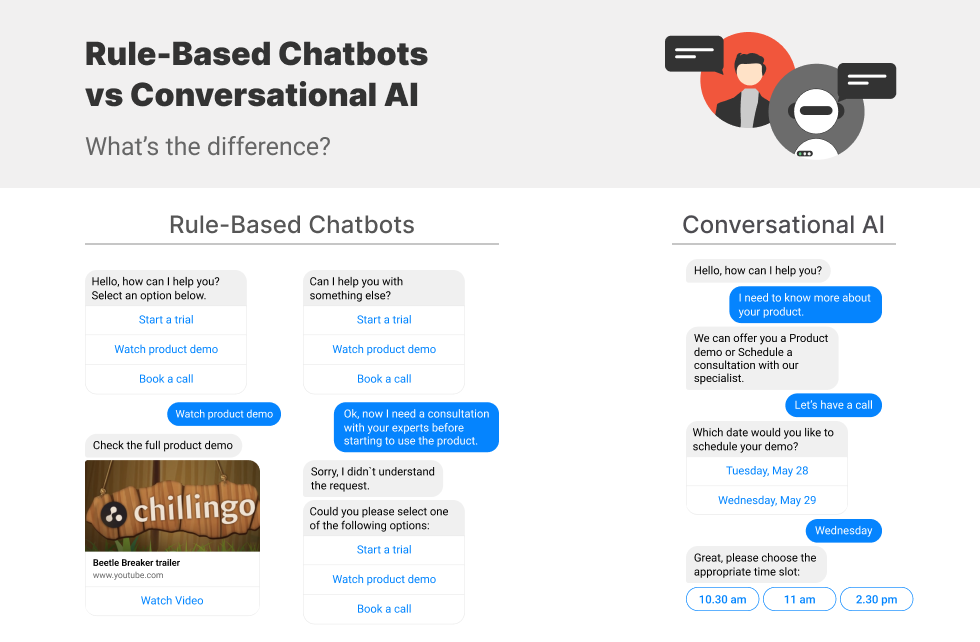
Many organizations, however, still employ hard-coded or rule-based pattern matching with small rule-sets for their conversational interfaces. This results in higher abandonment rates, low engagement, and perceived project failures.
Natural Language Understanding (NLU) technologies utilize machine learning and training data that allows them to understand user utterances without the need to manually hard code all the pattern matching logic. NLU platforms also provide hooks into domain-specific knowledge bases and forums.
By integrating and maximizing the power of NLU platforms, organizations can enable virtual assistants to respond to human queries efficiently and effectively, improving engagement and providing an overall positive customer service experience.
From disjointed multiple bots, to a seamlessly integrated omnichannel experience
With an increase in the development of virtual agents, some larger organizations are facing a new challenge. Individual departments are creating conversational interfaces with a narrow scope of handling queries related to very specific use-cases or business functions such as HR or IT. As a result, accessing and discoverability of the numerous virtual assistants becomes a challenge for users.
When appropriate for their situation, organizations can overcome this challenge with the introduction of a “master virtual assistant”. This assistant can be made responsible for handling a range of tasks for the customer by understanding their intent and routing the request to the use-case-specific virtual agent. For example, a financial institution may have separate chatbots to handle commercial and consumer mortgage use cases and a master chatbot that seamlessly manages the interactions across them.
Challenges in Conversational AI Adoption
Even as artificial intelligence becomes more common, the path to full-scale deployment is anything but smooth. Here are the biggest blockers we see across industries.
- Data privacy & compliance. 40% of organizations have experienced an AI-related privacy breach, and over 50% of consumers view its use of personal data as a significant threat to privacy. With growing regulation and public scrutiny, businesses must implement robust data governance and transparent usage policies before deployment.
- Managing bias. Roughly 63% of clients worry about bias and discrimination in algorithm decision-making, prompting calls for transparent intent-handling and fairness checks. Yet only a fraction of companies currently audit or adjust their training data to counteract bias.
- Integration with legacy systems. 22% of IT decision-makers report they have data trapped in systems that cannot be migrated, and 79% struggle with undocumented pipelines. This creates barriers for real-time integration, pushing teams to invest heavily in data modernization or middleware.
- User trust & adoption barriers. Confidence struggles create immense pressure: 57% of global consumers view AI as a privacy threat, and 61% remain distrustful of such systems. Without clear value and transparency, clients hesitate to embrace automated service, even when it’s available.
Each of these issues highlights the distance between machine intelligence’s potential and its practical rollout. Addressing them is critical to building solutions people actually want to use. Let me know if you’d like to integrate visuals or real-world remediation strategies for any challenge.
Conversational AI Trends by Industry
Driven by advances in Conversational AI, leading players are moving beyond automation to build trusted, responsive experiences.
Retail & eCommerce
- Shift toward conversational shopping & AI-driven product discovery to replace traditional search bars.
- Rise of voice-based and multimodal commerce integrated with smart devices.
- Growing focus on intelligent personalization in loyalty and retention strategies.
- Adoption of proactive notifications (e.g., restocks, delivery updates).
- Expansion of retail-specific governance to ensure brand-aligned conversations.
- Growth of AI shopping agents and in-chat checkout through protocols such as ACP and UCP, which makes accurate, consistent product feeds a priority.
Also worth exploring: the rise of Conversational AI for consumer goods and how it’s redefining shopping journeys at scale.
Healthcare & Wellness
- Virtual health assistants are becoming standard for non-urgent care navigation.
- Increasing use of emotionally aware algorithms for mental wellness and behavior change.
- Integration of healthcare Conversational AI into remote patient monitoring and chronic care plans.
- Movement toward HIPAA-compliant tooling for higher data sensitivity.
- Providers using machine intelligence for patient education and follow-up engagement at scale.
- Multimodal intake that lets patients share photos of prescriptions, insurance cards, or symptoms during the conversation, with human review for clinical decisions.
Finance & Banking
- Push for AI-enabled financial coaching for mass-market banking users.
- Rise of regulatory-compliant conversational apps in high-stakes interactions.
- Banks investing in hyper-personalized digital concierge bots.
- Chatbots transitioning from reactive to predictive financial support tools.
- Emphasis on trust-building AI tone and transparency in customer communication.
- Real-time voice AI replacing legacy IVR for card activation, fraud alerts, and payment arrangements, with full-context handoff to human agents.
HR and Internal Operations
- Shift to secure, audit-ready tools for enterprise-grade HR compliance.
- Uptick in employee-facing copilots to assist with daily workflow tasks.
- Trend toward smart onboarding with conversational walkthroughs.
- HR teams embedding automation for pulse surveys and morale tracking.
- Increased demand for AI-native knowledge bases accessible via chat.
- AI coworkers resolving routine IT and HR requests end to end, from password resets to leave requests, with escalation to specialists.
Conversational AI Statistics in 2026: Insights from 8 Strategic Angles
The conversational AI market is projected to grow from $17.05 billion in 2025 to $49.80 billion by 2031, a compound annual growth rate of 19.6%, according to MarketsandMarkets. Customer service remains one of the largest areas of spending: in a 2022 forecast, Gartner predicted that conversational AI would reduce contact center agent labor costs by $80 billion in 2026.
- Enterprise adoption. 88% of organizations use AI in at least one business function, 62% are at least experimenting with AI agents, and 23% are scaling agents in at least one function (McKinsey, 2025).
- Leadership pressure. 91% of customer service leaders face executive pressure to implement AI in 2026 (Gartner, February 2026).
- Investment. AI spending by customer service leaders has grown 38%, while overall service and support budgets rose just 2% (Gartner, August 2026).
- Return on investment. Service leaders put a median 12% of their 2025 budget into AI, the most of any of the 10 business functions surveyed, yet only 24% show positive financial returns (Gartner, July 2026).
- Customer behavior. Customers are about three times more likely to use third-party GenAI tools than company chatbots for service, and 87% say companies using GenAI must offer access to a human agent (Gartner, 2026).
- CX expectations. 74% of consumers expect 24/7 service, 74% are frustrated when they have to repeat themselves, and 85% of CX leaders say unresolved first contacts drive customers away (Zendesk CX Trends 2026).
- Retail and commerce. Traffic from generative AI tools to US retail sites grew 693.4% year over year in the 2025 holiday season (Adobe, January 2026).
- Banking at scale. Bank of America’s Erica has passed 3.2 billion client interactions since 2018, including nearly 700 million in 2025 (Bank of America, March 2026), and Wells Fargo’s Fargo assistant has supported more than 1 billion interactions since 2023 (Wells Fargo, March 2026).
Implementing Conversational AI: Your Next Move
Getting started with conversational applications? Success depends on how well you plan, build, and scale, not just which tool you pick. Here are simple tips to getting it right the first time.
- 1. Choose the Right Vendor
Pick a partner who does more than just deliver code. Look for:- Experience with enterprise-grade conversational solutions.
- Industry-specific knowledge (e.g., healthcare, banking).
- Support for integrations, multilingual bots, and analytics.
- Security and compliance expertise (GDPR, HIPAA, SOC2).
- 2. Start With Strategy
Before building anything, align your goals and identify how Conversational AI maps to real business outcomes. A good implementation plan answers:- Can we do it? (Tech feasibility)
- Should we do it? (Business value)
- How will we measure success? (Impact & KPIs)
- 3. Prep Your Data Early
Algorithms can’t learn without good data. Before launch, audit what you have:- Is your data structured, labeled, and relevant?
- Are systems integrated or siloed?
- Do you have the right permissions and governance?
- 4. Define Clear KPIs
Performance isn’t just about precision, it’s about outcomes. Monitor metrics such as:- Containment rate (how many queries the bot resolves solo)
- Escalation rate
- CSAT & NPS post-chat
- Average handle time
- Cost-per-interaction vs. human agents
- 5. Train, Tune, Repeat
Model performance improves over time if you feed it the right feedback. Invest in:- Curated training datasets from real customer queries
- Ongoing intent mapping and NLP tuning
- A/B testing to improve flows
- Feedback loops with human agents and QA teams
- 6. Build a Cross-Functional Team
You don’t need to hire everyone in-house. But someone needs to:- Manage the project (PM)
- Define use cases and flows (BA, CD)
- Build and tune the model (ML/AI engineers)
- Maintain governance (compliance and security leads)
- Measure and optimize results (data analysts)
Advanced Conversational AI isn’t just a tech deployment—it’s a transformation. Start with a strategy. Align your data, tools, and people. Measure what matters. And choose a partner who understands the difference between launching a bot and launching a solution.
Want help mapping it out? Start here.
The Future of Conversational AI: 2026 to 2030
This technology is entering a new era, one where it no longer just responds, but actively supports, decides, and collaborates.
- From reactive to proactive: Virtual assistants will shift from scripted responders to autonomous agents capable of initiating actions based on user behavior, context, or real-time data. These systems won’t wait for a prompt. They’ll suggest, remind, and even solve before users ask. Agentic AI is the engine of this shift, as agents that resolve issues end to end start to act on signals before customers reach out.
- Rise of hybrid AI-human teams: In workplaces, expect seamless collaboration between employees and copilots. These assistants will handle repetitive tasks, prep data insights, and flag anomalies, freeing humans to focus on creativity, strategy, and emotional intelligence. The path runs from agent assist to copilots to AI coworkers that own full tasks and hand off with complete context.
- Artificial intelligence as decision support, not just automation: Organizations will increasingly use AI solutions to amplify complex decision-making. From financial forecasting to care coordination in healthcare, technology will surface trends, compare options, and simulate outcomes, making leaders faster and more confident in their choices. Real-time, promptable CX analytics will bring this to customer service, letting leaders ask why customers get in touch and get an answer within minutes.
- Emotionally aware AI: Advances in sentiment analysis, voice modulation, and behavioral cues will enable it to better read and adapt to human emotions. This won’t be limited to customer guidance—it will affect learning, healthcare, and personal assistants, helping build trust and reduce friction in digital interactions. Persistent memory will make this more useful, combining what the AI senses in the moment with what it knows from past conversations.
- Convergence with other modalities: Multimodal Conversational AI is becoming standard. Eventually, chatbots will “see” (via camera input or image recognition), “hear” (via voice and sound cues), and “speak” across multiple channels. This will allow unifying conversations across voice, text, and visuals. Real-time voice and screen context will join text and vision in the same live conversation.
- Customized Conversational AI at scale: With improved model fine-tuning and transfer learning, enterprises will be able to deploy purpose-built bots trained on proprietary data. They will be delivering brand-specific tone, domain fluency, and contextual accuracy without requiring huge custom builds. Customers will also reach these brand-specific agents through third-party assistants like ChatGPT, Gemini, and Perplexity, so consistent data across every channel becomes essential.
- Governance will define competitiveness: As machine intelligence becomes embedded in everyday operations, how well companies govern, monitor, and ethically use these tools will become a competitive differentiator. Transparent, explainable tech will be the baseline, not the exception. EU AI Act transparency rules and AgentOps practices such as continuous evaluation and observability are already turning this into everyday practice.
By 2030, Conversational AI for enterprises won’t be an interface. It’ll be infrastructure: a core layer of how people interact with businesses, services, and each other. Those who plan today will lead tomorrow.
Final Thoughts
As we have explored, Conversational AI is redefining client care and retention. The technology not only addresses the current challenges in CX but also opens up new avenues for enhanced consumer interaction and business growth. From providing personalized offers to boosting service quality, artificial intelligence is an indispensable tool for any forward-thinking enterprise.
At Master of Code Global, our leadership in Conversational AI services positions us to help your company stay ahead of the curve. With our guidance, adopting discussed trends becomes a seamless process, leading to improved business outcomes. We provide an omnichannel approach, ensuring consistent CX across all platforms.
Partner with us for a full-cycle artificial intelligence strategy and robust integration capabilities. We prioritize flexible communication and stringent data security in all our applications. Contact Master of Code Global to elevate your user engagement with advanced AI solutions. Let’s redefine your customer interactions together.
Ready to build your own Conversational AI solution? Let’s chat!