



The companies pulling ahead in 2026 aren’t just experimenting with AI. They’ve done something more fundamental – they’ve rebuilt how software is conceived, specified, built, and shipped. While most organizations are still grafting AI tools onto the same waterfall-shaped processes they’ve run for a decade, a smaller cohort of transformation leaders has quietly made those processes obsolete.
The gap this creates is not theoretical. In controlled research conducted by GitHub and MIT, developers using AI coding assistants completed tasks 55% faster than those working without them – a finding replicated across Accenture’s deployment study spanning 4,800 developers.
The DORA 2025 report – surveying nearly 5,000 technology professionals globally – found that 90% of organizations now use AI in software development, yet AI acts as an amplifier, not a fix: it magnifies the strengths of well-structured teams and the dysfunctions of struggling ones.
Deloitte’s 2026 Software Industry Outlook projects 30–35% productivity gains for teams that restructure workflows around AI, but BCG’s research across 1,000 executives in 59 countries tells the other side of the story: 74% of companies still can’t move beyond proofs of concept to generate tangible value. The majority are bolting AI tools onto unreformed processes and wondering why the gains are marginal.
The question on every innovation director’s desk right now isn’t whether to adopt an AI native SDLC. It’s how much runway you have left before the organizations that already have one turn your competitive gap into a competitive wall.
Table of Contents
Key Takeaways
Before we get into the mechanics, here are the strategic insights that matter most for decision-makers evaluating this shift:
- Specification is the new source code. The real engineering effort has migrated upstream. A machine-readable, high-fidelity spec is now 80% of the work – the implementation is its automated execution.
- Speed is a vanity metric. Product excellence is the real ROI. The compounding return of an AI-driven development lifecycle isn’t faster code; it’s broader feature sets, fewer production defects, and tighter alignment with what end users actually need.
- Human ownership is non-negotiable – not a disclaimer. AI accelerates every phase. Humans govern every gate. Every artifact, every architectural decision, every release has a named person accountable for it.
- Data sovereignty is the new competitive moat. In regulated industries, the model you choose matters far less than the governance layer surrounding it. Platform-agnostic methodology is a strategic requirement, not a nice-to-have.
- Your AI tools are replicable. Your execution depth is not. Any agency can activate Cursor or Copilot tomorrow. The orchestration layer, context pipeline, and 20+ years of domain expertise that make those tools deliver enterprise-grade outcomes – those take decades to build.
The Old Playbook Has a New Problem
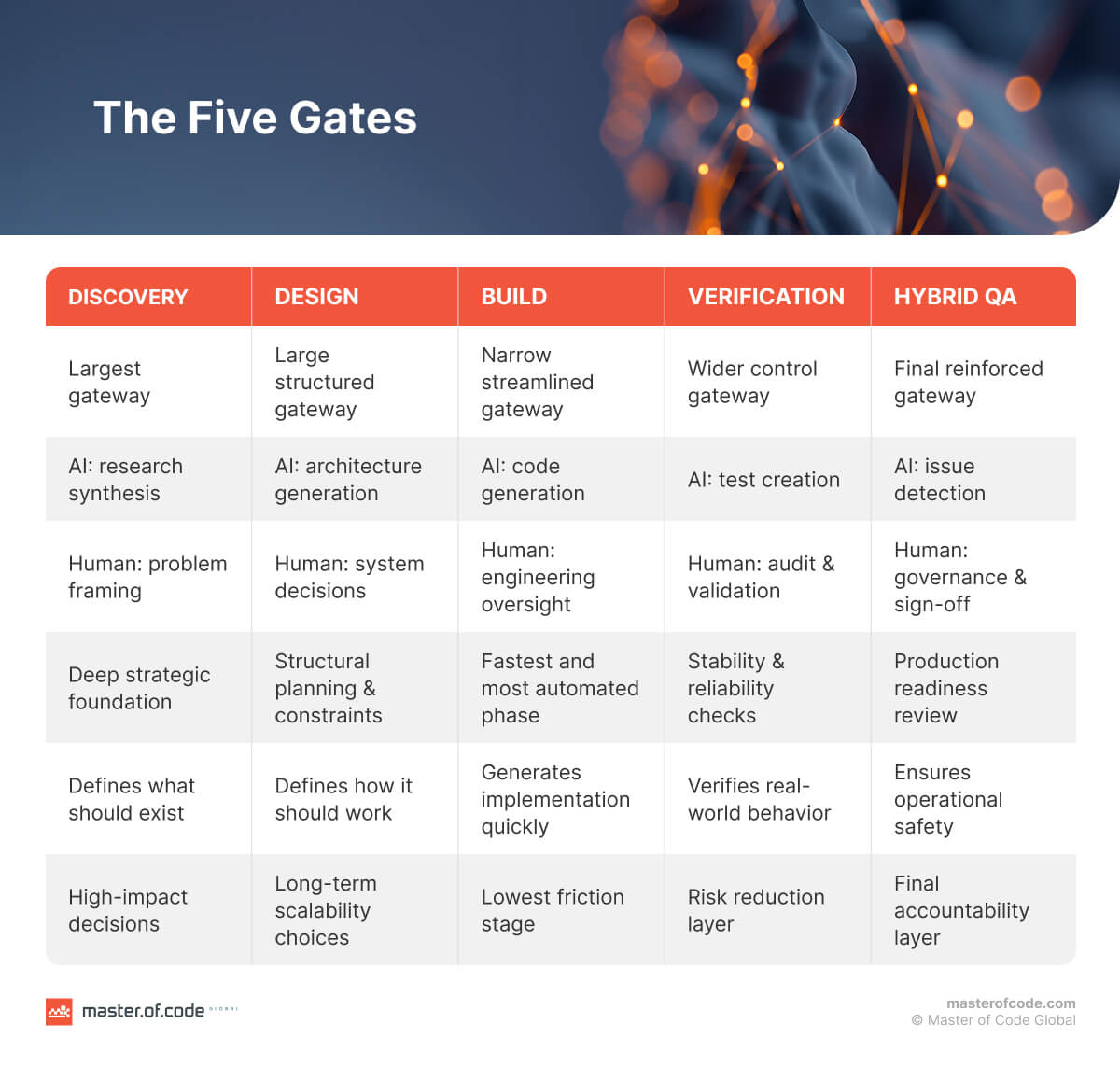
There’s a specific failure mode showing up across enterprise software programs right now. Teams adopt a flagship AI coding assistant, developers report productivity gains in controlled demos, and then – six months later – the delivery metrics look roughly the same. Timelines haven’t compressed meaningfully. Defect rates haven’t dropped. The business is frustrated.
The diagnosis is almost always the same: they optimized the wrong phase.
Coding accounts for a fraction of holistic product delivery. The real cost centers – misaligned requirements, slow discovery, ambiguous specifications, rework cycles – remain entirely untouched. Grafting an AI tool onto a broken input process doesn’t fix the process. It just generates bad output faster.
This is the fundamental case for AI-first development: not as a tool decision, but as a process reinvention. Moving from a monolithic SDLC to an agentic SDLC built on continuous micro-cycles changes where intelligence is applied, where humans intervene, and what “done” actually means.
The role transformation that follows is equally significant.
- Project Managers evolve into Product Owners – accountable for business outcomes, not task lists.
- Developers operate as Architects – defining the “what” with precision so AI can execute the “how.”
- Planning, Architecture, and Verification stop being administrative steps and become the essential human activities that govern everything else.
- Developer productivity stops being measured in lines of code and starts being measured in product decisions per sprint.
AI-assisted testing already reduces test design and preparation time by approximately 30% while simultaneously expanding scenario coverage (Master of Code Global internal QA data, 2025). That efficiency isn’t captured by accelerating coding. It’s captured by rebuilding the entire quality layer around AI-augmented verification.
From Ambiguity to Deployment: The Five Gates That Change Everything
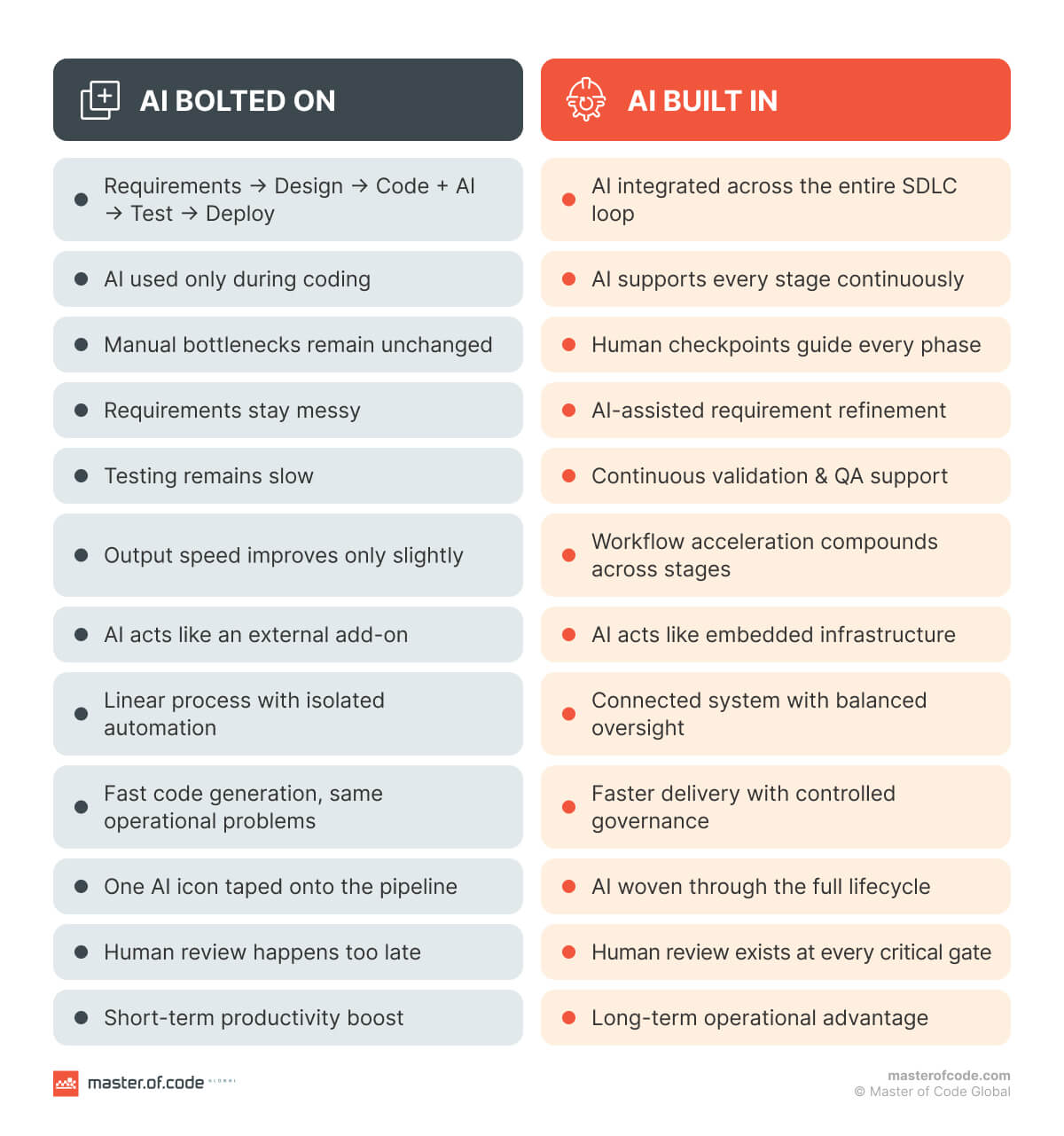
This is where AI in the SDLC stops being a marketing concept and becomes an engineering discipline. Every phase has named AI activities, specific tools, measurable outputs, and explicit human checkpoints. Sophistication lives in the governance structure, not the tool names.
Gate 1. Discovery: Structural Synthesis, Not Status Meetings
Traditional discovery produces slide decks and stakeholder alignment sessions. The AI native SDLC produces a machine-readable Single Source of Truth before the first sprint begins.
In this phase, AI serves as a structural synthesis engine – ingesting unstructured inputs like Slack threads, call transcripts, meeting notes, and fragmented documentation, then cross-referencing them with existing codebase context to identify requirement gaps. Tools like
- Fireflies.ai handle structured insight extraction from recorded sessions.
- NotebookLM maintains living knowledge repositories that update as the project evolves.
- GitHub Spec Kit generates early technical drafts and architectural analysis.
The output isn’t a document. It’s a high-fidelity OpenSpec – a structured, machine-readable specification that agents can execute without ambiguity. What once took weeks of back-and-forth clarification cycles is compressed into a 15-minute human audit of an AI-generated tech spec. Master of Code Global solution architects report a 20–30% increase in requirements synthesis speed when AI is applied consistently at this stage.
Gate 2. Design: Establishing the Orchestration Guardrails
This is the most underestimated phase in any AI-native software development engagement. Everything downstream – every agent action, every code increment, every automated test – operates within the architectural constraints defined here.
The tech stack is finalized in strict alignment with client requirements. Regulatory constraints are mapped. Compliance obligations are locked. And critically, the AI tooling is selected at this stage based on client-specific governance, not default preference. An internal enterprise co-pilot serving 50,000 employees has fundamentally different orchestration requirements than a public-facing customer service bot. The AI coding assistant chosen for one context may be entirely inappropriate for the other.
This phase acts as the configuration layer for everything that follows. Rushing it is the single most reliable way to accumulate alignment debt downstream.
Gate 3. Build: The Agentic Inner Loop
With a verified OpenSpec in place, the build phase becomes what it should always have been: the shortest, most automated part of the cycle. This is the agentic SDLC in its most visible form.
Business-level features are decomposed into atomic, testable increments. Agents ingest the feature brief alongside repository context, identify the precise impact areas, propose a technical design for human architect approval, and then generate code generation outputs in small increments with built-in self-correction. A “Critic Agent” audits every output for style and logic violations before any human gate is triggered.
Tools are selected based on client compliance requirements, not tool preference. Claude Code, GitHub Copilot, and Gemini CLI all have roles – the selection logic is what differentiates a sophisticated implementation from a chaotic one. Human-only checkpoints punctuate every cycle: senior developers audit every AI-generated artifact to eliminate context leakage and verify architectural integrity before the next increment begins.
Our open-source LOFT framework operates as the orchestration backbone throughout – enabling 43% less setup effort, 3x faster project support, and up to 20% budget savings at scale compared to assembling point solutions.
Gate 4. Verification: The Hardening Gate
This is the most critical quality gate in the entire AI software development lifecycle, and the one most often underbuilt by organizations implementing AI SDLC for the first time.
AI agents generate bespoke end-to-end and unit test suites – including edge-case stress testing tailored to feature-specific logic. But automated testing is not self-validating. Human QA reviews and approves every generated test suite for real-world relevance and meaningful coverage. Security Engineers process all changes through automated vulnerability scans, reviewing high-risk findings before any deployment decision is made.
The Human-in-the-loop sign-off is mandatory and non-negotiable. The developer provides a final “Strategic Sign-off” – confirming that code, verified tests, and original client intent are in alignment. Nothing ships without it.
The results of building this gate properly are measurable: our AI-assisted QA process consistently achieves 90%+ test coverage against an industry average of 70%. Industry data shows AI-driven testing improves defect detection by approximately 35% and accelerates regression testing cycles by up to 60% (Ishir, 2025).
Gate 5. Hybrid QA: Where AI Judgment Meets Human Acceptance
The final layer merges human-centric UX and acceptance testing with AI-driven UI validation and LLM-as-a-judge evaluation frameworks – purpose-built to govern agent behavior in conversational and graphical interfaces alike.
One point deserves direct address, because it comes up in every serious enterprise evaluation: production bugs are not “AI errors.” Within a properly governed SDLC, every artifact and every line of code is anchored to human responsibility. A failure in the field is a breakdown in governance and architectural guardrails – not a model hallucination that was unavoidable. Risks like database corruption or logic regressions are symptoms of bypassed quality gates, not inherent AI limitations. Speed never supersedes design in this methodology. Senior-led oversight is the final gateway. Always.
Garbage In, Hallucination Out: The Overlooked Variable
The single biggest differentiator in AI-native software development has nothing to do with which model you use. It’s context hygiene – the discipline of providing LLM-based coding agents with high-fidelity, unambiguous, noise-free input.
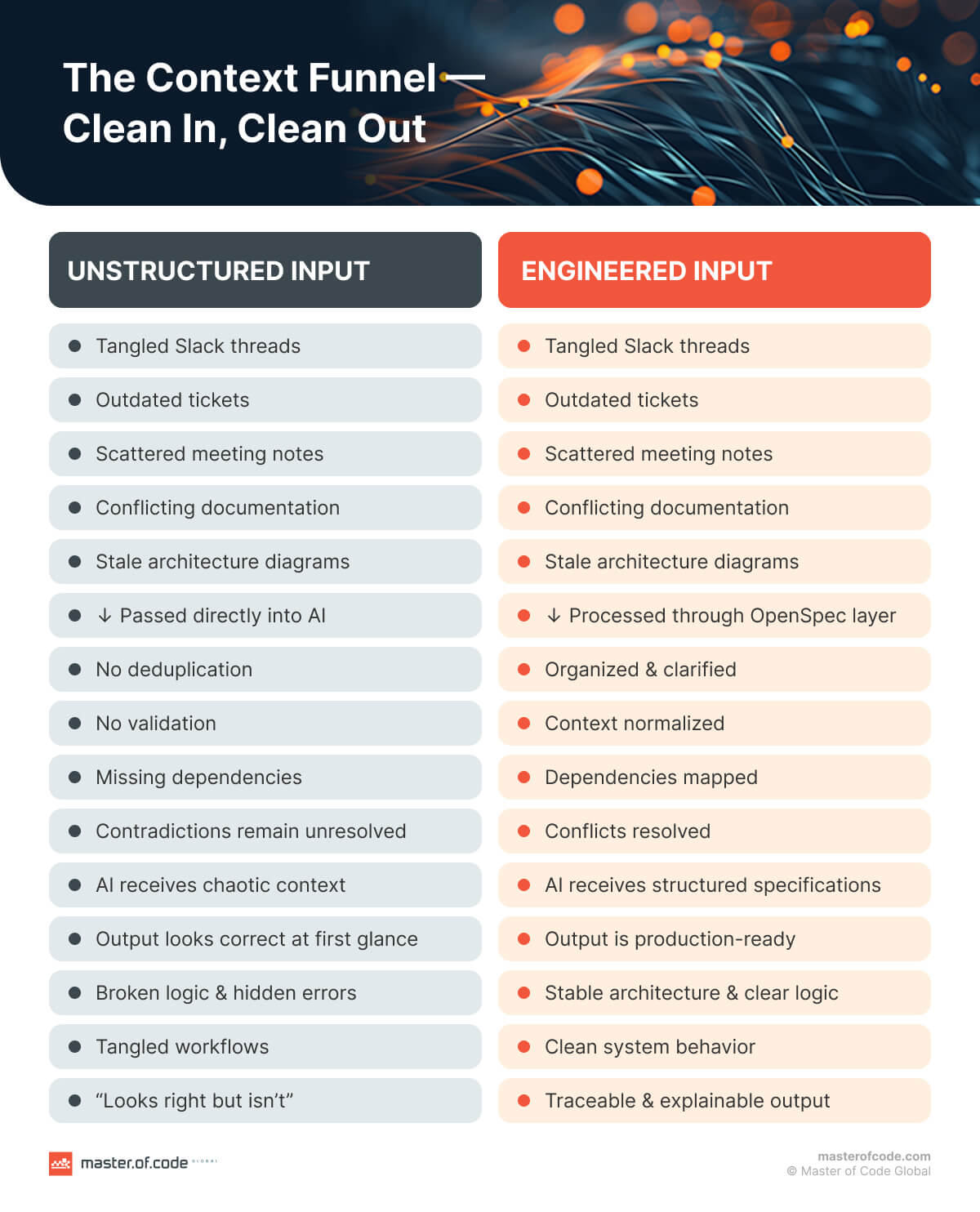
This is where most AI SDLC implementations quietly fail. Organizations feed agents a chaotic mix of outdated Jira tickets, informal Slack messages, and month-old architecture diagrams – and then express surprise when outputs require extensive rework. LLM hallucinations are not random. They are probabilistic outputs shaped by whatever context the model received. Noisy, incomplete, or contradictory input produces confident-sounding outputs that are subtly wrong in ways that only surface in production.
The antidote is architectural, not prompt-based. Our implementation of OpenSpec replaces “Narrative PRDs” with structured, machine-readable frameworks that create a single, continuously updated source of truth. Critically, rather than feeding entire codebases into agent context windows – a common and expensive mistake – Master of Code Global uses Claude Code to programmatically select only the relevant code symbols and dependencies for each feature increment.
The implication is counterintuitive but significant: a perfect specification is now 80% of the engineering effort. The implementation is its automated execution. “Alignment debt” – the compounding cost of ambiguous requirements – is eliminated not by working faster, but by engineering the input with the same rigor previously reserved for the output.
AI in the SDLC done correctly shifts the most important creative work upstream, where human judgment has maximum leverage.
Why Generic AI Tools Are Everyone’s Starting Point – and No One’s Competitive Advantage
Here is the uncomfortable reality that separates a strategic AI conversation from a procurement one: every one of your competitors can activate the same tools your team is evaluating. Cursor, Copilot, Claude Code – these are table stakes. The tool is the entry fee. The orchestration layer around it is the competitive advantage.
This is the central argument for partnering with a custom AI development company rather than deploying off-the-shelf solutions and hoping the results compound. Generic AI tools produce generic outputs. They lack the context pipeline, the governance discipline, and the domain-specific institutional knowledge required to deliver solutions that move business metrics rather than just shipping features.
The contrast is concrete. Off-the-shelf AI tools require your team to build the orchestration layer, design the context hygiene protocols, establish the verification gates, and learn from expensive mistakes on live projects. A purpose-built Generative AI SDLC methodology – refined across 1,000+ projects in finance, healthcare, eCommerce, and automotive – arrives with those lessons already encoded.
The pricing conversation deserves equal honesty. If AI is handling a significant portion of code generation, what exactly are clients paying for? The answer reframes the entire value proposition: strategy, governance, product excellence, and measurable business outcomes. A pricing model tethered to code delivery volume reflects the old “coding factory” paradigm – where the vendor’s positioning is decoupled from the value the software actually creates. The Generative AI SDLC approach operates on a business-value-first definition of done. Delivery is measured by product excellence and market impact, not output volume.
An AI proof of concept is the most direct way to experience this distinction. Our fixed-price, 30-day AI Pilot replaces the traditional discovery phase entirely. Rather than delivering wireframes and clickable prototypes – artifacts that require imagination to evaluate – clients receive working software that real users can interact with and provide feedback on, within the same timeline. Implementation waste is reduced by 50–70% before a single production line is committed. No competitor offers an equivalent entry point at equivalent speed.
Honest Positioning: The Environments Where This Thrives – and Where It Doesn’t
Enterprise trust is built, in part, by knowing when to say no. Not every project is an ideal candidate for a fully AI-driven development lifecycle, and positioning otherwise is a credibility problem, not a sales advantage.
The AI software development lifecycle delivers maximum ROI in environments where business logic is standardized, and the core value driver is precision-grade synthesis of user requirements – not the engineering of proprietary algorithms. Business process automation, customer-facing AI agents, intelligent recommendation systems, conversational interfaces – these are environments where the methodology produces compounding returns.
Regulated industries are not excluded. The orchestration layer selection logic simply shifts. Where enterprise security requirements prohibit third-party cloud vendors like OpenAI or Anthropic, our platform-agnostic approach facilitates the transition to on-premises infrastructure using high-fidelity open models and open-source harness tools. Data sovereignty is preserved. Governance standards remain identical. The tools change; the methodology does not.
Safety-critical and deterministic systems require a different calibration. AI remains part of the process – but human-only verification layers become substantially more rigorous, and the verification gate is widened rather than compressed. The methodology flexes; the governance does not bend.
The clearest signal for a difficult engagement: legacy codebases with no documentation. Context hygiene is a prerequisite for the methodology to function. Without a navigable repository of requirements, the input pipeline has nothing to work with – and no amount of tooling compensates for that foundational gap. AI data preparation and codebase archaeology are solvable problems, but they require dedicated effort before AI-first development can deliver its full return.
Any Agency Can Buy the Same Tools. Not Every Agency Has Done This 1,000+ Times.
Positioning is most credible when it’s built on specifics. Here are Master of Code Global’s.
Ten years delivering AI, conversational, and enterprise software for brands like Tom Ford, Electronic Arts, Golden State Warriors, T-Mobile, and Burberry. Over 1,000 projects across Finance, Healthcare, eCommerce, and Automotive, backed by a 4.7 Clutch rating, ISO 27001 certification, and zero staff turnover on active projects.
The results: 15x revenue growth from AI recommendation systems, 3x higher conversion rates, 80% CSAT improvement, and recognition as Infobip’s Technology Partner of the Year – Americas 2025.
But the attribute that most distinguishes our agentic SDLC approach from competitors is one that rarely appears in vendor positioning: zero vendor lock-in by design. The OpenSpec + FlowForge.MoC methodology is documented, transferable, and shared with client teams as part of the engagement. When a project transitions from Master of Code Global to an internal team, it arrives with a fully established orchestration layer, documented context pipelines, and the institutional knowledge to operate them. Another team can adopt the methodology. That’s a feature, not a vulnerability.
Generative AI consulting is embedded into the lifecycle from day one, alongside AI data preparation and delivery planning – not offered as separate service lines that require additional procurement conversations. The engagement model begins with a high-fidelity discovery of the client’s existing SDLC flow, followed by a customized toolset adoption blueprint, AI agent development services aligned to operational needs, and a transparent communication loop for all educational and onboarding activities.
The productivity U-curve – the 2–3 month adaptation dip that Ciklum and Eficode have documented extensively – is structurally compressed in Master of Code Global’s model. For motivated teams already proficient with AI coding tools, the adoption window is 1–2 weeks. For teams new to the methodology, the onboarding is built into the engagement design rather than treated as an obstacle to delivery.
The Window Is Open. It Won’t Stay That Way.
The AI native SDLC is not a future state. For the organizations using it to compete against yours, it’s the present operational reality. The competitive asymmetry created by AI-first development compounds with every sprint cycle – every discovery phase built on narrative PRDs, every verification gate staffed by manual QA alone, every build phase where alignment debt accumulates unchecked.
The entry point has never been more accessible. A 30-day fixed-price AI Pilot. Working software – not wireframes – within the timeline of a traditional discovery phase. Real user feedback on a real product. A validated foundation for full-scale implementation.
As Master of Code Global’s CTO Bogdan Sergiienko puts it: “No matter which AI you choose – or how heavily you rely on it – ownership of the outcome remains yours.”
That’s the principle on which the entire methodology is built. The AI accelerates. The humans govern. The business wins.
The question is whether that advantage belongs to you – or to the competitor already moving faster. Consult us before they do.
Discover how Master of Code Global can help enhance your customer’s experience and boost sales growth.