



Every enterprise wants AI that delivers. Budgets get approved, pilots launch with fanfare, and expectations soar. Then reality intervenes. According to Gartner’s February 2025 analysis, 63% of organizations either lack or are unsure they have the right data management practices. Gartner also forecasts that through 2026, organizations will abandon 60% of projects specifically because their data is not AI-ready.
The model is rarely the problem. The infrastructure holds up. What fractures is upstream: fragmented knowledge bases, inconsistent documentation, datasets that grew wild over decades without governance.
Our Head of Conversational AI Design & Strategy, Henrique Gomes, sees this pattern in nearly every enterprise engagement: “The biggest obstacle is not the model or infrastructure – it is the structure and readiness of the organization’s data.” AI data preparation – the discipline of making organizational knowledge machine-readable – is where success or failure is determined. Let’s dive deeper into this topic based on insights from Henrique Gomes and our AI engineer Tetiana Chabaniuk.
Table of Contents
Key Takeaways
- Data readiness – not model sophistication – dictates AI ROI. Two-thirds of enterprises cannot scale AI because their data foundation is not prepared for it.
- “Clean” and “AI-ready” are fundamentally different standards. Removing duplicates is table stakes. Semantic structuring, contextual enrichment, and intent alignment are what separate functional AI from failing AI.
- Data preparation is an operational capability, not a project phase. Organizations that build continuous pipelines gain a compounding advantage with every deployment.
- RAG architectures amplify both excellent and terrible data equally. Poorly structured knowledge bases produce confident but wrong answers – the most dangerous kind.
- Custom data preparation outperforms generic tooling at enterprise scale. Off-the-shelf solutions plateau precisely where organizational complexity begins.
Why Most AI Projects Fail Before the Model Even Starts
There is an uncomfortable truth most vendors will not volunteer: the majority of AI failures originate before a single model is deployed. Fragmented sources, poorly structured knowledge bases, inconsistent content formats, and missing context for AI reasoning – these are the silent saboteurs. McKinsey’s 2025 State of AI report confirms that while 88% of organizations now use AI in at least one business function, roughly two-thirds have not yet begun scaling it across the enterprise. The bottleneck, repeatedly, is data.
Henrique Gomes shared a case from our practice that illustrates the problem in sharp relief. A company attempted to deploy an AI agent backed by a knowledge base of over 10,000 articles. The volume was impressive. The results were not. Answer precision was dismal because the articles lacked standardized structures, clear question-and-answer formats, and consistent metadata. They had accumulated organically over years – a patchwork of PDFs, wiki entries, screenshots, and tribal knowledge.
The lesson is counterintuitive: more information does not automatically make AI smarter. Without proper structuring, large knowledge bases can actually confuse AI systems, converting volume into noise.
What AI Data Preparation Actually Means
For business leaders who hear the term without fully grasping its scope: AI data preparation encompasses everything required to make organizational knowledge usable by machines. That includes cleaning and standardizing datasets, structuring knowledge into consumable formats, enriching metadata, removing irrelevant and sensitive information, and aligning content with real user intents. It is the ETL (Extract, Transform, Load) discipline reimagined for the era of intelligent systems – spanning structured data, unstructured data, and the sprawling semi-structured data that most enterprises accumulate.
As Henrique Gomes puts it: in many enterprise environments, knowledge bases grow organically without consistent structure. Articles combine plain text with screenshots, hyperlinks, and informal explanations in a single document. Before this information can support AI systems, it requires extensive data transformation and standardization.
Think of enterprise metrics as a warehouse stacked floor-to-ceiling with unlabeled boxes. Some contain gold; many are outdated. AI data preparation builds the navigation system – the indexing, the signage, the retrieval logic – that allows AI to find the right knowledge instantly rather than rummaging through everything.
Clean Data vs. AI-Ready Data: The Distinction That Determines Everything
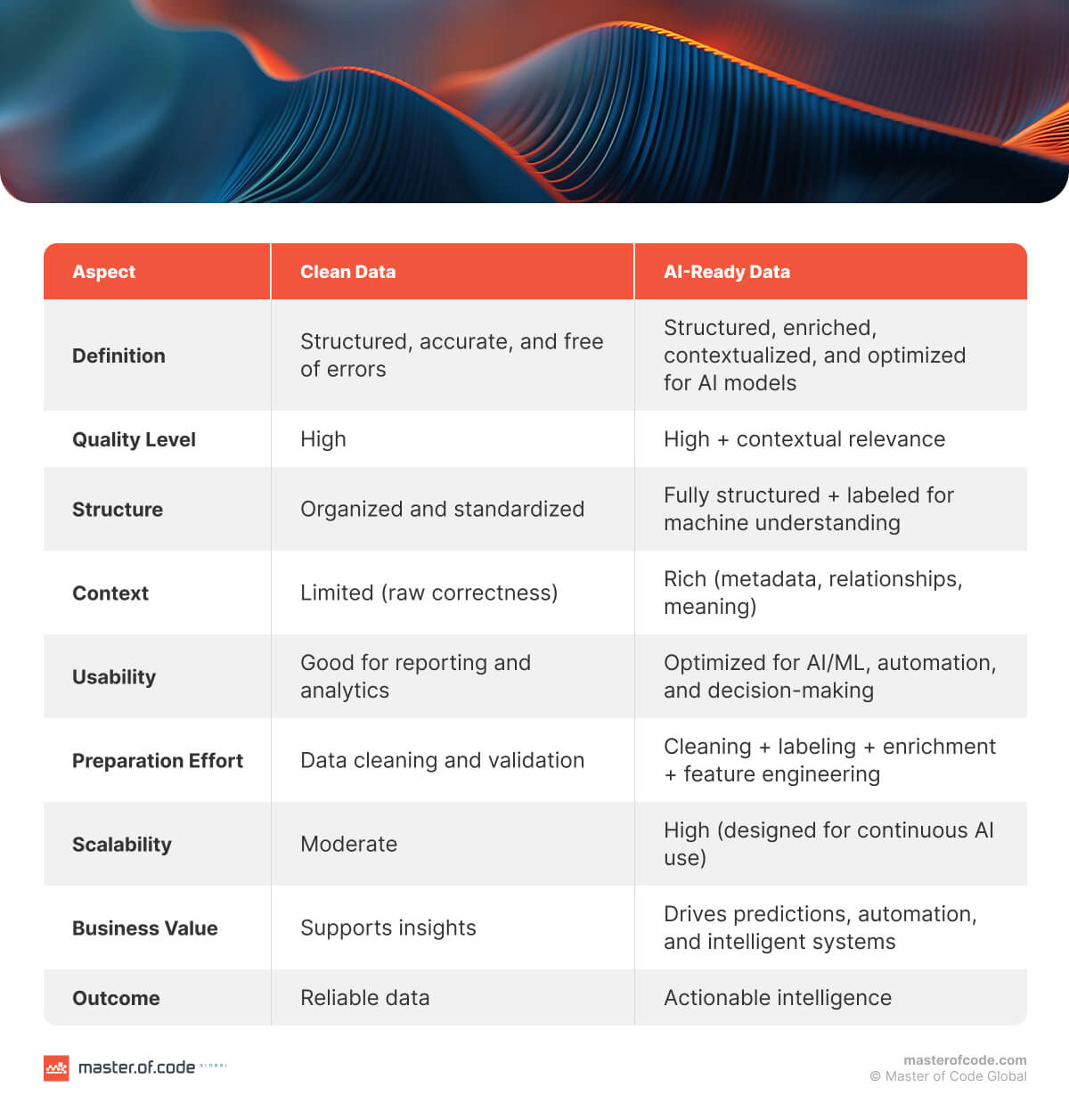
One of the most expensive mistakes in enterprise tech innovation is assuming “clean data” equals “AI-ready data.” They are not the same. Data cleaning addresses surface-level hygiene: duplicates removed, formatting corrected, inconsistencies resolved. Necessary, yes. Sufficient? Not remotely.
AI-ready data operates at a different altitude. It is semantically structured, contextualized across systems, optimized for retrieval, and linked to business logic. Tetiana Chabaniuk, a data engineering specialist at Master of Code Global, draws the line precisely:
“Clean data means metrics artifacts are correct, formatted, and not conflicting with each other. AI-ready data goes further: it’s annotated, structured, and enriched with everything the model needs to act – field descriptions, expected formats, edge-case guidance, validation rules, intent labels, canonical entities, confidence signals.”
The practical implications are stark. In RAG-based systems, Henrique has observed that poorly structured knowledge bases cause the model to retrieve the wrong context, leading to incorrect answers — even when the model itself is highly capable. Data quality, in this context, is not a hygiene metric. It is a performance multiplier. And the gap between clean and truly AI-ready is where most enterprise deployments stall.
Why Data Preparation for AI Cannot Be a One-Time Project
Perhaps the most damaging misconception in implementing AI in business is treating data preparation as a finite project phase – something you complete before launch and never revisit. Enterprise AI systems exist in a living environment. Products update weekly. Policies shift quarterly. New customer questions surface patterns that did not exist six months ago.
IBM’s 2025 CDO Study, surveying 1,700 chief data officers, found that 43% of them identify data quality as their most significant priority, and over a quarter of organizations estimate they lose more than $5 million annually due to poor data quality alone. These losses accelerate when organizations layer AI on top of deteriorating foundations.
Henrique has seen the consequences firsthand in our engagements: many organizations prepare their data thoroughly for an initial deployment, then neglect maintenance. Inconsistencies creep back. Knowledge gaps widen. AI response accuracy degrades gradually – not dramatically enough to trigger alarms, but enough to erode user trust over months.
The organizations that succeed treat data preparation as a lifecycle: ingestion, structuring and enrichment, validation, deployment, monitoring, and continuous improvement. Building this as an operational capability – with dedicated data pipelines, data governance frameworks, and automated feedback loops – is what separates enterprises that scale AI from those that stall after a pilot.
Preparing Knowledge for RAG Systems and AI Agents
Modern enterprise AI increasingly relies on Retrieval-Augmented Generation (RAG), where models pull relevant context from external knowledge bases before generating responses. The architecture is powerful: it grounds AI answers in your organization’s actual data, reducing hallucinations and increasing relevance. But it also amplifies whatever it retrieves – good or bad.
Effective data preparation for AI/ML systems using RAG involves document chunking (breaking large documents into semantically coherent segments), semantic indexing, metadata tagging, and standardized Q&A formatting. Each step demands deliberate design decisions shaped by how real users will query the system.
When knowledge bases are poorly structured, retrieval systems surface irrelevant content. The AI agent then builds its response on incorrect context — and delivers confidently wrong answers.
— Henrique Gomes, Head of Conversational AI Design & Strategy
Data preparation for AI model training and retrieval is often the most labor-intensive phase of implementation. It is also the phase that determines whether the system earns user trust or quietly destroys it.
The Hidden Goldmine: Cleaning Transcripts and Extracting Intent
Knowledge articles are not the only source demanding preparation. Customer conversation transcripts – chat logs, call recordings, support tickets – represent a goldmine of intent metrics. But only after significant data cleaning and data labeling.
Raw conversation logs are cluttered with greetings, filler messages, timestamps, system prompts, sensitive customer information, and multi-step exchanges where the actual question is buried three turns deep. AI-driven data preparation for these sources means extracting the user’s core intent, the relevant question, and the final resolution – then discarding everything else.
This process sits at the intersection of feature engineering and data transformation: the raw transcript becomes a structured training signal that teaches models not just what customers ask, but how they ask it, in what sequence, and with what emotional register. Henrique’s team has developed systematic approaches to this extraction in our client engagements, and the difference in downstream model quality is consistently dramatic.
How Better Data Preparation Directly Improves AI ROI
Strategy without numbers is storytelling. So here is what the metrics show.
Based on outcomes from Henrique’s engagements, properly structured knowledge bases produced a 20–30% increase in AI containment rate and a 10–20% improvement in customer satisfaction (CSAT). Those numbers translate directly into AI cost reduction: fewer tickets escalated to human agents, shorter resolution times, higher first-contact resolution.
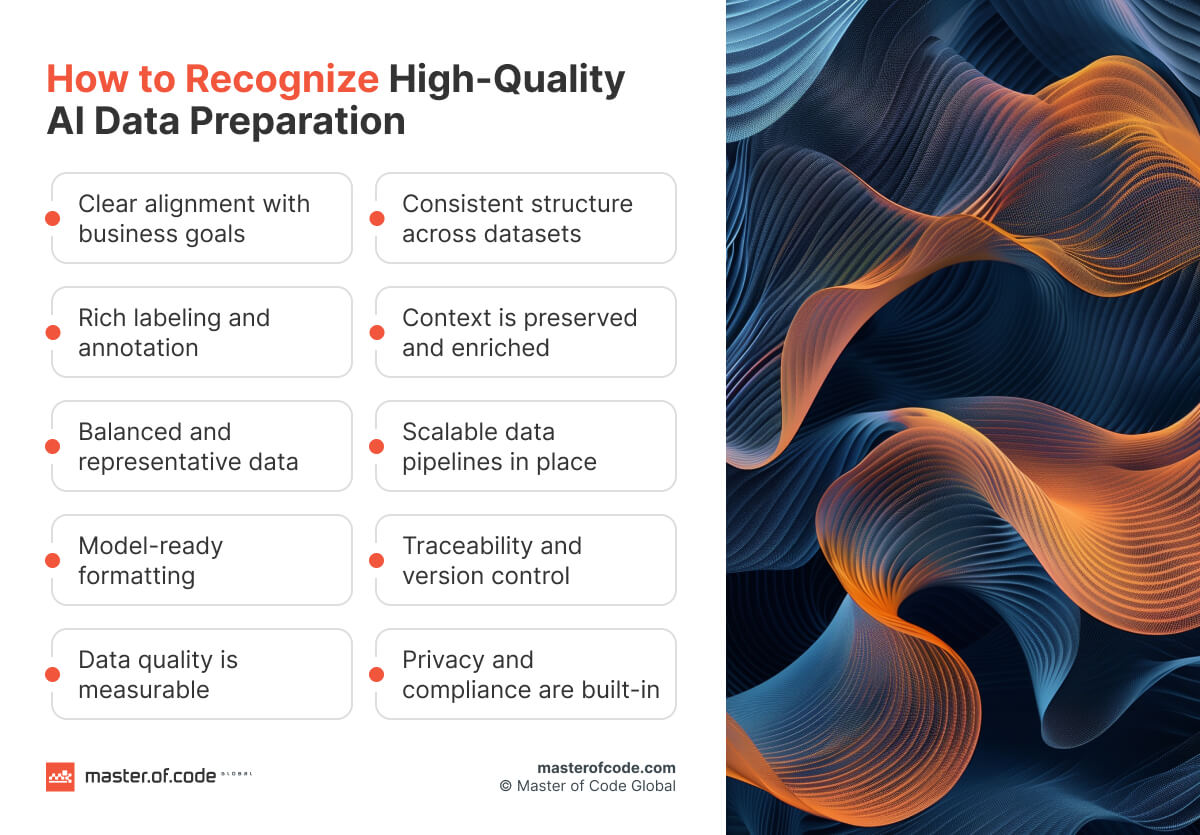
AI data preparation best practices yield faster deployment cycles (models need less tuning with well-structured inputs), fewer hallucinations (retrieval pulls from coherent, validated sources), higher automation rates, and improved customer experience. AI data preparation analytics benefits compound over time: as the info foundation matures, every new model or automation layer performs better from day one. The ROI is not linear. It is exponential.
Why Off-the-Shelf Falls Short – And What Custom AI Integration Services Deliver
Generic AI-powered data preparation tools serve a purpose. For standardized datasets with predictable schemas, they work adequately. But enterprise reality is messier. Your knowledge base contains fifteen years of institutional history embedded in formats no SaaS tool was designed to parse. Your conversational data spans four CRM platforms, two ticketing systems, and a legacy phone system exporting in a proprietary format.
Off-the-shelf tools plateau at the precise threshold where enterprise complexity begins. They cannot build the custom taxonomies your domain requires. They do not account for the regulatory nuances of your industry’s data governance requirements. They lack the data integration depth to unify disparate sources into a coherent, AI-ready foundation. True implementation across enterprise systems demands domain expertise that no plug-and-play tool replicates.
This is where AI strategy consulting and purpose-built solutions change the equation. Our enterprise AI development company constructs custom data pipelines, tailored enrichment workflows, domain-specific structuring frameworks and delivers ROI that generic tools cannot approach. The difference is not incremental – it is categorical.
Turning Enterprise Data Into a Strategic AI Asset
AI models advance at a staggering pace. Foundation models grow more capable with every release. But here is the quiet truth that separates enterprises thriving with AI from those merely experimenting: the model is almost never the bottleneck. Enterprise data preparation for AI services – the painstaking work of structuring, enriching, governing, and maintaining organizational knowledge – determines whether powerful models produce business impact or expensive noise.
Organizations that invest in structured knowledge bases, AI-ready datasets, scalable pipelines, data integration, and robust governance frameworks build a strategic asset that appreciates with every deployment. They do not just implement artificial intelligence. They build the foundation that makes every future initiative faster, cheaper, and more effective.
We help enterprises make that transformation. From AI strategy consulting through implementation and ongoing optimization, our AI integration services are designed to convert the messy reality of enterprise information into a competitive advantage. Because the organizations that master data preparation for AI today are the ones that will lead their industries tomorrow.