


Every startup founder loves velocity. Ship the MVP in a weekend, demo it on Monday, raise a seed round by Friday. With AI vibe coding tools flooding the market – 138 and counting – that fantasy has never felt closer to reality. A quarter of Y Combinator’s Winter 2025 batch had codebases that were 95% AI-generated. By early 2026, nearly half of all new code across the industry is written by intelligent algorithm.
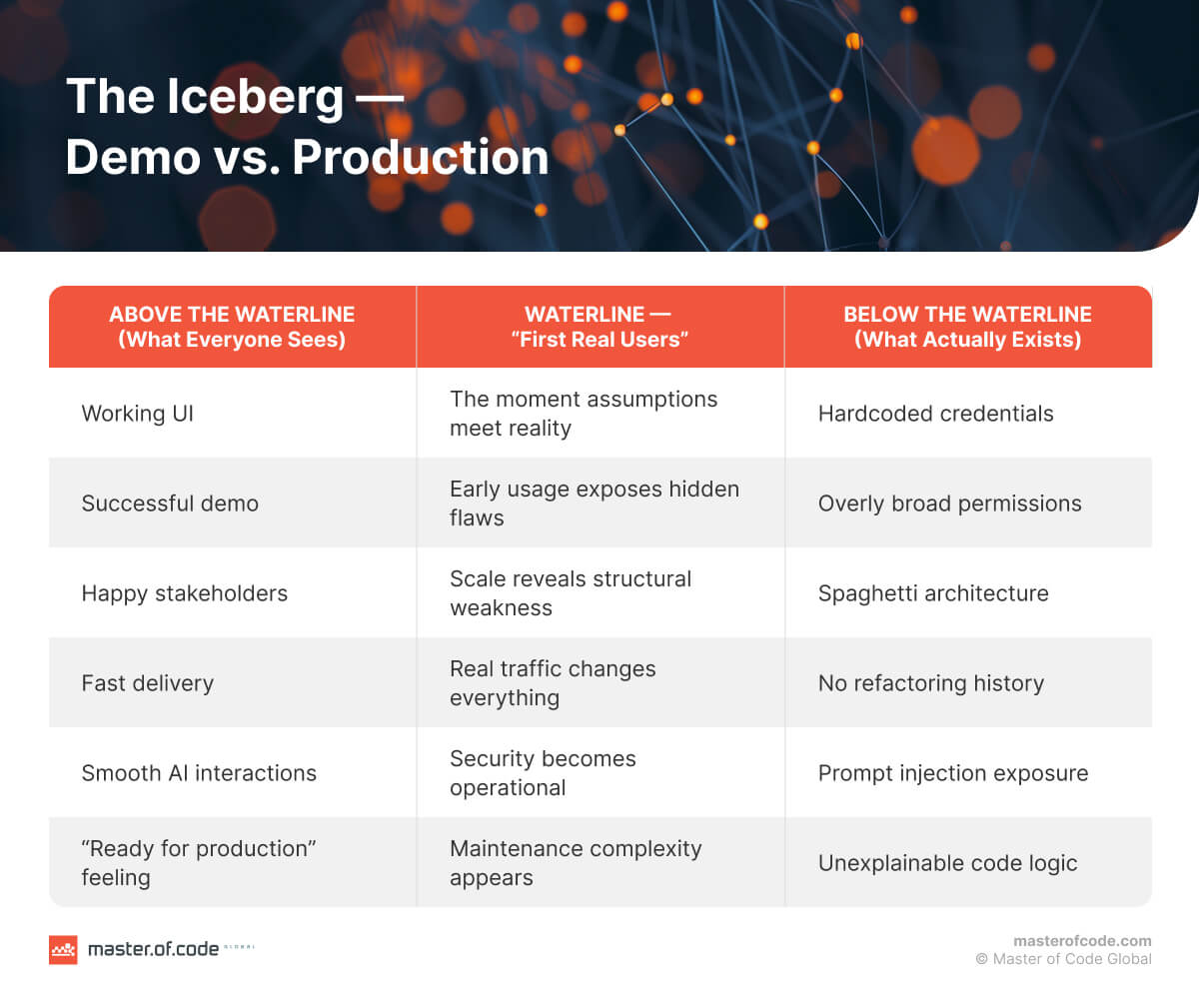
The speed is intoxicating. But increasingly, companies arrive with AI-generated products that work in demos and start failing under real usage.
One startup recently came to Master of Code Global after months of vibe coding its platform internally. The system exposed sensitive user data through flawed authentication logic, while the UI became unstable once real users began interacting with it simultaneously. Fixing the issues required reworking core parts of the architecture before the product could safely scale.
And this is becoming a pattern. Companies are encountering hidden security gaps, fragile integrations, unreliable AI behavior, and frontend experiences that break under production conditions. That is why Master of Code Global introduced its technical audit for AI platform service – helping businesses identify architectural, operational, and security risks before they turn into expensive failures.
For AI vibe coding startups, the real question isn’t whether to use AI-assisted development. It’s whether your codebase is an asset or a time bomb – and who finds out first, you or your investors.
Table of Contents
Key Takeaways
- “Working software” ≠ “investable software.” Investors now treat AI code governance as a due diligence line item. A codebase without documented review processes can depress valuations or kill deals outright.
- The security math has shifted. Nearly half of AI-generated code contains OWASP Top-10 vulnerabilities. AI-written code is already a documented source of real-world breaches.
- Technical debt compounds in the dark. Code duplication is surging, refactoring is collapsing, and developers increasingly spend more time debugging AI output than writing it themselves would have taken.
- Custom AI architecture is the new competitive moat. Off-the-shelf vibe coding tools optimize for demo speed, not production resilience. The startups raising Series B and beyond are the ones whose codebases survive scrutiny.
From Prompt to Product – And Everything That Gets Skipped
Andrej Karpathy coined the term “vibe coding” in February 2025, describing it as a style where you “fully give in to the vibes, embrace exponentials, and forget that the code even exists.” The developer becomes a director. The AI writes the screenplay, the dialogue, and the stage directions. You just say whether the scene works.
For non-technical founders, that proposition is magnetic. Describe your app in plain English, watch it materialize in minutes, iterate by conversation. Tools like Lovable, Bolt.new, and Replit have turned this workflow into a product category worth billions — Replit alone raised $400 million in March 2026. The vibe coding gold rush is real.
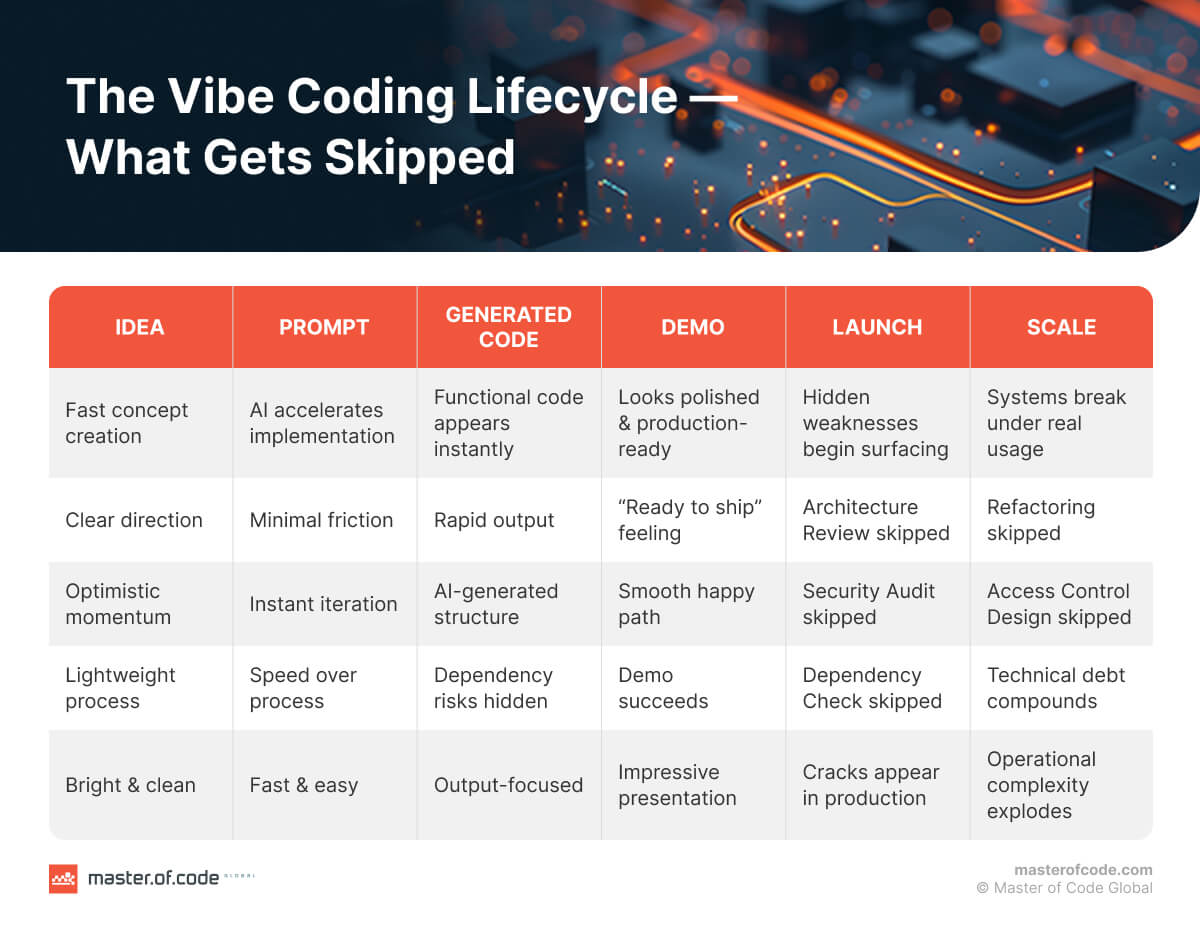
But there’s a wide canyon between “it works in the demo” and “it works in production.” When founders push vibe coding production apps to real users without engineering oversight, that canyon becomes a cliff. Adoption has essentially reached saturation among US developers. Trust, however, tells the opposite story. Developer confidence in AI-generated output dropped from 77% in 2023 to just 60% in 2026. Only a third trusts AI code accuracy. The industry is running on a tool it doesn’t fully believe in — and for AI vibe coding startups building their core product on that foundation, the stakes are existential.
The 3 Risks Nobody Puts in the Pitch Deck
Vibe Coding Security: The Vulnerability Assembly Line
Think of AI-generated code as a building contractor who works incredibly fast but occasionally skips the wiring inspection. The structure looks solid. The doors open. Buyers tour the model unit. But inside the walls, exposed wires wait for the first spark.
The data is blunt. Veracode’s 2025 GenAI Code Security Report found that 45% of AI-generated code contains security flaws mapping to the OWASP Top-10. Independent security researchers have tested popular vibe coding tools by building identical applications across platforms – and consistently found dozens of vulnerabilities, including critical ones. AI generated code vulnerabilities aren’t theoretical anymore. They’re measurable, documented, and already linked to issues like insecure authentication flows, exposed API keys, prompt injection paths, and vulnerable dependency suggestions.
Vibe coding security problems run deeper than individual bugs. AI-generated backend code frequently ships with overly broad permission settings, expanding the attack surface before a single user logs in. AI tools hardcode API keys and credentials into sample code with alarming regularity. And the LLM security risks extend beyond the code itself: prompt injection attacks targeting developer copilots are now a documented enterprise threat vector, with security firms tracking incidents across dozens of organizations.
The uncomfortable punchline? Fewer than half of developers consistently review AI-generated code before committing it. The tools are prolific. The oversight is not.
The Silent Compounding Problem: Technical Debt Vibe Coding Creates
Security flaws announce themselves through breaches. Technical debt is quieter and often costlier.
The longitudinal data paint a stark picture. Code churn is climbing. Code duplication has multiplied. Refactoring – the essential discipline of cleaning and improving existing code – has collapsed as a share of developer activity, and continues to decline. AI doesn’t refactor. It generates. And what it generates often looks functional while being structurally fragile – what developers are increasingly calling vibe coding spaghetti code.
When developers use an AI agent to generate a complete web application (C# backend, React TypeScript front end), the pattern is clear: the functional application emerges quickly, but the code lacks coherence and structure, making maintenance a nightmare. That’s the limitation of LLM-based code generation in a sentence. The output compiles. It may even pass tests. But nobody – including the model that wrote it – can explain why it’s structured the way it is, or confidently predict what breaks when you change something.
This is where technical debt vibe coding accumulates fastest. Developers increasingly report a painful irony: they spend more time debugging AI-generated code than writing it themselves would have taken. Speed purchased today becomes a maintenance invoice tomorrow, with compounding interest.
The Investor Reckoning
The smartest money in the room already knows about these risks, and it’s adjusting its diligence accordingly.
Bain & Company’s 2026 M&A Report found that one in five strategic dealmakers walked away from a transaction because of the anticipated impact of AI risk on the target’s business. AI coding investor due diligence is no longer a footnote in tech assessments. It’s become a standalone workstream with its own buyer team and its own price impact. Investors are now specifically asking: How much of this codebase was AI-generated? What review processes exist? Can the engineering team explain its own architecture?
The valuation consequences are tangible. FE International’s 2026 analysis reports that regulatory, privacy, and technical risks can reduce AI business valuation multiples by 15–30%. And those discounts stack: a target with high model dependency and a weak data moat sees both compressions applied. Across AI code quality governance, regulatory compliance, and architectural soundness, the message from investors is consistent: show us the controls, or accept the discount.
The Off-the-Shelf Illusion
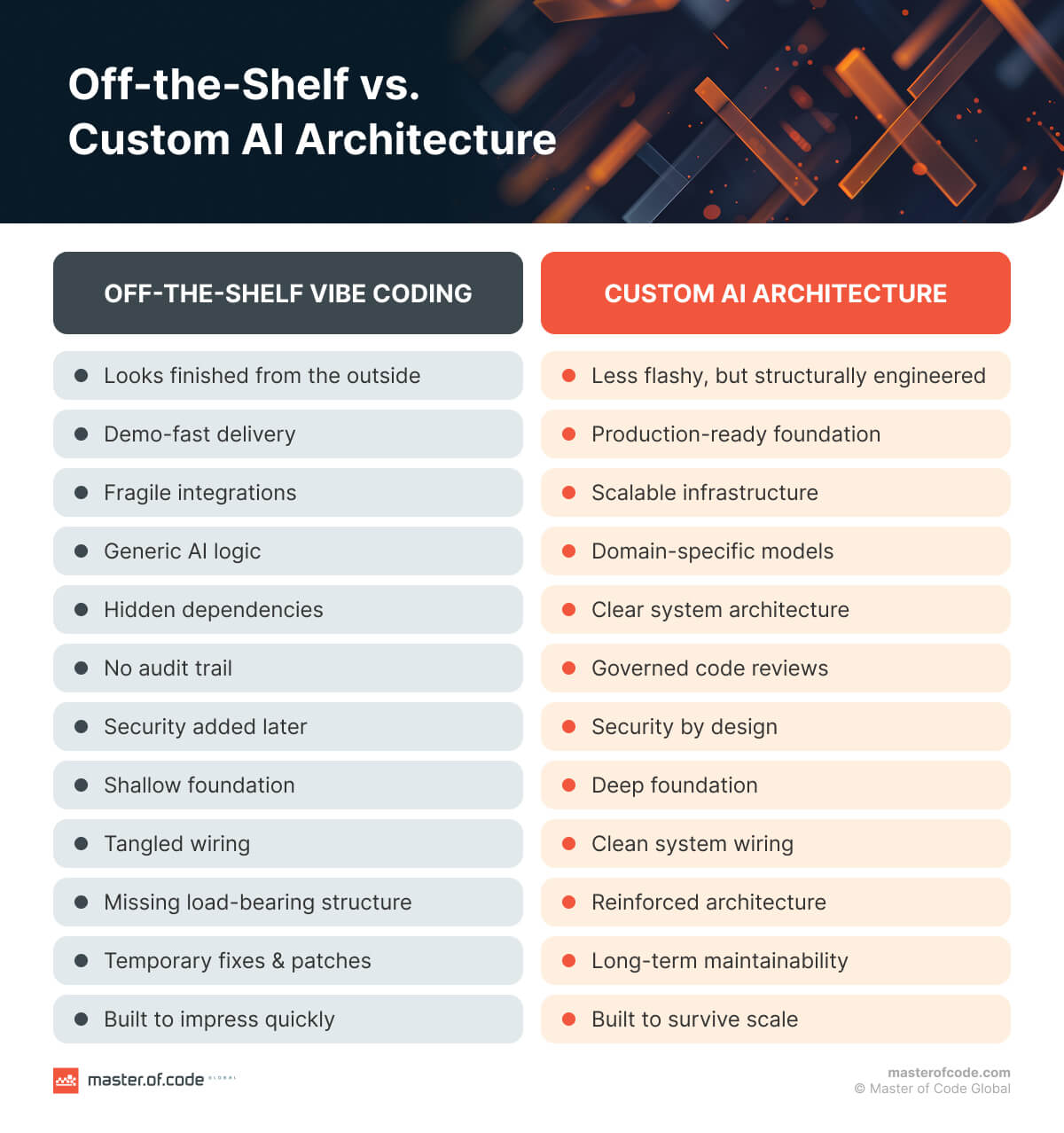
Generic vibe coding tools are optimized for one thing: getting a working demo in front of you as fast as possible. That’s a genuine value for prototyping, internal tools, and early concept validation. Part of that miscalculation is cost Replit credits, for example, run on an effort-based billing model where each AI task consumes from a shared pool covering agent usage, hosting, database compute, and storage, with no spending cap and no upfront cost estimate before a task runs. The trouble begins when founders mistake demo-day speed for production readiness.
The failure patterns are becoming increasingly familiar. AI coding systems have already been observed generating deceptive user-facing content, introducing destructive database operations, and making unauthorized changes that developers explicitly tried to prevent. LLM hallucinations don’t just affect chatbot responses – they corrupt code logic, invent nonexistent API endpoints, and introduce phantom dependencies that silently break downstream.
These are the vibe coding risks that scale with your ambition. An internal dashboard can tolerate a quirky bug. A payment system processing real transactions cannot. And the deeper the AI-generated codebase grows without architectural oversight, the harder it becomes to untangle – because every new layer of generated code inherits the assumptions (and errors) of the layers beneath it.
The choice between custom AI solutions vs off-the-shelf vs hybrid approaches comes into sharpest focus at the moment a startup needs to scale, pass a security audit, or withstand investor technical diligence. Off-the-shelf tools build quickly. Custom architecture builds durably.
From Vibes to Validation: The Architecture That Separates MVPs from Market Leaders
Production-grade AI development doesn’t mean abandoning speed. It means ensuring that speed doesn’t create wreckage you’ll spend the next two years cleaning up. The distinction is architectural, not philosophical.
Vibe coding security in a production context starts at the foundation: role-based access controls from day one, dependency scanning baked into CI/CD pipelines, and audit trails that make compliance demonstrable rather than aspirational. It means building with agentic AI development best practices – guardrails, observability, and human-in-the-loop oversight – so that AI agents operate within defined boundaries, not as unsupervised autonomous systems.
Addressing AI generated code vulnerabilities requires more than static analysis tools bolted on after the fact. The minimum standard is automated code review combined with human oversight at every commit – because fewer than half of developers currently review AI-generated code before merging it. That gap between generation and governance is where the vibe coding risks concentrate most heavily.
The difference between “AI-assisted” and “AI-abandoned” development is whether engineering judgment remains in the loop. When it does, AI becomes a powerful accelerant. When it doesn’t, you’re building on a foundation that nobody fully understands – and praying nothing shifts beneath you.
Your Code Should Survive the Questions Investors, Regulators, and Users Will Ask
This is the gap experienced AI engineering teams exist to close – and where deep delivery expertise matters far more than generating code quickly.
If you’re building a startup around AI-assisted development, speed alone is not the challenge anymore. The real challenge is turning an early prototype into something stable, secure, scalable, and investable. That is where Master of Code Global combines its fixed-price AI proof of concept process, AI consulting services, and expertise as an AI MVP development company to help founders move from idea to production without scaling architectural mistakes alongside the product. The team works closely with founders during the earliest stages of development, bringing practical insight into system design, AI orchestration, infrastructure planning, model behavior, security boundaries, and long-term operational risks that vibe coding tools alone cannot anticipate.
But many companies are already past that stage. They already have an AI-generated product, internal tool, or startup built through vibe coding workflows – and now face a different question: is the system actually safe to scale? This is where a technical audit for AI platform readiness becomes critical. Master of Code Global approaches these audits as hands-on engineering investigations, not surface-level reviews. Teams analyze architecture decisions, AI-generated code quality, dependency risks, orchestration logic, permission structures, scalability bottlenecks, operational reliability, and vibe coding security exposure across the entire product lifecycle. As an ISO 27001-certified company, the team also embeds AI security threat consulting directly into the review process to identify vulnerabilities that often remain invisible during rapid AI-assisted development.
The company’s engineers have spent more than a decade building production-grade AI systems across complex environments. That experience shapes how they approach Generative AI, AI agent development, and production deployment today. Instead of treating AI as a standalone feature, the team works deeply inside the operational realities of each product: how systems fail under scale, where AI-generated architecture creates hidden technical debt, how orchestration breaks across multiple models, and how vibe coding risks evolve once products move beyond prototypes into real operational environments.
To support faster but more controlled delivery, Master of Code Global developed its proprietary LOFT framework – an open-source orchestration approach that reduces setup effort by 43%, delivers up to 20% budget savings at scale, and enables 3× faster long-term project support. The goal is not simply faster development. It is helping companies build AI systems that remain reliable once real users, production traffic, compliance requirements, and operational complexity enter the picture – without compromising long-term stability, maintainability, or vibe coding security.
Build Fast. But Build to Last.
Vibe coding has genuinely democratized software creation. A non-technical founder can go from idea to functional prototype in hours. That’s remarkable. But it didn’t democratize engineering judgment, security discipline, or architectural planning – and those are what separate a demo from a business.
The AI vibe coding startups that will raise their next round aren’t the ones that shipped fastest. They’re the ones whose codebase can withstand the scrutiny of investors, regulators, and real users at scale. They’re the ones who treated speed as a tool and quality as the strategy.
If your codebase was built fast, the smartest next move is finding out what’s under the hood – before someone else does it for you.
Book a free technical audit to find out if your AI codebase is investor-ready.
Discover how Master of Code Global can help enhance your customer’s experience and boost sales growth.