




If you’re reading this, you’ve likely moved past artificial intelligence curiosity and into a more practical phase. You’re not asking whether AI matters anymore. You’re trying to figure out how to make it work inside your organization consistently, responsibly, and at scale.
Across industries, the conversation has shifted in the same direction. As Dmytro Hrytsenko, our CEO, recently noted after attending the World Economic Forum in Davos, there’s far less focus on promises and pilots, and much more attention on adoption, workflows, and measurable outcomes. Many companies start by exploring AI strategy consulting services to clarify where this technology should create value and what needs to change internally to support it. Others arrive at the same questions later, after a solution is already built, but struggle to gain traction.
In both cases, the challenge isn’t access to technology. It’s execution. This article is meant to help you understand what changes when AI is treated as an organizational capability, what an AI implementation partner actually owns, and how to evaluate whether that model fits what you’re trying to achieve.
Table of Contents
Key Takeaways
- An implementation expert is accountable for outcomes across the full lifecycle (from early decisions to production use), not just for delivering a technical solution, which is the core difference in the AI implementation partner vs AI vendor model.
- The gap between strategy and results is where most initiatives stall. Understanding AI consulting vs AI implementation helps clarify why advice alone is rarely enough without shared delivery ownership.
- Treating artificial intelligence as a program, not a project, reduces failure rates by defining clear paths to scale, pivot, or stop, instead of leaving pilots and MVPs in limbo.
- Real value from technology depends on adoption, workflow integration, and iteration after launch, not on how quickly a model or tool is deployed.
- AI implementation risk and compliance must be addressed continuously, especially in enterprise and regulated environments, where security, governance, and legal constraints shape context from day one.
- Choosing the right partner means evaluating engagement models, ownership after launch, and the ability to operate within real organizational constraints, not just technical expertise.
What an AI Implementation Partner Does When the Real Race Begins
If you’ve already tried artificial intelligence in your organization, you might recognize this situation. You scoped a use case, hired a vendor or consultants, built something that technically works, and then it never became part of how teams actually work day to day.
This is exactly the gap an AI implementation partner is meant to address.
At a practical level, such a partner is a team that takes responsibility not just for building a solution, but for getting it to work inside your business across systems, teams, constraints, and real-world conditions. The focus is not on delivering code or a demo. It’s on delivery outcomes.
That’s what makes this role different from models you’ve likely worked with before.
- An AI vendor typically delivers a defined scope: a feature, an integration, a chatbot, a model. Once that scope is shipped, the engagement often ends. If adoption is low or priorities shift internally, that risk sits mostly on your side.
- AI consulting, on the other hand, helps you define strategy, identify opportunities, or select tools. That input can be valuable, but it usually stops short of owning execution. When plans meet operational reality, consultants are often no longer in the loop.
An AI implementation partner sits between — and beyond — those models.
In practice, this means staying involved from early decision-making through AI production deployment and ongoing iteration. It means helping you answer uncomfortable but necessary questions along the way: Is this use case still worth scaling? Are teams actually using the solution? Do metrics support further investment? What needs to change to make this work in the organization you have today?
Another important factor is this: ownership. When something underperforms, an AI deployment partner doesn’t just point to assumptions or documentation. They assist in diagnosing the issue, adjusting the approach, and moving forward. Or, just as importantly, help you decide when to stop or pivot.
For many companies, especially at enterprise scale, that shared ownership is what turns technology from a series of experiments into something that delivers sustained business value.
How an Implementation Partner Keeps You on Track: From One-Off Projects to AI Programs
Once you understand AI implementation ownership, the next question usually comes up on its own: Why did our previous initiatives stall, even though the technology worked?
In most cases, the issue isn’t the model, the platform, or the vendor. It’s how technology is positioned inside the organization. That’s something an implementation partner addresses, too, by aligning delivery, ownership, and long-term use.
Many companies still approach artificial intelligence as a project — something with a start date, a delivery milestone, and a finish line. In doing so, they often underestimate the cost of implementing AI as an ongoing investment. That mindset works for websites, integrations, or even traditional software rollouts. It rarely works for AI.
Here’s what we typically see when this happens:
- A pilot or MVP is launched without a clear path forward.
- Success metrics exist on paper, but no one owns them after launch.
- Teams don’t know how the solution fits into daily workflows.
- Internal priorities shift, and the intelligentization initiative quietly loses support.
- No decision is made to scale, pivot, or stop — the application just lingers.
Over time, these stalled initiatives pile up. You end up with what many leaders privately call “big AI fails”: tools that technically function but never become part of how the business operates.
An AI program approach looks very different.
Instead of asking, “Can we build this?”, the organization starts with broader questions:
- What role should this technology play in our business over the next 1–3 years?
- Which use cases are worth experimenting with — and which aren’t?
- How will we decide whether an initiative scales, changes direction, or stops?
- Who owns outcomes once the initial build is done?
This shift doesn’t eliminate experimentation. It adds the structure.
Such programs treat pilots, PoCs, and MVPs as intentional steps, not endpoints. Each initiative has a purpose, evaluation criteria, and a clear next decision. That’s the difference between “trying it” and actually building AI capability inside the company. And it’s where an implementation partner becomes especially valuable.
Delivery Ownership with an AI Implementation Partner Until the Final Lap
When artificial intelligence is treated as a program, ownership doesn’t show up in one place. It shows up across the entire lifecycle — from the first conversation to long after the solution is live. This is where a partner plays a very different role from a build-only team.
Below is how that AI delivery accountability typically unfolds in practice.
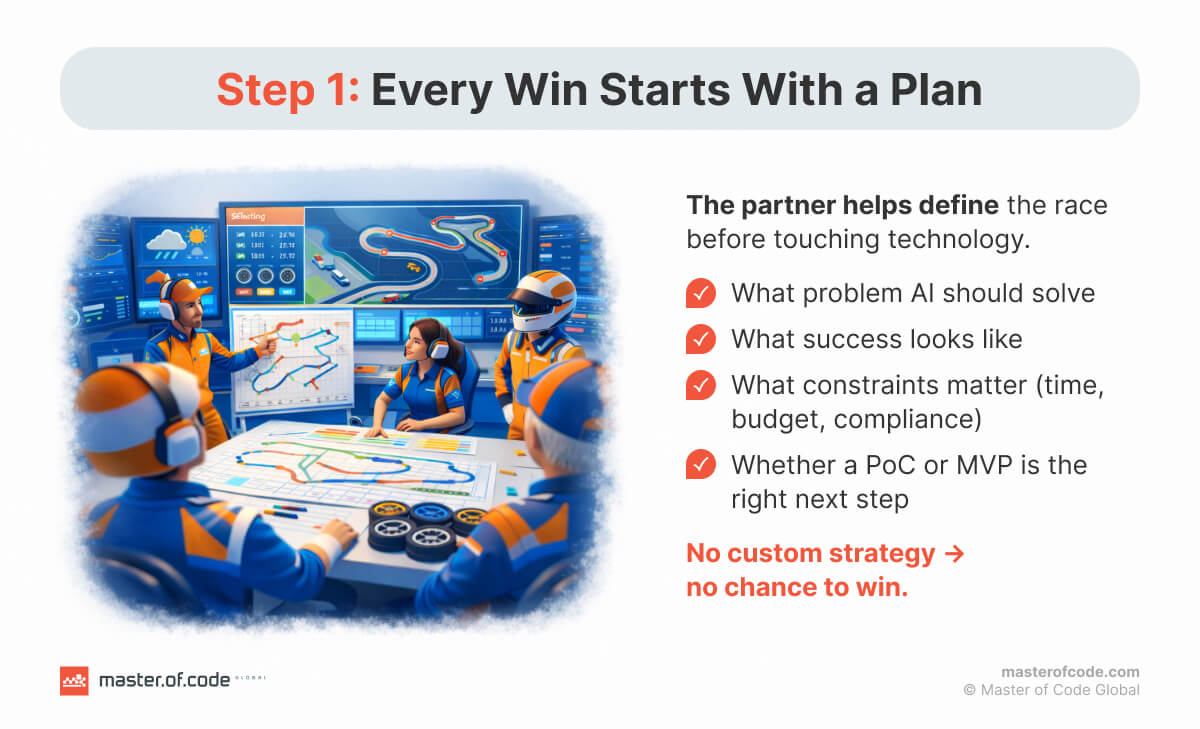
Defining the pain point before touching technology
Before models or platforms enter the picture, the focus is on clarity:
- What business problem are you actually solving?
- How will you know whether this initiative worked?
- What constraints matter most right now — time, budget, compliance, internal readiness?
- Is this a PoC, an MVP, or something that should go straight to production?
Without shared answers here, delivery risks compound later.
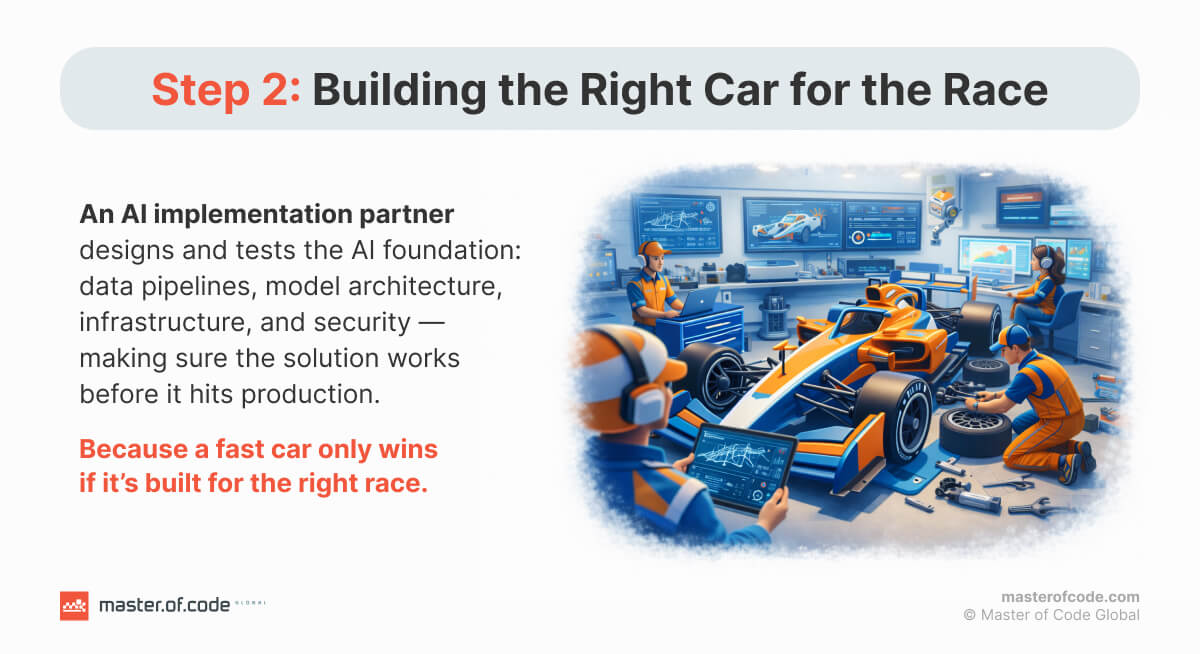
Designing for production reality
This stage is about building the foundation correctly the first time:
- Data pipelines that reflect real data quality, not ideal inputs.
- Architecture that fits your infrastructure and security requirements.
- Early decisions that support scale, not just fast demos.
Many solutions fail later because they were never designed for where they needed to land.
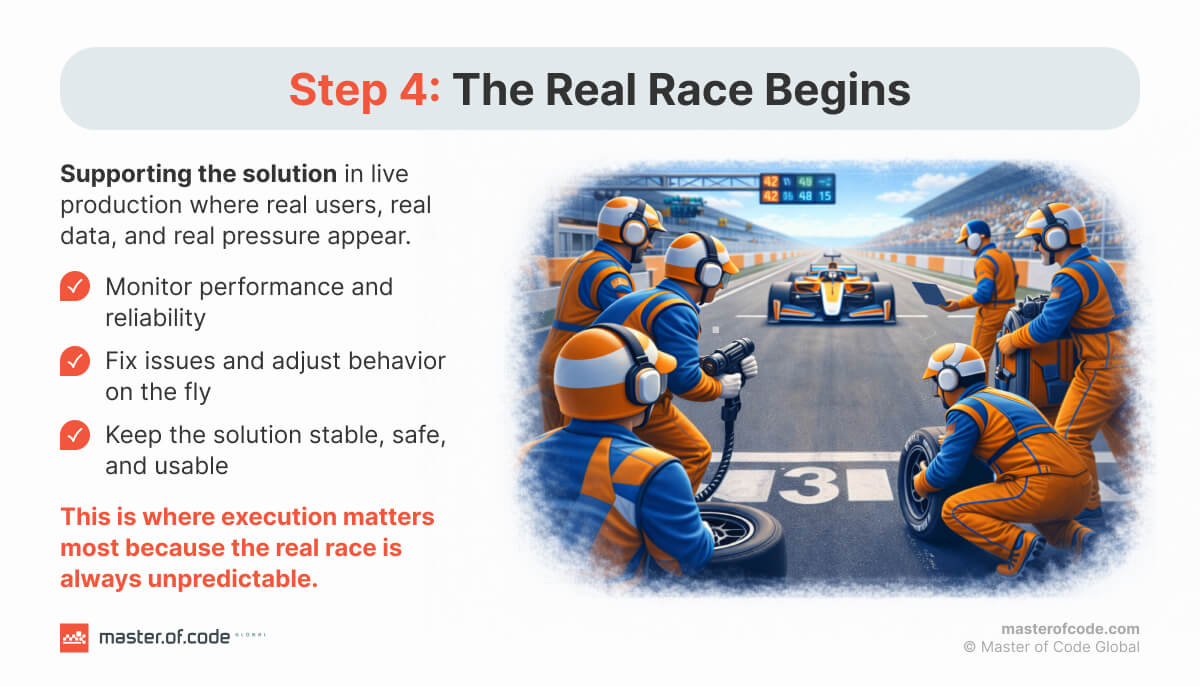
Validating before scale
Before rolling anything out widely, ownership means pressure-testing assumptions:
- Validating behavior in controlled environments.
- Learning from early users without exposing the business to unnecessary risk.
- Defining clear criteria to scale, pivot, or stop.
This is where “successful failure” becomes possible — learning early instead of fixing later.
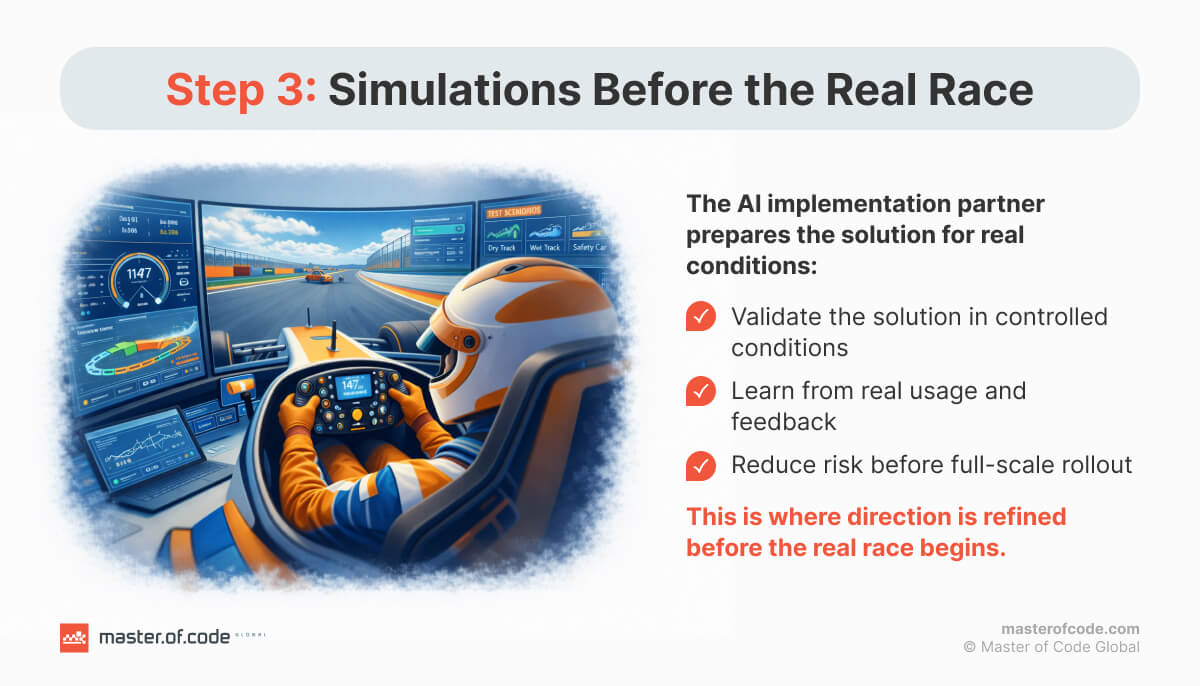
Operating in live production
Once AI meets real users and real data, new challenges appear:
- Monitoring performance and reliability over time.
- Adjusting behavior as usage patterns change.
- Responding quickly when something breaks or underperforms.
Delivery doesn’t end at launch — this is where it actually starts.
Working within enterprise and AI implementation for regulated industries
For many organizations, especially in governance-heavy environments:
- Compliance, legal review, and security are ongoing concerns.
- Decisions must align with specific laws and rules, not just technical best practices.
These constraints shape delivery, not the other way around.
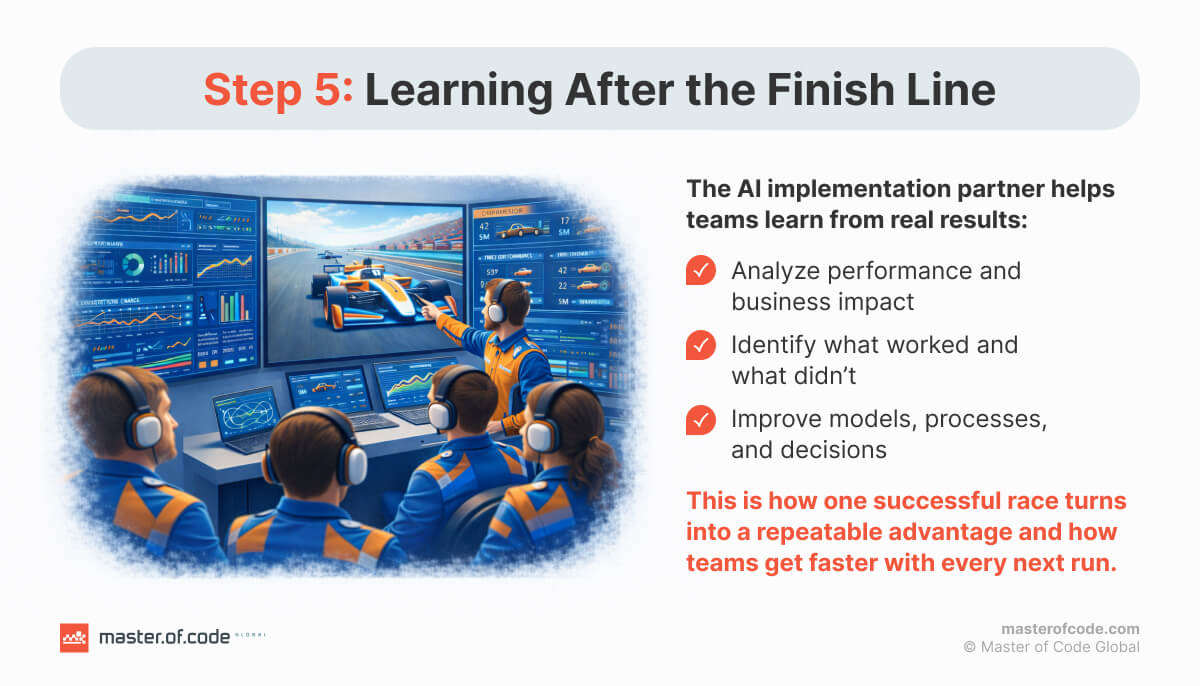
Learning and compounding value
After launch, ownership means asking:
- What worked — and what didn’t? For example, understanding how AI reduces costs in business is one of the main drivers for many mid-sized financial organizations, as highlighted in our recent report.
- How should models, processes, or workflows evolve?
- How do lessons from this initiative inform the next one?
If you have the next section (or an image / banner block coming up), send it over and I’ll format it the same way.
This is how individual efforts turn into repeatable advantages, not isolated wins — with an AI implementation partner applying hard-earned experience, helping avoid common mistakes, and supporting each step forward.
How One Partner Keeps AI on Track Across Different Contexts
By this point, a pattern usually becomes clear: while use cases may look very different on the surface, the delivery challenges behind them are often the same. That’s why the partner model tends to scale across contexts instead of being tied to one specific type of solution.
Conversational AI Implementation
This is often where organizations start. Chatbots, voice assistants, internal copilots — they’re visible, fast to launch, and relatively easy to pilot. But they’re also where problems show up quickly if ownership is missing.
Common issues include:
- Low adoption despite “working” functionality;
- Inconsistent tone or behavior across channels;
- Poor escalation to human teams;
- Difficulty improving the system once it’s live.
A conversational AI implementation partner focuses less on launching a bot and more on making sure it fits real workflows, evolves with user behavior, and stays reliable over time.
Enterprise AI Implementation
At a larger scale, complexity increases — not because the models are harder, but because the environment is. Multiple systems, security requirements, internal governance, and long decision chains all shape what’s possible.
Here, the partner’s role often expands to:
- Navigating organizational constraints and approvals;
- Coordinating across teams that don’t normally work together;
- Ensuring continuity when priorities, owners, or structures change.
This is where many internal teams struggle, not due to lack of skill, but because AI delivery cuts across too many silos. Subtle nuances are easy to overlook.
Generative AI Implementation
GenAI adds another layer of risk and expectation. It’s powerful, flexible, and often demo-friendly, which makes it easy to overestimate readiness.
An experienced Generative AI implementation partners for global enterprises help ground your efforts by:
- Integrating them safely into existing systems;
- Setting guardrails around behavior, accuracy, and usage;
- Designing for real business outcomes, not just impressive outputs.
Across all three contexts, the model stays the same. What changes are the constraints, risks, and scale, not the need for ownership, continuity, and practical execution.
How to Choose an AI Implementation Partner That Keeps You in the Lead
Based on what consistently holds up in real delivery, these are the signals worth paying attention to.
- Ability to say no (or not yet)
A reliable partner doesn’t push every idea forward. They help you assess when a use case is premature, too risky, or unlikely to deliver value. This saves time and budget, even if it slows momentum in the short term. - Experience beyond successful demos
Look for teams that have lived through both successful and failed initiatives. Partners who have only shipped polished pilots often struggle when adoption drops, data quality disappoints, or internal priorities change. Experience fixing or reassessing underperforming solutions is a strong indicator of maturity. - Clear ownership model after launch
You should be able to answer a simple question upfront: Who is responsible once the solution is live? An implementation partner stays involved when KPIs are missed, usage is lower than expected, or adjustments are needed, not only when delivery goes smoothly. - Knowledge transfer, not dependency
The goal isn’t to outsource thinking indefinitely. A good implementation expert helps your internal teams understand decisions, trade-offs, and delivery patterns so capabilities can grow internally over time. - Ability to operate within real constraints
Strong partners adapt to your reality instead of pushing generic patterns. This includes working with:- Existing infrastructure and legacy systems;
- Security and compliance requirements;
- Internal governance and approval processes.
- Team continuity and context retention
AI implementation in business benefits from accumulated context. Rotating contributors or short-term staffing often leads to repeated decisions, lost knowledge, and inconsistent outcomes. Long-term engagement with stable teams reduces that friction significantly. - Domain and business understanding
AI is rarely domain-agnostic. Whether it’s healthcare, energy, finance, or enterprise operations, understanding how decisions are made — and where risk actually lies — matters as much as technical skill. - Structured approach to learning and iteration
Intelligentization initiatives improve through feedback, not assumptions. Look for partners who explicitly plan for measurement, learning, and iteration instead of treating delivery as a one-time effort.
None of these criteria guarantees success on its own. But together, they significantly reduce the risk of ending up with another AI initiative that technically works and practically goes nowhere.
How Master of Code Global Sets AI Up for a Clean Run from Day One
When companies come to us, they’re often at very different stages. Some are running their first pilot. Others already have tools in place that aren’t delivering the impact they expected. In both cases, the approach starts the same way: (1) understanding what role AI should realistically play in your organization.
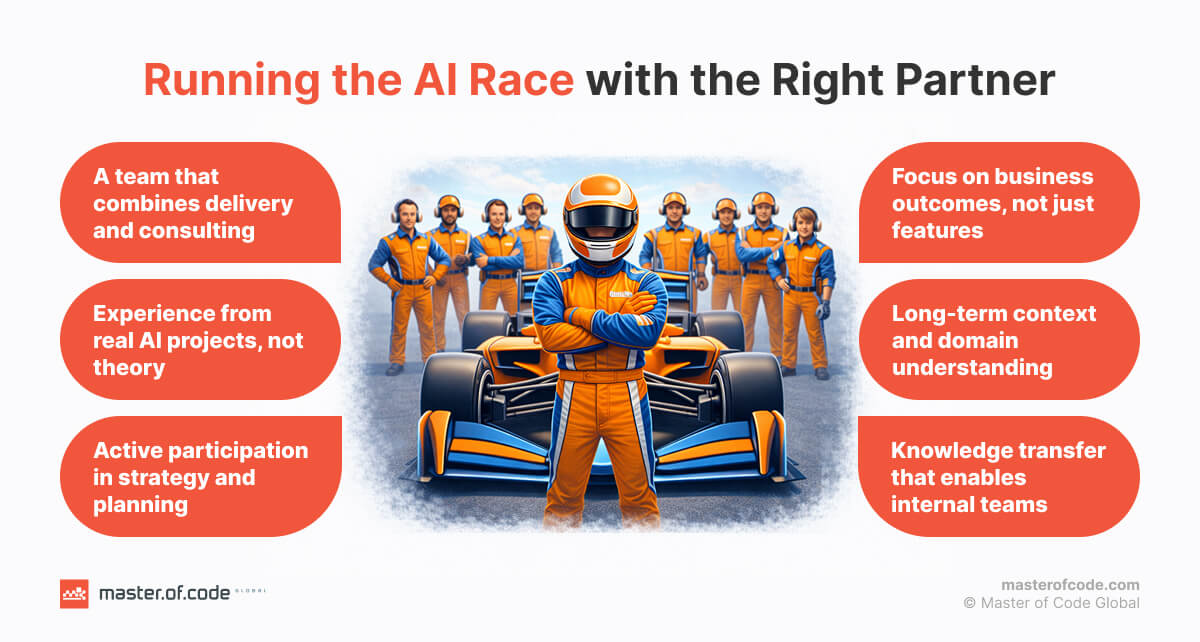
We don’t treat AI implementation as a fixed recipe. Instead, we work at the program level. That means (2) helping you evaluate use cases, assess readiness, and decide where experimentation makes sense — and where it doesn’t. Sometimes the right move is to build. Other times it’s to pause, audit what already exists, or narrow the scope before going further.
From a delivery standpoint, we’re platform-agnostic by design. Rather than pushing a specific tool or model, we focus on (3) fitting the solution into your existing systems, data landscape, and operating model. That flexibility matters, especially in enterprise environments where infrastructure, security, and compliance requirements are non-negotiable.
Execution is handled by (4) a managed dedicated, cross-functional team that stays with the initiative over time. Continuity is intentional. As context builds — around your business processes, constraints, and past decisions — delivery becomes faster and more predictable. You’re not re-explaining the same things every few months, and lessons learned don’t disappear with team changes.
Another important part of our work is transparency. We (5) involve your teams in decision-making, explain trade-offs, and document why certain choices are made. The goal isn’t to create dependency, but to help internal stakeholders understand how custom AI development actually works in practice — from planning and validation to production and iteration.
In the long run, this approach gives companies more than a working solution. It gives them a repeatable way to think about, build, and operate artificial intelligence across the organization with fewer surprises and fewer stalled initiatives.
Wrapping Up
We see many businesses today taking a thoughtful approach to partner selection, comparing vendors based on their own criteria. That’s a healthy shift. Companies are becoming more aware of the nuances involved — from engagement models to domain experience, and from governance readiness to the specifics of custom Generative AI development services.
As a team that works with organizations at different stages of AI maturity, we’re always open to sharing what we’ve learned — not to push a predefined solution, but to help you evaluate what will be most effective and sustainable in your context. If you’re looking for guidance, a second opinion, or a clearer path forward, feel free to reach out. We’re happy to explore what makes sense for your goals and what’s most likely to work in practice.
![Why a Managed Dedicated Team Is the Best Model for AI Solutions [Interview with the Director of Delivery]](https://masterofcode.com/wp-content/uploads/2026/02/cover-640x400.jpg)