

Somewhere in your organization, a person is copying data from one system into another. Someone else is waiting three days for an answer that lives in a document no one can find. A third is manually checking invoices, flagging expenses, or chasing a supplier for an update that should have been automatic.
None of that is strategy. None of it requires judgment. And most of it is already being handled by AI agents for internal operations – deployed inside real enterprises across finance, HR, legal, manufacturing, logistics, and more.
As an agentic AI development company, we researched what’s actually running in production today and distilled it into 27 use cases with nearly 60 sourced, named deployments decision-makers can act on.
What you’ll find isn’t a single technology or a uniform playbook. It’s a set of distinct capabilities – each solving a concrete operational problem – that the most forward-thinking organizations are now connecting into something larger: coordinated orchestration across entire business functions.
If your organization is next, this is where to start.
Table of Contents
Key Takeaways
- AI agents for internal operations are no longer experimental. Enterprises across banking, manufacturing, retail, pharma, and logistics are running them in production. They are automating workflows, cutting costs, and freeing teams from work that doesn’t require human judgment.
- The use cases span every function. From invoice processing and contract review to predictive maintenance and clinical trial documentation, business process automation services are being applied wherever there is a repeatable, data-driven process.
- Multi-agent orchestration multiplies the impact. The most advanced deployments don’t run a single agent – they coordinate networks of specialized agents working in parallel across systems, delivering outcomes no single tool could achieve alone.
- ROI is measurable from day one. The examples in this article show consistent, quantifiable results: hours saved, costs cut, error rates reduced – making the business case straightforward to build.
- Governance isn’t optional. Scaling agents responsibly requires clear oversight frameworks, human-in-the-loop checkpoints, and monitoring in production – especially in regulated industries.
HR & People Operations
HR Policy, Benefits & Onboarding Helpdesk Agent
AI agents for business operations connect to the company’s HRIS, policy documents, and benefits platforms to answer employee questions instantly. It handles everything from updating direct deposit details to explaining parental leave policies, resolving most queries autonomously, and escalating only the edge cases.
Benefits:
- Eliminates the ticket queue for routine HR queries.
- Frees HR teams from repetitive request handling to focus on complex cases and strategic work.
- Ensures consistency – every employee gets the same accurate, policy-compliant answer.
Examples:
- Bank of America. Erica is used by over 90% of the bank’s 210,000+ staff for HR, benefits, payroll, and IT queries, reducing service desk calls by more than 50%.
- Johnson & Johnson. Internal HR chatbot has displaced nearly 10 million employee interactions with HR services annually.
- Coca-Cola Andina. Built “Andi” on Microsoft Copilot Studio to answer HR and policy questions in real time for employees across Argentina, Paraguay, Brazil, and Chile.
Recruitment & Talent Acquisition Agent
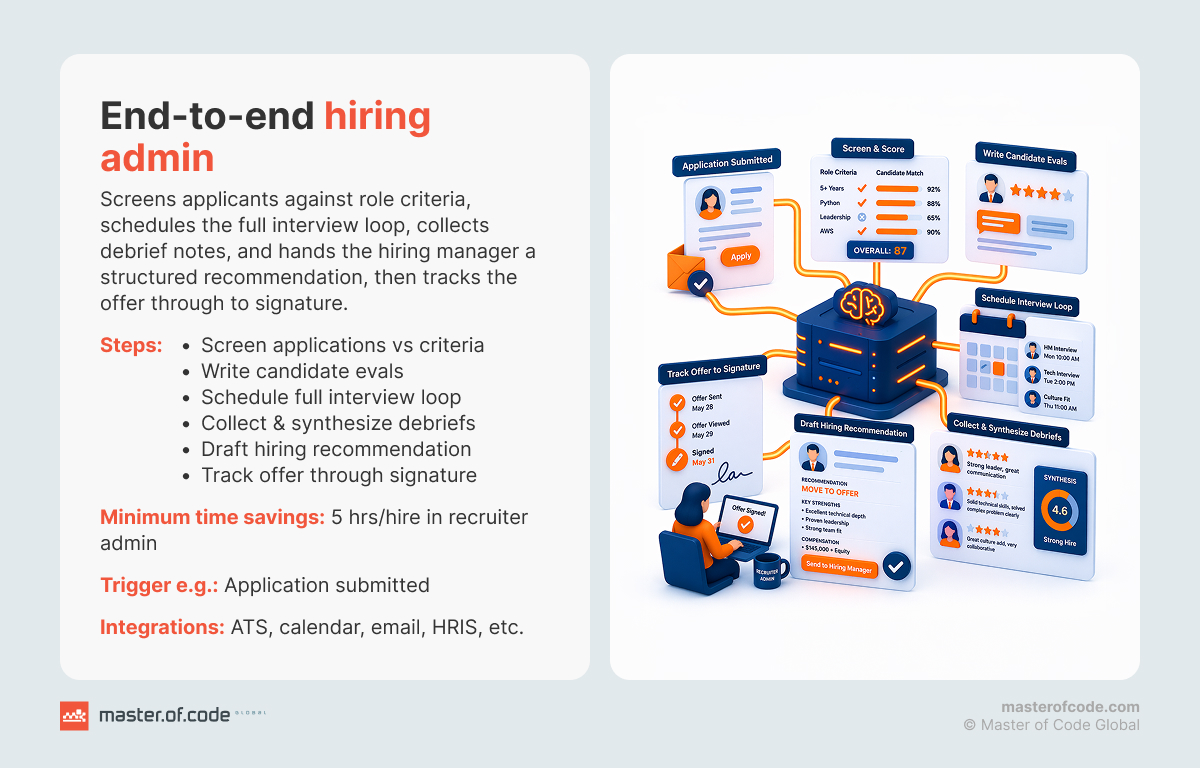
Hiring is one of the biggest time drains on talent teams, and most of it is repeatable work. A scalable recruitment agent handles that layer end-to-end: drafting role briefs, building candidate scorecards, generating structured interview kits, and publishing posts across channels, all from a single intake request.
Benefits:
- Cuts time from approved headcount to live job posting.
- Standardizes job description quality across hiring managers and regions.
- Frees recruiters to focus on candidate evaluation and stakeholder management.
Example:
- Vodafone. Built an AI Hiring Manager Agent that produces a full suite of on-brand resources, such as job descriptions and adverts, LinkedIn posts, interview guides, and assessment exercises.

AI Lead Recovery Tool
Master of Code Global developed a multichannel text and voice AI assistant that turns abandoned carts into completed sales
Check out case study
ML Sales Forecasting
We built a bespoke inventory intelligence engine that correlates historical sales data with seasonal trends and harvest cycles
Check out case study
Tom Ford AI Chatbot
Master of Code Global helped Tom Ford Beauty engage their audience during the holiday season and generate new leads with an AI chatbot
Check out case studyEmployee Training & Coaching Agent
Most organizations can coach at the top – managers, senior staff, and structured programs. The challenge is the frontline: thousands of employees in different locations, on different shifts, with no dedicated trainer in the room. AI agents for business operations close that gap by delivering role-specific feedback, running practice scenarios, and tracking skill development continuously and at scale.
Benefits:
- Makes learning continuous, employees get feedback in the flow of work
- Scales growth plans to thousands of people simultaneously across geographies
- Standardizes coaching quality so every worker receives the same baseline support
Examples:
- Delta Air Lines. Nadia provides frontline managers with on-demand coaching to develop leadership skills previously unavailable to them.
- Hilton. A VR/WebXR training platform enables staff to simulate guest scenarios and build soft skills across 400,000+ employees.
IT Operations & Internal Knowledge Management
IT Service Desk Triage & Resolution Agent
When employees can’t access systems, reset credentials, or troubleshoot devices, they file tickets – and those tickets pile up. Internal operations automation allows intercepting requests the moment they come in, resolving routine issues autonomously, and routing only the genuinely complex cases to human engineers with context already assembled.
Benefits:
- Reduces ticket volume, cutting resolution time.
- Available 24/7 across time zones without adding headcount.
- Enables IT teams to focus on infrastructure and strategic projects.
Example:
- Coca-Cola Consolidated. “Bottlecap” serves as the unified IT and employee support entry point, automating IT tickets.
Enterprise Knowledge Search & Research Agent
Organizational data is scattered across intranets, SharePoint, policy docs, product manuals, internal databases, and email threads. AI workflow automation lets employees query all of it in plain language, getting a synthesized, sourced answer in seconds instead of hunting through systems manually.
Benefits:
- Eliminates time lost to manual document searches across fragmented systems.
- Surfaces accurate, up-to-date information consistently – regardless of who’s asking.
- Reduces dependency on subject-matter experts for routine requests.
Examples:
- Wells Fargo. Internal agent deployed to 35,000 bankers across 4,000 branches, cutting information-search times from 10 minutes to 30 seconds; 75% of searches now flow through it.
- BBVA Peru. Built “Blue Buddy” that navigates product manuals, regulations, and internal processes to give bankers contextualized answers in real time, described internally as a knowledge synthesizer used directly on the front lines.
- Walmart. “Ask Sam” helps employees quickly find store information, check inventory and prices, and access guidance, giving them more confidence and time to focus on serving customers.
- JPMorgan Chase. LLM Suite, rolled out to over 200,000 employees, drafts investment banking pitch decks in seconds, supports code review, assists with legal contract work, and now helps managers prepare performance reviews.
Autonomous Software Engineering Agent
Legacy codebases are expensive to maintain, slow to migrate, and require experienced engineers who are in short supply. An autonomous coding agent reads existing code, writes new modules, runs tests, and migrates systems under human supervision, multiplying engineering output.
Benefits:
- Accelerates legacy system migration without pulling senior engineers off higher-value work.
- Handles repetitive coding tasks – boilerplate, documentation, test generation – at machine speed.
- Scales engineering capacity on demand, reducing backlog.
Example:
- Goldman Sachs. Became the first major bank to deploy Cognition Labs’ “Devin” autonomous coding agent with human-in-the-loop to update legacy code and migrate it.
Finance & Accounting
Accounts Payable & Invoice Processing Agent
An AP agent reads incoming invoices from any channel, extracts line-item data, matches against purchase orders and receipts, and either posts payment or routes exceptions to a human reviewer – with context already assembled. The difference from basic OCR is reasoning: the agent interprets mismatches rather than just flagging them.
Benefits:
- Cuts invoice cycle time from days to hours on straight-through transactions.
- Eliminates duplicate payments, miscoded entries, and missed early-payment discounts.
- Transfers AP teams’ focus from data entry to supplier relationships and spend analysis.
Example:
- Billerud. The paper and packaging manufacturer rebuilt its AP workflow around AI-driven invoice processing. Over 90% of PDF invoices are now auto-validated. The share requiring manual review dropped from 15% to 9%, and total monthly invoice costs fell by 25%.
ESG & Sustainability Reporting Agent
Calculating emissions manually means chasing data from thousands of suppliers, properties, and partners – then reconciling it across spreadsheets for months. Internal operations automation simplifies that collection, applies the correct emission factors by source, and generates audit-ready reports in a fraction of the time.
Benefits:
- Replaces weeks of manual data consolidation with automated, continuous data collection.
- Improves reporting accuracy by applying up-to-date regulatory emission factors consistently.
- Frees sustainability teams to concentrate on reduction initiatives.
Example:
- Marriott Hotels. Deployed AI food waste technology across 53 hotels in the UK, Ireland, and the Nordics, achieving a 25% reduction in food waste within six months and mitigating an estimated 486 tonnes of greenhouse gas emissions.

AI Data Collection Flow
We built an AI agent that transforms network troubleshooting from a manual, time-intensive process into an intelligent conversation.
Check out case study
GiveaWhy Platform
Master of Code Global developed two interconnected digital platforms to drive mentorship and donation—with automation and trust at the core.
Check out case study
Predictive Maintenance
Master of Code Global developed an intelligent AI-powered predictive maintenance platform that monitors equipment health in real-time.
Check out case studyFraud Detection & Financial Risk Monitoring Agent
An advanced agentic AI for operations watches transactions in real time, detects behavioral anomalies, scores risk, and flags suspicious activity – reducing both undetected fraud and the false positives that drain investigator time on legitimate transactions.
Benefits:
- Monitors 100% of transactions continuously, not just sampled or flagged batches.
- Cuts false positive rates, freeing compliance teams from manual alert review.
- Adapts to emerging patterns faster than rule-based systems.
Examples:
- Mastercard. Decision Intelligence AI secures over 159 billion transactions per year. The Consumer Fraud Risk model improved the identification of mule accounts by 60%.
- HSBC. Anomaly-detection agents cut fraud false positives by 60%, significantly decreasing the manual review burden.
Legal & Compliance
Contract Review & Legal Intelligence Agent
Agentic system searches, reads, and summarizes docs at scale – extracting key clauses, surfacing inconsistencies between global and local terms, and answering queries across millions of files in seconds. What previously required teams of lawyers working for weeks gets done in a single query.
Benefits:
- Eliminates manual document review for routine analysis and clause extraction.
- Surfaces inconsistencies across large portfolios that human reviewers routinely miss.
- Scales capacity without proportionally increasing headcount or outside counsel spend.
Examples:
- JPMorgan Chase. COiN examines 12,000 commercial loan agreements in seconds – work that formerly consumed an estimated 360,000 lawyer-hours per year.
- UBS. LAIA digs 26 million multilingual documents, giving legal teams instant access to relevant precedents and clauses across the bank’s full database.
- Nestlé. AI reviews hundreds of thousands of procurement contracts for inconsistencies between global framework terms and local supplier agreements.
- Moderna. A contract companion GPT deployed within legal reduced review turnaround significantly and simplified decision-making.
Sales & Marketing Operations
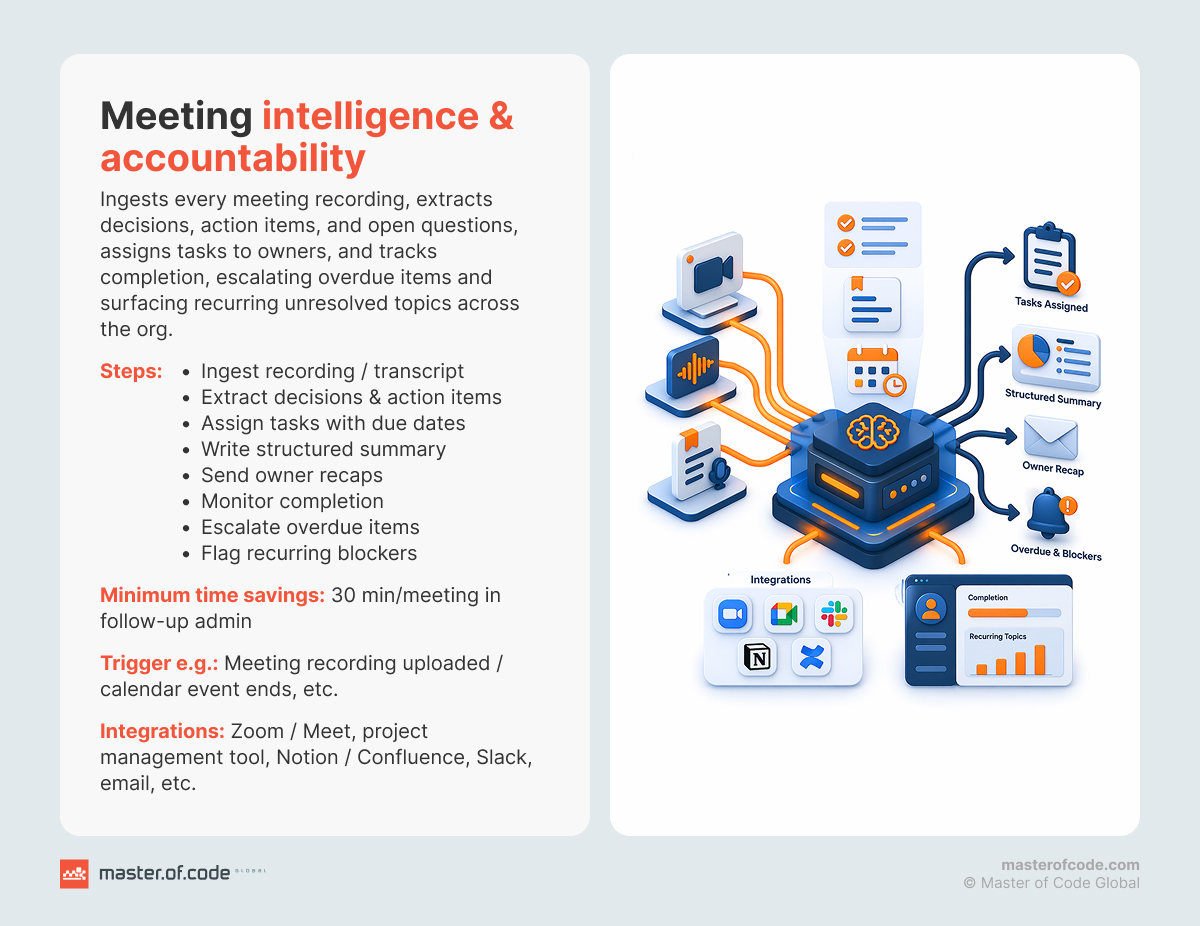
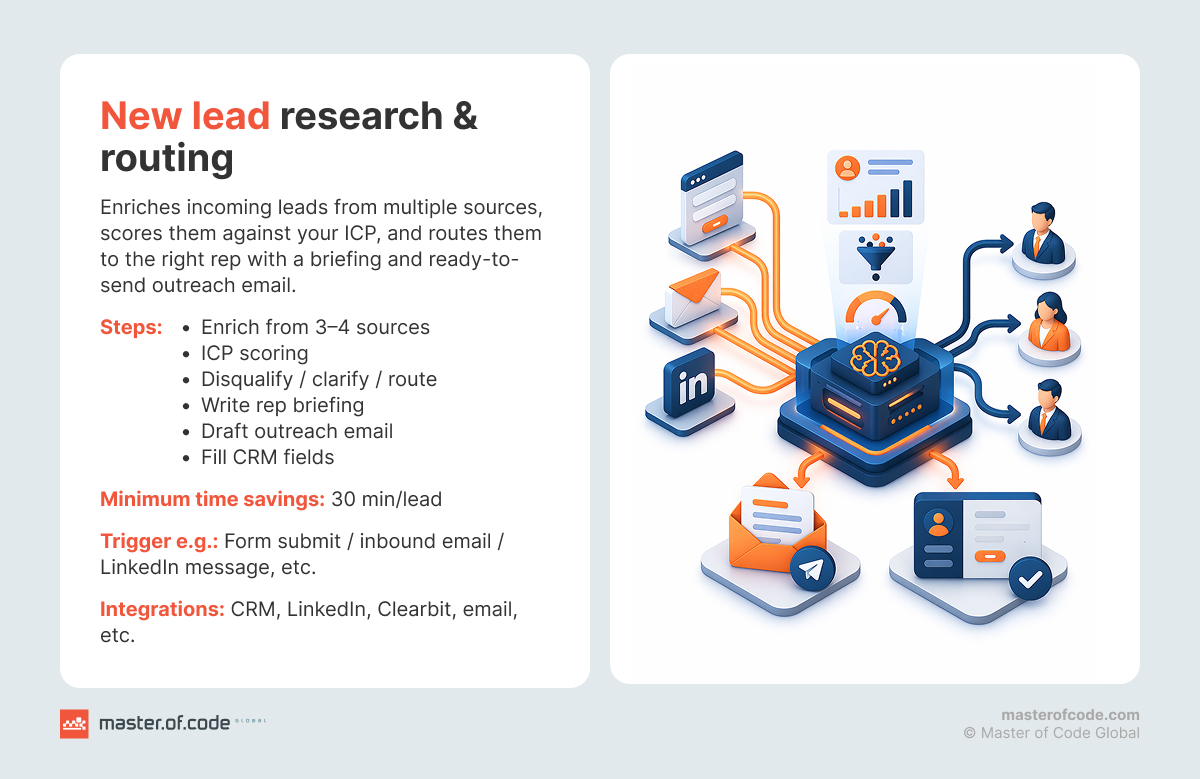
Sales Meeting Intelligence & CRM Agent
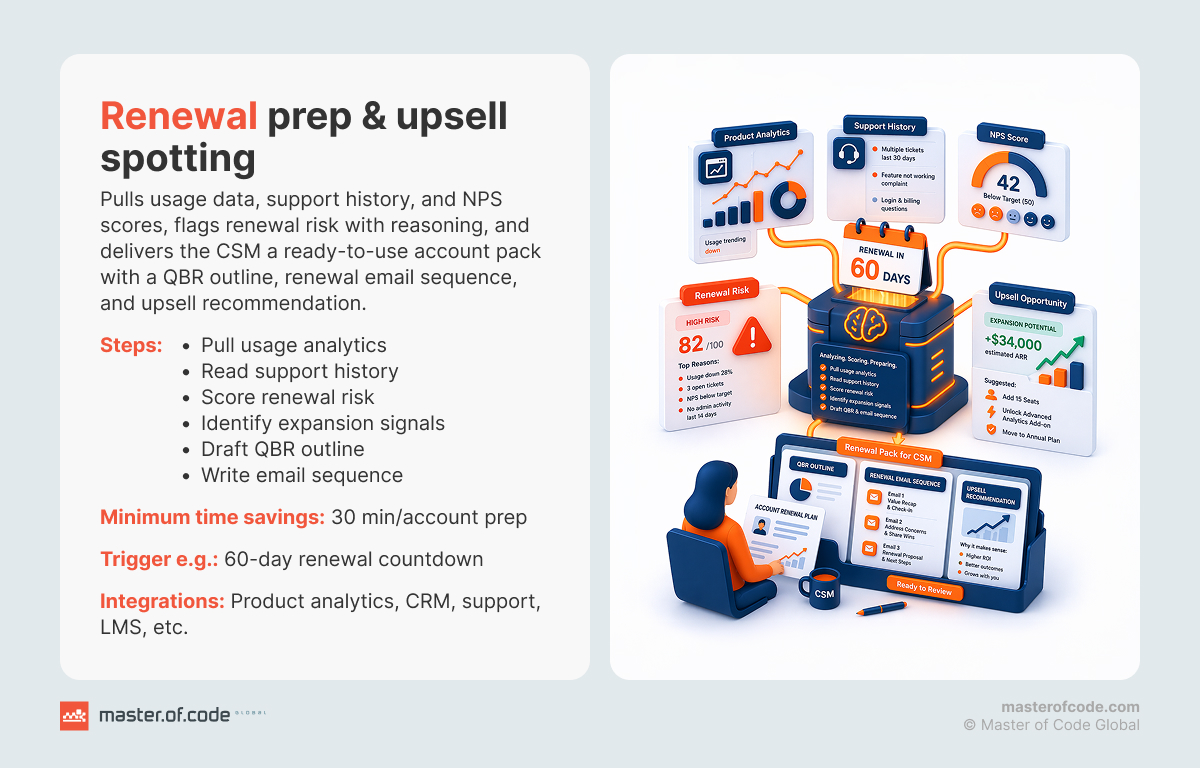
After every customer call, representatives face the same admin cycle: writing up notes, logging action items, and updating the CRM. Intelligent agent handles that entire layer autonomously – transcribing calls, drafting follow-ups, extracting commitments, and pushing structured data directly into the software without a single manual entry.
Benefits:
- Eliminates post-meeting admin, giving reps more time for active selling
- Ensures CRM data stays accurate and up to date without relying on rep discipline
- Surfaces action items and deals with risks for manager review
Examples:
- Morgan Stanley. “Debrief” transcribes meetings, drafts follow-up emails, and creates notes that are automatically pushed into Salesforce CRM.
- Commerzbank. A voice-call summarization system built with Google Gemini automates advisory protocol documentation for corporate-client sales advisors, removing the manual write-up step after every interaction.
Sales Enablement & Field Rep Agent
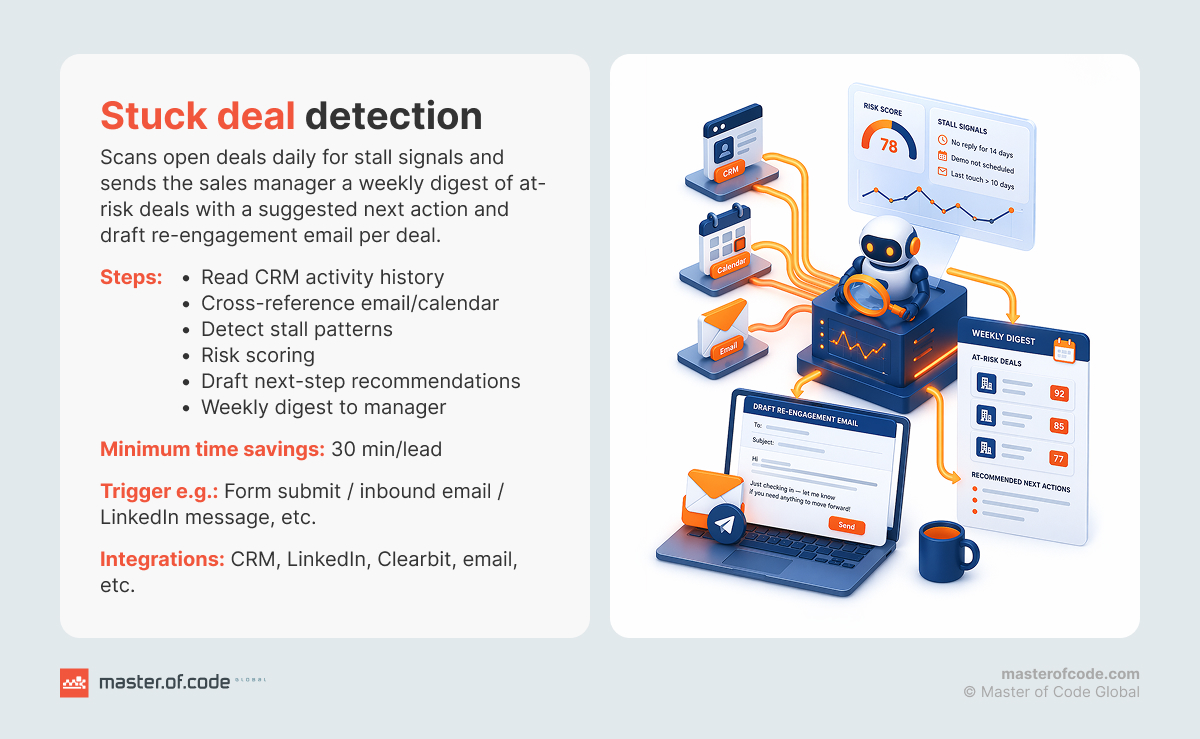
Workflow automation gives reps real-time guidance before and during customer interactions. It synthesizes product data, account history, competitor intel, and market trends into a concise briefing so reps walk in prepared rather than researching manually.
Benefits:
- Reduces pre-meeting research time from hours to minutes across large field teams.
- Delivers consistent, data-driven suggestions at every interaction, regardless of one’s seniority.
- Scales the impact of top performers by giving every rep access to the same quality of preparation.
Examples:
- Johnson & Johnson. A GenAI copilot coaches sales on healthcare professional engagement.
- PepsiCo. AI synthesizes data from warehouses, retailer POS systems, and consumer trends to give managers localized promotion and stock-order recommendations.
- Nestlé. A virtual sales assistant built on agentic AI automates up to 40% of routine tasks, delivering 20–35% time savings in pilot markets.
Marketing Content Operations Agent
Producing and localizing marketing assets across dozens of markets is one of the most resource-intensive operations in any large consumer brand. AI-based algorithm handles the production layer – generating, adapting, and publishing assets at scale – so creative teams focus on direction and strategy rather than execution.
Benefits:
- Compresses content production cycles from weeks to hours across multiple markets simultaneously.
- Reduces reliance on external agencies for localization, translation, and asset production.
- Maintains brand consistency while allowing local adaptation.
Examples:
- Unilever. AI and digital twin-powered product shoot workflow delivered 55% cost savings and 65% faster content creation.
- L’Oréal. The in-house CREAITECH platform is used to speed up production deployment of campaigns.
- Hilton. Intelligent marketing resulted in double-digit incremental revenue growth as part of a broader suite of 41 live AI use cases.

Mira POC Solution
Master of Code Global developed Mira – a reflection platform combining conversational intelligence, voice interaction, and teacher analysis
Check out case study
Zipify Agent Assist
Master of Code Global developed an internal AI agent and analytical dashboard that ensure more efficient support workflows for Zipify
Check out case study
Energy Data Reconciliation
Master of Code Global built an agentic AI tool that automatically detects and resolves data discrepancies across energy management systems.
Check out case studyProcurement & Supply Chain
Procurement Intelligence Agent
Buying teams manage thousands of vendor relationships, contracts, and spend categories simultaneously – most of it tracked manually across disconnected systems. Agentic AI in supply chain looks through partner databases, checks agreements, detects spend irregularities, and delivers organized sourcing insights, replacing hours of manual analysis with on-demand answers.
Benefits:
- Surfaces spend anomalies and contract inconsistencies that human reviews routinely miss.
- Reduces time spent on vendor research and profile building across large partner bases.
- Gives data-driven recommendations at the point of decision.
Example:
- BMW Group. “AIconic,” the company’s multi-agent platform, has 1,800+ active users running 10,000+ searches across 10 specialized agents covering supplier quality control, contract specifications, and procurement processes.
Logistics Coordination & Exception Handling Agent
Logistics operations run on communication – scheduling carrier appointments, following up on delayed shipments, coordinating warehouse arrivals, and resolving abnormalities across dozens of simultaneous threads. Workflow automation helps to handle that entire layer autonomously across phone, email, and messaging, at a volume no human team can match.
Benefits:
- Processes high volumes of routine logistics communication without adding operational headcount.
- Resolves exceptions faster by acting immediately rather than waiting for a human to pick up the task.
- Scales coordination capacity across regions and time zones without proportional cost increases.
Examples:
- DHL Supply Chain. HappyRobot autonomous agents handle appointment scheduling, driver follow-ups, and high-priority warehouse coordination across multiple regions.
- Maersk. The Star Connect AI platform computes 2.5 billion IoT data points in real time to support smarter decision-making during voyages.
- FedEx. Building a hierarchical AI agent workforce targeting over 50% of workflows automated by 2028.
Manufacturing & Operations
Predictive Maintenance & Fault Diagnosis Agent
Scheduled upkeep is expensive. The reactive one is worse. Agentic algorithm is monitoring equipment sensors continuously, detecting early fault signatures before failure occurs, and surfacing natural-language diagnostics with targeted repair recommendations. It substitutes both calendar-based overmaintenance and unexpected breakdowns.
Benefits:
- Reduces unplanned downtime by catching failures before they happen.
- Cuts maintenance costs by replacing fixed schedules with condition-based interventions.
- Gives engineers immediate, actionable defect identification without manual data analysis.
Examples:
- BMW Group. “Factory Genius” speeds fault diagnosis across production plants, giving engineers natural-language answers to maintenance queries in real time.
- Mercedes-Benz. A system at the Berlin-Marienfelde Digital Factory Campus autonomously analyzes quality deviations and recommends corrective actions, while a chatbot gives employees real-time access to databases.
- Siemens. The “Eigen” Engineering Agent reports up to 50% higher efficiency, 2–5x faster task execution, and 80% higher solution quality compared to previous approaches.
Manufacturing Process Optimization Agent
Beyond predictive maintenance, AI agents are being deployed to analyze production line data in real time and recommend or execute process adjustments – from cleaning cycles and energy consumption to throughput and yield optimization. The goal is constant enhancement without waiting for a human engineer to spot the inefficiency.
Benefits:
- Identifies workflow inefficiencies in real time rather than through periodic audits.
- Reduces utility consumption and operational waste without manual intervention.
- Builds a continuous improvement loop that compounds gains over time across sites.
Examples:
- Unilever. An AI pilot at the Poznań foods plant optimized machine cleaning cycles, saving €100,000 per year, cutting cleaning time by 20%, and reducing utility usage by 10%.
- Procter & Gamble. AI is used in manufacturing through R&D by accelerating molecular discovery and product formulation – analyzing large datasets to design and test new products faster.
Store & Hospitality Operations Agent
Hotels, retail floors, and drive-throughs run on thousands of small decisions made every hour – room upgrades, inventory management, order accuracy checks, staff routing. Artificial intelligence handles the rules-based layer of that workload autonomously, so floor teams can focus on the moments that genuinely need a human presence.
Benefits:
- Processes high volumes of routine operational tasks without manual intervention.
- Cuts errors in time-sensitive environments where speed and accuracy run against each other.
- Puts real-time operational data in the hands of frontline staff without escalating to managers.
Examples:
- Marriott International. The Automated Complimentary Upgrade system automates room upgrade assignments– a process that previously took front desk staff hours, now completed in a fraction of a second.
- Wendy’s. FreshAI drive-thru voice agent raised company-operated restaurant margins, improved order accuracy, and is being expanded to 500 locations.
R&D & Product Development
Research Acceleration & Knowledge Synthesis Agent
Most R&D bottlenecks are about access. Workflow automation cuts through that problem by querying internal studies, published papers, and clinical data simultaneously, returning structured, sourced replies in seconds instead of making scientists wait days for a literature review to come back.
Benefits:
- Accelerates the earliest stages of development by eliminating manual search cycles.
- Uncovers relevant internal findings buried across siloed databases that would otherwise go unnoticed.
- Allow scientists to devote more time to hypothesis generation and experimentation rather than administrative retrieval work.
Examples:
- Bayer. “PRINCE” – a multi-agent preclinical knowledge engine queries 18,000+ studies, giving researchers instant answers across the entire organizational data history.
- Pfizer. AI is used in research to boost productivity and reduce costs by accelerating R&D processes, supporting scientists with faster data analysis and decision-making, and enabling the company to handle more drug development programs.
- An internal MCP solution unifies 85 enterprise tools in one conversational workspace, allowing teams to complete tasks, investigate issues, trigger workflows, and analyze operations through natural language instead of switching between disconnected systems.
Clinical Development & Trial Operations Agent
Getting a drug from concept to trial-ready protocol involves hundreds of interdependent documents, global site evaluations, and regulatory submissions – each step a potential delay. A multi-agent system works through that pipeline in parallel: drafting, assessing, and filing concurrently rather than sequentially.
Benefits:
- Compresses months of sequential document work into concurrent workflows.
- Automates site feasibility assessments across dozens of global locations simultaneously.
- Frees clinical teams from assembly and coordination to work on scientific and regulatory judgment.
Examples:
- Novartis. “Development Assistant,” built on AWS, reached a production-ready MVP in six months and is scaling to 1,000+ users. Combined with other AI initiatives, Novartis targets up to 19 months reduction in its overall drug-development cycle time.
- Moderna. “Dose ID” is a dose-selection assistant for clinical trials capable of integrating and visualizing large datasets to support evidence-based dosing decisions.
Customer Service Operations
AI-Powered Customer Service Agent
AI is capable of overseeing inbound inquiries end-to-end – resolving billing questions, processing requests, updating account details, and managing complaints autonomously, with seamless escalation to a human agent only when the situation genuinely requires it. The result is 24/7 coverage and higher customer satisfaction.
Benefits:
- Resolves the majority of routine inquiries without human involvement, cutting cost per interaction significantly.
- Reduces average handling time by eliminating queue wait and manual lookup steps.
- Maintains consistent service quality at any volume, including peak periods.
Examples:
- Klarna. An OpenAI-driven agent handled 2.3 million chats in its first month – equivalent to the work of 700 full-time employees. It resolved issues in 2 minutes on average versus 11 minutes for human agents, drove a 25% drop in repeat inquiries, and contributed to a projected $40M profit improvement and 40% reduction in cost per transaction over two years.
- BT Group. “Aimee” handles tens of thousands of weekly conversations with automation success rates reaching ~50%.
Frontline Employee Coaching & Agent-Assist Copilot
Service quality is only as consistent as the least-prepared person on the floor. A copilot closes that gap by sitting alongside staff in real time – surfacing the right information, suggesting next-best responses, and flagging compliance issues mid-conversation, without anyone needing to pause, search, or escalate.
Benefits:
- Cuts handling time by delivering relevant context at the exact moment it’s needed.
- Shortens onboarding cycles by removing the need to memorize product and policy details upfront.
- Raises first-contact resolution rates by giving every team member access to the same quality of support.
Example:
- Deutsche Telekom. An AI coaching engine deployed across 8,000 call-center and field-service agents delivered a 2% reduction in call transfers and a 10% increase in first-time resolution rates. It’s guiding employees in real time during live interactions rather than only in training sessions.
The Business Case Is Already Written
The examples across this list share a common thread: none of them started as moonshots. They started as a single process, a specific bottleneck, a measurable problem – and they delivered ROI that justified the next step.
The question for most organizations isn’t whether AI agents work. It’s where to start, how to build responsibly, and how to move from a proof of concept to something running in production with proper governance around it.
That’s exactly what we do at Master of Code Global. Whether you’re looking to deploy one of the use cases covered here or analyze something distinctive to your operations, our team can assist you in scoping, creating, and scaling it – with the architecture, integrations, and oversight frameworks to make it last.
Ready to move from reading to building? Explore our AI agent development services or reach out directly – we’ll help you identify where agents can make the biggest dent in your processes, fast.