


Your ERP was built for a different era. It works until a single dependency breaks and fulfillment stops for 72 hours. And every quarter those systems stay untouched, technical debt reduction gets harder, and the cost of change climbs.
That’s why enterprise legacy modernization has moved from roadmap item to board-level priority. But it isn’t a lift-and-shift job. It demands partners who can decompose monoliths without breaking what runs in production, migrate data while protecting business continuity, and prove value before the full transformation is complete.
This guide compares the top legacy modernization companies with one goal: help you shortlist faster. You’ll find AI-driven companies alongside full-service engineering firms, each evaluated on their ability to cut technical debt, maintain operational resilience, and ship working software.
Table of Contents
Key Takeaways
- The strongest companies don’t replace everything at once. They drive transformation that preserves what works while incrementally retiring what doesn’t.
- Application portfolio assessment is step one. Without a clear map of dependencies, risks, and business value, modernization budgets land on the wrong systems first.
- Cloud-native architecture and microservices architecture are means, not goals. The right partner selects patterns based on your workloads, not ideology.
- API-led integration turns isolated legacy modules into composable services, reducing the blast radius of changes and accelerating time to market.
- A sound data modernization strategy addresses lineage, quality, and governance, the foundations that determine whether new systems actually outperform the old ones.
- Enterprise architecture modernization must account for security, compliance, and legacy migration risks from day one.
- Technical debt reduction is not a one-time event. Look for partners who build automated guardrails into the CI/CD pipeline so debt doesn’t re-accumulate.
How We Created the List of Legacy Systems Modernization Companies
To build this list, we evaluated each firm on the criteria that matter most for enterprise legacy modernization: engineering depth, modernization track record, security certifications, and the ability to handle real-world migration complexity.
We looked at how each company approaches application portfolio assessment; specifically, whether they use automated code analysis and dependency mapping before proposing architecture changes. We also weighted delivery maturity: structured phases, defined KPIs, and evidence of incremental value delivery rather than big-bang rewrites that stall at 60%.
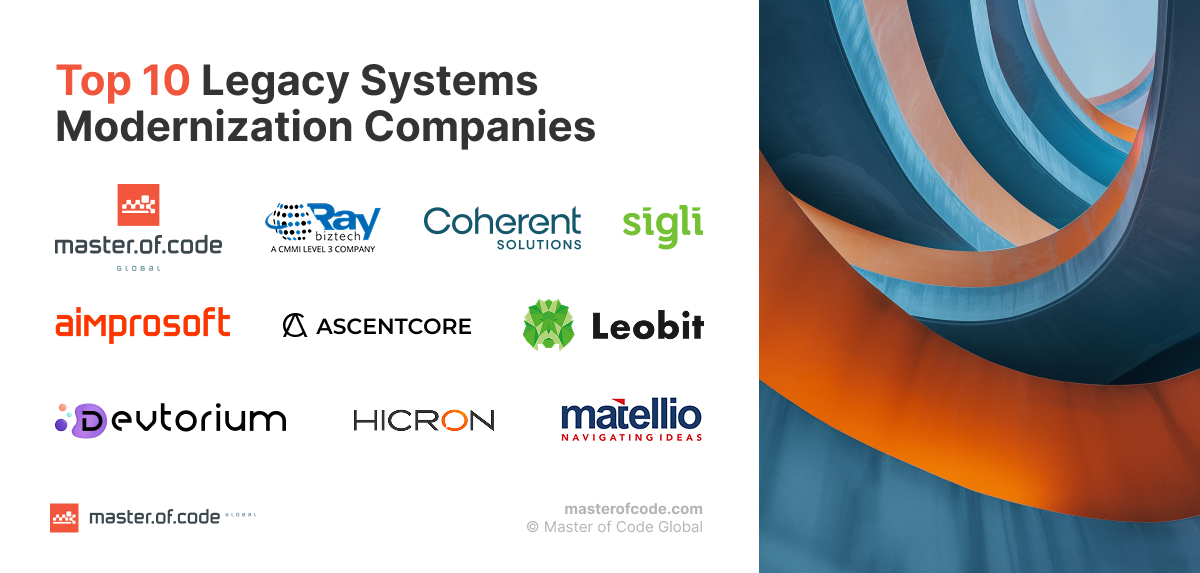
Top 10 Legacy Systems Modernization Companies in 2026
Below is a list of companies, ordered by the criteria enterprise leaders typically compare first: modernization depth, engineering capabilities, delivery model, and support maturity.
1. Master of Code Global
Founded: 2004
Headquarters: Redwood City, CA, USA
Team size: 200+
Hourly rate: $50–99/hr
Minimum project budget: $30,000+
Services: AI consulting, legacy application modernization, AI integration, conversational AI, custom software development, enterprise AI solutions
Master of Code Global brings 20+ years of engineering experience and 1,000+ completed projects to legacy systems transformation. Rather than treating modernization as a pure infrastructure exercise, the team applies artificial intelligence consulting to accelerate every phase, from assessing which systems to retire first, to automating the workflows that sit on top of them.
Their AI integration solutions connect new cloud-native architecture to existing enterprise systems through LOFT, an open-source LLM orchestration framework that cuts setup effort by 43% and reduces scaling costs by up to 20%. For enterprises handling sensitive data during legacy migration, the team builds with ISO 27001 practices and addresses emerging LLM security threats as a core part of the migration architecture.
Their enterprise AI development services span the full modernization lifecycle: technical debt assessment, microservices architecture design, AI workflow automation for post-migration processes, and ongoing optimization. Clients who modernized customer-facing systems with AI-driven interfaces have seen 15× revenue uplift and 3× higher conversion rates – proof that modernization done right compounds beyond IT.
2. Coherent Solutions
Founded: 1995
Headquarters: Minneapolis, MN, USA
Team size: 2,000+
Hourly rate: $50–99/hr
Minimum project budget: $50,000+
Services: Digital product engineering, enterprise app modernization, AI/ML, cloud migration, IT staff augmentation, DevOps, QA
Coherent Solutions has made enterprise architecture modernization a core practice for nearly three decades. Their team of 2,000+ engineers covers the full modernization arc: assessment, re-architecture, cloud migration, and post-launch optimization across .NET, Java, Python, AWS, and Azure.
With offices in 10 countries, including Bulgaria, Romania, Poland, Mexico, and Colombia, they provide timezone-flexible delivery and nearshore options. AWS Advanced Consulting Partner status, 1,000+ completed projects, and a 95% client retention rate.
Strongest verticals: healthcare, finance, and insurance, where legacy application modernization complexity runs deepest.
Worth noting: their 4.7 Clutch rating is the lowest among top-ranked competitors, with some reviews citing staffing challenges, difficulty scaling teams quickly, and occasional turnover disrupting project continuity. Cultural differences and timezone friction have also been flagged, particularly by US West Coast clients who need to accommodate offshore working hours.
3. Aimprosoft
Founded: 2005
Headquarters: Kharkiv, Ukraine
Team size: 350+
Hourly rate: $50–99/hr
Minimum project budget: $50,000+
Services: Enterprise Java development, SAP Hybris/Commerce Cloud, .NET, cloud migration, AI/ML, legacy re-platforming
Aimprosoft has spent nearly 20 years modernizing enterprise systems built on Java, .NET, and SAP, exactly the technologies that anchor most legacy estates. With 350+ engineers and client relationships lasting up to 16 years, they understand long-running modernization programs where business continuity can’t be compromised.
Their SAP Commerce Cloud expertise is especially relevant for retail and eСommerce enterprises replacing aging Hybris implementations. Portfolio of 959+ projects, with development centers in Kharkiv and Dnipro, Ukraine.
Worth noting: multiple Clutch reviewers noted language barriers with certain team members, suggesting uneven English proficiency across the team. Their SAP Hybris specialization, once a differentiator, is becoming less relevant as the market shifts toward composable commerce architectures. With only 19 Clutch reviews across nearly 20 years and 350+ engineers, their platform engagement is surprisingly low — fewer than one review per year on average.
4. Leobit
Founded: 2011
Headquarters: Lviv, Ukraine (offices in USA, UK, Estonia, Poland)
Team size: 170+
Hourly rate: $25–49/hr
Minimum project budget: $25,000+
Services: .NET development, AI/ML, cloud migration, web and mobile apps, DevOps, legacy re-platforming
If your legacy estate runs on .NET, and a large portion of enterprise middleware does, Leobit deserves a close look. The company has built 150+ applications on Microsoft’s ecosystem, serving Fortune 500 enterprises and startups alike.
Five-country presence (USA, UK, Estonia, Poland, Ukraine) provides timezone coverage for global modernization programs. The team works across Azure, AWS, Docker, and Kubernetes, supporting transitions to cloud-native architectures from monolithic .NET applications. 53 Clutch reviews deliver stronger validation than most competitors at this price point.
Worth noting: their 4.8 Clutch rating sits below the 4.9–5.0 range typical of top competitors, and multiple clients flagged timezone differences affecting urgent communication. Some reviewers noted occasional quality variance between team members, and older reviews tend to reference smaller, less complex projects — raising questions about consistency at larger scale.
5. Ray Business Technologies
Founded: 2009
Headquarters: Plano, TX, USA (also Hyderabad, India; Melbourne, Australia; Toronto, Canada)
Team size: 300+
Hourly rate: $50–99/hr
Minimum project budget: $50,000+
Services: Microsoft Dynamics 365 (ERP/CRM), Boomi integration, Azure Cloud, AI/ML, Power BI, data analytics
Ray Business Technologies specializes in replacing fragmented legacy ERP and CRM systems with Microsoft Dynamics 365 – a well-worn modernization path for mid-market and enterprise organizations. Their Boomi integration expertise tackles one of modernization’s most persistent challenges: connecting new platforms to the dozens of systems enterprises can’t switch off overnight.
ISO CMMI Level 3 and ISO 27001 certified. Their API-led integration approach helps enterprises expose legacy data as services rather than rebuilding from scratch. Case studies report 80% efficiency gains from ERP implementations. Five-country delivery model keeps costs competitive.
Be aware: Clutch reviews note some projects experienced minor delays, often due to client-side scope changes. Glassdoor reviews (3.9/5) reveal mixed employee sentiment, with complaints about management style, salary delays, and limited job security. The stack is heavily Microsoft/Boomi-centric, which may not suit projects requiring open-source or non-Microsoft ecosystems. Seed funding of just $52K suggests a bootstrapped operation with limited investment backing.
6. AscentCore
Founded: 2017
Headquarters: Cluj-Napoca, Romania
Team size: 138+
Hourly rate: $50–99/hr
Minimum project budget: $100,000+
Services: AI/ML, full-stack development, DevOps, QA, cybersecurity, legacy-to-digital transformation
AscentCore ranks #1 fastest-growing company in Romania and #200 in Europe on the Financial Times FT 1000 list (2024 and 2025). Their strongest modernization credential: a 5+ year partnership with Fortune magazine, transforming print-era technology into a modern digital platform. One client described the team as partners who “thought like co-founders building for long-term success.”
They maintain a 100% NPS – every surveyed client is a promoter. AI Proof of Concepts ship in as little as two weeks, a useful entry point for organizations still defining their data modernization strategy. European Technology Award winner for AI (2022 and 2025). Java, Python, React, and AWS form the core stack.
Consider: the $100,000+ minimum project size puts them out of reach for startups or small-scope work. All development is Romania-based, with no real US operational presence despite a Herndon, VA address that appears administrative. Clutch reviewers specifically advised clients to “define requirements well upfront” to avoid scope creep, and revenue estimated at ~$6M means they’re still a small company by enterprise standards.
7. Devtorium
Founded: Ukraine
Headquarters: Kyiv, Ukraine (global delivery)
Team size: 200+
Hourly rate: $25–49/hr
Minimum project budget: $25,000+
Services: Custom software (.NET, React, Angular, Node.js), AI/ML, data science, QA, UI/UX
Devtorium (formerly Morebis) pairs a 200-person engineering team with ISO/IEC 27001:2013 certification – an important credential when modernization involves migrating sensitive enterprise data. Over 80% of their clients have been with them for 5+ years, the kind of trust that long-running technical debt reduction programs demand.
Their stack (.NET, React, Angular, Node.js) maps directly onto the most common legacy and target architectures in enterprise environments. Rates of $25–49/hr combined with ISO-level process maturity make them a cost-effective option for organizations that need operational resilience during phased modernization without sacrificing governance. Clutch Global & Champion 2024 winner.
Heads up: several Clutch clients noted that timezone differences occasionally slowed communication, especially for urgent same-day requests. The rebrand from Morebis split their review history across two Clutch profiles, creating confusion. There’s limited publicly available information about company leadership and organizational structure, and their own 2024 report acknowledged struggles in the Ukrainian IT market — suggesting potential talent retention headwinds.
8. Sigli
Founded: 2015
Headquarters: Antwerp, Belgium (engineering: Vilnius, Lithuania)
Team size: ~100
Hourly rate: $50–99/hr
Minimum project budget: $50,000+
Services: AI/ML, data engineering, BI, web and mobile development, consulting, digital transformation
Sigli positions itself between large Western European consultancies and offshore cost-cutters: senior-only teams, ISO 27001 certified, with measurable modernization outcomes. Client results tell the story: 99.95% improvement in platform uptime, 38% decrease in API latency, and release frequency increased from quarterly to biweekly for a logistics client. Those are metrics that signal real legacy systems transformation, the kind where performance actually improves after cutover.
They offer an “AI Discovery Sprint” (£24,950, two weeks), producing problem framing, data audit, ROI model, clickable prototype, and a six-month implementation plan, a structured entry point for enterprises mapping their modernization path. Belgium HQ with Lithuanian engineering; 90% of revenue from European clients.
Watch for: €5M revenue and ~100 employees after 10 years of operation reflects measured rather than explosive growth. Glassdoor reviews (4.6/5) include comments about poor salary and compensation, frequent terminations linked to cash management issues, and limited project variety. The rebrand from Cortlex to Sigli may complicate reference checking, and 15 Clutch reviews over a decade is thin validation for a company positioning itself as a premium partner.
9. Hicron Software
Founded: 20+ years ago
Headquarters: Poland (also Spain, Germany, Switzerland, Australia)
Team size: Not disclosed (90% development in Poland)
Hourly rate: $50–99/hr (est.)
Minimum project budget: Not disclosed
Services: Custom software, AI/automation, cloud solutions, legacy modernization, .NET, Java
Hicron Software is one of the few companies on this list that explicitly positions legacy modernization as a named service line, front and center, rather than buried inside “digital transformation.” Part of the larger Hicron group, the software division operates across five countries, with 90% of engineering based in Poland.
Their client portfolio includes PSA Group (now Stellantis), with industry focus spanning PropTech, insurance, fleet management, and automotive – sectors where legacy systems run deep, and regulation is strict. Stack includes .NET, Java, Angular, and React. Caveat: no Clutch reviews yet, so direct reference checks are essential.
Important caveat: they have zero Clutch reviews — not a single piece of independent third-party validation despite 20+ years of operation. There’s no US presence whatsoever, very limited Glassdoor data to assess internal culture, and unclear organizational independence from the parent Hicron group. For a company of this age, the complete absence of verified client feedback suggests minimal investment in building an independent brand reputation.
10. Matellio
Founded: 2014
Headquarters: San Jose, CA, USA (development: Jodhpur, India)
Team size: 250+
Hourly rate: $25–49/hr
Minimum project budget: $25,000+
Services: AI/ML, custom software, cloud migration, IoT, .NET, React, Angular, Node.js, DevOps
Matellio operates a hybrid onshore/offshore model: US-based project managers oversee India-based development teams, combining communication clarity with competitive rates. AWS Advanced Tier Services Partner, Siemens MindSphere partner, and GE Digital Alliance member – partnerships that signal enterprise-grade delivery capability.
600+ completed projects, 98% client retention rate, and verticals spanning healthcare, manufacturing, logistics, and retail. For enterprises pursuing data modernization on a tighter budget, Matellio’s pricing makes large-scale cloud-native architecture transitions more accessible without sacrificing expertise in the AWS and Azure ecosystems.
Worth noting: some platforms list rates under $30/hr, which may signal junior-heavy teams or high developer rotation. ZoomInfo flags “very low activity” levels compared to sector peers. Glassdoor reviews mention long working hours (6-day weeks, 10-hour days), and the breadth of services — web, mobile, AI/ML, IoT, blockchain, GIS, embedded — from a 250-person team means each specialty may have thin depth. No notable enterprise brand-name clients have been publicly disclosed.
How to Choose the Right Legacy Modernization Partner
Pressure-test AI-driven legacy modernization companies across five dimensions:
Integration depth. Can they connect modernized components to your ERP, CRM, and operational tools through clean, scalable interfaces? This is where most programs stall.
Data readiness. Do they assess and improve your data foundations before building on top? Fragmented data across business units is the silent killer of modernization projects.
Delivery discipline. Do they run structured phases with defined milestones and measurable KPIs or do they promise agility and deliver chaos?
Security and compliance posture. How do they handle regulated data during migration? Look for ISO 27001, SOC 2, and clear data governance practices.
Total cost of ownership. Factor in maintenance, scaling costs, and long-term support alongside the initial estimate. The cheapest partner upfront is rarely the cheapest over three years.
Conclusion
Legacy systems don’t age gracefully. Every quarter you delay, technical debt compounds, integration costs rise, and the gap between what your infrastructure can do and what your business needs widens. The companies on this list bring different strengths, but they share one thing: a proven ability to modernize production systems without disrupting what already works.
Pick two or three from this list. Run a scoped pilot. Measure what matters to your P&L. That’s how legacy application modernization programs build momentum: one working system at a time.
Discover how Master of Code Global can help enhance your customer’s experience and boost sales growth.