





$110 billion poured into AI in 2025. In the same window, 90% of AI startups failed — compared to roughly 70% of traditional tech ventures. Read those two numbers side by side and you have the defining contradiction of this market cycle.
It has never been easier, faster, or cheaper to build an AI product. A solo founder can prototype over a weekend, vibe-code a working demo, and pitch investors before Monday. The technology is more accessible than at any point in history. So why AI startups fail more often, not less?
Because speed without expertise doesn’t prevent mistakes. It accelerates them.
This article maps four failure patterns we see repeatedly — drawn from our 10+ years of delivering AI projects for startups and enterprise organizations alike — and what the survivors do differently.
Table of Contents
Key Takeaways
- AI tools give founders unprecedented speed — and a dangerous illusion of expertise. The first prototype looks like a finished product. It isn’t.
- Validating real demand hasn’t become easier just because prototyping got cheaper. Users pay for value, not for “AI-powered” labels.
- Token economics is the new unit economics, and the hidden costs of the last 20% of development — where data readiness gaps, AI development cost overruns, and execution failures converge — are where most ventures actually die.
- Platform dependency, governance gaps, and vendor lock-in kill ventures quietly — long after the demo impressed the boardroom.
- Choosing the right AI implementation partner is the single highest-leverage decision a founder or enterprise buyer can make.
The Illusion of Expertise – When AI Makes You “Dangerous Enough”
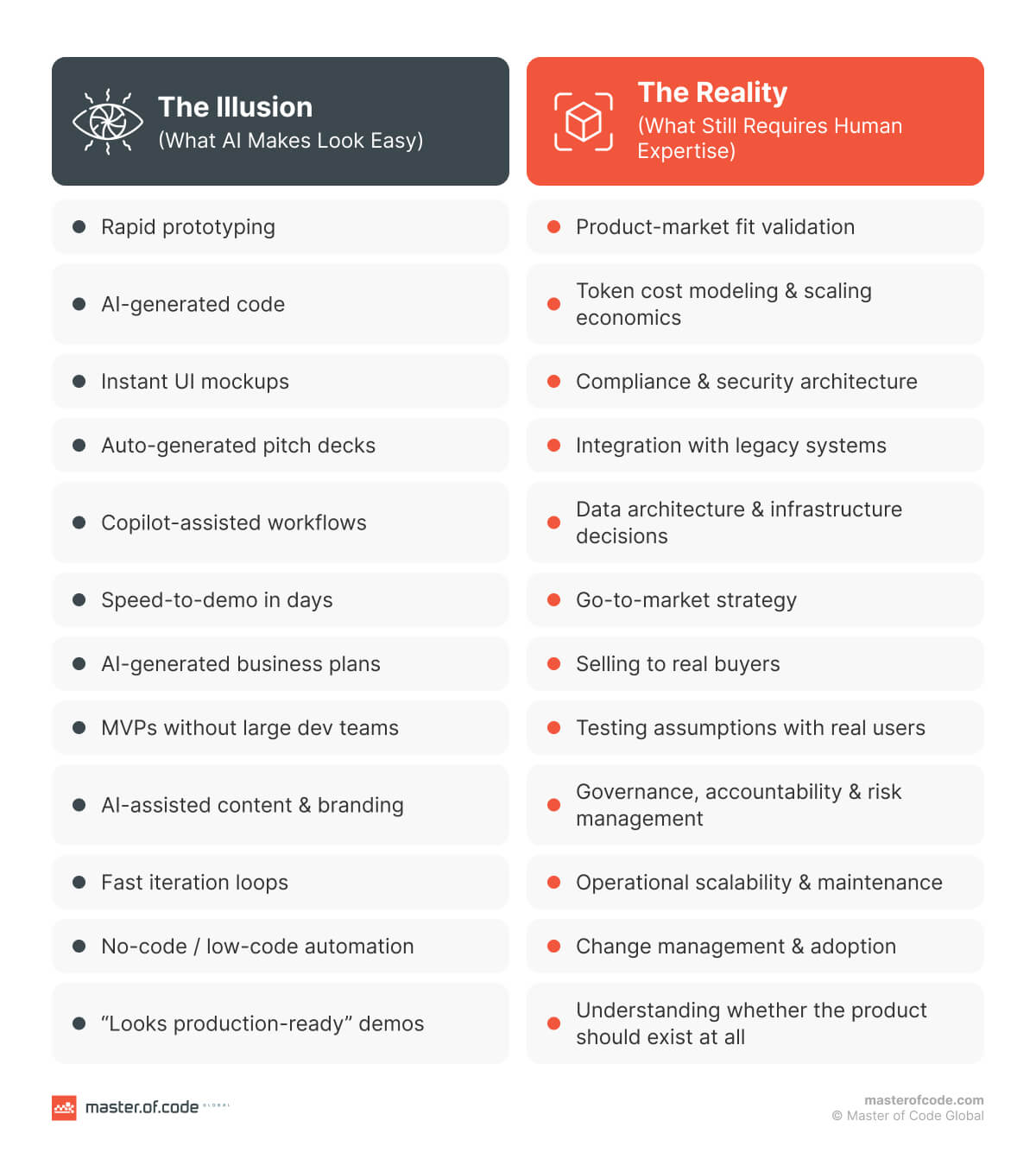
Here’s what’s changed. A founder with deep industry knowledge can now use AI to expand into adjacent domains – product strategy, technical architecture, even coding – without hiring for those roles. On paper, that’s liberation. In practice, it’s a minefield.
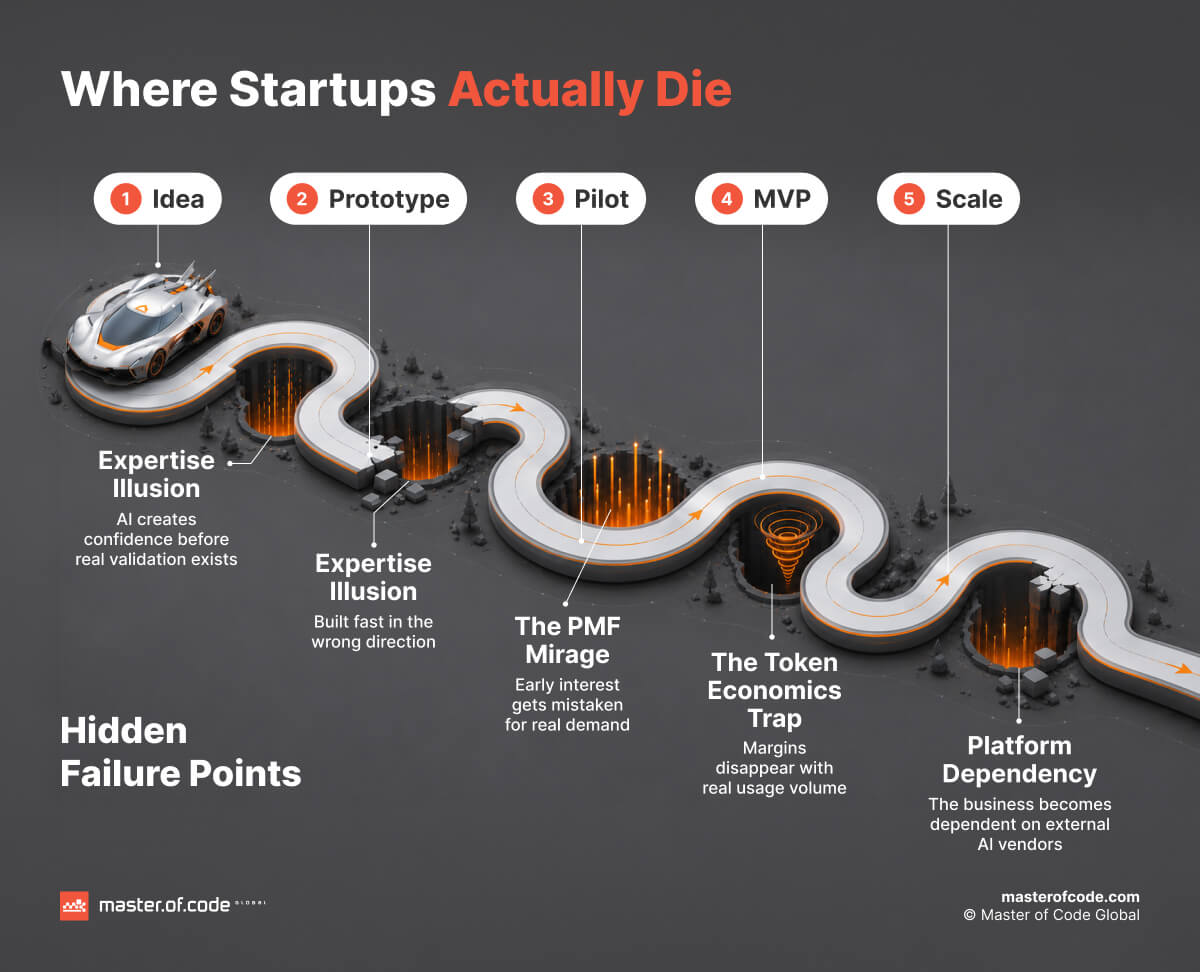
“AI gives you actual expertise you didn’t have before, but also creates an illusion of expertise,” says Dmytro Hrytsenko, CEO of Master of Code Global and a serial entrepreneur who has watched this pattern play out across dozens of engagements. “The first result comes fast, and it looks convincing. But a fast first result is an illusion of a final product. And people want to believe the illusion.”
The problem isn’t that founders use AI to think bigger. It’s that AI validates whatever direction you feed it. If you start with a flawed assumption, AI won’t challenge it – it’ll wrap your entire product around that wrong anchor point. Without a human-in-the-loop expert to detect bad assumptions early, execution accelerates in the wrong direction. And the cost of correcting a course at speed is exponentially higher than catching it in a workshop.
The toolset has expanded what one person can do. But the judgment required to build something people will pay for hasn’t been automated. Not yet.
“Users Pay for Value, Not for Output” – The Product-Market Fit Mirage
There’s too much optimism right now – about AI capabilities, about Conversational AI adoption, and about human readiness for AI-driven products. Founders frequently assume that adding “AI” to their product equals instant product-market fit. It doesn’t.
“End users just pay for solving their problems. They don’t care whether AI is in the product or not,” explains Olga Hrom, Chief Delivery Officer at Master of Code Global. “We ask clients: what are your success metrics? And sometimes the answer is, ‘If one user completes this flow, that’s success for us.’ We launch, one user completes the flow, and everyone’s disappointed. Because the real homework – who’s the buyer, what’s the pain, how will you sell this – never happened.”
This pattern is one of the clearest reasons why AI startups fail at a higher clip than their traditional counterparts. The technology lowers the barrier to building, which floods the market with more ventures. But building is the easy part. Selling is harder than ever precisely because competition has multiplied. As Dmytro Hrytsenko puts it: “Development got faster. Selling got slower and more expensive. And most founders are still thinking about the development.”
MIT’s Project NANDA report confirmed this disconnect: 95% of organizations deploying generative AI saw zero measurable return. Not low returns. Zero. The 5% generating real P&L impact shared a common trait – they validated the problem before building the solution and tied every feature to a business outcome, not a technology showcase.
The AI proof of concept approach exists for exactly this reason. Before committing six-figure budgets to an MVP, a structured pilot validates whether your hypothesis survives contact with actual users. Fail fast, pivot cheaply, or proceed with confidence. Skipping this step is the most expensive shortcut in AI implementation in business.
The Cost of the Last 20% — Token Economics and the Prototype-to-Production Gap
Unit economics has always been the quiet killer of startups. But AI introduces a cost layer most founders aren’t modeling at all: token economics.
“Nobody is counting tokens as part of their monetization model,” says Olga Hrom. “Everyone’s hyping features, ‘users will love this,’ and so on — but the actual token cost per interaction? Nobody’s calculating it. And it’s volatile. Prices change, providers raise rates, and suddenly you spent 99 cents resolving something that earned you a dollar.”
This is where compute and infrastructure costs become existential. Traditional SaaS had predictable hosting. AI products carry ongoing, variable costs that scale with every user interaction — and those models are notoriously difficult to forecast. Token pricing shifts, API rate changes, and model deprecations can destroy your margins overnight.
There are also two separate token economies at play. One starts after launch, when real users consume tokens with every conversation, query, or generation. The other begins earlier — during development itself.
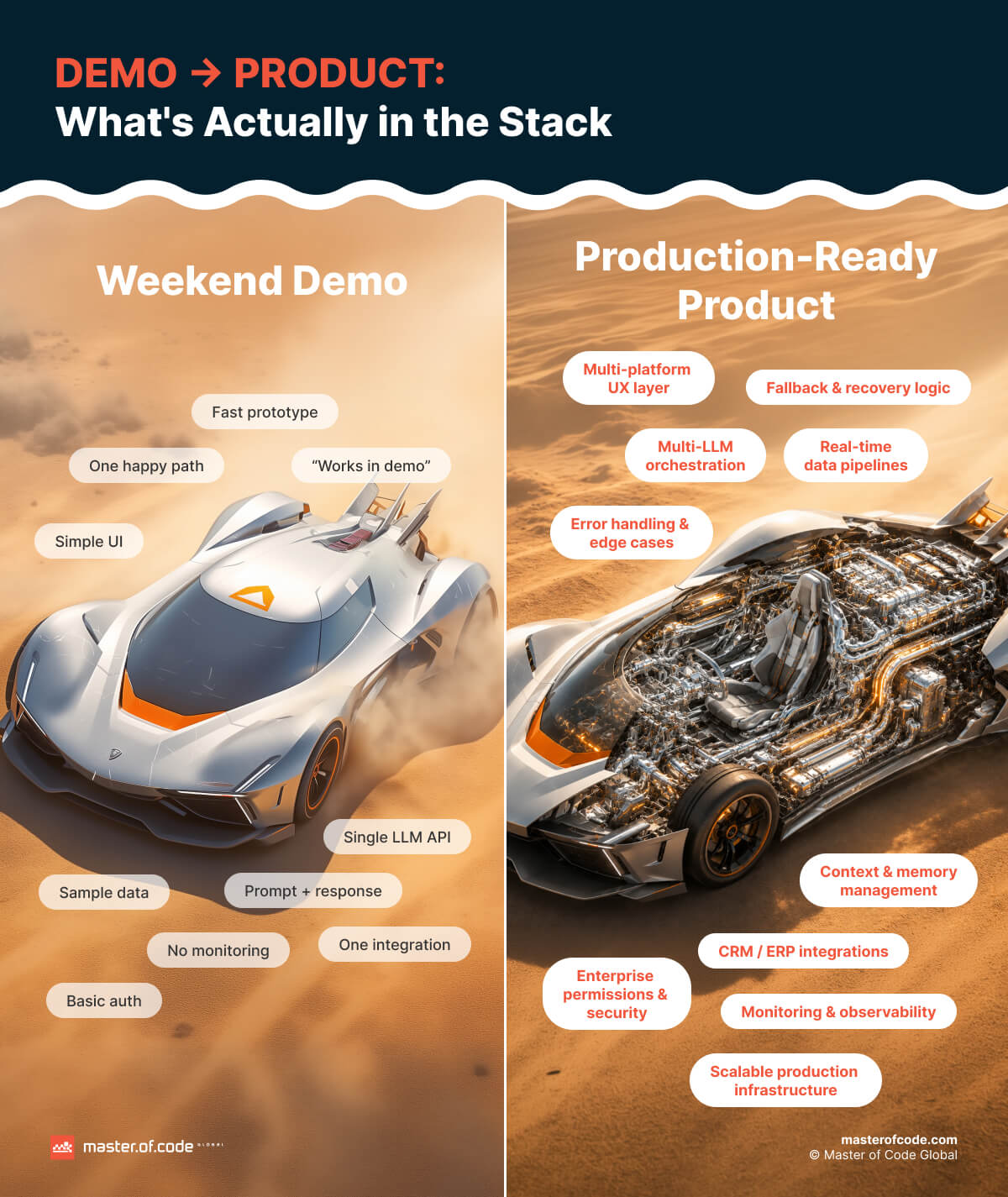
That second layer is where the 80/20 trap hits hardest. AI handles the first 80% of any build remarkably fast. The remaining 20% — the polish, the edge cases, the error handling that separates a demo from a production-ready product — consumes exponentially more compute, more tokens, and more money. Founders who budget only for the fast initial build discover too late that the last mile was the expensive part all along.
And the cost problem doesn’t end with tokens. It extends into the chasm between prototype and production — where models meet real enterprise workflows, where integration friction stacks up, and where technical debt accumulates faster than in any other category of software.
“You see something and you want to believe it’s your final product. But it’s an illusion,” Dmytro Hrytsenko explains. “AI creates that illusion efficiently. Then, for that illusion to become something that meets real users and walks them through workflows they’ll actually pay for — that requires an expertly built product, not just a fast implementation.”
Data quality and data readiness sit at the core of this gap. An AI model trained on messy, incomplete, or poorly governed data doesn’t just underperform — it hallucinates, generates compliance risk, and erodes the user trust you need to survive. Cited by Gartner, 42% of companies abandoned their AI initiatives in 2025, and poor data foundations were among the most frequently cited reasons.
Scaling a working prototype to production demands integration with CRMs, payment systems, legacy platforms, and compliance frameworks. Every connection point is a potential failure. This is why execution — not algorithmic sophistication — determines whether an AI venture survives. The models typically work fine. It’s the system around them that breaks.
Olga Hrom describes the pattern: “Clients want to stuff everything into a pilot and treat it like the final product. But a pilot exists so you can fail fast and learn cheaply. The discipline of phased releases — pilot, then MVP, then production — is more critical now than it’s ever been, because the illusion AI creates makes everyone think they can skip steps.”
The Dependency You Didn’t Architect For
There’s one more failure pattern that rarely makes headlines but kills ventures quietly: platform dependency without a fallback.
When your product depends on a single LLM provider, you’ve introduced a supply-chain risk that most founders never had to think about. Price hikes evaporate your margins. Model deprecations force mid-flight rebuilds. Outages become your outages — and you can’t fix them.
“I see clients constantly asking us to build architecture that isn’t locked to one specific LLM,” says Olga Hrom. “That tells me they understand the dependency – but they should have been thinking about it from day one.”
Add regulatory complexity to this picture, and the risk compounds. The EU AI Act, sector-specific governance mandates, and evolving data sovereignty requirements mean that architecture decisions made in month one will either protect you or expose you for years. Governance isn’t a cost center – it’s a competitive moat most startups don’t build until a regulator forces them to.
What the Survivors Do Differently
Every failure pattern above is, at root, a judgment problem — not a technology problem. And judgment problems compound when founders try to solve them with the same generic, off-the-shelf tools that created them. Pre-packaged AI gives you the same models, same limitations, and same vendor dependencies as every competitor. Customization is shallow. Integration is superficial. One platform update can erase whatever differentiation you thought you had.
The ventures that break through — and the enterprise teams that successfully deploy AI at scale — share a different profile. They build custom: models tuned to their data, workflows designed around their operations, compliance baked into the architecture, token economics modeled before the first line of code ships. They validate before they commit. And they partner with teams that have shipped production AI before, not just prototyped it.
This is how Master of Code Global aligns solutions to strategy, stack, and scale. Our AI consulting starts with whether an idea can survive real operational complexity — integrations, scaling, security, long-term maintenance, actual user behavior after launch — not with whether it demos well. As a custom AI development company with more than 1,000 delivered projects for brands like Tom Ford, Electronic Arts, and T-Mobile, we’ve learned that the challenge is rarely building a prototype. The challenge is building something a company can realistically operate and evolve.
One of our current clients illustrates the point: a non-technical founder with 25 years of real estate expertise. No CTO, no engineering background — but deep domain knowledge and a clear problem to solve. Five years ago, she would have needed a full founding team. Today, paired with the right AI implementation partner, she’s shipping a product that puts her industry insight into production-grade AI. That’s what changes when expertise — not just tooling — enters the equation.
It’s also why we built LOFT, our open-source LLM-Orchestrator — to solve the scaling and dependency problems described in this article at the infrastructure level: 43% less setup effort, 20% budget savings at scale, 3x faster project support. Combined with our AI integration services, it’s designed to keep companies vendor-agnostic and operationally resilient rather than locked into a single ecosystem.
As Dmytro Hrytsenko puts it: “Experts are still needed. But they have to be very AI-friendly experts.” That’s what we are.
Build to Last, Not Just to Launch
Why AI startups fail isn’t a mystery. It’s a pattern — one that plays out predictably when speed outpaces judgment, when token economics go unmodeled, when demand is assumed rather than validated, and when architecture decisions are made for convenience rather than resilience.
Every one of these failure modes is preventable — not with better algorithms, but with better process, better partners, and the discipline to treat the first prototype as a starting point, not a finish line. Whether you’re validating a concept or scaling a product already in market, the partner you choose determines whether you ship a demo or a competitive advantage.
An AI managed dedicated team that stays with you from kickoff to production is where that advantage starts. Talk to us — or start with an AI proof of concept.
Discover how Master of Code Global can help enhance your customer’s experience and boost sales growth.