


Last year, 17% of companies walked away from most of their AI initiatives. This year, that number hit 42%, according to the S&P Global, 2025. Not because AI doesn’t work — but because they launched without a plan for what happens after the demo.
The pattern is painfully familiar. A team builds a promising proof of concept. Leadership gets excited. Then the project hits production requirements — security reviews, data integration, compliance checks, workforce adoption — and stalls. The PoC sits on a shelf. The budget gets questioned. The next proposal faces twice the skepticism.
This is what happens when organizations treat AI as a series of isolated experiments instead of an enterprise-wide discipline. What separates the companies extracting real value from innovation from the ones burning through innovation budgets is a structured enterprise AI roadmap. This is a strategic instrument that connects every AI investment to measurable business outcomes and compresses time-to-value from years to months.
Here’s what that actually takes.
Table of Contents
Key Takeaways
- Start with use cases, not technology. The companies seeing returns prioritize business problems first and pick tools second. Getting this backwards is the single most expensive mistake in enterprise AI.
- Data foundations are the silent killer. Only 26% of Chief Data Officers are confident their data can actually support AI-driven revenue. The rest are building on sand.
- An AI governance framework isn’t overhead — it’s acceleration. Organizations that treat governance as a checkbox after deployment consistently fail to scale.
- A phased rollout always beats a big-bang launch. Controlled, iterative deployment manages risk and builds organizational confidence simultaneously.
- Production-grade deployment is a different discipline than model building. A working model in a notebook and a system handling 156,000+ monthly interactions at scale are fundamentally different things.
- Custom-built AI consistently outperforms generic platforms for enterprises with complex workflows, strict compliance needs, and proprietary data.
What This Roadmap Actually Is — and Why Most Companies Get It Wrong
Let’s be direct about what this is and isn’t. It’s not a slide deck with a timeline and some technology logos. It’s a living strategic document that connects AI capability development to business value at every stage — from first use case to full organizational scale.
Most organizations get this wrong because they start with the technology. They see what’s possible with large language models or computer vision and work backwards to find a business problem. The result: technically impressive prototypes that nobody asked for and nobody uses.
The IBM Institute for Business Value’s 2025 CEO Study puts numbers on this: only 16% of AI initiatives have successfully scaled across the enterprise. The other 84% got stuck somewhere between “interesting experiment” and “operational reality.”
The fix isn’t more technology. It’s building an AI operating model — the organizational structure, processes, governance, and talent strategy that sustain AI beyond any single project. Companies that need help developing an enterprise AI roadmap usually discover this gap only after their first initiative has already stalled or underdelivered.
Phase 1: Strategic Foundation — Aligning AI to Business Value
Start with the problem, not the platform.
Every successful AI solution we’ve built at Master of Code Global started the same way: with a hard look at where the business actually hurts. Not where AI seems cool, but where it solves something expensive, slow, or broken.
This means building a use case portfolio — a scored, prioritized list of AI opportunities ranked by business impact against implementation feasibility. The high-impact, low-friction applications go first. They fund and de-risk everything that follows.
Customer Success Story: ML Sales Forecasting
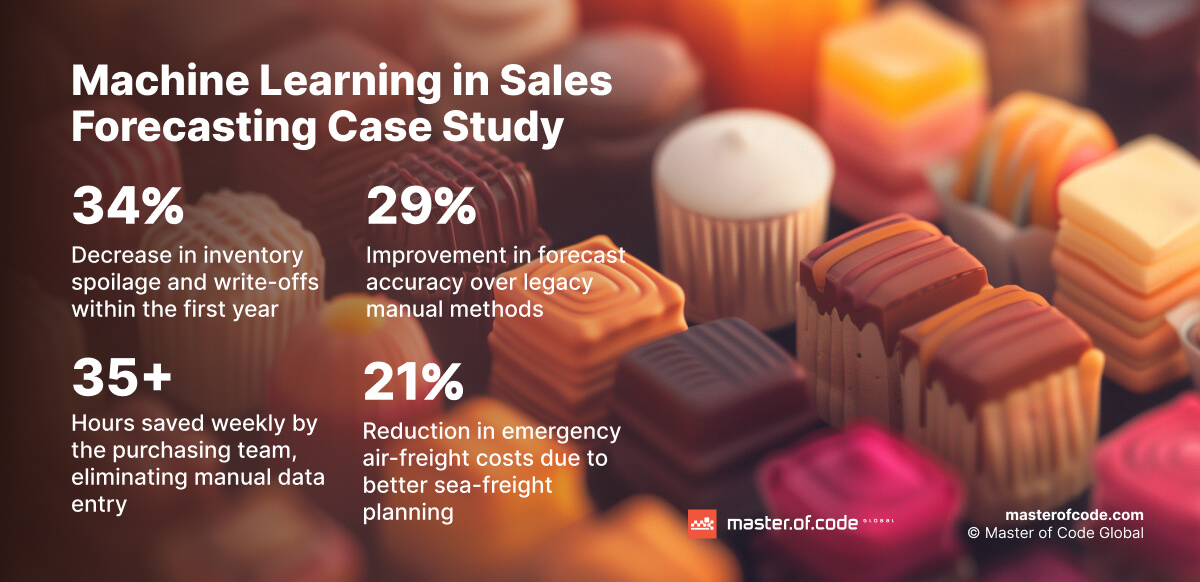
A concrete example. When a major EU food ingredients distributor came to us, their challenge wasn’t a technology gap. Their purchasing team was drowning in manual spreadsheets, overordering perishables that expired before sale, and scrambling through emergency air-freight during seasonal spikes. The enterprise AI transformation roadmap began not with algorithm selection, but with mapping procurement pain points, seasonal patterns, and supplier reliability. The technology decisions came later — and they were better for it.
At this stage, you need two things locked down:
Clear KPIs tied to real outcomes. Not “model accuracy” — that’s an internal engineering metric. The KPIs that matter are the ones your CFO cares about: cost per interaction reduced, inventory write-offs eliminated, revenue per customer increased, hours returned to high-value work. For that food distributor, the north star was reducing spoilage and emergency logistics costs. These are metrics the procurement team could feel in their daily work.
An honest data readiness assessment. Before you commit a budget to model development, you need to know what data you actually have versus what you need. This isn’t a formality. It’s the difference between a project that ships and one that gets stuck in data preparation for six months. More on this next.
Phase 2: Data and Infrastructure Readiness
Your AI is only as good as the data beneath it.
Here’s a stat that should make every executive pause: according to IBM’s 2025 CDO Study, 81% of CDOs say their data strategy is integrated with their technology roadmap. But only 26% are confident that data can actually support new AI-enabled revenue streams. That’s a 55-point confidence gap between “we have a plan” and “our data is ready.”
The PEX Report 2025/26 backs this up. When asked about the biggest barrier to AI adoption, 52% of professionals pointed to data quality and availability — ahead of lack of expertise, regulatory concerns, or organizational resistance. Data isn’t just a barrier. It’s the barrier.
Building solid data foundations means doing the work that nobody finds exciting but everyone needs: integration across siloed systems, cleansing and deduplication, cataloging so teams can actually find what exists, and building pipeline architecture that can serve both current models and future ones.
Data governance is non-negotiable here. Who owns the data? How does it flow between systems? How is it protected? These questions need clear answers before a single model gets trained — not after a compliance audit surfaces problems. The same applies to data readiness at the infrastructure level: your architecture blueprint needs to account for MLOps pipelines, model versioning, and the compute resources required for training and inference at production volumes.
Risk management enters the picture here too. Data privacy regulations, bias detection protocols, and audit trail requirements vary by industry and geography. A financial services company operating under PCI DSS standards has fundamentally different data governance and handling requirements than a retail operation. Build for your regulatory reality from the start, not as a retrofit.
Phase 3: Build, Validate, Deploy — The Phased Rollout
From controlled pilot to production-grade deployment.
The ISG State of Enterprise AI Adoption Report found that in 2025, 31% of AI use cases reached full production — double the figure from 2024. Progress is real. But that still means nearly 70% of use cases are stuck somewhere in the pipeline between prototype and operations.
This is where a disciplined enterprise AI implementation roadmap pays for itself. The jump from “works in a notebook” to “runs reliably at scale” is where most projects die. And it’s almost always because organizations underestimate what production demands.
Deploying at production grade means security hardening, load handling, failover planning, compliance checkpoints, and monitoring — none of which exist in a proof-of-concept environment. Model monitoring in production is its own discipline: detecting drift, tracking performance degradation, and building feedback loops that keep the system improving after launch.
This iterative approach manages the complexity of the whole enterprise AI roadmap. You deploy to a controlled segment first, measure, fix what breaks, then expand. Each phase builds organizational confidence and surfaces integration issues before they become expensive.
Customer Success Story: Voice AI Agent for Financial Services
We saw this play out directly with a leading EU financial institution. Their 600+ agent contact center was handling 285,000 calls monthly, with over 65% being routine balance checks and payment confirmations. Average handle time sat at 7.2 minutes. Wait times during peak hours exceeded 9 minutes. Call abandonment hit 14%.
We didn’t try to automate everything on day one. We built a Voice AI agent across 58 conversational paths — from balance inquiries to dispute processing to card activation — with multi-factor authentication including voice biometrics, PCI DSS-compliant encryption, and sentiment-aware conversation adaptation. The system integrates directly with core banking platforms for real-time data access during calls.
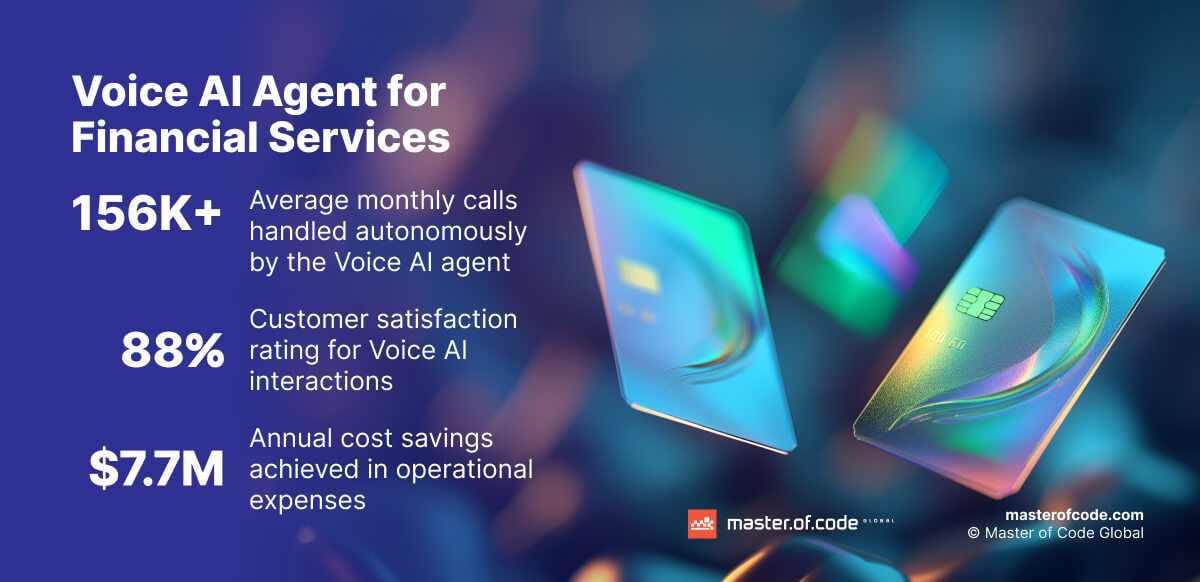
The result: 156,000+ calls handled autonomously each month, 88% customer satisfaction, $7.7 million in annual cost savings, and 94% first-call resolution for routine inquiries. Risk management was baked into every layer — 28 specific security inquiry types trigger additional verification or immediate human handoff. This is what production-grade looks like at scale.
Phase 4: Measure, Optimize, Scale
The enterprise AI roadmap doesn’t end at launch.
Deployment is a milestone, not a finish line. The organizations that extract sustained value from AI treat it as a continuously optimizing system, not a one-time project.
This means monthly performance reviews, model refinement cycles, and a structured process for expanding the use case portfolio into adjacent problems. It also means connecting AI performance back to business outcomes — the feedback loop that justifies continued investment and unlocks the budget for the next initiative.
Customer Success Story: AI Architecture Audit
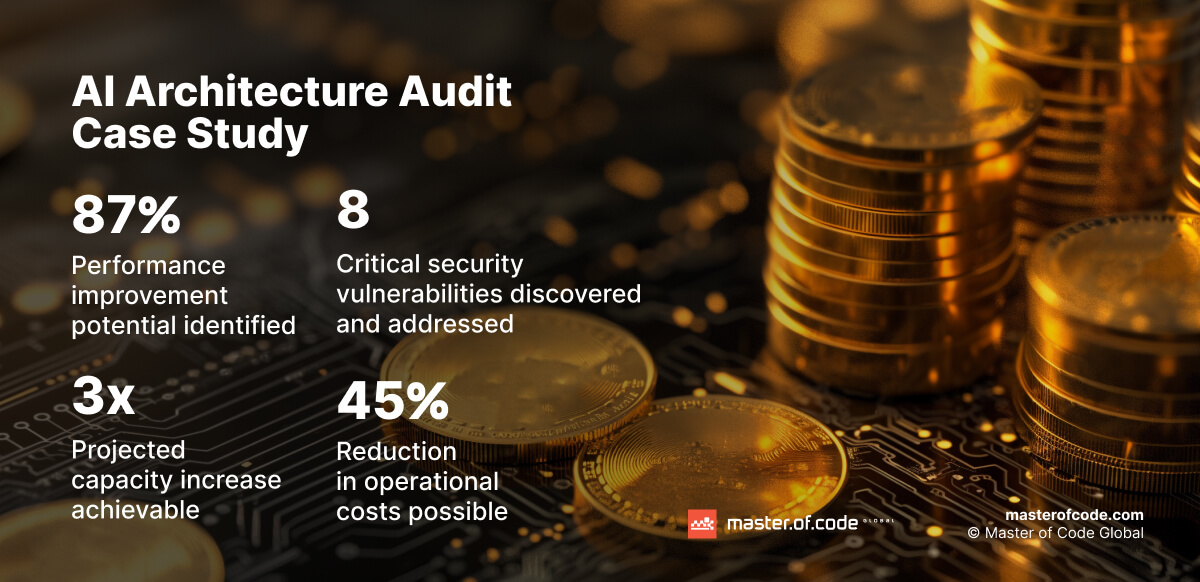
When a UK asset management firm came to us, they’d already built a functional GenAI assistant handling 2,000+ client queries daily. But 40% year-over-year portfolio growth was exposing infrastructure cracks: CPU limits during market volatility, API response times climbing above 3 seconds, compliance flags on data retention. Our architecture audit identified 87% performance improvement potential, uncovered 8 critical security vulnerabilities before they hit production scaling, and mapped a path to 3x capacity — all within a 6-month implementation timeline.
That’s the difference between an enterprise AI adoption roadmap and a one-off project. The former builds each initiative on the foundation of the last, accelerating time-to-value with every cycle. The food distributor we mentioned earlier? After the initial ML forecasting platform cut inventory spoilage by 34% and improved forecast accuracy by 29%, they moved into the next phase: an Agentic AI assistant that translates raw predictions into natural-language explanations for their procurement team.
And there’s a reason to move fast on this maturity curve. Gartner predicts that 40% of enterprise applications will integrate task-specific agents by the end of 2026 — up from under 5% today. An enterprise AI deployment roadmap that only accounts for today’s tech capabilities is already outdated.
Why Off-the-Shelf AI Falls Short at Enterprise Scale
Generic platforms get you started fast. They also cap your ceiling fast.
The appeal is obvious: plug-and-play, pre-built models, minimal upfront investment. But the trade-offs surface quickly at enterprise scale. Off-the-shelf solutions struggle with complex system integrations, industry-specific compliance requirements, nuanced workflows, and the proprietary data that actually gives your organization a competitive edge.
So, how does AI reduce costs in practice? It’s not through generic chatbots or boilerplate automation. It’s through models trained on your operational data, tuned for your processes, and integrated into your existing technology stack. The EU financial institution we worked with needed a Voice AI system that could authenticate callers via biometrics, process real-time banking transactions mid-conversation, and comply with PCI DSS encryption standards — none of which come in a box.
Enterprise AI development solutions built for your specific operating reality consistently outperform lowest-common-denominator products. The premium food distributor needed ML models that treat shelf-stable flour differently from perishable dairy derivatives, account for Madagascar vanilla harvest cycles, and incorporate unconfirmed handshake deals from account managers. No vendor’s off-the-shelf forecasting tool handles that.
When a custom AI development company builds for your reality, the ROI compounds. This is why how to choose an AI development company matters when evaluating potential partners. Early adopters with structured, custom approaches report $3.70 in value per dollar invested on average — and top performers hit $10.30 per dollar. That gap between average and exceptional is almost entirely a function of how well the AI fits the business, not how advanced the underlying model is.
What Separates Great Vendors from the Rest
If you’re evaluating enterprise AI implementation partners, here’s what actually matters — beyond the pitch decks.
End-to-end lifecycle ownership. The partner who designs your conversation flows should also handle deployment, integration, compliance architecture, and ongoing optimization. Handoffs between vendors are where projects go to die.
Team stability. Rotating consultants destroy project continuity. Look for partners who guarantee the same team from kickoff to completion — zero turnover on active engagements.
Security and compliance depth. ISO 27001 certification is the baseline, not the differentiator. What matters is demonstrated experience building within regulated environments: PCI DSS in financial services, HIPAA in healthcare, GDPR across the EU.
A framework that accelerates delivery. At Master of Code Global, our open-source LOFT framework cuts initial setup effort by 43%, saves up to 20% of budget at scale, and makes ongoing support 3x faster. That’s not a sales claim — it’s what 20 years and 1,000+ delivered projects taught us about eliminating repetitive engineering work.
Platform-agnostic architecture. Certified partnerships with AWS, Google Cloud, and Salesforce — plus strategic alliances with major platforms — mean the enterprise AI strategy fits your ecosystem, not the other way around. AI integration services should expand your options, not lock you into a single vendor’s roadmap.
This combination of deep expertise, proven delivery, and a partner mindset over a vendor mindset is why organizations like Tom Ford, Electronic Arts, T-Mobile, and Golden State Warriors trust us with their most complex AI initiatives.
The Bottom Line
An enterprise AI roadmap isn’t a document you create once and file away. It’s the strategic discipline that separates technology as a cost center from being a competitive weapon. The organizations seeing real returns — not just pilot results — are the ones investing in the full lifecycle: from use case prioritization and data preparation through scaled deployment and continuous optimization.
If you’re sitting on stalled AI initiatives, unclear ROI, or a growing gap between your ambitions and your operational reality, start with a strategic conversation. We offer a fixed-price AI Proof of Concept designed to validate your roadmap, reduce development waste by 50–70%, and give your leadership team a clear, confident path forward.