


One of the primary challenges enterprises face today is delivering the highest level of service. With the ever-increasing clients’ demands, businesses have to continuously seek more efficient tools and technologies. A standout in this pursuit is undoubtedly AI customer support.
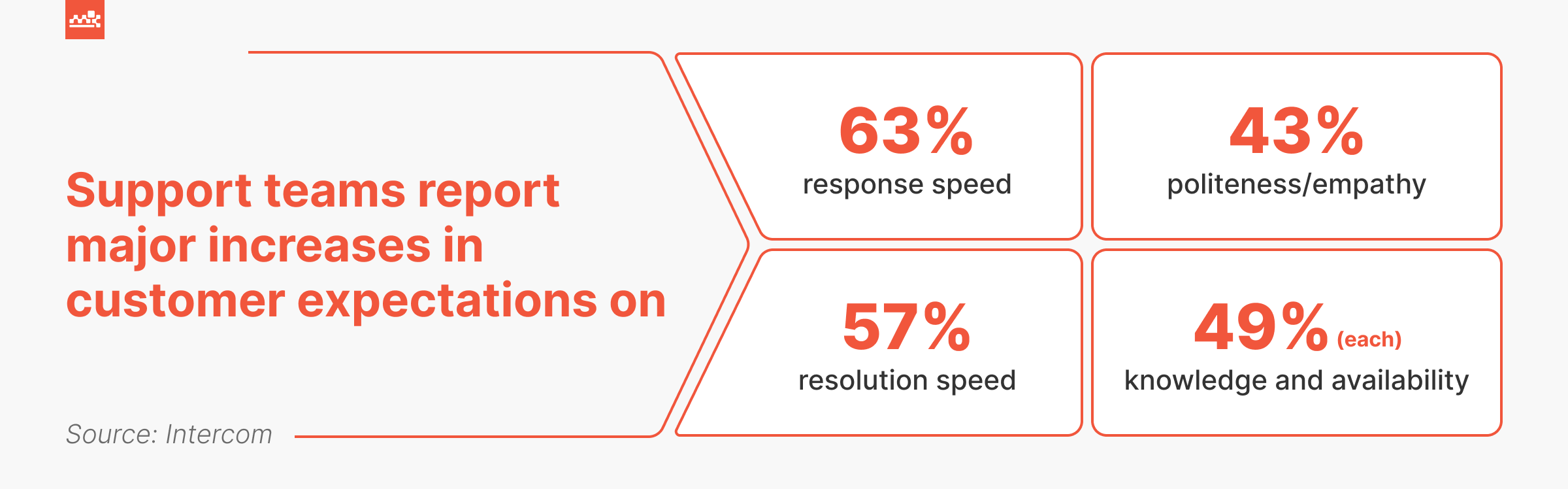
Thanks to ongoing advancements in artificial intelligence, companies can better prepare for the future of client care. Interestingly, 82% of executives are reevaluating their consumer experience (CX) strategies in light of recent technological progress.
In this comprehensive guide on AI in customer service (CS) statistics, we will delve into the limitations and opportunities presented by this technology. Read on to explore the real business value of AI in customer service — and what the future may hold as adoption continues to grow.
Table of Contents
Key Takeaways
- Gartner predicts conversational AI will reduce contact center labor costs by $80 billion in 2026.
- By 2029, agentic AI could autonomously resolve 80% of common customer service issues, reducing operational costs by 30%.
- The global AI customer service market is projected to grow from $12.06 billion in 2024 to $47.82 billion by 2030, at a 25.8% CAGR, according to MarketsAndMarkets.
- 79% of Americans strongly prefer speaking with a human rather than an AI customer service agent.
- 85% of CX leaders say customers leave brands when their issues remain unresolved after the first contact.
The Business Perspective on AI in Customer Service
How do client support professionals perceive the impact of artificial intelligence?
According to HubSpot’s customer service statistics:
- 79% of CS specialists value AI/automation for their strategy. This includes 56% in B2B and 54% in B2C sectors.
- 62% say the technology aids in understanding buyers.
- 78% state that it helps focus on crucial job aspects.
- 71% report AI increases time spent on enjoyable work duties.
- 78% feel automation enhances their efficiency in roles.
- 75% say it improves collaboration and data sharing.
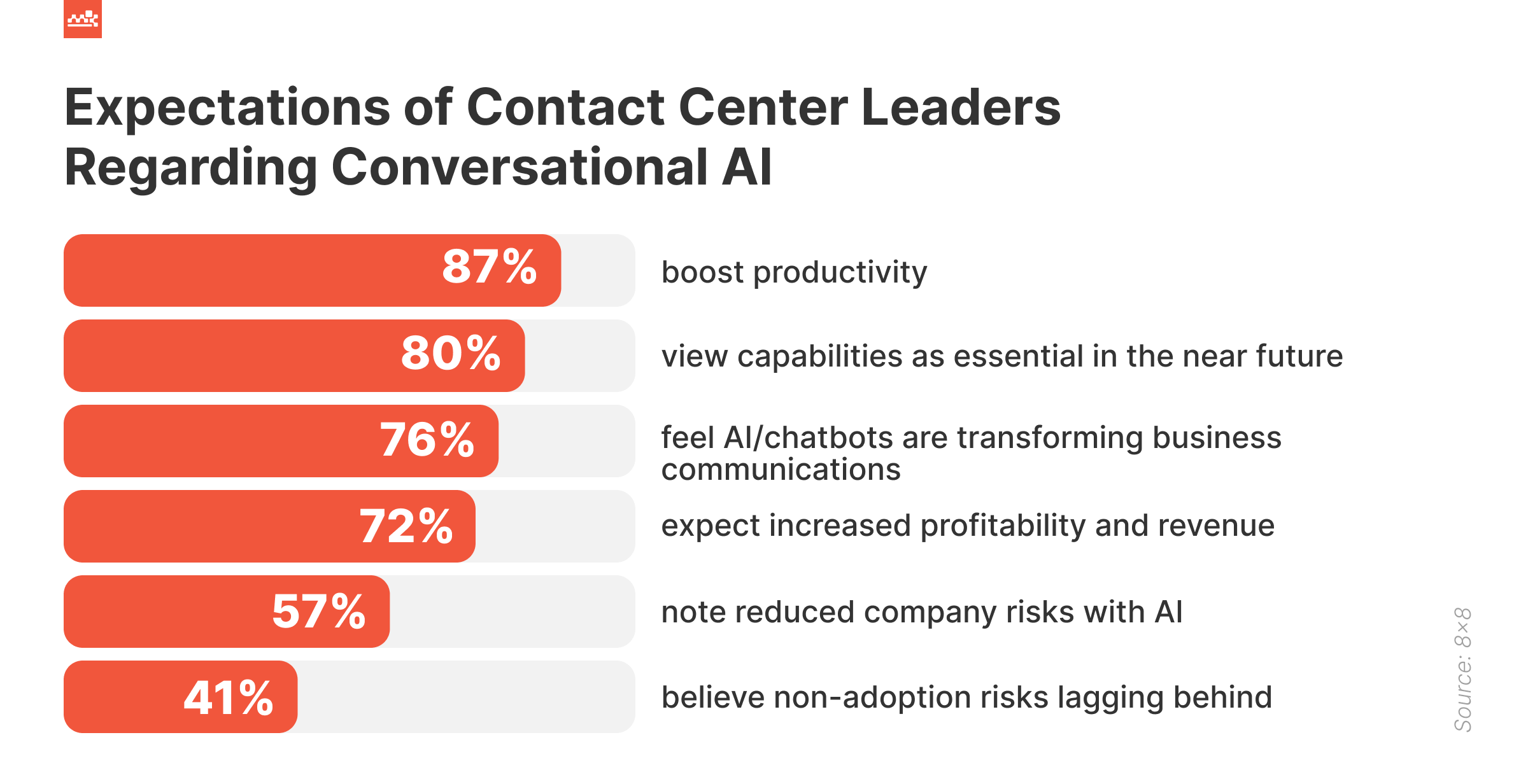
What are business leaders’ expectations of AI in customer engagement?
According to the report by LivePerson:
- 84% of executives use the technology to interact with clients.
- 88% think automated systems for quick resolutions boost user loyalty.
- 91% of businesses are positive about using AI for consumer engagement.
- 96% believe Generative AI will enhance customer interactions.
Companies also consider artificial intelligence as a solution for other multiple challenges:
- 67% for faster information or answers.
- 62% to reduce wait times.
- 53% for more accurate data.
- 42% to create consistent experiences.
- 41% for personalized responses.
- 28% to lower operational costs.
Executive Pressure & Cost Projections
Customer service leaders face growing pressure to improve both efficiency and experience. Gartner predicts that conversational AI will reduce global contact center labor costs by $80 billion in 2026. At the time of the forecast, only 1.6% of contact center interactions were automated. Gartner expected that share to reach one in ten interactions by 2026.
The financial impact is significant because labor represents up to 95% of contact center costs. However, automation requires upfront investment. Gartner estimates conversational AI integration costs at approximately $1,000-1,500 per agent, while some organizations report costs reaching $2,000. Leaders should therefore compare implementation expenses with expected savings, resolution volume, and customer experience improvements.
The Shift to Agentic AI
The next stage moves beyond chatbots that only answer questions. Gartner forecasts that agentic AI will autonomously resolve 80% of common customer service requests by 2029. This shift could reduce operational costs by 30%.
Agentic systems can interpret intent, retrieve information, complete actions, and coordinate workflows across connected platforms. Yet the forecast does not remove the need for human support. Companies still need clear escalation paths for sensitive, complex, or high-risk cases where judgment and empathy matter.
Understanding AI Through the Consumer Lens
Consumer Skepticism
Business enthusiasm for automation is not fully shared by customers. A December 2025 SurveyMonkey study of 2,017 Americans found that 79% strongly prefer speaking with a human instead of an AI agent. The preference was stronger among women than men, at 70% versus 60%.
Trust remains the central issue. According to the same research, 84% believe human agents provide more accurate support than AI. Another 63% do not expect artificial intelligence to fully replace humans in customer service roles. Overall, 56% feel negatively about companies using AI across the customer experience.
Customers are also skeptical about companies’ motivations. 81% believe businesses primarily implement AI to save money rather than improve service. At the same time, 89% say companies should always provide the option to speak with a human agent. This makes smooth escalation a core requirement, not an optional feature.
Transparency alone may not solve the trust gap. 54% feel confident they can identify when they are communicating with an AI chatbot. Younger customers are slightly more open to automated service. When all other factors are equal, 14% of Gen Z and 11% of Millennials would choose AI, compared with 7% of Gen X and 4% of Boomers.
What Businesses See vs. What Customers Feel
Businesses report strong operational results, but customers want more control. According to Twilio’s State of Customer Engagement 2025, 96% of companies say AI improves customer-facing operations. However, only 54% of consumers want clear disclosure about whether they are communicating with AI or a human.
Personalization creates a similar tension. AI can use customer history to make interactions faster and more relevant. Yet 84% of consumers want control over their personalization settings. Companies must therefore balance convenience with consent, transparency, and easy access to human assistance.
What Customers Actually Want From CX in 2026
The Zendesk CX Trends 2026 report shows that speed matters, but complete resolution matters more. 85% of CX leaders say customers leave brands when their issue is not solved during the first interaction. Meanwhile, 88% of consumers expect faster response times than they did one year ago.
Availability is becoming a baseline expectation. 74% of consumers now expect customer service to be accessible around the clock. However, always-on support should not create fragmented experiences. 74% find it frustrating when they must repeat their story to different agents or channels.
Customers also expect AI to remember relevant context while remaining transparent. 83% of CX leaders see memory-rich AI agents as essential for personalization. At the same time, 63% report that customer demand for AI transparency has increased since last year. The strongest CX strategies will combine contextual automation, clear disclosure, and immediate human escalation.
The Use of Artificial Intelligence in Client Support Applications
How are AI agents & Agentic AI being used in customer service today?
- In 2025, 95% of customer interactions are predicted to be handled by AI.
- 69% of consumers prefer to use AI-powered self-service tools for quick issue resolution, showing growing comfort with AI agents.
- 75% of customer inquiries can now be resolved by AI tools without human intervention.
What is the current level of AI adoption among CS teams?
- Nearly half of the client support units have implemented the technology, with additional investments planned for 2024.
- 52% of contact centers have invested in Conversational AI and 44% plan to adopt it.
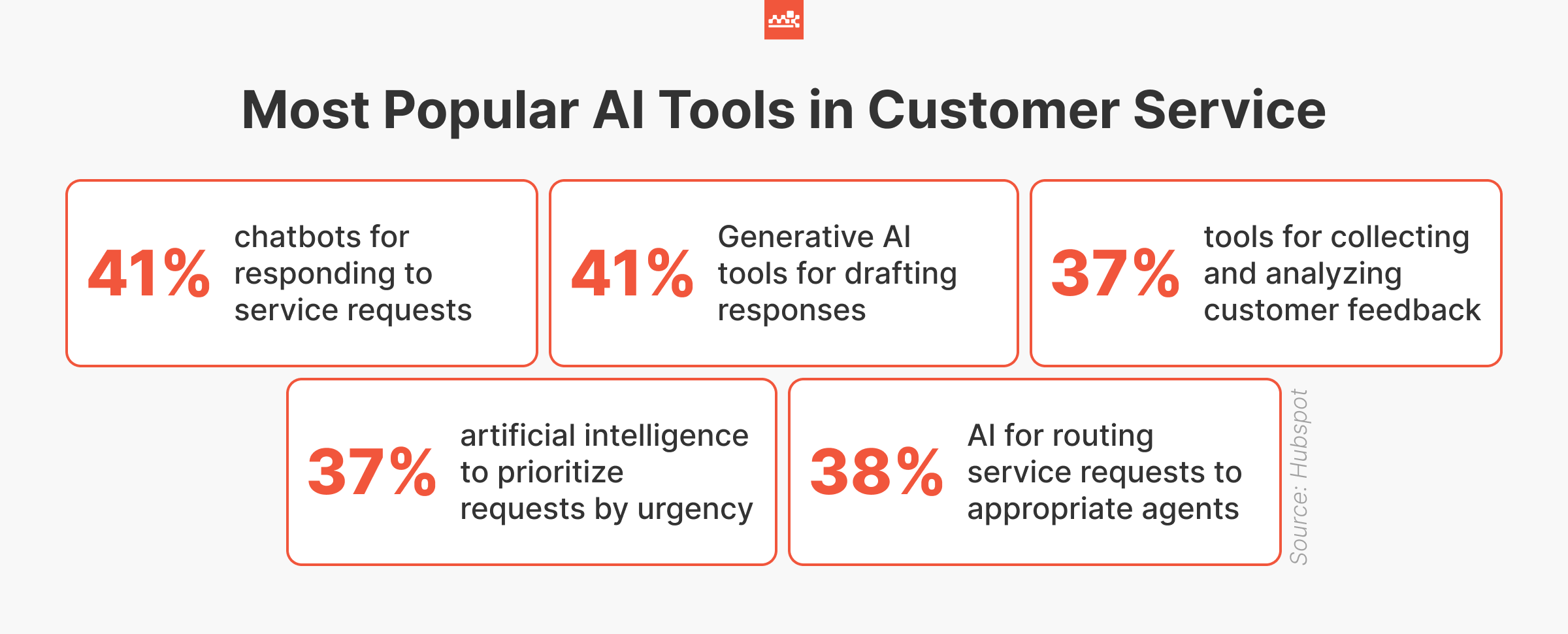
What are some examples of companies using AI for customer service?
Popular applications in client care include routing requests (29%), analyzing feedback (28%), and chatbots or self-service tools (26%).
- Vodafone uses AI chatbots to manage customer inquiries, allowing their support teams to focus on more complex issues.
- Sephora offers a virtual assistant that helps users discover products and book services, enhancing the shopping experience.
- Bank of America introduced Erica, an AI assistant that guides users through daily banking tasks like budgeting and bill payments.
- KLM Royal Dutch Airlines automates customer support on social media, delivering quick, consistent answers across multiple languages.
- Nutribees used Breeze Customer Agent to decrease the number of human-handled tickets by 77% and simultaneously improve conversion rates as well as customer satisfaction scores by implementing 24/7 customer support.
What are the primary objectives businesses seek to achieve by implementing AI in contact centers?
- Companies using artificial intelligence aim to enhance CS (62%), streamline workflows (42%), boost satisfaction (36%), and reduce wait times (33%).
- 83% of organizations are transforming CX for measurable outcomes, with 41% updating or launching Generative AI, virtual assistants, and bots.
Which automation tools do businesses prioritize for CS automation?
- 25% are eager to start employing the technology for routing to the right representative.
- 21% wish to implement AI self-service mechanisms for independent client solutions.
- 20% aim to use artificial intelligence for collecting and analyzing customer feedback.
- Another 20% are interested in instruments that sort requests by urgency.
How are bots and Generative AI being utilized in customer service?
- Customer support chatbots, as a leading artificial intelligence tool, improve digital journeys for 84% of users, with 46% offering a more personalized experience.
- Most B2B and B2C service specialists find Gen AI aids in personalizing responses, with 48% being confident in its accuracy.
- Business leaders also use the technology for process optimization (68%) and enhanced data and analytics capabilities (49%).
AI Customer Service Statistics Across Industries
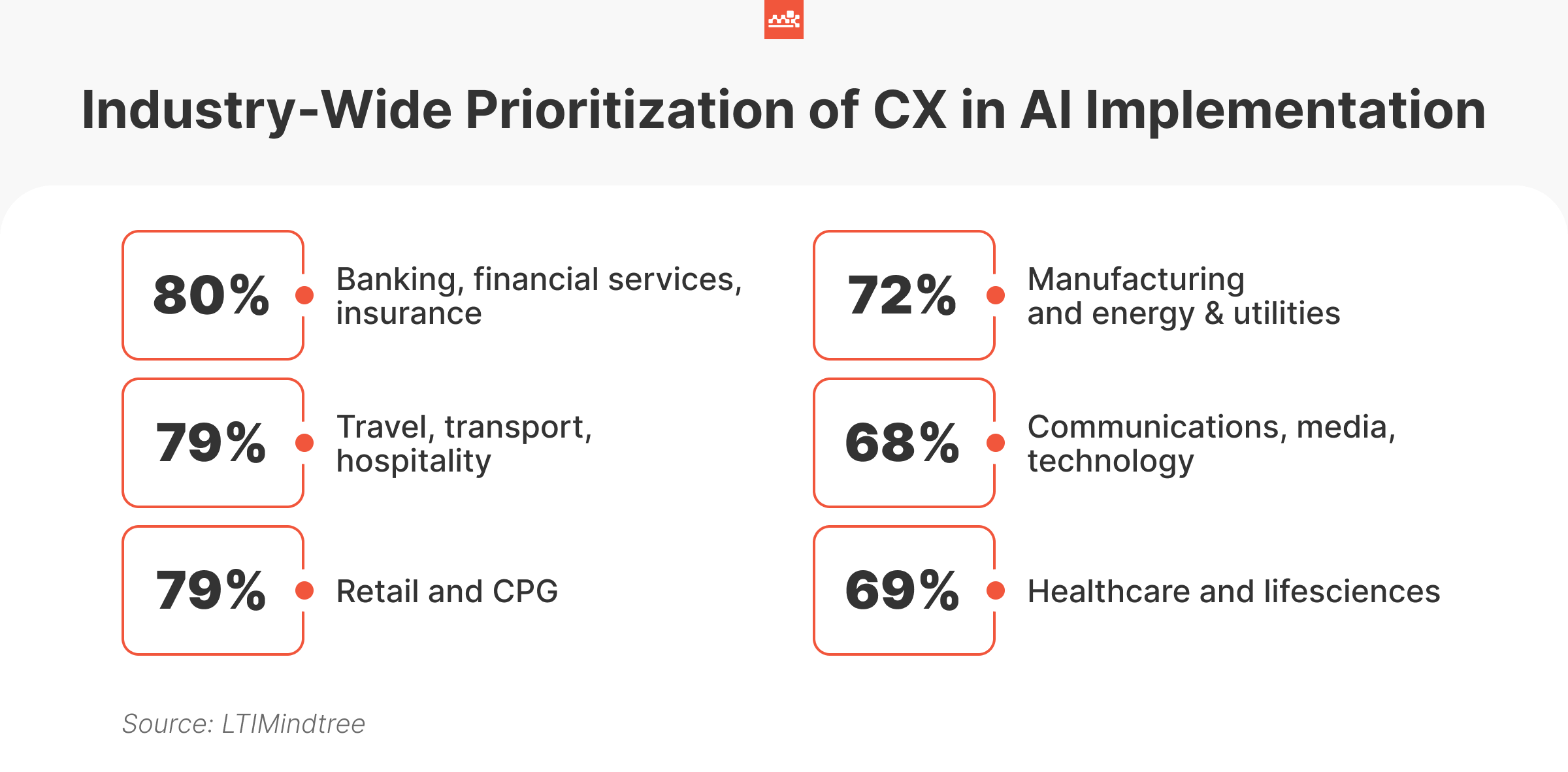
Retail
- 63% of retailers use AI to improve customer interactions, with 40% dedicating teams and budgets to the technology.
- Consumers see its biggest benefit in promoting price-sensitive shopping (28%) due to global cost-of-living pressures.
- Other key areas: 23% in loyalty and personalized rewards, 23% in online product discovery, 19% in item validation, and 19% in AI-customized recommendations.
- 57% of buyers are comfortable with AI in eCommerce for their journey if businesses maintain transparency.
- 73% of shoppers expect brands to understand their unique needs and expectations — AI agents help retailers meet this demand through personalized support.
Banking and Finance Sector
- 46% of financial institutions using artificial intelligence have reported improved customer experience.
- 79.5% plan to increase CX technology investment with a focus on the technology for digital service improvement (58.5%), and enabling self-service for basic (47%) and complex needs (42%).
- Future AI investments include analyzing contact center data for insights (82.5%), optimizing chatbots (72.5%), and virtual client assistants for self-service (65.5%).
- Financial institutions invested $35 billion in AI in 2023, with projections reaching $97 billion by 2027, indicating a significant commitment to AI-driven transformation.
Healthcare
According to Deloitte:
- Over 70% of patients believe artificial intelligence could revolutionize care delivery and their experience.
- They use AI in health and wellness: 19% for learning about medical conditions, 16% for understanding treatments, and 15% for decoding technical language and enhancing well-being.
- 69% of users rate the provided information as very or extremely reliable.
- 75% of leading healthcare companies are experimenting with or planning to scale generative AI across their organizations.
Telecommunications
- 97% of communications service providers report Conversational AI positively impacts customer satisfaction.
- 91% of executives foresee digitized, automated workflows by 2026, with telecom leaders highlighting its high value for client experiences.
- AI-powered chatbots allow 82% of users to access services without long waits.
- 56% of customers prefer self-service for plan selection; 77% use it for bill payments and recharges (Haptik).
- Personalization in telecom leads to 5-15% revenue growth, aided by digital assistants.
- Automation through AI can lead to a 30% reduction in operational costs for telecom companies.
Benefits of Artificial Intelligence in Client Care
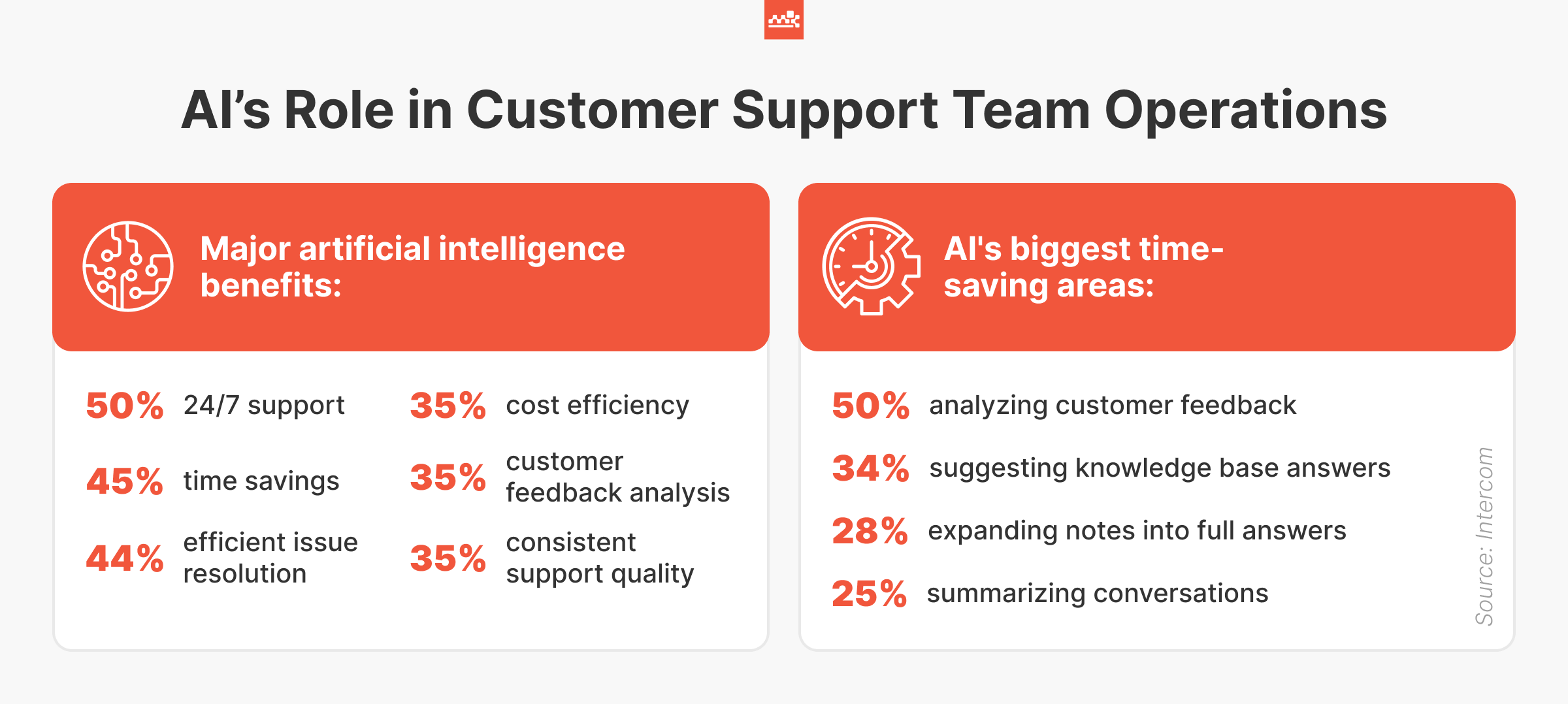
What are the major benefits of implementing AI in customer service roles?
- 36% of experts highlight AI’s role in ensuring 24/7 CS availability.
- 31% appreciate it for saving time and automating manual tasks.
- 30% note this technology helps in responding faster to client support requests, reducing handling time.
- 28% find it handles minor duties, freeing them for complex issues.
- 25% feel artificial intelligence enhances the effectiveness of addressing consumer queries.
- Report an average daily time saving of 2 hours and 20 minutes using chatbots.
- 84% see it simplifies ticket response, with 64% noting increased personalization in correspondences.
- Implementing helpdesk software helps resolve as much as 22% of all service desk tickets for free through automation.
What are the impacts of AI-based applications in contact centers?
- 91% of businesses with artificial intelligence in support units are satisfied with the effects. Moreover, 56% of teams feel more optimistic about the technology enhancing their success compared to last year.
- Key advantages include improved consumer service (69%), decreased wait times (55%), and streamlined workflows (54%). Other benefits are enhanced customer satisfaction (48%) and better use of data and analytics (41%).
- Conversational AI and chatbots have boosted CS specialist’s productivity (94%), sped up issue resolution (92%), and reduced agent effort (87%). Plus, 65% report lowered costs due to higher efficiency.
- Over half (53%) say these capabilities have reduced overall operational costs in their AI-based call centers.
- 40% of support units introduced agent assist, making it the leading AI-powered application. They witnessed a 27% reduction in average handle time with it. Tailored integrations can push these benchmarks even higher. For example, a dedicated case study of the Zipify Agent Assist deployment by Master of Code Global showed a 65% faster response time, 2x faster ticket closure, and a 30% lower operating cost. To help businesses achieve and verify such custom metrics quickly, Master of Code Global offers a structured AI Pilot Program that delivers a testable conversational solution within a 30-day fixed timeline, validating core workflows while reducing initial validation time and costs by roughly 1:3.
- Among those measuring the tool’s impact, 34% see revenue increase, 40% in client ratings, and 32% in team members productivity. Organizations pairing agents with virtual assistants handle 7.7% more simultaneous chats. Additionally, the combination results in an average of $4.3 million in staffing cost savings.
Concerns and Challenges with AI in Customer Service
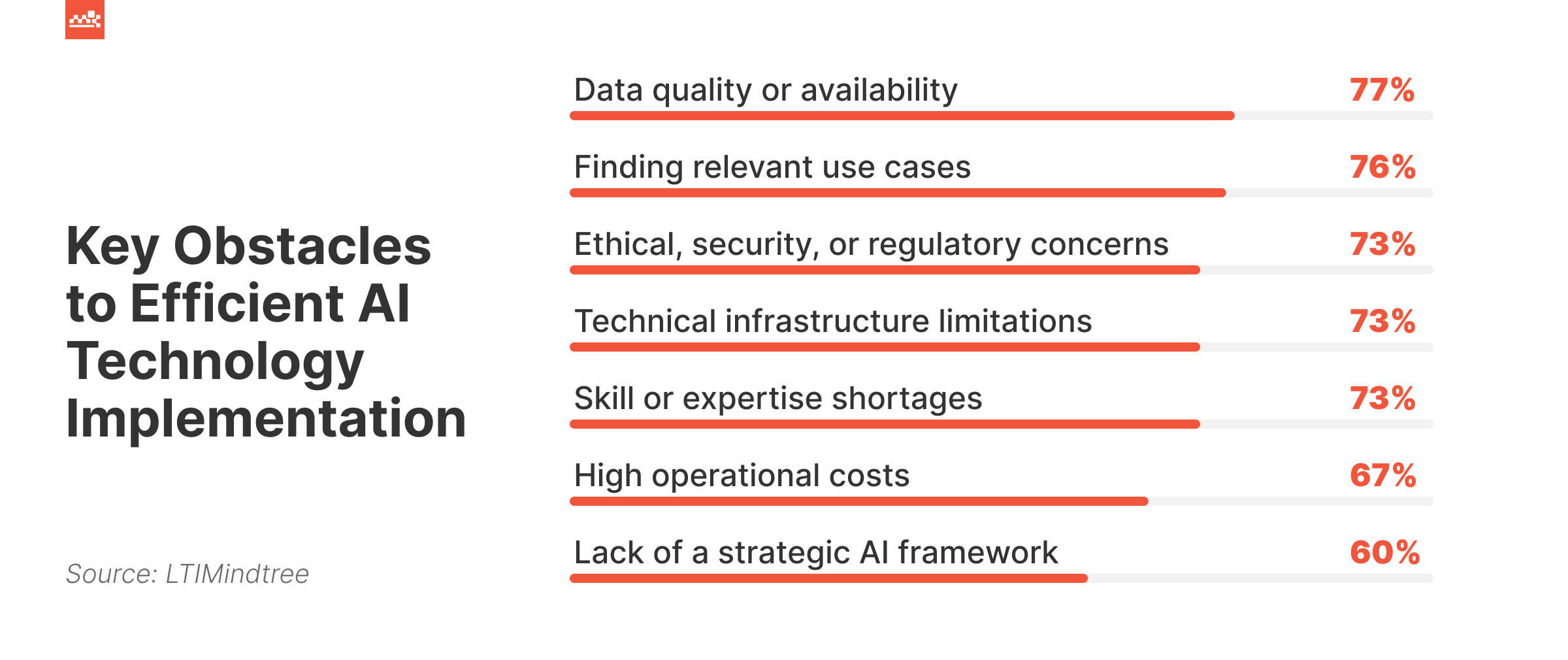
What are the main barriers to using artificial intelligence in CS?
- 45% cite maintaining a personalized experience as a challenge.
- 40% point to occasional inaccuracies in AI tool outputs.
- 32% face difficulties integrating such instruments with existing data and systems.
Why are consumers and support specialists hesitant about businesses using AI?
- 44% of clients prefer interaction with agents over AI, and 36% find it less personal than human service.
- 30% of enterprises don’t want to become overly dependent on the technology; 23% mention cost considerations.
- 39% of CS units worry about artificial intelligence replacing their jobs in the next few years.
- 55% of support teams believe instruments like ChatGPT can provide incorrect information, with only 42% confident in detecting such hallucinations.
What are the perspectives on the transparency of AI use in customer support?
- Over 90% of businesses and consumers agree on the importance of disclosing the use of artificial intelligence in client care.
- 77% of companies and 73% of buyers favor human monitoring of AI. Furthermore, shoppers are more inclined to buy from firms that oversee its usage.
The Future of AI in Customer Support
AI agents are rapidly becoming essential across industries, streamlining operations, enhancing customer experiences, and enabling real-time decision-making—making them a key driver of digital transformation and competitive advantage in today’s business landscape.
What are the main predictions and expectations for artificial intelligence this year and beyond?
- By 2024, most businesses believe AI/automation will assist in various roles, including built-in software, Generative AI, and chatbots.
- 49% of CS professionals already using it think it will independently handle most customer service tasks by 2024. Moreover, 61% agree the majority of specialists will employ the technology in their role.
- Over half of Americans (52.4%) are also optimistic about artificial intelligence improving CS. Anticipations include 24/7 assistance (34.7%), no wait times (19.5%), and reduced phone communication.
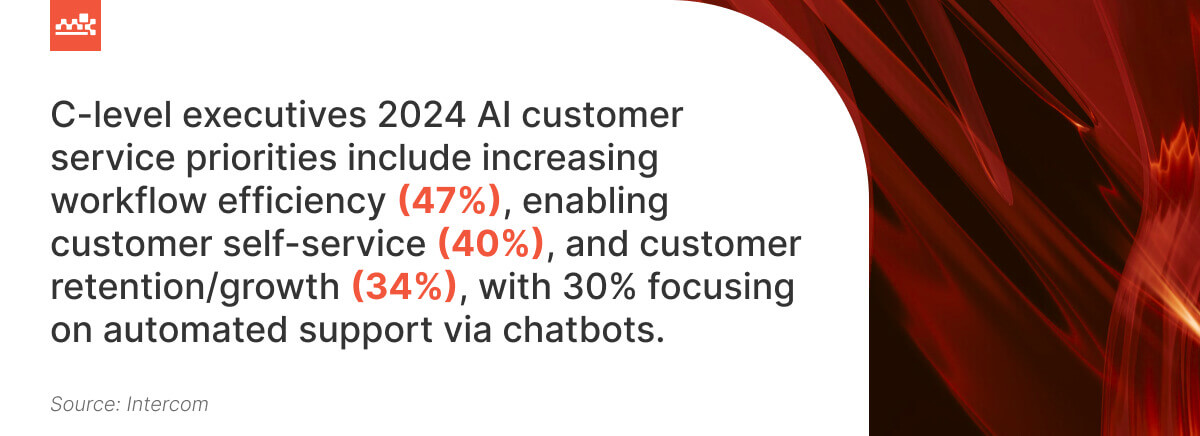
- AI investment trends: 20% of C-level client care execs significantly invested in the technology in 2023, with 70% planning more in 2024. Top funding areas for support teams: AI-powered bots (44%), user behavior analysis (42%), and knowledge base enhancement (29%).
- Forrester predicts that 60% of skeptics will use Gen AI in 2024, knowingly or not.
- Market forecasts show that AI-powered customer service is moving from experimentation toward large-scale investment. MarketsAndMarkets projects that the global market will grow from $12.06 billion in 2024 to $47.82 billion by 2030. This represents a compound annual growth rate of 25.8%.
- The technology itself is also becoming more autonomous. By 2029, Gartner expects agentic AI to close 80% of common customer service requests without human intervention. Gartner links this change to a potential 30% reduction in operational costs. Businesses preparing for this shift need connected data, clear governance, measurable escalation rules, and reliable human oversight.
FAQ
How Much Will AI Cut Contact Center Costs by 2026?
Gartner predicts conversational AI will reduce global contact center labor costs by $80 billion in 2026. The savings are primarily connected to automating high-volume, repeatable interactions.
Do Consumers Trust AI More Than Humans in Customer Service?
No. A SurveyMonkey study found that 79% of Americans strongly prefer speaking with a human rather than an AI customer service agent. 84% also believe human representatives are more accurate.
How Big Will the AI Customer Service Market Get?
MarketsAndMarkets projects growth from $12.06 billion in 2024 to $47.82 billion by 2030. That equals a compound annual growth rate of 25.8%.
What Frustrates Customers Most About AI Service?
Repeatedly explaining the same issue remains a major frustration. According to Zendesk CX Trends 2026, 74% of consumers are frustrated when they must repeat their story to different agents.
Conclusion
Artificial intelligence is a transformative force, offering businesses a complete reinvention of customer interactions. As consumer expectations grow, using AI development services becomes necessary for maintaining a competitive edge. The insights gathered in our article clearly indicate the growing importance of technology in boosting CX. Thus, the question isn’t if AI should be part of your strategy, but rather how quickly and effectively you can integrate it.
Are you prepared to employ AI’s extensive capabilities in your client care framework? Reach out to us, and let’s collaborate to transform your customer service approach, establishing new industry standards together.
Don’t miss out on the opportunity to see how AI can boost your customer support and raise client satisfaction.
Explore how AI voice agents enhance call center operations.