

The gap between retailers who treat AI as a strategy and those still running pilots is widening fast. Companies that have moved AI into production, for demand forecasting, dynamic pricing, virtual try-ons, and personalized customer journeys, are the ones protecting margins, gaining market share, and building loyalty programs that actually bring shoppers back. Generative AI in retail is accelerating this shift across product discovery, promotions, and post-purchase engagement.
But the partner you choose determines whether your investment becomes a revenue driver or a stalled proof of concept. The right vendor understands the complexity that comes with this industry: omnichannel operations, fragmented legacy systems, seasonal demand swings, and the constant pressure to deliver personalization at scale without sacrificing speed or security. They also know that ROI is about time to value – how quickly AI starts moving real KPIs.
This guide compares the top companies serving this sector with one goal: to help you shortlist faster. You’ll find providers ranging from AI consulting services to industry-native platforms, each evaluated on depth of delivery, domain expertise, and ability to drive measurable impact within real workflows.
Table of Contents
Key Takeaways
- The best AI development companies in retail stand out not for model novelty, but for their ability to integrate AI into real systems, including ERP integration, POS integration, supply chain, and omnichannel customer touchpoints, without disrupting operations.
- Retail-specific AI expertise matters. Companies that understand retail analytics, inventory management, visual merchandising, and shopper behavior deliver measurably better ROI than generalist AI firms.
- Production readiness separates winners from stalled pilots. Look for partners with strong MLOps practices, security certifications (ISO 27001, SOC 2), and experience taking AI from PoC to full implementation.
- Integration depth drives ROI. Vendors that connect AI to your existing data pipelines, improve data quality, automate cross-system workflows, and reduce manual processes help retailers move from insight to action faster.
- Evaluate total cost of ownership, not just hourly rates. Factor in implementation timelines, maintenance overhead, scaling costs, and long-term time to value when evaluating partners.
- Start small, but strategically: deploy one production-grade AI workflow to demonstrate adoption and ROI, then scale personalization, analytics, and automation across the organization.
How We Created the List of AI Development Companies in Retail
To keep this catalog practical and easy to scan, we focused on the criteria that matter most when choosing an AI partner: domain expertise, team size, geographic presence, pricing model, minimum project budget (when available), and the depth of the service offering.
We assessed each company’s delivery approach across the full retail AI value chain. That includes how they handle sector-specific challenges like retail analytics accuracy, personalization at scale across channels, supply chain optimization, visual merchandising automation, and customer experience enhancement. We also evaluated how teams move solutions from pilot to production and how they support growth beyond a single business unit or geography.
The companies were selected based on market visibility, documented delivery experience, and clear positioning around AI implementation for the sector. The list includes custom AI development services firms, retail-native SaaS platforms, data science consultancies, and specialized point-solution providers, so you can compare engagement models side by side and shortlist the best fit for your AI roadmap.
We paid close attention to operational maturity, including MLOps practices, security certifications, and the ability to handle retail-specific customer data and compliance requirements. Vendors that modernize data pipelines, reduce data silos, and implement governance tend to scale faster and deliver cleaner outcomes in retail environments, improving total cost of ownership over time.
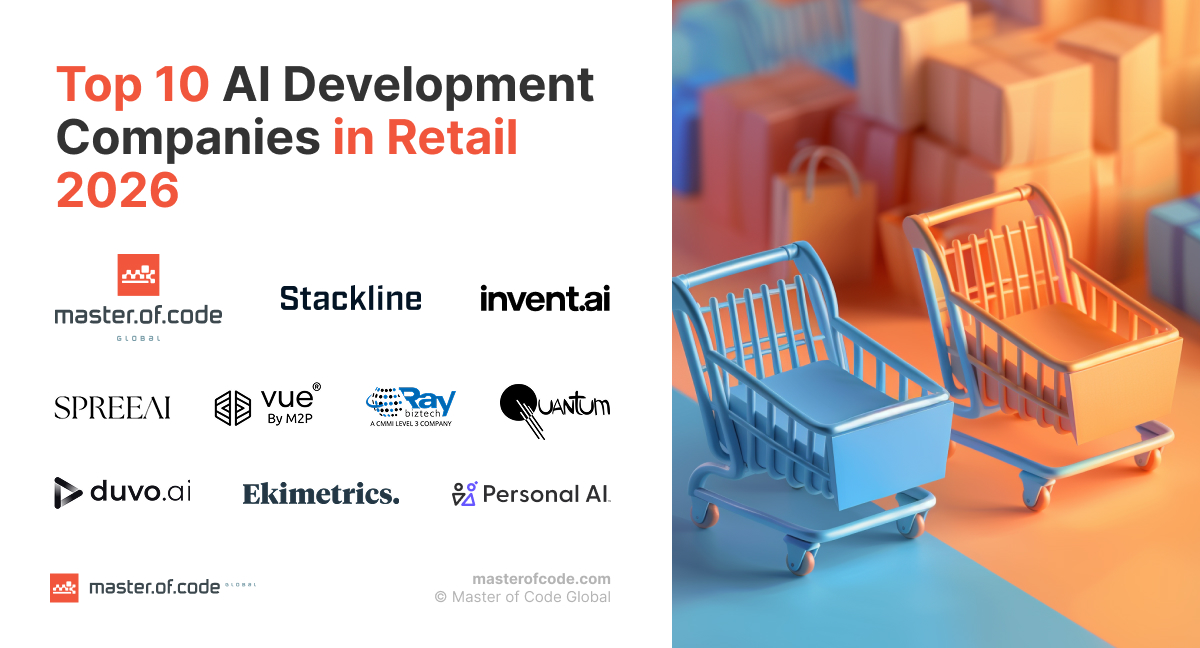
Top 10 AI Development Companies in Retail in 2026
Below is a list of companies, in order of the details retail leaders typically compare first: domain depth, AI capabilities, delivery model, and support maturity.
1. Master of Code Global
Founded: 2004
Headquarters: Redwood City, CA, USA
Team size: 200+
Hourly rate: $50–99 / hr
Minimum project budget: $30,000+
Services: AI consulting, AI chatbot development, Conversational AI, CRM integration, Generative AI, AI agents, voice solutions, custom software development
Master of Code Global is a long-term AI implementation partner with deep retail expertise, focused on production-ready solutions that deliver measurable business outcomes. Over 20+ years, the team has completed 1,000+ projects across industries, including eCommerce, fashion, and beauty, reaching 1B+ users globally. Results include 15× revenue uplift, 3× higher conversions, and 80% improvement in customer satisfaction, providing consistent ROI across retail engagements.
Their retail AI consulting practice covers the full spectrum of use cases: from AI-powered shopping assistants and product recommendations to virtual try-ons, stock optimization, smart promotions, and post-purchase engagement. Conversational commerce in retail is a core focus. Notable projects include an AI chatbot for Tom Ford Beauty that drove $500K in revenue within its first months, a skincare advisor bot for La Mer delivering tailored recommendations, and a Conversational AI in retail concierge for Burberry.
The company’s delivery model emphasizes stability: clients work with the same dedicated team from kickoff to launch, backed by ISO 27001 security practices. Master of Code Global is platform-agnostic, with partnerships across Google Cloud, Salesforce, AWS, and leading CX platforms. Their AI integration services are powered by LOFT (LLM-Orchestrator open-source framework), which accelerates delivery with 43% less setup effort, up to 20% scaling savings, and 3× faster support, reducing time to value when AI must connect to complex ecosystems and omnichannel workflows.

AI Lead Recovery Tool
Master of Code Global developed a multichannel text and voice AI assistant that turns abandoned carts into completed sales
Check out case study
ML Sales Forecasting
We built a bespoke inventory intelligence engine that correlates historical sales data with seasonal trends and harvest cycles
Check out case study
Tom Ford AI Chatbot
Master of Code Global helped Tom Ford Beauty engage their audience during the holiday season and generate new leads with an AI chatbot
Check out case study2. Stackline
Founded: 2014
Headquarters: Seattle, WA, USA
Team size: 250+ engineers, data scientists, and innovators
Hourly rate: Custom / not publicly listed
Minimum project budget: Custom / not publicly listed
Services: AI-enabled intelligence, commerce analytics, media automation, shopper analytics, AI-powered forecasting, content optimization
Stackline is an industry-native AI platform purpose-built for consumer brands selling across Amazon, Walmart, Target, and other major marketplaces. The platform serves over 7,000 brands globally, tracks more than one billion products, and delivers unified insights across sales, advertising, content, pricing, and shopper behavior.
A standout capability is AI Visibility, a first-of-its-kind module that tracks how shoppers discover products via Conversational AI platforms such as ChatGPT and Amazon Rufus. By capturing millions of real shopping questions daily and measuring brand exposure across AI-driven discovery, Stackline gives brands a closed-loop view of how agentic commerce translates into actual business outcomes.
Additional AI-powered products include Advisor (an AI agent that connects sales, media, and shopper data to answer questions and deliver action plans with forecasted returns), Beacon (unified insights with 52-week SKU-level forecasts), and Ad Manager (dynamic media automation).
Worth noting: Stackline is a product company, not a services provider; it cannot be hired for custom AI development. Its intelligence is tightly coupled to the Amazon/Walmart ecosystem, and enterprise-tier pricing may put it out of reach for smaller brands.
3. Ekimetrics
Founded: 2006
Headquarters: Paris, France
Team size: 500+ data scientists and consultants
Hourly rate: Custom / not publicly listed
Minimum project budget: Custom / not publicly listed
Services: Data science and AI consulting, Marketing Mix Modeling, customer analytics, AI deployment, data engineering, sustainability, and ESG analytics
Ekimetrics is a global data science and AI consultancy that helps large organizations operationalize analytics across business functions, with particular expertise in retail, luxury, beauty, and consumer goods. Since 2006, the company has delivered 1,000+ projects across 50+ countries, working with brands including LVMH, L’Oréal, Carrefour, Estée Lauder, and Accor.
Ekimetrics focuses on turning data into repeatable decision systems, particularly in marketing effectiveness (Marketing Mix Modeling), customer analytics, omnichannel optimization, and pricing strategy. Their platform-plus-services model supports AI deployment at scale across enterprise workflows, with a proprietary tech stack designed to streamline deployment and operations.
Worth noting: Ekimetrics operates at premium consulting rates (estimated $150–199/hr) and has no Clutch service profile for independent review comparison. Its delivery model is consulting-heavy – clients receive analysis, strategy, and models but may need separate partners for production engineering and deployment.
4. Vue.ai
Founded: 2016
Headquarters: San Francisco, CA, USA (also Chennai, India)
Team size: 100+
Hourly rate: Enterprise pricing; Virtual Dressing Room starts at $30,000/license
Minimum project budget: Custom / not publicly listed
Services: Enterprise AI orchestration platform, visual merchandising, product tagging and catalog enrichment, personalized recommendations, virtual try-on, AI styling, on-model image generation
Vue.ai is an enterprise AI orchestration platform built specifically for e-commerce. The platform brings together data, models, workflows, and AI agents into a single composable system designed to deliver business outcomes across site merchandising, product management, marketing operations, and customer personalization. The company serves 150+ enterprises across five continents.
Vue.ai offers a suite of AI-powered capabilities: automated product tagging and catalog enrichment, personalized product recommendations, AI-driven outfit curation (Complete the Look), and a Human Model Generator that creates on-model imagery at roughly one-quarter the cost of traditional photoshoots. The platform’s virtual try-on technology and AI Stylist help shoppers visualize clothing in a lifelike way, boosting conversion rates and average order values.
Worth noting: Vue.ai’s strengths skew heavily toward fashion and apparel, which limits broader retail applicability. Visual AI for product tagging and virtual try-on is an increasingly crowded space, with competitors like Syte, ViSenze, and Lily AI offering overlapping capabilities.
5. Duvo.ai
Founded: 2024
Headquarters: Dover, DE, USA (also Prague, Czech Republic)
Team size: 15 (rapidly growing after $15M seed round)
Hourly rate: Custom / subscription-based
Minimum project budget: Custom / six-figure annual contracts reported
Services: AI-native automation for retail operations, AI agents for SAP/ERP, supplier management, demand planning, promotions, margin reviews, vendor onboarding
Duvo.ai is a retail-focused AI automation platform that gives operations teams an AI workforce for day-to-day tasks across SAP, Oracle, supplier portals, email, and spreadsheets. Co-founded by Tomas Čupr (founder of Rohlik Group, one of Europe’s fastest-growing online grocery platforms), Duvo is built from direct operational experience inside multi-billion-dollar retail enterprises.
The platform ships with ready-made AI assistants for common pain points: weekly margin reviews, promotion activation and price changes, supplier invoice reconciliation, assortment optimization, and vendor onboarding. Business users describe tasks in plain language; the AI agents execute across systems using browser automation, with built-in governance, audit trails, and human-in-the-loop approvals. This approach supports both in-store execution and back-office operations.
Worth noting: As a 2024-founded company with a 15-person team, Duvo.ai has a very limited commercial track record. While the founder’s operational pedigree is strong, the platform is still early-stage, and publicly verifiable case studies and client references are scarce.
6. SpreeAI
Founded: 2022
Headquarters: New York, NY / Los Angeles, CA, USA
Team size: Not publicly listed
Hourly rate: Custom / not publicly listed
Minimum project budget: Custom / not publicly listed
Services: Photorealistic virtual try-on, AI-powered sizing technology, AI stylist, virtual wardrobe, in-store and online retail integration
SpreeAI is a fashion technology company specializing in photorealistic virtual try-on experiences. The platform uses advanced computer vision and Generative AI to let shoppers see themselves wearing clothing in lifelike imagery, technology so realistic that, according to the company, it is indistinguishable from actual photography to the naked eye.
Combined with sizing technology that claims 99% accuracy, SpreeAI delivers hyper-personalized shopping experiences for both online and in-store environments. The company has secured partnerships with notable fashion brands, including luxury label Sergio Hudson and London-based womenswear brand Kai Collective. It is backed by the Council of Fashion Designers of America (CFDA).
Worth noting: SpreeAI is an early-stage company with limited major retailer deployments to date. The virtual try-on space is increasingly competitive, with Walmart (via Zeekit), Google, and Snap all investing in similar capabilities. Accuracy across diverse body types remains a recognized industry challenge.
7. Personal AI
Founded: 2020
Headquarters: La Jolla, CA / San Francisco, CA, USA
Team size: 25+
Hourly rate: Custom / not publicly listed
Minimum project budget: Custom / not publicly listed
Services: Small Language Model platform, AI personas and teammates, memory-powered AI, edge AI deployments, enterprise knowledge management
Personal AI is a Small Language Model (SLM) platform that enables businesses to create, train, and deploy specialized AI teammates with deep proprietary knowledge. While the company is not exclusively retail-focused, its platform offers compelling applications for operations, especially in building AI personas that embody brand voice, product expertise, and customer engagement protocols at scale.
The platform is centered around a proprietary Memory Core that transforms accumulated interactions and experiences into a persistent, evolving AI identity. This means brands can train AI teammates on product catalogs, company values, customer service protocols, and sales strategies, creating AI that becomes more personalized and effective over time rather than relying on static knowledge bases.
Worth noting: Personal AI is not exclusively retail-focused; its platform is horizontal, and retail use cases are secondary to its core personal knowledge management offering. The concept of brand-specific Small Language Models is still niche, with limited enterprise adoption evidence in commerce settings.
8. Quantumobile (Quantum)
Founded: 2011
Headquarters: Kyiv, Ukraine
Team size: 100+
Hourly rate: $25–50 / hr
Minimum project budget: Custom / not publicly listed
Services: AI and ML development, Generative AI, LLM development, computer vision, custom AI agent development, data science, web and mobile development, dedicated teams
Quantumobile (trading as Quantum) is an AI development company with over a decade of experience building data-driven solutions across industries, including retail, e-commerce, healthcare, and fintech.
The company operates a Data Science Center of Excellence and specializes in LLM-powered solutions built on the RAG architecture and agentic AI. Their services cover the full AI lifecycle: strategy, use case design, architecture, development, deployment, and ongoing support. Quantum offers flexible engagement models, including dedicated teams, solution development, and technology consulting, making them accessible to both startups and enterprise retailers.
Worth noting: Quantum has very few Clutch reviews relative to its portfolio breadth, and its team size is not publicly disclosed. The company’s brand name creates search confusion with quantum computing firms. While its data science and computer vision work is solid, Quantum’s brand name creates some search overlap with quantum computing firms, and its visibility outside specific niches (agricultural AI, energy forecasting) is more limited compared to retail-native competitors.
9. Ray Business Technologies
Founded: 2009
Headquarters: Plano, TX, USA (also Hyderabad, India; Melbourne, Australia; Toronto, Canada)
Team size: 250+
Hourly rate: $25–49 / hr
Minimum project budget: Custom / not publicly listed Services: AI and ML solutions, Microsoft Dynamics 365 (ERP/CRM), Boomi integration, data analytics, Power BI, cloud solutions, digital transformation
Ray Business Technologies (RBT) is an ISO CMMI Level 3 and ISO 27001-certified IT services company that combines AI capabilities with deep enterprise systems expertise, particularly in the Microsoft ecosystem. RBT helps organizations deploy Dynamics 365 for operations, integrating AI-driven analytics, automation, and CRM into existing workflows.
With offices across the US, Australia, India, Canada, and the Philippines, RBT operates a global delivery model that keeps costs competitive. Their Boomi integration expertise is particularly relevant to enterprises facing fragmented data across multiple systems. The company serves BFSI, healthcare, manufacturing, and commerce verticals, with case studies demonstrating 80% efficiency improvements through ERP implementation.
Worth noting: RBT is heavily centered on the Microsoft/Boomi ecosystem, which may not suit projects requiring open-source or non-Microsoft stacks.
10. Grid Dynamics
Founded: 2006
Headquarters: San Ramon, CA, USA
Team size: 4,961
Hourly rate: Custom / not publicly listed
Minimum project budget: Custom / not publicly listed
Services: Enterprise AI, generative and agentic AI, data engineering, cloud modernization, product engineering, digital commerce, IoT, computer vision, MLOps, and managed services
Grid Dynamics is a publicly traded technology consulting and engineering company focused on enterprise AI transformation. Its services cover the full implementation cycle, including AI readiness, use case selection, infrastructure development, deployment, and enterprise-wide scaling. The company also builds data platforms, multi-agent systems, predictive models, knowledge assistants, and AI-powered customer experiences.
The company works primarily with large enterprises and Fortune 1000 organizations. Its industry experience spans retail, technology and telecommunications, financial services, manufacturing, healthcare, and pharmaceuticals. Retail capabilities include intelligent search, personalized recommendations, catalog enrichment, merchandising, composable commerce, inventory management, and omnichannel fulfillment.
Grid Dynamics operates a global delivery model across the Americas, Europe, and India. As of December 31, 2025, it had 4,961 employees and contractors. The company also works with cloud and technology providers such as Google Cloud, AWS, Microsoft Azure, and NVIDIA.
Worth noting: Grid Dynamics focuses on large enterprise and Fortune 1000 engagements. Its scope combines AI development with data platforms, cloud engineering, digital commerce, and broader transformation programs.
How to Make the Right Choice
Choosing among the top AI development companies in retail is not about picking the most impressive feature set or the lowest price. It’s about selecting a partner who can integrate AI into your specific environment, data, channels, legacy systems, and compliance requirements, without disrupting business continuity during peak seasons or across geographies.
Start by pressure-testing partner fit across five dimensions:
- Retail integration depth: Can they connect AI to your ERP, CRM, POS, and operational tools with clean, scalable interfaces? Deep integration is where most AI projects either accelerate or stall.
- Data quality and readiness: Do they assess and improve your data foundations before layering AI on top? Retailers with fragmented data across channels need a partner who can first modernize their pipelines and reduce silos.
- Delivery model and implementation track record: Do they run structured phases that reduce rework and keep stakeholders aligned? Look for clear milestones, defined KPIs, and a history of successful deployments.
- Value proof and ROI commitment: Do they define success criteria upfront and commit to measurement tied to real workflows? The best partners don’t just promise impact — they prove it with metrics that matter to your P&L.
- Total cost of ownership and execution realism: Can they drive use case identification and deliver a production slice that demonstrates adoption, not just feasibility? Factor in maintenance, scaling costs, and long-term support.
Conclusion
Don’t start with the vendor – start with the problem. Map the use case that would have the most immediate impact on your margins, customer experience, or operational efficiency. Then evaluate which partner can get that first win into production fastest, with the lowest risk and clearest path to scale. The companies that succeed with AI aren’t the ones that chose the flashiest technology. They’re the ones who chose a partner who understood their business well enough to deliver outcomes that mattered.