


Let’s get straight to what this article is actually about. We researched 7 real AI logistics examples: companies each dealt with a specific operational problem. For each one, we broke down what the challenge was, how they solved it using artificial intelligence in logistics tools, and what that solution delivered. You’ll also find practical guidance on how to move in that direction yourself.
That matters because knowing AI works isn’t the hard part anymore. Knowing where to start in your own operation is. These AI use cases in logistics cover the problems the sector is actually struggling with right now. Moreover, they show what realistic AI logistics ROI looks like when the approach is right. If anything raises questions about your specific situation, our experts are happy to help.
Table of Contents
Key Takeaways
- AI in logistics adoption is accelerating across the industry. Companies like Ryder, Walmart, UPS, Maersk, and C.H. Robinson are running production deployments across forecasting, fraud detection, visibility, and automation with documented productivity and cost outcomes.
- The highest-impact use cases share a common pattern: high transaction volume, predictable inputs, and a measurable cost of error. Route optimization, predictive maintenance, and freight classification all fit that profile.
- Artificial intelligence in logistics isn’t one system. It’s a stack of specialized tools each solving a specific problem that compound in value as they share data and feed into each other.
- AI inventory management and dynamic pricing logistics are moving from large-enterprise capabilities to accessible builds for mid-size operators, as pre-built infrastructure and scoped pilots compress both cost and deployment time.
- The gap most companies face isn’t technology availability. It’s knowing which processes are actually ready for AI in logistics automation and building in the right sequence. Master of Code Global can help businesses close that gap through stakeholder interviews, process mapping, and prioritized build plans that fit what the operation can actually execute.
AI Use Cases in Logistics: What Companies Are Actually Building
The pressure on these companies right now is real: tighter margins, labor shortages, rising customer expectations, and supply chains that seem to find new ways to break. AI in logistics is becoming the practical answer to these pressures as a set of working tools that companies are deploying today.
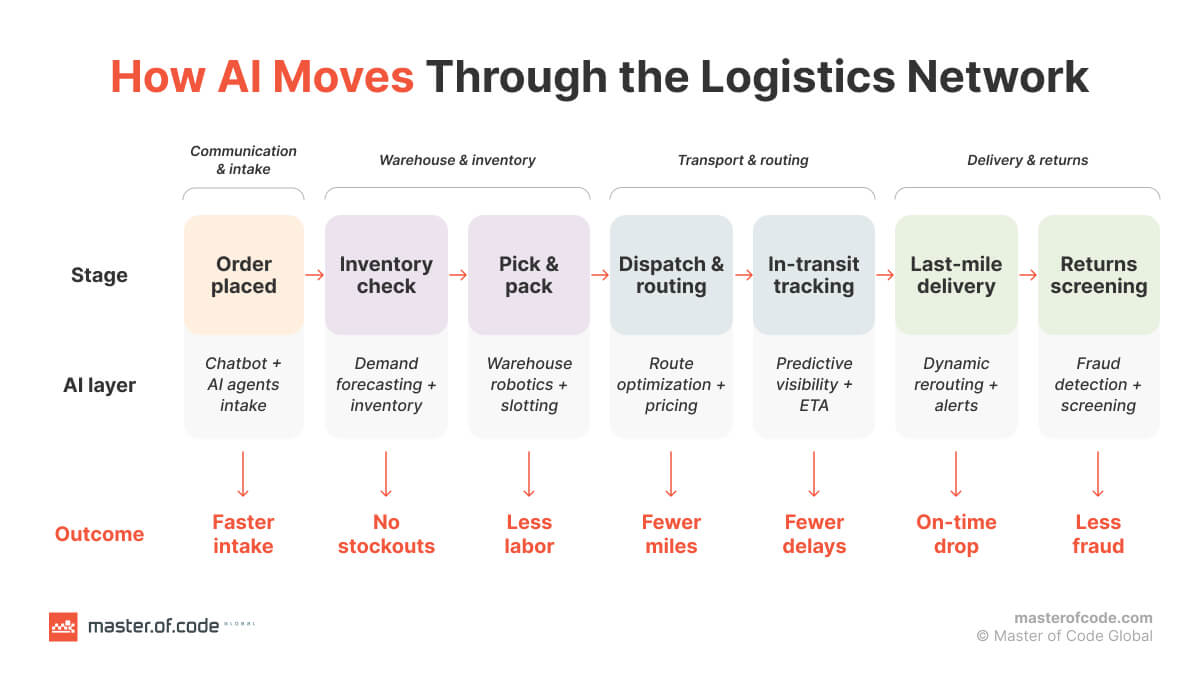
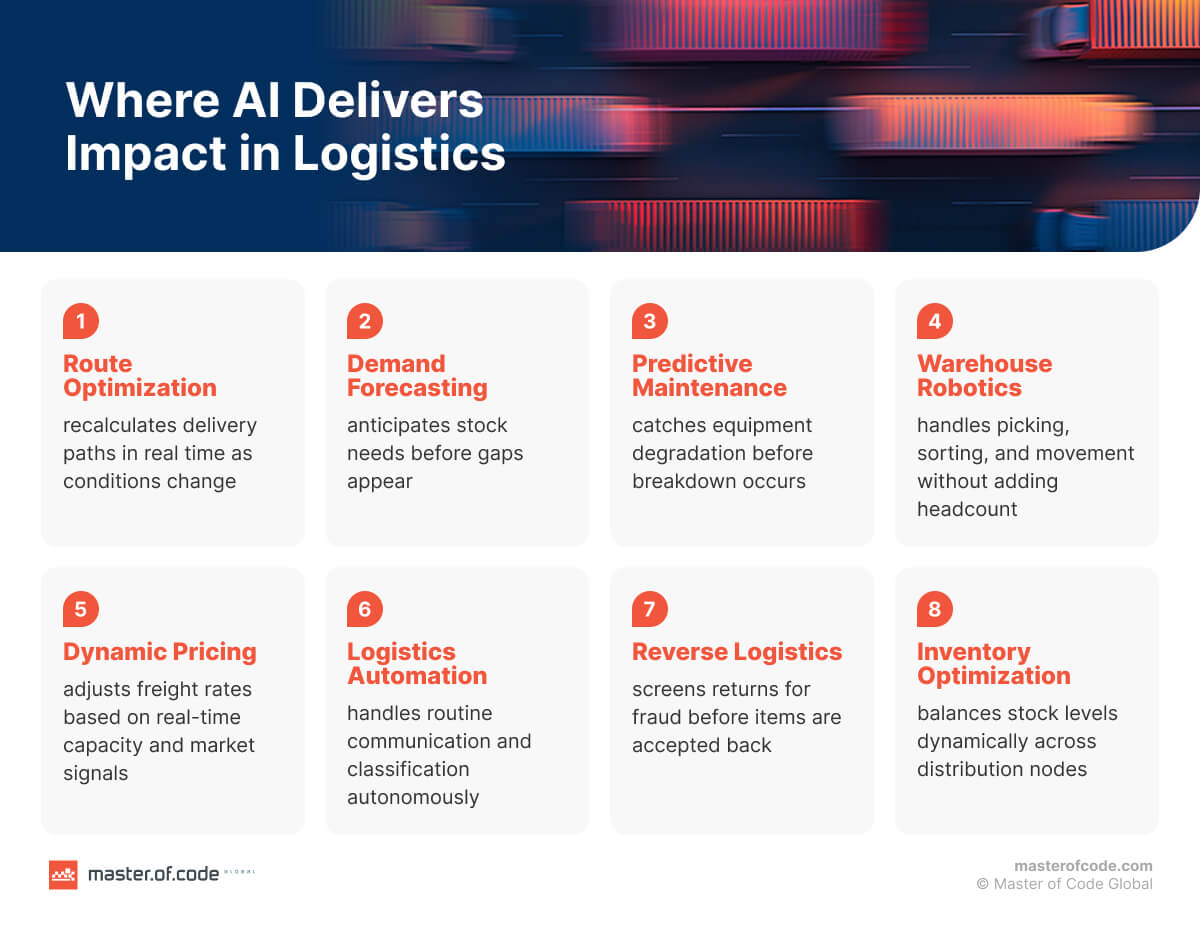
Here are the AI use cases in logistics industry that are gaining the most traction:
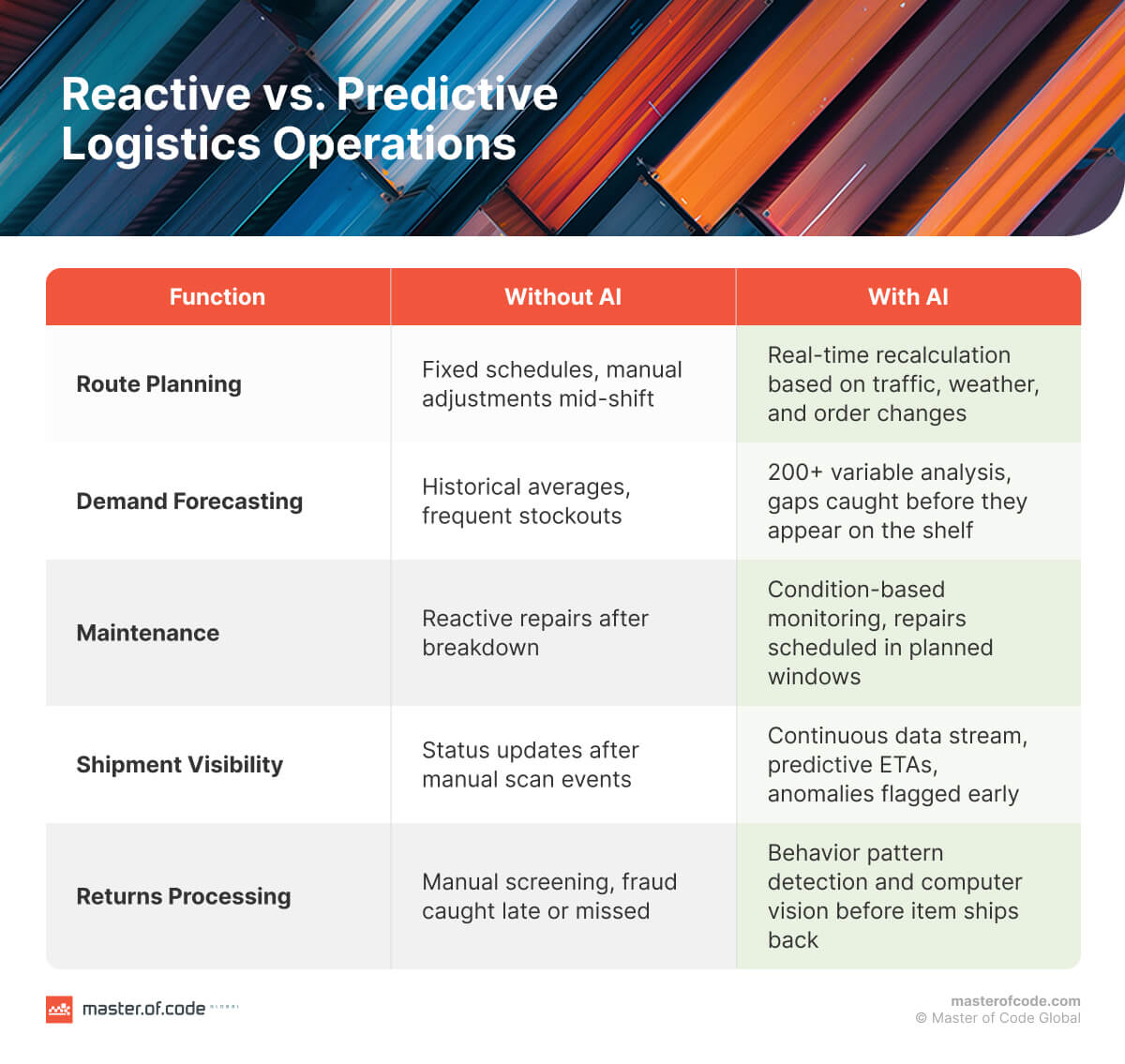
- Dispatchers spending hours manually juggling delivery schedules are turning to multi-constraint route optimization that recalculates in real time as traffic, weather, and last-minute order changes come in.
- Warehouses struggling to keep up with order volume and unpredictable demand are using AI-driven demand forecasting to anticipate what stock is needed, where, and when before the gap appears on the shelf.
- Operations teams watching maintenance costs spiral are deploying condition-based predictive maintenance, catching equipment degradation early and scheduling repairs during planned windows rather than scrambling after a breakdown.
- Fulfillment centers dealing with chronic labor shortages are bringing in AI-guided warehouse robotics to handle picking, sorting, and inventory movement without adding headcount.
- Finance and pricing teams losing ground on competitive freight lanes are applying AI dynamic pricing logistics models that adjust rates based on real-time capacity and market signals, replacing static rate cards that are outdated before the ink dries.
- Brokers and carriers drowning in inbound emails, quote requests, and tracking queries are using AI logistics automation to handle routine communication autonomously, freeing up teams for higher-value work.
- Retailers and 3PLs absorbing growing return volumes are building AI-powered reverse screening to catch fraud early and process returns faster without scaling their operations teams proportionally.
- Companies managing inventory across multiple distribution nodes are applying inventory optimization to balance stock levels dynamically, reducing the carrying costs of overstocking and the revenue impact of running short.
The thread connecting all of these is the same: teams are using GenAI, predictive analytics, LLMs, and machine learning in logistics to get ahead of problems that used to catch them off guard, and to take repetitive, time-consuming work off the plates of people who have better things to do.
AI Logistics Examples: 7 Companies, 7 Problems, 7 Solutions
Company #1: Ryder System
The problem
Ryder is one of North America’s largest 3PLs, operating over 100 million square feet of warehouse space. When Steve Sensing, Ryder’s President of Supply Chain and Dedicated Transportation Solutions, spoke to DC Velocity, he described the market as being in its “ninth quarter of freight recession,” customers cutting volumes, tightening budgets, and demanding cost reduction above all else.
Alongside that, labor pressure was mounting. Clients couldn’t staff omnichannel fulfillment operations and were turning to their 3PL for automation to compensate. “Customers are concerned about getting people,” Sensing said, “so they look to us for both technology and automation solutions as well as innovative hiring and retention programs.”
How They Are Addressing It
Ryder has responded by investing over $1.7 billion in technology since 2018, building proprietary platforms, like RyderShare, RyderView, and RyderGyde, for supply chain visibility, last-mile tracking, and fleet management. On the warehouse side, roughly 40% of Ryder’s facilities now have some form of automation deployed, up from single digits a decade ago.
Applying This in Your Operations
Labor forecasting and workforce automation are common pain points across logistics felt by regional 3PLs, eCommerce fulfillment operators, and dedicated carriers alike. The challenge isn’t always the technology itself; it’s knowing where to start and which processes are actually ready for automation.
Master of Code Global’s supply chain AI consulting addresses exactly that gap. The engagement covers:
- stakeholder interviews and process mapping to document how work actually flows,
- use case identification and prioritization to separate high-impact opportunities from noise, and
- AI strategy and roadmap development to define a build sequence grounded in real operational constraints.
The outcome is a clear picture of where AI in logistics delivers measurable value and a plan that fits the company’s actual capacity to execute.
Company #2: C.H. Robinson
The problem
C.H. Robinson is one of the world’s largest freight brokers, orchestrating shipments for 83,000 customers annually. When Dave Bozeman took over as CEO in 2023, he found a company running much of its order-to-cash process on manual effort: quote requests answered by hand, appointments scheduled person-to-person, freight classified individually for each shipment.
“Our business model is really an order-to-cash process. But in reality, it’s a very physical process; there’s friction on all of [the steps in the process].” Bozeman told Semafor. Too much of that process depended on human labor for tasks that produced no strategic value, making it impossible to grow volume without growing headcount in parallel.
How They Are Addressing It
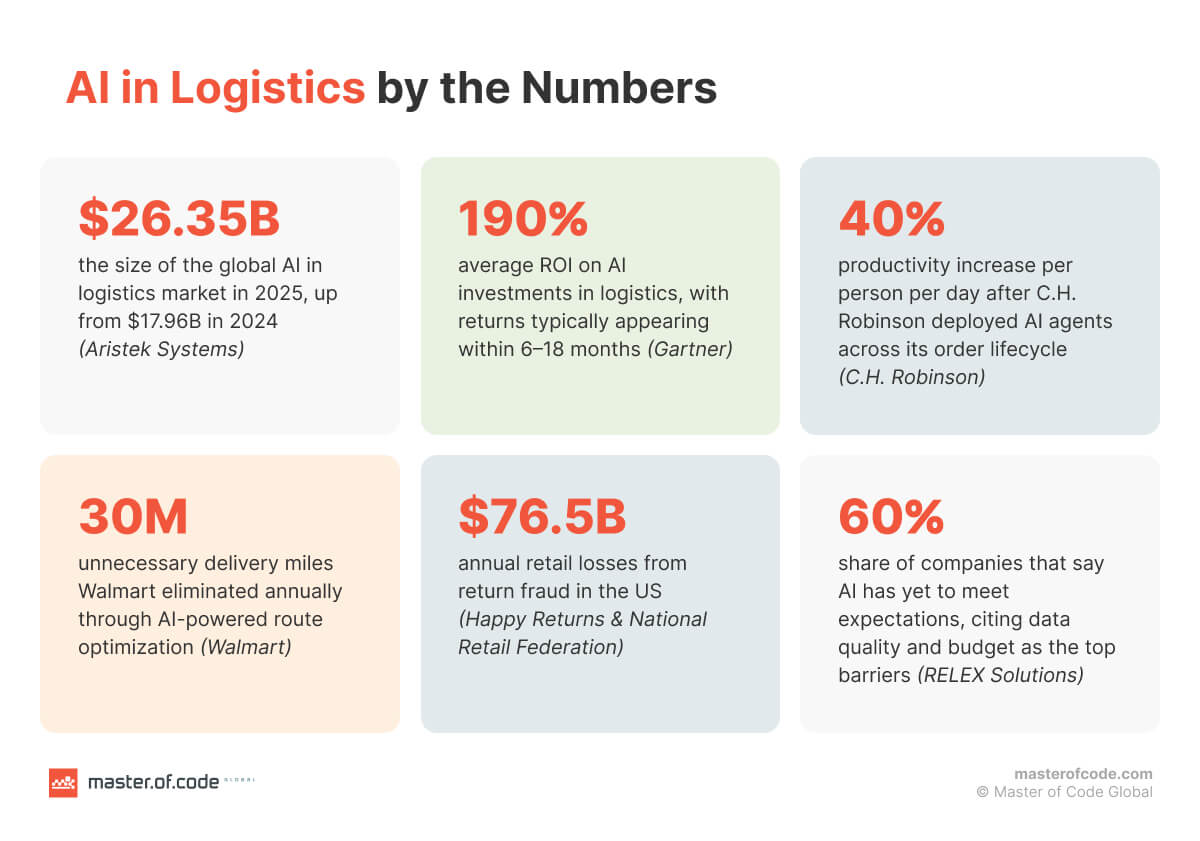
C.H. Robinson built an in-house AI layer covering the most repetitive parts of their operations. Today, over 30 AI agents handle tasks across the order lifecycle, from reading and sorting customer emails to freight classification and shipment tracking. The company has processed over 3 million shipping tasks through Generative AI and achieved a 40% productivity increase per person per day.
Applying This in Your Operations
Manual, low-value work in freight functions is not unique to large brokers. Mid-size freight operators, regional forwarders, and growing logistics businesses face the same bottleneck, just without the internal engineering capacity to solve it at scale. For companies at that stage, the right starting point is often understanding what to build before committing to how.
Master of Code Global’s agentic AI development services cover the full path from identifying the highest-friction workflows to deploying intelligent agents that connect to existing systems and execute tasks autonomously. The focus is on processes where the input is predictable, the output is well-defined, and a human’s time is genuinely better spent elsewhere.
Company #3: Walmart
The problem
Walmart serves over 275 million customers weekly across roughly 10,500 locations worldwide, making supply chain disruption one of its most expensive operational risks. Weather events, geopolitical shifts, and inbound inventory quality issues can cascade across a network of that scale in ways that are nearly impossible to manage manually.
Indira Uppuluri, SVP of Supply Chain Technology at Walmart, put it plainly in an interview with Supply Chain Dive: “End to end, every segment of what we do is driven by some form of intelligence.” That statement reflects not an aspiration but a necessity: at Walmart’s volume, reactive supply chain management is simply not viable.
How They Are Addressing It
Walmart has built a layered AI infrastructure covering demand forecasting, inventory placement, inbound quality control, and disruption response. Computer vision identifies quality issues at inbound receiving, from damaged goods to expired products.
AI-powered route optimization has eliminated 30 million unnecessary delivery miles annually. The company’s agentic AI framework handles autonomous decision-making during disruptions, allowing the network to adapt in real time rather than waiting for human intervention.
Applying This in Your Operations
Real-time disruption response and demand forecasting are priorities for retailers and logistics operators well below Walmart’s scale, particularly those managing multi-node distribution networks or seasonal volume spikes. Building that capability from scratch, however, requires more than selecting a tool. It starts with understanding where current visibility gaps sit and which forecasting failures cost the most.
Master of Code Global’s GenAI solutions address this by translating data into working intelligence. Systems surface anomalies early, model disruption scenarios, and feed actionable signals to the teams responsible for acting on them. What makes this work in practice is the combination of conversation design expertise and deep system integration experience. We build solutions that fit into the operational workflows where decisions actually get made.
Company #4: UPS
The problem
UPS is one of the world’s biggest parcel carriers, processing millions of shipments daily across more than 220 countries. As eCommerce volumes grew, so did one of its most expensive operational headaches: returns.
Carol Tomé, UPS CEO, was direct about the scale of the issue on a Q1 2026 earnings call: “Returns are the nemesis of anybody who’s in the eСommerce space. In fact, 19% of all eCommerce sales are returned.”
Beyond the volume, the quality problem compounds the cost. Return fraud alone accounts for an estimated 9% of all retail returns in the US, totaling roughly $76.5 billion in annual losses to retailers, according to a 2025 report by Happy Returns and the National Retail Federation.
How They Are Addressing It
UPS developed Return Vision, an AI fraud detection tool piloted in late 2025. The system flags suspicious returns based on shopper behavior patterns. Then it uses computer vision to compare returned items against retailer catalog images, catching discrepancies that human workers in high-volume warehouses would routinely miss.
Applying This in Your Operations
Returns fraud and reverse logistics inefficiency are not problems exclusive to carriers at UPS’s scale. Any retailer or operator handling significant eCommerce volume faces the same combination of cost and complexity. For companies building or improving their returns infrastructure, the question is rarely whether AI can help; it is what to build first and how to validate it before full deployment.
Master of Code Global’s AI Pilot Program is designed for exactly that stage. It’s a fixed-scope, fixed-budget engagement that delivers a working proof of value in 30 days. The process starts with a discovery phase covering technical fit, legal exposure, security, and business case, followed by a focused build with a cross-functional team. At the end, you walk away with a tested solution, a clear architecture, and a data-backed decision on whether to scale.
Company #5: Maersk
The problem
Maersk operates across more than 130 countries, connecting ocean freight, warehousing, and supply chain services into one integrated network. Running that network means managing data from hundreds of suppliers, transport modes, and destinations simultaneously.
Jacco Weterings, Global Head of Integrated Supply Chain Engine at Maersk, describes the core difficulty: “When we think about the supply chain, people often draw it as a linear chain. In reality it’s a network with multiple factories, multi-tier level suppliers, different components coming together, going to different destinations. This multiplies the data and increases the complexity exponentially. The challenge is to gather data from all different sources and somehow make sense of it.”
How They Are Addressing It
Maersk has been applying GenAI to forecasting, capacity planning, and pricing optimization since 2024, with Ashish Saxena, SVP of Supply Chain, noting the company now has “ample proof points where we have successfully applied Generative AI in supply chain decision-making.” Maersk has also reduced its market adaptation time from months to weeks by continuously reconfiguring its ocean and logistics networks using AI-assisted planning tools.
Applying This in Your Operations
Fragmented data and the gap between AI awareness and actual implementation are challenges shared by freight forwarders, regional carriers, and supply chain operators of all sizes. Most have data sitting in disconnected systems with no single layer making sense of it.
For companies at that stage, Master of Code Global’s Generative AI in supply chain capabilities focus on connecting those data sources into coherent, actionable intelligence: systems that support planning decisions, surface risks early, and reduce the manual work of interpreting signals across fragmented operations. The work starts from the existing data landscape, not from a clean-slate assumption, which is precisely what makes it deployable in real environments rather than controlled demos.
One example of this approach in practice is a GenAI data collection flow we built for a client managing high volumes of incoming operational data across multiple channels. The solution aggregated unstructured inputs in real time, interpreted them contextually, and delivered structured insights to the teams responsible for resolution, resulting in:
- +25% more cases resolved without escalation
- -18% less time spent per case
- +10 NPS points.
Company #6: Kuehne+Nagel
The problem
Kuehne+Nagel handles freight forwarding and logistics operations across more than 100 countries, moving millions of shipments annually by air, sea, and road. At that scale, shipment visibility becomes a persistent operational weakness. Most tracking solutions in the industry are reactive: they tell customers where a shipment is after someone scans it, not where it is between scans.
Alireza Nemati, Global Head of Road Logistics Innovation, put the limitation plainly: “Many visibility solutions focus on reducing time spent on track-and-trace conversations. The real value lies in the efficiency gains driven by automation and in enabling proactive decision-making through AI in logistics.”
How They Are Addressing It
Kuehne+Nagel build a barcode-free smart label system called Max Visibility. Printable labels equipped with sensors transmit real-time location and condition data to the cloud, where AI processes the inputs to deliver predictive ETAs at item level.
Applying This in Your Operations
Reactive visibility is a problem shared by companies that rely on manual scan events to track goods in transit. Most businesses have more data available than they are currently using; the gap is in how it gets collected, connected, and acted on. Building a system that monitors shipment data continuously, detects anomalies early, and triggers the right response without manual intervention requires custom architecture tailored to the specific data sources and workflows involved.
As a custom AI development company, Master of Code Global designs and builds those systems from the ground up, working with the data infrastructure a company already has rather than requiring a clean slate. The outcome is a visibility layer that moves from recording what happened to flagging what is about to.
What accelerates that process is having a dedicated AI team that brings cross-industry experience to the table. Having built similar data collection and monitoring systems across multiple sectors, our engineers recognize failure patterns, integration bottlenecks, and architectural tradeoffs before they become project risks.
Company #7: Transfix
The problem
Transfix is a New York-based digital freight marketplace connecting shippers with a network of over 30,000 carriers. As the platform grew, so did its exposure to a problem spreading across the entire freight industry: identity fraud. Bad actors began impersonating legitimate brokers, offering loads to carriers, collecting the freight, then vanishing before payment was due, leaving carriers unpaid and shippers exposed.
Jonathan Salama, CEO and co-founder of Transfix, described the scope plainly in an interview with FreightWaves: “Fraud affects everyone. It’s like a full circle that begins with the shippers, brokers, carriers that are moving the freight. When fraud happens in the freight industry, it costs brokers, carriers and ultimately it costs regular consumers, because it gets passed on to consumers.”
According to the Transportation Intermediaries Association, freight fraud has grown into an $800 million industry problem, with double brokering activity increasing by 400% in some regions. 78% of brokers now cite identity fraud as a top business challenge.
How They Are Addressing It
In March 2024, Transfix launched Transfix Shield, a proprietary fraud prevention suite covering both broker and facility-level verification. RateCon Shield detects bad actors impersonating legitimate freight brokers before a load is accepted. Facility Shield adds a validation layer at the shipper facility level.
The tools use proprietary identity verification systems built specifically for the freight marketplace context, and Salama has been vocal that the industry needs to treat this as a collective problem, not a competitive one: “Fraud is an issue that will never get solved unless we all come together as an industry.”
Applying This in Your Operations
Freight identity fraud is not a problem exclusive to large digital marketplaces. Regional brokers, mid-size carriers, and independent freight operators face the same exposure, often with less infrastructure to detect it. The pattern recognition required to catch fraud before it causes damage, such as flagging unusual load acceptance timing, mismatched carrier identity signals, or behavioral anomalies across transactions, is precisely the kind of problem machine learning in logistics is built to solve.
Master of Code Global’s machine learning consulting helps logistics businesses define the right data inputs, select and train the appropriate detection models. We also integrate fraud scoring into existing workflows, so the system flags risk in real time rather than after the fact.
The Future of Logistics AI: What Comes Next
The deployments covered in this article represent where the industry is today. What’s forming now is a different kind of shift. It’s less about adding AI to individual workflows and more about building logistics networks where intelligence is structural rather than bolted on.
From task automation to decision infrastructure. The current generation of logistics AI solves discrete problems: a route, a forecast, a fraud flag. The next layer connects those outputs into a continuous decision loop. It’s where inventory signals feed pricing models, pricing models inform carrier allocation, and carrier data feeds back into demand planning. Most operators aren’t there yet, but the companies investing in data architecture now are building the foundation that makes it possible.
Consolidation of fragmented visibility. The data problem Maersk’s Jacco Weterings described: multiple factories, multi-tier suppliers, different destinations, exponentially multiplying data, is not unique to global shipping. Regional carriers and mid-size 3PLs face the same fragmentation at smaller scale. As AI-native data layers become cheaper to build and deploy, expect visibility consolidation to move down-market fast. What required a nine-figure infrastructure investment three years ago is becoming a scoped build for operators a fraction of that size.
Sustainability as an optimization target. Route optimization and inventory optimization have been justified on cost and speed. Increasingly, carbon output is being added as a third variable. That’s both because regulators are pushing it and because enterprise shippers are setting scope 3 emissions targets that flow to their partners. AI use cases in logistics industry will expand to include emissions forecasting and green lane optimization as these requirements move from voluntary to contractual.
Workforce augmentation, not just replacement. The dominant narrative around warehouse robotics and logistics automation has focused on headcount reduction. The more durable opportunity is augmentation: AI systems that make dispatchers, planners, and brokers faster and more accurate rather than eliminating the role. Companies that deploy Generative AI in transportation and logistics as a decision-support layer are seeing productivity gains without the operational risk of full automation in high-variability environments.
The future of logistics AI is not a single capability. It’s the compounding effect of narrower, better-integrated systems across every node of the network. Each one will reduce a specific cost, each one feeding cleaner data into the next.
Conclusion
The AI in logistics deployments covered in this article from warehouse robotics and predictive maintenance to fraud detection and real-time visibility share one thing: they started with a clear operational problem, a defined scope, and a realistic build sequence. Not a platform overhaul. Not a clean-slate transformation.
Artificial intelligence in logistics compounds when the foundation is right. The companies seeing the strongest returns are the ones that invested in understanding their operation first, which processes have the data to support automation, where the highest-friction points sit, and what to build before committing a budget to complexity that isn’t yet needed. That logic holds whether you’re managing a global ocean freight network or optimizing last-mile delivery for a regional fulfillment operation.
If you’re working out where AI fits in your logistics business or how to move from awareness to a working deployment, Master of Code Global can help. Contact us to scope your first AI engagement.