

Finding the right AI outsourcing company isn’t just about checking boxes for skills or hourly rates. It’s about finding people who can actually get your product, build fast, and make things work. Artificial intelligence moves quickly, and you need a team that can move with it.
Across every function: finance (97%), HR (93%), IT (92%), and even strategy (92%) – AI adoption is no longer experimental but operational. Companies are moving aggressively: 60% are leveraging existing outsourcing partners for custom-built services, while 57% are forming entirely new vendor relationships focused specifically on delivery. The reason is simple: done right, AI outsourcing can reduce human effort, increase throughput by 45%, and unlock new capabilities without blowing up the core tech stack.
The companies below aren’t here because of fancy marketing. They’ve earned their spot by shipping real products, solving messy problems, and proving their value over time. Whether you’re building your first chatbot or scaling enterprise AI, these are the teams worth a look.
Table of Contents
Why AI Outsourcing Could Be the Most Profitable Decision You Make in 2025
Impressed with these statistics? Think of companies, for which quarterly reviews are a chance to track progress and plan ahead, but they continuously can’t reach the goals. This reveals a clear pattern: competitors using AI to move faster, cut costs, and deliver better customer experiences.
The truth is, building smart systems fully in-house is out of reach for most companies in 2025. Between the global talent shortage, rising compute costs, and complex compliance demands, the barriers are steep. That’s where outsourcing artificial intelligence becomes strategic.
What Outsourcing AI Actually Solves (That In-House Often Can’t)
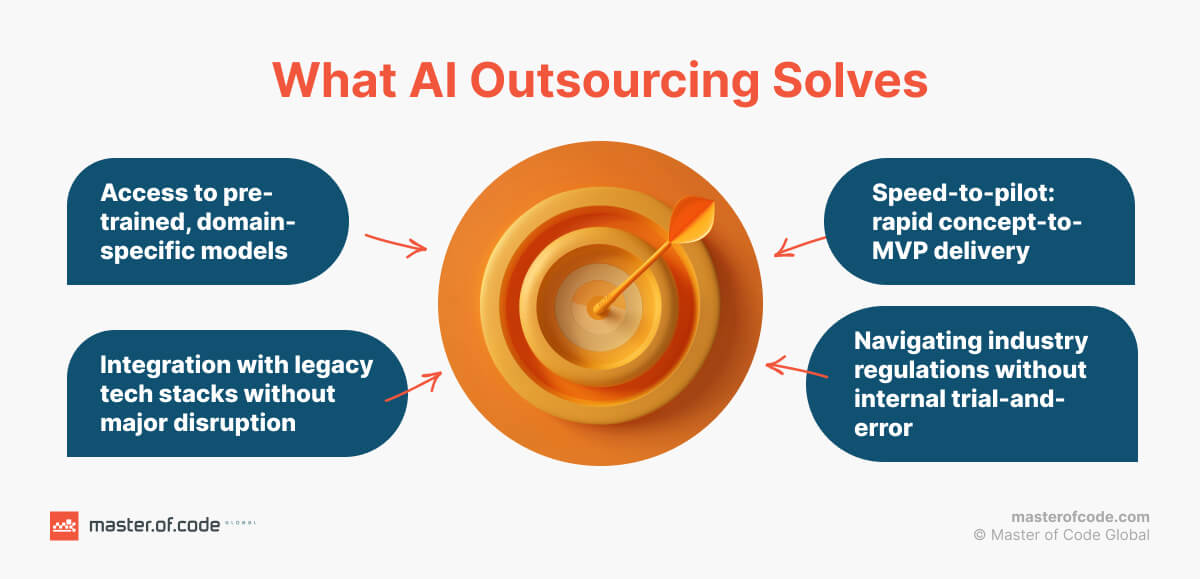
Big visions don’t always translate into real results. Companies get stuck, whether it’s because of missing talent, stretched budgets, or compliance roadblocks. External development can bridge those gaps. It gives businesses access to expertise, tools, and ready-made models that speed up progress and reduce risk. In practical terms, it solves problems that often keep in-house teams from moving forward.
Here’s what AI outsourcing can unlock, especially when internal teams hit resource, time, or compliance walls:
Access to pre-trained, domain-specific models
- 83% of executives expect vendors to deliver advanced AI as part of their services, giving companies access to specialized models without spending months (or millions dollars) training them in-house.
- An idea for inspiration: a healthcare organization could deploy a clinical language model on day one, rather than investing quarters into building and validating one internally.
Integration with legacy tech stacks without major disruption
- 45% report better throughput and smoother integration by working with partners who can enhance existing systems without rewriting them.
- An idea for inspiration: a manufacturer outsourcing AI development to embed predictive analytics into an aging ERP: no downtime, no infrastructure overhaul.
Navigating industry regulations without internal trial-and-error
- 38% of organizations outsource AI to gain regulatory expertise and avoid costly missteps. Vendors often build with HIPAA, GDPR, or SOC 2 compliance as default, not an afterthought.
- An idea for inspiration: A banking team might fast-track a conversational assistant because the vendor already embeds regulatory safeguards into the architecture.
Speed-to-pilot: rapid concept-to-MVP delivery
- 28% of organizations say intelligent technology outsourcing improves cycle time. With reusable frameworks and automation libraries, vendors can move from idea to MVP in weeks.
- An idea for inspiration: launching a GenAI-powered product advisor before your next campaign cycle, while competitors are still drafting their RFP.
AI Readiness: The 5-Point Self-Assessment Before AI Outsourcing
Prior to handing off any intelligent technology project to an external team, take a moment to assess your company’s readiness. This isn’t a pass/fail quiz. It’s a quick reality check to ensure you and your future vendor start on solid ground.
1. Data Maturity
Clean, structured data is the backbone of every initiative. Without it, even the most advanced models deliver weak or misleading outputs. If your data is siloed across departments, trapped in legacy systems, or lives mostly in spreadsheets, flag this early. A skilled outsourcing AI partner might suggest building automated pipelines or migrating datasets to the cloud before tackling use cases. These steps add time and cost upfront, but skipping them can result in models that don’t reflect reality.
Ask yourself: Do we have clean, structured data that’s accessible, or will our strategic ally need to handle a lot of cleanup and wrangling?
2. Use Case Clarity
Saying “we need AI” is too vague to deliver results. The strongest projects start with a clearly defined business problem and measurable outcomes. Do you want to reduce customer service ticket volume by 30%? Improve demand forecasting accuracy by 15%? Cut invoice processing time from weeks to days? Being precise here matters. It helps outsourcing companion scope projects properly and align technical design with business goals. Without clarity, your future solution risks becoming expensive “science experiments” with no ROI.
Ask yourself: Can we exactly articulate the problem we’re solving and the result we expect?
3. Integration Complexity
Digital intelligence doesn’t run in isolation. It has to connect with your existing systems and workflows. If your organization relies on fragile legacy stacks, outdated ERPs, or heavily customized CRMs, implementation could be trickier than expected. The good news: many outsourcing development partners have experience working with older systems. They’ll anticipate potential friction points and design integration layers that minimize disruption. But only if they know the full picture upfront.
Ask yourself: How complex are our current systems and workflows, and how ready are we to adapt?
4. Compliance Load
Industries like Healthcare, Finance, and Retail carry strict regulatory requirements. Think HIPAA, GDPR, SOC 2, or PCI DSS. Non-compliance isn’t just a technical issue – it’s a legal and reputational risk.
Experienced outsourcing AI development firms bring compliance expertise as part of their service, building safeguards into the solution from day one. This is often faster and safer than internal trial-and-error approaches. Still, you need to surface your compliance needs clearly so they can be addressed in contracts, governance, and technical architecture.
Ask yourself: Are there specific privacy, security, or regulatory requirements our solution must meet?
5. Internal Champions
AI that never leaves the pilot stage is a wasted budget. For projects to succeed, you need decision-makers inside your company who will advocate for adoption, drive cross-team buy-in, and scale the solution once it’s live. Without champions, even the best outsourcing ally will struggle to deliver long-term impact. Projects risk being shelved after MVP, leaving you with sunk costs instead of transformation.
Ask yourself: Do we have leaders who will own adoption and ensure this project moves from pilot to production?
Quick gut check:
If you said “yes” to most of these, you’re in a strong spot.
If you’re unsure about one or two, don’t worry. Our AI consultants will help you fill the gaps.
How We Selected These Companies
There are hundreds of AI outsourcing firms out there. To make this list useful, we focused on what actually helps projects succeed:
- Companies that have delivered real, deployed projects in similar industries. We looked for measurable outcomes like higher conversions or more efficient support operations.
- Teams that can handle both strategy and implementation. The best partner defines the problem, designs the system, and integrates it without disruptions.
- Vendors with strong technical foundations. This includes model development, data pipelines, system architecture, APIs, and cloud integration.
- Stable delivery teams with low turnover and long-term client relationships. Consistency across the project lifecycle often determines whether AI systems succeed or stall.
- Clear, verified data protection standards such as ISO 27001 and GDPR compliance.
- A forward-looking approach to innovation. Companies that use Generative AI, automation, and orchestration frameworks to solve practical problems.
- Evidence that the work pays off. Case studies, metrics, or ROI figures that show AI contributing to business goals.
- Teams that communicate clearly, work across time zones, and fit naturally into existing cultures.
Each company on this list meets these expectations and has proven it can build solutions that work in the real world.
Who Made the List
Just before we check the list, let’s clarify one last thing. When we mention AI outsourcing, we mean working with an external team that designs, builds, or improves your systems. This model is often used when companies need to move faster, fill skill gaps, or scale efficiently without hiring large in-house teams. It’s practical, flexible, and widely adopted across industries.
Master of Code Global
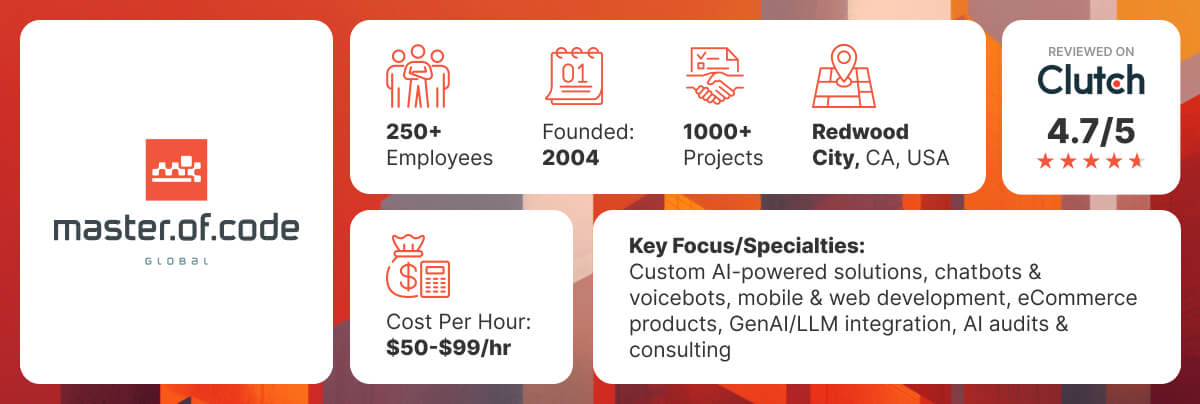
Founded in 2004, Master of Code Global is a leading US-based AI development and consulting company. They have delivered over 1,000 successful projects for global brands such as Tom Ford, Electronic Arts, Go Malta, T-Mobile, and Burberry. What sets them apart is their unique blend of deep Conversational-AI expertise, full-lifecycle engineering, and enterprise-grade delivery, combined with the agility of a product-driven firm.
Powered by its proprietary LOFT framework, Master of Code Global accelerates delivery by reducing setup effort by 43%. Plus, it helps to cut budgets by up to 20% and enables 3x faster project support. Their ISO 27001–certified operations ensure security and stability. Having zero staff turnover on active projects, they’re a reliable choice for AI outsourcing. Certified by Google Cloud, AWS, and Salesforce, and partnered with Cohere, Glia, Sinch, Parloa, Infobip, and Voiceflow, they remain platform-agnostic and integration-ready, delivering scalable, high-performance AI solutions for global enterprises. Their five-year partnership with Glia shows how this delivery model works in practice. Master of Code Global has completed more than 25 projects across four engagement models and became Glia’s primary external vendor for long-term engineering support.
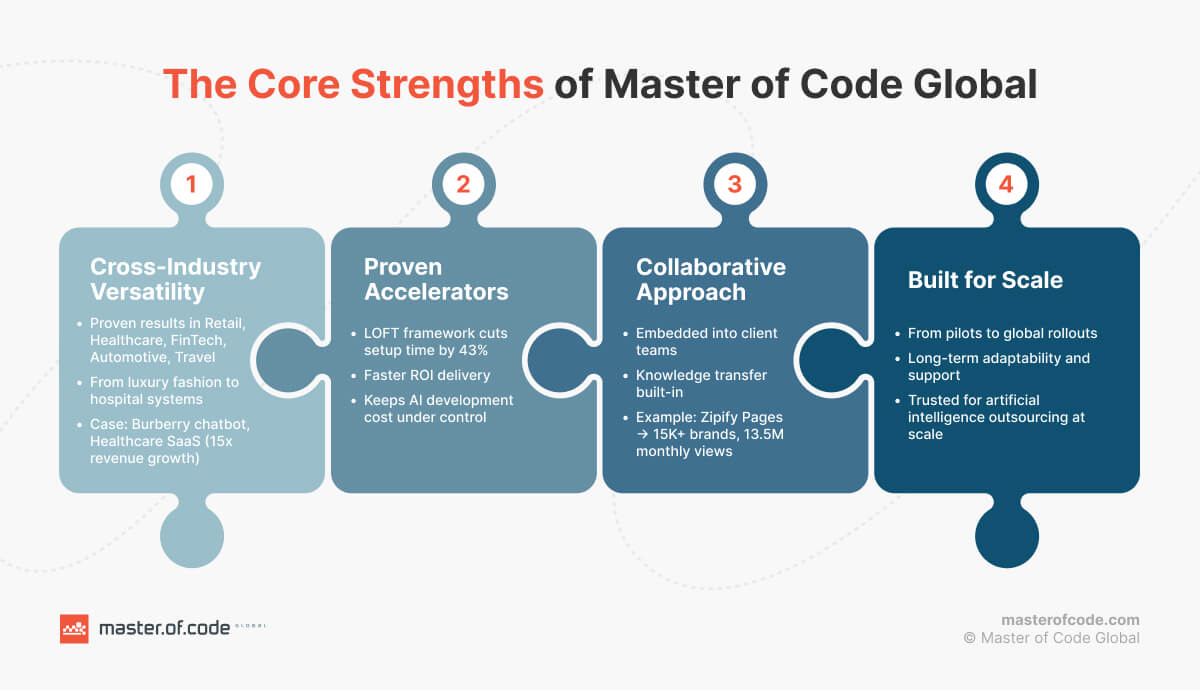
The cross-industry versatility speaks for itself. For Burberry, they built a Conversational AI concierge that let shoppers watch fashion shows, explore curated collections, and shop directly in chat: boosting engagement, loyalty, and sales. For a Healthcare SaaS company, they engineered a multi-platform solution that processed massive datasets in real time. The result? 15x revenue growth in two years, 30 hospitals onboarded, and 162,000+ assets managed. And together with Zipify Pages, they created a Generative AI-powered Shopify page builder now trusted by 15,000+ brands, powering 100K+ active pages and generating 13.5M monthly views.
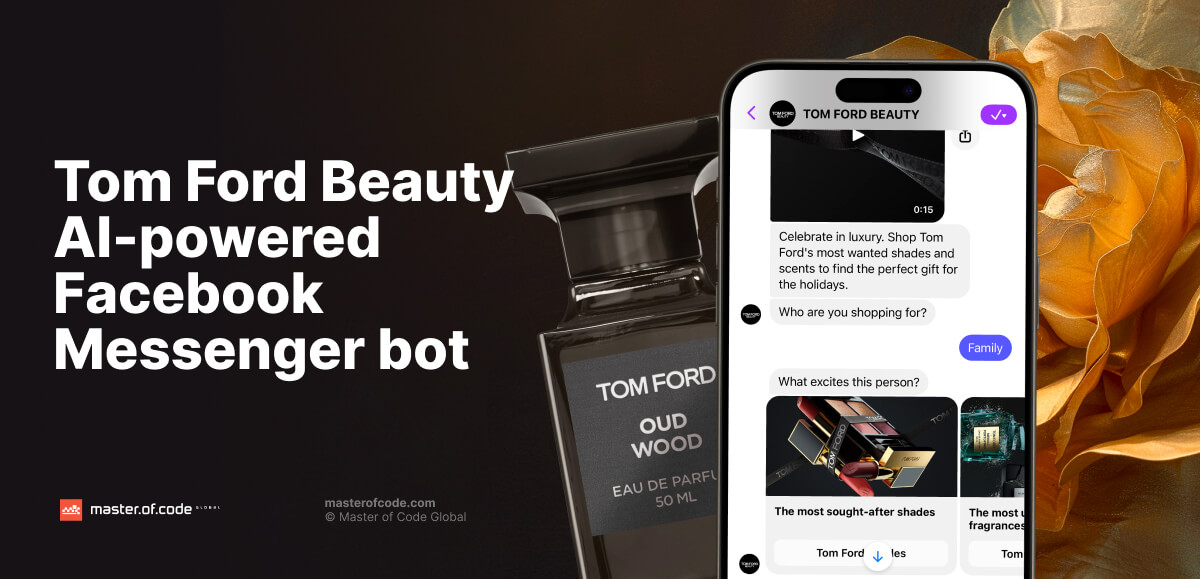
When Tom Ford Beauty wanted to connect with holiday shoppers in a more personal way, they partnered with Master of Code Global to launch an AI-powered gifting concierge on Messenger. In just one month, it engaged over 8,000 users and generated 2,000+ product clicks – proving that strategic outsourcing can scale fast without vendor lock-in or brand compromise.


Noam Bardin
Founder
We had a great experience with Master of Code Global — the speed in which they built up a multidisciplinary team including eng, design, QA, TPM allowed us to quickly roll out our product while hiring an internal team.
Check case study

Axelle Basso Bondini
Senior Manager Marketing
Master of Code Global worked on a tight turn-around, was extremely helpful and professional in developing all components of the project up to the brand’s high standards.
Check case study

Matt Meisner
VP, Performance Marketing
The chatbot not only drove $500,000 in revenue within the first few months but also achieved 3X better conversion than the website and an 89% user response rate. Master of Code Global proved to be creative and technical experts in the chatbot space.
Check case studyRisingMax Inc.
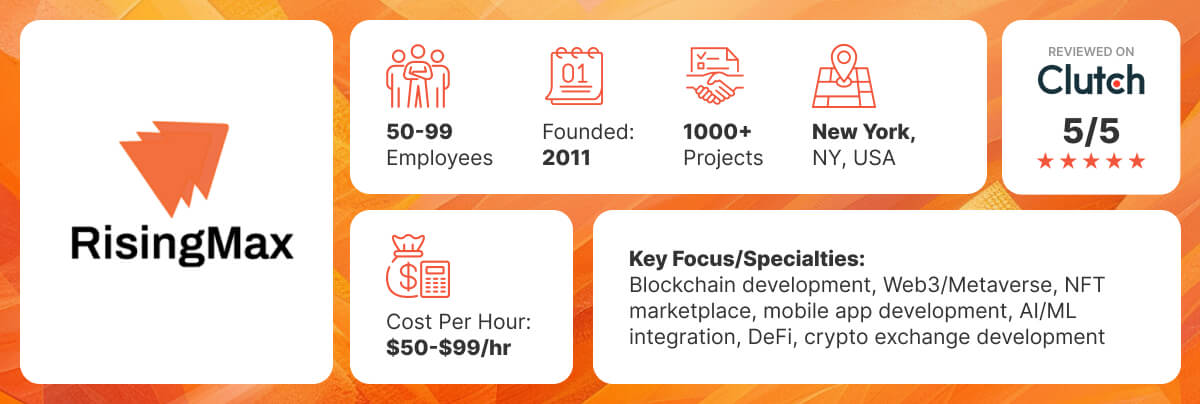
RisingMax Inc. is a New York–based IT consulting and software development company. The vendor is known for assisting businesses in modernizing through smart digital transformation powered by AI. They specialize in providing cost-effective web and mobile applications across industries like fintech, government, IoT, and gaming.
From concept to launch, RisingMax supports startups and Fortune 500 companies alike, offering expertise in blockchain, Web3, and the metaverse. Their approach blends consulting with emerging tech implementation. As a result, organizations streamline processes, improve efficiency, and explore opportunities without overspending.
MindTitan
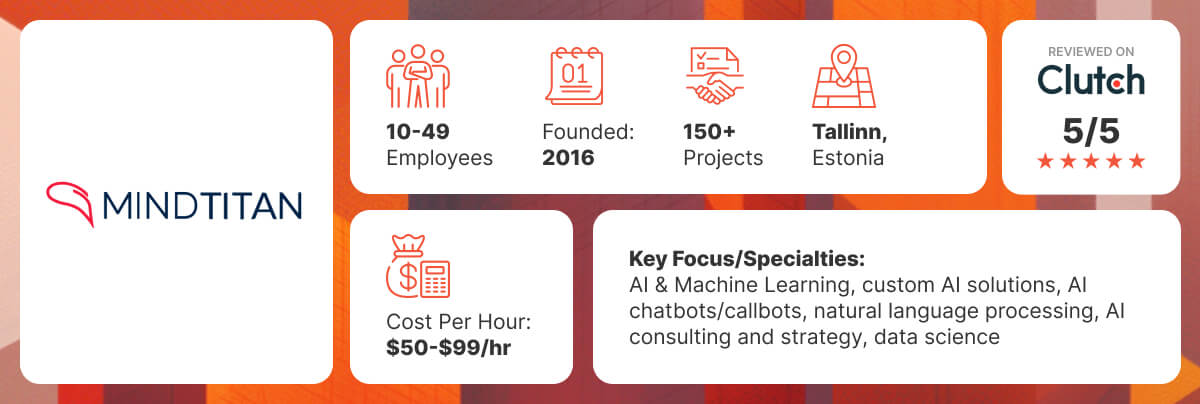
MindTitan is an Estonian consultancy that helps organizations become truly AI-driven. They provide end-to-end smart solutions covering strategy, data validation, model development, and full-stack deployment. Working across both public and private sectors, MindTitan supports national AI strategies, telecom modernization, and industrial automation.
Their strength is combining scientific research with real-world apps. With projects in over 20 countries and recognition from Gartner for innovation, MindTitan positions itself as a strategic partner for accelerating intelligentization.
TATEEDA
TATEEDA GLOBAL is a San Diego–based custom software and AI development company with a strong focus on healthcare, pharma, and insurance. The team helps U.S. organizations upgrade legacy platforms, connect EHR/EMR and RCM systems, and embed AI agents, chatbots, and automation into existing products.
With 100+ senior engineers across Eastern Europe and LATAM, TATEEDA combines U.S. project leadership with nearshore delivery using .NET, JavaScript, cloud-native architectures, data pipelines, and standards such as HL7/FHIR. Their engineers work daily with PHI and comply with HIPAA, CCPA, and PCI-DSS, which is why providers, payers, and health-tech vendors rely on TATEEDA for custom AI software development, remote patient monitoring solutions with AI, and compliant digital health applications.
Lemberg Solutions
Lemberg Solutions is a full-cycle software and hardware engineering company founded in 2007. Their four areas of expertise include Data & AI, Embedded Engineering, Digital Experiences, and Cloud & DevOps. This combination makes the company a strong partner for developing complex, scalable products. Within their Data & AI expertise, Lemberg Solutions offers AI development, data science, and data engineering services. They help clients build AI chatbots, AI agents, or computer vision solutions.
Lemberg Solutions serves clients across several industries, including healthcare, energy, manufacturing & industrial IoT. For one of their clients, a German retail enterprise, the company developed an AI-powered solution that streamlined document processing. Another client was able to automate 70–80% of routine customer inquiries thanks to a scalable AI chatbot. The company also built a computer vision-based app for detecting and monitoring skin diseases.
eSparkBiz
eSparkBiz is an India-based software development and AI engineering firm founded in 2010. Specialization spans custom software development, application modernization, generative AI integration, and dedicated development teams. With 400+ engineers and 1,000+ delivered projects, they serve finance, healthcare, eCommerce, and logistics clients.
eSparkBiz stands out for CMMI Level 3 certification and a 95%+ long-term client retention rate, built on transparent delivery and engineering consistency. Their model blends senior engineering talent with flexible hiring options, staff augmentation, dedicated teams, or full project ownership, giving startups and enterprises a scalable path from idea to production-ready software.
eSparkBiz
- Employees: 400+
- Founded: 2010
- Location: Ahmedabad, India
- Cost Per Hour: $12-$25/hr
- Reviewed on Clutch: 4.9/5
Key Focus/Specialties:
IT staff augmentation, custom software development, AI & data engineering, cloud & DevOps, web & mobile app development, QA automation
Oxagile
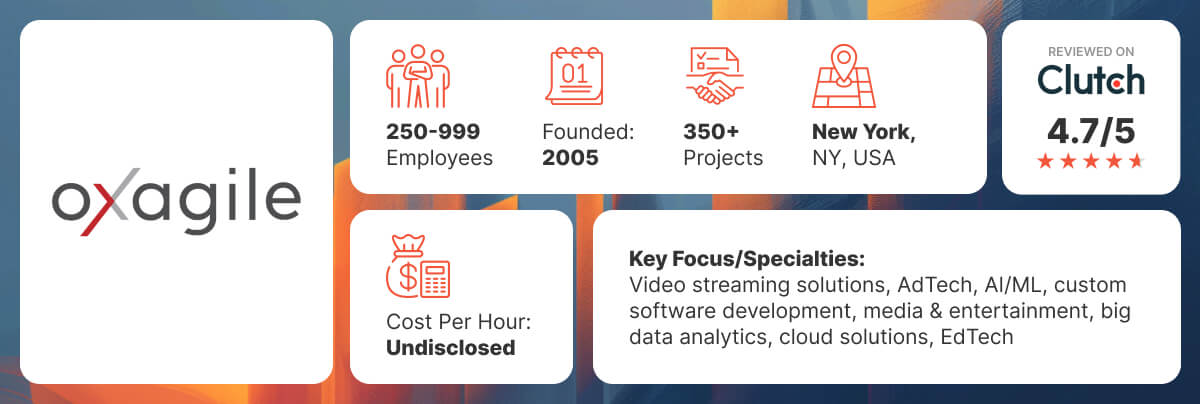
Oxagile is a global software development and AI consulting firm known for its expertise in multi-platform video streaming, ad-tech, e-learning, big data, and Generative AI. Since 2005, the company has delivered over 450 successful projects. The top industries they serve are media, transportation, finance, and healthcare.
Oxagile stands out for its ability to handle complex, large-scale initiatives, particularly in real-time communications with working AI prototypes. With a strong product-engineering mindset, they guarantee full-stack workflows for startups and enterprises alike, helping businesses build scalable, high-performance solutions across diverse digital domains.
Tooploox
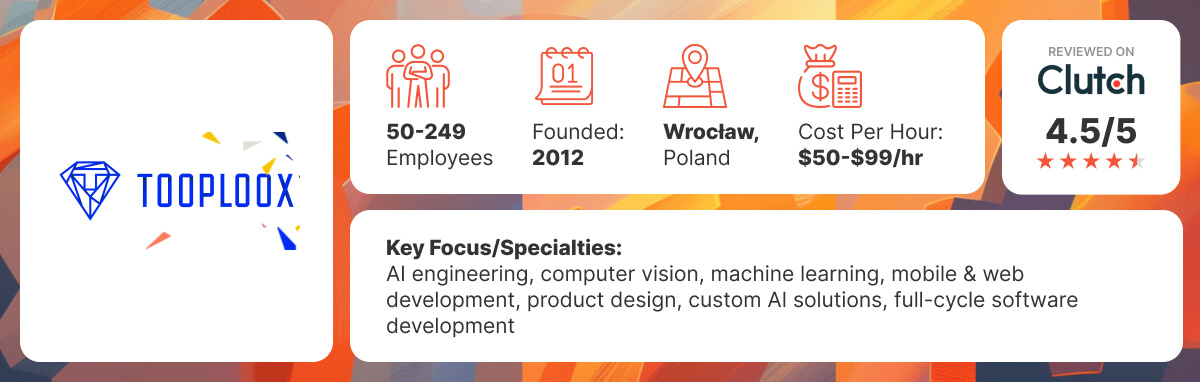
Tooploox is a Poland-based AI-first IT company founded in 2012. Specialization includes custom artificial intelligence, Generative AI, and full-cycle web and mobile apps development. The team integrates advanced machine learning and AI capabilities throughout every stage of product creation, from discovery to deployment.
Working closely with startups, research-driven organizations, and global enterprises, Tooploox focuses on innovation over simple outsourcing. With 50+ research papers published in leading venues, they combine academic depth with engineering expertise to deliver cutting-edge, AI-powered digital products.
Azumo, Inc.
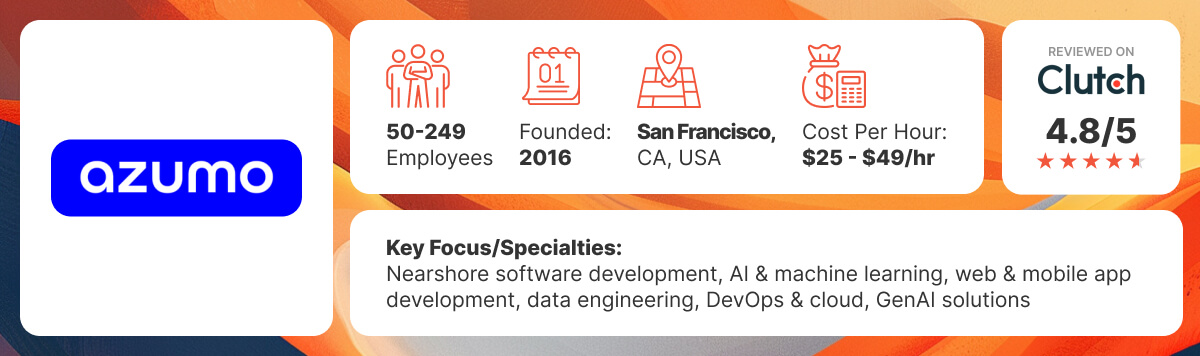
Azumo is a nearshore full-service software provider delivering AI, data, web, and enterprise solutions from Latin America. The vendor targets building long-term, dedicated teams of developers, data scientists, and cloud engineers. The approach helps clients accelerate delivery and reduce time-to-market.
Serving both large-scale firms and fast-growing startups, including its first client, Twitter, Azumo combines technical excellence with nearshore efficiency. Their model emphasizes engineer retention, collaboration, and project continuity, making them a reliable partner for scalable, high-quality AI and software development initiatives.
Waverley Software
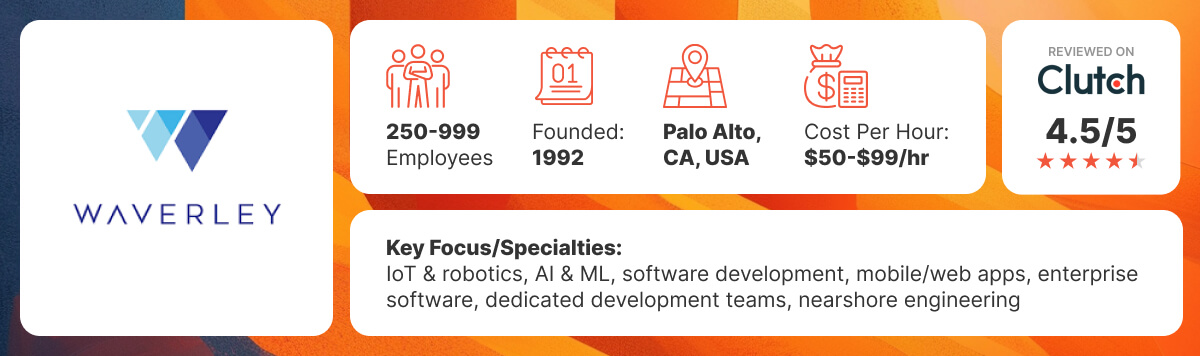
Waverley Software is a U.S.-based company with over 30 years of experience delivering innovative digital systems for startups and Fortune 500 companies. Development centers are in Latin America and Eastern Europe. Waverley excel in AI (GenAI, ML, BI, computer vision, ChatGPT), IoT, robotics, mobile and web dev, DevOps, and cloud consulting.
Core strength: assembling senior-level engineering teams capable of moving from discovery to launch quickly, often within three weeks. Their proven expertise and global reach make them a trusted partner for complex, innovation-driven software projects.
Apriorit
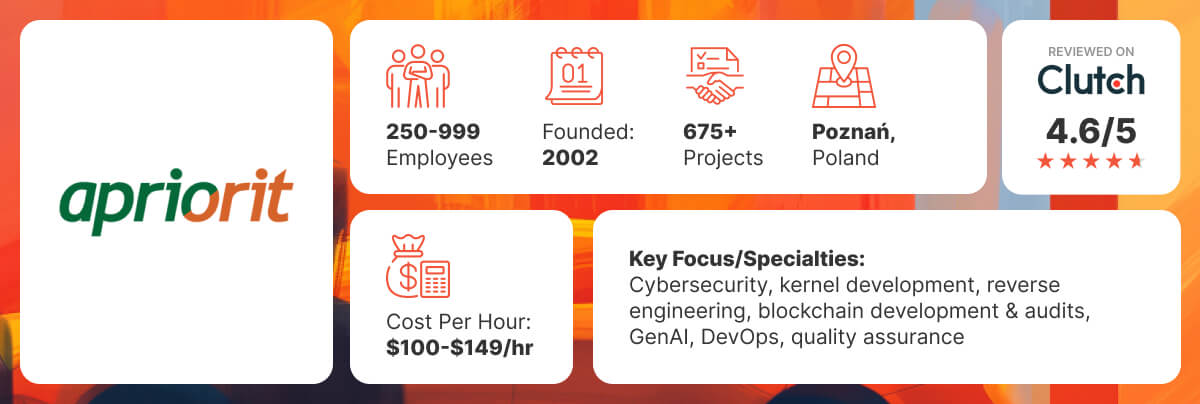
Apriorit is a full-cycle software development company founded in 2002. They have a strong focus on cybersecurity and systems programming. The core competencies span driver and kernel dev, AI chatbots, Generative AI, reverse engineering, embedded tools, and “kernel-to-cloud” SaaS and mobile solutions.
Serving industries like IoT, manufacturing, and cloud infrastructure, Apriorit excels in technically demanding projects. Their approach emphasizes security-first engineering, offering robust, high-trust architectures. With deep technical specialization, Apriorit stands out as a reliable partner for organizations tackling tough, system-level, or mission-critical challenges.
Systango
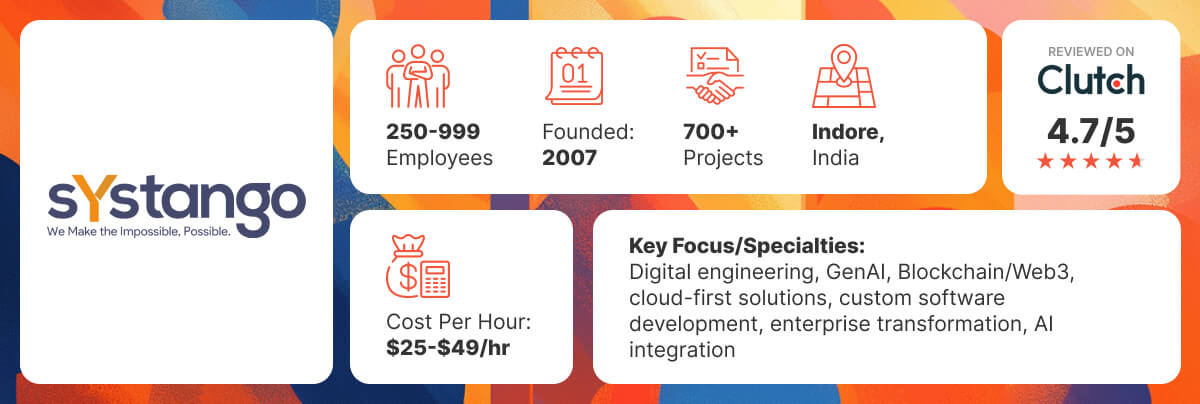
Being a UK-based digital engineering firm established in 2007, Systango specializes in AI, data, cloud, blockchain, and enterprise product development. With a global delivery model, the vendor helps clients modernize their workflows, deploy AI/ML platforms, and build safe, cloud-native infrastructure.
Systango serves domains such as fintech, eCommerce, energy, and public-sector transformation. Aspects that stand out: its “secure by design” approach, ISO 27001 certification, and rapid pilot or MVP delivery through its GenAI Studio. Moreover, Systango combines speed, scalability, and governance, boosting workflow efficiency.
DXC Technology
DXC is a global IT services leader providing consulting, cloud, engineering, and outsourcing solutions to enterprise clients worldwide. With annual revenues around US$12.6–12.9 billion, DXC focuses on large-scale digital modernization, cloud migration, and AI integration.
The company serves industries such as financial services, healthcare, insurance, manufacturing, and the public sector. Its strength lies in combining global reach with full-stack delivery, enabling organizations to update legacy systems, adopt AI, and manage complex IT ecosystems under one trusted provider.
Connext Global Solutions
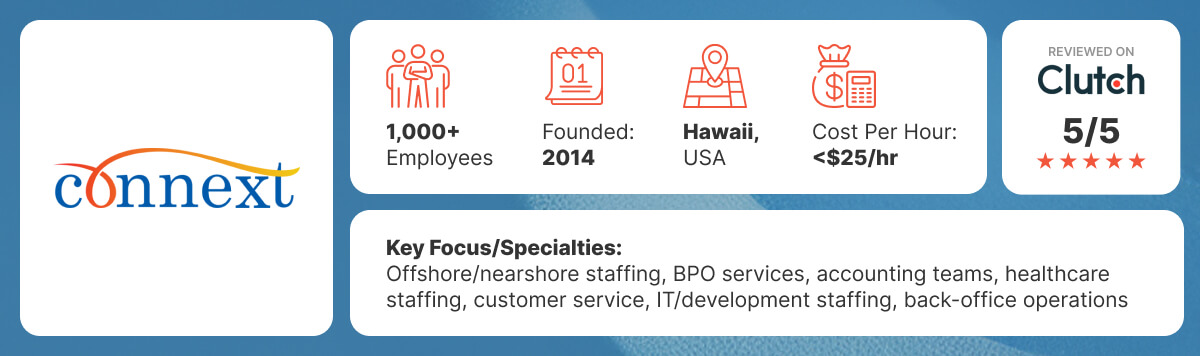
Connext is an offshore staffing and managed outsourcing provider. The firm enables businesses to build dedicated remote teams, experienced in AI and other advanced technologies, across the Philippines, Colombia, India, and Mexico. Founded in 2014, they are experts in creating long-term team extensions rather than short-term partnerships.
Their services span IT, healthcare, finance, logistics, and construction. Emphasizing language proficiency, cultural alignment, and workforce continuity, Connext promotes the idea of “your employee supported by the entire Connext family.” It’s a strong option for companies seeking scalable, integrated offshore teams with lasting value and reliability.
Choosing Your AI Partner: The Decision-Makers’ Field Guide
Let’s face it: artificial intelligence outsourcing isn’t just about who can build models. It’s about who can build momentum inside your organization. The right collaborator won’t just “develop.” They’ll move with you, challenge assumptions, and quietly prevent the bottlenecks you haven’t even hit yet. Here’s what to look for when evaluating a strategic partner.
Sector Experience
Would you trust a financial chatbot built by someone who’s only worked in eCommerce? Context matters. Great solutions start with understanding your industry’s unique pain points, regulations, and data quirks. If a vendor has walked your road before, they’ll ask better questions and solve faster.
Proven Results
Glossy slide decks are easy. Real metrics? That’s harder. Ask potential vendors what outcomes they’ve delivered, like “30% drop in churn” or “claim processing time cut in half.” This is especially important when considering ai development outsourcing beyond the experimentation phase.
Technology Agnosticism
If a vendor only builds on one stack, you’re already boxed in. True outsourcing AI means they fit into your world, whether you’re running Azure, AWS, Salesforce, or something homegrown from 2014. Flexibility here saves months later.
Built-In Scalability
Some vendors build what you ask for. The best build with your future in mind. A well-structured MVP should quietly lay the groundwork for potential features, teams, and data sources. If your pilot can’t stretch into something bigger, you’re just buying a demo. Starting with an AI proof of concept is fine, as long as it doesn’t end there.
Innovation Speed
Your project won’t stand still. Why should your vendor? Make sure your associate can move as fast as the market. That means adjusting to new APIs, updated regulations, and better LLMs mid-project, not waiting for a v2 six months from now. If you’re exploring how to implement AI in business, look for a team that moves at your speed, not one that holds you back.
A quick tip: Start small. Test the waters with a focused initiative or AI PoC development services, then scale with confidence. That’s how smart companies are approaching AI outsourcing: calculated, but fast.
The Unspoken Concerns Executives Have About AI Outsourcing
Even with all the potential, bringing in an external team for artificial intelligence projects can raise valid concerns at the leadership level. Here’s what decision-makers worry about most and how smart vendors help solve this.
Concern 1: “What if our IP or proprietary data leaks?”
Data is the crown jewel of modern enterprises, and handing it to a third party can feel like giving away the keys to the castle. Executives fear models trained on their data could expose trade secrets or accidentally surface sensitive insights elsewhere.
Smart solution: Strong contracts and NDAs are just the starting point. Mature vendors also design secure data-handling policies, such as training models in controlled environments, encrypting data end-to-end, and implementing “clean room” setups where raw data never leaves the client’s infrastructure. The result is clear: IP stays yours, always.
Concern 2: “Will we lose control of our strategy?”
No leader wants outsourcing to mean abdicating responsibility. The risk is real. Some software development companies overstep, pushing their own roadmaps instead of following the client’s.
Smart solution: With the right governance, you remain in the driver’s seat. Effective frameworks ensure your team owns the business goals, while the vendor provides execution muscle. Weekly steering sessions, transparent KPIs, and escalation protocols keep control where it belongs – with you. This balance is especially critical in the outsourcing of AI, where aligning technical decisions with long-term business strategy determines success.
Concern 3: “Are we locking ourselves into one vendor?”
Some leaders worry that choosing one vendor means dependency, higher costs, and less flexibility. But in reality, what you’re building isn’t a lock-in. It’s a dedicated partnership.
Smart solution: At Master of Code Global, we act as an extended IT service provider, supporting and scaling your solution long after launch. Many of our collaborations last 10+ years, and we take pride in those relationships. Instead of fearing dependency, think of it as gaining a team that already knows your systems, understands your business, and grows with you. That continuity is what keeps innovation moving and ensures your solution evolves alongside your strategy.
Concern 4: “What if their culture doesn’t fit ours?”
Technology alone doesn’t deliver transformation, but people do. A mismatch in working style, communication, or values can quietly derail even the best-designed solutions.
Smart solution: Treat cultural fit as non-negotiable. In artificial intelligence outsourcing, look for vendors who listen first, align with your organizational values, and embed themselves into your workflows. The right partner will feel less like an outsider and more like an extension of your team.
Conclusion
Outsourcing AI work can be a smart decision when you want to move fast without stretching your internal team. The right partner can help you experiment, validate ideas, and scale what works, while staying focused on your core business.
Every company on this list has shown they can deliver real outcomes, not just talk about innovation. Take time to explore their strengths, look at their case studies, and find the one that fits your goals and way of working. The best AI partner is the one that feels like part of your team.
Picture the Q2 boardroom review: unsatisfying results on the screen, competitors unveiling AI-driven products, and your own team explaining why you’re still “evaluating options.” Every quarter without adoption is a quarter your competitors are learning faster, cutting costs deeper, and scaling smarter. That’s why outsourcing AI isn’t a shortcut, it’s a way to close the gap before it becomes permanent. With the right partner, you can test, validate, and scale initiatives in months, not years.
Schedule your AI Readiness Session today to uncover where Artificial Intelligence can drive measurable ROI in 90 days or less and ensure the next quarterly review tells a very different story.