An enterprise launches its first GenAI application using a single model and API. A year later, there’s a new model that’s cheaper, more reliable, or simply better. But switching now means touching prompts, integrations, agent logic, evaluations, and data infrastructure.
Vendor dependency is not automatically vendor lock-in. It becomes lock-in when changing a provider creates disproportionate cost, engineering work, disruption, or compliance risk.
The Stanford AI Index 2026 reports that 88% of surveyed organizations use AI. The IBM 2026 Tech Leader Study, covering 2,000 senior technology executives, found that organizations designed for portable workloads and replaceable models reported 10% higher AI ROI in 2025. The research shows an association, not proof that portability alone caused the gain.
This guide explains how enterprises can avoid AI vendor lock-in across architecture, models, data, contracts, governance, and migration planning. See our enterprise AI development services for broader implementation support.
Table of Contents
Key Takeaways
Using one AI vendor does not necessarily mean you’re heading toward lock-in. The key question is whether it can be replaced economically.
AI lock-in can sit in models, prompts, agents, data layers, infrastructure, and contracts.
A gateway layer can reduce model coupling, but that layer must also remain portable.
MCP can reduce tool and integration lock-in without making the whole AI stack portable.
Multi-model and multi-cloud approaches solve different concentration risks.
A credible migration path has to be tested, not only documented.
What Is AI Vendor Lock-In, and Why Is It Different From SaaS Lock-In?
AI vendor lock-in occurs when an organization becomes dependent on an AI model, provider, platform, API, workflow, or proprietary artifact to the point where changing it creates disproportionate cost, risk, or disruption.
Enterprises depend on cloud platforms, databases, SaaS products, and APIs every day. That alone is not a problem. The practical question is simple: What would it cost us to change?
Traditional SaaS migration usually involves data export, integrations, process migration, retraining, and contract termination. AI adds model-specific behavior, prompts, fine-tuning, embeddings, evaluation datasets, RAG pipelines, model APIs, agent state, and orchestration logic.
Those dependencies also evolve quickly. Frontier model providers update and retire models, so migration capability has operational value even when a company has no intention of leaving voluntarily.
That is why switching costs in AI can go far beyond licenses. They may include prompt rework, regression testing, safety checks, infrastructure changes, and renewed LLM security and compliance validation.
Where Does AI Vendor Lock-In Actually Happen?
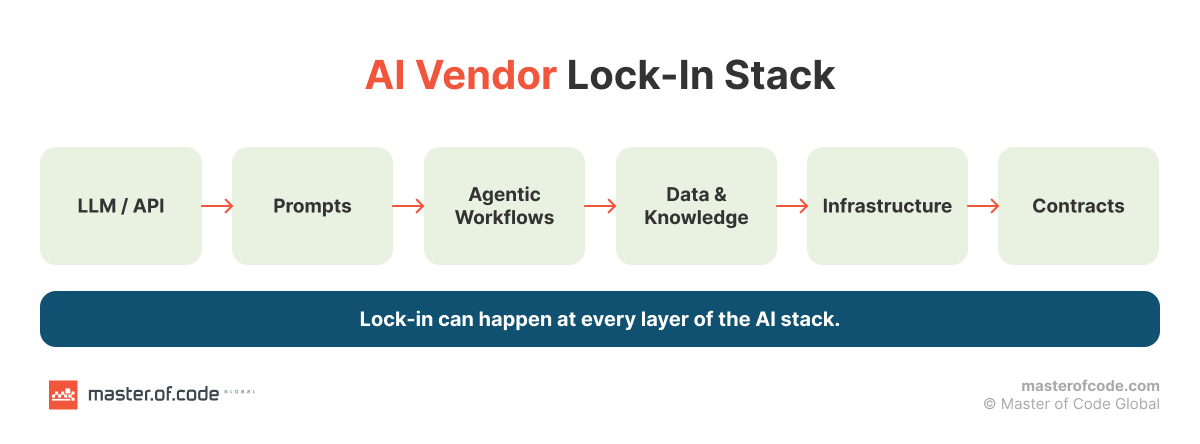
Think about the problem as an AI Lock-In Stack. A system can be portable at one layer and heavily coupled at another.
LLM and API Lock-In
Application code may depend directly on one LLM provider through proprietary API parameters, authentication, SDKs, tool-calling formats, or structured-output behavior.
Prompt Lock-In
This happens when system prompts, few-shot examples, structured-output instructions, or workarounds are optimized around one model’s behavior. Changing models may require rewriting and reevaluating them.
Agentic Workflow Lock-In
This appears when tools, memory, state, workflow graphs, handoffs, or orchestration logic live inside a proprietary agent framework.
Data and Knowledge-Layer Lock-In
Owning the source documents does not make the knowledge layer portable. Embeddings, indexes, vector stores, conversation histories, logs, and evaluation datasets may still depend on proprietary formats or services.
Infrastructure Lock-In
Managed inference, cloud AI services, GPU environments, monitoring, identity, and security tooling can all create migration work.
Commercial and Contract Lock-In
Long commitments, minimum spend, difficult termination, egress charges, restricted export, or inaccessible logs can turn a technical choice into a commercial constraint. Portable code may still be expensive to move.
Lock-In Layer
What Becomes Dependent
Why Switching Is Difficult
Primary Portability Control
LLM/API
Model/API
Provider-specific interfaces
Gateway layer
Prompt
Prompts/model/model behavior
Outputs change across models models
Prompt versioning + evals
Agentic workflow
Tools/state/orchestration
Proprietary framework logic
Modular orchestration/MCP
Data
Embeddings/indexes/logs
Proprietary storage/formats
Portable data formats
Infrastructure
Cloud/inference stack
Managed proprietary services
Hybrid/multi-cloud
Commercial
Contracts/pricing
Termination/export constraints
Exit clauses
What Does AI Vendor Lock-In Look Like in Practice?
A model retirement exposes hidden coupling. The endpoint itself may be easy to replace, yet teams still have to migrate, retest prompts, rerun evaluations, confirm tool behavior, recheck security, and verify output quality.
An outage exposes resilience risk. If every critical workflow depends on one hosted model, a provider incident becomes an application incident unless a fallback path already exists.
Vendor viability matters too. A provider can change strategy, be acquired, discontinue a product, or fail financially.
None of those events is automatically an example of lock-in going wrong. They expose the consequences of concentrated dependency when no realistic alternative path exists.
The question is not how many AI vendors an enterprise uses. It is what would break if one disappeared tomorrow.
Start With an AI Dependency Audit
The Flexera 2026 State of the Cloud report, based on 753 cloud decision-makers, found that 54% identify understanding application dependencies as their biggest cloud-migration challenge.
AI migrations can uncover even more connections because applications may be coupled at the model, prompt, data, agent, and infrastructure levels.
For every AI-enabled application, inventory its business owner and criticality, model/provider, APIs and SDKs, prompts, fine-tuning, RAG sources, vector infrastructure, agent framework, external tools, cloud environment, monitoring stack, contract renewal date, available replacement, and estimated migration effort.
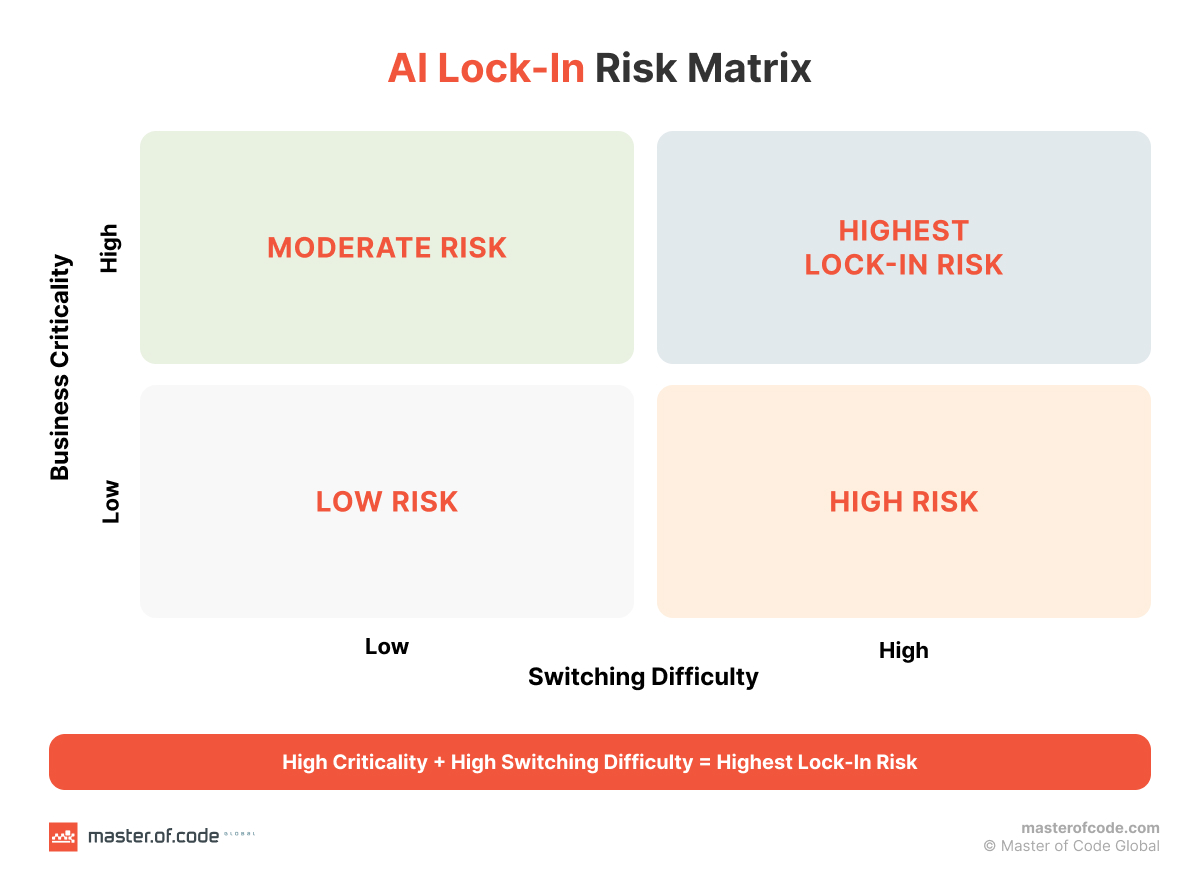
Then score each system using:
Business criticality × switching difficulty
Optionally add:
Estimated time to replace
High-criticality systems with high switching difficulty should be addressed first. This audit is not about eliminating every external service. It identifies dependencies that could materially constrain the business.
How to Architect AI Systems to Avoid Vendor Lock-In
To avoid AI vendor lock-in, do not make every component interchangeable. Focus on the parts most likely to change and make them replaceable without rebuilding the surrounding application.
Put an AI Gateway Between Applications and Models
An AI gateway is an abstraction layer between applications and model providers:
Application → Gateway → Model Providers
It can centralize authentication, standardized requests, cost controls, logging, fallback, governance policies, and model routing based on quality, cost, latency, availability, compliance, or geography.
Replacing an LLM provider then becomes less disruptive because provider-specific logic stays out of individual applications. LLM integration services can help establish these consistent interfaces.
We’re not vendor-locked, so we can recommend the best combination of technologies for your specific situation rather than forcing you into a single platform’s constraints.
An AI gateway can also become a lock-in point. Check whether routing rules, logs, and configuration are exportable, standard APIs are supported, and multiple providers can be used. A vendor-agnostic design should not simply move dependency one layer higher.
Separate the AI Stack With Modular Architecture
Modular architecture keeps application logic, orchestration, models, retrieval, tools, and observability behind clear boundaries. Some systems may use microservices, but clear interfaces matter more than the pattern itself.
A second abstraction layer can isolate model-specific services behind stable internal interfaces.
We used this separation for an agentic data reconciliation application for a US energy company. It combines a standalone application, Snowflake, Azure Cognitive Services with GPT-4o-mini, and our open-source LOFT orchestrator. Data, application, orchestration, and model logic remain distinct, showing the role LLM orchestration can play in a wider AI stack.
Use Open Standards, Including MCP, Where They Actually Help
Open standards can reduce proprietary integration dependencies. Model Context Protocol (MCP) standardizes how AI applications and agents connect to external tools and data sources.
MCP solves only part of the portability problem. It can make tool integrations reusable, but it does not make model behavior, prompts, fine-tuning, infrastructure, or proprietary data layers portable.
We saw the interoperability benefit while building an internal MCP solution for a global technology company. It connects 85 enterprise tools through one AI-powered workspace, giving the company reusable integrations instead of dozens of point-to-point connections. The same principle applies to broader agentic AI development services.
Use Multi-Model and Multi-Cloud Strategies for Different Risks
A multi-cloud AI strategy to avoid vendor lock-in should not be confused with a multi-model design.
A multi-model setup diversifies model concentration. One gateway can route workloads across several models based on quality, cost, latency, or availability.
A multi-cloud strategy diversifies infrastructure dependency. Flexera reports that 73% of surveyed organizations operate hybrid cloud environments in 2026. Multiple clouds still do not solve model concentration if every AI application depends on the same model interface.
A hybrid architecture may combine public cloud, private cloud or VPC, and on-premise infrastructure. The multi-cloud strategy addresses infrastructure resilience. Multi-model design addresses model choice.
Strategy
What It Diversifies
Main Benefit
What It Doesn’t Solve
Multi-model
LLMs/providers
Model flexibility/fallback
Cloud dependency
Multi-cloud
Infrastructure
Infrastructure resilience
Model dependency
Hybrid AI
Public/private/on-prem
Control + placement flexibility
Poor application coupling
Open-model option
Model access/deployment
Greater deployment control
Tool/infrastructure dependency
Keep Open-Source and Open-Weight Models as an Option
Open-source models and open-weight alternatives create another sourcing option. The Stanford AI Index 2026 reports a 3.3% gap between the top closed and top open model as of March 2026, with four leading providers within 25 Arena Elo points.
Open models are not automatically independent. Companies can still depend on an inference vendor, GPU environment, fine-tuning stack, orchestration framework, or cloud. Their value is optionality.
If your stack has grown around one provider, our strategic AI consulting team can identify which dependencies are worth abstracting.
Protect Portability Through Data, Governance, and Contracts
Data Sovereignty vs. Data Portability
Data sovereignty asks where data resides, where it is processed, which jurisdictions apply, and who can access it.
Portability asks a different question: Can we export the data and reuse it elsewhere?
That may include source documents, prompts, conversation histories, generated outputs, evaluation datasets, logs, fine-tuning data, configuration, and agent definitions. A compliant data location does not make migration easy if those assets cannot be exported in a useful format.
Put Portability Into Vendor Contracts
Technical, procurement, security, and legal teams should review portability before signing long commitments.
Contracts should cover data ownership, IP ownership, vendor training rights, export formats, termination assistance, deletion requirements, model retirement notice, pricing-change notice, service levels, logs and observability export, documentation access, subprocessor visibility, and self-hosting or escrow where relevant.
Contract Area
Question to Ask
Lock-In Risk
Data ownership
Can we export all business-owned data?
Trapped data
IP
Who owns prompts/configuration/custom code?
Asset dependency
Model changes
How much notice precedes retirement?
Forced migration
Pricing
Can terms/prices change materially?
Commercial dependency
Logs
Can operational/evaluation data be exported?
Lost history
APIs
Are interfaces documented?
Technical dependency
Termination
Is migration assistance included?
Expensive offboarding
Deletion
How is customer data removed?
Compliance risk
Include Vendor Dependency in AI Governance
Governance should track provider and model concentration alongside security, privacy, quality, cost, performance, and compliance.
Flexera found that 53% of cloud leaders cite security and compliance as their top challenge for cloud-based AI initiatives. It also reports that 47% of large enterprises are establishing dedicated governance teams or leaders.
Vendor concentration does not itself violate the EU AI Act. However, dependency can create compliance risk if an enterprise cannot obtain the documentation, logging, transparency, data access, or controls required to meet its own obligations.
Architecture gives an enterprise the technical ability to leave. Contracts and governance give it the operational ability to do so.
Build vs. Buy: Which Approach Reduces AI Vendor Lock-In?
“Build” does not automatically mean independent, and “buy” does not automatically mean locked in. A custom application hardcoded to one provider’s SDK can be harder to move than a commercial platform with standard APIs, exportable data, and interchangeable models.
The better question is: Which components create competitive differentiation and should we own, and which should remain replaceable external services?
Enterprises may own business logic, critical data, differentiated workflows, and evaluation criteria while using external foundation models or commodity infrastructure. Our build vs buy AI guide and custom AI solutions vs off-the-shelf comparison explores these choices.
Create an Exit Strategy Before You Need One
Start with one diagnostic question:
If our primary AI provider disappeared today, how long would it take to restore this workflow elsewhere?
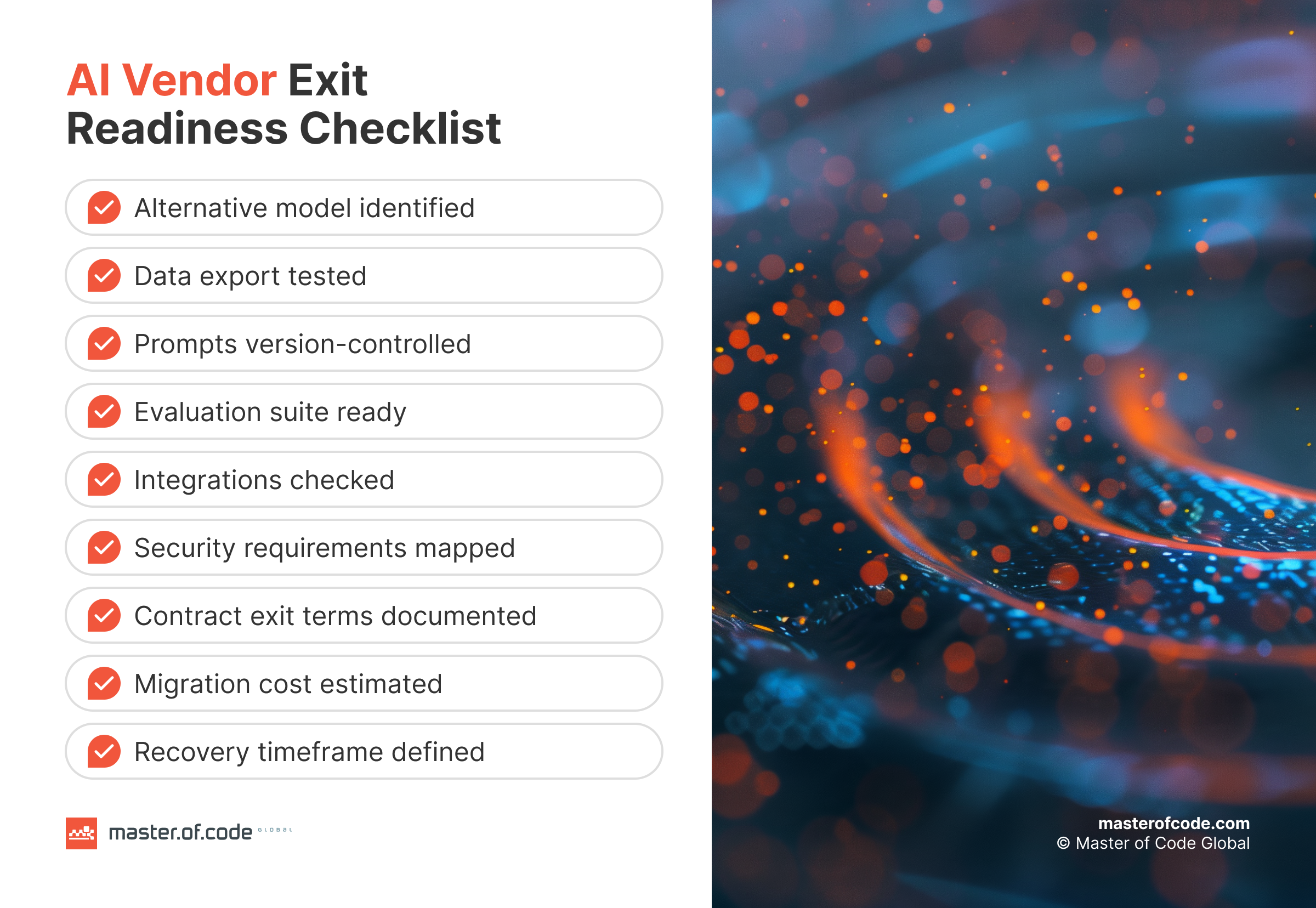
A migration test should identify a replacement provider, export required data and configuration, route a sample workload, migrate representative prompts, rerun evaluations, compare quality and latency, validate integrations, reassess security, and estimate migration effort and cost.
For critical applications, also define acceptable downtime and fallback behavior. Run the test before major contract renewals, architecture expansion, model retirement, or significant pricing changes.
One useful diagnostic benchmark is: Could we replace the primary model provider within 30 days without rebuilding the application? It is not an industry standard. It is a practical test for uncovering hidden switching costs.
How Master of Code Global Helps Reduce AI Lock-In Risk
The goal is not zero vendors. The goal is intentional dependency with a realistic path to change.
Master of Code Global can help enterprises map concentrated risk, decide where abstraction is worthwhile, design modular systems, implement gateway and orchestration layers, introduce MCP where it adds value, evaluate open-model options, and prepare migration tests.
That work can begin with a technical assessment. From there, we can redesign constrained layers, add model routing, or build interoperability into new AI systems.
If your current AI architecture is becoming difficult to change, talk to our strategic AI consulting team about an architecture and dependency review.
Conclusion
Enterprises do not need to avoid AI vendors. They need to avoid architectures where replacing one provider means rebuilding the business capability around it.
The progression is simple: Audit → decouple → standardize → protect → test.
Portability preserves the option to adopt a better model, cheaper provider, different cloud, open models, or new regulatory requirements without starting over.
That is the real goal when you avoid AI vendor lock-in: not permanent independence, but the ability to change direction when economics, technology, or business requirements change.
Explore our enterprise AI development services if you want to assess where your AI stack is flexible and where it is not.
Request a Demo
Discover how Master of Code Global can help enhance your customer’s experience and boost sales growth.