


The automotive sector is experiencing a massive transformation fueled by artificial intelligence. From intelligent ADAS and voice assistants to AI-powered image recognition and manufacturing automation, the applications are vast and far-reaching.
Industry giants like BMW, Toyota, Tesla, General Motors, and Volkswagen have been actively exploring the technology for years, and with the advent of Generative AI and LLMs, they continue to push the boundaries to deliver exceptional experiences for their employees and customers. But it’s not just global corporations that are adopting machine intelligence; businesses of all sizes are capitalizing on its potential to stay in the race.
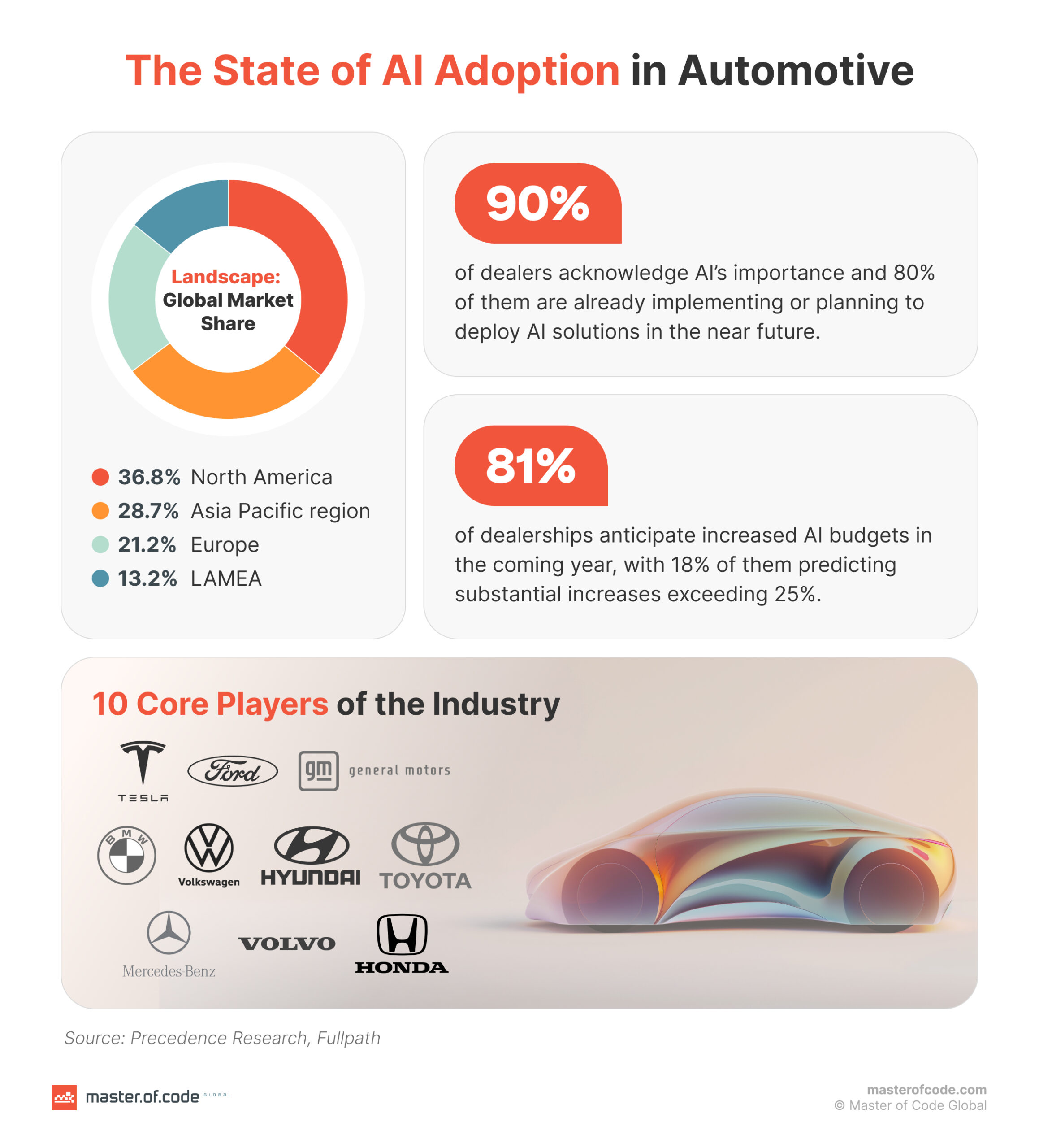
With hundreds of software and service providers claiming expertise in ai-driven automotive solutions, choosing the right partner for your specific needs can be overwhelming. The market is saturated, and the range of offerings, products, and platforms available is extensive and diverse. To simplify this complex terrain, we’ve curated a catalog of 13 leading AI automotive companies in different categories. From firms presenting custom development services to those integrating autonomous driving or smart maps, this list aims to provide a detailed overview of some major players. We hope this will help executives find the perfect fit for their unique requirements. Let’s take a closer look at these trailblazing vendors.
Table of Contents
Key Takeaways
- The top AI automotive companies in 2026 are Master of Code Global, Cerence, NVIDIA, HERE Technologies, Edvantis, CCC Intelligent Solutions, Cognata, AEye, Arbe Robotics, Brego, Scale AI, Waymo, and Revv ADAS.
- Companies were selected for automotive industry background, real-world impact, and a diverse range of specializations.
- The list covers voice assistants, ADAS and autonomous driving, lidar and radar, simulation, mapping, insurance claims, and dealership analytics.
- Automotive businesses use Generative AI for vehicle design, synthetic training data, personalized marketing, and in-car assistants.
- The right AI partner combines an automotive track record, ecosystem knowledge, and measurable results.
Our Approach to Selecting Leading Automotive AI Companies in the Auto Sector
Our selection process focused on several key factors. Firstly, we sought to include providers with a strong background and extensive experience in the automotive market. This guarantees they possess the knowledge and expertise to develop intelligent solutions that effectively address the industry’s challenges. Secondly, we prioritized vendors with a demonstrable real-world impact. This includes those with an established history of successful deployments, established partnerships with major tech players, and clear contributions to advancements in their specific niche.
Get real-world AI examples from the biggest automotive companies and apply them to your business.

Furthermore, we aimed to showcase the diversity of the landscape by including firms with varying specializations. This encompasses companies offering Conversational AI development services, specialists in large-scale projects for manufacturing and design, and platforms with distinctive products like autonomous driving technologies. As a result, the list caters to a wide range of needs and provides a valuable resource for brands seeking to adopt AI in their operations. While each provider on this catalog has a unique vision, they share a common commitment to enhancing safety, improving the driving experience, and creating better outcomes for both businesses and consumers.
Let’s immerse ourselves in the profiles of these artificial intelligence companies and explore the innovative solutions they offer.
Quick Comparison: Top Automotive AI Companies
| Company | Best For | Core AI Expertise | Automotive Use Case | Solution Type |
|---|---|---|---|---|
| Master of Code Global | Custom automotive AI | GenAI, voice, agents, predictive AI | Dealerships, after-sales, maintenance, CX | Custom development |
| Cerence | In-car assistants | Conversational & Generative AI | Voice control, navigation, cockpit AI | Automotive AI platform |
| NVIDIA | Autonomous driving infrastructure | Physical AI, simulation, compute | ADAS, autonomous driving, digital twins | Hardware + platform |
| HERE Technologies | Mapping & navigation | Location intelligence | ADAS maps, navigation, EV routing | Platform |
| Edvantis | Automotive software engineering | AI/ML, cloud, analytics | Logistics, supply chain, operations | Custom development |
| CCC Intelligent Solutions | Automotive insurance | Predictive AI, connected data | Claims, repairs, insurance | Industry platform |
| Cognata | ADAS/AV simulation | Synthetic data, GenAI simulation | Testing and validation | Simulation platform |
| AEye | LiDAR | Intelligent sensing | ADAS, autonomous driving | Sensor platform |
| Arbe Robotics | Radar | Perception radar | ADAS, autonomous vehicles | Sensor platform |
| Brego | Dealership analytics | Valuation, pricing AI | Vehicle valuation, inventory | Specialized platform |
| Scale AI | Automotive AI data | Data labeling, model evaluation | AV model training | AI infrastructure |
| Waymo | Autonomous driving | AV systems | Robotaxi/autonomous mobility | Autonomous driving |
| Revv ADAS | ADAS service workflows | AI-assisted vehicle analysis | Calibration, collision repair | Specialized platform |
Top Automotive AI Companies Shaping the Future of Mobility
Master of Code Global
Master of Code Global stands out among automotive AI companies with their fully customized approach to AI applications. They build a wide range of solutions adapted to unique business demands. Their build-from-scratch AI agents, chatbots, voice assistants, and LLM-powered tools cover diverse practical scenarios. These include AI-driven sales optimization, streamlined after-sales services, as well as enhanced engagement and retention strategies.
Their technology-agnostic strategy ensures seamless integration with existing tech stacks, and their ISO certification guarantees high-quality engineering processes. Whether it’s an online auto retailer, a parts manufacturer, or an insurer, Master of Code Global delivers software optimized for scalability and flexibility.
This company is also a key player among Generative AI automotive companies. They use advanced technologies like OpenAI, Palm, Bison, Gemini, RedPajama, LLama2, Mistral, Davinci, GPT-3.5, etc. The brand’s LOFT framework accelerates the development of GenAI projects, requiring up to 43% less effort for initial setup and offering an average of 20% budget savings when scaling before MVP. Covering multiple channels and platforms, their solutions are designed to meet the various needs of today’s businesses and their customers.

Predictive Maintenance
Master of Code Global developed an intelligent AI-powered predictive maintenance platform that monitors equipment health in real-time.
Check out case study
Automotive Voice Agent
We developed a hands-free virtual assistant for automotive excellence that engages prospects and boosts after-sales engagement
Check out case study
Car Dealership Chatbot
Master Of Code Global developed an un-authenticated web messaging with an FAQ bot powered by Generative AI.
Check out case studyCerence

Cerence.ai is a developer of AI-powered applications for the auto industry, specializing in Conversational and Generative AI, audio, and communication AI. With over 25 years of experience and a portfolio of nearly 650 patents, Cerence has shipped its technology in over 500 million cars and serves more than 80 OEMs and Tier-1 suppliers.
Their CaLLM and CaLLM Edge are designed specifically for automotive use cases, enabling features like voice control, navigation, and personalized experiences. Cerence Chat Pro integrates LLMs like ChatGPT for advanced in-car assistance. The company also offers solutions for noise reduction, emergency automobile detection, and exterior vehicle interaction. Their focus is on creating safer and more enjoyable driving through AI-driven innovation.
NVIDIA
NVIDIA is one of the major players in the automotive AI space with a suite of hardware and software solutions. Their technologies span the entire lifecycle, from design and visualization using RTX GPUs and Omniverse, to engineering simulation, digital twin creation, and virtual showrooms.
NVIDIA’s GenAI tools are used for tasks like scenario generation for autonomous vehicle testing and creating AI-powered assistants. The company’s DRIVE platform, including the DRIVE AGX and Hyperion sensor suite, provides the computing power and infrastructure for developing self-driving cars. NVIDIA partners with major automakers like Volvo and BMW, integrating its tech into their vehicles and manufacturing processes. Plus, their Cosmos platform speeds up the development of physical AI systems.
HERE Technologies

HERE Technologies specializes in location data and mapping solutions for the automotive domain. Their offerings include highly accurate and up-to-date maps for ADAS and automated driving, featuring lane-level detail and real-time updates. ISA Map covers precise speed limit info, while their ADAS Map enriches the functionality of advanced driver-assistance systems.
They also sell solutions for EV routing and charging, including information on power station availability and range prediction. HERE’s navigation apps are designed for connected cars and the digital cockpit, and their fleet management tools optimize routing and boost efficiency. The brand partners with numerous OEMs and has its technology integrated into millions of vehicles.
Edvantis
Edvantis constructs end-to-end software for the auto and logistics industries. They deliver solutions for transportation management, warehouse administration, inventory control, and AI-driven supply chain modeling. Edvantis emphasizes data analytics, AI/ML, and cloud computing expertise. They offer various cooperation models, including staff augmentation, dedicated teams, fixed-price initiatives, IT consulting, and digital transformation services.
This automotive AI application development company works with over 2500 transportation and logistics companies, producing apps to modernize operations, streamline delivery routes, optimize efficiency, and upgrade the overall experience for both businesses and end-users.
CCC Intelligent Solutions
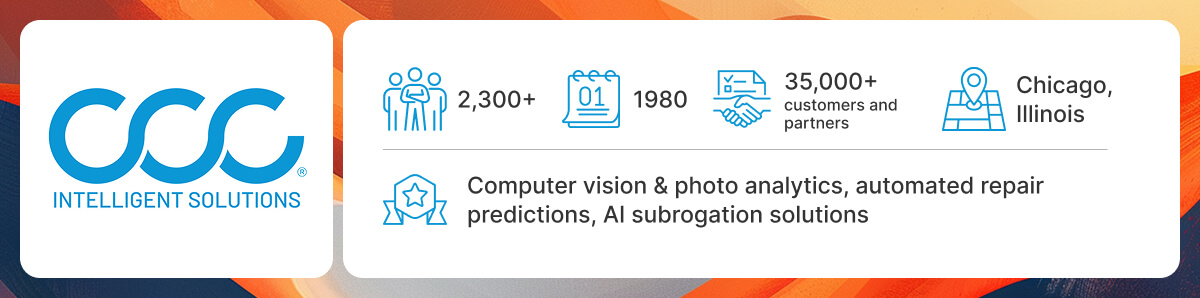
CCC Intelligent Solutions delivers technology software for the property and casualty insurance industry, connecting insurers, repairers, and auto manufacturers. Their platform relies on data, AI, and a connected network to streamline claims processing, repair workflows, and aftersales experiences. CCC offers instruments for incident detection, maintenance coordination, total loss management, customer experience, fraud prevention, telematics, and subrogation.
For automobile producers, the provider presents tools for managing certified repair networks, optimizing parts sales, and using data for interconnected car services and usage-based insurance. The company processes billions of dollars in transactions annually and connects over 35,000 businesses in the automotive ecosystem.
Cognata

Cognata supplies a supervised GenAI simulation platform for developing and validating autonomous systems, including AVs, ADAS, drones, and robots. Their system combines real-world information with synthetic data generation and 3D rendering. DriveMatriX, a key product, augments on-road driving metrics by creating variations in weather, lighting, and object placement, enhancing datasets for training and validation.
Cognata’s platform features photorealistic simulation with digital twins, a library of scenarios, and support for multiple sensors. They offer tools for automated testing, custom rule authoring, and deep analytics. The brand prioritizes cost-effectiveness, data maximization, and seamless integration with current components.
AEye, Inc.
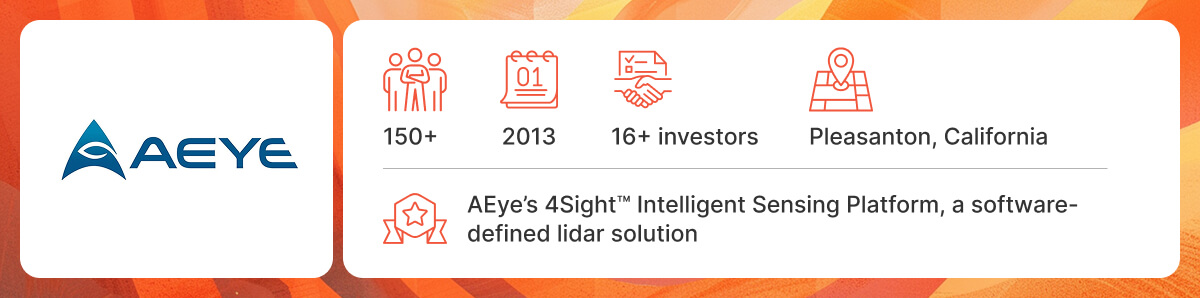
AEye specializes in software-defined lidar solutions designed for the automotive, trucking, and smart infrastructure sectors. Their core product is the 4Sight Intelligent Sensing Platform. It enhances perception capabilities, enabling faster and more reliable data capture for ADAS and self-driving systems.
4Sight lidar’s key strengths include long-range detection, adaptability to diverse scenarios, and robust situational awareness. Its patented bistatic architecture contributes to high reliability. Plus, it integrates intelligent processing for improved object recognition and reduced false positives. Ultimately, AEye aims to advance safety and performance in the autonomous vehicle space through its innovative lidar technology.
Arbe Robotics
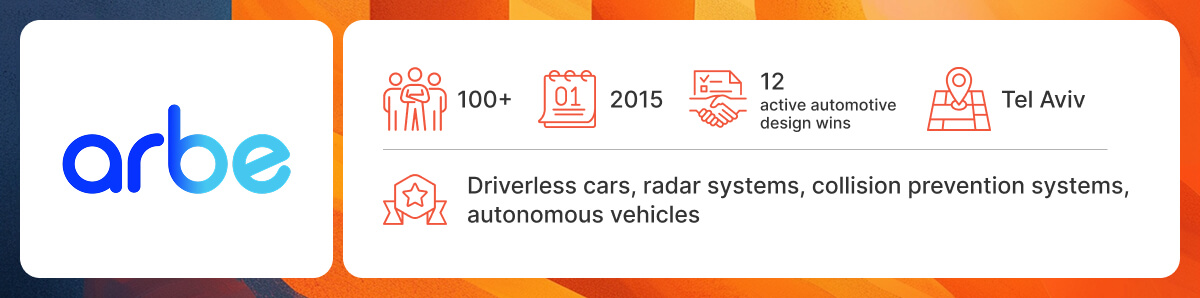
Arbe develops advanced radar solutions for driver-assistance systems and autonomous driving. Their Phoenix Perception Radar facilitates ultra-high resolution imaging with 2,304 virtual channels, allowing detailed object detection, free space mapping, and SLAM. Arbe positions Phoenix as a critical detector for redundancy and diversity in sensor suites, enhancing algorithms where optical sensors may fail.
Their Lynx Surround Imaging Radar is designed for corner and back installations, providing long-range performance, sharp quality, and a wide field of view at a lower cost. Arbe’s tools are intended for passenger vehicles, trucks, robotaxis, delivery pods, and heavy machinery, enabling features from emergency braking to highway autopilot.
Brego

Brego provides an AI-driven vehicle valuation and analytics platform for the automotive sector. Founded by tech-savvy brothers, the company uses advanced AI and data science to revolutionize how vehicles are valued. Their system delivers real-time valuations, industry insights, and tools tailored for dealerships, such as inventory pricing optimization, automated advert creation, and efficient stock sourcing.
For manufacturers, Brego presents market analysis, construction streamlining, competitive intelligence, and product marketing resources. The brand prioritizes client support through live chat and frequent updates. Serving both retailers and car makers, Brego helps optimize pricing, supply chain, promotional strategies, and production techniques.
Scale AI

Scale AI suggests an end-to-end platform for managing the machine learning lifecycle. They focus on high-quality information to improve model output and accelerate deployment. Their Automotive Data Engine grants tools for records labeling (such as 2D and 3D annotation from multiple sensors), evidence curation, and system assessment.
They also introduced a phased approach to model design, from initial dataset creation to continuous improvement and targeted data acquisition. The company is trusted by leading businesses for their capability to deliver sure-fire model improvements, maximum performance, and faster development cycles. Scale draws attention to the reliability of resources, cost-effectiveness, scalability, and diversity in their solutions.
Waymo
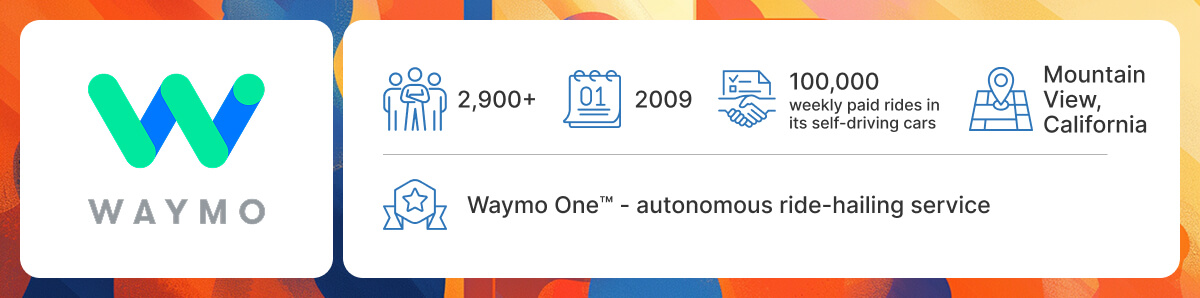
Waymo is developing autonomous driving tech with the goal of creating the world’s most trusted driver. Their Waymo One service offers ride-hailing in several cities, using a fleet of fully electric vehicles powered by renewable energy. The brand accentuates safety, citing data from their first 33 million miles driven that suggests a significant reduction in airbag deployments, injury-causing crashes, and police-reported collisions compared to human drivers.
The company’s mission is to improve road protection, increase mobility access for everyone, and promote sustainability. Moreover, they aim to reduce traffic fatalities, provide inclusive transportation, and contribute to a greener planet.
Revv ADAS

Revv was founded by software professionals with collision repair industry ties to address the challenge of researching ADAS calibrations. The provider recognizes the difficulty technicians face navigating OEM manuals and aftermarket resources. As a result, Revv developed RevvADAS, an AI-powered platform designed to streamline the process. This system decodes VINs and generates calibration reports, revealing ADAS features and mandated OEM procedures.
This helps facilities identify revenue opportunities, ensure OEM-compliant repairs, and return vehicles to customers faster. RevvADAS integrates with estimating platforms, supplies tailored invoicing and white-label briefs, and provides links to documentation. The RevvADAS Plus version adds features like a rules engine, CRM capabilities, workflow management, custom services, and QuickBooks integration.
How to Choose the Right Automotive AI Partner
The criteria above are a good starting point. Use this checklist when you compare vendors:
- Track record. Ask for deployments in automotive and partnerships with established industry players.
- Ecosystem understanding. Your partner should know how OEMs, dealerships, suppliers, and insurers work together.
- Tangible results. Request metrics such as reduced downtime, more test drives, or faster claims.
- Integration and security. Confirm the vendor can connect AI to your DMS, CRM, and vehicle data platforms and holds certifications such as ISO 27001.
Frequently Asked Questions
How are automotive companies using Generative AI?
GenAI is being utilized across the industry for a variety of purposes. Manufacturers are implementing it to streamline vehicle design procedures, optimize components, and generate synthetic data for training self-driving cars. Dealerships are integrating AI instruments to create personalized marketing materials, redefine client support conversations through intelligent chatbots, and develop interactive virtual showrooms. Insurers are exploring the adoption of technology for fraud detection, claims processing, and risk assessment. Additionally, many businesses are developing AI-fueled virtual assistants, advanced driver-assistance systems (ADAS), and voice agents to upgrade the in-car experience and improve safety.
What can be automated with AI in the automotive industry?
On the manufacturing floor, robots perform tasks like welding, painting, and assembly with precision and efficiency. Smart algorithms analyze images from cameras and sensors to conduct quality control inspections, identifying defects and ensuring high standards. Supply chain management is optimized through AI-based implementations that predict demand, simplify logistics, and manage inventory. Customer service interactions are increasingly automated through AI-powered conversational agents, providing instant guidance and individualized experiences. Perhaps most notably, artificial intelligence is at the core of autonomous vehicles, automating the driving process and paving the way for a future of safer and more efficient transportation.
How much does custom automotive AI development cost?
Cost depends on the use case, data, and integrations. According to Master of Code Global’s project data, generative AI chatbots for mid-sized companies typically cost $50,000 to $150,000, and predictive maintenance solutions range from $50,000 to $500,000. Advanced speech recognition for voice agents costs $100,000 to $300,000, and image recognition can reach $1 million for complex vision systems. A proof of concept, usually $25,000 to $80,000, is a practical way to test an idea first.
How long does it take to develop and deploy an automotive AI solution?
It depends on scope, data availability, integrations with dealer or manufacturing systems, and safety validation. A dealership chatbot launches much faster than an ADAS feature, which needs extensive testing and certification. Most companies start with a pilot, measure results, and scale in phases.
Should automotive companies build custom AI or use an existing AI platform?
Platforms suit well-defined needs, such as vehicle valuation, mapping, or ADAS calibration, and they reduce development effort. Custom AI suits unique workflows, brand-specific customer experiences, and cases that need several systems connected. Many automotive businesses use platforms for standard tasks and custom AI for areas where they compete.
How should automotive companies measure ROI from AI adoption?
Set baselines and track metrics tied to the use case: downtime and maintenance costs in manufacturing, test drives and leads in sales, and engagement in after-sales. In a Master of Code Global predictive maintenance project, the client saw 67% less downtime, a 45% drop in maintenance costs, and a 23% increase in OEE. An automotive voice agent delivered a 26% increase in test drives.
Ready to build your own Conversational AI solution? Let’s chat!