


Your head of sales asks the new AI assistant a simple question: “What’s our Q3 pipeline?” The assistant answers in two seconds with a confident number. The number is wrong. It counts closed-lost deals, and it uses calendar quarters instead of your fiscal ones. The query ran fine. The meaning was wrong.
This is the most common way data agents fail. On BIRD, an academic text-to-SQL benchmark over 95 databases, ChatGPT reached 40.08% execution accuracy, against 92.96% for human experts (Li et al., 2023). Models have improved since then. The gap in business meaning hasn’t closed, because no model can guess what “pipeline” means at your company.
We designed around this problem when we built the AI Assistant for Zipify. Instead of open access to production, we gave it a curated dataset with exactly the numbers it needed. 617 merchants have used it since launch.
This guide explains what a semantic layer for AI agents does, the lightest version that works without a data team, and when you need more.
Table of Contents
Key Takeaways
- A semantic layer gives agents one definition per metric, so they pick numbers instead of inventing formulas.
- Most mid-market companies can start light: a metric catalog plus verified queries exposed as MCP tools.
- Zipify’s AI Assistant reached release in about 2.5 months on a curated, synced dataset. 38% of engaged merchants came back for more than 3 conversations.
- In dbt Labs’ vendor benchmark, a semantic layer scored 98.2–100% on modeled questions. When it couldn’t answer, it said so instead of returning wrong data.
- Only 21% of companies have well-developed data curation (MIT CISR).
What Is a Semantic Layer for AI Agents?
What is a semantic layer? MIT CISR defines it as “a system of technologies and techniques that organizes and maintains a consistent and unified representation of data” from many sources, “interpretable by humans and machines.” In practice, it sits between your data and its users, human or machine, and stores what your numbers mean.
For an AI agent, that means a semantic data model it can read. It has four main parts:
- Dimensions and measures. Dimensions “represent categorical attributes,” such as region or sales rep. Metrics are “quantifiable measures of business performance calculated by aggregating facts,” such as total deal value (Snowflake docs).
- Entities and joins. Entities are “the join keys of your semantic model”, such as a customer ID that links your CRM to your billing tool.
- Metric definitions. “Qualified pipeline” means open opportunities at stage 2 or later, in the current fiscal quarter. You write that down once. A SaaS company might start with pipeline, ARR, net revenue retention, and days sales outstanding.
- Synonyms and descriptions. Agents need to know that “bookings,” “new business,” and “closed-won” may mean the same thing. Databricks metric views, for example, allow up to 10 synonyms per field or measure.
None of this is new. BI tools have used semantic models for years, and Microsoft calls Power BI datasets “semantic models.” What’s new is the consumer. Dashboards showed numbers to people who knew the context. Agents answer questions for people who assume the agent knows it.
So how does it work? The agent stops writing formulas and starts choosing from definitions. The next section shows the steps.
How a Semantic Layer Turns a Question Into an Accurate Query
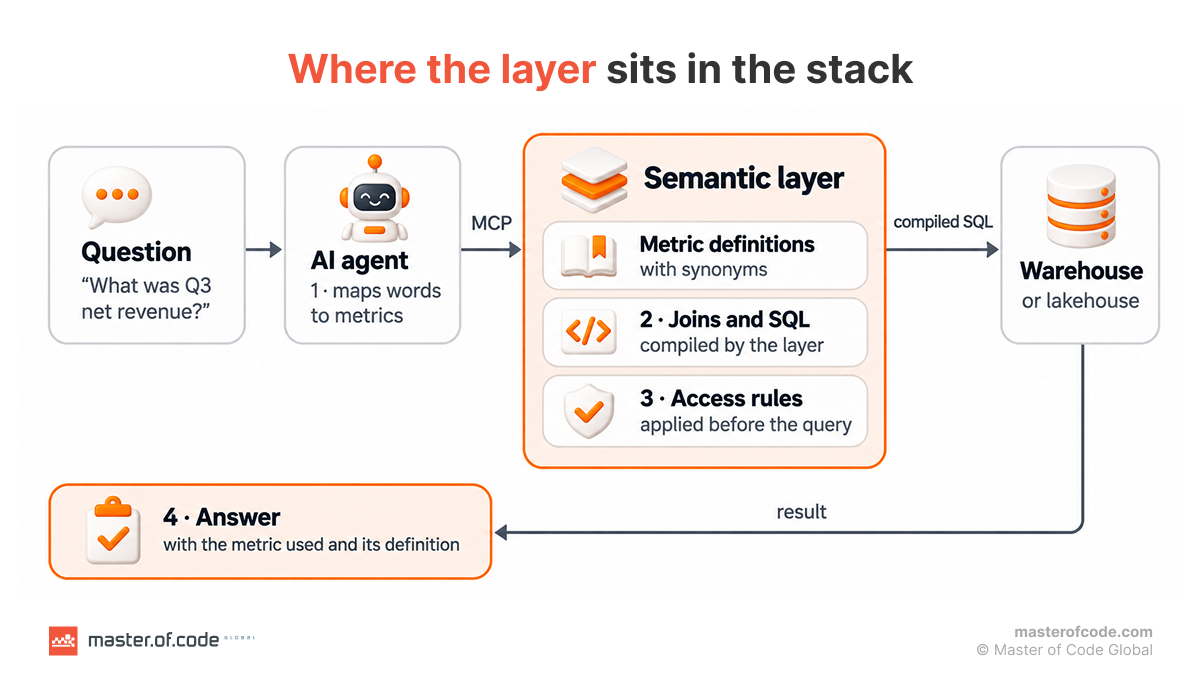
A semantic layer turns a question into a query in four steps:
- The agent maps words to metrics. “Q3 pipeline” becomes the governed metric “qualified pipeline” and the dimension “fiscal quarter.” Synonyms help it match the words people actually use.
- The layer writes the SQL. The model doesn’t build joins. dbt’s MetricFlow, for example, “constructs any joins necessary to reach the requested dimensions at query time”.
- Access rules apply. The layer checks what this user may see before the query runs.
- The answer comes with its definition. The head of sales sees the number and the rule behind it: open deals, stage 2+, fiscal Q3.
Compare that with an agent that has no layer. It sees tables called opportunity, stage, and close_date. It has to guess which stages count, whether lost deals belong in the total, and when your quarter starts. Each guess is reasonable. Together, they produce the wrong number from the opening scenario, and nothing in the answer tells the head of sales that anything was guessed.
This is why a semantic layer for AI agents and LLMs helps with business metrics. The model picks from a menu of certified metric definitions instead of inventing the business logic each time. If “net revenue” excludes refunds and credits, that rule lives in the layer, not in a prompt the model may ignore.
How do agents reach the layer? Increasingly through the Model Context Protocol (MCP), an open standard for connecting AI applications to external tools and data (MCP docs). Products already support it. Snowflake lets you add a semantic view “as a tool on an agent”. dbt’s MCP server gives agents access to the dbt Semantic Layer. If your systems don’t have an MCP server yet, you can build one. That’s what our MCP connector development team does.
Semantic Layer Architecture: Where It Fits in Your Data Stack
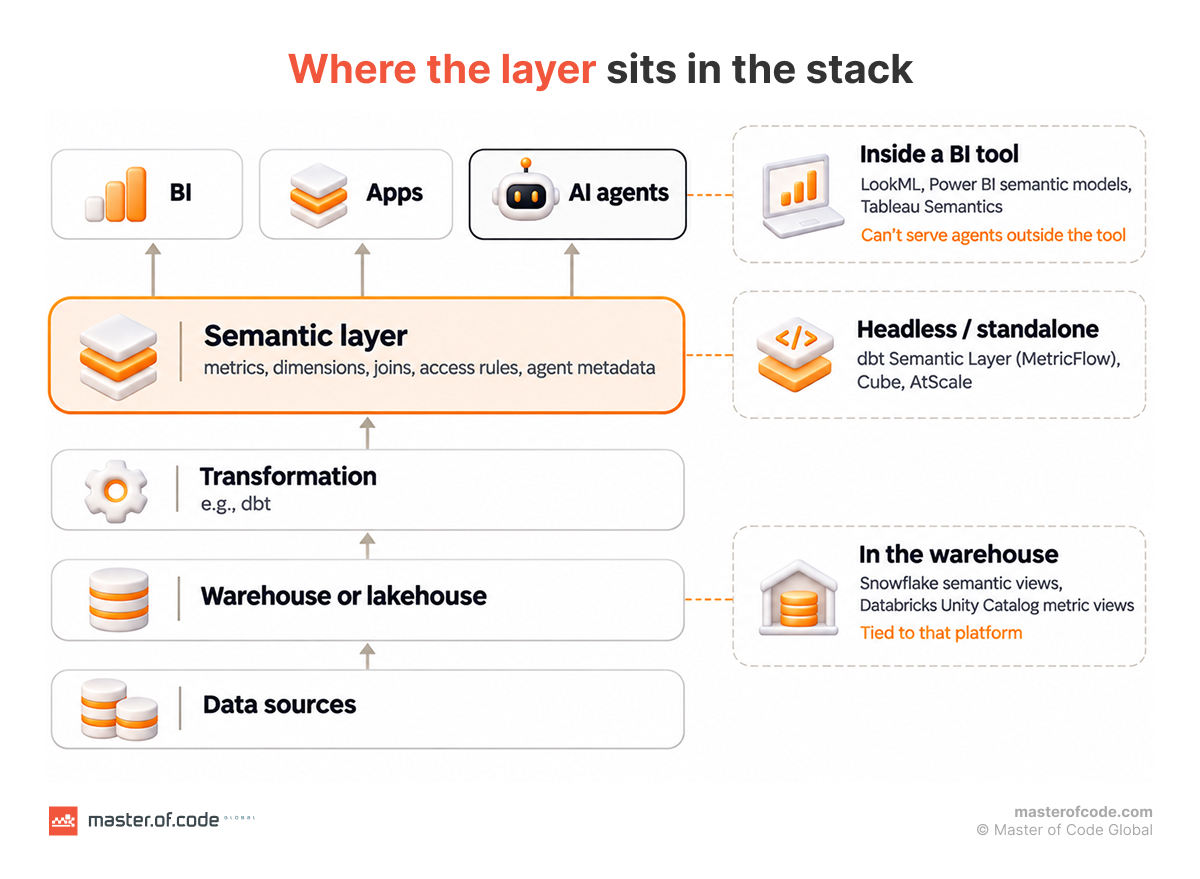
In a classic semantic layer architecture, the layer sits between transformation and consumers. Data flows from sources into a warehouse or lakehouse, gets cleaned (often with dbt), and then the semantic layer defines what it means for BI tools, apps, and AI agents.
The layer can live in three places:
- In the warehouse: Snowflake semantic views or Databricks Unity Catalog metric views.
- Headless, as a standalone layer: dbt Semantic Layer, Cube, or AtScale.
- Inside a BI tool: LookML, Power BI semantic models, or Tableau Semantics.
Each choice has a trade-off. A layer inside one BI tool can’t serve agents outside it. A warehouse-native layer ties you to that platform.
Notice what all three assume: a warehouse and a data team to run it. Most mid-market companies have neither. Their numbers sit in a CRM, an ERP, and a billing tool. We cover that case in the next section.
What makes an agentic semantic layer different from a BI-era one? Three things:
- Machine-readable descriptions and synonyms, written for agents, not analysts
- An API or MCP access point, so agents can query it directly
- Governance enforced at query time, for every request
Portability is improving too. Apache Ossie (incubating), previously the Open Semantic Interchange (OSI), is a vendor-neutral, Apache 2.0 specification for exchanging semantic metadata across analytics, AI, and BI platforms. It joined the Apache Incubator in July 2026. Whatever you choose, clean source data comes first. Our guide to AI data preparation covers that step.
Semantic Layer for AI Agents Without a Data Team: Which Option Fits a Mid-Market Company?
Most mid-market companies don’t need a semantic layer platform to start. They need a lightweight layer: a catalog of the metrics leadership actually uses, each with one definition and one owner, plus verified queries the agent calls as MCP tools. Move to a full semantic layer when your sources, metrics, and questions outgrow it.
The Lightweight Layer: A Metric Catalog Plus Verified Queries
The first half is a metric catalog. It can be a shared document, a spreadsheet, or a YAML file in a repository. For each metric, it records:
- The name and a plain-language definition
- The formula
- The source system: CRM, ERP, or billing
- Filters, such as “exclude closed-lost”
- Time logic, such as your fiscal calendar
- The owner who approves changes
The second half turns each metric into a verified query that the agent calls as a tool. Under the MCP Tools spec, each tool has a name, a description, and an input schema, and tools let models interact with external systems, “such as querying databases, calling APIs.” So you build a tool called get_qualified_pipeline with two inputs: quarter and region. It runs one tested query against your CRM, and it returns the number with its definition. The agent picks the tool. It never writes the SQL.
Enterprise tools use the same idea. Snowflake’s verified query repository is “a collection of questions and corresponding SQL queries to answer them.” Databricks Genie’s trusted assets are “example SQL queries and SQL functions that provide verified answers.” The lightweight version applies the same pattern to the systems you already run.
Zipify shows how this works at mid-market scale. Zipify builds Shopify apps for 18,000+ brands. Its OneClickUpsell app has generated over $1.2 billion in upsell revenue, but merchants rarely logged in. Our AI Assistant for Zipify reads each merchant’s performance data and suggests a next step. It runs on its own database, separate from the core app. “A daily sync feeds it exactly what it needs — store statistics, funnel performance, health signals.” A dedicated data agent handles the numbers. The Assistant went from kickoff to release in about 2.5 months. Since launch, 617 merchants have started 1,749 conversations, and 38% of engaged merchants have returned for more than 3.
Three Options, Side by Side
| Option | What you build | Fits when | Who maintains it | Trade-off |
|---|---|---|---|---|
| Direct access or prompt context | Schema and notes in the prompt | Small, stable schema; one team; rough answers are OK | Whoever built the agent | Wrong numbers arrive silently as questions grow |
| Lightweight layer | Metric catalog plus verified queries as MCP tools | No warehouse; numbers live in CRM, ERP, and billing; a defined set of KPIs | A business owner (RevOps, finance) plus a developer | Answers only the questions you’ve built tools for |
| Full semantic layer | Warehouse-native, headless, or custom on open specs | You run a warehouse, have many sources, and get many ad hoc questions | A data team | Modeling effort and platform cost |
How to Choose
You need at least the lightweight layer when one or more of these is true:
- Agent answers reach executives, the board, auditors, or customers.
- The same metric differs between your CRM and your billing tool.
- Several agents or apps query the same data.
- Access rules differ by user, team, or client.
- Your schema is too large to fit in a prompt.
Move to a full semantic layer when most questions need joins across many systems, when ad hoc questions outnumber repeat ones, or when you already run a warehouse and a data team.
The lightweight layer isn’t wasted if you outgrow it. The catalog becomes the spec for the full layer, and the agent’s tools can call the new layer instead of the CRM. The agent itself doesn’t need to change.
Direct access is still fine for a small, stable schema used by one team for exploratory work. Even dbt Labs, which sells a semantic layer, draws the same line in its 2026 benchmark. It recommends a semantic layer “when accuracy matters (board data, auditors, OKRs, KPIs, weekly reports).” For ad hoc work, it suggests checking the semantic layer first and falling back to text-to-SQL.
Building and buying aren’t either-or here. Most companies buy the platform pieces and build the definitions, which only they can write. Our guide to build vs buy AI solutions covers the wider decision.
Semantic Layer vs. Text-to-SQL vs. RAG
They solve different problems. Text-to-SQL writes queries from the database schema. RAG retrieves text. A semantic layer supplies governed meaning for structured data. Mature systems often combine all three.
| Approach | What it gives the agent | Best for | Main failure mode |
|---|---|---|---|
| Text-to-SQL | The schema; the model writes SQL | Flexible, ad hoc questions | A plausible wrong number, with no warning |
| RAG | Relevant passages from documents | Policies, contracts, docs | Retrieves text; doesn’t compute metrics |
| Semantic layer | Governed metrics and dimensions | KPIs, plus finance and board reports | Can only answer what’s modeled |
RAG, as defined in the original paper, pairs a retriever over a dense vector index with a text generator (Lewis et al., 2020).
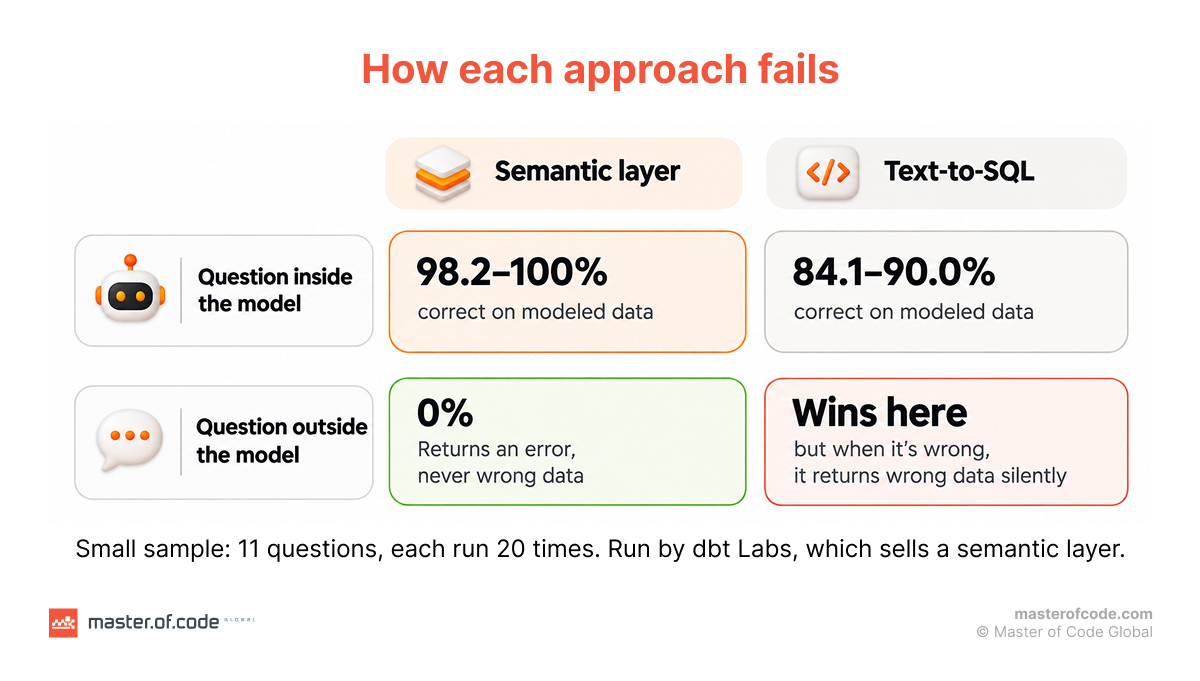
Semantic layer vs text-to-SQL comes down to accuracy and how each one fails. The research shows the scale of the problem. On Spider 2.0, a benchmark of 632 real enterprise tasks, the best agent solved only 21.3% (Lei et al., 2024).
dbt Labs ran a head-to-head test in 2026. It’s a vendor benchmark with a small sample: 11 questions, each run 20 times. On questions the model covered, the semantic layer scored 98.2–100%, and text-to-SQL scored 84.1–90.0%. dbt notes that text-to-SQL got the entire schema as context, “which isn’t practical for larger datasets.” On questions that needed joins the model didn’t cover, the semantic layer scored 0%, and text-to-SQL won.
The real difference is the failure mode. When the semantic layer can’t answer, dbt says it “tells you it can’t answer. It never returns invalid data.” Text-to-SQL returns a number either way. For a board report, a loud failure beats a silent one.
In practice, many teams combine the two, as dbt suggests. The agent tries the semantic layer first. If the question falls outside it, the agent falls back to text-to-SQL and labels the answer as unverified. Leaders get governed numbers for the questions that matter and flexible answers for the rest, and they can tell which is which.
Semantic layer vs RAG is simpler. RAG over documents can’t reliably compute “Q3 net revenue.” A semantic layer can’t answer “What’s our refund policy?” Most assistants that handle both kinds of questions need both.
When to Add Knowledge Graphs or Vector Databases
Use a semantic layer for governed numbers, a vector database for finding relevant text, and a knowledge graph for relationships across entities and sources. Companies with mixed questions often need two or three of them.
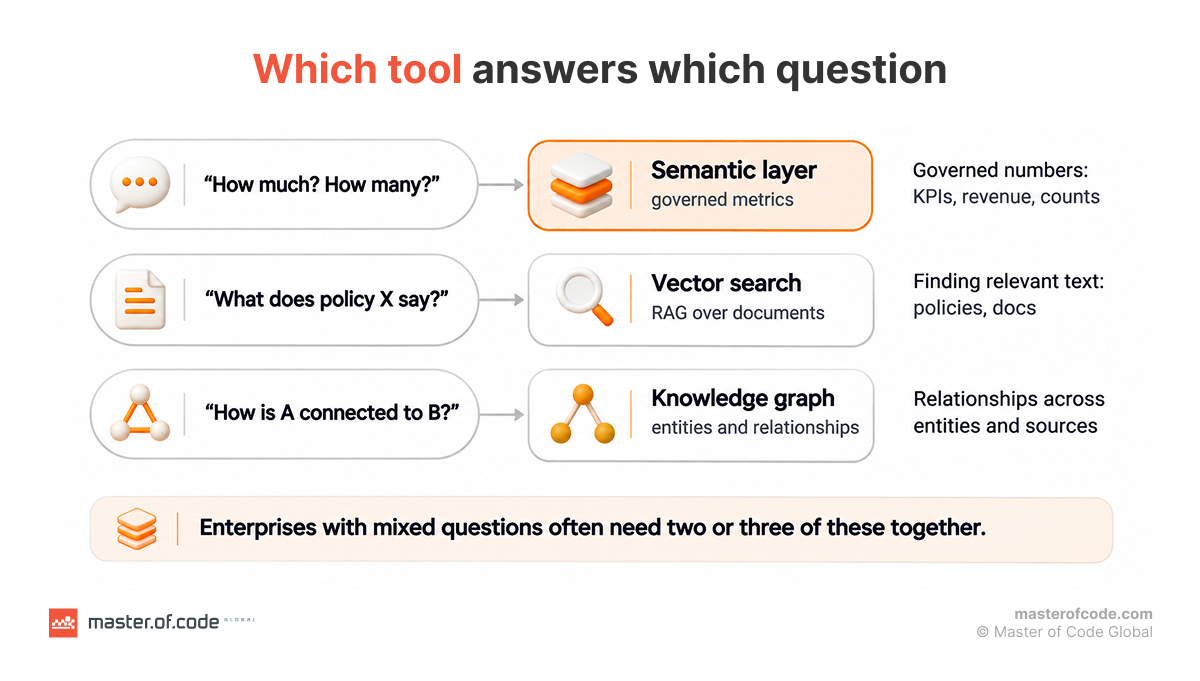
The research supports this split:
- Sequeda, Allemang, and Jacob found that GPT-4’s accuracy on enterprise SQL questions rose from 16% to 54% when the same database was represented as a knowledge graph (2023). It’s vendor research: the authors were at data.world, which sells a knowledge-graph data catalog.
- Microsoft researchers showed that “RAG fails on global questions directed at an entire text corpus,” and that graph-based summaries answered them better (Edge et al., 2024).
- MIT CISR recommends investing in techniques that close contextual gaps, such as taxonomies and knowledge graphs.
A simple guide:
- “How much? How many?” → semantic layer
- “What does policy X say?” → vector search
- “How is A connected to B?” → knowledge graph
Most mid-market teams won’t need a knowledge graph on day one. A metric catalog for numbers and RAG for documents cover most early questions. Add a graph when questions start to cross entities, such as which customers share a parent account across regions.
If most of your questions are about documents and processes, start there. Our guide to AI for knowledge management covers that side.
One Definition of “Revenue” Across Every Source
The layer stores each metric once. Every agent, dashboard, and app reads the same definition, so a CRM agent and a finance agent can’t disagree on “active customer.”
Different systems often count the same thing differently, and both can be right. Your CRM may count a new customer when a deal closes. Your billing tool may count them when the first invoice is paid. The agent needs to know which one the CFO means, and the answer belongs in the definition, not in each prompt.
That’s what a single source of truth means in practice. Three habits make it work:
- Define once, reuse everywhere. Databricks describes metric views as a way to “define metrics once and query them at runtime”. dbt semantic models work the same way.
- Version definitions. Keep certified metrics in code or in the catalog, with a history of changes.
- Name an owner. One person approves every change to a definition.
A large, real example comes from MIT CISR. Healthcare IQ built a semantic layer over “nearly six million unique healthcare products from more than 25,000 manufacturers.” Its semantic technologies “automated 80 percent of the effort required to onboard new hospitals.” Your catalog will be far smaller. The principle is the same: standardize meaning once, and every new user or system benefits.
Governance, Access Control, and Security
A governed semantic layer for AI agents applies the same permissions to an agent as to the human it acts for, before the query runs.
The main controls:
- Row-level security. In Power BI, RLS “restricts data access for specific users of a Power BI semantic model,” and “you define filters within roles.” A sales rep sees their own region; the CFO sees all of them.
- Per-user enforcement for agents. For Databricks Genie, row filters and column masks defined in Unity Catalog “are enforced per user automatically”.
- Column masking for personal and payment data.
- Certified vs. draft metrics, so agents only use approved definitions.
- Lineage and audit, so you can see which definition produced which answer.
Tools don’t replace ownership. Data governance needs a person behind it. MIT CISR says a semantic layer “needs an owner who is accountable for its quality and results.” At a mid-market company, that’s usually someone in finance or RevOps.
Agents add one more risk: identity. An agent may run as a service account with broad access, while the user asking has narrow access. The layer must check the user’s permissions, not the agent’s. Mid-market companies have one advantage here. Their CRM, ERP, and billing tools already have roles and permissions. Verified query tools should pass the user’s identity to those systems instead of running every request as an admin. That way, the agent can never see more than the person asking.
If agents connect through MCP, follow the MCP authorization spec, which builds on OAuth 2.1. For a review of your setup, see our AI security consulting.
Can a Semantic Layer Reduce Hallucinations and Calculation Errors?
Yes, for questions the layer models, because the model selects metrics instead of inventing formulas. No, for questions outside the model. And it does nothing for hallucinations in narrative text, such as a made-up reason why revenue dropped.
The evidence is promising but limited. In dbt’s 2026 benchmark, the semantic layer reached 98.2–100% on the questions it covered, and “It never silently returns wrong data.” That’s a vendor-run test with 11 questions, so treat it as a signal. A 2023 study by data.world researchers, on the same insurance dataset, points the same way: GPT-4’s accuracy rose from 16% to 54% over a knowledge graph.
A semantic layer for AI agents is one control among several. To stop hallucinating metrics, we use these:
- Define metrics outside the prompt. Prompts drift; definitions in a catalog don’t.
- Return the definition with every answer, so users can spot a wrong rule.
- Run known-answer tests before each release. Ask questions finance has already answered, such as last quarter’s closed revenue. If the agent’s number differs from the signed-off one, the release waits.
- Trace and review. On the Zipify project, we tuned each agent’s prompt to the features it owns, traced how requests move between agents, and reviewed live chats every week.
For more on why models make things up, see our guide to LLM hallucinations.
Use Cases and Business Benefits
The best use cases are the questions leadership asks every week:
- Pipeline and forecast reviews from CRM data, with one definition of “qualified”
- Cash and receivables questions across the ERP and billing tool
- Churn and renewal risk, with one definition of “active customer”
- Customer-facing reporting, where strict tenant isolation matters
- Operations agents that act when a metric crosses a threshold
- Forecasting fed by consistent inputs, the basis for AI predictive analytics services
Start with the one question leadership asks most and gets inconsistent answers to. That’s where the first metric definitions pay off fastest.
The business case rests on data curation. In MIT CISR’s 2024 survey of 349 executives, organizations with well-developed data curation were “more than three times as likely to be effective at implementing value-realizing data and AI initiatives.” They were also twice as likely to report a meaningful competitive advantage. Only 21% had such practices.
The work also pays off more than once. A semantic layer for AI agents and applications serves dashboards and apps with the same governed metrics. You model “net revenue” once, and every tool uses it. Our guide to generative AI for data analytics shows more ways to use those numbers.
Challenges and Costs
The main cost is modeling and ownership, not licenses. Someone has to define, approve, and maintain every metric.
- Modeling effort and coverage. The layer only answers what you’ve modeled. In dbt’s benchmark, it scored 0% on questions outside the model.
- Keeping definitions current. New products, pricing, and territories change what metrics mean.
- Ownership and politics. Sales and finance may define “revenue” differently. Someone has to decide, and MIT CISR says that someone should be one accountable owner.
- Adoption. People have to stop keeping their own spreadsheet versions of the truth. In our experience, that’s harder than the technical work.
- Latency. Precomputed or cached numbers answer faster than live queries. Zipify’s daily sync is one way to handle it.
- Lock-in. Definitions written for one vendor’s format are hard to move. Apache Ossie aims to fix that.
What does it cost? No neutral source publishes price ranges, so we won’t invent one. The cost depends on the number of metrics and sources, your governance requirements, and whether you already pay for a warehouse with a semantic layer built in. A lightweight layer for a defined set of KPIs is a much smaller project than a full platform. Its size depends mostly on three things: how many metrics you start with, how many source systems the tools must call, and how complex your access rules are.
How We Built Natural-Language Data Agents
Three of our projects show the range, from a curated dataset to rule-based agents over a warehouse.
AI Assistant for Zipify. Zipify wanted to help OneClickUpsell merchants act on their own performance data. We built an assistant with four agents: an orchestrator, a data agent for the numbers, a strategist for recommendations, and an agent for database queries. It runs on its own database, fed by a daily sync. Agents are gradually gaining access to production-mirrored data, but only in isolated, closely monitored stages. The result: release in about 2.5 months, 617 merchants and 1,749 conversations since launch, and 38% of engaged merchants returning for more than 3 conversations.
AI Energy Data Tool. At an energy and carbon management company, non-technical staff couldn’t query data without SQL. We built a chat-based agent that turns plain-English questions into SQL, handles joins across datasets, explains each query in plain language, and enforces access through Active Directory. As usage grows, governed definitions are the next step to keep answers consistent.
Data Discrepancy Reconciliation Tool. A US energy company reconciled water and oil readings by hand. We built an agentic assistant over its Snowflake data. It applies explicit business rules, such as flagging when offload volume differs from hauler volume by more than 2.7%. It explains root causes and supports role-based access. The business logic lives outside the prompt, where it can be tested. Our LLM integration services team builds systems like these.
Conclusion
A semantic layer for AI agents doesn’t make models smarter. It gives them fewer ways to be wrong about your business.
For a mid-market company, start light. Pick the metrics that reach leadership. Give each one a definition and an owner. Expose them to agents as verified tools, and add access rules before anyone outside the team uses them. Then build incrementally, as MIT CISR recommends, and move to a full platform only when your questions demand it.