




Every health system CFO has now seen the same slide. It shows a hockey stick. It promises hundreds of billions in savings, generated by automating administrative labor, catching billing errors and fraud, and optimizing clinical operations. The deck arrives from a vendor, a consultancy, or an internal innovation team, and it lands on a desk already crowded with problems that are considerably less abstract: labor costs that rose during the pandemic and never fully retreated, denial rates climbing quarter over quarter, capital projects deferred for a third consecutive budget cycle, and a payer mix that keeps drifting in the wrong direction.
The slide is not wrong. Researchers from Harvard and McKinsey, publishing through the National Bureau of Economic Research, estimated that broader adoption of artificial intelligence could reduce US healthcare spending by 5 to 10% — roughly $200 billion to $360 billion annually, using technologies that already exist and without sacrificing quality or access. That is not a speculative figure pinned to some future breakthrough. It is an arithmetic ceiling built from specific, documented use cases.
A ceiling is the number you reach if execution is close to perfect, and healthcare execution is almost never close to perfect. The distance between that ceiling and what most organizations actually capture is a management gap — a question of which processes you target, how deeply the solution integrates with systems built in the 1990s, who owns the financial metric, and whether anyone defined what success meant before the pilot began.
So, how does AI reduce costs in healthcare? And how can your organization actually measure them, defend to a board, and sustain past the enthusiasm of the first quarter? This article answers that. It maps the specific mechanisms, quantifies the economic impact of AI in healthcare across three distinct cost pools, and — because credibility requires it — details what these deployments actually cost to build and run.
Reach out to Master Of Code Global if you want to jump straight to business
Table of Contents
Key Takeaways
The savings are structural, not incidental. Meaningful cost reduction comes from eliminating process steps entirely, not from making existing steps marginally faster. A tool that helps a clerk complete a form in four minutes instead of six saves you almost nothing. A system that completes the form without the clerk changes the unit economics.
Your proprietary data is the only durable advantage. Generic models are trained on everyone’s information, which effectively means they are trained on no one’s in particular. Your denial patterns, your payer contract quirks, your scheduling behavior, your clinicians’ documentation habits — these constitute an asset no competitor can replicate and no vendor can package.
Data sovereignty has become a competitive position, not a compliance chore. Where patient information travels, who processes it, and under what contractual terms now determine which use cases you can pursue at all. Organizations with clean answers move faster than those still negotiating.
Integration friction is where returns die. The model is rarely the failure point. The handoff between the model and the electronic health record almost always is.
Pilot economics are not scale economics. A deployment that succeeds in one department, with a dedicated team and focused vendor attention, behaves very differently across twelve facilities and three states. Budget for the transition, not just the trial.
Payback windows now fit inside a single budget cycle — which changes who must approve the initiative and how it gets defended when the CFO asks for evidence in month seven. Realistic healthcare cost savings are achievable within the fiscal year, provided the target was chosen for measurability rather than for demo appeal. That single choice separates the projects that survive review from the ones quietly defunded.
Many AI projects fail on unit economics before they fail on product. Someone plugs AI into a workflow, and nobody stops to calculate what the infrastructure will actually cost, the conversions, the cost of resolving a single case. AI makes a project faster to build, but the moment it gets complex, it also makes it more expensive. Add the infrastructure costs on top, and the ROI stops adding up. You end up spending 99 cents to deliver something worth a dollar.
Sometimes the math is even more brutal. In some support bot cases, resolving a query through AI costs more than having a person do it, which sounds backwards, but it happens. That’s what makes unit economics more critical now than it used to be: there’s an ongoing cost baked into every interaction, driven by tokens, that traditional infrastructure never had.
Where the Money Actually Leaks: A Three-Pool Model
Before evaluating any specific application, it helps to have a framework you can reuse — one that survives contact with a board meeting and lets you sort vendor pitches in about ninety seconds.
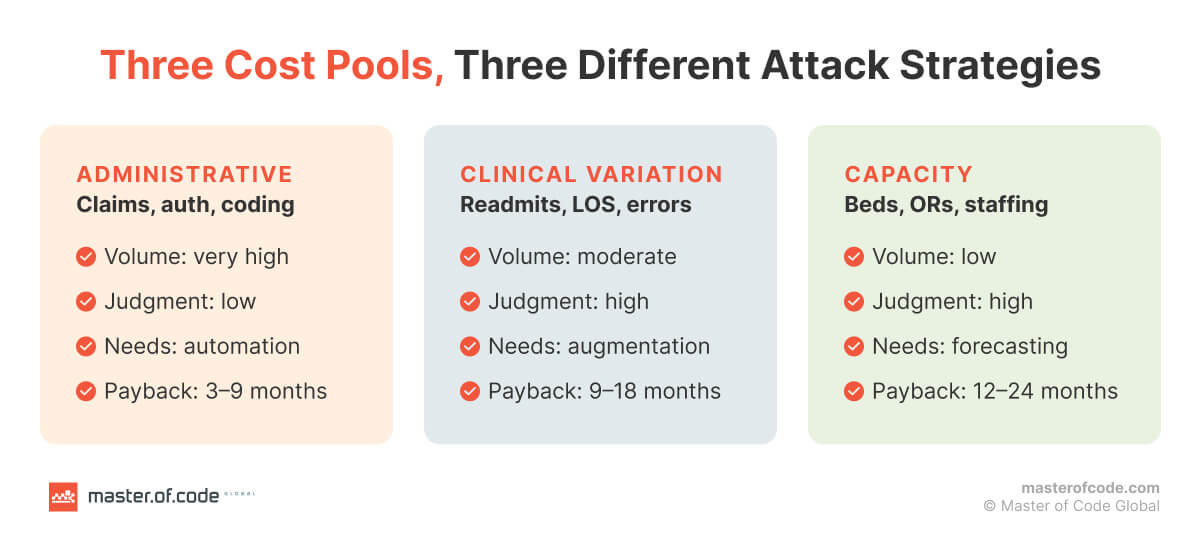
Healthcare cost leaks into three pools. Each behaves differently. Each demands a different kind of intelligence.
Pool One is administrative overhead. Claims processing, eligibility verification, authorization requests, medical coding, collections, and credentialing. These transactions are high in volume and low in judgment. They follow rules. They generate structured artifacts. They are, in the most literal sense, work that consumes salaries without touching a patient.
Pool Two is a clinical variation. Avoidable admissions. Redundant imaging. Complications that develop because a deterioration signal went unnoticed for eleven hours. Two clinicians treating identical presentations along paths that differ by thousands of dollars and several days. This pool is lower in transaction volume but far higher in judgment, which means the goal is not automation but augmentation — better information, delivered at the moment of decision.
Pool Three is capacity and capital. Operating rooms that sit empty on Tuesday afternoon and run over on Thursday. Imaging suites are idle at 40 percent utilization. Shifts staffed for a census that never materialized. Patients who simply do not arrive. Here, the decisions are few, but each one carries enormous weight, and the required capability is forecasting.
Think of it as three leaks in one hull. Patch only the loudest, and the ship continues to sink quietly.
This framework also explains a pattern you have probably noticed. Most vendors sell into Pool One, because Pool One demos beautifully — clean before-and-after numbers, immediate visual impact, no clinician sign-off required. Pool One is real money and worth pursuing. But the compounding returns, the ones that change your cost structure rather than trimming it, live in Pools Two and Three, where resource allocation decisions cascade through every other line on the operating statement.
Understanding how does AI reduce costs in healthcare therefore requires looking at all three pools and accepting that they require different technologies, different governance, and different timelines.
Pool One: The Paperwork Dividend
The administrative burden in American healthcare is not a rounding error. It is one of the largest single categories of expenditure in the system, and the majority of it consists of work that exists solely because two organizations need to agree on who pays for something that already happened.
This is where administrative automation delivers its fastest, most legible returns, and it is the reason most organizations begin here.
The flagship case: authorization requests
Few processes illustrate the opportunity better than prior authorization. A manual request involves phone calls, faxes, portal logins, clinical documentation retrieval, and follow-up — often several rounds of it. Staff time accumulates on both sides of the transaction, and the patient waits.
Automation changes the arithmetic in two ways. It reduces cost per transaction, and it compresses cycle time, which has downstream effects on scheduling, revenue recognition, and patient retention that rarely appear in the original business case.
A caution worth stating plainly: partial automation frequently performs worse than none at all. When a system handles intake but hands off exceptions to a human who must then re-enter data into a second interface, you have created what operations teams call the swivel chair — two systems, one person, twice the work. The organizations capturing real value automate the full path of a prior authorization request, including exception handling, or they do not bother.
The industry-level evidence is encouraging. The 2025 CAQH Index found that US healthcare avoided an estimated $258 billion in administrative costs through electronic transactions and improved data exchange, with roughly $21 billion in additional savings still available. The same report found that more than half of health plans and a quarter of provider organizations had already introduced AI tools into administrative workflows.
Note the asymmetry in those adoption figures for administrative automation. Payers are moving roughly twice as fast as providers. For any organization, that gap is a strategic problem: the counterparty across every negotiation is automating faster than you are.
Documentation and the recovery of clinical capacity
Ambient capture systems that draft clinical notes from the encounter itself have moved from novelty to near-standard equipment. The common framing centers on burnout, and that framing is accurate — physicians did not train for a decade to spend evenings on data entry.
But burnout is the human story. Recovered capacity is the finance story. Both are true; only one gets funded reliably.
When you reduce documentation time by a meaningful margin across a large physician population, you are not primarily buying satisfaction. You are buying appointment slots that already existed but were being consumed by clerical work. That capacity converts directly into throughput without a single additional hire, which is why this application clears finance review faster than almost anything else in the portfolio.
Revenue integrity and the denial problem
Coding accuracy, denial prediction, and appeal generation form a cluster that most organizations underestimate. A denial is not merely delayed revenue; it is revenue that costs money to chase and frequently never arrives.
Models trained on your historical claims can flag submissions likely to be rejected before they leave the building, identify the specific documentation deficiency, and draft the appeal when a rejection does occur. This is simultaneously a cost lever and a revenue lever, which is unusual and useful — it means the initiative can be defended on two separate grounds when budget pressure arrives.
Fraud, waste, and abuse
At the payer level, fraud detection has become one of the most mature applications in the sector. Pattern recognition across claim volumes that no special investigations unit could ever staff manually surfaces anomalies that traditional rules engines miss entirely: billing patterns that look normal individually but form an implausible cluster, provider behavior that deviates from peer norms, upcoding signatures that emerge only across thousands of encounters.
The economics of AI healthcare fraud detection are unusually clean, because recovered and prevented improper payments are hard dollars that appear directly on the ledger. Provider organizations benefit too, on the compliance side — the same fraud detection capability that identifies external bad actors also identifies internal documentation practices likely to attract an audit.
What to measure in Pool One: cost per transaction, touchless processing rate, days in accounts receivable, denial rate, denial overturn rate, and clinical hours returned to patient-facing work. If a vendor cannot map their product to at least two of these, the business case is not ready.
This is how AI reduces costs in the most direct sense available — by removing work that never needed to exist. Administrative automation is the entry point for most organizations precisely because it requires no clinical validation, no physician behavior change, and no regulatory approval. But treating it as the destination rather than the on-ramp leaves the larger opportunity untouched.
Pool Two: Precision as a Cost Strategy
The most expensive thing in medicine is being wrong slowly.
A missed early-stage diagnosis becomes a late-stage treatment. An unrecognized deterioration becomes an intensive care admission. A discharge that ignores an unaddressed risk factor becomes a readmission thirteen days later. In each case, the cost multiplier is not incremental — it is often an order of magnitude.
Cost reduction in the clinical pool is therefore mostly error reduction and time-to-correct-pathway reduction. The savings are real, but they are indirect, which makes them harder to attribute and easier for skeptics to dismiss. Organizations that succeed here build the attribution model before they build the system.
Precision imaging and the economics of catching things early
Imaging triage, anomaly detection, and second-read applications have accumulated the deepest evidence base of any clinical use case, and regulatory clearances have concentrated heavily in radiology for exactly that reason.
Improved diagnostic accuracy produces savings along two paths. The first is stage-shifting: disease identified earlier costs dramatically less to treat and produces better outcomes, a rare alignment of clinical and financial interest. The second is avoided redundancy — when the initial read is confident and correct, the follow-up imaging, the specialist referral, and the diagnostic detour never happen.
There is a third benefit that appears in no business case but matters to any executive who has sat through a malpractice deposition: diagnostic error is among the most common sources of claims. Improving diagnostic accuracy reduces that exposure directly.
Clinician receptivity, long assumed to be the primary obstacle, has shifted decisively. The American Medical Association’s 2026 survey found that 81 percent of physicians used AI professionally, more than double the 38 percent recorded in 2023, with the average number of applications per physician rising from 1.1 to 2.3. More than three-quarters now believe these tools improve their ability to care for patients, and the advantages they cite most often are diagnostic accuracy and workflow efficiency.
Read that carefully, because it reframes the implementation problem. Your clinicians are not the blocker. They are already using these tools, frequently without institutional sanction. The blocker is governance, integration, and the absence of an approved path, which means the risk you are managing is no longer resistance but unmanaged, unmonitored adoption happening around you.
Decision support and the cost of unwarranted variation
Two patients present with identical symptoms, identical comorbidities, and identical insurance. They see different physicians. One pathway costs four thousand dollars; the other costs eleven thousand. Neither clinician did anything wrong. They simply drew on different training, different experience, and different recall of a literature that expands faster than any human can track.
Clinical decision support narrows that variance by surfacing relevant evidence, comparable cases, and pathway recommendations at the point of decision rather than in a policy document nobody reads. The savings come from the expensive tail of the distribution — the outlier pathways that consume resources without producing better outcomes.
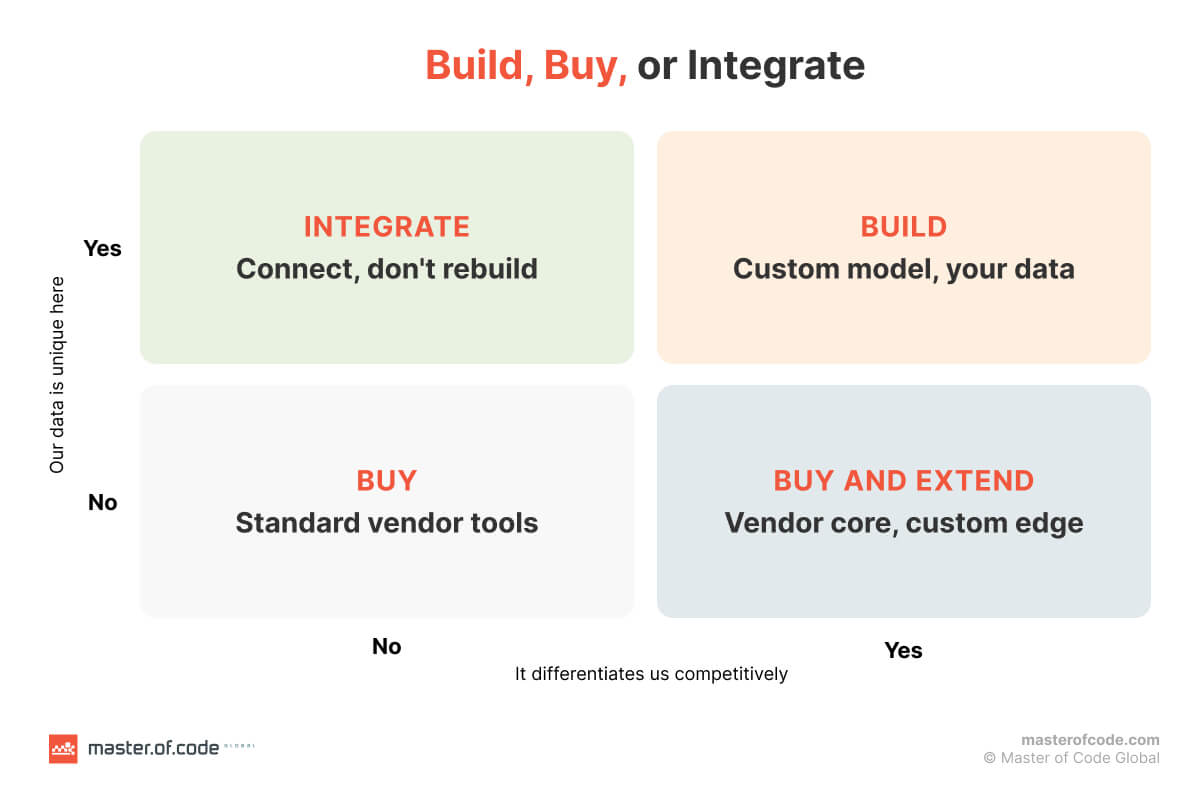
The implementation requirement here is unforgiving: recommendations must appear inside the existing workflow, in the EHR, at the moment of the order. A separate application requiring a separate login will be used enthusiastically for three weeks and then abandoned. This is not a technology constraint. It is a human one, and it has defeated more deployments than any algorithmic limitation.
Readmissions and the discharge decision
Hospital readmissions carry a distinctive economic profile because they are penalized as well as costly. Under value-based care arrangements, the same event damages you twice: once through the cost of care delivered at reduced or zero reimbursement, and again through quality scores that affect future contract terms.
Risk stratification at discharge — combining clinical indicators, social determinants, medication complexity, and historical utilization — identifies which patients need intervention and, critically, which do not. The second half matters more than most organizations appreciate. Blanket post-discharge programs are expensive and dilute intervention resources across a population that mostly does not need them. Targeting concentrates effort where it changes outcomes.
Reducing hospital readmissions is often the fastest-converting business case in the clinical pool, because the counterfactual is unusually easy to establish and the financial impact appears in a line item finance already tracks.
The throughput multiplier hiding in a single day
Most executives underestimate the value of a single day. Reduce the median length of stay by twenty-four hours across a medical-surgical unit, and have increased annual bed capacity by a percentage that would otherwise require capital construction to achieve.
The mechanism is the prediction of discharge barriers rather than prediction of discharge dates. Most excess days accumulate not because the patient is unwell but because a consult is pending, a placement has not been arranged, a test is scheduled for tomorrow that could have run today, or a transport slot was missed. Models that flag these barriers twenty-four to forty-eight hours in advance let case management resolve them before they become delays. Managing length of stay this way is closer to logistics than to medicine.
Extending the ward into the home
Remote patient monitoring applies the same logic outside the building. Continuous signals from patients with chronic conditions, interpreted by models tuned to detect meaningful deviation rather than raw threshold crossings, allow intervention at the point where a phone call and a medication adjustment still suffice — before the emergency department becomes the only option.
Taken together, these AI in healthcare use cases share a common shape: they do not make care cheaper by delivering less of it. They make care cheaper by delivering the right care sooner, which is the only version of cost reduction that survives clinical scrutiny and public attention.
Pool Three: Forecasting the Floor
Here is an uncomfortable observation about hospital operations: a large share of what gets classified as clinical waste is actually a scheduling problem wearing a clinical costume.
The census was underestimated, so the unit ran short and premium labor was called in at triple cost. The operating room block was allocated on historical averages that no longer hold, so Tuesday sat half empty while Thursday ran three hours past. Eleven patients did not arrive for their appointments, and the slots could not be refilled on four hours’ notice.
None of this is a medical failure. All of it is expensive.
Census forecasting and staffing
Predictive analytics applied to admissions volume, discharge timing, and acuity mix produces a forecast horizon long enough to act on — typically several days rather than several hours. That horizon is the entire value proposition, because the difference between knowing on Monday and knowing on Thursday morning is the difference between scheduling and scrambling.
Staffing optimization built on those forecasts attacks the single most volatile line in the operating budget. Agency and overtime premiums are not primarily a wage problem; they are an information problem. Organizations pay them because they discovered a gap too late to fill it any other way. Close the information gap and a meaningful portion of the premium disappears without a single change to base compensation or staffing ratios.
There is a workforce dimension as well. Predictable schedules reduce turnover, and turnover is enormously expensive once you account for recruitment, orientation, and the productivity ramp of a new hire.
The no-show problem
Missed appointments waste a resource that cannot be recovered — a clinician-hour, once elapsed, is gone. Models that predict no-shows based on appointment history, lead time, distance, weather, transportation access, and prior communication response allow targeted intervention: a reminder sequence for moderate-risk patients, a direct call for high-risk ones, a transportation arrangement where that is the actual barrier.
Some organizations then move to predictive overbooking. This works, and it carries genuine risk. Overbook too aggressively and you have traded an empty slot for a waiting room full of irritated patients and a clinician running ninety minutes behind. The discipline is to calibrate against measured accuracy rather than optimistic assumptions, and to revisit the calibration quarterly. Handled well, no-shows shift from an accepted cost of doing business to a managed variable.
Capacity, capital, and cross-site allocation
Operating room utilization, imaging suite scheduling, and inpatient bed management respond to the same forecasting logic. So does supply chain — inventory carrying costs, expiration waste, and emergency procurement premiums all shrink once predictive analytics makes demand legible several weeks out.
The most sophisticated applications of AI in hospital management optimize resource allocation across facilities rather than within them. A multi-site system holds far more slack than any individual site can see. Surfacing that slack — a scanner idle at one campus while another has a nine-day backlog — captures value that no single-site optimization can reach.
This is where AI predictive analytics in healthcare earns its position in the strategic portfolio rather than the efficiency portfolio. Better forecasting does not merely trim the cost of current operations; it defers capital expenditure by extracting more capacity from assets you already own. A deferred construction project is worth more than several years of operational savings, and it appears in a completely different section of the financial statement.
Worth noting: the same forecasting infrastructure that predicts census also predicts which patients will return, which is why organizations that invest here often find their hospital readmissions program improving as a side effect. Predictive analytics capabilities compound in ways that point solutions do not.
The Long Game: Discovery and Personalization
For pharmaceutical organizations, biotech firms, and the payers who ultimately fund therapy, the cost equation operates on a different timescale but follows similar logic.
Compressing the most expensive failure mode
The dominant cost in pharmaceutical development is not the drug that succeeds. It is the nine that fail, and specifically the ones that fail late, after hundreds of millions have been committed.
Applications of AI to drug discovery attack that failure curve at several points. Target identification narrows the field before laboratory work begins. Candidate molecule screening evaluates vastly more compounds than physical experimentation permits. Toxicity and interaction prediction surfaces problems that would otherwise emerge in phase two.
The clinical trial, the most capital-intensive phase of drug discovery, offers equally significant opportunity. Site selection models predict which locations will actually enroll rather than which promise to. Patient matching identifies eligible candidates across health records that no coordinator could manually review. Enrollment forecasting flags trials likely to miss timelines while intervention remains possible.
The value created by drug discovery applications is best understood not as cost reduction but as failure acceleration. Killing a doomed candidate in month eight rather than month thirty is worth more than any efficiency gain in the work that follows.
Matching therapy to the responder
Personalized treatment approaches the same problem from the delivery side. When a therapy works in roughly a third of patients, two-thirds of the spend produces no clinical benefit while still generating side effects, monitoring costs, and delay before an effective alternative is attempted.
Models that predict response from genomic markers, biomarker panels, comorbidity profiles, and prior treatment history redirect those who spend. The savings are the therapy that was never going to work and was therefore never prescribed. For payers managing specialty pharmacy costs, personalized treatment has become one of the few levers that reduce spending while improving outcomes rather than trading between them.
What is actually running underneath
Two technology families power most of what has been described.
Machine learning covers systems that infer patterns from historical examples rather than following explicitly programmed rules. Show a model a hundred thousand discharges labeled by whether readmission followed, and it identifies predictive combinations no analyst would have hypothesized. The strength is pattern discovery at scale. The limitation is dependence on data quality, which is why machine learning projects succeed or fail on data governance rather than algorithm selection.
Natural language processing (NLP) handles unstructured text — clinical notes, discharge summaries, correspondence, the sixty to eighty percent of healthcare information that never reaches a structured field. Extracting that content into an analyzable form is frequently the unlock that makes everything else possible.
The economic impact of AI in healthcare across discovery and personalization operates on a longer horizon than administrative or operational work. Budget accordingly, and do not let a five-year value curve compete for approval against an eight-month one. They are different instruments serving different purposes.
The Other Side of the Ledger: What This Actually Costs
Most content on this subject stops before this section. That is a mistake, and an expensive one for the reader, because a business case built on savings without a credible cost model does not survive its second board review.
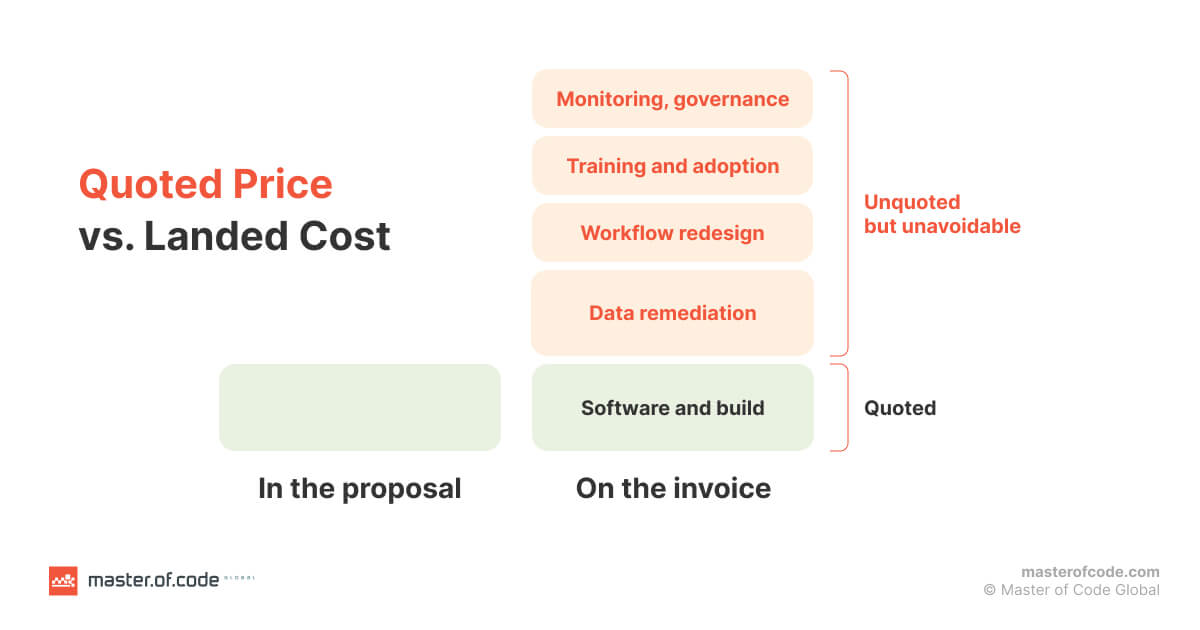
The visible line items
Software licensing or development cost. Compute infrastructure, whether cloud consumption or on-premises capacity. Integration engineering to connect the system to your EHR, revenue cycle platform, scheduling system, and data warehouse. Clinical validation. Security review.
These are the numbers in the proposal. They are rarely the numbers in the final accounting.
The costs nobody quotes
Data remediation is almost always the largest hidden expense. Models require consistent, complete, accessible information, and most healthcare data is none of these — fragmented across systems, inconsistently coded, missing at exactly the moments that matter. Assessing and repairing this frequently consumes more effort than building the model.
Workflow redesign follows. Introducing a capability into a process designed without it requires rethinking the process, and that work is organizational rather than technical. It cannot be outsourced entirely and it cannot be rushed.
Training and adoption support extends well past go-live. Clinical staff need to understand not only how to use the tool but when to trust it and when to override it. That judgment develops over months.
Model monitoring is the cost most organizations forget entirely. Performance degrades as patient populations shift, coding practices change, and clinical protocols update. Without ongoing surveillance, a system that performed well at launch quietly deteriorates, and nobody notices until an audit or an adverse event surfaces it. This is a permanent operating expense, not a project cost.
Governance — review boards, documentation, bias assessment, incident procedures — is similarly permanent, and similarly absent from most vendor proposals.
The realistic cost of implementing AI in healthcare therefore runs materially above the quoted figure, with the gap concentrated in exactly the areas that determine whether the deployment works.
Technical debt and the pilot graveyard
There is a second-order cost that compounds. Every ungoverned pilot becomes a maintenance obligation. Multiply that across departments running independent experiments and you accumulate a portfolio of half-integrated systems, each with its own vendor relationship, data flow, and security exposure, none with a clear owner.
Shadow adoption makes this worse. Staff who cannot access sanctioned tools use unsanctioned ones, which means patient information moves through channels your security team has never reviewed. This is now among the most common findings in healthcare technology audits, and it is a direct consequence of institutional slowness rather than employee misconduct.
Building a defensible return model
The failure rate here is genuinely sobering. Research from MIT’s NANDA initiative found that 95% of generative AI pilots produced no measurable return, with the root causes identified as poor integration and misaligned priorities rather than inadequate models.
That finding deserves a sympathetic reading. It is not a story about foolish buyers or fraudulent vendors. It is a story about a missing discipline — organizations deployed capable technology into environments that were not prepared to absorb it, and measured nothing that would have revealed the problem in time to correct it.
Three principles separate the defensible business case from the vulnerable one.
Separate hard savings from soft savings, and never blend them. Hard savings are dollars that leave the expense line: reduced agency spend, eliminated vendor contracts, avoided penalties, recovered payments. Soft savings are hours returned, satisfaction improved, risk reduced. Soft savings are real and worth pursuing. Presenting them as equivalent to hard savings destroys your credibility permanently the first time a CFO tests the claim.
Capture the baseline before deployment. The most common measurement failure is having no pre-deployment data, which leaves every post-deployment number floating without context. Measure the current state for at least one full cycle first, even if it delays the launch.
Assign one owner to the financial metric. Clinical operations tracks utilization, IT tracks uptime, finance tracks cost — and nobody owns the connection between the model’s output and the dollar figure. Name that person before the project starts, and make the ROI calculation their explicit responsibility.
Applied consistently, this discipline produces an ROI case that survives scrutiny. Skip it, and you will generate impressive activity metrics that quietly fail to appear in the financial statements, which is precisely the pattern the AI in healthcare statistics on pilot failure are describing.
One more note on the cost of AI in healthcare: the expense of doing nothing is not zero. It is the administrative overhead you continue to carry, the capacity you continue to leave unused, and the widening gap between your operating efficiency and that of competitors who moved earlier. The ROI of AI should always be evaluated against a realistic status quo, not an imaginary one in which current costs remain flat.
Security, Sovereignty, and the Cost of Getting It Wrong
Security in this context is not a compliance topic. It is a financial one, and the arithmetic is stark.
Healthcare has been the most expensive sector for data breaches for well over a decade. The average incident now costs approximately $7.42 million, with organizations requiring 279 days to detect and contain one — roughly five weeks longer than any other industry.
Any honest accounting of the cost of AI in healthcare has to carry that number. Set it against a successful automation program saving, say, two million annually. A single breach erases nearly four years of gains, before accounting for reputational damage, regulatory response, and the operational disruption of a nine-month remediation.
This changes how security investment should be evaluated. It is not overhead attached to the initiative. It is the insurance that prevents the initiative’s returns from being reversed.
The questions procurement should be asking
Where does patient information physically reside during processing? If a third-party model is involved, does data leave your environment, and if so, under what contractual protection?
Is your information used to train models that serve other customers? The answer is sometimes yes by default, buried in terms nobody reads.
What is the subprocessor chain? Vendors use vendors. Each link is a potential exposure, and each requires its own business associate agreement.
Can you produce, on demand, a complete record of which model made which recommendation using which inputs? Regulators increasingly expect this. So do plaintiffs’ attorneys.
What happens at contract termination? Data portability provisions written after a relationship sours are rarely favorable.
Organizations with clean answers to these questions move faster than those still negotiating them, which is the practical sense in which data sovereignty has become a competitive advantage rather than a defensive posture. The cost of AI in healthcare includes the cost of doing it safely, and the organizations treating that as optional are accumulating a liability they have not priced.
For our part, every solution Master of Code Global builds is secured to ISO 27001 standards. We state this as a fact of how we work rather than a differentiator, because in this sector it should be table stakes — and the fact that it frequently is not tells you something about the market.
Choosing a Partner That Survives Contact With Your Legacy Stack
Selection criteria matter more than vendor claims, so here are the six questions worth asking any potential partner — along with, transparently, how we answer them.
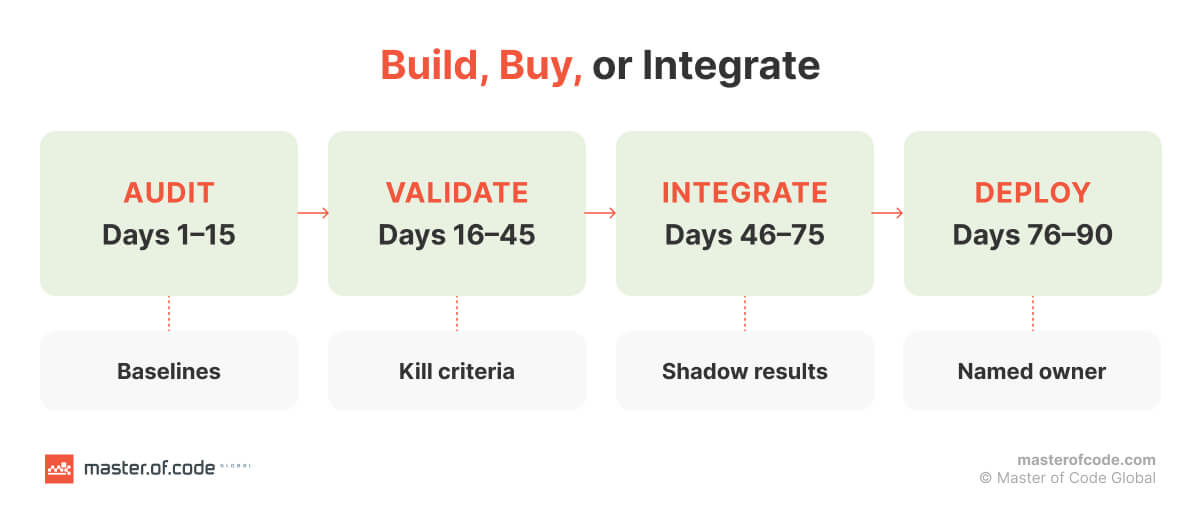
Do they validate before they build? The most expensive failure is a solution engineered flawlessly for the wrong problem. Master of Code Global begins with a strategic, fixed-price Proof of Concept — a collaborative phase that validates the idea and surfaces technical requirements before major commitment. For a US digital wellness platform, that meant an 8-week PoC scoped to a single clinical pathway before any commitment to the full four-domain build — a sequencing that let a 500-member pilot clear every success gate the client had defined before a dollar went toward scaling it. It reduces potential development waste by 50 to 70 percent, and it occasionally concludes that the project should not proceed as scoped. That outcome saves more money than most successful projects, and it’s a useful discipline for anyone still asking how does AI reduce costs in healthcare when the answer depends entirely on picking the right problem first.
Will the team that pitched be the team that delivers? Continuity is not a nicety in complex healthcare integration; it is the difference between a partner who understands your architecture in month nine and one relearning it. We guarantee zero staff turnover on active projects. You finish with the same experts you started with — the same team that took a leading US healthcare provider’s concierge assistant from an initial rollout of 219 conversations in its first month to over 760 within three, without a rebuild or a handoff in between.
Are they platform-agnostic or reselling a stack? A partner with a preferred platform will find that your problem requires their platform. We are certified with Google Cloud, Salesforce, and AWS, and work as strategic allies of Sinch, Glia, Cohere, Infobip, LivePerson, and Voiceflow. That breadth exists so we can recommend the right answer rather than the convenient one, and so that integration with your proprietary CRM or gateway is an engineering task rather than a negotiation.
Can they prove outcomes at enterprise scale? Twenty years. More than a thousand delivered projects across finance, healthcare, eCommerce, and automotive. Solutions reaching over a billion users. Measured results including a 15x revenue increase from intelligent recommendations, a tripling of conversion rates, and an 80 percent improvement in customer satisfaction.
Does independent validation exist? We hold a place among the world’s Top AI Consulting Companies on Clutch with a 4.7-star rating, and were named Infobip’s Technology Partner of the Year – Americas 2025. The brands that trust us with their most complex work include Tom Ford, Electronic Arts, T-Mobile, the Golden State Warriors, Burberry, and Jo Malone.
Do they think like an owner or a contractor? Having built and scaled our own products, we approach engagements with a founder’s mindset — attentive to adoption, market fit, and the strategic conditions for success, not only to the technical build. We take responsibility for the full lifecycle: user journey and conversation design, development, analytics, and ongoing support. That ownership mentality is also what separates vendors who chase pilots from partners who drive durable AI adoption in healthcare, where the win isn’t a single successful deployment but a track record that compounds across every subsequent one.
Effective healthcare AI consulting should reduce your risk before it increases your spend. And healthcare AI software development in this sector is fundamentally an integration discipline — the model is the straightforward part, while connecting it safely to a twenty-year-old clinical system without disrupting care is the work that determines whether any of it pays off.
Frequently Asked Questions
Which savings are realistically achievable in the first year?
The fastest returns come from administrative processes — authorization handling, claim scrubbing, denial prediction, and clinical documentation. These require no clinical validation, no regulatory approval, and no change to care delivery, which removes most of the delay from the timeline. Clinical and operational applications generally take longer to demonstrate impact because the savings are indirect and require careful attribution, but they produce larger and more durable structural change.
What is the realistic cost of implementing AI in healthcare?
Meaningfully more than the quoted price, with the difference concentrated in data remediation, workflow redesign, training, and ongoing model monitoring. Data preparation is typically the largest hidden expense. Treat governance and performance surveillance as permanent operating costs rather than one-time project line items, and build the business case against that fuller figure — a case that survives contact with reality is worth more than one that looks better in the approval meeting.
Which application delivers the fastest measurable return?
For provider organizations, denial prediction and clinical documentation tend to convert first, because both produce effects in metrics finance already tracks. For payers, claims automation and improper payment detection lead. For multi-site systems, capacity forecasting frequently produces the largest absolute impact, though it takes longer to demonstrate.
How do we use AI without increasing our data risk?
Establish where patient information travels before evaluating features. Confirm whether your data trains models serving other customers, map the full subprocessor chain, require complete audit logging of model inputs and outputs, and negotiate data portability terms at contract signing rather than at termination. Given what a breach costs in this sector, security architecture is part of the return calculation, not a constraint on it.
Discover how Master of Code Global can help enhance your customer’s experience and boost sales growth.