


Mid-market companies rarely start from zero with artificial intelligence. Teams already use Copilot, ChatGPT, automation platforms, or isolated AI tools. Leadership wants ROI, while IT worries about security, data, and integrations. Yet nobody owns the decisions about what to buy, build, stop, or scale.
This is where AI consulting services can add focus. AI consulting in mid-market businesses is usually narrower than enterprise transformation. It identifies a few valuable initiatives, validates them quickly, and builds essential foundations. It should also transfer enough knowledge to prevent permanent consultant dependence.
This guide covers readiness, costs, engagement models, use cases, partner selection, and ROI. It also explains when outside support is unnecessary.
Table of Contents
Key Takeaways
- Mid-market companies usually need prioritization before generating more AI ideas.
- A useful engagement connects business strategy with practical implementation decisions.
- Consultants help when specialist expertise is needed before permanent hiring makes sense.
- Readiness covers processes, data, technology, people, security, and governance.
- The first pilot needs one business KPI and a production path.
- Consulting may be unnecessary when existing software or internal expertise suffices.
What Is AI Consulting for Mid-Market Businesses
AI consulting in mid-market businesses provides external strategic and technical support. It helps companies identify, validate, implement, and scale AI initiatives. This support avoids establishing a large permanent AI function too early. The emphasis stays on decisions, execution, and measurable results.
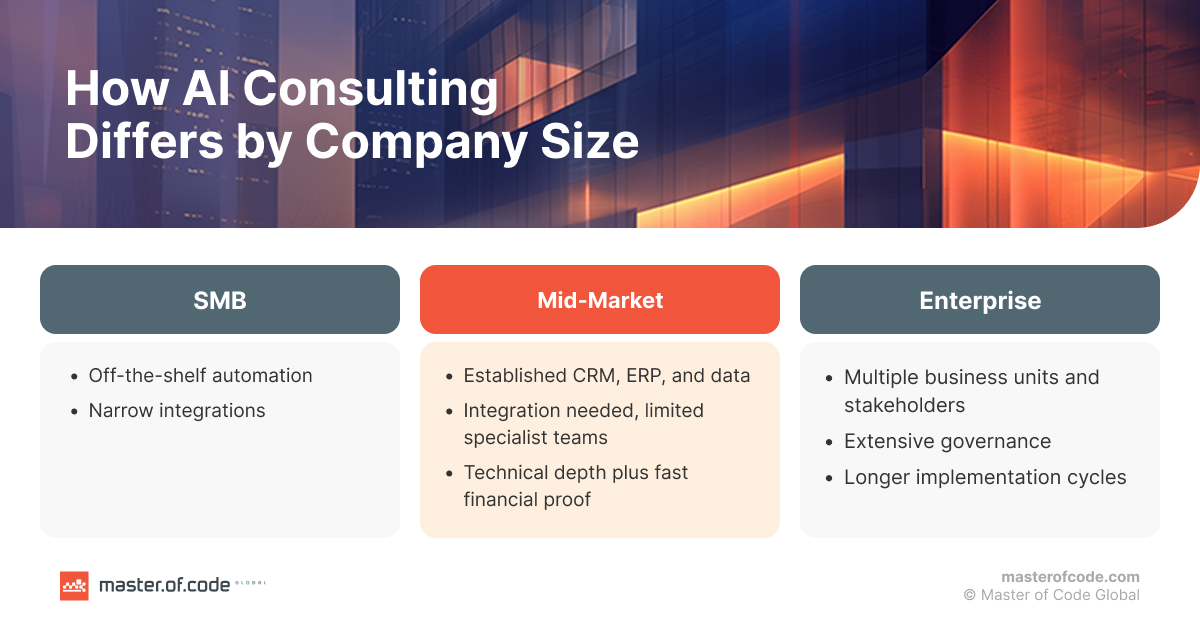
Enterprise AI consulting often spans multiple business units and stakeholder groups. It commonly includes extensive governance and longer implementation cycles. SMB consulting relies more heavily on off-the-shelf automation and narrower integrations. Mid-market businesses sit between these two operating models.
They often have established CRM, ERP, and data infrastructure. Their operations require integration, yet specialist teams and budgets remain constrained. AI consultants must therefore balance technical depth with faster financial proof. Mid-market should never be treated as a smaller enterprise program.
Why and When Should a Mid-Market Business Hire an AI Consultant
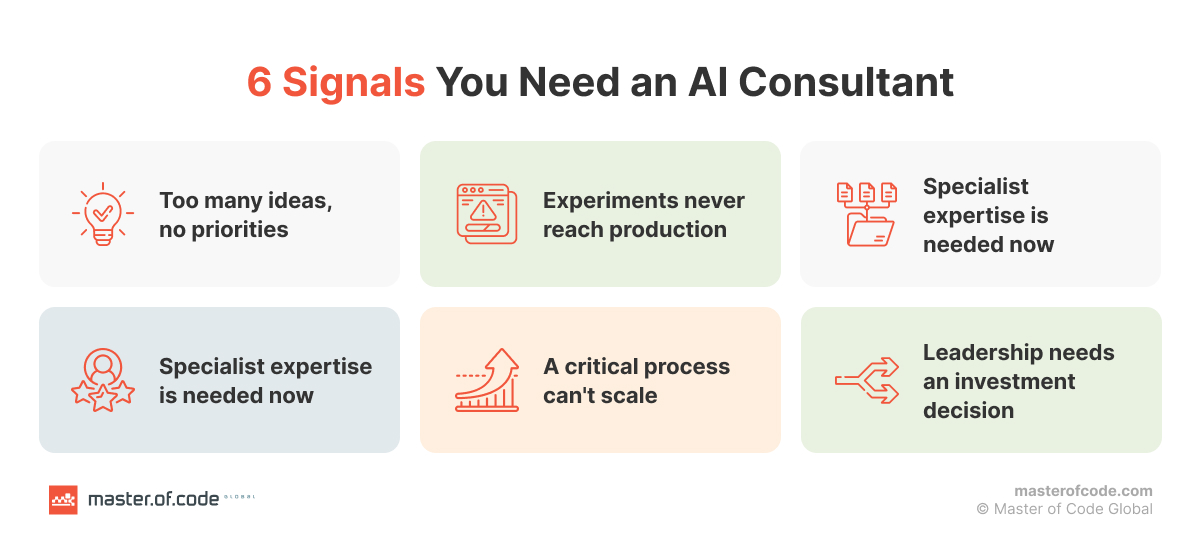
Outside expertise is most useful when uncertainty blocks an important decision. The company may have ideas but lack prioritization, architecture, or ownership. An AI consultant can test assumptions before larger commitments are made. The following signals indicate that support may be timely.
Strong Signals You Need Outside Expertise
- Too many ideas and no priorities. Departments propose projects, but nobody can compare value and feasibility.
- Experiments never reach production. Existing proofs of concept lack integrations, owners, or adoption plans.
- Data readiness remains unclear. Information is fragmented across CRM, ERP, spreadsheets, and departmental tools.
- Expertise is temporarily required. Senior product, architecture, data, or AI skills are needed now.
- A critical process cannot scale. Support, sales, finance, or operations rely too heavily on headcount.
- Leadership needs an investment decision. The unresolved choice is whether to buy, build, integrate, customize, or stop.
Why invest now rather than wait? AI capabilities and vendor offerings change quickly, but operational bottlenecks remain measurable. A focused assessment can separate durable opportunities from short-lived product hype. It can also prevent scattered experimentation from becoming unmanaged AI spend.
When Is AI Consulting Not the Right Investment
Consulting should reduce uncertainty, not manufacture an AI project. An existing SaaS product may already solve the business problem adequately. The company may also lack a clear problem, accessible data, or implementation funding. In those situations, another strategy document creates little value.
Outside support is also premature without an internal project owner. Employees must be willing to change workflows and test new processes. Expected benefits must exceed deployment, software, maintenance, and change-management costs. Otherwise, the economics do not justify moving forward.
Consulting may be unnecessary when capable AI leadership and engineering already exist. The internal team can run the audit, compare options, and own delivery. However, a focused specialist can still help with unfamiliar architecture or regulation. The deciding question is whether outside expertise materially improves the decision.
Many failed AI transformation efforts begin without ownership, usable data, or operating change. Recognizing those gaps early may be the most valuable outcome.
What Should Mid-Market AI Consulting Actually Focus On
Good consulting starts with business constraints rather than preferred technology. It connects process economics, technical feasibility, and organizational capacity. Four workstreams usually provide enough coverage without creating an oversized program.
Business Strategy and Opportunity Mapping
Consultants map pain points against strategic objectives and economic value. Opportunity mapping compares impact, feasibility, risk, and required effort. It supports buy, build, integrate, or stop decisions. The result is a prioritized roadmap rather than an AI wishlist.
Workflow and Process Automation
The assessment examines the full workflow, not isolated repetitive tasks. It identifies manual handoffs, bottlenecks, high-volume decisions, and repeated knowledge searches. This context shows whether automation improves the whole process. Automating one weak step can simply move the bottleneck elsewhere.
Data and Technical Readiness
The technical review covers data availability, APIs, infrastructure, and legacy dependencies. It also examines security controls, model requirements, and existing AI tools. A promising use case may first require data integration or access changes. That prerequisite belongs in the business case and delivery plan.
Governance Risk and Adoption
Governance defines approved usage, access, ownership, evaluation, and human oversight. The work should address sensitive data and unacceptable failure modes. Adoption requires training, feedback channels, and clear process responsibility. These controls support confident usage without slowing every experiment.
An AI maturity assessment can establish this baseline before major investment. AI consulting provides direction, while implementation services design, integrate, and operate the chosen system. Strong partners can cover both, but their deliverables should remain distinct.
What Does an AI Consulting Engagement Typically Include
A practical engagement moves from diagnosis to an investment-ready plan. Each stage narrows uncertainty and makes the next decision easier. The sequence should remain compact enough for leadership to use.
An audit should include current AI spend when that data exists. Licenses, duplicate tools, and abandoned experiments often reveal immediate savings. The readiness review should also identify missing owners or evaluation standards. These findings prevent avoidable problems during delivery.
A useful roadmap contains sequencing, dependencies, and accountable decisions. It explains what must happen before the first build begins. It also identifies evidence required for the next funding decision. An AI Compass Sprint packages this work into a focused starting point.
Which AI Consulting Engagement Model Fits Your Situation
The right model depends on decision urgency and internal delivery capacity. A company may use several models as its portfolio matures. The table compares their most common roles and constraints.
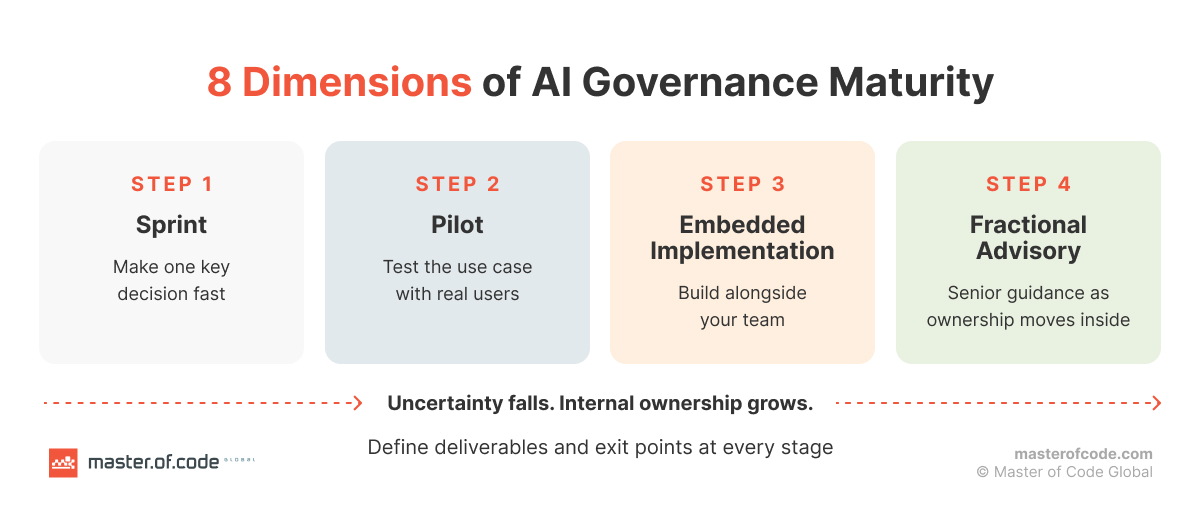
These engagement types are stages, not isolated product categories. A common path is Sprint, Pilot, Embedded implementation, then Fractional advisory. The sequence changes as uncertainty falls and internal ownership grows. Contracts should still define deliverables and exit points at every stage.
Which AI Use Cases Deliver the Most Value for Mid-Market Businesses
High-value AI addresses a measurable operational constraint. It should improve revenue, cost, speed, quality, or risk. The strongest starting point is rarely the most technically impressive idea. It is the opportunity with workable data and visible economics.
For many companies, document processing or knowledge retrieval comes first. A fully autonomous agent may introduce unnecessary risk and operating cost. The first application should match process maturity and oversight capacity. Its value should be observable within a realistic evaluation period.
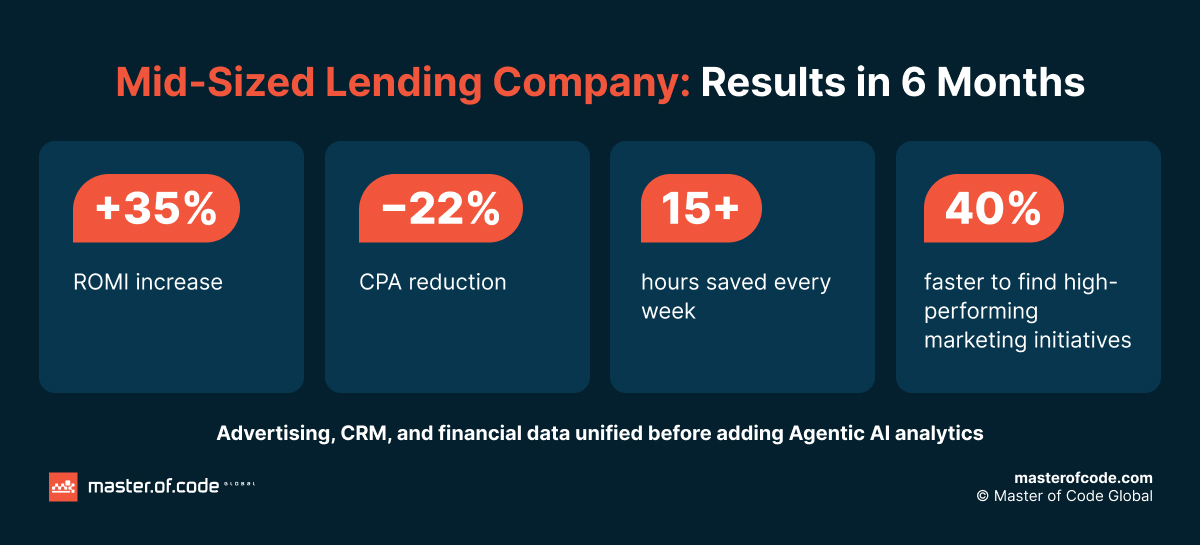
The mid-sized lending company revenue engine shows why readiness work matters. Our initial audit found fragmented advertising, CRM, and financial-system data. We unified those sources before adding Agentic AI analytics. The prerequisite for AI had to be solved before AI itself.
Within six months, the case reported a 35% ROMI increase. It also achieved a 22% CPA reduction and saved 15-plus hours weekly. Teams identified high-performing marketing initiatives 40% faster. The consulting value began with diagnosing the foundational data problem.
Should You Buy an AI Tool or Invest in Custom AI Development
Consultants should not assume custom software is the correct answer. The choice depends on differentiation, fit, control, and lifetime economics. Many companies need a combination of software and focused customization.
Buying usually provides faster deployment and predictable product updates. Integration preserves a proven platform while adapting it to company data. A custom build makes sense when proprietary workflows create defensible value. It also requires stronger ownership, testing, and maintenance capabilities.
Good advice may be simple: buy one product, integrate another, and build only the differentiating layer. Compare all options using the full AI development cost, not the initial build estimate.
AI Consulting vs Building an Internal AI Team
The decision is not limited to consulting or permanent hiring. The correct model changes as AI demand becomes sustained and predictable. Companies should compare speed, expertise, context, flexibility, and ownership.
Consulting makes sense when expertise is needed faster than hiring permits. An internal team makes sense when AI becomes a permanent capability. The hybrid approach often fits companies between those stages. External specialists establish architecture, governance, and initial delivery while employees build ownership.
Knowledge transfer must therefore be a defined deliverable. It should include documentation, training, operating procedures, and supported handoff. A Fractional leader can guide priorities while internal employees execute them. Over time, responsibility can move inside without disrupting active systems.
The Zipify AI transformation case shows this hybrid model in practice. The Shopify app company had AI tools, but adoption across its engineering team was uneven. We standardized the AI toolset, introduced spec-driven development, and built a knowledge base that helps non-technical staff resolve technical issues on their own. A dedicated fast-iteration team now tests product hypotheses with AI-assisted design and development. Zipify reached working prototypes 12x faster and delivered specific features up to 4x faster. One feature estimated at more than three months shipped in a week.
How Much Does AI Consulting Cost for Mid-Market Businesses
No single hourly rate represents the market accurately. Pricing depends on engagement type, team composition, and delivery responsibility. Published 2026 pricing guides report wide ranges across individual consultants and large firms. Treat the following figures as market context, not Master of Code Global pricing.
These ranges combine current benchmarks from a 2026 AI consulting pricing analysis with provider market examples. Separately, Clutch pricing data reports an average reviewed AI development project cost near $120,595. The datasets measure different service categories, so neither should replace a scoped estimate. They demonstrate why one universal consulting rate is misleading.
Important cost drivers include process count, data quality, architecture, and integrations. Regulation, custom development, seniority, duration, and delivery ownership also matter. Poorly defined scope adds contingency or creates change requests later. Strong readiness can reduce uncertainty before implementation pricing begins.
The consulting fee is not the total AI investment. Budget for software, model usage, infrastructure, integrations, change management, maintenance, and employee time. The broader AI development cost determines whether the business case works.
How to Choose the Right AI Consulting Partner
Partner selection should function as technical and commercial due diligence. Evaluate evidence, methods, and delivery capability across six dimensions. The scorecard below keeps comparisons focused on business outcomes.
- Business diagnosis. Does the partner examine economics and workflows before suggesting models?
- Implementation capability. Can the same company move from strategy through production?
- Technical depth. Can its team handle data, architecture, security, integrations, and evaluation?
- Relevant proof. Do comparable cases include measurable outcomes and clear baselines?
- Vendor neutrality. Can the partner recommend buying, building, integrating, waiting, or stopping?
- Knowledge transfer. Will employees make stronger decisions after the engagement ends?
Ask who will perform the work after contract signature. Review the proposed team, responsibilities, assumptions, and escalation path. Every deliverable should connect to a decision or business metric. References should resemble your scope, operating constraints, and industry risk.
Red Flags
- A specific tool appears before the business problem is understood.
- Every recommendation involves generative AI, regardless of workflow fit.
- ROI is discussed only after development has already started.
- The team lacks production, integration, or security experience.
- Nobody defines ownership and maintenance after launch.
- Pricing remains vague while deliverables and assumptions stay undefined.
- The partner cannot explain when it would recommend against AI.
Use a broader AI consulting companies comparison before shortlisting providers. The lowest quote may omit foundations, ownership, or production work. The most expensive firm may add brand prestige without better delivery. Compare the same scope, team seniority, and success measures.
How Should You Measure ROI From AI Consulting
Consulting ROI and solution ROI answer different questions. Consulting value includes avoided mistakes, faster decisions, and better prioritization. Solution value measures the operational or financial result after deployment. Both require a baseline established before work begins.
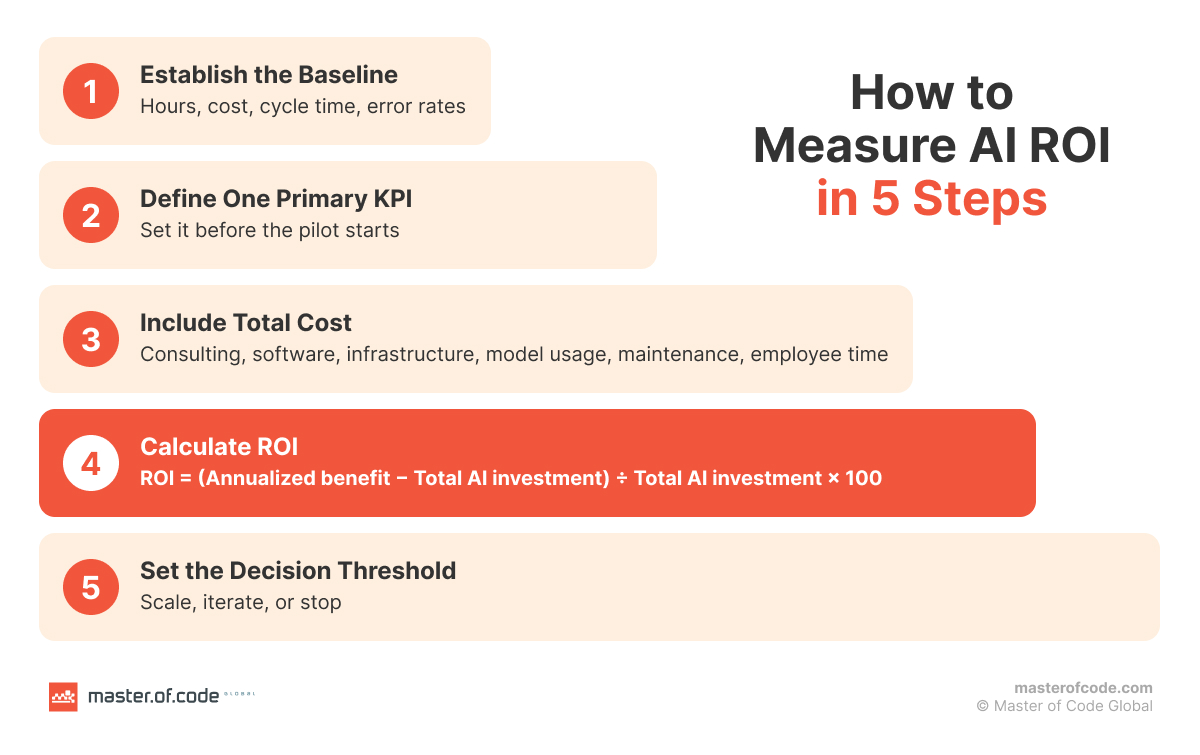
Establish the Baseline
Measure labor hours, process cost, cycle time, and error rates. Add conversion, support volume, revenue leakage, or compliance effort where relevant. Use the same method before and after deployment. Without a stable baseline, improvement claims remain difficult to defend.
Define One Primary KPI Before the Pilot
Each project needs one primary business metric. Support teams may track cost per resolved inquiry. Sales may track qualified opportunities per representative. Finance can measure reporting time, while operations measures cost per transaction.
Secondary measures still protect quality and risk. A support assistant should not reduce costs by lowering resolution quality. A sales tool should not increase activity while weakening lead quality. Define guardrails alongside the primary outcome.
Include Total Cost
Add consulting, software, infrastructure, model usage, and implementation expenses. Include maintenance and the time employees spend supporting delivery. Apply the same time period to costs and benefits. This prevents the pilot from appearing cheaper than production reality.
Calculate ROI
ROI = (annualized benefit – total AI investment) / total AI investment x 100
Document every assumption behind annualized benefits. Separate verified savings from forecast revenue. Use ranges when adoption or demand remains uncertain. Update the model after real usage data becomes available.
Define the Decision Threshold
Agree on results that mean scale, iterate, or stop. Set the threshold before the team sees pilot results. This reduces pressure to defend weak experiments after money is spent. A pilot should produce an investment decision, not merely prove technical feasibility.
How Do You Move From AI Strategy and Pilot to Production
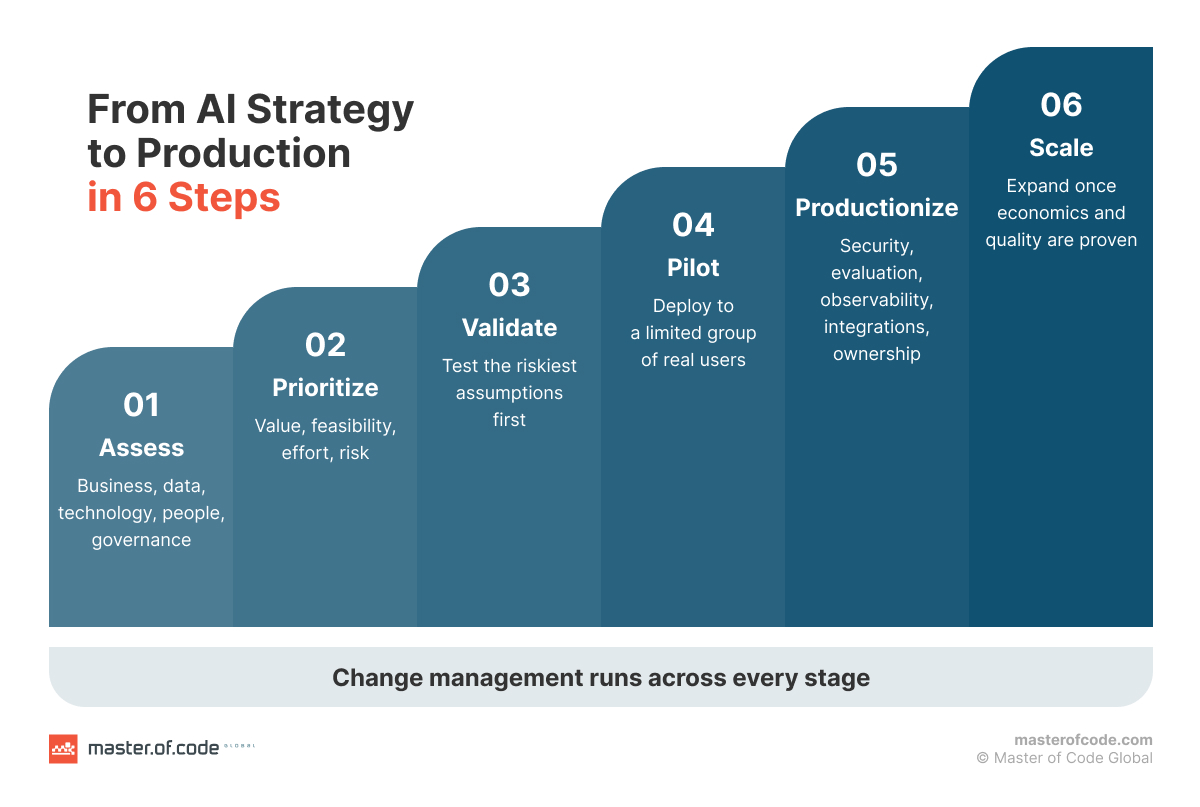
The production path should be designed before development starts. Each stage addresses a different investment risk. Skipping a stage usually moves uncertainty into a more expensive phase.
- Assess. Review business, data, technology, people, and governance readiness.
- Prioritize. Rank opportunities by expected value, feasibility, effort, and risk.
- Validate. Test the most uncertain assumptions before extensive development.
- Pilot. Deploy with a limited group of real users.
- Productionize. Add security, evaluation, observability, integrations, service levels, and ownership.
- Scale. Expand users or workflows after economics and quality are proven.
A successful prototype proves that an idea can work. A production system must prove repeatability, security, economics, ownership, and adoption. That difference explains why many experiments stall after a promising demonstration. The AI pilot to production transition requires engineering and operating discipline.
Change management runs across every stage. Redesign the process, train employees, capture feedback, and measure usage. Assign responsibility for quality, incidents, model changes, and business performance. Our guides on how to implement AI in business and running an AI Pilot explain these steps further.
What a Good Mid-Market AI Consulting Outcome Looks Like
A successful engagement leaves fewer ideas but better decisions. The company should have one to three prioritized initiatives and a baseline KPI. It should know what to buy, build, integrate, postpone, or reject. Required data and architecture changes should already be visible.
Internal owners need a practical production roadmap and governance rules. They should understand costs, dependencies, risks, and evaluation methods. Evidence must support a scale, iterate, or stop decision. Employees should also be better equipped to make the next decision independently.
The mid-sized retail bank Voice AI case demonstrates this chain. We tied a clear support bottleneck to an integrated voice assistant. The deployed system reduced call-center volume by 26% and reached 94% FAQ accuracy. It also achieved 79% first-call resolution for common inquiries.
The outcome was not simply a functioning voicebot. It connected a business constraint, defined use case, system integration, and measured performance. That sequence makes the result useful for future investment decisions.
Conclusion
AI consulting in mid-market businesses should not produce an unused strategy document. Its purpose is making better investment decisions faster. Leaders need clarity about where AI belongs and what must change first. They also need evidence that justifies further spending.
Some companies require a short readiness Sprint or Fractional leadership. Others need hands-on implementation or an Embedded partner through production. The right engagement reduces uncertainty while strengthening internal capability. It should never create permanent dependence without a clear reason.
If you are unsure where AI can create measurable value, begin with AI maturity assessment consulting or the AI Compass Sprint.