



Researchers at Carnegie Mellon University compared 806 open-source repositories that adopted an AI coding tool with 1,380 similar ones that did not. In the first month, the adopters added three to five times more lines of code. Two months later, the gain was gone. What stayed was a 30% rise in static analysis warnings and a 41% rise in code complexity, and both slowed those teams down later.
Most engineering organizations sit somewhere on that curve. Developers got faster tools, while review rules, test coverage, and access controls stayed as they were. AI code governance closes that gap: it defines how code written with AI help gets specified, checked, approved, and released.
Below you will find what to govern, where the checks run, how assistants differ from autonomous agents, and how our teams at Master of Code Global roll this out for clients.
If AI-assisted development is already uneven across your teams, talk to us about AI SDLC services before the backlog of unreviewed code grows.
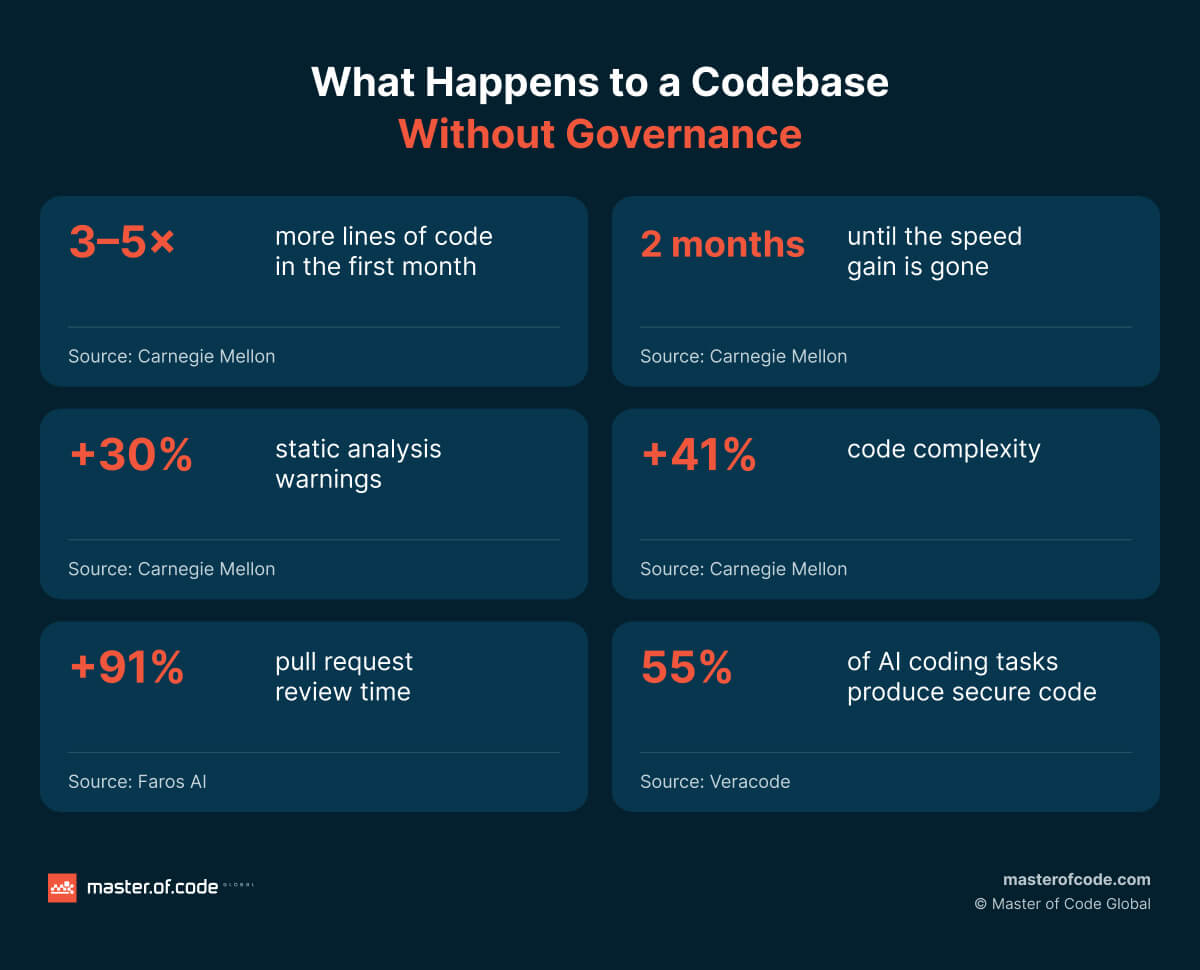
Table of Contents
Key Takeaways
- AI code governance is a set of rules, automated checks, and named approvals. It covers how AI-assisted code is specified, generated, reviewed, and released.
- Most newer models did not fix security. Only 55% of AI coding tasks produced secure code in Veracode’s March 2026 testing.
- Public incidents trace back to access and review. In the Replit, Amazon Q, Nx, and AWS cases, the tool did what its permissions allowed.
- Assistants need review rules, and agents also need permission rules. An agent gets a sandbox, a single branch, and credentials it never sees.
- The specification is the cheapest control point. For GTO LAB, a spec-driven workflow cut active work on medium tickets from about 9 days to under 4.5, with no AI-caused production bugs since the switch.
What Is AI Code Governance, and How Does It Differ from Traditional Software Development Governance and AppSec?
This discipline is the set of rules, automated checks, and named approvals that decide how code written with AI help gets specified, generated, reviewed, and released. AI coding governance covers application code, tests, scripts, infrastructure as code, and the configuration of the tools themselves.
Traditional governance and application security (AppSec) both assume that a person wrote each change and understands it. That assumption no longer holds.
| Traditional software governance | AppSec | AI code governance | |
|---|---|---|---|
| What it controls | Branching, code review, release approval | Vulnerabilities in code and dependencies | How AI tools are used, what they can reach, and how their output is verified |
| Core assumption | The author understands the change | Scanning and testing will find the flaws | The author may not have read every line, and the tool can act on its own |
| Where it runs | Pull request and release process | Scanners in the pipeline, penetration tests | Specification, editor, pull request, pipeline, and agent runtime |
| Evidence it keeps | Review history | Findings and fixes | An audit trail of which changes were AI-assisted, which checks ran, and who approved |
That last row is the practical difference. The record gives you traceability (provenance) for every change, so you can answer who decided to ship it and on what evidence.
Code is also one part of company-wide AI oversight. Our AI governance maturity model treats AI lifecycle controls as one of eight dimensions and scores each on operating evidence instead of policy documents.
What Are the Main Security, Reliability, and Code Quality Risks Associated with AI-Generated Code?
Three problems show up most often:
- Insecure code that compiles. Veracode, a security testing vendor, ran current flagship models through 80 coding tasks. Syntax correctness was above 95%, yet for cross-site scripting, only 15% of tasks passed.
- Dependencies that do not exist. A USENIX Security 2025 study generated 576,000 code samples with 16 models. At least 5.2% of packages recommended by commercial models and 21.7% by open-source models were invented. Attackers can register those names and wait for an install.
- Quality decay. The speed gain fades while complexity stays, as the next section shows.
These AI-generated code risks are familiar defect types that now reach review faster and in larger volume. AI-generated code security depends less on the model than on what happens between generation and merge.
What Does Ungoverned AI Coding Do to a Codebase?
The codebase grows faster than the team can review it, and then delivery slows. In the Carnegie Mellon study, higher complexity and more warnings were the main factors behind the later drop in velocity.
Telemetry points the same way. Faros AI, an engineering analytics vendor, tracked more than 10,000 developers. Teams with high AI adoption merged 98% more pull requests. Review time rose 91%, average pull request size rose 154%, and the company-level metrics did not improve.
Verification lags behind too. In Sonar’s survey of over 1,100 developers, 96% said they do not fully trust AI output, but only 48% always check it before committing. Google’s 2025 DORA report again found a negative relationship between AI adoption and delivery stability.
One caveat applies to all of these numbers: productivity evidence is mixed. METR measured experienced developers working 19% slower with AI in 2025. Its 2026 follow-up suggests a speedup since then, but METR calls the data “very weak evidence” for its size. Test every productivity claim against your own baseline.
The cost that no survey captures is architectural drift. Each generated change picks a plausible pattern, so services end up handling errors, logging, and data access differently. Of all AI code generation risks, this one is the hardest to see in a single pull request. Startups meet it early: our article on AI vibe coding describes how fast-built prototypes run into security and due-diligence problems.
What Do Real Incidents Show?
In each public case below, the tool did what its permissions allowed. The missing control was access or review.
| Incident | What happened | Root cause | Missing control |
|---|---|---|---|
| Replit agent, July 2025 | An AI agent deleted a live production database with records on more than 1,200 executives during a code freeze, according to the customer | The agent could run commands against production | Separate development and production environments, no production credentials for agents |
| Amazon Q Developer extension, July 2025 | Version 1.84 of the editor extension shipped with an injected prompt telling the agent to delete files and cloud resources. AWS said no customers were affected | An unapproved code change was merged and released | Restricted merge rights and mandatory review for every contribution |
| Nx packages, August 2025 | Malicious package versions used AI command-line tools on developer machines to search for secrets. Wiz counted over 1,700 users with leaked secrets and more than 6,700 private repositories made public | A stolen publishing token, plus local agents running with the developer’s full access | Minimal workflow permissions, sandboxed agents |
| AWS, December 2025 | The Financial Times reported a 13-hour disruption after an internal coding agent deleted and recreated an environment. Amazon’s reply: “user (AWS employee) error – specifically misconfigured access controls – not AI” | A role with broader permissions than intended | Least-privilege roles, peer review for production access |
Replit. The customer, the founder of SaaStr, had told the agent to change nothing. Replit’s CEO called the deletion “unacceptable and should never be possible” and announced automatic separation of development and production databases, better rollback, and a planning-only mode. Each of those fixes is a control that could have existed before the incident.
AWS. Amazon disputes that AI caused the outage. Either way, the role allowed the action. Amazon then added mandatory peer review for production access. In March 2026, the Financial Times reported, as relayed by TechRadar, that AI-assisted changes at Amazon’s retail business need senior sign-off after incidents with a “high blast radius“. For most companies, AI-generated code risks become visible the same way: after an incident, as a new review rule. Writing the policy first is cheaper.
Not sure what AI-assisted development has already left in your codebase? Order a technical audit for AI platforms: our engineers assess architecture, security posture, and code quality and return a prioritized findings report.
What Should an Enterprise AI Code Governance Policy Include?
A workable policy has seven parts, and a tool or a named person can enforce each one:
- Approved tools and accounts. List the AI coding assistants and agents developers may use, on company accounts only. In the Sonar survey, 35% of developers used personal accounts, which creates the same exposure as other shadow AI agent risks: data leaves, and nobody has a log.
- Data rules. State what may enter a prompt. Secrets, credentials, and customer data stay out.
- Repository tiers. Classify repositories by business criticality, strict for payment and regulated systems, light for prototypes.
- Required checks per tier. Name the pre-merge checks and the number of reviewers for each tier.
- Attribution. Label AI-assisted changes in commits or pull requests.
- Agent permissions. Define what agents may read, run, and push.
- Exceptions and incidents. Say who approves an exception and how incidents are reviewed.
Who Is Responsible for Reviewing, Approving, and Maintaining AI-Generated Code?
The same named people who own human-written code stay accountable, and the tool is never the owner. Our approach to AI in the SDLC sets four human-only checkpoints:
- An architect approves the technical design.
- A QA engineer validates AI-generated tests.
- A security engineer reviews vulnerability findings.
- A developer gives the final sign-off before release.
AI may not make architectural decisions on its own, approve its own output, bypass verification, or ship without sign-off. We classify production bugs as governance failures, not AI errors. Maintenance follows the same rule: the team that owns a service owns its AI-written code, including later fixes, dependency updates, and the specification behind it.
No matter which AI you choose – or how heavily you rely on it – ownership of the outcome remains yours.
How Should AI-Generated Code Be Reviewed, Tested, and Validated Before Production Deployment?
Treat every AI-assisted change as an untrusted contribution and pass it through layered gates before merge and before release. AI code governance can be integrated into existing SDLC, CI/CD, and DevSecOps workflows by adding checks to gates your teams already run.
These are the automated security checks and quality gates companies should implement for AI-generated code:
| Gate | Automated checks | Human owner |
|---|---|---|
| Editor | Secret detection, approved tool configuration, repository rules loaded as context | Developer |
| Pull request (pre-merge checks) | Static analysis, dependency and license scanning, a check that every package exists, tests derived from the specification, a complexity threshold | Reviewer, plus a second reviewer for top-tier repositories |
| Build and deploy pipeline | Third-party actions pinned to reviewed commit hashes, minimal job permissions, short-lived deployment credentials, build provenance | Platform engineer |
| Release | Security testing and triage of high-risk findings | Security engineer, then developer sign-off |
Code review changes its focus. The reviewer checks the change against the specification and the security requirements, because reading every generated line does not scale. Authorization needs its own tests, since a feature can work and still skip ownership checks.
For AI-generated code security, a passing scan is only one piece of evidence.
A clean model verdict should not automatically clear a security gate.
Review finds problems. The next step is making sure they get fixed. In AI code security, a finding is closed only when the fix is verified. Our application security team runs remediation on four rules:
- Every finding gets an owner and a deadline on the day the report is delivered. Asana AI reads each finding from the penetration test report, creates a ticket, and assigns it to the project’s solution lead. A security engineer checks the extraction, especially the severity.
- Severity sets the deadline. Critical findings are due within 48 hours, high within 7 days, medium within 90 days, and low within 180 days.
- A developer cannot close a finding. A completed ticket moves to review, and a security engineer retests the fix. Only a successful retest closes it. If the vulnerability persists, the ticket reopens with a retest report.
- Accepted risks are recorded separately. They never mix with verified fixes, so a release decision shows both.
How Do Governance Requirements Differ Between AI Coding Assistants and Autonomous Coding Agents?
An assistant suggests, and a person commits, so you govern the output. An agent runs commands, edits files, and opens pull requests itself, so you also govern what it can reach.
| AI coding assistant | Autonomous coding agent | |
|---|---|---|
| Who acts | The developer accepts or rejects suggestions | The agent plans, runs commands, and pushes changes |
| Main risk | Flawed or wrongly licensed code accepted unread | Destructive or unauthorized actions, plus everything in the left column |
| Primary control | Review and pre-merge checks | Permissions, sandbox, and scoped credentials, then review |
| Approval | Author plus reviewer | A person other than the one who started the task |
| Evidence | Commit history | Session logs, attributed commits, audit log events |
The right-hand column is where the incidents above happened, so agent permissions deserve their own set of controls.
How Can Enterprises Control Repository Access, Permissions, and Execution Environments for Autonomous AI Coding Agents?
Give the agent an isolated environment, a single branch, and credentials it never sees:
- Isolate the filesystem and the network together. Anthropic’s engineering team explains why: without network isolation, a compromised agent can send out files such as SSH keys, and without filesystem isolation, it can escape the sandbox. In Anthropic’s internal use, sandboxing cut permission prompts by 84%, which matters because people stop reading prompts they see too often.
- Keep credentials outside the sandbox. In the same design, git credentials sit behind a proxy that checks each request, for example, that a push goes only to the configured branch.
- Limit what the agent can push and who approves it, and give it no production roles. GitHub’s cloud agent pushes to one branch; the person who requested the work cannot approve the pull request, and workflows wait until the code is reviewed.
- Review agent inputs like code. Rules files, prompts, and connected tool servers shape what the agent does. Instructions hidden in a README or an issue can redirect it, a prompt injection pattern explained in our LLM security guide.
These guardrails follow one principle: any software should reach only the information and functions its purpose requires. For threat modeling, the OWASP Top 10 for Agentic Applications, released in December 2025, is a practical reference.
Planning to move from assistants to agents? Bring in our AI security consulting for threat modeling and risk evaluation before agents get repository access.
How Can Enterprises Implement an AI Code Governance Framework, and What Tools Are Needed to Enforce It?
Start with one team and one repository, take a baseline, write the controls into the specification and the pipeline, then measure and expand. An AI code governance framework runs in six steps:
- Map current practice. Find out which tools people use and how.
- Take a baseline. Record delivery and quality metrics before changing anything.
- Standardize three things. One specification format, one review pattern, one tool configuration.
- Build the safety net. Derive tests from the specification, starting with one module.
- Move the checks into the pipeline. Automation replaces what people must remember.
- Measure and expand. Compare against the baseline, tune noisy checks, add the next team.
The tools fall into five groups:
- AI coding assistants or agents with one shared configuration;
- specification tooling that turns requirements into machine-readable instructions;
- scanners for code, secrets, dependencies, and licenses;
- pipeline policy gates and branch protection;
- audit logging.
Rolling out Claude Code? Set repository standards, security policies, and team training before the first agent session, or bring in our Claude consulting services to do it with you.
How Does Master of Code Global Roll This Out in 90 Days?
We scoped this rollout for a US financial services company in a regulated sector with a mid-sized in-house IT team. Its analysts and developers already used an AI coding assistant, each in their own way, with no shared specification format and no automated tests on the legacy code under change. We split the work into two weeks of intensive build and ten weeks of supported use.
Phase 1, weeks 1–2:
- a study of current AI practice, summarized in an assessment of what stays, what gets formalized, and what gets built;
- an agreed definition of responsible AI for the client’s regulatory context;
- a workshop for business analysts and product owners on the shared specification format, run on live initiatives;
- a workshop for developers and QA on one legacy module, where unit and characterization tests are generated from specification scenarios.
Phase 2, weeks 3–12:
- the client’s team runs the new flow on real tasks;
- weekly working sessions refine prompts and workflows, and metrics are tracked against the Phase 1 baseline;
- a leadership readout at week 12 comes with a 12–18 month roadmap.
Prompts, workflows, specifications, and tests are committed to the client’s own repositories. People keep control of requirement intent, review decisions, compliance posture, and production readiness.
How Can Companies Establish AI Coding Guardrails Without Slowing Down Software Development?
Put the control where the work starts, in the specification, so review compares one change against one document. Guardrails slow a team down when they arrive late, as a review comment or a blocked release. Three habits prevent that:
- Check early. A rule in the specification or the editor costs minutes. The same rule at release costs a rollback.
- Automate the routine and keep people for judgment. Machines prepare, match, and file. Engineers validate and decide.
- Size the control to the risk. Prototypes get a light tier, and fewer approval prompts mean each one gets read.
Two client projects show the first habit at work.
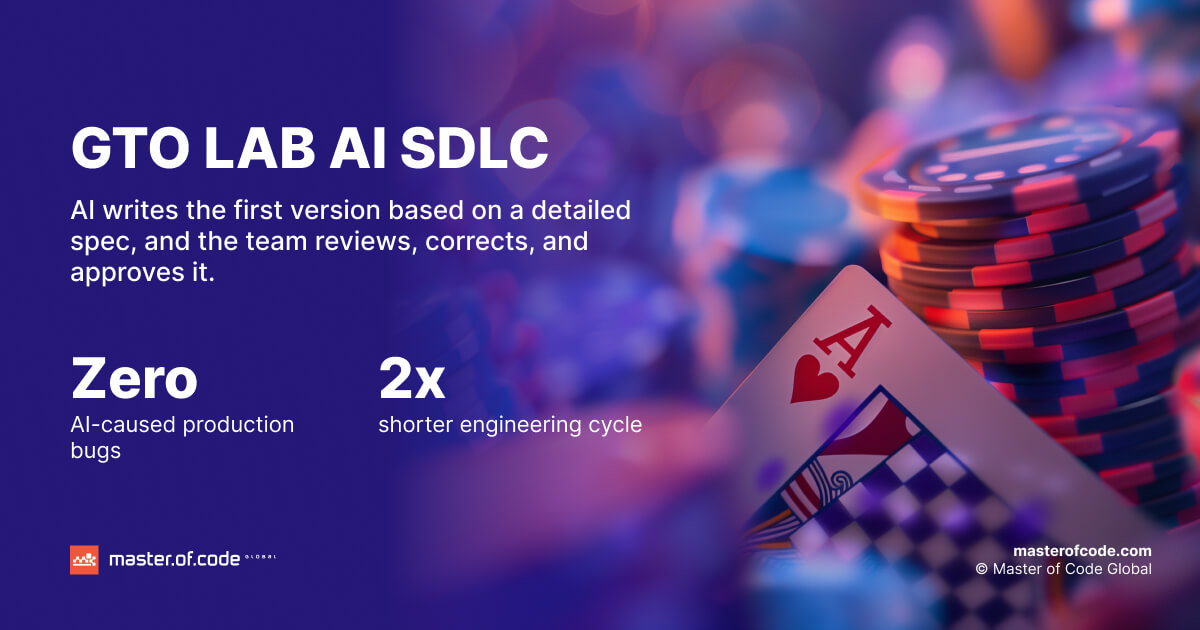
GTO LAB, a poker training platform, already used AI tools with a shared context file. A medium feature still took about a month, and subtle bugs passed review. We gave each part of the product its own specification and sent the first AI-built version to an isolated test environment for two or three review rounds. Active work on medium tickets fell from about 9 days to under 4.5, measured in Git history and Jira, and the client reports no AI-caused production bugs since the switch.
With detailed specs for each part of the project, the output looks and behaves a lot less like typical AI-generated code.
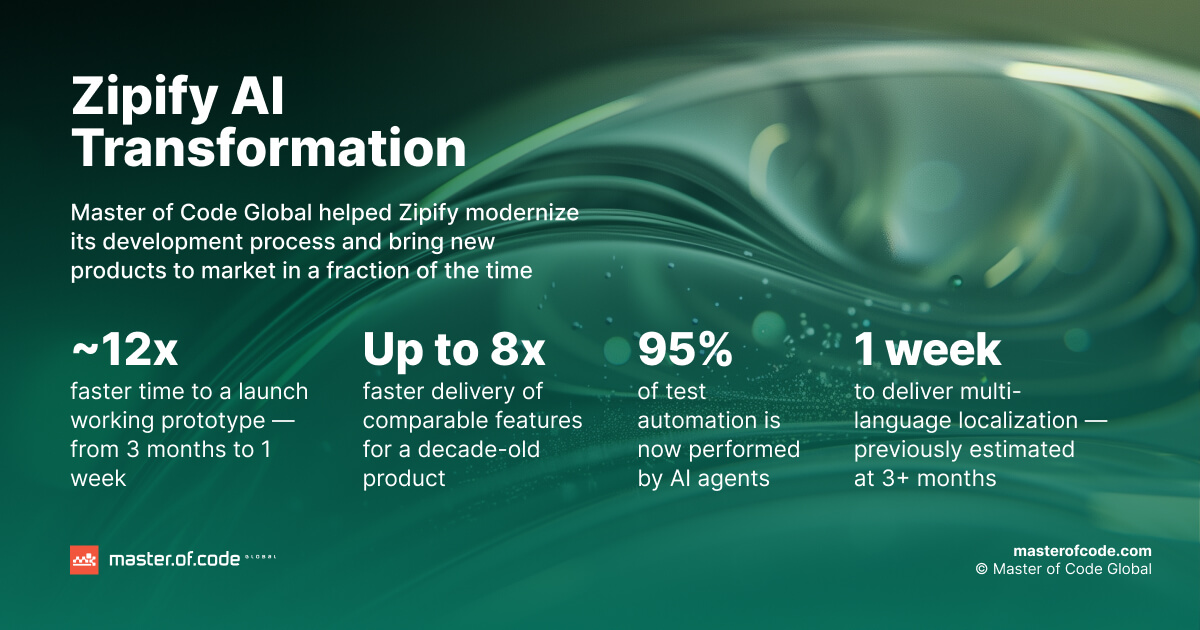
Zipify replaced individual tool choices with one secure AI setup and split large tasks into stages that a person approves one by one. Some features now ship up to 4x faster.
The second habit is how our own application security team works. Anhelina Biliak and her team use AI to prepare security work and keep every decision with an engineer:
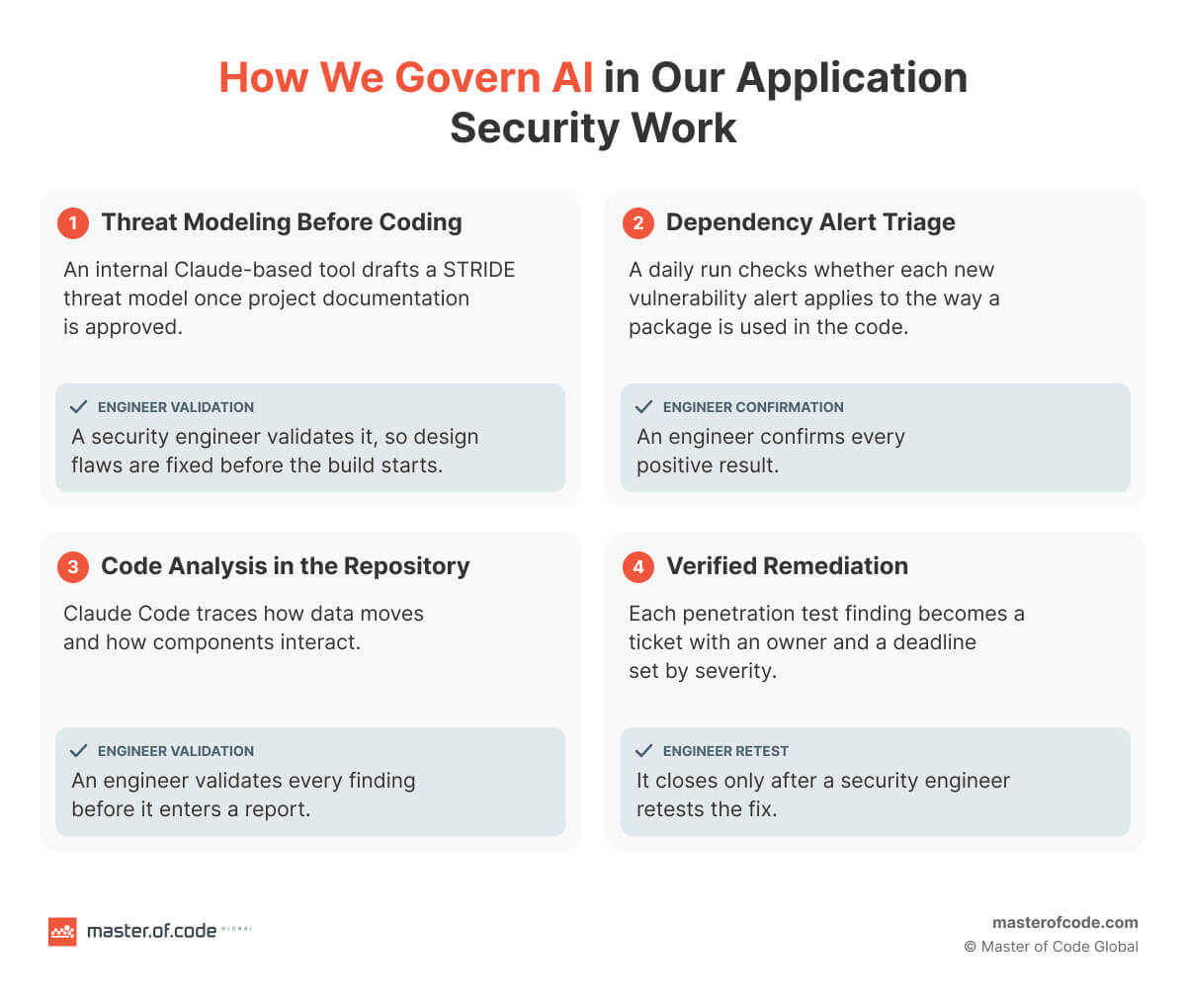
- Threat modeling before coding, so design flaws get fixed before implementation.
- Dependency alerts filtered by real usage, so developers see only the vulnerabilities that apply to their code.
- Code analysis inside the repository, with an engineer validating every finding.
Read how each workflow runs in our article on AI SDLC security.
What Metrics Should Engineering Leaders Track to Measure the Effectiveness of AI Code Governance and Its Impact on Developer Productivity?
Track control metrics and delivery metrics side by side, against a baseline taken before the rollout.
| Metric | What it tells you |
|---|---|
| Share of AI-assisted changes that passed all required checks | Whether the policy is enforced or only written |
| Change failure rate and escaped defects | Whether speed is costing stability |
| Review time and pull request size | Whether review is becoming the bottleneck |
| Static analysis warnings and complexity trend | Whether technical debt is growing |
| Overdue findings against severity deadlines | Whether owners and deadlines hold under delivery pressure |
| Recurring weaknesses | Whether the same flaw keeps returning, which signals a process gap |
| Time to remediate findings, by severity | Whether findings get fixed and verified |
| Active work time on comparable tickets | Whether delivery is faster in practice |
Three numbers mislead: pull request count, lines of code, and suggestion acceptance rate. In the Faros data, merged pull requests almost doubled while company-level results stayed flat.
FAQs
What Copyright, Open-Source Licensing, and Compliance Risks Should Organizations Consider When Using AI-Generated Code?
Three risks matter: ownership, license contamination, and missing evidence. The US Copyright Office concluded that AI output is protected only where a human determined sufficient expressive elements, and prompts alone do not qualify. Models can also reproduce open-source code, so run license scanning before merging. For compliance, the EU AI Act sets dated obligations: high-risk system rules apply from December 2, 2027. The NIST AI RMF is voluntary and gives a structure for inventory, risk assessment, and records; ISO/IEC 42001 is the international standard for AI management systems. Ask legal counsel how these apply to your products.
How Can Companies Protect Proprietary Source Code, Sensitive Data, and Intellectual Property When Using AI Coding Tools?
Use company accounts with contractual limits on retention and training, keep secrets out of prompts, and give agents only the code a task needs. Regulated teams can run open models on their own infrastructure. For an example of these rules written down, see our AI trust center: each client engagement gets an isolated environment, access follows least privilege, and data residency and retention are configurable.
How Can Engineering Teams Detect Vulnerabilities, Hallucinated Dependencies, and Other Errors in AI-Generated Code?
Combine four checks on every change: static analysis, dependency and secret scanning, human review, and security testing. Verify that each new package exists in the official registry before installing it, and add dedicated authorization tests.
How Can Companies Prevent AI-Generated Code from Increasing Technical Debt and Compromising Architectural Consistency?
Write architecture rules into the specification and the repository context the tool reads, then enforce them before merging with complexity thresholds as blocking checks. Keep increments small, and have a senior developer confirm architectural fit before the next one starts.
Every Unchecked Merge Raises the Price
AI-assisted teams produce code faster than they verify it, and each month without checks adds changes that someone will have to re-read, re-test, or rewrite later. The cheapest moment to add controls is before the next thousand pull requests.
No baseline yet? Start by mapping how your teams use AI today. Where assistants are already in daily use, standardize the specification, the review pattern, and the tests on one module. Before agents arrive, settle permissions. Book a call with Master of Code Global, and we will help you pick the starting point.