



An enterprise can have an AI policy, a governance committee, security reviews, and a model registry, yet still have weak governance. Documents show intent, but maturity becomes visible when someone launches an unapproved tool, a model drifts, an employee shares restricted data, a vendor changes its model, or an agent takes an unexpected action. It is also tested when an auditor asks who approved a system, which evidence supported the decision, and what happened after deployment.
An AI governance maturity model tests whether governance works across the organization under those conditions. This guide covers eight dimensions, five maturity levels, assessment evidence, framework mappings, metrics, ownership, and a practical roadmap. To benchmark the wider foundations first, start with our AI maturity assessment.
Table of Contents
What Is an AI Governance Maturity Model
An AI governance maturity model is a structured method for evaluating how consistently an organization directs and controls AI. It examines leadership, accountability, inventory, data, risk, compliance, security, lifecycle management, and monitoring. The result shows both what exists and how reliably it operates across teams and systems.
An AI governance framework defines the capabilities and controls that should exist. A maturity model examines how consistently those capabilities operate today and whether the organization can prove it. It answers five practical questions: Where are we, what can we prove, where are the gaps, what level do we need, and what should improve next?
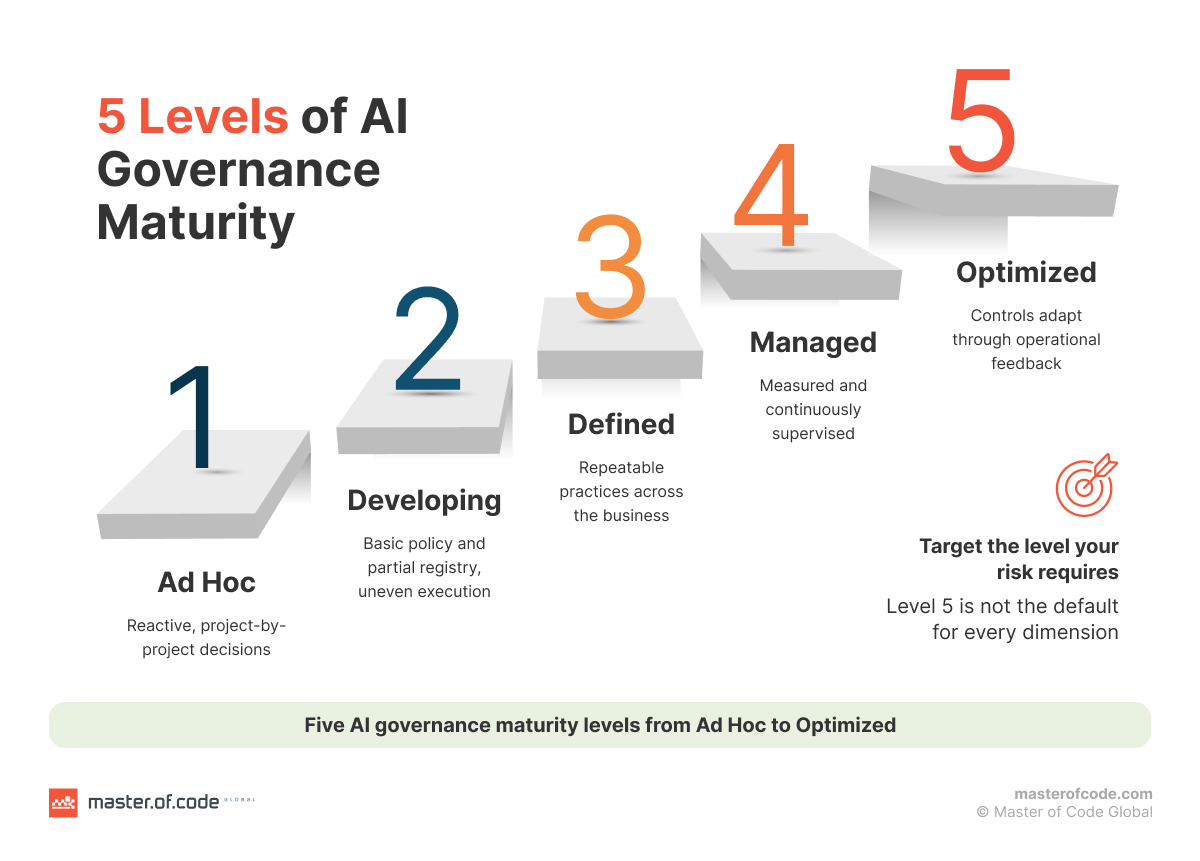
Our AI governance maturity model framework uses five levels: Ad Hoc, Developing, Defined, Managed, and Optimized. Each dimension receives its own score because leadership, inventory, security, and monitoring rarely advance at the same rate. As Master of Code Global CTO Bogdan Sergiienko says about our AI-native SDLC approach, “No matter which AI you choose, or how heavily you rely on it, ownership of the outcome remains yours.”
AI Governance Maturity Compared with AI Maturity and AI Security Maturity
These three models answer related but different questions. AI maturity covers the organization’s ability to adopt and scale AI, while governance maturity tests whether that adoption is directed, controlled, and auditable. Security maturity focuses more narrowly on how well AI systems and usage are protected.
The models overlap because security supports governance, and governance supports responsible AI adoption. They are not interchangeable, however. A company may have strong data science skills but weak approval records, or a capable security team that lacks a complete inventory of AI use.
The Cloud Security Alliance’s 2026 AI Security Maturity Model makes this boundary explicit. It concentrates on operationalizing an enterprise AI security program rather than measuring broad governance or one AI project. Companies that need to strengthen that layer can review our AI security consulting services.
Why AI Governance Maturity Matters
Governance matters when AI moves from a few pilots into daily operations. At low maturity, reviews depend on individual judgment, approvals vary by team, systems appear outside the inventory, and past decisions are difficult to reconstruct. Policies also depend too heavily on employees noticing a rule and applying it correctly.
At higher maturity, a use case’s classification triggers the appropriate controls. Owners and approval rights are known, evidence is retained, high-risk systems receive stronger review, and leaders can see where governance is working. Known patterns move through approval faster because teams do not rebuild the process for every project.
This changes business performance in concrete ways. The organization sees fewer surprise deployments, clearer accountability, better auditability, easier regulatory mapping, and safer AI scaling. The NIST AI Risk Management Framework supports this operating view by treating Govern as a cross-cutting function that informs Map, Measure, and Manage throughout the AI lifecycle.
The Eight Dimensions of AI Governance Maturity
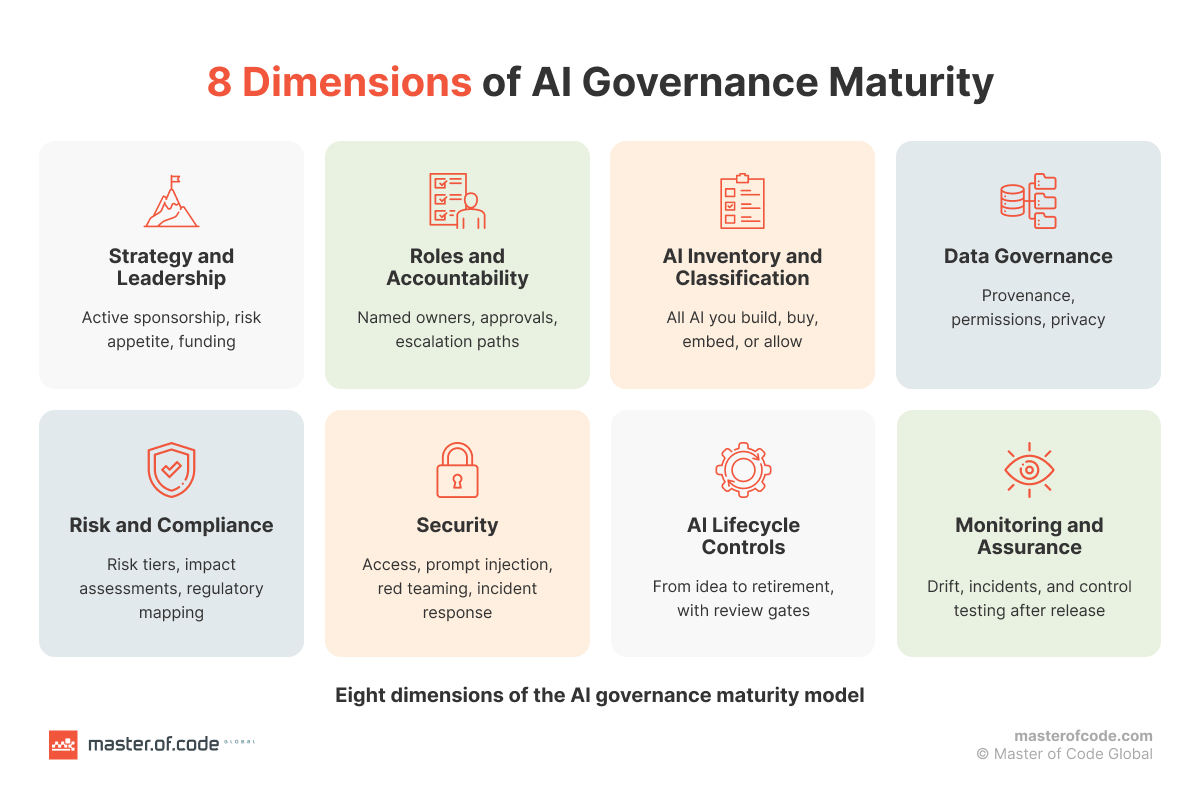
A useful AI governance maturity model framework separates capabilities that can mature at different speeds. Combining them into broad categories may make a score easier to present, but it can hide the reason a control fails. The following eight dimensions keep ownership, inventory, security, lifecycle controls, and assurance visible.
1 Strategy and Leadership
This dimension tests whether executive sponsorship is active and connected to business priorities. Leaders should define AI risk appetite, decide where stronger governance is justified, and fund the capabilities needed to support it. Evidence can include approved objectives, portfolio decisions, budgets, and leadership review records.
2 Roles and Accountability
Clear Accountability means each AI use case has a business owner, a technical owner, approval authorities, and defined escalation paths. A cross-functional body should coordinate decisions, but it should not become a place where individual ownership disappears. A documented RACI and signed decisions show whether the structure works in practice.
3 AI Inventory and Classification
The organization should know what AI it builds, buys, embeds, and permits employees to use. Its inventory should identify models, vendors, customer exposure, agentic capabilities, owners, data access, lifecycle status, and risk tier. Discovery must also cover tools outside central procurement, a problem addressed in our guide to shadow AI agent risk mitigation.
4 Data Governance
Data governance covers provenance, quality, permissions, retention, privacy, and sensitive-data handling. For generative systems, it also includes prompts, user inputs, retrieval-augmented generation sources, generated content, and training or fine-tuning data. Mature teams can trace which data a system uses and show that its use is authorized.
5 Risk and Compliance
This dimension connects each use case to a repeatable Risk classification and applicable Compliance duties. It covers impact assessments, regulatory mapping, vendor risk, residual-risk decisions, and documented exceptions. The evidence should explain why the organization accepted, reduced, transferred, or avoided a risk.
6 Security
Security deserves its own dimension because a general risk review may not test technical exposure. The scope includes identity and access, secrets, model and API exposure, prompt injection, third-party models, red teaming, and incident response. Our resources on LLM security and ChatGPT security risks for business cover controls for common generative AI attack paths.
7 AI Lifecycle Controls
Lifecycle governance follows a system from idea and data selection through development, evaluation, approval, deployment, change, and retirement. Each stage should have defined evidence, review triggers, and decision rights that reflect the system’s risk. An AI SDLC and a technical audit for AI platforms can connect these requirements to engineering work.
8 Monitoring and Assurance
Monitoring tests model performance, drift, incidents, policy exceptions, human overrides, and control effectiveness after release. Assurance adds periodic review or independent testing to determine whether controls operate as designed. Together, Monitoring and Oversight turn governance from a launch checkpoint into a continuing management practice.
The Five AI Governance Maturity Levels
The AI governance maturity model levels describe how governance changes from reactive decisions to adaptive controls. They should be applied by dimension, using evidence from real systems rather than a general impression. For every score, reviewers should record the governance state, observed practice, available evidence, biggest gap, and next move.
Level 1. Ad Hoc
Governance state: Reactive. AI systems sit outside central visibility, decisions are project-specific, and general IT or security policies stand in for AI rules. Ownership follows individuals, so governance activity often begins after an incident.
Evidence: The strongest evidence is usually evidence of absence or inconsistency. Teams cannot produce a reliable inventory, repeatable classification, defined RACI, or consistent approvals across similar use cases. Control quality depends on who is involved.
Biggest gap: The organization does not know its full exposure or who can make binding decisions. Next move: discover AI use, create a minimum inventory, and assign accountable business and technical owners. This establishes the facts needed for later controls.
Level 2. Developing
Governance state: Formalization has started, but execution remains uneven. A basic AI Policy, preliminary risk categories, a partial registry, and a named owner now exist. Legal and security review selected projects, while others follow informal channels.
Evidence: Reviewers can find a committee charter, policy, sample forms, named leaders, and records for some systems. These artifacts show intent, but not that every relevant project follows the process. Spreadsheets and email approvals may remain hard to maintain.
Biggest gap: Documentation creates false confidence when enforcement remains manual and optional. Next move: standardize inventory fields, review triggers, risk tiers, templates, and decisions across the scope. Training should explain when the process applies and who must act.
Level 3. Defined
Governance state: Core practices are repeatable across the business. A central inventory, standardized classification, mandatory review triggers, documented RACI, lifecycle gates, vendor checks, baseline testing, human oversight requirements, and exception procedures apply to covered systems. Business units can follow one operating model even when their tools and risks differ.
Evidence: A reviewer can reconstruct a system’s owner, classification, assessment, approvals, testing, release decision, and status. Records also show changes to models, data, vendors, or intended use. This traceability proves that practice has moved beyond policy publication.
Biggest gap: Defined controls may still be ineffective, slow, or easy to bypass. Next move: measure whether each control finds meaningful issues, changes decisions, and remains effective after deployment. The organization should set baselines before it automates the process.
Level 4. Managed
Governance state: Governance is measured and continuously supervised. The organization tracks governance KPIs, production performance, incidents, residual-risk decisions, policy exceptions, and the results of control tests. Lifecycle requirements are integrated with engineering and procurement workflows, while leadership receives regular reporting.
Evidence: Audit trails connect decisions to approved evidence and show whether controls worked. Teams can produce coverage, failed-control rates, remediation times, incident trends, approval times, and independent-review results. Metrics are segmented by risk tier so low-risk systems do not mask a weak high-risk process.
Biggest gap: Measurement can become another reporting layer if results do not change controls or priorities. Next move: automate repeatable checks, evidence collection, and escalation where the process is stable. Keep a named owner responsible for reviewing exceptions and acting on signals.
Level 5. Optimized
Governance state: Controls adapt through operational feedback. Requirements are embedded in technical workflows, evidence is collected continuously, and risk signals can change monitoring or approval. Incidents, assurance reviews, and system performance inform policy and portfolio decisions.
Evidence: The organization can show automated results, versioned decision logic, continuous risk signals, tested escalation paths, and changes linked to findings. It can show where automation stops and a human decision begins. Optimization remains auditable rather than becoming an opaque score.
Biggest gap: Teams may pursue automation or a Level 5 label where the cost is not justified. Next move: optimize where risk, scale, or decision frequency supports it, and reassess when the use case changes. An internal summarizer should not carry the same machinery as an agent that executes financial transactions.
Level 5 is not the default destination for every dimension. The target follows exposure, impact, legal duties, and the organization’s ability to operate the controls. A deliberate Level 3 can be more responsible than an unsustainable Level 5.
How to Conduct an AI Governance Maturity Assessment
An AI governance maturity model assessment should test operating evidence, not collect optimistic yes or no answers. The method below produces a profile that leaders can use to prioritize work. It also prevents one strong capability from hiding a critical weakness.
Step 1. Define Scope
Decide whether the assessment covers the whole enterprise, one business unit, an AI portfolio, or a regulated environment. Record the included systems, geographies, business processes, and third parties so that later scores share the same boundary. A narrow, explicit scope is more useful than an enterprise label built from incomplete evidence.
Step 2. Score All Eight Dimensions Separately
Assess each dimension before calculating a summary. Use the lowest level at which the required practices operate consistently, rather than averaging isolated strengths. The example shows why a company-wide score would mislead.
This organization is not simply Level 3. Strong security does not repair poor visibility, and strategy cannot replace runtime assurance. Leaders should read the pattern before the average.
Step 3. Require Evidence
Test each claim through five evidence states. Documented means the process exists, Owned means someone is accountable, and Executed means records show use. Measured tracks effectiveness, while Tested means assurance has confirmed that the control works.
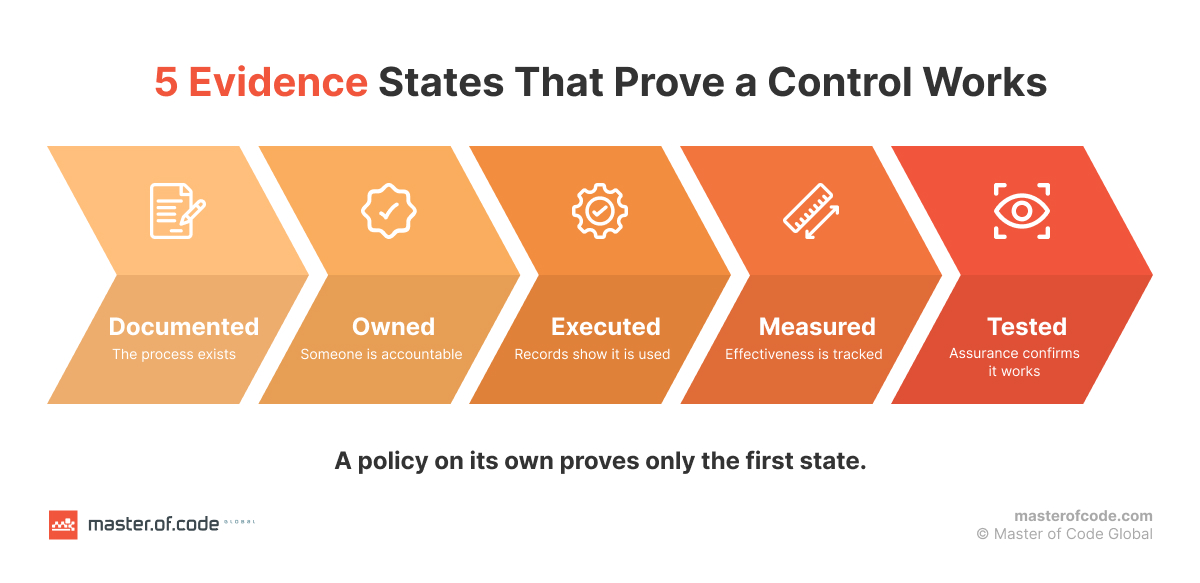
One artifact rarely proves all five states. A policy proves documentation, while assessment, approval, monitoring, exception, and assurance records show operation. Sample systems from different teams rather than selecting the best example.
Step 4. Identify Critical Floors
Do not average away a Level 1 capability that protects a high-risk process. Scores of 5, 5, 5, 5, 5, 5, 1, and 1 do not justify Level 4 when lifecycle and monitoring remain unmanaged. Set a minimum floor for critical dimensions.
Our AI maturity tool can support an initial discussion, while a formal AI maturity assessment examines evidence and dependencies. Treat questionnaire results as a starting hypothesis, not the final score. A defensible score comes from sampled records, interviews, and control testing.
Policies Processes and Controls at Each Level
Policies define expectations, processes organize the work, and controls prevent or detect unacceptable outcomes. These elements should mature together, but organizations often advance one faster than the others. The table shows the expected progression and the evidence a reviewer should find.
At Level 1, general rules may address privacy or acceptable use, but they do not connect to repeatable AI decisions. Level 2 adds AI-specific documentation and selected reviews, while Level 3 makes the process mandatory for the defined scope. Level 4 tests effectiveness, and Level 5 adjusts stable controls using current signals.
Maturity is not the number of policies. It is the distance between policy and actual behavior. A 60-page governance manual with no enforcement can represent lower maturity than a concise policy backed by complete inventory, mandatory review, auditable Control evidence, and active Management.
Who Should Own AI Governance
AI governance needs distributed ownership with central coordination. The executive sponsor sets risk appetite, while each system retains accountable business and technical owners. Legal, privacy, security, risk, audit, and users contribute decisions or assurance within defined boundaries.
The governance committee connects these roles and resolves cross-functional issues. It does not absorb accountability from system owners or become the approver for every routine decision. A RACI should identify who is accountable, responsible, consulted, and informed for each decision rather than for the program in general.
Mapping to NIST AI RMF ISO IEC 42001 and the EU AI Act
A maturity model is not a substitute for a standard, certification, or legal compliance assessment. It can organize evidence and expose readiness gaps, but each external requirement needs its own scope and interpretation. The crosswalk below shows the closest operational relationships, not legal equivalence.
The NIST AI RMF 1.0 uses Govern, Map, Measure, and Manage. Govern is cross-cutting, while the other functions establish context, evaluate risk, prioritize treatment, and support ongoing improvement. NIST’s AI Resource Center states that version 1.0 is being revised, so publishers should confirm the version in force when this article goes live.
ISO/IEC 42001 specifies requirements for establishing, implementing, maintaining, and continually improving an AI management system. This model can reveal gaps in readiness and operational consistency, but it cannot determine certification. Certification requires assessment against the standard by the appropriate independent body.
As of September 2026, the EU AI Act is generally applicable, and EU and national authorities have enforcement responsibilities. Following the AI Omnibus, rules for Annex III high-risk systems apply from December 2, 2027, while rules for high-risk systems embedded in Annex I products apply from August 2, 2028. Teams should map current duties for risk management, data governance, documentation, logging, human oversight, cybersecurity, and post-deployment monitoring to the systems actually in scope.
KPIs That Measure AI Governance Maturity
Useful KPIs distinguish coverage, control effectiveness, and operational performance. Coverage tells leaders how much of the AI estate the program can see, while effectiveness tests whether controls work. Operational metrics show whether governance is responsive enough to support the business.
Each metric needs a denominator, scope, owner, target, and review cadence. For example, 90 percent monitoring coverage means little unless the missing 10 percent is identified by risk tier. A median approval time can also hide slow decisions for the systems that need the most scrutiny.
Activity alone does not prove maturity. “We completed 83 AI assessments” reports volume but not whether findings changed releases, controls reduced exposure, or exceptions were resolved. Higher maturity links activity to decisions, outcomes, and tested control performance.
How to Build an AI Governance Maturity Roadmap
A useful roadmap is gap-based and risk-based. It should not assume that every organization must move one whole level each year. The sequence should address critical exposure and dependencies before adding automation.
Step 1. Establish the Current State
Build a heatmap using the eight-dimensional scores and record the evidence behind each rating. Mark critical floors, unresolved disputes, and areas where evidence is too weak to score. This gives leaders a current-state view that can withstand challenge.
Step 2. Define the Target by Dimension
Set the required level for each dimension using exposure, impact, regulatory duties, and operating scale. A company might target Level 3 for strategy and roles, but Level 4 for inventory, security, and monitoring. The decision should explain why the added rigor is worth its cost.
Step 3. Prioritize Critical Gaps
Rank gaps using exposure multiplied by business impact, regulatory importance, and dependency. A low inventory score often deserves early attention because risk classification, monitoring coverage, and reporting all depend on knowing which systems exist. A severe agent-permission gap may outrank a broad documentation improvement even when it affects fewer systems.
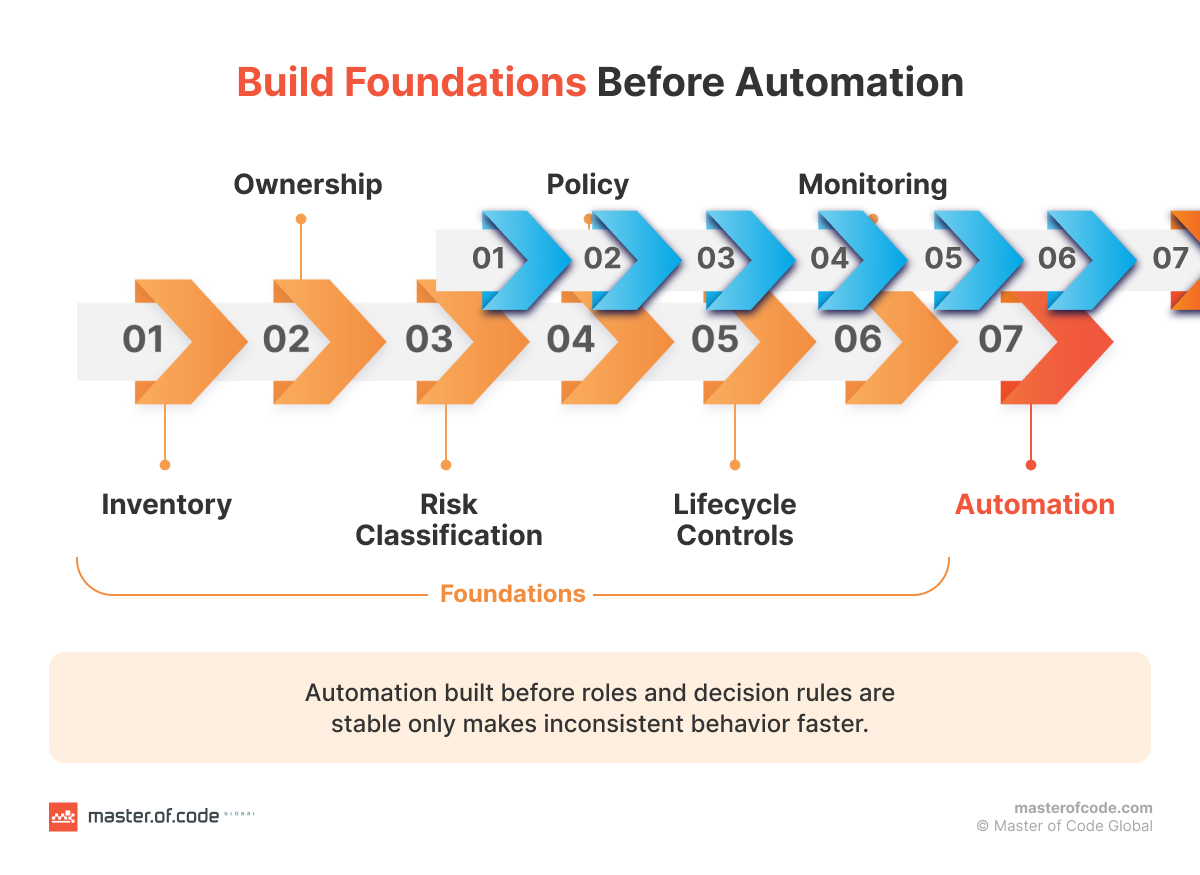
Step 4. Sequence Foundations Before Automation
A common sequence is inventory, ownership, risk classification, policy, lifecycle controls, monitoring, and then automation. Automation built before roles and decision rules are stable can make inconsistent behavior faster. A technical audit for AI platforms can identify architecture and lifecycle dependencies before teams commit to tooling.
Step 5. Reassess and Adjust
Review KPIs quarterly and conduct a fuller maturity reassessment on a defined cycle or after a major change. Re-score when the organization adds a new class of systems, enters a regulated market, changes a critical vendor, or expands agent authority. The roadmap should change when exposure changes, not only when a calendar milestone arrives.
7 Signs You Are Overestimating AI Governance Maturity
Self-assessments tend to reward visible documents and established committees. Operational gaps are harder to see because they appear between teams, systems, and lifecycle stages. The following signs should trigger deeper evidence sampling.
- You count policies instead of enforcement. Teams can show the rule, but not consistent reviews, exceptions, or consequences when it is bypassed.
- Your inventory covers only the models IT knows about. Employee tools, vendor features, pilots, and agents remain outside central visibility.
- Every system receives the same process regardless of risk. Low-risk work becomes slow, while high-risk systems do not receive enough scrutiny.
- You have a committee but unclear individual accountability. Decisions are discussed collectively, yet no system owner signs for the outcome.
- You assess before launch but rarely after deployment. Drift, vendor changes, new data, expanded use, and incidents do not trigger reassessment.
- Vendor questionnaires replace ongoing oversight. Initial answers remain on file, but models, subprocessors, controls, and terms can change without review.
- You average scores and hide Level 1 critical capabilities. A strong strategy score masks weak inventory, lifecycle, or monitoring where operational exposure remains high.
No single sign proves that the full program is weak. It does show that the maturity claim needs stronger samples or a narrower scope. A defensible rating explains both the strengths and the critical floors.
How Generative and Agentic AI Change Governance Maturity
Generative and agentic systems add objects, relationships, and runtime behavior that conventional AI governance may not capture. A program can therefore look mature against older systems while leaving new exposure unmanaged. The model should score these capabilities explicitly rather than assuming existing controls transfer without change.
Generative AI Adds New Governance Questions
A conventional inventory may connect a model, dataset, and application. Generative AI also requires visibility into prompts, inputs, retrieval sources, outputs, providers, model versions, and fine-tuning data. Teams must decide which inputs may contain restricted data and how outputs are evaluated, retained, labeled, or reviewed.
The risk profile includes hallucinations, prompt injection, data disclosure, harmful content, and provider changes. Testing must reflect the deployment context, and monitoring must detect material change. The NIST Generative AI Profile supplements the AI RMF with generative AI risk considerations and actions.
Security guidance should connect policy to interfaces and data paths. Controls may include input filtering, retrieval permissions, output validation, red teaming, audit logs, and human review thresholds. Our guides to LLM security and ChatGPT security risks for business explain common failure modes and safeguards.
Agentic AI Raises the Bar Again
An agent inventory must connect the agent, model, tools, permissions, data, actions, memory, and owner. Governance must define identity, delegated authority, limits, tool permissions, approval conditions, agent interactions, emergency shutdown, and runtime logs. A model registry alone cannot represent this action chain.
The key control question changes from what the model can produce to what the system can do. A mature design limits authority, records material actions, requires approval where consequences justify it, and supports rapid revocation. Our article on shadow AI agent risk mitigation explains why discovery and permission mapping come first.
An organization can be Level 4 for conventional AI governance and Level 1 for agent governance. Existing committees and dashboards do not prove that agent identity or runtime authority is controlled. Our article on how human-in-the-loop improves AI accuracy shows how review can follow confidence and consequence.
Enterprise and Mid-Market AI Governance Maturity
The required rigor should follow risk, while the operating model should follow organizational scale. A search for AI governance maturity model enterprise practices often surfaces large governance offices and complex tooling, but those are implementation choices rather than universal control objectives. A mid-market company can meet the same objective with fewer layers when ownership and evidence remain clear.
The enterprise model may need more coordination because it spans more systems, jurisdictions, teams, and decision paths. The mid-market model should reduce machinery, not control quality, by using clear risk tiers and fewer approval routes. The objective remains the same: know the AI estate, assign decisions, apply proportionate controls, and retain evidence that those controls work.
Build the Maturity Your AI Requires
An AI governance maturity model is valuable only when it changes decisions. A Level 3 label means little unless the organization can show which systems are governed, who owns them, which controls apply, whether they work, and how requirements change with risk. The goal is not Level 5 everywhere, but enough maturity for the AI in use and enough evidence to know the controls work.
Start with an AI maturity assessment, or review how Master of Code Global approaches operational controls through the AI Trust Center.
Discover how Master of Code Global can help enhance your customer’s experience and boost sales growth.