AI PILOT
Fixed budget. Fixed timeline. Built around your ROI expectations and measured against them from day one.
Days to a working PoV solution
Against your KPIs, not ours
Hidden costs or scope surprises
Master of Code Global is a consulting-led AI engineering partner. We help companies identify, validate, build, integrate, and scale AI solutions. Below are answers to the questions clients most often ask us about our company, services, industries, delivery process, pricing, timelines, technology, security, and legal terms.
Master of Code Global is a consulting-led AI engineering partner for startups, SMBs, and large companies. We help businesses decide which AI ideas are worth building, validate them, and take the right ones into production. Founded in 2004, we’ve built conversational AI since 2016 and delivered 1,000+ projects. Our solutions have reached more than a billion users.
We check the business case before we write code, and we tell you when the numbers don’t work. We’ve turned clients away after analyzing their AI idea because the build didn’t justify itself. Strategy and engineering sit in one team, and the same people stay with you from the first workshop to post-launch support.
Since 2016, six years before ChatGPT launched. We’ve worked through five shifts in AI since then: rule-based systems, NLU, transformers, GPT, and agentic AI. Before that, we spent 12 years building web, mobile, and custom software, so our AI work is built to run in production.
We’re a global team of 150+ people. A typical AI project team includes a project manager, a business analyst, a solution architect, AI and software engineers, QA engineers, and a conversation designer for chat and voice products. Most clients work with teams of two to ten people.
We have offices in Redwood City, California, and Winnipeg, Canada, plus delivery teams in Poland and Ukraine. That covers US Pacific, US Central, and Central and Eastern European time, so North American and European clients get the same-day working hours with the team.
Our clients range from startups like GiveaWhy, which we’ve supported since its first MVP, to global brands like T-Mobile, Electronic Arts, Burberry, Esso, Nord Anglia, and Dr. Oetker.
Yes. Our portfolio includes case studies with results from well-known companies, such as Burberry. You can also read our testimonials and verified reviews on Clutch, where we’re rated 4.7 out of 5 as of October 2026.
We hold an ISO/IEC 27001:2022 certificate. In 2026, Clutch certified us in AI Development, which was added to our existing Custom Software Development certification, and we joined Anthropic’s Claude Partner Network. We’re also an Amazon Connect Service Delivery Partner. Recognition includes #2 among AI companies in Clutch’s Global Leaders Awards and Infobip Technology Partner of the Year – Americas (2025). Clients give us an NPS of 82 and a CSAT of 9.2.
We’re certified partners with Google Cloud, Salesforce, and AWS, a member of Anthropic’s Claude Partner Network, and strategic allies of Parloa, Sinch, Glia, Cohere, Infobip, LivePerson, and Voiceflow. Chances are, we already work with one of your vendors, so you won’t have to explain your stack from scratch. Partnerships don’t decide what we recommend, though. Your use case, infrastructure, and budget do.
We cover the path from AI idea to production: AI consulting and strategy, 30-day AI Pilots, AI MVPs, custom AI development, AI agents, generative AI, conversational and voice AI, and AI SDLC consulting for engineering teams.
We help you decide what to build before you spend money building it. Our AI consulting covers AI readiness, use case prioritization, business cases, and implementation plans. Formats range from the free AI Maturity Assessment to the four-week AI Compass Sprint. We also offer OpenAI and Claude consulting, technical audits of AI platforms, and Apple Messages for Business and RCS consulting.
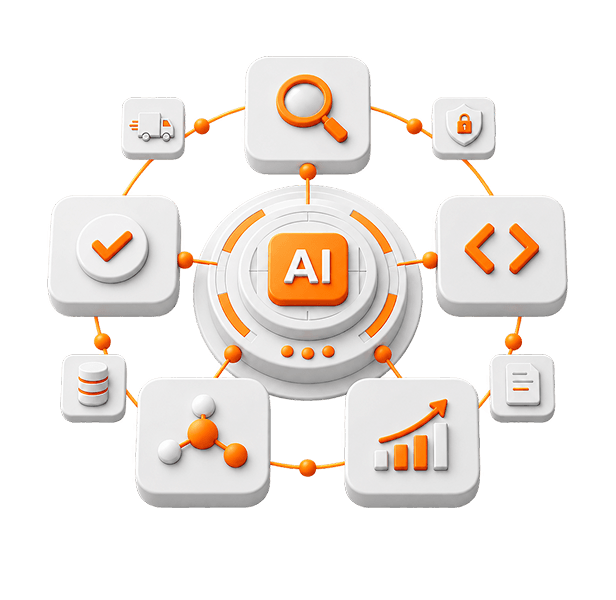
The AI Pilot is a 30-day, fixed-budget engagement that turns one AI use case into a working Proof of Value. Discovery first checks technical fit, legal exposure, security, and the business case. Then a team of four to five people builds the solution, with analytics tied to KPIs we agree on. You get a tool to test with real users, an improvement report, and the architecture for the next phase.
The AI Compass Sprint is a four-week discovery engagement that shows where AI fits your business and what to build first. We score your organization across 7 maturity dimensions and rank use cases by business impact and effort. You get a business case for each top opportunity, a 3-wave roadmap, and a 90-day activation plan.
The AI Maturity Assessment measures your AI readiness across 7 dimensions: strategy, data, AI in production, team skills, technology, governance, and operations. Our free 15-question self-assessment gives you an instant score and a next step. Our consultants can also run an expert assessment that ends with a prioritized roadmap.
AI SDLC consulting helps engineering teams redesign how they build software with AI, instead of adding AI tools to an unchanged process. We turn requirements into machine-readable specifications with OpenSpec, run agentic build cycles, and keep four human-only checkpoints before anything ships. On our active projects, this delivered 20–30% faster requirements work and 90%+ test coverage, against a 70% industry average.
We build agents that run in production. Zipify’s AI Agent Assist cut response times by 65% and doubled ticket resolution speed. An AI agent for network troubleshooting resolved 25% more issues with 18% less time per case. Our stack includes MCP, Amazon Bedrock AgentCore, Agno, and our own LOFT orchestration framework, with human approval steps where the stakes require them.
Yes, since 2016. We’ve built chatbots and AI assistants for T-Mobile, Burberry, Estée Lauder, Jo Malone London, and Aveda, and every project includes conversation design. A chatbot for Luxury Escapes drove $500,000 in revenue in its first few months and converted 3x better than the website. We deploy on web, mobile, WhatsApp, RCS, and Apple Messages for Business, in English, French, Spanish, Portuguese, and more.
Yes. We build AI voice agents and replace legacy IVR systems with voice bots connected to your CRM and telephony. A real estate voice agent we built cut response time by 78%, increased conversion by 35%, and generated 42% more inbound leads. We work with Parloa, SoundHound, ElevenLabs, and Amazon Connect.
Yes. We build generative AI applications on your business data, from knowledge search and document processing to workflow automation. An AI legal advisor we built reviews contracts 2–4x faster and returns a risk analysis in under a minute per document. A knowledge assistant for a financial company earned a 93% response accuracy rating.
We work with models from OpenAI, Anthropic, Google, and Cohere, including GPT, Claude, and Gemini, through platforms like Amazon Bedrock and Google Vertex AI. For private deployments, we use open models. We’ve also built on 15+ conversational AI platforms, including LivePerson, Glia, Infobip, Sinch, Voiceflow, Parloa, and Salesforce.
Yes. We build machine learning models for predictive analytics, forecasting, recommendations, predictive maintenance, and data analysis, and deploy them into your production systems. Our engineers also handle the data engineering these models depend on: cleaning, structuring, and preparing data before training starts.
Both. We can improve what you have, extend a platform you’ve bought, or build a custom solution. Partnering with Glia, we’ve delivered 25+ projects on its platform over 5+ years. When we build custom, we design it so you can switch models or vendors later.
Yes. We start with a technical audit of the live solution, its architecture, and its data, and give you a prioritized list of fixes. Then we can make the fixes, optimize LLM costs and performance, or take over development and support entirely.
Yes. You can outsource a project to a managed team that owns delivery, or hire AI engineers who join your team and work under your management. We share profiles that match the skills you need, and you interview candidates before anyone starts. Glia, for example, has used both models with us since 2020.
Yes. Every engagement includes knowledge transfer, so your team can run and extend what we build. We also train teams directly: Claude Code adoption for engineers, Claude Cowork and enterprise rollouts for business teams, and AI SDLC practices for engineering teams.
Yes. We built web, mobile, and custom software for 12 years before our first chatbot, and Clutch certifies us in Custom Software Development. We build web platforms, iOS and Android apps, CRMs, marketplaces, and Shopify apps.
We’ve delivered projects in eCommerce and retail, education, healthcare, banking, fintech, insurance, telecom, real estate, oil and gas, energy, automotive, aviation, travel and hospitality, manufacturing, supply chain, media, and nonprofits.
Yes. We designed a HIPAA-compliant AI assistant that engaged 18,500+ patients in its first 90 days and resolved 74% of their queries. For CNSI (Acentra Health), our work saved 17% of staff time across call centers with 20,000+ agents. Every Discovery checks legal exposure and compliance before we build, and we design for GDPR and HIPAA requirements. If your rules prohibit third-party AI vendors, we deploy on your infrastructure with open models.
An AI assistant for Tom Ford Beauty engaged 8,000+ users and drove 2,000+ product clicks in a one-month holiday campaign. Mira, a reflection platform built with Nord Anglia, got students writing 11.6x more per reflection. An AI agent for network troubleshooting added 10 points to customer NPS. You can filter our portfolio by industry. If your use case isn’t there, we’ll walk you through the closest projects on a call.
No, though we often have it. What decides an AI project is how well the team understands your process. Our Discovery goes unit by unit through your operations and interviews the people who do the work, and we bring in domain specialists where needed. In our experience, the use case that delivers the most value is often one nobody put at the top of the list.
You don’t need all the answers before you contact us. Fill out the contact form, and we’ll reply within 24 hours. Then we match the first step to where you are:
Yes, mapping comes first. Discovery includes workshops, process mapping, a review of your systems and APIs, and KPI definition. For each process, we record volume, time spent, fully loaded cost, current tools, and data availability.
No. A short description of the problem is enough. If you have documents, upload them through the contact form. In our experience, AI-written specs often describe three times the scope the budget allows, and part of our job is finding the piece worth building first.
Yes, and we have. A large energy utility once wanted a chatbot to automate HR for 20,000+ employees. Discovery showed its HR systems weren’t ready for AI, so we said so before any build began. Sometimes the honest answer is a ready-made platform or a smaller pilot.
We work in six stages:
1. Discovery and business analysis: workshops, process mapping, a system and API audit, and KPIs.
2. Conversation design: dialog flows, persona, fallbacks, and guardrails for conversational products.
3. Build and testing: complex parts first, early demos, and analytics setup.
4. Validation and go-live: a formal acceptance testing gate, a Go/No-Go meeting, and a phased rollout.
5. Post-launch support: two weeks of dedicated support and analytics reports at one week and one month.
6. Growth program: A/B tests, new flows, integrations, and ongoing CSAT and containment gains.
We offer four: fixed-scope consulting like the AI Compass Sprint, the fixed-budget 30-day AI Pilot, project delivery where our team owns the build, and dedicated teams or engineers who work under your management.
Yes, and we usually recommend it. Starting with Discovery and a pilot or PoC typically cuts development waste by 50–70%. The AI Pilot gives you a working solution and real performance data in 30 days. A PoC tests technical feasibility, and an AI MVP puts a product in front of real users in two to three months.
Yes. Every project has a project manager who owns scope, timeline, and communication, and is your main point of contact. On larger engagements, a solution lead also owns the technical direction.
Less than you might expect, but not zero. We need a decision-maker who can approve the scope, access to the right data and systems, and a few hours from the people who run the processes we’re improving. Your team also joins demos and acceptance testing.
Yes. Our engineers can join your sprints, work in your repositories, and follow your processes. Post used our engineers, designers, QA, and technical PM to ship its product while it hired its own team.
We work in sprints and show demos as features come together, so you see working software early. A typical rhythm includes weekly status calls with the project manager and leads, a shared Slack channel, and email. On long engagements, our leadership joins monthly reviews with your executives.
We expect them. With AI, requirements are rarely fully defined upfront, and better options often appear once the work starts. In the AI Pilot, the budget and timeline stay fixed while the technical approach flexes. On longer projects, we flag each change’s impact on scope, budget, and timeline and agree on it with you before work begins.
We agree on success metrics before the build starts. Two or three clear metrics defined upfront tell you more than ten defined later. Typical ones are adoption rate, time saved, task completion, containment, CSAT, and conversion. We build analytics into the solution to track them from day one.
Yes. After two weeks of dedicated launch support, you can choose a support package or a growth program. Many clients stay for years: we’ve supported La Mer’s chatbot for 7 years.
Most of our projects start at $25,000. The most common size among our Clutch-reviewed projects is $50,000 to $199,999. Our average hourly rate is $50 to $99. The AI Pilot runs on a fixed budget agreed before kickoff. [CONFIRM: publish the AI Pilot price or range.] If your budget is below what a custom build needs, we’ll say so. For one startup with $10,000, we recommended a partner platform, and it launched a bilingual chatbot in two weeks.
We reply within 24 hours. The AI Maturity self-assessment takes about 10 minutes, the AI Compass Sprint takes four weeks, an AI Pilot takes 30 days, and an AI MVP takes two to three months. Full production builds depend on integrations, data readiness, and compliance, so we commit to a timeline after Discovery.
We estimate after Discovery, once we’ve mapped your processes, defined the architecture, and scored each feature by impact and effort. Our fees have no hidden costs. Third-party costs sit outside our fee: LLM API usage, cloud hosting, and platform licenses. We list them in the estimate so you can plan for them.
We design for running costs from day one, because a solution that’s too expensive per conversation won’t survive production. We benchmark models on your real tasks and choose the cheapest one that meets your quality bar. Our open-source LOFT framework cuts setup effort by 43% and budgets by up to 20% at scale. In production, we track usage with tools like Langfuse and tune prompts and models as volumes grow.
Yes, that’s what the AI Pilot is for. We define the next phase’s architecture during the pilot, so the production build doesn’t start from scratch. A pilot isn’t production-ready: it’s built to test assumptions with real users. Afterward, you can move into the production build with the same team.
No. Most clients host in a cloud account they control, such as AWS or Google Cloud, where we’re certified partners. We can also host your solution in dedicated, isolated environments. If your rules prohibit third-party AI vendors, we deploy open models on your infrastructure to ensure full data sovereignty. You choose the deployment region and retention settings.
We hold an ISO/IEC 27001:2022 certificate covering AI software development and consulting. When we host your solution, your data is encrypted at rest and in transit, and access is role-based and limited to people who need it. Our core design rule: AI models never get direct access to sensitive data. Our Application Security team tests every solution against the OWASP Top 10 for LLM Applications. Details are in our AI Trust Center.
No, not unless your project needs it and you agree. We never use client data to train models for other clients or for our own products. With third-party model providers, we push for zero-retention API settings and check their data handling against your compliance requirements. When the contract ends, we transfer your environments and data back to you.
We test throughout the build. Our testing combines human UX and acceptance testing, automated E2E tests, and AI-specific checks for conversational interfaces, including LLM-as-a-judge evaluation of agent behavior. With our AI SDLC methodology, test coverage reaches 90%+, against a 70% industry average.
We build the controls into the architecture. Retrieval-augmented generation grounds answers in your data, and pre-generated responses or fine-tuning cover cases where accuracy is critical. Guardrails at input and output block prompt injection, jailbreaks, and data leaks, and retrieval-layer access controls show users only the data they’re allowed to see. Our security team red-teams every LLM solution and monitors production for anomalies.
Then you switch. We keep the model behind an orchestration layer, so changing providers means retesting and tuning prompts rather than rebuilding the product. Before any switch, we benchmark the new model on your real tasks, because results vary between models, tasks, and updates.
We integrate AI with CRMs, ERPs, contact center platforms, payment gateways, legacy tools, and proprietary systems, including Salesforce, Microsoft Dynamics 365, HubSpot, Shopify, Amazon Connect, LivePerson, Glia, and Infobip. In our experience, out-of-the-box connectors rarely fit a real business setup, so we build custom connectors and API layers where they fall short.
You do. The source code, prompts, AI workflows, configurations, and documentation we create for your project belong to you. Our LOFT orchestration framework is open source under the MIT license, so you can keep using it without us.
Yes. Tick “Send me NDA” on our contact form, and we’ll sign one before you share details. Under our ISO 27001-certified processes, only people working on your project can access your information, and every employee takes regular security awareness training.
No visit needed. We sign contracts remotely and run kickoffs over video. You don’t need to visit our office to start working together.
Yes. We update documentation as we build and review it before each release. At handoff, your team gets the code, documentation, and the processes and tooling we used to build it. We train your engineers and stay available during the transition.
We make it easy. We don’t build clients into a corner: no vendor lock-in, no forced ecosystem. When the contract ends, we transfer your environments, data, code, documentation, and tooling, then support the handover to your team or new vendor. That’s also why it’ll be easy to say goodbye to us, though many clients stay for years.
Don’t hesitate to ask us. Tell us what you’re working on, and we’ll do our best to reply within 24 hours. If needed, we’ll sign an NDA before you share the details.