


AI agents can help employees move faster, automate repetitive work, and connect tasks across tools. The problem starts when those assistants appear outside approved systems and governance processes.
This article explains what shadow AI agents are, why they emerge, what risks they create, and how enterprises can detect and mitigate them without discouraging overall adoption. We’ll also share how Master of Code Global approaches experimentation internally and why governed custom tools and small pilots can be practical alternatives to unsanctioned AI usage.
If you’re already dealing with this challenge, contact us for a direct consultation on how to assess the risks and define a safer path forward.
Table of Contents
Key Takeaways
- Shadow AI agents create a different level of risk than regular shadow AI because they can access tools, retrieve data, and take actions rather than simply generate responses.
- Untracked AI agents often signal an unmet business need, such as missing functionality, slow authorization workflows, or a lack of practical sanctioned alternatives.
- The main enterprise risks include data leakage, excessive permissions, compliance gaps, unauthorized actions, and a growing attack surface.
- Effective shadow AI agent risk mitigation starts with visibility, clear ownership, least-privilege access, approval processes, and continuous monitoring.
- The goal is not to stop experimentation. Enterprises should make safe, governed AI easier to use than shadow alternatives, whether through approved platforms, custom tools, or controlled pilots.
AI Adoption Has Two Very Different Problems
On one side are employees who remain skeptical. They may question the quality of LLM outputs, prefer established workflows, or simply see little reason to change the way they work. This hesitation is happening while pressure keeps growing:
- 65% of users say they fear falling behind if they don’t employ artificial intelligence to adjust quickly,
- yet 45% feel safer focusing on current goals than redesigning their work around the technology.
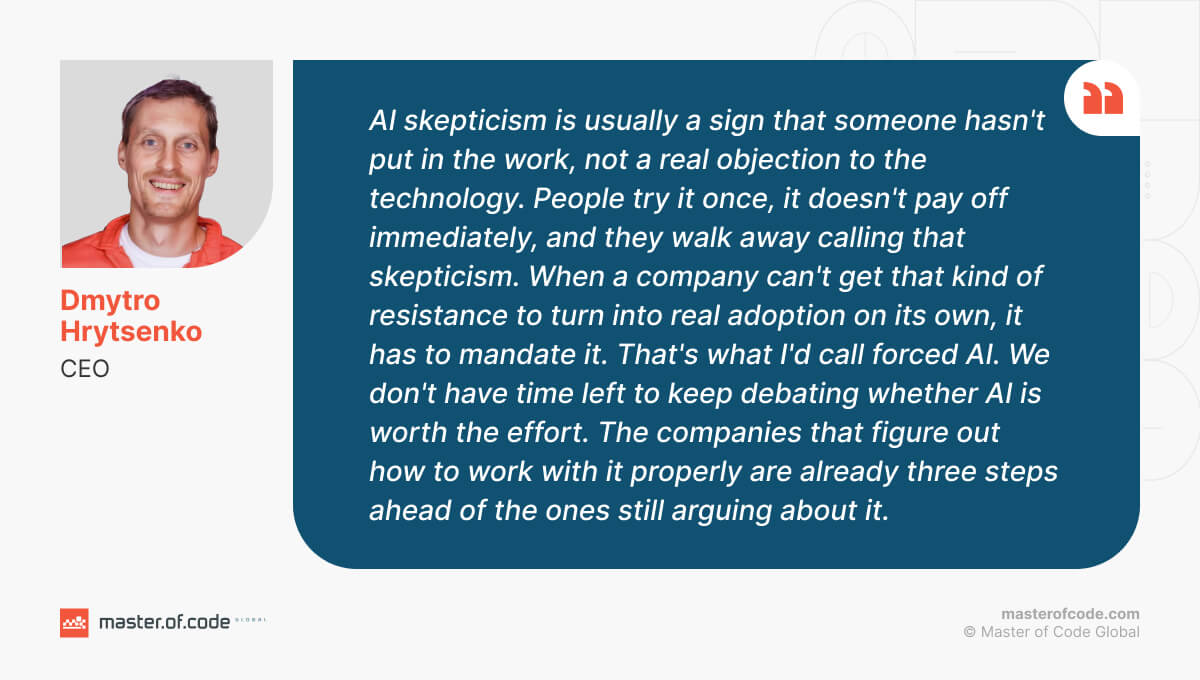
Our CEO, Dmytro Hrytsenko, sees much of this skepticism as a consequence of limited experimentation. His point is that getting meaningful value requires work: testing different approaches, structuring inputs properly, and changing processes where necessary. When organic adoption stalls, companies may eventually respond by pushing AI use more actively.
But another group of employees hardly needs a push.
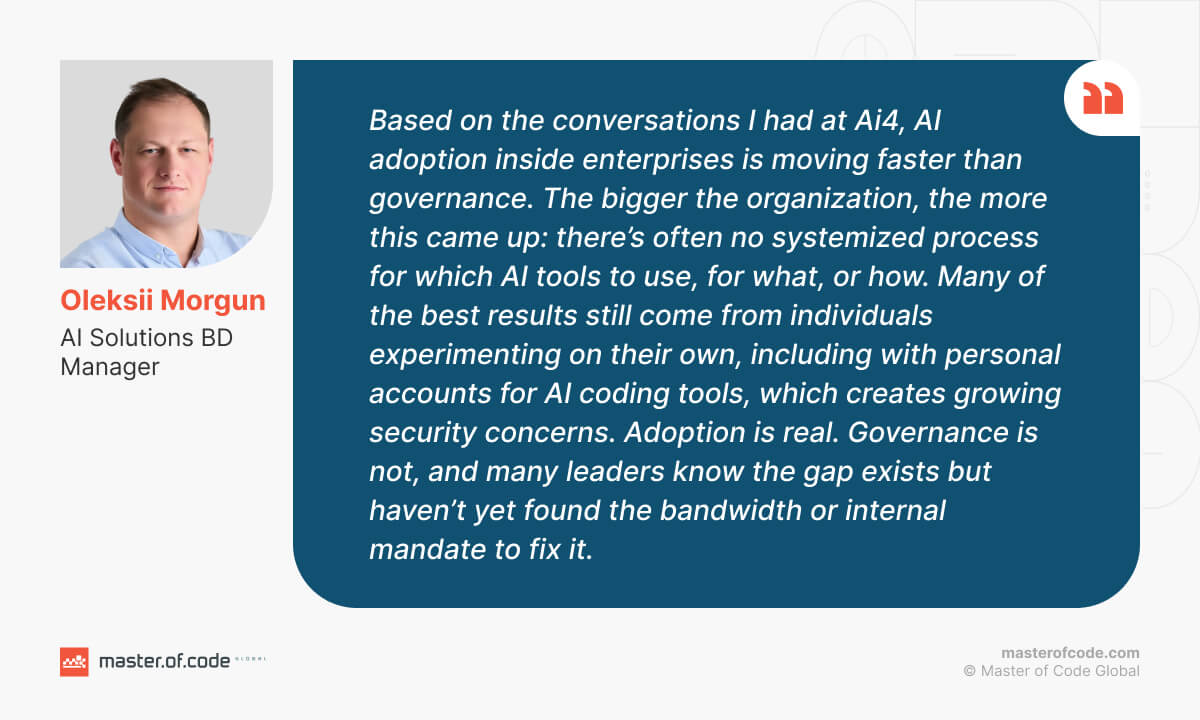
They are already experimenting on their own, sometimes faster than IT, security, and leadership can establish approved ways to use it. Microsoft found that 78% were bringing their own AI tools to work back in 2024. In 2026, 47% are still relying on personal apps for work.
These two behaviors may look contradictory, but they expose the same organizational gap. In Microsoft’s 2026 Work Trend Index, only 26% of respondents said their leadership was clearly and consistently aligned on artificial intelligence. Employees are being asked to adapt while the rules, tools, incentives, and support around that transition are still taking shape.
So the enterprise challenge is no longer simply how to make employees use AI. It is also how to ensure that the people already using it do so somewhere the organization can see, secure, and govern.
And that question becomes more urgent when an unapproved tool stops being just a chatbot and starts acting as an agent. For more background on how these systems work, their risks, and the concepts behind them, see our Agentic AI PoC guide.
What Makes Shadow AI Agents Different and More Dangerous?
A shadow agentic AI is an autonomous system used for work without appropriate organizational visibility, approval, or governance. It may start as a personal productivity experiment, an automation inside a SaaS platform, a custom assistant, or even a quick internal script. The common denominator is that IT or security teams may not know it exists, what it can access, or who is responsible for it.
That makes it different from the shadow technology businesses have dealt with for years. The progression is essentially from unauthorized software, to unauthorized intelligence, to unauthorized action.
| Shadow IT | Shadow AI | Shadow AI Agent | |
|---|---|---|---|
| Definition | Unapproved technology | Unapproved AI use | Unapproved agentic AI |
| Oversight | Limited IT visibility | Limited AI visibility | Limited action visibility |
| Typical risk | Security gaps | Data exposure | Unauthorized actions |
| Example | Personal SaaS app, e.g., an email client | Personal ChatGPT account | Unapproved n8n agent |
The distinction matters because AI agents can go beyond generating text. NIST describes these as systems that can use tools to take actions beyond simple text output, with different levels of access, autonomy, write permissions, and human intervention.
In simple terms, the interaction can shift from:
User → AI → Answer
to:
User → Agent → Company tools/data → Action
A few characteristics make untracked AI agents particularly important from a governance perspective:
- Autonomy. The system can plan and execute several steps with limited user involvement.
- Tool access. It may connect to files, APIs, SaaS applications, internal systems, or other resources.
- Inherited permissions. It can operate through existing user accounts, service accounts, or connected workflows, potentially gaining more reach than leadership realizes.
- Limited visibility. The organization may not have a clear record of the owner, purpose, permissions, or activity.
And this is already showing up in enterprise environments. 54% of organizations surveyed by the Cloud Security Alliance reported between 1 and 100 unsanctioned software. Only 15% said that 76–100% of their agents had clearly defined ownership. These and other AI agent statistics show how quickly adoption is moving ahead of formal governance.
So, the issue with shadow AI agents isn’t simply that employees are using another unapproved tool. It’s that the tool may now be able to interact with the business on their behalf, often before the organization has defined what it should be allowed to see or do.
Why Shadow AI Agents Keep Appearing Inside Enterprises
These systems rarely start with an employee deliberately trying to bypass security. More often, they start with a practical problem that needs solving quickly. Someone wants to automate reporting, summarize research, process documents, or connect information across several tools. An agentic artificial intelligence happens to offer the shortest path from problem to result. The Cloud Security Alliance similarly notes that shadow agentic workflows are often created by trusted employees trying to move faster and automate repetitive work.
The friction appears when business demand moves faster than the approved environment. Employees may already have access to corporate tools, but those solutions don’t necessarily support every workflow, integration, or use case they encounter. Building a lightweight agent or connecting another application can feel easier than waiting for a new capability to enter the official stack.
Several conditions make this especially likely:
- Slow approval processes. Testing a new AI tool can take minutes, while getting one reviewed and deployed enterprise-wide takes considerably more effort.
- Gaps in available functionality. An approved assistant may generate content but lack access to the applications or data employees need to automate a workflow.
- Pressure to become more productive. When teams are encouraged to use AI but aren’t given clear tools or boundaries, some will find their own route.
- Low technical barriers. No-code builders, APIs, and ready-made integrations allow employees outside engineering teams to create increasingly capable automations.
This doesn’t mean enterprises should remove approval altogether. The problem is the gap between experimentation and governance. If the sanctioned route feels disproportionately difficult compared with opening a personal account or connecting an agent, unsanctioned AI usage becomes a predictable outcome rather than an exceptional one.
And the issue can compound as AI adoption grows. An employee may begin with a harmless productivity experiment, then gradually give the assistant access to more files, applications, and workflows as it proves useful. What started as a convenient workaround can quietly become part of a business process without ever becoming part of the company’s governed technology environment.
That is where shadow AI agents become materially different from another unofficial productivity app. Once those retrieve company information and take actions through connected tools, convenience starts carrying operational, security, and compliance consequences.
If AI adoption is moving faster than your security controls, explore our AI security consulting services to identify exposure, define guardrails, and sustain a safer adoption.
What Risks Do Shadow AI Agents Create?
With ordinary shadow AI, the most obvious concern is what an employee puts into the tool. With autonomous agents, the question becomes broader: what can the system access, decide, and do once it is connected?
Sensitive Data Exposure and Data Leakage
An employee doesn’t necessarily have to manually upload a confidential document for data leakage to occur. A connected agent may retrieve information from files, applications, databases, or other resources available through its credentials.
This creates a wider exposure path for sensitive data and introduces many of the same LLM security concerns that apply to enterprise GenAI systems. The issue becomes especially serious when untracked software connects to resources outside the organization’s approved environment.
Unauthorized Actions and Excessive Permissions
The risk increases with broader access than the task requires. 53% of organizations surveyed by the Cloud Security Alliance said AI agents had exceeded their intended permissions. That makes access controls and least privilege especially important. Any software should only be able to reach the information and functions required for its purpose.
There is also a fundamental difference between a wrong answer and a wrong action. A hallucinated chatbot response usually requires a person to act on it. Enterprise AI agent solutions may be able to take that next step itself. Depending on its permissions, it could update a record, send a message, invoke an API, change a file, or trigger another workflow.
Compliance and Accountability Risks
This autonomy also complicates compliance and accountability. If an untracked algorithm makes a consequential change, the organization needs to know:
- who the owner is,
- what triggered the action,
- which systems and data it accessed,
- what permissions it operated under,
- and whether human approval was required.
Without that visibility, investigating incidents and demonstrating that internal controls were followed becomes more difficult. Unclear ownership can also leave security teams unsure who should review, restrict, or disable an assistant when something goes wrong.
MCP Connections and a Larger Attack Surface
Agentic systems become useful by connecting to other resources, but every new connection can expand the attack surface. APIs, SaaS platforms, databases, service accounts, and other apps create additional paths through which information and actions can flow.
MCP (Model Context Protocol) is one example. It provides a standardized way to connect with tools and data sources, making integrations easier to build. The protocol itself is not the problem; those connections still require appropriate authorization, access controls, and security review.
The risk appears when unapproved software gains access to connections the organization never evaluated. At that point, a small productivity experiment can quietly become part of the enterprise technology environment without going through the same scrutiny as other business software.
That is why shadow AI agent risk mitigation has to go beyond blocking individual applications. Enterprises first need visibility into where autonomous agents exist, what they connect to, and what they are allowed to do.
How to Detect and Mitigate Shadow AI Agent Risks
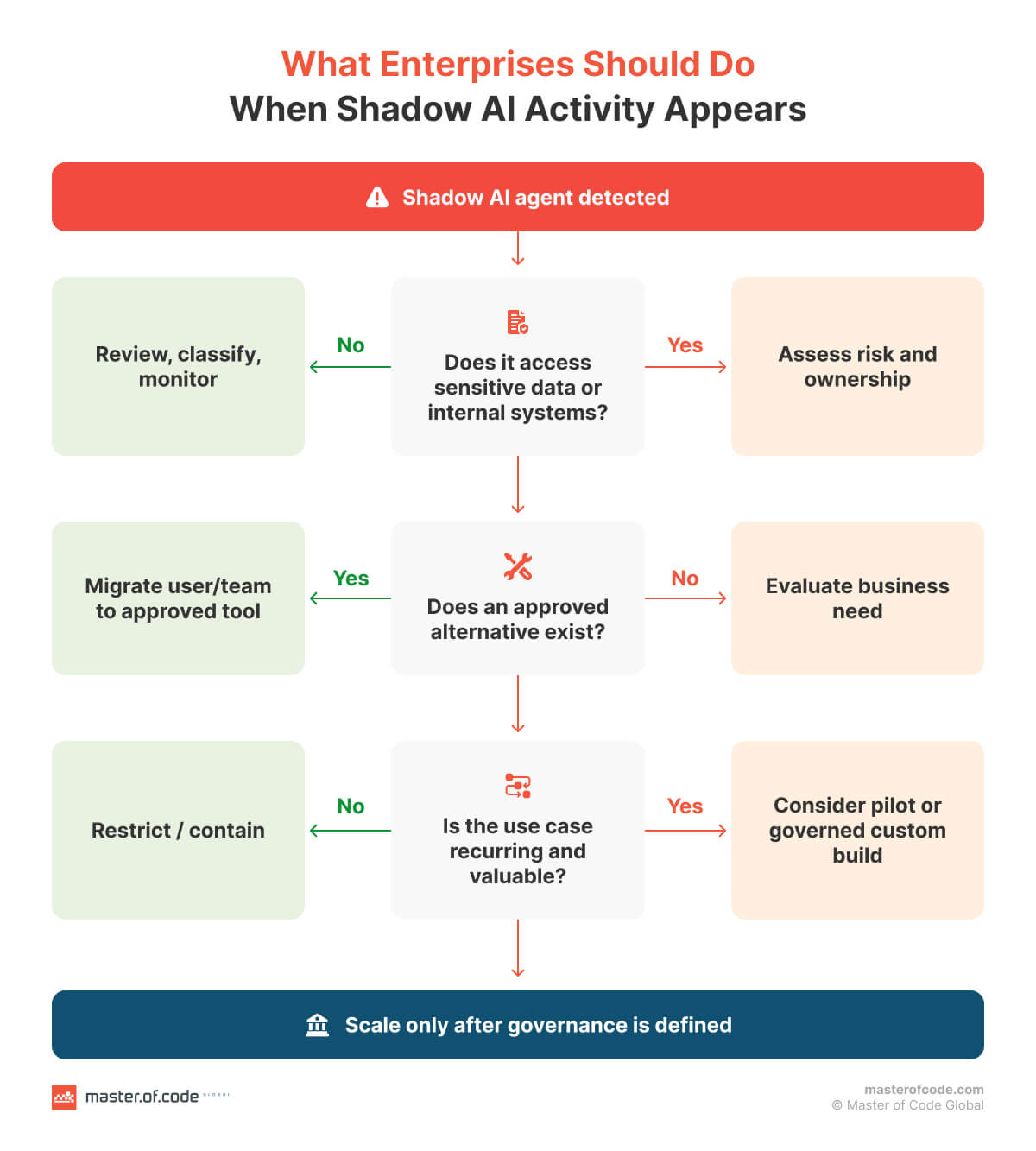
Blocking every unfamiliar AI application may reduce some exposure, but it doesn’t address why employees looked for those tools in the first place. Effective risk mitigation combines visibility and controls with approved alternatives that people can actually use.
How to Detect Shadow AI Agent Activity
You can’t govern a system you don’t know exists. The first step is therefore building visibility into AI apps, identities, integrations, and activity across the organization.
Common approaches include:
- maintaining an inventory of approvals;
- monitoring AI-related application and network activity;
- reviewing OAuth connections, API credentials, service accounts, and other integrations;
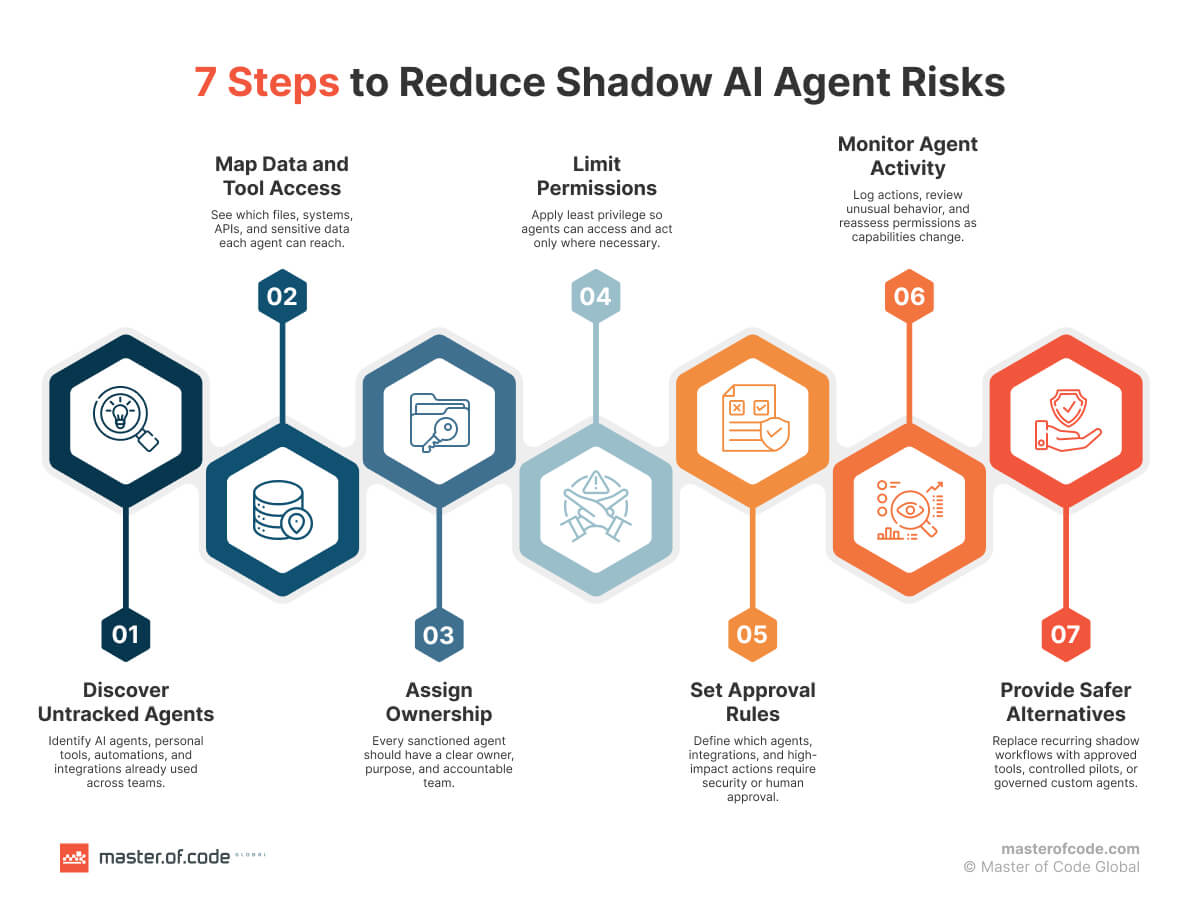
- assigning a clear owner and business purpose to every sanctioned agent;
- mapping which data sources and tools each it can access;
- logging actions so unusual behavior is investigated;
- periodically reviewing permissions as workflows and capabilities change.
We recommend the combination of inventory and discovery, explicit ownership, fine-grained least-privilege access, runtime authorization, and audit logging as core controls for enterprise AI agents.
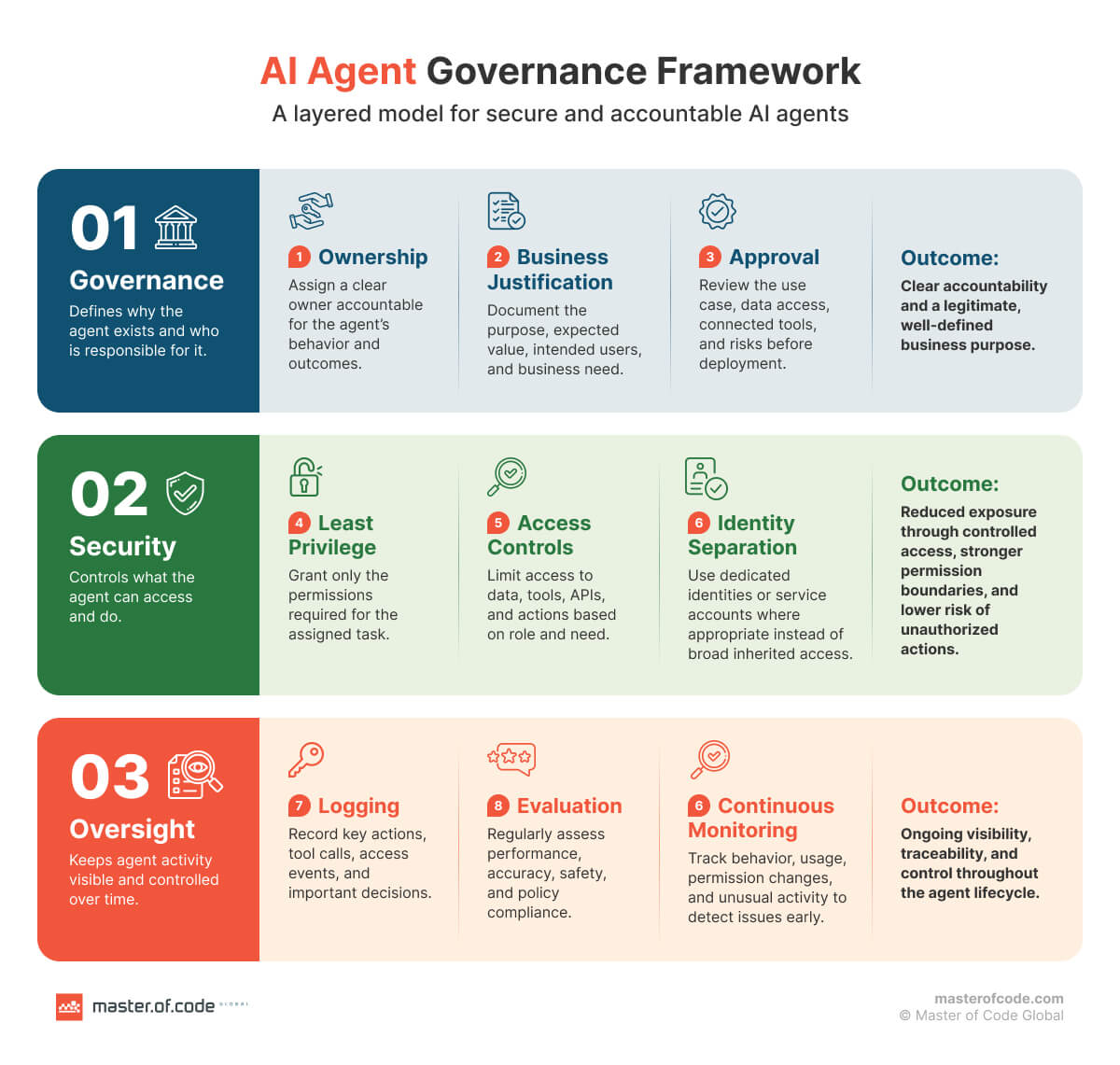
Discovery alone isn’t enough, though. AI agent governance should answer a few basic questions: Who owns it? Why does it exist? What can it access? What can it change? And where does a human need to step in?
From there, enterprises can apply access controls and least privilege, and separate credentials where appropriate. Plus, they may add human authorization for critical actions and introduce continuous monitoring and AI agent evaluation. OWASP likewise recommends restricting privileges to what the application actually needs and requiring human approval for high-risk operations.
Combine AI Adoption With Clear Security Rules
AI agent governance becomes easier when employees understand that the goal isn’t to stop them from using it, but to establish safe boundaries for doing so.
That’s the balance we’re working toward at Master of Code Global. Our CEO, Dmytro Hrytsenko, actively supports AI experimentation because you can’t properly assess its value without using it. At the same time, encouraging employees to explore technology doesn’t mean treating every third-party tool or integration as equally safe.
Our internal approach separates lower-risk experimentation from use cases that involve company systems or confidential information. For third-party tools used without such access, employees are expected to anonymize inputs and follow data-minimization and masking practices. Tools requiring access to sensitive information or company systems go through additional security review.
This creates room for experimentation without making security optional. It also gives employees a defined route for cases where a useful external tool needs deeper access. Rather than automatically rejecting the idea, the organization can assess the risk and consider a secure enterprise-grade alternative where appropriate.
For companies building their own framework, the exact policy will differ. But the principle is transferable: approval processes should distinguish between someone testing a tool with sanitized information and an autonomous assistant connecting to internal data or systems.
If you’re deciding how to introduce agents without losing control over security, permissions, and human oversight, we offer Agentic AI consulting services — feel free to get in touch.
Build and Pilot Safer Alternatives for Recurring Needs
Policies become much more effective when the sanctioned option solves the actual problem. If employees repeatedly create workarounds for the same workflow, that behavior can be useful input for your AI roadmap.
We’re applying this logic internally as well. Master of Code Global has been gathering requirements from different teams to understand which workflows employees want AI to improve and is now developing internal tools around those needs. For engineering organizations, the same governance principles can also be built into the AI SDLC, so AI-assisted development follows defined security, review, and human-accountability gates. Instead of leaving each team to assemble its own stack, recurring requirements can become governed solutions designed around the way people actually work.
For some organizations, an approved off-the-shelf application will be enough. In other cases, custom AI development can provide greater control over the parts that matter most, such as:
- which systems the agent integrates with;
- what information it can retrieve;
- how users and agents authenticate;
- which actions are permitted;
- what gets logged;
- and where human approval is required.
The advantage of custom is that security, permissions, integrations, and governance can be designed around the specific business case. You are not limited to whatever controls a generic product provides.
And if leadership is still skeptical about whether the proposed solution is worth building, you don’t have to start with a company-wide rollout. AI pilots can test one workflow with a small user group, limited integrations, clear success criteria, and appropriate safeguards before more budget or access is committed.
That’s how we approach it at Master of Code Global:
- keep the scope narrow,
- validate whether the assistant addresses a genuine user need, and
- expand only when the business case has been demonstrated.
Our existing methodology also recommends limited-user sandbox testing and evaluating business and technical KPIs before preparing for broader deployment.
In the End…
Shadow AI agents are unlikely to disappear through policy alone. Employees will keep choosing the fastest path to getting work done, especially when approved alternatives are limited, difficult to access, or poorly matched to the task.
That means effective shadow AI agent risk mitigation depends on more than detection. Enterprises need to make the sanctioned route practical by combining:
- clear guidance on what is allowed;
- fast approval processes for legitimate new use cases;
- secure tools that fit real workflows;
- appropriate access controls and monitoring;
- and a controlled way to test new ideas before scaling them.
The organizations that manage this well won’t be the ones that simply allow or prohibit more AI. They’ll be the ones that make safe AI use easier than working around the rules.
If you’re trying to understand where shadow AI agents may already exist in your organization, or how to replace risky workarounds with governed alternatives, contact Master of Code Global. Our team can help you assess the current setup, identify priority use cases, and design a safer path from AI experimentation to production.
FAQs
How do you build an AI agent governance framework?
Start by defining six elements for every agent: owner, purpose, data access, permissions, approval requirements, and monitoring. From there, apply least-privilege access, logging, human oversight for high-impact actions, periodic reviews, and a clear process for approving new software.
How can MCP increase shadow AI agent risks?
MCP makes it easier for agentic systems to connect with tools, applications, and data sources. The risk increases when an unapproved agent connects to resources the organization has not reviewed, potentially widening access to sensitive data.
How can companies detect shadow AI agent activity?
Detection starts with visibility into applications, identities, integrations, and permissions. Companies can monitor application and network activity, review OAuth and API connections, maintain an agent inventory, assign ownership, log actions, and regularly reassess what each agent can access and do.
Discover how Master of Code Global can help enhance your customer’s experience and boost sales growth.