


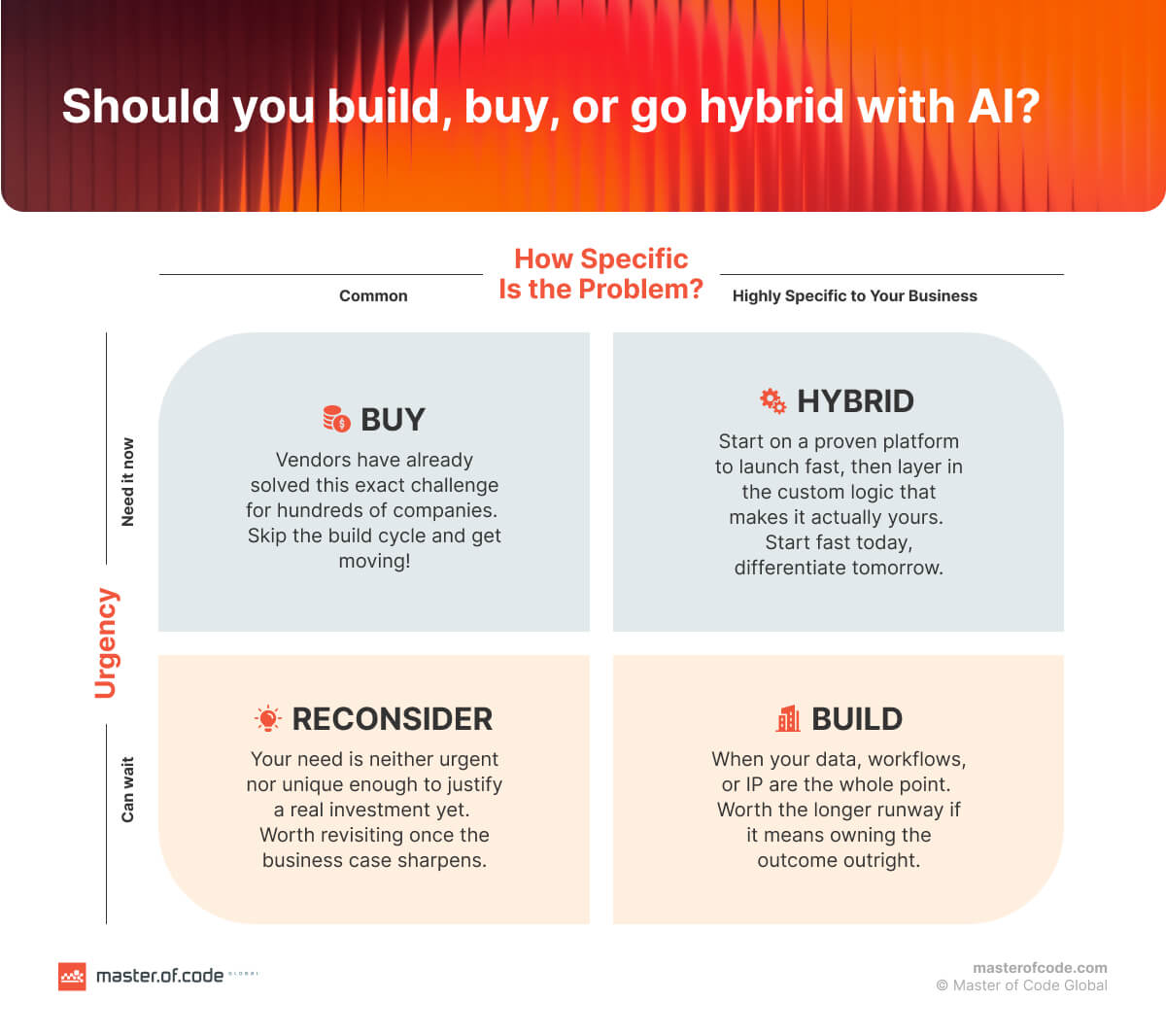
Every AI roadmap eventually faces the question of whether the company should build vs buy AI from someone.
This guide breaks down exactly how to think through that decision. You’ll learn when buying wins, when building pays off, and the hidden risks that trip up companies on either path.
If you’d rather skip the research and talk through your specific use case, get in touch with our team, and we’ll help you figure out what to do in the build vs buy AI dilemma.
Table of Contents
Key Takeaways
- Buy when your use case is common and already well solved by mature vendors, such as FAQ automation or document processing.
- Choose a vendor if you lack in-house AI talent and don’t want to carry the hiring and maintenance burden yourself.
- Build when your data or workflows are genuinely unique, and no off-the-shelf tool fits them well.
- Hire if you are ready to invest in the in-house AI expertise to build and maintain it long-term.
The Build vs Buy AI Dilemma, Explained
Long before AI entered the picture, companies also asked themselves whether they should build the tool or buy it from someone. Think CRMs, ERPs, and customer support platforms. This debate has played out in IT departments for decades. Most organizations settled into a comfortable rhythm of buying what’s commoditized and building what’s core to their edge.
AI has changed this rhythm, and your build vs buy AI strategy should be different from how you approached software in the past. Technology moves fast, vendors multiply by the month, and the line between a commodity and an advantage that separates you from competitors keeps shifting. A capability that seemed niche and build-worthy last year might now be a mature, off-the-shelf product.
In the meantime, foundational models have made custom development more accessible than ever. This makes it possible for teams to build things they’d have bought without a second thought five years ago. That’s what makes build vs. buy AI solutions such a harder call than the traditional software version of this question.
The Hidden Costs of Building AI In-House
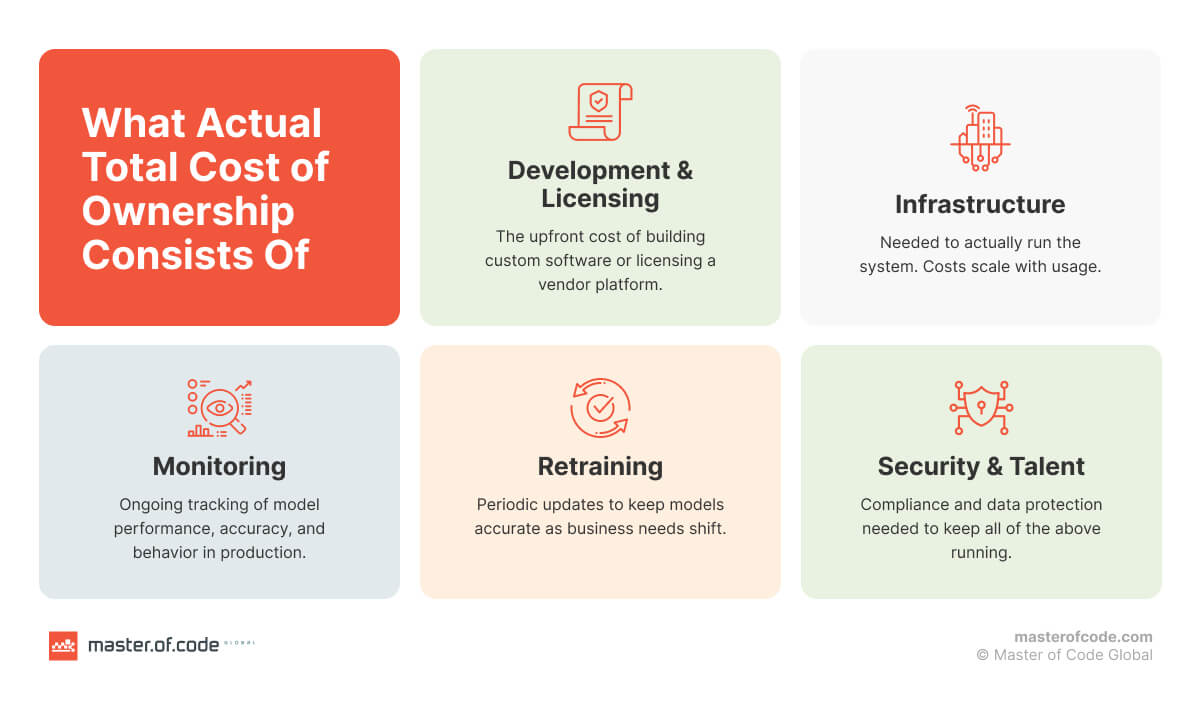
Most companies underestimate what building actually costs because some expenses in the total cost of ownership (TCO) rarely appear as line items in the original project budget.
Hiring and retention are usually the first surprise. Experienced AI engineers are in short supply, and the competition for them is fierce. You’ll likely pay a premium to bring someone in, and even then, there’s no guarantee they’ll stick around.
AI maintenance costs don’t stop once the system ships. Every model needs monitoring, every pipeline needs occasional fixes, and every security patch needs someone accountable for applying it.
None of this means building is the wrong call. It just means the sticker price was never the real price, bringing the factor of AI ROI into the equation.
Weighing these hidden costs before committing is what separates a build that pays off from one that quietly drains your engineering budget for years. And keeps your total cost of ownership (TCO) manageable.
When Buying AI Makes More Sense
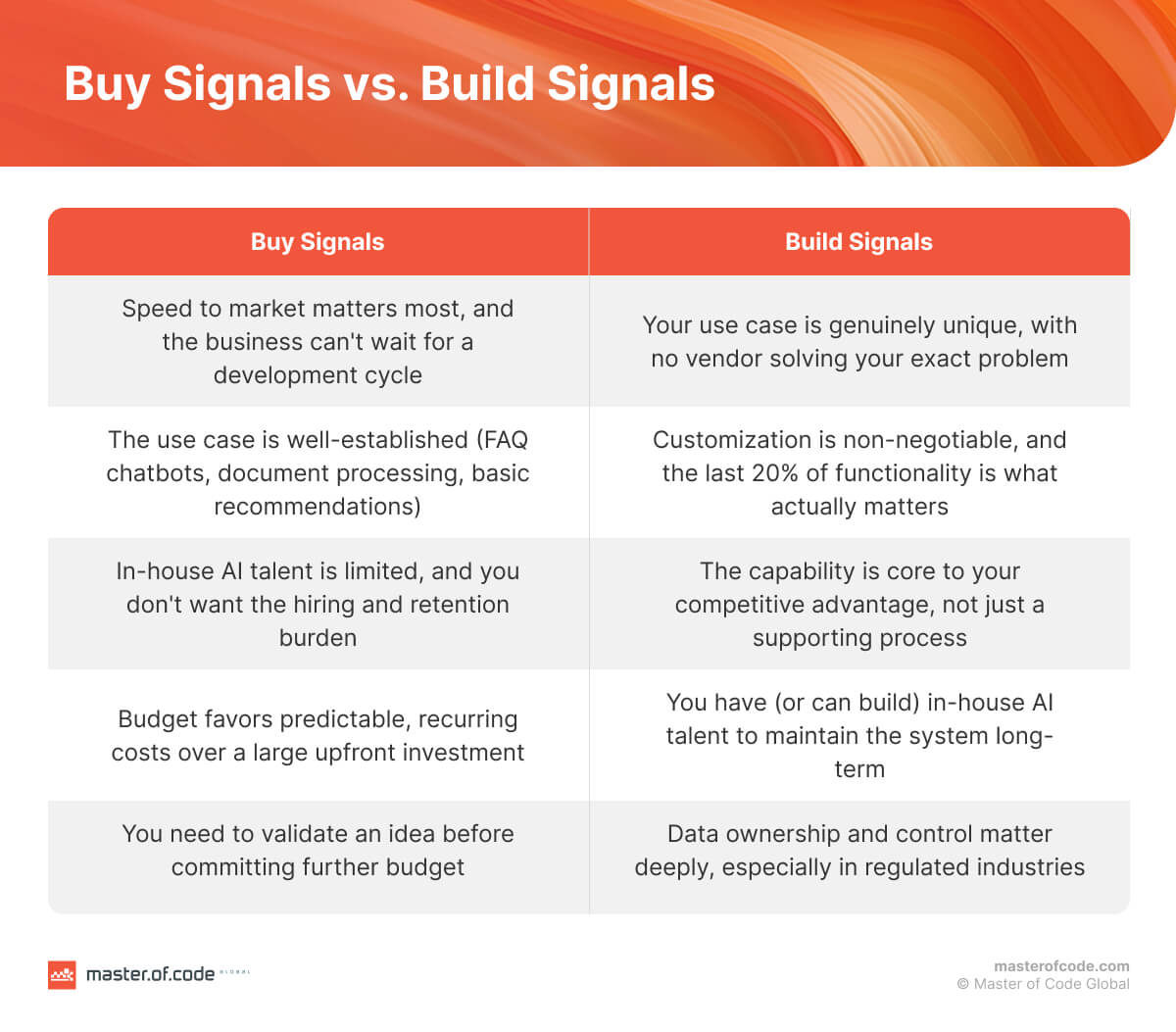
Buying makes sense when your use case is common enough that vendors have refined it across hundreds of clients, giving you a head start you can’t easily replicate from scratch.
Buying tends to win when:
- Speed to market matters most. A pre-built AI solution can go live in weeks, which matters when a competitor is already shipping or a business can’t wait for a development cycle.
- The use case is well-established. FAQ chatbots, document processing, basic recommendation engines — if it’s a solved problem, you’re paying for maturity, not reinventing it.
- In-house AI experts are limited. Not every company has (or wants) a dedicated AI engineering team. Buying lets you access expertise without the hiring, onboarding, and retention headaches that come with it.
- Your budget favors predictable costs. Subscription or licensing models turn a large, uncertain upfront investment into a manageable, recurring line item.
- You need to test an idea before committing. A vendor solution can validate whether AI actually moves the needle for your business via a proof of concept (PoC) engagement before you invest in anything custom.
For most companies, buying is a faster, lower-risk path to proving AI works for you before deciding whether it’s worth owning outright.
When Building AI Makes More Sense
Buying wins on speed and simplicity, but it isn’t always the right call. Building tends to win when:
- Your use case is genuinely unique. If no vendor has solved your exact problem, because your workflows, data, or industry constraints don’t fit a standard product, a custom build may be the only way to get what you actually need.
- Customization is non-negotiable. Self-powered scalability is important, and off-the-shelf tools are built for the average client, not your specific edge cases. When the last 20% of functionality is what actually matters to your business, building gives you the control to get there.
- The capability is core to your competitive advantage, and you expect scalability. If an AI feature is what differentiates you from competitors, rather than just supporting your operations, owning it outright protects that edge instead of handing it to a vendor everyone else can license too.
- You have (or can build) an AI team in-house. Companies with strong internal engineering and data science capabilities are in a better position to build such a team and maintain a level of AI solution flexibility.
- Data ownership and control matter deeply. In regulated industries, like enterprise AI build vs buy, for example, in healthcare, building keeps that data (and the intellectual property built on top of it) fully in your hands.
Building is rarely the cheaper or faster option. But when the capability in question is genuinely core to your business, it’s often the only option that lets you own the outcome rather than rent it.
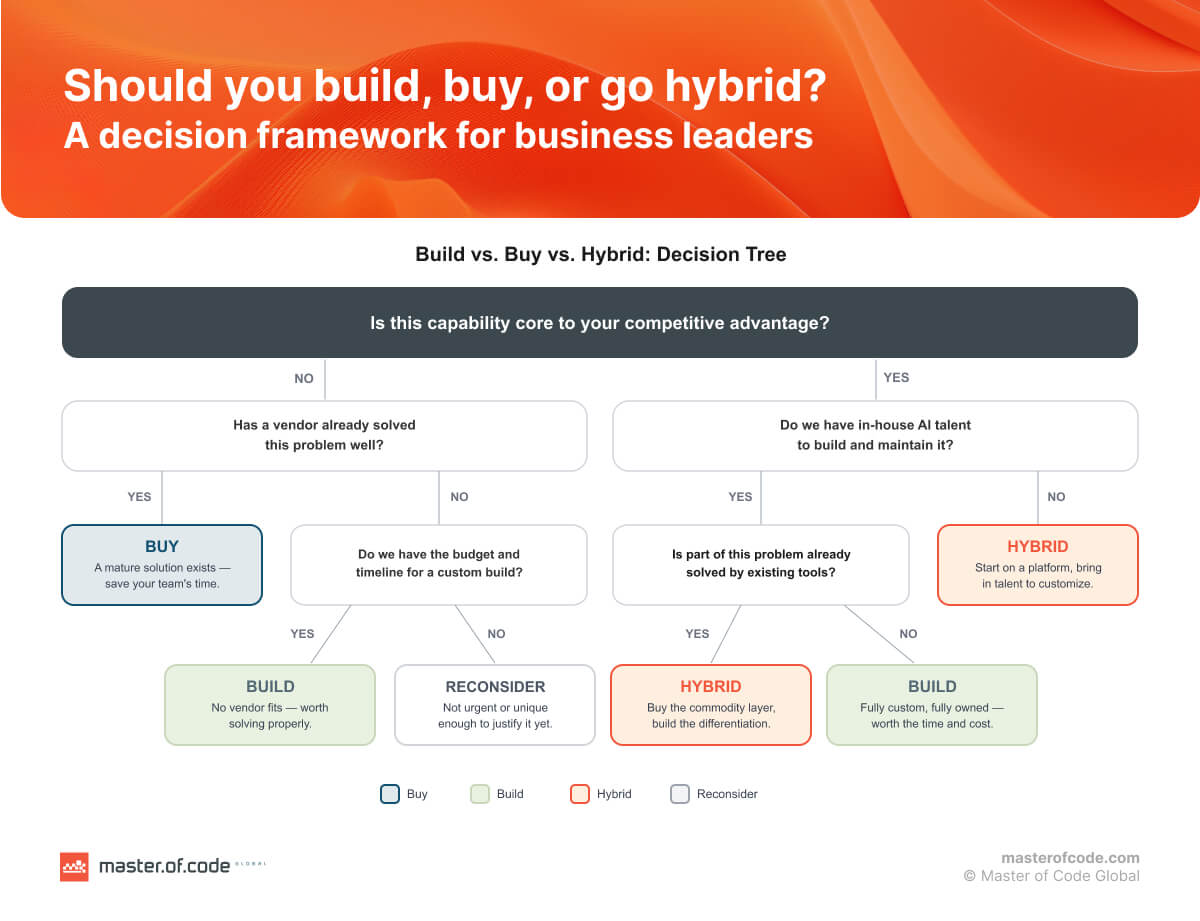
How to Evaluate Build vs. Buy for AI Capabilities
Before committing either way, work through these questions with your technical and business teams in the room together.
Here are six questions to ask before deciding:
- Is this capability core to our differentiation from competitors, or does it just support our operations?
- Has a vendor already solved this exact problem well, or would we be forcing our use case into their template?
- Do we have in-house AI specialists to build and maintain this, or would we need to hire AI engineers?
- What’s our real timeline? Can the business wait 6-12 months for a custom build, or do we need something live in weeks, even if it’s a proof of concept (PoC) or an AI Pilot?
- How unique is our data, and does that uniqueness actually require a custom model to exploit?
- What are our compliance and data security requirements, and can a third party meet them?
Run through these honestly, and a pattern usually emerges well before you reach the last question. It will help you decide whether you need to build vs buy AI solutions.
AI Project Risk Management: What Could Go Wrong Either Way
Risks of building in-house:
- Talent dependency. If your entire system knowledge lives in one or two engineers’ heads, losing them mid-project (or right after launch) can stall everything.
- Underestimated timelines. AI builds routinely take longer than planned, especially once real data exposes edge cases nobody scoped for.
- Technical debt. Code written under deadline pressure often can’t support the next feature request, forcing a costly rebuild down the line.
- Model drift and degradation. Without dedicated monitoring, a model’s accuracy can quietly decay as real-world data shifts away from what it was trained on.
- Sunk cost pressure. Once a team has invested months in a custom build, it’s tempting to keep funding it even after it’s clear the approach isn’t working.
Risks of buying a vendor solution:
- Vendor lock-in. The deeper your workflows and data get wired into a platform, the harder and more expensive it becomes to switch later.
- Data control concerns. Sensitive data often has to pass through a third party’s infrastructure, which raises the compliance stakes in regulated industries.
- Pricing changes. Subscription costs can climb sharply as usage scales or as the vendor adjusts its pricing model, sometimes with little warning.
- Integration fragility. Off-the-shelf tools aren’t always built to talk to your existing systems cleanly, and workarounds can become their own maintenance burden.
Neither list is meant to scare you off either path. It’s meant to make sure the risk you accept is the one you chose deliberately, not the one you discovered after the fact.
How Master of Code Global Approaches build vs buy AI
We don’t walk into a project with a default answer. Some of our clients need a fast, proven platform wired into their existing tools. Others are protecting proprietary data or workflows that no vendor has solved for. For those somewhere in between, we usually recommend our AI Compass Sprint, a focused engagement that gives you a 90-day AI integration plan.
All our engagements start with validation. Rather than jumping straight into a six-month custom build or a long-term vendor contract, we typically recommend AI PoC development services to test an AI assumption before you’ve spent the budget to find out the hard way. We also offer AI consulting.
From there, the path depends on what the pilot reveals. If a vendor solution covers 80% of what you need, we help you integrate it cleanly through our AI integration services, rather than forcing a custom build nobody asked for. If the use case is genuinely unique, our enterprise AI development services team builds it properly, with the architecture and talent to support it long after launch.
We’ve also written a practical guide on how to choose an AI development company, if you’re still evaluating partners rather than platforms. And for teams already past the pilot stage, our breakdown of moving from AI pilot to production covers exactly what that next phase should look like.
If you’re weighing build vs. buy for your own AI roadmap and want a second opinion grounded in real project experience, get in touch with our team. We’ll help you figure out which path actually fits your business, not just which one sounds better in a pitch deck.
FAQs
When to build vs buy AI tools?
As a rough rule: buy when the use case is common and well-solved by existing vendors, and build when the capability is core to your business or requires data and workflows no off-the-shelf tool can replicate. Most companies benefit from treating this as an ongoing build vs. buy AI strategy rather than a one-time decision, revisiting it as their needs, budget, and available talent change.
How do startups decide whether to build or buy AI?
Startups usually default to buying, and for good reason. Limited runway, small teams, and pressure to move fast all favor a vendor solution that can go live quickly without diverting engineers from the core product. Building only tends to make sense for startups when the AI capability is the core product, not a supporting feature around it.
How to evaluate build vs buy for AI capabilities at SMBs and enterprises?
The framework is similar, but the constraints differ. SMBs typically weigh limited budget and talent against speed to value, which usually tips toward buying unless the use case is central to what they do. Enterprise AI build vs. buy decisions carry more complexity: legacy systems, compliance requirements, and existing build vs buy AI infrastructure investments all factor in, which is why larger organizations often lean on a structured PoC or consulting engagement before committing either way.
Conclusion
There’s no universal answer to build vs buy AI, and anyone who hands you one without knowing your data, your team, or your budget is guessing. What we’ve walked through here, the hidden costs of building, the real risks on both sides, is meant to replace that guesswork with a framework you can actually apply.
If you’re still weighing where your own use case lands, that’s exactly the conversation we have with clients every week. Get in touch with Master of Code Global, and let’s figure out together whether building, buying, or a hybrid approach is the smartest move for your business.
Discover how Master of Code Global can help enhance your customer’s experience and boost sales growth.