




Some of the best AI requirements we get do not come from a brief. They come from a workaround.
One of our clients is a North American industrial distributor with multiple branches. Every morning, its central purchasing team works from a daily report that runs to roughly 1,000 pages. One senior reader can scan it in minutes because they know where the gaps are. Most buyers can’t. So a few of them started uploading the report to Claude and asking for a ranked shortlist of what to buy now.
That workaround is MRO inventory optimization in one picture: too much data, demand that rarely follows an average, and buying judgment that lives in a few people’s heads. On the maintenance side, the price of getting it wrong is downtime. A large plant loses 27 hours a month to unplanned downtime, and an hour in a large automotive plant costs $2.3 million, according to Siemens’ True Cost of Downtime.
Below, we cover where MRO stock goes wrong, how AI forecasts and replenishes spare parts, what data and systems it needs, and what we are learning from building a replenishment agent for that distributor, with input from Dmytro Hrytsenko, our CEO.
If your planners already decide reorders with their own spreadsheets or AI prompts, book a call with our manufacturing AI consulting team. We’ll map which parts of that workflow are ready to become a standard.
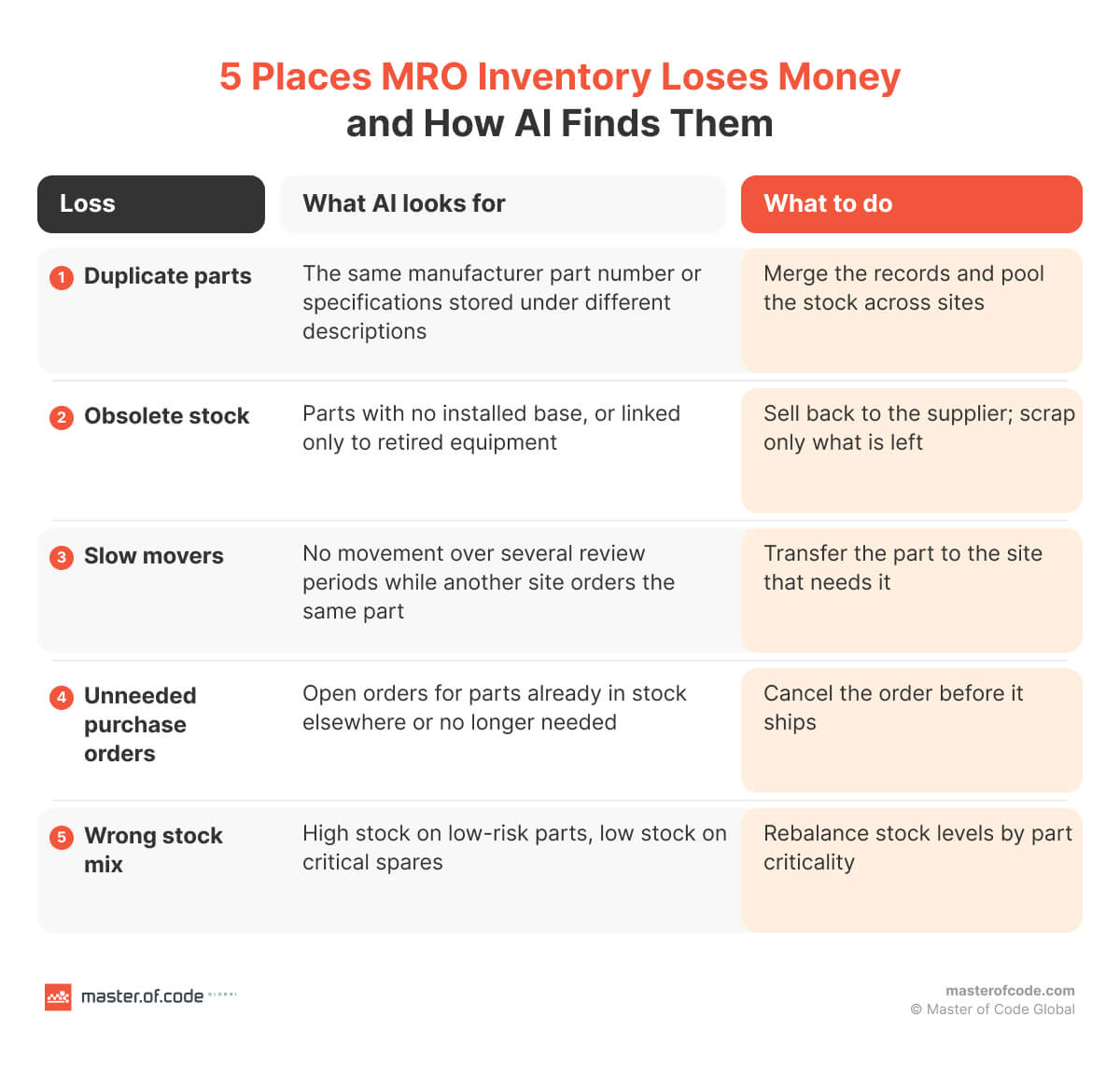
Table of Contents
Key Takeaways
- MRO stock splits into two problems. Repetitive consumables suit min/max rules. Critical spares are held against risk, and min/max is the wrong tool for them.
- Much of the waste is already on the shelf. In a recent Deloitte case at a global mining company, a control tower found $14 million in unneeded purchase orders during its first beta test.
- Spare parts forecasting starts with classification. About 42% of materials at one global energy company had intermittent demand. Machine learning helps on top of classification, but only 7.5% of M5 competition teams beat a very simple benchmark.
- Failure predictions are demand signals. Remaining useful life estimates can time each order against the supplier’s lead time.
- Stocking a critical spare is a break-even decision. In our illustrative model, a $40,000 part earns its shelf space once an hour of downtime costs more than about $2,780.
- Discovery comes before architecture. In our distributor project, the first three weeks settle data access, security, load, hosting, and the unwritten buying rules, then close with a Proceed / Proceed with Constraints / Pause / Stop decision.
What Makes MRO Inventory Different From Other Stock?
It exists to keep equipment running, not to be sold or built into a product. It covers spare parts, consumables, and tools. Its demand comes from failures and maintenance plans rather than customer orders, so most items move rarely and unpredictably.
In practice, MRO stock falls into two groups.
- Repetitive items, such as filters, belts, and lubricants, are replaced on a schedule. Min/max levels or vendor-managed policies work well here.
- Critical spares, such as a gearbox for a single production line, are held to control risk. They may sit unused for years, and when one is used, a simple min/max rule does not account for the cost of the line being down while the replacement arrives.
Why Do Traditional Methods Struggle with Spare Parts?
These assume steady, countable demand, which most spare parts do not have.
- Traditional MRO inventory management sets min/max levels once and reviews them yearly.
- ABC analysis ranks items by annual consumption value, so a $300 seal that stops a packaging line lands in class C.
- Just-in-time (JIT) ordering depends on planned maintenance and stable lead times.
- Vendor-managed inventory (VMI) hands replenishment control and stock visibility to the supplier.
Planners compensate with safety margins. The result is excess inventory (overstocking) on parts that never move, carrying costs (holding costs) for capital, space, and obsolescence, and stockouts on the few parts that matter.
How Does AI Improve MRO Inventory Optimization Compared to Traditional Inventory Management Methods?
Artificial intelligence replaces fixed rules with a forecast for each part that updates as conditions change. It does this in three ways:
- Forecasts each part from its own demand pattern instead of one average.
- Reads maintenance and condition data as leading demand signals.
- Recalculates safety stock and reorder points continuously instead of at an annual review.
The same logic drives AI inventory management for finished goods. Spares add the problem of parts that move once a year.
Where Is the Money Stuck in MRO Inventory?
Most of the money is stuck in parts that rarely move, in duplicates, and in orders nobody needed. Forecasting gets the attention, but a large share of the waste is already on the shelf.
A recent Deloitte case reveals a recurring trend. A global mining company overstocked spare parts during the pandemic to avoid downtime. It ended up with too many parts that rarely moved and too few critical ones, so teams still placed expedited orders. Deloitte also found misaligned goals between maintenance and supply chain teams. Its digital control tower identified $14 million in savings during the first beta test, mostly by canceling purchase orders that were no longer needed.
How Can AI Identify Excess, Obsolete, Slow-Moving, and Duplicate MRO Inventory Across Multiple Facilities?
It does so by matching part records across sites and comparing them with movement history and the installed base. It normalizes descriptions, matches manufacturer part numbers and specifications, and links each part to the equipment that uses it. That surfaces one bearing stored under three descriptions at three sites, items whose equipment was retired years ago, and slow movers at one site while another site orders the same part.
This cleanup cuts excess inventory before any forecast runs. The next step is recovery, in order of value: move parts to sites that need them, reuse or modify them, sell them back to suppliers, and scrap only what is left.
Case Study: How Are We Turning Buyers’ AI Workarounds Into a Replenishment Agent?
We are building it in two phases: a three-week discovery that settles data, security, and buying logic, then a pilot that puts a ranked buy list with buyer approval into production. The client’s buyers had already proven the use case. What they lacked was a version that is standardized, connected to live data, and owned by the company.
Starting point. The company recently completed an ERP implementation, paired with a separate accounting system and a reporting tool that produces the daily report. Buyers built their own Claude workflows on top of report uploads. Each buyer prompted differently. Nothing read live data. The rules behind each ranking belonged to employees with 15 to 20 years in the business. Leadership wants to grow the branch network without doubling headcount, with one non-negotiable: remove redundant analysis, never the buyer’s decision.
“Someone already found the workflow worth automating and proved it saves time. What’s left is smaller than it looks: take what one person built and make it live, connected to your real data, and secure enough for the whole team to use.”
Phase 1: Discovery (AI Compass Sprint)
The first phase is a three-week, fixed-budget AI Compass Sprint. A Lead Solution Architect spends week one on-site at the client’s largest warehouse, supported by a solution architect, an AI engineer, and a PM/PO.
Data structure and access. We map the ERP schema for inventory, sales, and pricing, plus the accounting data, then test the access path: direct API read or extract-only through the reporting tool. The output is a canonical schema and a normalization plan.
Security, hosting, and load. Discovery separates the actual compliance regime from the owner’s preference for private data, defines the local-versus-cloud data boundary, and recommends on-premises, cloud, or hybrid. Load sizing covers central purchasing for the pilot and a few hundred users across all branches for rollout.
Buying logic. Structured interviews capture how long-tenured buyers read the report. The AI engineer grades the per-buyer prompts (keep, improve, standardize), and the team converges them into one standard that subject matter experts review.
Discovery closes with a Final BRD, a Target Architecture, and an Estimate with a costed range, followed by a decision gate: Proceed, Proceed with Constraints, Pause, or Stop.
Phase 2: Foundation Pilot
The pilot is a buy-side replenishment agent for central purchasing. It reads live ERP and accounting data, applies the converged prioritization rules, and replaces the 1,000-page report with a ranked buy list. The buyer approves, edits, or rejects every line, and user roles control who acts on what. Connectors, hosting, approval controls, and security are built once, so later workflows, starting with sell-side enablement, extend them instead of rebuilding.
Swap the sales report for CMMS work orders and failure history, and the buyer for a maintenance planner, and the same structure becomes MRO procurement. The sections below show how each piece works for spare parts.
How Does AI Forecast Spare Parts Demand?
AI first classifies each part by its demand pattern. It then applies a forecasting method that fits that class, and only trusts a method after it beats a simple benchmark.
How Can Machine Learning (ML) Improve Spare Parts Demand Forecasting, Especially for Intermittent and Unpredictable Demand?
ML improves these forecasts by using signals that a single demand history does not contain, such as equipment age, work orders, and patterns shared across similar parts. It works best on top of a classification step.
The standard classification is the Syntetos-Boylan scheme. It splits parts by average demand interval (ADI) and squared coefficient of variation (CV²), with cut-offs of 1.32 and 0.49, into smooth, intermittent, erratic, and lumpy. Each class needs a different method. Croston’s method, for example, forecasts the size of a demand and the interval between demands separately, because standard exponential smoothing gives biased forecasts when many periods have zero demand. Its corrected version, SBA, is the usual baseline for intermittent items.
The share of affected parts is large. In a 2025 MIT capstone at a global energy company, 667 of 1,596 materials were intermittent. Segment-specific models, with AutoARIMA for intermittent and lumpy items and Croston SBA for erratic and smooth ones, showed a 27% inventory value reduction opportunity.
The evidence on ML is strong but conditional. In the M5 competition, all top methods were pure machine learning, mostly LightGBM. The winner was 22.4% more accurate than the best statistical benchmark. Statistical methods still did well on low-level intermittent series, and only 7.5% of teams beat a very simple benchmark. So benchmark every model against Croston, SBA, or TSB (a variant for parts at risk of obsolescence) before it drives demand forecasting. The same rule applies to machine learning in manufacturing beyond inventory: quality inspection or yield models also need a simple baseline, or nobody can tell whether the complex model earns its cost.
What Data Does AI Use to Predict MRO Inventory Needs, Including Maintenance History, Equipment Conditions, and Supplier Lead Times?
AI uses all three, plus stock and asset records. Maintenance history means corrective and preventive work orders and failure modes from the CMMS. Equipment conditions mean runtime, vibration, and temperature from condition monitoring. Supplier lead times matter with their variance: a supplier who averages four weeks but ranges from two to ten needs more safety stock than one who always takes five. Consumption per part and site, open purchase orders, and the installed base linking each part to its machines complete the picture.
How Can AI Connect Predictive Maintenance Insights With Spare Parts Inventory Planning?
AI connects them by turning each failure prediction into expected demand for a specific part, with a date and a probability. A prediction that a pump bearing will fail then becomes an input to the parts plan as well as an alert for the maintenance team.
The effect on parts volume is measurable. Siemens finds that fixing before failure reduces the need for replacement parts by up to 40%. In our recent AI predictive maintenance in manufacturing project for an automotive parts maker with 12 facilities, the platform cut unplanned downtime by 67% and predicted failures 30 days ahead with 92% accuracy. Thirty days sits inside many spare parts lead times, so the parts plan has to read the same predictions as the maintenance team.
How Can Equipment Failure Predictions and Remaining Useful Life Estimates Improve Spare Parts Replenishment Decisions?
They tell the system when a part will be needed, so it can order just inside the supplier’s lead time. If the probability of failure before the lead time plus the review period crosses a set threshold, the system drafts a requisition. If the window is wide, it waits and keeps capital free. This is MRO inventory replenishment driven by the condition of the equipment rather than by a calendar.
How Does AI Optimize Safety Stock Levels, Reorder Points, and Automated Replenishment?
Algorithm recalculates all three from current forecast error, supplier lead times, and equipment condition. Safety stock comes from forecast error at a target service level; the MIT model used RMSE at 95%, z = 1.96. The reorder point equals expected lead-time demand plus safety stock, and it moves earlier as condition data deteriorates. Automated replenishment drafts the order, and a planner approves anything above a cost or criticality threshold.
Lead-time logic alone can move large sums. In the Deloitte mining case, new stocking policies cut maximum inventory targets and reorder points by more than $25 million, and revised lead-time logic for 11,000 parts lifted on-time, in-full delivery by about 10%.
Do your maintenance predictions and your parts plan live in separate systems? Book a session to discover our AI predictive analytics services and map how to connect them into one forecast.
Which Critical Spares Should You Keep in Stock?
Keep a spare in stock when the expected cost of waiting for it is higher than the cost of holding it. Other parts can be pooled across sites, held on consignment by a supplier, or ordered on demand.
How Can ML Identify and Prioritize Critical Spare Parts Based on Equipment Importance and Failure Risks?
This technology scores each part by the risk its failure creates and ranks parts so planners review the riskiest first. Reliability teams already do this manually: they rate asset criticality, run a failure mode and effects analysis (FMEA), and give each failure mode a risk priority number based on severity and likelihood. Typical inputs include:
- time to production disruption,
- safety and environmental impact,
- mean time between failures,
- redundancy, and
- supplier lead time.
Machine learning keeps those scores current with live failure history and condition data, instead of a one-off workshop that goes stale.
How Do You Decide Whether a Critical Spare Earns Its Shelf Space?
Calculate the expected cost of not stocking the part and compare it with the annual cost of holding it:
Expected cost of not stocking = annual failure probability × hours of downtime while waiting × downtime cost per hour
Take a $40,000 gearbox, a 25% annual carrying rate (about $10,000 a year), a 5% annual failure probability, and a 72-hour wait for an expedited replacement.
| Downtime cost per hour | Expected annual cost of not stocking | Decision |
|---|---|---|
| $2,300,000 (large automotive plant) | $8,280,000 | Stock it |
| $20,000 | $72,000 | Stock it |
| $2,000 (a backup line exists) | $7,200 | Pool one unit across sites |
Note: It’s an illustrative model. One figure is real: the $2.3 million hourly downtime cost comes from Siemens’ True Cost of Downtime. All other inputs are assumptions; replace them with your finance team’s carrying rate and your own failure data.
At these inputs, holding pays off above roughly $2,780 of downtime cost per hour. Below that line, one pooled unit across several sites beats one per site. Consignment works when a supplier serves enough customers to justify holding the part.
How Can AI Help Manufacturers Prevent Spare Parts Stockouts and Equipment Downtime Without Maintaining Excessive Inventory?
AI runs this comparison for every part, across the whole network, every time an input changes. It stocks deep where waiting is expensive, pools parts across sites where one unit can cover several machines, and drops parts whose equipment is gone. Because the inputs are live, a part moves between those categories as failure risk, lead times, or downtime costs change.
How Do You Get Data and Systems Ready for AI?
Start with the data you already have, connect systems with read access first, and clean the catalog before training any model. Most delays in these projects come from data and integration work, not from the models.
What Data Is Required to Implement AI-Powered MRO Inventory Optimization?
The required data comes from five systems:
| Source | What it provides |
|---|---|
| ERP | Item master, consumption history, open purchase orders, supplier lead times, costs |
| CMMS | Work orders, failure codes, maintenance schedules |
| EAM | Equipment hierarchy, criticality, installed base linking each part to its machines |
| WMS | On-hand and in-transit stock by location |
| Condition monitoring | Runtime, vibration, temperature, remaining useful life estimates |
Two years of consumption and work order history for one part family is enough to start.
How Can AI Inventory Optimization Solutions Integrate with Existing ERP, CMMS, EAM, and Warehouse Management Systems?
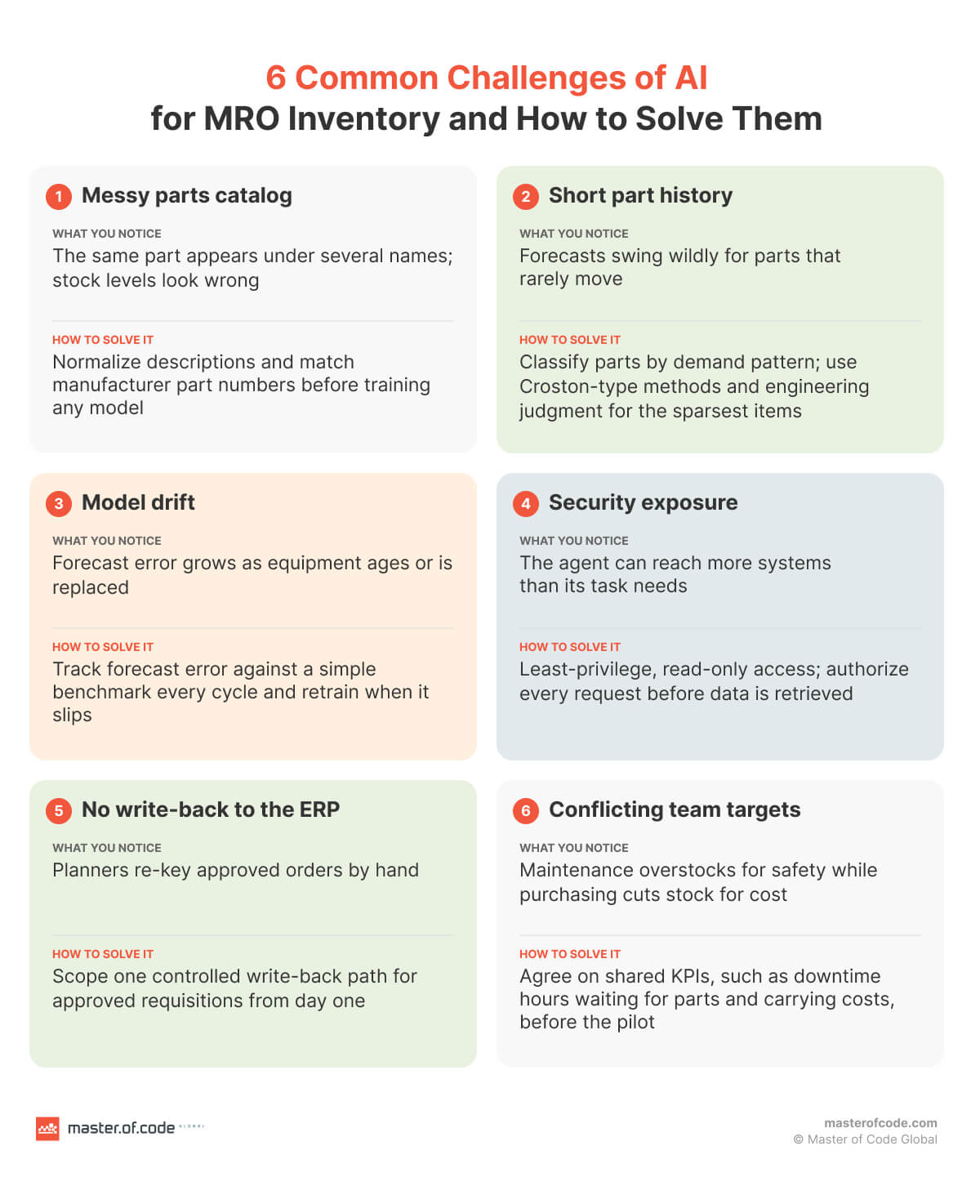
They integrate through read access or scheduled extracts into one canonical schema, plus a single write-back path for approved requisitions. Read access decides what the model sees. Write access decides whether approved orders reach the ERP without re-keying. Scope both directions from day one; AI integration services that cover only read access leave planners re-keying approved orders.
An agent connected to the ERP is also a new entry point into it. Our AI SDLC security guide, featuring Anhelina Biliak, our Application Security Leader, states the rule: “Enforce authorization before retrieving data or executing tools.” In practice, the agent gets least-privilege, read-only access, and only an approved requisition can write back.
How Can Manufacturers Address Poor Data Quality, Inconsistent Spare Parts Catalogs, and Incomplete Maintenance Records when Implementing AI?
Manufacturers can fix these issues in three steps.
- Normalize descriptions into a noun-modifier taxonomy (“BEARING, BALL” rather than “brg 6205 skf”) and match manufacturer part numbers.
- Flag records with missing attributes before training anything.
- Where maintenance records are incomplete, start with part families that have reliable history and make failure codes mandatory on new work orders.
These are core AI data preparation steps, and they belong inside the project rather than on someone else’s to-do list, because AI inherits whatever state your records are in. As Olga Hrom, our Chief Delivery Officer, puts it:
“An AI solution is a reflection of how your processes are already built. If your data is scattered, inconsistent, or nobody actually owns it, you can’t just layer such a solution on top of that and expect it to work.”
Where Does a Large Language Model Fit?
An LLM fits in two places: reading unstructured maintenance notes and explaining a recommendation to the planner. Hard rules such as discontinued items, minimum order quantities, and approved suppliers belong in code. Forecasting belongs to statistical and machine learning models. Keeping the LLM narrow keeps cost predictable. Bogdan Sergiienko, our CTO, explains it in his article on the economics of agentic AI “every single turn of the loop requires another model call.” For a nightly run over tens of thousands of parts, that means the LLM should touch only the items that need explanation, not every line in the catalog.
How Should Manufacturers Implement AI-Powered MRO Inventory Optimization, From an Initial Pilot to Multi-Site Deployment?
Start with one workflow at one site, prove it against a baseline, then extend the same foundation to more sites. These MRO inventory optimization best practices keep each step verifiable:
- Baseline. Record inventory value, stockouts on critical spares, and downtime hours spent waiting for parts.
- Pilot. Pick one site and one part family with several years of history. Run recommendations in parallel with current planning for a few cycles.
- Controls. Set approval thresholds by cost and criticality, and log every override. Overrides show where the model or the rules are wrong.
- Extend. Reuse the same connectors, hosting, and approval controls at the next site instead of rebuilding them. Align MRO inventory management rules across sites so pooled spares can move between them.
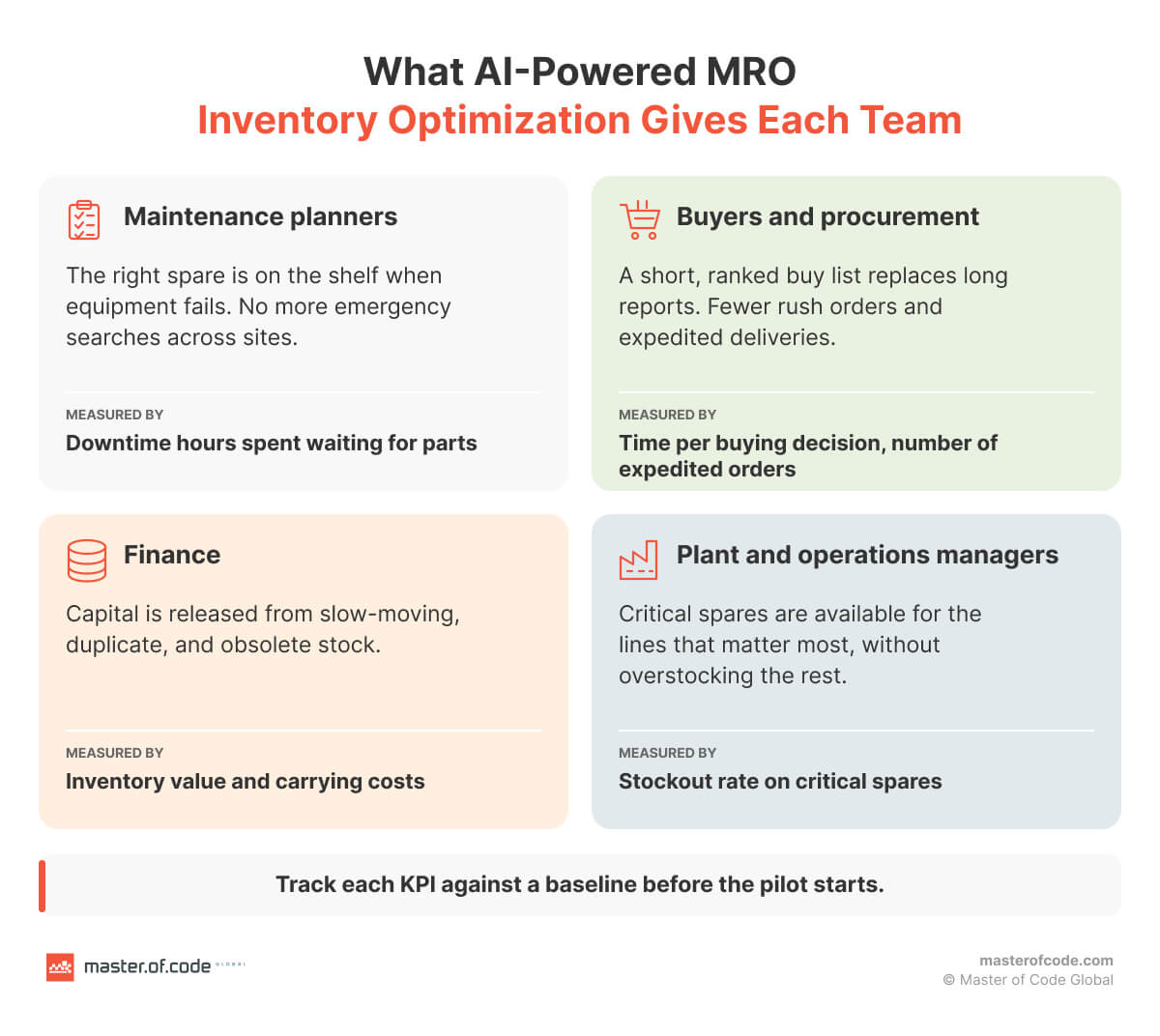
What KPIs Should Companies Track to Measure the ROI of AI-Driven Inventory Optimization, Including Inventory Carrying Costs, Stockouts, and Equipment Downtime?
Track six KPIs, each measured against the baseline:
| KPI | What it shows |
|---|---|
| Inventory value and carrying costs | Capital freed or added |
| Stockout rate on critical spares | Whether availability held |
| Downtime hours waiting for parts | The cost that matters most |
| Forecast error vs Croston/SBA | Whether the model beats the benchmark |
| Excess and obsolete value | Cleanup progress across sites |
| Buyer or planner time per decision | Workload removed |
Want proof that a model beats your current planning method before a rollout? Contact our machine learning consultants to set up a benchmark on your own data.
FAQ
What Are the Main Business Benefits of AI-Powered MRO Inventory Optimization for Manufacturers?
The main benefits are less capital tied up in spares, fewer stockouts on critical parts, fewer downtime hours spent waiting for a delivery, and less planner time per decision. Catalog cleanup can deliver savings early, because duplicates and obsolete stock surface as soon as records are matched.
Should Manufacturers Use Off-The-Shelf AI Inventory Optimization Software or Develop a Custom Machine Learning Solution?
Packaged MRO inventory optimization software fits standard processes. IBM’s Maximo Inventory Optimization, for example, lists its Essentials tier from $3,094 per month for up to $50 million in inventory. A custom solution fits when your rules, systems, or approval flow are specific to how you operate, as with the buying logic in our case. Score both on cost, time to deploy, integration, and vendor lock-in. Our breakdown of custom vs off-the-shelf AI solutions includes a scoring framework you can reuse to make an informed decision.
What Are the Main Costs, Limitations, and Implementation Challenges of AI-Powered MRO Inventory Optimization?
The highest costs are usually data cleanup and integration, not the model. Based on our project data, a pilot on one site and one part family typically runs $15K–$40K over 4–8 weeks. A production system connected to ERP, CMMS, EAM, WMS, and condition monitoring, with buyer approval built in, sits closer to $100K–$200K, and each ERP connection adds about $8K–$20K. Plan 15–20% of the build per year for maintenance; our AI agent development cost breakdown covers the detail. Beyond cost, parts with almost no history still need engineering judgment, models drift as equipment ages, security work grows with every system the agent can reach, and adoption fails if maintenance and purchasing keep conflicting targets.
Where Should You Start?
Start with one part family and the data you already have. Pull two years of consumption and work order history, run the ADI/CV² classification, and check the share of intermittent and lumpy items. That number shows where MRO inventory optimization with AI will pay off first. Keep the final call with the planner, the principle our distributor client set on day one.
Not sure your data is ready? That’s the most common starting point. Our supply chain AI consulting team handles data preparation, integrations, and the pilot itself, so you can start wherever you are. Book a call, and we’ll map the fastest route from your current records to a working replenishment pilot.