

A few weeks ago, our marketing and sales team talked to William, a Head of Innovation at a fast-scaling healthcare company who was asked to find an AI partner. In just one week, he spoke with over ten vendors. Some didn’t support the tools his organization used. Others couldn’t meet basic compliance needs. A few looked promising but didn’t feel like a good fit.
He wasn’t looking for magic — just someone who understood his goals and could deliver without adding more complexity.
We’ve had a lot of conversations like this lately. So, we put this list of AI agent development companies together. For teams like his. For people like you. If the search has been frustrating, we hope this saves you time and helps you find the right fit.
And if you want to see how we might fit into your plans — our door’s open.
Table of Contents
Key Takeaways
- Not every AI agent vendor builds real agentic systems. A proper AI agent evaluation should examine reasoning, tool use, system integration, and live deployments — not rebranded chatbots or basic automation.
- Custom development and plug-and-play platforms solve different problems. Platforms work well for narrow, repeatable tasks, while custom enterprise AI agent solutions are better for proprietary workflows, complex integrations, and regulated environments.
- The partner matters as much as the technology. Proven delivery, security practices, Human-in-the-Loop (HITL) controls, governance, and post-launch support often determine whether a project reaches production or stays a pilot.
- The best AI agent development companies depend on your priorities. Some are a strong option for fast MVPs, enterprise automation, or for developer-led builds and complex custom systems.
- AI agents can work with the systems you already use. With the right architecture, permissions, and Model Context Protocol (MCP) connections, they can access CRM, ERP, internal databases, and APIs to retrieve data, update records, and trigger workflows.
Why Everyone’s Talking About AI Agents — and What They Actually Do
Intelligent agents are autonomous software that can make decisions, perform tasks, and interact with users or other systems, often with little to no human oversight. What makes them different from traditional automation? It’s their ability to reason, adapt, and act based on goals rather than just fixed rules.
Think of them as digital workers. They can schedule meetings, summarize documents, analyze customer behavior, or even orchestrate workflows across tools. Powered by large language models (LLMs) and multimodal inputs, today’s virtual assistants go beyond chat — they combine memory, planning, and tool use to complete multi-step processes.
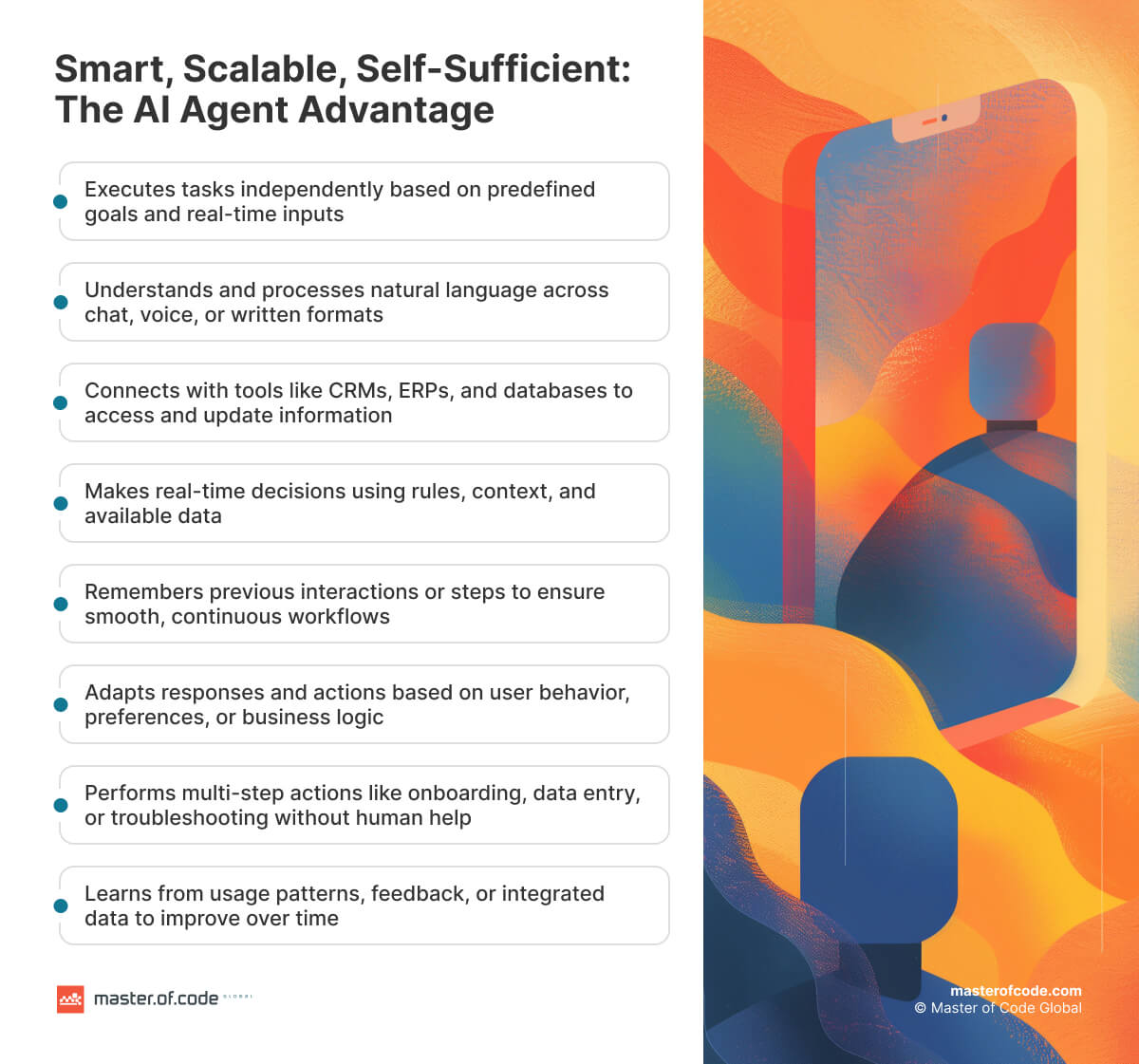
Use cases span internal operations (like IT ticket resolution), sales (lead qualification), client support (case deflection), and HR (onboarding automation). The hype isn’t just hype — it’s a response to measurable business value. Autonomous intelligent systems reduce manual work, accelerate decisions, and free up human teams for higher-level strategy.
Real-world results back this up:
- One global bank cut customer service costs tenfold with virtual agents,
- A biopharma company sped up R&D by 25% and saved 35% of the time spent on clinical reporting.
- In IT, teams using tech to upgrade legacy infrastructure saw productivity rise by up to 40%.
As our CEO, Dmytro Hrytsenko, noted: “While governments and global organizations are looking for ways to safely regulate AI and corporations are trying to do initial AI transformations, small teams are doing innovations at neck-breaking speeds, redefining the landscape every couple of weeks. The world is becoming a playground for AI agents, integrating into every part of life.”
The pace is relentless, and for companies ready to leverage this shift, the biggest question now is how to start. That begins with one key decision: choosing the right development partner.
How We Selected These AI Agent Development Companies
We didn’t rank these vendors by marketing budget or launch-day noise. We weighed each against the criteria that actually decide whether an agent project reaches production — drawn from independent research, not vendor claims.
Proven results, not just pilots
MIT’s Project NANDA report, The GenAI Divide: State of AI in Business 2025, found that about 95% of enterprise generative-AI pilots deliver no measurable P&L impact. This is one of the most telling AI agent statistics for companies evaluating the market. We favored providers with verifiable case studies and live deployments.
A partner, not a DIY project
In that same MIT study, projects sourced from specialized vendors succeeded roughly 67% of the time, versus about 33% for internal builds. We prioritized teams that combine hands-on delivery with agentic AI consulting, helping clients define the use case before building it.
Genuine agentic capability
In its June 2025 analysis, Gartner estimated that only about 130 of the thousands of vendors claiming agentic AI are real, with the rest “agent washing” — rebranding chatbots and RPA. We vetted for teams building true reasoning-and-action systems with clearly defined agent autonomy levels.
Security and compliance
Gartner projects that by 2028, 25% of enterprise Generative AI applications will experience at least five minor security incidents per year, up from 9% in 2025, as agentic systems built on protocols like MCP widen the attack surface. We prioritized providers with certifications like SOC 2 and ISO 27001, documented governance, and robust safety guardrails.
Support and governance for the long haul
Gartner predicts more than 40% of agentic AI projects will be canceled by the end of 2027, due to escalating costs, unclear business value, or inadequate risk controls. We valued partners offering strategic support, ongoing AgentOps, and oversight after launch — not just implementation.
AI Agents Sound Great — But Where Do You Even Start?
The truth is, building such an advanced application isn’t just about plugging into an LLM and hoping for the best. It requires defining goals, mapping workflows, choosing instruments, ensuring data access and security, and most critically, having the right development partner.
Why? Because the gap between a basic chatbot and a fully autonomous system is massive. You need a team that understands not just the tech stack, but also your business logic, integrations, and user expectations.
The market is growing fast, but it’s also crowded. From no-code platforms to custom engineering firms, hundreds of vendors claim they “do AI agents.” Some focus on simplicity, others on scalability. Few can do both.
That’s why we did the research for you. Below, we’ve mapped out two categories of top-rated AI agent companies — custom solution providers and platform-based tools — to help you find the right fit.
10+ Top AI Agent Development Companies Leading the Way in Custom Development
| Company | Founded | Team Size | Agent Specialization | Notable Client | Best For |
|---|---|---|---|---|---|
| Master Of Code Global | 2004 | 201-500 | End-to-end, high-complexity custom agents with deep system integration | T-Mobile, Burberry, Tom Ford, Zipify | Enterprises needing a high-touch partner for adaptive, strategy-aligned builds |
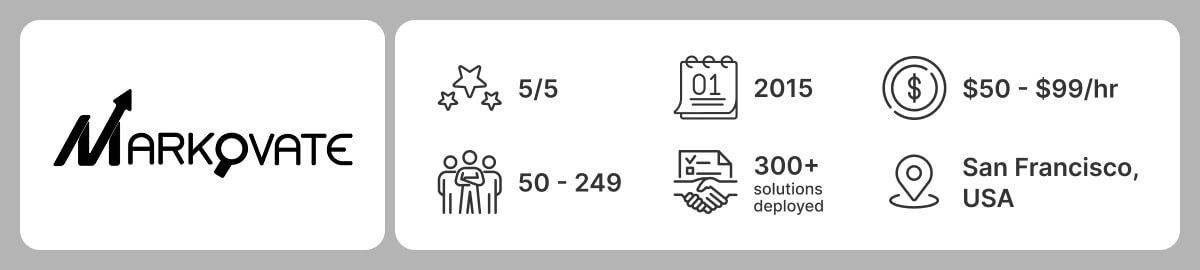
| Markovate | 2015 | 50-249 | Use-case-specific agents for targeted operational workflows | 3M Corporation, Kira Talent, CompuClaim | Teams boosting task efficiency without rebuilding their stack |
| Azumo | 2016 | 201-500 | LLM fine-tuning and agent deployment for focused automation | Twitter, Discovery Channel, Angle Health | Businesses wanting cost-effective, fine-tuned agents in an existing environment |
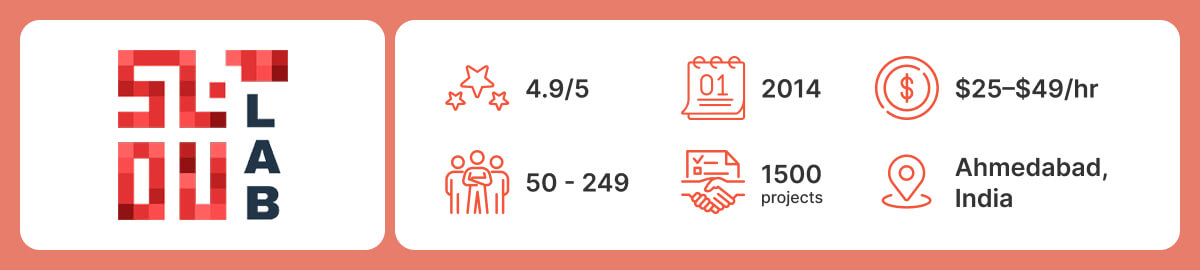
| SoluLab | 2014 | 50-249 | Custom agents with behavioral modeling and broad domain flexibility | MakerDAO, Alpha Wallet, Lokkaroom | Companies needing nuanced agent behavior and flexible design |
| LeewayHertz | 2007 | 50-249 | Modular agents built to slot into existing infrastructure | ESPN, Procter & Gamble (P&G), Siemens | Orgs wanting plug-and-play automation that scales across departments |
| Rapid Innovation | 2019 | 50-249 | Fast-track builds with model orchestration and 90-day MVP delivery | Spatial Labs, Aletha Health, AMJ Bot | Startups/enterprises launching AI solutions fast with iterative scaling |
| Suffescom Solutions | 2013 | 250 – 999 | White-label & no-code agentic AI with rapid MVP delivery (LangChain, AutoGen, CrewAI) | Mycoach AI, AI Tax Flow, Martial Arts Gaming Company | Businesses wanting fast, brandable agent deployment across many verticals |
| Brocoders | 2014 | 50 – 249 | AI features and agents embedded in custom SaaS product builds | Gokada, Backbone International, FUCHS | VC-backed startups & midsize SaaS needing product builds with AI baked in |
| GenAI-Labs | 2015 | 10 – 49 | AI agents, chatbots & RAG knowledge systems with guardrails | Google, Disney, ServiceNow | Teams turning internal knowledge into trustworthy agents/RAG assistants |
| Intellectyx AI | 2025 | 250 – 999 | Domain-specific agentic AI + AgentOps for data-heavy, regulated workflows | Tacoma Public Utilities, Zones LLC, eGoldFax | Enterprises in regulated industries needing production-grade, data-grounded agents |
| Entrans | 2019 | 250 – 999 | AI-first digital engineering with agentic AI services; legacy modernization | Fujifilm, Red Bull, Cisco | Enterprises modernizing legacy systems with AI-first product engineering |
| Azilen Technologies | 2009 | 250 – 999 | Enterprise product engineering + custom/multi-agent systems (Azeon agentic OS) | Dormakaba, Innovaccer, Gantner | Product companies embedding agents into HRTech, FinTech, or InsurTech workflows |
Master of Code Global
Focus: End-to-end, high-complexity AI agent development with strategic integration
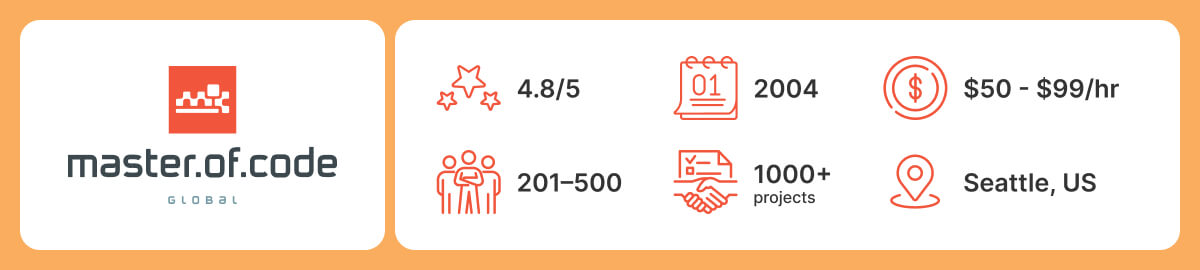
Master of Code Global is a custom AI agent development company (est. 2004, ISO 27001-certified) that builds enterprise-grade, multi-agent systems integrated with your CRM, ERP, and internal APIs. With 1,000+ projects delivered and a 9.2 average client-satisfaction score, its proprietary LOFT framework cuts setup effort by 43%.
Beyond that, Master of Code Global brings a holistic, deeply consultative approach to engineering intelligent applications. Their strength lies in building bespoke, multi-functional systems from the ground up — equipped with reasoning capabilities, LLM integration, and seamless multi-system orchestration. Many AI development companies rely on off-the-shelf components. At Master Of Code Global, however, we design architectures tailored to the nuances of each business.
The agents we build often combine process automation, user engagement, and data analysis. They are delivered with enterprise-grade security, performance monitoring, and omnichannel readiness. For teams beginning with an agentic AI POC, the proprietary LOFT framework can reduce setup effort by 43%, lower costs by up to 20% before MVP, and provide 3x faster support.
Our core agent technologies are:
- Multi-Agent Orchestration — coordinating specialized agents (planning, execution, monitoring, verification) so they collaborate on one complex workflow rather than acting alone.
- Model Context Protocol (MCP) — the open standard that lets agents connect securely to external tools and data through a common interface.
- Agentic RAG — retrieval-augmented generation where the agent decides what to retrieve, from where, and when — grounding its actions in current, trusted data.
- LLM Fine-Tuning — adapting foundation models to a company’s domain, tone, and tasks for higher accuracy than off-the-shelf prompting.
For teams comparing the top AI agent companies 2026, these recent recognitions provide additional context:
- April 28, 2026 — Master of Code Global approved to move forward in Anthropic’s Claude Partner Network
- April 27, 2026 — we’re included in Techreviewer.co’s Top Software Developers in the USA list
- April 24, 2026 — Techreviewer.co included us in the Top 100 Telecom Software Development Companies list
Best fit for: Enterprise teams seeking a high-touch partner to build intelligent software that is designed to adapt, grow, and align with complex business strategies.


Noam Bardin
Founder
We had a great experience with Master of Code Global — the speed in which they built up a multidisciplinary team including eng, design, QA, TPM allowed us to quickly roll out our product while hiring an internal team.
Check case study

Axelle Basso Bondini
Senior Manager Marketing
Master of Code Global worked on a tight turn-around, was extremely helpful and professional in developing all components of the project up to the brand’s high standards.
Check case study

Matt Meisner
VP, Performance Marketing
The chatbot not only drove $500,000 in revenue within the first few months but also achieved 3X better conversion than the website and an 89% user response rate. Master of Code Global proved to be creative and technical experts in the chatbot space.
Check case studyMarkovate
Focus: Use-case-specific AI designed to streamline targeted workflows
Based on information provided in their case studies, Markovate focuses on building smart agents that solve clearly defined problems. These are often in operational, administrative, or analytical roles.
Their portfolio includes applications in legal document review, insurance processing, and medical claims automation. They also emphasize quick value delivery by applying tools like crewAI and LLM-powered assistants into narrow, structured contexts. While their builds are typically not fully custom, they are configured to fit within existing systems and adapted through iterative performance optimization.
Best fit for: Companies looking to enhance task efficiency through artificial intelligence without rebuilding their tech stack. Especially beneficial in regulated or document-heavy environments.
Azumo

Focus: Model fine-tuning and agent deployment for targeted automation
Azumo provides development services with a strong emphasis on optimizing pre-trained LLMs for specific use cases. Their approach starts with foundational models — such as LLaMA, OpenAI, or Gemini.
They adapt those to fit tasks like customer care, document summarization, or risk analysis. Rather than building generalized systems, Azumo concentrates on creating programs that operate efficiently within clearly defined routines. Their process includes integration with instruments like CRMs and ERPs, support for private model tuning under SOC 2 compliance, and continuous performance refinement.
Best fit for: Businesses seeking cost-effective, fine-tuned agent deployment. Works well for focused optimization or predictive workstreams within existing tech environments.
Scopic
Focus: Custom AI agent development and enterprise-grade AI integration built on 20 years of software engineering experience
Best fit for: Businesses seeking to build custom AI agents and assistants that integrate deeply into existing software, especially in regulated or data-sensitive industries.
Scopic is a software development company with two decades in business, over 1,500 projects delivered, and a remote presence worldwide. The company specializes in building AI assistants and copilots, and LLM-powered applications using models like GPT, Claude, Gemini, and LLaMA. Their services span prompt engineering, fine-tuning, retrieval-augmented generation, computer vision, and text-to-SQL interfaces.
Scopic’s AI engineering team brings hands-on experience in agentic AI, intelligent document processing, and production-ready ML systems. They also offer the option to train open-source LLMs on local infrastructure for clients with strict data privacy needs. The process follows a structured path from feasibility assessment through prototyping, agile MVP development, and continuous deployment, backed by an established MLOps culture.
Suffescom Solutions

Focus: Custom AI agent and intelligent automation development with scalable, enterprise-ready solutions.
Suffescom Solutions is an award-winning digital product and technology company with its headquarters in Wilmington, Delaware, and New York (USA), and a strong international presence in the UAE and India. With over 13 years of experience in the IT industry, Suffescom has established itself as a trusted partner for businesses seeking reliable mobile app development, AI solutions, Web3, and enterprise-grade software development. The company is widely recognized for delivering efficient, scalable, and cost-effective websites, applications, and software products that are built to perform today and scale for tomorrow.
Driven by a team of 250+ experienced developers and backed by 10,000+ satisfied clients worldwide, Suffescom has successfully delivered high-impact digital products across multiple industries. The company has developed and launched 550+ ready-to-deploy MVPs, enabling startups and enterprises to accelerate time-to-market while minimizing development risks. With hands-on expertise across 40+ cutting-edge technologies, Suffescom consistently adapts to evolving market demands while maintaining strong technical depth and execution quality.
Best fit for: Organizations seeking custom AI agents that automate multi-step operational processes and integrate deeply with enterprise systems.
Brocoders
Brocoders is a software development partner helping SaaS companies and midsize businesses build and integrate AI-powered products. Founded in 2014, their team of 87 engineers — 60% senior level — has delivered 85+ products across agritech, edtech, healthcare, logistics, and field operations, with AI embedded into production systems like EveryPig (AI-driven livestock management) and HeyPractice (AI-based sales training platform).
Their AI agent work covers LLM integration (GPT-4, LLaMA), custom ML models, LangChain-based agents, and MCP-enabled AI workflows built into real client products. Brocoders holds a perfect 5.0 rating across 30 Clutch reviews and was named among the Top 100 Software Development Companies in the USA for 2026.
Reenbit
Focus: AI-driven custom software development for growing businesses
Reenbit provides custom software development services with a strong emphasis on AI, data engineering, cloud solutions, and flexible delivery. Their approach is built around helping companies create intelligent digital products, modernize existing systems, and scale technical capabilities without building everything in-house.
The company supports businesses with custom web and mobile development, digital transformation, AI and ML, business intelligence, data engineering, cloud and DevOps, and IT staff augmentation. With 100+ certified tech experts and Microsoft Partner status, Reenbit is well-positioned to help teams extend their engineering capacity and implement data-driven solutions.
Best fit for: Growing companies that need a reliable software development partner to build custom digital products, strengthen AI and data capabilities, modernize systems, or scale their tech teams with experienced engineers.
GenAI-Labs
Focus: End-to-end AI agent development, generative AI systems, and custom workflow automation tied to real business operations.
GenAI-Labs is a USA-based AI consultancy focused on building production-ready AI products that go beyond basic chat experiences. Their work includes AI agents, internal assistants, workflow automation, and domain-specific generative AI applications designed to integrate with business systems and support measurable outcomes. Rather than relying on generic implementations, the company emphasizes tailored solutions aligned to each client’s goals, workflows, and operational constraints.
Their positioning highlights full-lifecycle delivery, from discovery and planning through development, validation, and deployment. GenAI.Labs also emphasizes a blend of technical depth and product thinking, with messaging centered on scalable, cost-effective execution and practical business value. With experience supporting both startups and larger organizations, they are best suited for teams that want a hands-on partner to build custom AI systems that are designed for real-world use.
Best fit for: Companies looking for a custom AI development partner to design and deploy AI agents, intelligent assistants, and workflow automation systems that fit specific business needs.
Intellectyx AI
Focus: Custom AI agent development, agentic AI architecture, and autonomous workflow automation for enterprise transformation.
Intellectyx AI is a custom AI agent development company in the USA that helps businesses move beyond traditional automation by embedding intelligent, decision-driven AI agents into core operations. They design and deploy custom AI agents for high-volume workflows such as invoice processing, expense validation, data reconciliation, reporting automation, and customer interaction management.
Their agentic AI solutions integrate seamlessly with enterprise systems like ERP and CRM platforms, enabling scalable, secure, and adaptive automation. Intellectyx AI also provides continuous monitoring and optimization to ensure AI agents evolve with business rules, compliance needs, and industry standards.
Best fit for: Mid to large enterprises and regulated industries looking to modernize legacy workflows and implement production-ready autonomous AI agents.
SoluLab
Focus: Custom AI systems with behavioral modeling and broad domain flexibility
SoluLab describes its development approach as highly adaptable, with an emphasis on tailoring solutions to match specific operational needs. Their offering includes a variety of copilots types — from reactive to logic-based — built using tools like AutoGen Studio and Vertex AI. The business emphasizes behavioral training as a core differentiator. This aspect allows agents to simulate human-like decision-making in dynamic scenarios. They also emphasize long-term performance tuning and post-deployment guidance, aimed at helping clients evolve their applications over time.
Best fit for: Businesses that require nuanced behavior, flexible design options, and a partner capable of adjusting systems as business conditions shift.
Entrans
Focus: Autonomous workflow integration, tailored AI systems that go beyond standard RPA, and industry-specific transformation
Entrans provides a full suite of Agentic AI services focused on transitioning enterprises from manual workloads to embedding autonomous decision-making. They design and deploy custom AI agents that can perform high-volume tasks, such as ticket triaging, lead qualification, and document processing. A flagship example is their proprietary Agent — Thunai, which automates end-to-end business processes. It can function as a voice, chat, and email agent that supports sales, support, and meeting assistance, and direct CRM updates. Their Agentic AI services include ongoing monitoring, continuous training to ensure agents adapt to industry standards, and evolve according to business.
Best fit for: Improving MVP cycles, mid to large enterprises, and Fortune 500 companies, modernizing legacy platforms.
Azilen Technologies
Azilen Technologies specializes in developing intelligent AI agents that act as self-sufficient digital partners, allowing companies to automate decisions, streamline workflows, and manage complex operations with remarkable precision. Azilen creates agentic systems that are context-aware, resilient, and production-ready by combining deep engineering knowledge with superior GenAI capabilities. These agents can read data, grasp operational context, communicate across systems, and carry out multi-step tasks with minimum human intervention. They seamlessly interact with ERPs, CRMs, data platforms, and APIs, allowing enterprises to eliminate manual work, accelerate operations, and maintain consistent operational performance.
Best fit for: Organizations looking to automate complex operational workflows, enhance decision-making with intelligent autonomy, or build scalable agent-powered platforms aligned with real business goals.
LeewayHertz
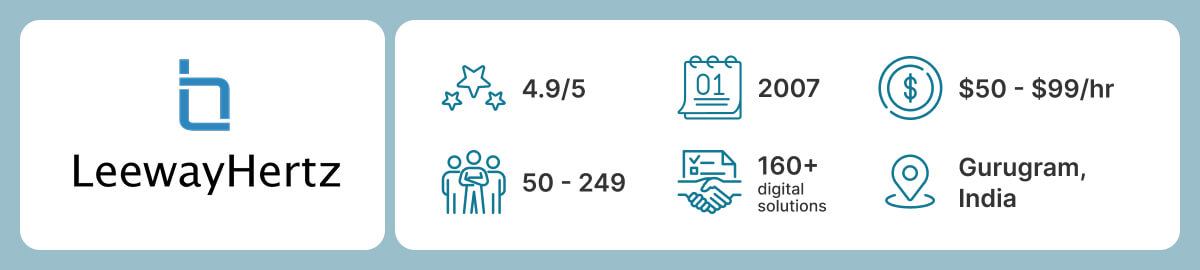
Focus: Modular solutions designed for integration into existing infrastructure
LeewayHertz positions itself as a builder of modular, task-focused digital agents that emphasize adaptability and integration. Their apps typically rely on well-known platforms like Vertex AI and AutoGen Studio, allowing them to move quickly from concept to deployment. According to their published offerings, they support both single- and multi-agent frameworks, with capabilities that span customer service, HR assistance, and IT intelligentization. Rather than custom-building every component, they apply a reusable model framework strategy, which can be cost-effective for companies with clearly defined workflows.
Best fit for: Organizations prioritizing plug-and-play automation that can scale across departments without requiring significant customization or long development cycles.
Rapid Innovation
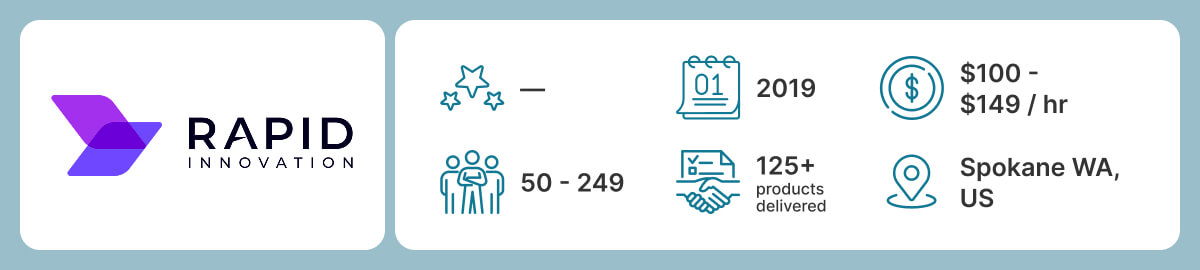
Focus: Fast-track AI development with emphasis on model orchestration and MVP delivery
Rapid Innovation frames its intelligent engineering around speed and modular flexibility. As stated on their website, they offer guaranteed MVP delivery within 90 days. They build instruments capable of handling research, audits, and multi-step process automation. Their services also include custom development, behavioral modeling, and Conversational AI, with options for both single- and multi-agent systems. The firm highlights its use of structured workstreams and improved LLM inference, allowing for faster and more autonomous execution. Their messaging emphasizes rapid deployment and coordinated help, appealing to teams that prioritize time-to-market and practical, use-case-aligned builds.
Best fit for: Startups or enterprises aiming to launch AI-powered solutions quickly. Well-suited for those needing configurable copilots with fast timelines and iterative scaling paths.
6+ Leading AI Agent Companies Delivering Plug-and-Play Intelligence
Teneo.ai

Teneo is a platform built for large-scale AI agent deployments. It is reported to have over 17,000 assistants in production across industries like telecom, banking, and retail. Brand positions itself as an all-in-one solution for automating Tier 1 support via Conversational and voice AI. The platform integrates tightly with enterprise tools and emphasizes measurable outcomes like reduced costs and faster resolution rates.
Key aspects:
- Automates high-volume interactions with up to 60% call containment
- Supports omnichannel service with voice, chat, mobile, and more
- Offers real-time reasoning and adaptive personalization using LLM orchestration
- Centralized platform to design, deploy, and monitor assistants
- Security and compliance features tailored to enterprise needs
- Reported savings of $32M+ monthly from users like Telefónica and Swisscom
While powerful, the platform is highly specialized toward contact center modernization, less suited for broader, non-customer-facing use cases without additional customization.
Zapier Agents

Zapier Agents let users create lightweight digital assistants that execute tasks across 8,000+ apps. Invented for non-technical teams, the platform focuses on speed, accessibility, and integration with tools like HubSpot, Jira, and Google Sheets. Autonomous systems are configured using plain English prompts and work by combining LLM output with live business data and pre-set automations.
Key aspects:
- Build and deploy agents in minutes without writing code
- Access prebuilt templates for sales, support, and meeting prep
- Pulls from synced knowledge sources (e.g. Notion, Confluence)
- Executes multi-step actions across instruments like Slack, Airtable, and Gmail
- Chrome extension for web-based research
- Backed by its ecosystem and 50,000+ user base
While flexible for task optimization, these solutions are better suited for narrow functions and may lack the depth and reasoning capabilities found in more advanced platforms.
Relevance AI

Relevance AI markets itself as a platform for building and managing collaborative virtual intelligent teams. It enables users to visually create agentic processes, assign skills, and deploy them across business functions like sales, support, SEO, and finance. The company promotes its “Workforce” feature as a way to build synthetic teams that coordinate tasks and adapt to new roles in real time.
Key aspect:
- No-code builder for assembling multi-agent workflows
- Prebuilt templates for lead qualification, inbox management, CRM enrichment, and more
- Copilots can be trained with custom instructions and upgraded using AI tools (e.g., search, transcribe, summarize)
- LLM agnostic — compatible with OpenAI, Anthropic, Meta, and Google models
- Drag-and-drop interface for real-time collaboration and task orchestration
- Integrates with common enterprise instruments through Zapier, Snowflake, and APIs
While versatile, the platform is geared toward fast setup and task automation, not deep customization or highly specialized behavior without third-party expansion.
Beam AI

Beam AI positions itself as an enterprise-ready platform for constructing and orchestrating teams of autonomous intelligent systems. Rather than focusing on single-use solutions, it emphasizes cross-functional automation with software tailored to departments like finance, healthcare, and HR. Its interface is designed for non-technical users, making configuration and launch accessible across business units.
Key aspects:
- 30+ specialized tools for functions like claims processing, order management, and customer onboarding
- Multi-agent orchestration with modular logic and collaborative workflows
- Flexible deployment options (cloud and on-prem), with SOC 2 compliance and localized data hosting
- Customizable personas for role-specific tone and interaction style
- Incremental learning capabilities that evolve based on task history and user input
While highly flexible, the platform’s extensive scope may require upfront effort to align configurations with nuanced, organization-specific processes.
Dust.tt

Dust presents itself as a platform designed to integrate deeply with company knowledge and processes. Marketed as an AI operating system, it enables non-technical teams to build, deploy, and manage collaborative agents in minutes without coding. It supports a broad set of business functions, from customer help to analytics, emphasizing fast setup and tailored contextual responses. Rather than focusing solely on conversation, Dust copilots are built to act — connecting to data, triggering actions, and improving gradually.
Key aspects:
- Visual interface for orchestrating teams of AI agents across departments
- Integrations with Slack, GitHub, Notion, and internal tools via API
- Model-agnostic (supports OpenAI, Anthropic, Mistral, and more)
- Chrome extension and Slack bot for in-context interaction
- Role-specific templates
- Enterprise-grade compliance (SOC2 Type II, HIPAA, GDPR)
Despite its ease of use and breadth, its customization is primarily constrained to predefined workflows unless extended through developer tools.
Lyzr AI

Lyzr is presented as a comprehensive platform for designing, deploying, and orchestrating enterprise-grade software. It markets itself as “agent infrastructure” with a core focus on automating full job functions, not just tasks. The company offers flexibility in deployment (cloud or on-prem), integrates Safe AI principles into its architecture, and facilitates low-code development for both business and technical users. Lyzr emphasizes cross-functional workstreams across industries like banking, HR, and customer service, powered by a growing library of prebuilt solutions and orchestration tools.
Key aspects:
- Supports a variety of types: voice, browser, SQL, ML, and task-based
- Visual low-code Agent Studio with no-code onboarding and testing
- Multi-agent coordination engine for handling end-to-end workflows
- Secure deployments with SOC 2 compliance and on-premise options
- Native integrations with Salesforce, SAP, ServiceNow, and over 250 LLMs
- Safe AI and Responsible AI guardrails embedded into all tools
While powerful and flexible, the broad scope may introduce a steeper setup curve for users without specialized guidance or defined workflow structures.
Tidio
Tidio is an all-in-one customer experience platform that blends live chat, AI automation, and help desk tools. This AI agent company can automate up to 67% of customer inquiries using conversational AI while allowing for human handover when needed. Its signature AI, Lyro, leverages generative technology and learns from your past conversations as well as help docs. You can use it even if you don’t have any technical coding skills.
Key aspects:
- Combines live chat, helpdesk, and AI automation in one platform
- Lyro AI handles repetitive questions with natural, personalized dialogue
- Seamless integrations with Shopify, Wix, WooCommerce, and 30+ ecommerce tools
- Centralized dashboard for chat, email, and messenger channels
- Detailed analytics and automation insights to improve sales and support efficiency
- Scales easily for small businesses through to growing ecommerce brands
Which Company Should You Choose?
The top AI agent development companies are not interchangeable. The best choice depends on what you are trying to build, how quickly you need to move, and how much customization the project requires. Some providers work best for narrow use cases. Others are better suited to complex systems that need to evolve over time.
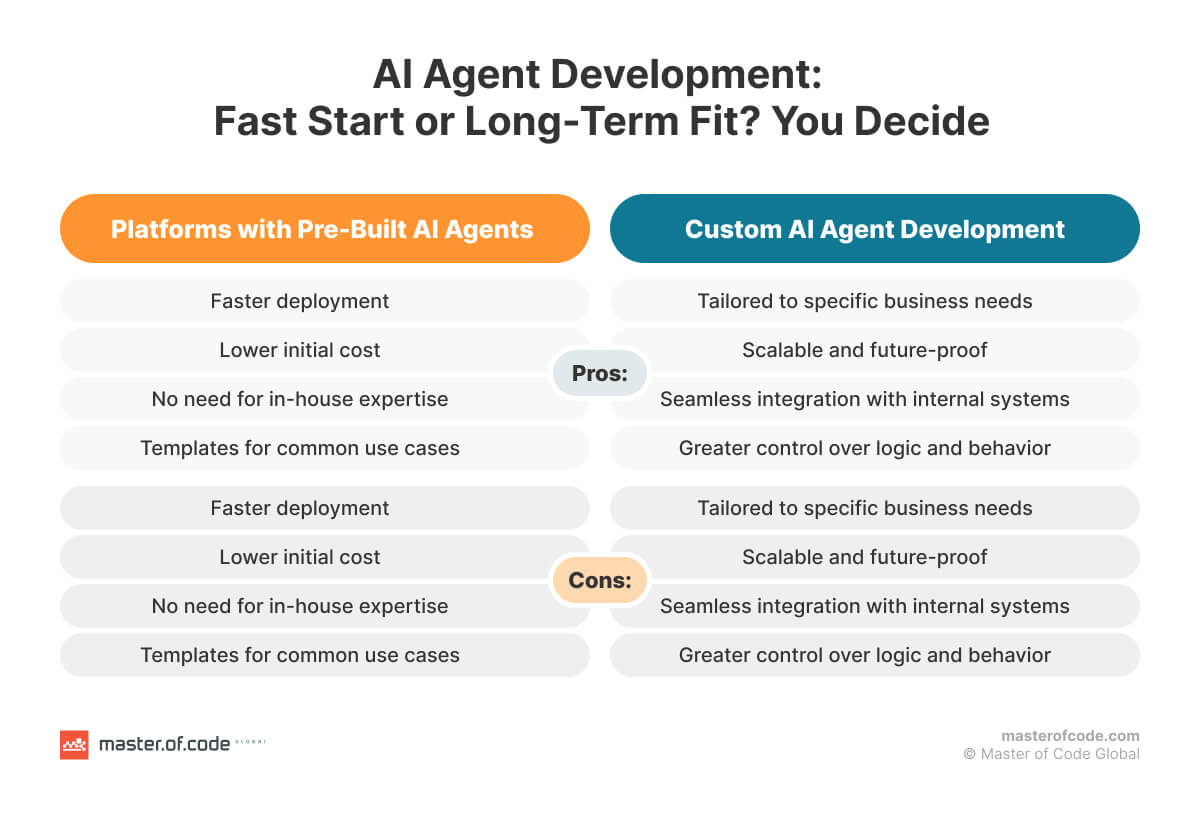
A focused use case may only require a configurable platform or a fast MVP partner. But once the project involves several systems, proprietary processes, strict security requirements, or plans to scale across departments, AI agent companies need to offer more than a list of individual features. The decision becomes more about the partner’s ability to connect everything.
That is where Master of Code Global stands out. Its combination of strategy, custom engineering, system integration, and post-launch optimization makes it a strong fit for organizations that want more than a standalone agent.
| Best for | Company | Why it may be a good fit |
|---|---|---|
| Custom builds | Master of Code Global | Best suited for companies that need a bespoke agentic system built around their workflows, integrations, data, and long-term business goals. |
| Developers | Lyzr AI | A good fit for technical teams looking for orchestration tools, broad model support, and more control over development and deployment. |
| Enterprises | Beam AI | Well-suited for larger organizations that need cross-functional automation, flexible deployment, and enterprise-focused security controls. |
| Startups | Rapid Innovation | A practical option for teams that want to move quickly, validate an idea, and launch an MVP within a defined timeline. |
FAQs
What’s the Difference Between Custom AI Agent Development and Plug-and-Play Platforms?
Custom development starts with your workflows, data, users, and existing systems. The architecture, integrations, reasoning logic, and security controls are designed around how your business already operates. Experienced AI agent development companies may also build capabilities such as memory & state management, allowing the system to preserve context across longer and more complex workflows.
Plug-and-play platforms offer prebuilt templates, integrations, and visual tools. They are usually faster to launch but provide less control over specialized behavior. They work well for clearly defined tasks, while custom agentic AI development services are better suited to proprietary processes, regulated environments, and solutions that need to scale across several systems.
How Much Does It Cost to Build a Custom AI Agent in 2026?
The cost depends on what the agent needs to do. A focused proof of concept may cost between $25,000 and $80,000, while a production-ready AI feature or integration can range from $60,000 to $180,000.
More complex platforms involving multi-agent orchestration, enterprise integrations, RAG, and advanced security controls may cost $150,000 to $500,000 or more. Data preparation, infrastructure, compliance, and ongoing monitoring can also affect the final budget.
What Certifications Should an AI Agent Development Company Have?
Look for an ISO/IEC 27001 certification and a current SOC 2 report, especially when the agent will access sensitive business or customer data. ISO 27001 shows that the company has a structured information security management system, while SOC 2 is an independent examination of relevant organizational controls.
For healthcare projects, be careful with companies claiming to be “HIPAA certified.” HHS does not recognize third-party HIPAA certification. Suitable AI agent development companies should instead follow the required safeguards and be ready to sign a Business Associate Agreement when handling protected health information.
How Long Does It Take to Build and Deploy an AI Agent?
A focused proof of concept can usually be delivered in four to eight weeks. A production-ready agent with custom workflows and system integrations may take two to four months.
Large multi-agent platforms can require four to twelve months, depending on data readiness, security reviews, integrations, and testing requirements. Features such as agentic RAG and human handoff can also extend development because they require additional data validation, workflow design, and testing.
Can AI Agents Integrate With Existing ERP and CRM Systems?
Yes. A custom AI agent can connect with existing CRM, ERP, internal databases, and business applications through APIs, middleware, or standards such as Model Context Protocol.
Through function calling, the agent can retrieve information, update records, trigger workflows, and coordinate actions across several tools. The main challenge is rarely whether integration is possible. It is making sure the agent has the right permissions, reliable data, and clear limits on what it can do.
Ready to build your own Conversational AI solution? Let’s chat!