Few sectors face as much pressure to evolve as oil and gas – an industry shaped by volatile markets, tight margins, and an endless need to reinvent itself. But 2026 is shaping up to be a turning point – not because of another boom or bust, but because of AI.
Artificial intelligence is no longer just a buzzword or a back-office experiment. It’s now the engine behind safer drilling, faster site analysis, smarter logistics, and even more sustainable operations. Whether it’s predicting equipment failure before it halts production or optimizing energy use across vast facilities, AI is helping companies work leaner, smarter, and greener.
And here’s what’s interesting: It’s not just the oil majors building these systems in-house. A new wave of specialized organizations is stepping in to tackle some of the sector’s hardest problems, like upstream exploration or downstream refining. These are the partners driving innovation where it counts most.
So, which players are making the biggest impact? And how are they reshaping one of the world’s most complex industries? Let’s explore the top AI development companies in oil and gas that are fueling transformation across the energy value chain.
Table of Contents
Key Takeaways
- The top AI development companies in oil and gas for 2026 are Master of Code Global, Data Insights AI, VarIntel, 7Puentes, gAIn.energy, Earth Analytics, Collide AI, AIQ, Satelytics, and Akselos.
- AI is reshaping the sector through predictive maintenance, more accurate exploration and drilling, remote monitoring, and emission reduction.
- Specialized vendors focus on single areas such as geospatial analytics, digital twins, or methane detection.
- Full-lifecycle partners build connected AI systems across SCADA, ERP, and custom platforms.
- The right partner knows industrial infrastructure, handles edge and remote sites, and has production results.
- Generative AI, digital twins, and autonomous operations will shape the next stage of AI in oil and gas.
Why AI Is Reshaping the Oil and Gas Sector
This advanced technology isn’t just adding convenience to existing workflows – it’s fundamentally changing how the industry operates. Machine intelligence now connects the entire oil and gas value chain, enabling quicker insights, smarter strategies, and safer operations.
Predictive Maintenance for Equipment
Heavy machinery failures can compromise operational stability. AI activates predictive maintenance by analyzing sensor data to detect subtle signs of wear or performance issues. This allows operators to schedule repairs before breakdowns occur, minimizing downtime and extending asset lifespan.
Exploration & Drilling Accuracy
Drilling is one of the costliest and most data-heavy phases of production. AI helps geoscientists interpret seismic data more precisely, identify optimal drilling locations, and reduce the risk of tapping unproductive zones. It’s like having an intelligent assistant that continuously refines geological models as new data comes in.
Remote Monitoring & Automation
Oil fields are often remote and hazardous. Digital systems can remotely monitor pipeline pressure, flow rates, and equipment conditions, flagging anomalies in real time. In many cases, automated AI agents can adjust system parameters on the fly, eliminating the need for manual intervention.
Emission Reduction & Energy Optimization
Sustainability is no longer optional. Digital tools now help operators analyze fuel usage, detect inefficiencies, and modify energy-intensive processes. Whether it’s optimizing burner performance or managing flaring events, AI supports cleaner, more compliant operations without sacrificing productivity.
Quick Comparison: Top AI Companies for Oil and Gas
| # | Company | Specialization | Best For |
|---|---|---|---|
| 1 | Master of Code Global | Full-lifecycle AI ecosystems, LLM assistants, AI copilots | End-to-end AI partner across SCADA, ERPs, custom platforms |
| 2 | Data Insights AI | Predictive maintenance, anomaly detection | Midstream operators, pipeline/compression systems |
| 3 | VarIntel | Geospatial analytics, reservoir intelligence | Exploration teams improving drilling accuracy |
| 4 | 7Puentes | Custom AI for offshore/refinery workflows | Remote/edge deployments, modular pipelines |
| 5 | gAIn.energy | AI + climate strategy, ESG optimization | Producers focused on emissions/sustainability reporting |
| 6 | Earth Analytics | Satellite geospatial intelligence | Remote infrastructure monitoring, terrain risk |
| 7 | Collide AI | LLM + agent-based copilots for frontline ops | Production engineers, shift supervisors |
| 8 | AIQ | Enterprise industrial AI (ADNOC/G42 JV) | National-scale drilling, safety, production optimization |
| 9 | Satelytics | Spectral satellite imagery, methane detection | Regulatory compliance, ecological risk monitoring |
| 10 | Akselos | Digital twin, structural integrity monitoring | Offshore/subsea asset lifespan management |
Best AI Companies for Oil and Gas Industry
With artificial intelligence moving from pilot projects to production-grade systems, choosing the right development partner is no longer a technical decision, but a strategic one. The organizations listed below were selected based on their relevance to the oil and gas industry, proven innovation, real-world deployments, and deep expertise in technologies such as machine learning, computer vision, and predictive analytics.
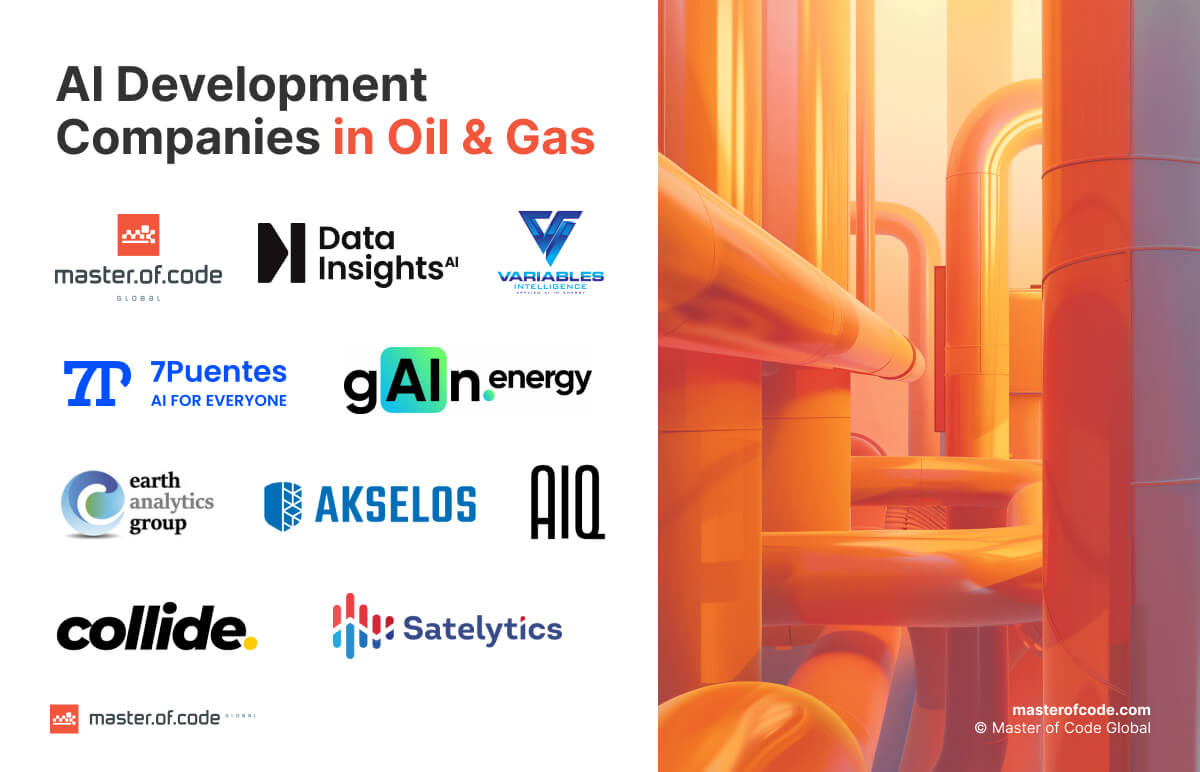
Let’s explore the top AI companies for oil and gas redefining what’s possible in 2026.
Master of Code Global
Master of Code Global brings over a decade of experience in enterprise-grade software development, now combined with cutting-edge expertise tailored for the energy sector. What sets the firm apart is its ability to build not just standalone models, but fully integrated AI ecosystems – from intelligent agents and predictive dashboards to multimodal systems connecting field hardware, cloud platforms, and control room interfaces.
Operating across North America, the Middle East, and Europe, the team has deep knowledge of industrial environments and the constraints that come with legacy infrastructure. That’s why their approach is technology-agnostic and designed for interoperability – working seamlessly with SCADA, ERPs, and custom-built energy platforms. Be it an LLM-based assistant improving maintenance efficiency, an AI copilot guiding drilling engineers or an AI-powered conversational data analysis tool, Master of Code Global unites adaptability with proven depth.
Their capabilities span the full AI lifecycle: use case mapping, PoC delivery, model training, multi-platform integration, and ongoing performance monitoring. Projects in oil and gas include real-time alerting systems for offshore platforms, virtual assistants for refinery safety checks, and remote monitoring tools that cut manual site visits in half.
What truly differentiates the company is its LOFT framework – an accelerator that reduces AI project setup by 40% and enables rapid scaling from prototype to production. Combine that with a strong UX practice, ISO-certified development pipelines, and close collaboration models, and you get a partner capable of delivering measurable business impact, not just code.


Noam Bardin
Founder
We had a great experience with Master of Code Global — the speed in which they built up a multidisciplinary team including eng, design, QA, TPM allowed us to quickly roll out our product while hiring an internal team.
Check case study

Axelle Basso Bondini
Senior Manager Marketing
Master of Code Global worked on a tight turn-around, was extremely helpful and professional in developing all components of the project up to the brand’s high standards.
Check case study

Matt Meisner
VP, Performance Marketing
The chatbot not only drove $500,000 in revenue within the first few months but also achieved 3X better conversion than the website and an 89% user response rate. Master of Code Global proved to be creative and technical experts in the chatbot space.
Check case studyData Insights AI
This firm brings precision tools to industrial environments, with a core strength in machine learning models built for asset-intensive sectors. Known for their expertise in real-time data ingestion and anomaly detection, Data Insights AI has developed predictive maintenance systems that integrate directly with SCADA and edge devices. Their approach is pragmatic and performance-driven, designed to flag mechanical failures before they disrupt production. With a portfolio spanning pipeline networks and gas compression systems, they’re helping midstream operators turn terabytes of sensor data into smarter interventions.
VarIntel
VarIntel is all about intelligent exploration. Headquartered in Houston, they focus on geospatial analytics and reservoir intelligence, applying proprietary ML models to seismic and geological data. Their strength lies in improving subsurface visibility, enhancing drilling accuracy, and minimizing dry wells. What sets them apart is their seamless integration into existing geophysical toolchains, making it easy for exploration teams to layer AI into their decision-making process. Recent deployments include automated seismic interpretation platforms and risk modeling dashboards for onshore drilling programs.
7Puentes
With roots in Latin America and a strong footprint in energy consulting, 7Puentes delivers custom AI systems tailored for complex industrial workflows. Their team combines robust data engineering capabilities with applied artificial intelligence to serve offshore platforms, refineries, and utility-scale energy sites. Unlike firms that offer one-size-fits-all models, 7Puentes builds modular pipelines that can operate on constrained edge infrastructure – ideal for remote field deployments. Recent projects were natural language processing tools for compliance documentation and predictive analytics engines for rotating equipment.
gAIn.energy
This boutique firm operates at the intersection of AI and climate strategy. gAIn.energy partners with energy producers looking to modernize operations while meeting ESG targets. Their platform blends artificial intelligence with domain-specific knowledge to optimize combustion efficiency, track carbon emissions, and recommend operational shifts that lower environmental impact. What makes them unique is their laser focus on measurable sustainability outcomes, offering tools that not only improve performance but also support verifiable emissions reporting.
Earth Analytics
Earth Analytics is a geospatial intelligence firm that turns satellite data into operational insights. Their strength lies in applying AI to petabyte-scale image datasets, permitting clients to monitor remote infrastructure, assess terrain risks, and detect environmental anomalies. What sets them apart is their ability to automate the interpretation of complex terrain features and surface activity in near real time. Oilfield operators use their tools to prioritize inspection zones, reduce field surveys, and boost situational awareness across vast areas.
Collide AI
The company builds intelligent interfaces for frontline operations. Their specialty is combining LLMs with agent-based systems to create copilots for production engineers and shift supervisors. Rather than replacing human expertise, their tools act as digital teammates, suggesting optimizations, managing alerts, and helping teams navigate complex plant environments. Their human-in-the-loop approach stands out, giving operators control while improving decision-making. Use cases include AI-enhanced control room software and conversational tools for shift handover reporting.
AIQ
AIQ, a joint venture between ADNOC and G42, has rapidly emerged as a major force in industrial AI. With enterprise-grade scale and deep domain expertise, they’ve deployed intelligent systems across drilling, safety, and production optimization. Unlike smaller players, AIQ builds end-to-end platforms – from edge sensing to cloud analytics – capable of supporting thousands of concurrent workflows. Their work in HSE automation and reservoir analytics is already producing significant operational efficiencies inside one of the world’s largest national oil companies.
Satelytics
Satelytics transforms spectral satellite imagery into real-time environmental intelligence. Their AI models detect methane leaks, hydrocarbon plumes, and surface disturbances, providing geolocated alerts that help companies meet regulatory requirements and minimize ecological risks. Their technology stands out for its precision and scale, delivering insights across hundreds of square kilometers with minimal delay. Used by both operators and ESG teams, their platform is an essential tool for proactive compliance and rapid incident response.
Akselos
This organization brings next-generation digital twin technology to structural integrity management. Their reduced-order modeling engine combines physics-based simulation with AI to monitor fatigue, stress, and degradation across large offshore and subsea assets. The company’s strength lies in its ability to provide real-time risk assessments for critical infrastructure, activating preemptive interventions and optimized maintenance schedules. The solutions they offer are trusted by global energy majors to extend asset lifespans and reduce inspection overhead.
How to Choose the Right AI Partner for Oil and Gas
Use these criteria to compare any vendor, including companies outside this list.
Proven work with industrial infrastructure. Your partner should have connected AI to SCADA, ERP, historians, and legacy control systems before. Ask for examples.
Technology-agnostic approach. A partner that works across models, clouds, and hardware helps you avoid vendor lock-in and adapt as the technology changes.
Edge and remote deployment experience. Offshore platforms and remote fields have limited connectivity. Check that the vendor can run models on edge devices.
Expertise that matches your use case. Predictive maintenance, geospatial exploration, digital twins, and ESG reporting each need different skills and data. Shortlist partners with depth in your priority area.
A production track record. Many AI projects stall after the pilot. Ask for deployments that have run in live operations and the results they delivered.
The Future of AI in Oil and Gas: What’s Next?
The next chapter of the sector is already being written with smart technology at the center of it. Generative AI is accelerating R&D and documentation workflows, while digital twins are enabling real-time simulations of physical assets across platforms and pipelines. Autonomous rigs, once experimental, are inching closer to operational reality. And digital optimization engines are now tuning energy use, second by second, across global networks.
What’s clear? The industry is moving from reactive to predictive, from manual to autonomous, and from carbon-heavy to carbon-aware.
But transformation doesn’t happen by waiting. The AI solutions providers for oil and gas today – experimenting, iterating, scaling – are the ones positioning themselves as leaders in the net-zero future.
FAQ
How much does custom AI development for oil and gas cost?
Cost depends on scope, data volume, and integrations. According to Master of Code Global’s project data, an AI proof of concept typically costs $25,000 to $80,000, and predictive maintenance solutions range from $50,000 to $500,000. High-complexity systems, such as enterprise-wide analytics or digital twins, can start at $400,000 and reach several million dollars.
How long does it take to deploy AI in field or offshore operations?
Timelines depend on data readiness, sensor coverage, connectivity, integration with control systems, and safety approvals. Most operators start with a pilot on one asset or site, validate results, and then scale across facilities in phases.
Can custom AI integrate with existing SCADA, ERP, and legacy industrial systems?
Yes. Custom AI connects to SCADA and historian data through industrial protocols such as OPC UA and MQTT, and to ERP systems through APIs or middleware. For legacy equipment, edge gateways collect and standardize sensor data before it reaches AI models. Master of Code Global builds solutions that work with SCADA, ERPs, and legacy platforms.
What ROI can oil and gas companies expect from AI adoption?
ROI comes from less unplanned downtime, lower maintenance costs, fewer site visits, better drilling decisions, and lower emissions. In a Master of Code Global predictive maintenance project, the client saw a 67% reduction in downtime and a 45% drop in maintenance costs. Master of Code Global’s remote monitoring tools have also reduced site visits by 50%.
When should an oil and gas company choose custom AI development instead of an industry-specific AI platform?
A platform works well for a defined need, such as methane detection or satellite monitoring. Choose custom development when your workflows are unique, when you need AI across several connected systems, or when you want to own the solution and its data.
Ready to lead the shift? Partner with an AI team that understands your industry, your challenges, and how to turn vision into measurable results.