



![Top 11 AI Integration Companies for Enterprise [2026]](https://masterofcode.com/wp-content/uploads/2026/02/Cover_-Conversational-AI-in-Hospitality-4.jpg)
Enterprise AI rarely fails because the model is “bad.” It fails because the model can’t plug into identity, data, APIs, and governance, so value never reaches the people who need it. That’s where AI integration challenges show up first: messy handoffs, brittle connectors, and “works in a demo” features that collapse in real operations.
The real differentiator is enterprise systems integration: who can connect AI to ERP/CRM, modern data stacks, and customer channels without turning rollout into a months-long rebuild. The right partner helps you move from pilot to production fast, strengthen security and compliance, and prove impact with measurable ROI, inside real workflows, not slide decks.
This guide compares the top AI integration companies for enterprise with one goal: help you shortlist faster. You’ll see providers with the right process, controls, and production readiness to support digital transformation at scale, so you can pick a vendor that fits your architecture, timeline, and risk tolerance.
Table of Contents
Key Takeaways
- AI integration firms connect models, agents, and intelligent features with existing applications, data, infrastructure, and operational processes.
- The companies were selected based on systems expertise, architecture capabilities, AI maturity, MLOps, governance, delivery evidence, and post-launch support.
- The comparison covers 11 enterprise AI integration providers, outlining their focus, team size, pricing, minimum budget, and suitable engagement types.
- Each profile explains the company’s current services, technical strengths, delivery scope, and relevant implementation experience.
- Partner selection should consider system compatibility, data foundations, production readiness, compliance, pricing transparency, and long-term ownership.
- Warning signs include demo-only portfolios, limited modernization experience, generic architectures, unclear monitoring practices, and undefined support responsibilities.
How We Created the List of AI Integration Companies
To make this list practical and easy to scan, we reviewed each provider’s market presence, service positioning, engagement model, and documented experience with complex business conditions. We included specialized vendors, hybrid consultancies, and firms with proprietary accelerators, giving you a balanced view of the top companies offering AI integration services for your enterprise roadmap. Each candidate was then evaluated against six selection criteria.
- Enterprise systems integration expertise. Experience connecting artificial intelligence with ERP and CRM platforms, identity systems, operational applications, APIs, middleware, and legacy infrastructure.
- Data and architecture readiness. Ability to strengthen data foundations and design cloud-native architectures that work across private, public, hybrid, and multi-cloud environments.
- Modern AI integration capabilities. Practical expertise with LLMs, RAG pipelines, vector databases, AI agents, model APIs, and orchestration frameworks supporting complex workflows.
- MLOps and production maturity. Established processes for model monitoring, version control, fallbacks, retraining, testing, deployment, and reliable operation under production workloads.
- Security, governance, and compliance. Controls for data access, auditability, privacy, model oversight, and requirements associated with GDPR, HIPAA, SOC 2, and regulated environments.
- Enterprise delivery evidence. Relevant case studies, credible client feedback, measurable outcomes, transparent pricing information, and structured support after launch.
Top 11 AI Integration Companies in 2026
| Company | Core Focus | Team Size | Hourly Rate | Minimum Project Budget | Best For |
|---|---|---|---|---|---|
| Master of Code Global | Enterprise AI transformation, AI agents, AI SDLC, Generative AI, conversational experiences, and custom integrations | 150+ | 50-99/hr | $25,000+ | Organizations taking AI from readiness assessment and validation through production and scaling |
| Ekimetrics | Enterprise AI deployment, data engineering, decision systems, customer analytics, and marketing measurement | 500+ | Not publicly disclosed | Not publicly disclosed | Large organizations operationalizing data and AI across commercial and operational functions |
| Scopic | AI integration, Generative AI, model APIs, and custom software engineering | 250–999 | 50-99/hr | $10,000+ | Businesses connecting AI with ERP, CRM, cloud platforms, and existing software products |
| Miquido | Generative AI, RAG systems, data readiness, cloud integration, and digital product development | 50–249 | 50-99/hr | $25,000+ | Companies introducing knowledge assistants, document intelligence, and AI features into applications |
| Reelixy | AI agents, CRM automation, document workflows, predictive analytics, and custom software | 2–9 | 25-49/hr | $1,000+ | Organizations seeking focused workflow automation with short delivery cycles |
| Lemberg Solutions | Data and AI, edge AI, computer vision, embedded systems, IoT, and cloud integration | 50–249 | 50-99/hr | $25,000+ | Product companies connecting AI with hardware, industrial equipment, medical devices, or IoT systems |
| Leanware | AI consulting, managed AI agents, AI product engineering, data readiness, and dedicated engineering teams | 10–49 | 50-99/hr | $50,000+ | Startups and mid-sized businesses building AI products or automating defined operational workflows |
| Octogamma | AI marketing systems, marketing agents, analytics dashboards, GTM execution, SEO, and GEO | 10–49 | 50-99/hr | $5,000+ | Technology, FinTech, Web3, and SaaS companies integrating AI into marketing operations |
| Equitysoft Technologies | AI integration, AI development, automation, and custom web and mobile applications | 50–249 | 25-49/hr | $5,000+ | Companies incorporating AI functionality into customer-facing or internal software |
| Matellio | AI and machine learning, intelligent automation, cloud platforms, IoT, and enterprise modernization | 250–999 | 50-99/hr | $100,000+ | Mid-market and enterprise organizations coordinating complex modernization and integration programs |
| 10Clouds | AI consulting, enterprise AI implementation, LLM integrations, AI agents, and custom products | 50–249 | 50-99/hr | $25,000+ | Organizations deploying Generative AI within customer experiences, internal platforms, and regulated workflows |
Master of Code Global
Founded: 2004
Headquarters: Winnipeg, Canada, with a US office in Redwood City, CA
Team size: 150+
Hourly rate: 50-99/hr
Minimum project budget: $25,000+
Services: AI integration services, AI consulting and transformation, agentic workflows, GenAI product development, AI pilots, Conversational AI, custom connectors, AI SDLC consulting, and custom software development
Master of Code Global is an AI consulting and engineering company founded in 2004. Its 150+ specialists have delivered more than 1,000 projects, with digital products reaching over one billion users. The company helps enterprises integrate AI into existing applications, data environments, customer channels, and operational workflows.
Its expertise covers CRM and ERP platforms, internal databases, data warehouses, APIs, cloud infrastructure, legacy systems, and customer-facing products. The team develops Generative AI applications, RAG systems, AI agents, conversational interfaces, custom connectors, and orchestration layers. Master of Code Global remains platform-agnostic, with partnerships across Google Cloud, Salesforce, AWS, and leading CX/AI platforms.
The company supports the complete integration journey within one consulting and engineering team. Engagements include AI readiness assessment, use case prioritization, solution architecture, pilot validation, custom development, deployment, monitoring, optimization, and workforce training. Its ISO/IEC 27001:2022 certification covers AI consultancy and AI-powered software development, supporting enterprise requirements for data protection, access control, secure cloud architecture, vulnerability testing, and LLM guardrails.


Noam Bardin
Founder
We had a great experience with Master of Code Global — the speed in which they built up a multidisciplinary team including eng, design, QA, TPM allowed us to quickly roll out our product while hiring an internal team.
Check case study

Axelle Basso Bondini
Senior Manager Marketing
Master of Code Global worked on a tight turn-around, was extremely helpful and professional in developing all components of the project up to the brand’s high standards.
Check case study

Matt Meisner
VP, Performance Marketing
The chatbot not only drove $500,000 in revenue within the first few months but also achieved 3X better conversion than the website and an 89% user response rate. Master of Code Global proved to be creative and technical experts in the chatbot space.
Check case studyEkimetrics
Founded: 2006
Headquarters: Paris, France
Team size: 500+ data and AI experts
Hourly rate: Custom / not publicly listed
Minimum project budget: Custom / not publicly listed
Services: Data science and AI consulting, AI deployment, data engineering, analytics enablement, marketing measurement and optimization, sustainability and ESG analytics
Ekimetrics is a data science and AI consultancy focused on helping large organizations operationalize analytics and artificial intelligence across business functions. Since 2006, the company reports delivering 2,000+ AI and marketing measurement projects across 50+ countries, with teams distributed across multiple regions.
A practical differentiator is its emphasis on turning data work into repeatable decision systems, especially in areas like marketing effectiveness, customer analytics, operations, and sustainability reporting. Ekimetrics also positions its delivery around a platform and services model to support AI deployment at scale inside enterprise workflows.
Azilen Technologies
Founded: 2009
Headquarters: Irving, Texas, USA
Team size: 250–500
Hourly rate: $25-49/hr
Minimum project budget: $10,000+
Services: AI integration services, generative AI integration, AI workflow integration, enterprise AI platform integration, AI consulting
Azilen Technologies is an enterprise AI development company that connects AI capabilities with the systems businesses already run on, including ERP, CRM, SaaS platforms, and internal tools. Its integration work spans applications, workflows, data ecosystems, and cloud infrastructure such as Azure, AWS, and Google Cloud.
The company follows a four-stage delivery process: ecosystem assessment, integration architecture, implementation, and optimization, with a strong focus on legacy system enablement and security. Azilen serves FinTech, healthcare, retail, and manufacturing clients, tailoring integrations to sector-specific systems and regulatory needs.
Scopic
Founded: 2006
Headquarters: Marlborough, MA, USA
Team size: 250–999
Hourly rate: 50-99/hr
Minimum project budget: $10,000+
Services: AI integration services, AI development, Generative AI, AI consulting, and custom software development
Scopic is an end-to-end software development company that helps businesses incorporate AI into existing systems and workflows. Its integration work covers strategy and roadmap planning, followed by implementation that connects models and APIs with environments such as CRMs, ERPs, and cloud platforms.
The company also offers Generative AI development services covering data preparation, model development, and deployment. This makes Scopic relevant for organizations introducing AI-powered assistants, automation, or intelligent features into operational software.
Miquido
Founded: 2011
Headquarters: Kraków, Poland
Team size: 50–249
Hourly rate: 50-99/hr
Minimum project budget: $25,000+
Services: AI integration, Generative AI development, AI consulting, custom software development, and cloud consulting
Miquido is positioned as a full-service software team with dedicated AI capabilities. Its offering spans end-to-end work, from solution discovery and data readiness through implementation, allowing AI features to be embedded into business applications and internal tools.
One of its notable accelerators is the AI Kickstarter framework, designed to speed up LLM-powered application delivery using RAG architecture, with an emphasis on accuracy, data security, and cost management. This can be useful when integrating Generative AI into enterprise knowledge bases, document workflows, or support experiences while controlling what the model can access and return.
Reelixy
Founded: 2025
Headquarters: Dnipro, Ukraine
Team size: 2–9
Hourly rate: 25-49/hr
Minimum project budget: $1,000+
Services: AI agents, CRM automation, document workflows, predictive analytics, custom software
Reelixy develops AI-powered automation and custom software for organizations seeking to streamline sales and operational workflows. Its work centers on connecting intelligent agents, CRM functionality, communication channels, documents, and internal business processes.
The company’s publicly documented solutions include AI-assisted lead capture and qualification, omnichannel CRM workflows, automated follow-ups, chatbots, document and data-processing systems, and custom operational applications. Its CRM product supports communication channels such as Telegram, WhatsApp, Instagram, Facebook, and websites, alongside integrations through APIs, webhooks, and Zapier.
Lemberg Solutions
Founded: 2007
Headquarters: Lviv, Ukraine
Team size: 50–249
Hourly rate: 50-99/hr
Minimum project budget: $25,000+
Services: Data and AI, edge AI, computer vision, embedded systems, IoT, and cloud integration
Lemberg Solutions is a software and hardware engineering company with experience developing AI-enabled digital and connected products. Its capabilities span data engineering, machine learning, cloud infrastructure, firmware, sensors, and on-device intelligence.
The company works across healthcare, manufacturing, industrial IoT, automotive, energy, and consumer electronics. Its portfolio includes an edge AI predictive maintenance system for industrial machinery and a platform that helps German retailer hagebau process batches of up to 10,000 documents.
Lemberg Solutions covers discovery, architecture, development, deployment, monitoring, and maintenance. Its post-launch services include model performance tracking, software and firmware updates, and technical troubleshooting.
Leanware
Founded: 2020
Headquarters: Bogotá, Colombia
Team size: 10–49
Hourly rate: 50-99/hr
Minimum project budget: $50,000+
Services: Data readiness, managed AI agents, AI product engineering, and dedicated engineering teams
Leanware is an AI engineering company that helps businesses evaluate opportunities, develop intelligent products, and deploy custom agents within existing workflows. Its engagement models include readiness assessments, milestone-based product development, managed agents, and embedded technical teams.
Its documented projects include a multi-model agent for evaluating dental crown preparations and a production RAG pipeline for a government traffic platform. The latter connects incident reports through Azure AI Search and OpenAI to support traffic analysis.
For managed agents, Leanware handles deployment, hosting, model access, monitoring, maintenance, and ongoing refinement. Clients retain ownership of the custom system instead of relying on a closed, per-seat AI product.
Octogamma
Founded: 2021
Headquarters: London, England
Team size: 10–49
Hourly rate: 50–99/hr
Minimum project budget: $5,000+
Services: AI marketing agents, GTM strategy, fractional CMO, ABM, SEO/GEO, paid acquisition, websites and landing pages, analytics dashboards
Octogamma is an AI marketing agency serving technology, FinTech, Web3, and SaaS companies. It combines marketing strategy and campaign execution with systems designed to automate content production, outreach, lead qualification, and reporting.
Its current products include a content production agent and an outreach tool that identifies prospects, scores leads, prepares personalized messages, and passes suitable contacts to sales teams. The company also provides GEO services intended to improve brand visibility across ChatGPT, Perplexity, Gemini, and other AI-powered search experiences.
Equitysoft Technologies
Founded: 2015
Headquarters: Ahmedabad, India
Team size: 50–249
Hourly rate: 25-49/hr
Minimum project budget: $5,000+
Services: AI integration, AI development, automation, and custom web and mobile applications
Equitysoft Technologies combines AI engineering with full-cycle web and mobile development. Its integration services connect intelligent features with new or existing applications, business workflows, CRMs, ERPs, data infrastructure, and internal tools.
The company develops AI agents, chatbots, predictive analytics systems, and custom automation for customer engagement and operational processes. Its delivery process covers readiness assessment, planning, implementation, testing, deployment, support, and continued optimization.
Equitysoft also maintains offices in Germany, France, and Bahrain, alongside its headquarters in Ahmedabad.
Matellio
Founded: 2014
Headquarters: Palo Alto, California, USA
Team size: 250–999
Hourly rate: 50–99/hr
Minimum project budget: $100,000+
Services: AI integration services, AI development, machine learning, enterprise software, cloud and system integration, and custom product engineering
Matellio positions itself as an enterprise-grade product engineering firm with a dedicated focus on integrating AI into business environments. The company highlights connecting intelligent capabilities with existing ecosystems, including IoT and edge environments, with an emphasis on practical rollout and modernization.
Its broader engineering offering covers legacy workflow modernization, intelligent automation, cloud-native architecture, DevOps, and platform reliability. Matellio applies these capabilities across healthcare, FinTech, retail, communications, SaaS, and industrial infrastructure projects.
10Clouds
Founded: 2009
Headquarters: Warsaw, Poland
Team size: 50–249
Hourly rate: 50–99/hr
Minimum project budget: $25,000+
Services: AI development and consulting, AI integration, ChatGPT and LLM integrations, chatbots, custom software, and digital product development
10Clouds is a product-oriented software company that implements artificial intelligence within customer-facing applications and internal platforms. Its current positioning focuses particularly on production AI for banks, insurers, FinTech companies, and digital commerce businesses.
The company offers AIConsole, an enterprise platform for orchestrating agents, knowledge sources, automated workflows, and integrations across business systems. Additional capabilities include secure internal assistants, agentic commerce, workflow automation, and deploying AI within environments that require governance, security, and compliance controls.
How to Choose the Right AI Integration Company
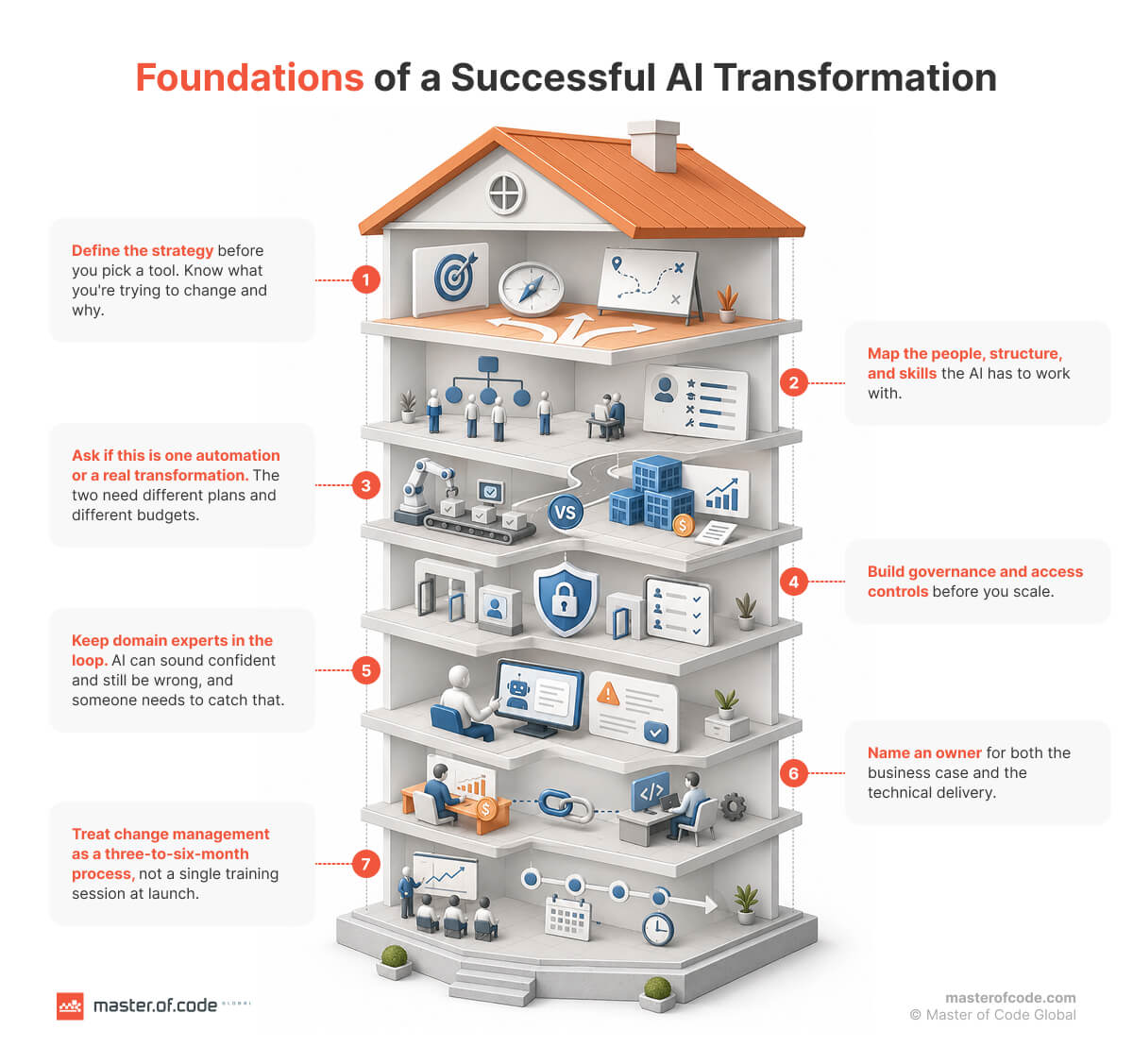
Choosing among AI integration consultancies requires more than comparing service lists, rates, or team sizes. Start by pressure-testing an AI integration partner in six areas to understand whether it fits your technology environment, operational requirements, and long-term plans. This evaluation is especially important when implementing AI in business, where technical decisions directly affect adoption and value.
Integration and System Compatibility
Ask which enterprise platforms, APIs, data sources, and applications the company has connected before. The team should explain how it handles API/middleware integration, identity management, access permissions, and system interoperability across cloud and on-premises environments.
Experience with legacy systems is particularly important. Request examples showing how the provider modernized or extended older software without disrupting critical operations.
Data and Architecture Readiness
Review how the company evaluates data readiness before development begins. It should examine availability, quality, ownership, access, privacy, and consistency across relevant sources.
The proposed architecture should support current requirements without restricting future growth. Ask how the provider selects models, vector databases, orchestration tools, hosting environments, and integration patterns based on your existing technology stack.
MLOps and Production Readiness
A successful demonstration does not prove that a system will perform reliably at scale. Ask how the team approaches versioning, testing, observability, model evaluation, fallbacks, retraining, incident response, and cost monitoring.
The provider should define what production-grade deployment means for your use case. Look for documented experience moving from AI pilot to production, including how performance and business results were measured after launch.
Governance and Compliance
Discuss security, privacy, and oversight before selecting technologies or designing workflows. The provider should explain its approach to role-based access, encryption, audit trails, human review, data retention, and model accountability.
For regulated environments, confirm relevant experience, e.g., compliance with GDPR, HIPAA, or SOC 2. Ask which responsibilities belong to the vendor, your internal team, and third-party technology providers.
Delivery and Pricing Transparency
Request a delivery plan with defined stages, responsibilities, dependencies, milestones, and acceptance criteria. Pricing should clearly distinguish discovery, implementation, infrastructure, model usage, third-party licenses, maintenance, and future improvements.
Ask how scope changes are managed and which assumptions affect the estimate. Transparent answers reveal whether the provider understands your environment or has produced a generic proposal.
Post-Launch Ownership
Clarify who monitors the system, resolves incidents, updates integrations, manages prompts or models, and approves future changes. Ownership should remain clear after the initial release, especially when multiple internal and external teams are involved.
Also confirm documentation, training, knowledge transfer, service levels, and exit arrangements. These measures reduce dependence on one vendor and help internal teams maintain the system as requirements evolve.
Red Flags to Avoid
Watch for these warning signs during vendor evaluation:
- Demos without production examples. A polished prototype does not demonstrate reliability, scalability, user adoption, or measurable business impact.
- Limited experience with legacy systems. The provider may underestimate dependencies, undocumented logic, data limitations, and migration risks.
- Vague answers about MLOps, security, or monitoring. General assurances often indicate that operational controls have not been planned in sufficient detail.
- One-size-fits-all architecture. Recommending the same models, platforms, or frameworks for every project suggests limited attention to your environment.
- No clear post-launch ownership. Undefined responsibility for monitoring, incidents, updates, and optimization creates operational gaps after deployment.
These issues often explain why AI transformations fail: the technology receives more attention than integration, governance, adoption, and operational responsibility.
FAQ
1. What’s the difference between an AI integration company and an AI development company?
An AI development company builds new models or applications. An integration company connects AI with existing data, software, infrastructure, and workflows.
2. When should an enterprise hire an AI integration company?
External support becomes valuable when an initiative involves multiple platforms, sensitive information, complex permissions, or outdated infrastructure. It also fills gaps in specialized technical expertise.
3. Why use an external AI integration partner instead of building in-house?
Experienced specialists reduce recruitment time and provide proven delivery practices. Internal employees remain focused on core operations and strategic priorities.
4. How long does AI integration take for an enterprise?
A focused implementation may require several weeks, while broader programs often run for several months. Scope, technical dependencies, security reviews, and information quality determine the schedule.
5. How much does enterprise AI integration cost?
Focused engagements may start around $50,000, while complex programs may exceed $500,000. Hosting, model usage, third-party licenses, security controls, and maintenance affect the final investment.
6. What industries benefit most from AI integration?
Finance, healthcare, retail, manufacturing, logistics, telecommunications, and insurance often gain substantial value. These sectors rely on large information volumes and repeatable processes suitable for automation.
7. What are common enterprise AI integration challenges?
Typical obstacles include fragmented information, restricted access, incompatible software, unclear ownership, security risks, and poor user adoption. Weak success metrics also make results difficult to demonstrate.
Discover how Master of Code Global can help enhance your customer’s experience and boost sales growth.