



In today’s technological domain, knowledge truly is power. Businesses armed with insights into Gen AI market trends, competitor strategies, and customer preferences make more informed decisions and act on opportunities more effectively. As a leading Generative AI development company, Master of Code Global is committed to empowering our clients with the data they need to thrive.
For instance, our recent blog post on ChatGPT Statistics appeals strongly to our audience, underscoring the undeniable impact of this model. Now, we shift our focus to the broader landscape of artificial intelligence, exploring its potential across various industries and functions.

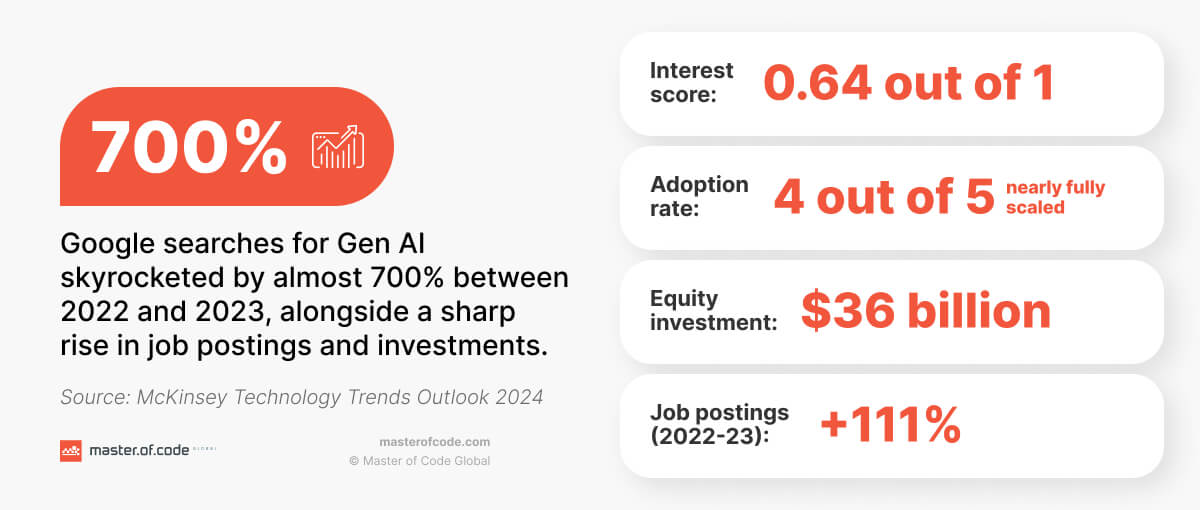
We’ll take a closer look at the major trends shaping the Generative AI field, including its integration into the workplace, its diverse applications, and the key benefits and threats it presents. Why should you invest your time in this article? The answer is clear: staying ahead of these changes is no longer optional. It’s essential for identifying emerging possibilities, adapting to market shifts, and mitigating possible risks.
Don’t miss the insights behind today’s biggest AI shifts. Explore the Generative AI statistics that can help shape smarter business decisions and uncover new growth opportunities.
Table of Contents
Key Takeaways
The “Pilot Purgatory” is Real: While 88% of organizations now use AI in at least one function, true scaling is lagging behind. A massive 62% are stuck in the experimentation phase, with only 7% of companies having fully scaled AI across their enterprise.
The Tool Landscape has Split: ChatGPT remains the dominant force with 40.52% of total downloads, but specialized competitors are surging. Notably, DeepSeek has captured 17.59% of downloads, signaling a shift toward more diverse toolsets.
Agents are Replacing Chatbots: The industry is pivoting from text prompts to autonomous action. 40% of enterprise applications are projected to include task-specific AI agents by the end of 2026, and 23% of companies are already scaling them.
Workforce Impact is Measurable: Adoption is driving efficiency, with businesses reporting an average 24.69% increase in productivity and 15.7% in cost savings. However, this comes with anxiety: 32% of organizations expect to decrease their workforce size in the coming year due to AI.
The Generational Divide: Gen Z is the power-user demographic, with 70% utilizing the tech. In the workplace, 80% of Gen Z professionals use AI for more than half their daily duties, compared to 50% of Boomers who don’t use it at all.
Global Leaders: Adoption varies significantly by region. India leads globally with 73% usage, significantly outpacing the US (45%) and the UK (29%).
Trust Remains the Barrier: Despite the hype, 51% of organizations report negative consequences from AI use, with inaccuracy and hallucinations (56%) remaining the top concerns preventing faster deployment.
That was just a snapshot. Now let’s look at the full picture. In the sections below, we have compiled the complete AI statistics for 2026 broken down by industry, tool, and trend, and backed by verified sources so you can see exactly where the data comes from.
What Tools Are We Using? Core AI Technologies and Generative AI Systems
By 2026, the GenAI stack looks far more settled than it did just a year ago. Teams aren’t testing everything anymore, they’re standardizing around a small set of tools that prove reliable at scale. The split is clear: a handful of general-purpose assistants handle reasoning, drafting, and search, while more specialized systems focus on creativity, education, or productivity inside existing workflows.
What’s notable isn’t just which platforms lead, but how they’re used. Some tools dominate through everyday, high-frequency tasks. Others earn their place by integrating tightly with enterprise environments or solving narrow problems exceptionally well. The data below shows where attention, usage, and trust are concentrating as intelligent systems move from novelty to infrastructure.
Improve your Generative AI knowledge with 65 use cases for effective industry applications.


Tool-Specific Generative AI Usage Statistics 2026
According to Statista, the most downloaded apps and tools during the previous year were:
- ChatGPT – 40.52% of total downloads
- DeepSeek (DeepSeek publisher) – 17.59%
- Google Gemini – 9.6%
- Doubao – 8.89%
- DeepSeek (Hangzhou Deep Search) – 7.76%
- PixVerse – 6.19%
- Talkie – 4.68%
- Nova – 4.35%
- Microsoft Copilot – 2.83%
- Character AI – 2.81%
The global number of intelligent tool users is projected to grow by 826.2 million between 2025 and 2031, reaching an estimated 1.2 billion users by the end of that period.
As of November 2025, the most visited platforms by monthly web traffic included:
- ChatGPT – 5.6 billion visits
- Gemini – 650 million monthly users
- DeepSeek – 328.2 million visits
- Perplexity – 239.97 million visits
- Claude – 185.93 million visits
- Character.AI – 141.1 million visits
- Microsoft Copilot – 110.32 million visits
- QuillBot – 59.06 million visits
- Duolingo – 48-51 million visits
Generative AI Statistics: What the Data Says About 2026 Trends
2026 isn’t about asking chatbots to write funny poems anymore. It’s the year businesses stop playing around with experiments and start plugging these tools into the messy, real-world machinery of how they actually operate. We are seeing a massive move from simple text prompts to independent “agents” that can plan and finish entire tasks for you. The focus has changed from novelty to utility, and you can clearly see this maturity in the latest generative artificial intelligence statistics.
Perspectives on AI Adoption & What We Already Have
We have officially passed the point of novelty. If 2024 was about “wowing” at ChatGPT and 2025 was about implementation, the data shows we are entering an era of separation: the gap between those just using AI and those actually running their business on it is widening.
Here is the reality of our current statistics in Generative AI sector:
- Usage is ubiquitous, but depth is shallow. Adoption has effectively maxed out. 88% of organizations now use AI in at least one business function, and 72% specifically utilize Generative AI. If your competitor isn’t using AI, they probably don’t exist anymore.
- We are still stuck in “Pilot Purgatory.” Despite widespread use, true integration is rare. A massive 62% of companies are still stuck in the experimenting or piloting phases. Only a tiny fraction (7%) have “fully scaled” AI across their enterprise.
- Agents are the new obsession. The industry is pivoting hard to Agentic AI (systems that execute tasks autonomously). 62% of organizations are already experimenting with AI agents, and 23% have successfully started scaling them in at least one business function.
- The “High Performer” gap is financial. The companies winning at AI are putting their money where their mouth is. While most companies tread carefully, 35% of AI high performers are now allocating more than 20% of their total digital budget specifically to AI technologies.
- Workforce anxiety is becoming a statistic. The “replacement” conversation is shifting from theory to data. While many firms hold steady, 32% of organizations now expect to decrease their workforce size in the coming year due to AI implementation.
- Inaccuracy is still the biggest headache. We haven’t solved the hallucination problem yet. 51% of organizations report experiencing negative consequences from AI, with “inaccuracy” remaining the number one risk that businesses are actively fighting.
- According to the 2025 Key Issues Study, 89% of enterprises are actively advancing their Gen AI initiative.
- Looking ahead, 92% of businesses plan to increase their investments between 2025 and 2027, signaling continued momentum.
- Deloitte forecasts that 50% of GenAI-using companies will deploy intelligent agents by 2027.
Generative AI Market Growth
- The generative landscape is expected to grow at a 46.47% CAGR from 2024 to 2030, reaching US$356.10 billion.
- Long-term forecasts push the boundaries even further, with Bloomberg estimating the Gen AI market will surpass $1.3 trillion globally by 2032.
- The U.S. sector alone is set to exceed $302.31 billion by 2034, a massive leap from $7.41 billion in 2024, driven by a CAGR of 44.90% from 2025 to 2034.
- 92% of Fortune 500 firms have adopted the technology, including major brands like Coca-Cola, Walmart, Apple, General Electric, and Amazon.
- The industries with the highest potential for growth through GAI in the near term are consumer services, finance, and healthcare.

Generative AI Adoption Statistics
- According to Bain, GAI is a top 3 priority for nearly 50% of executives, and a top 5 concern for another 28% due to its high potential to disrupt industries. Key areas of impact include core product differentiation (56%), new customer engagement approaches (52%), new business models (48%), and cost structure changes (43%).
- McKinsey reports that 53% of C-suite leaders now interact with Gen AI at work on a regular basis, compared to 44% of mid-level managers. Most companies apply it in marketing, product development, service operations, and software engineering.
- 63% of organizations incorporating technology focus on generating text, while 35% create images, and 25% utilize it to generate code. Adoption of multimodal GenAI is particularly strong in tech, automotive, and aerospace domains.
- MIT found that 95% of companies have incorporated it, yet 76% are still limited to just 1–3 use cases. However, 90% plan to boost investments, especially in data readiness and organizational transformation.
- According to AI adoption statistics, 67% of organizations are increasing investments in generative tech due to its strong perceived value.
- However, 68% of institutions have moved fewer than 30% of their artificial intelligence experiments into full production, indicating most efforts remain at the pilot or proof-of-concept stage.
- GAI could contribute $2.6 to $4.4 trillion annually across 63 use cases—comparable to the UK’s entire 2021 GDP of $3.1 trillion. This would boost AI’s overall impact by 15–40%.
Overall Generative AI Usage Statistics:
Adoption is no longer just a headline; it is a daily habit. Based on Generative AI user statistics 2025, the global daily active user base for the technology ranges between 115M and 180M as of early 2025. So, we aren’t just “trying” it anymore—we are relying on it.
- Who is using it? Nearly 40% of U.S. adults aged 18–64 have adopted Gen AI, with one-third logging in daily or weekly to get work done. For 27% of Americans, it’s an obsession: they interact with AI almost constantly or multiple times a day.
- The Leaderboard: Global Generative AI usage varies widely by country. India is the runaway leader with 73% usage, followed by Australia (49%), the US (45%), and the UK (29%).
- The Generational Divide: Younger generations are driving the ship. Millennials and Gen Z make up 65% of all users. In fact, 70% of Gen Z use the tech, while 68% of non-users come from Gen X or Boomer cohorts.
- The Work Gap: 80% of Gen Z professionals use AI for more than half their daily tasks. Compare that to 50% of Boomers who don’t use it at all.
- What are we doing with it? According to Adobe, 53% of Americans have used generative models. The breakdown of their focus is telling:
- 81% for personal tasks
- 30% for work
- 17% for school
- 41% of these regulars engage with AI every single day
- The Trust Factor: Consumers believe that Gen AI usage can deliver faster service (65%), personalized interactions (48%), and cheaper products (44%). Interestingly, 70% of consumers now say tools like ChatGPT are replacing traditional search for product recommendations.
- As stated by The Washington Post, the most common use of Generative AI among specialists are creative writing and role-play (21%), homework help (18%), search inquiries (17%), work or business tasks (15%), coding (7%), image generation (6%), health advice (5%), and jailbreaks (4%).
- Over 40% of surveyed clients want GenAI to be integrated into their communication with organizations, particularly for automating support, search, and content creation across text, video, images, and audio.
Who Are These Users? The 5 Stages of AI Maturity
Not everyone is a power user. In 2026, we can clearly see five distinct “personas” emerging, ranging from those who actively avoid the tech to those building their entire business on top of it.
- The AI Skeptics
Who they are: The “wait-and-see” group.
The Vibe: Caution over curiosity.
The Insight: These users aren’t necessarily anti-technology; they are anti-risk. They have seen the headlines about hallucinations and data privacy leaks, and they simply don’t trust the output yet. For them, the potential efficiency isn’t worth the headache of fact-checking every single sentence. They are waiting for the guardrails to get stronger before they jump in. Generative AI statistics prove this: 53% of consumers still distrust AI-generated search summaries and results. - The AI Novices
Who they are: The “willing but blocked.”
The Vibe: FOMO (Fear Of Missing Out) without the know-how.
The Insight: These people aren’t Skeptics, as they actually want to use AI. The problem is they don’t know where to start. They are often paralyzed by the “blank prompt” problem or are waiting for permission from their company to use these tools officially. They are sitting on the sidelines, watching colleagues zoom past them, just waiting for someone to show them the ropes. - The AI Experimenters
Who they are: The “Life Hackers” and corporate dabblers.
The Vibe: “Let’s see what this button does.”
The Insight: For this group, AI isn’t a workflow; it’s a sporadic superpower. They use it for specific, isolated tasks, like planning a vacation itinerary, rewriting a tough email, or brainstorming party ideas. They haven’t fully integrated it into their daily grind, but they keep the tab open just in case they need a quick creative boost. - The AI Practitioners
Who they are: The daily drivers.
The Vibe: “I can’t imagine doing this manually anymore.”
The Insight: This is the workforce of the future. For Practitioners, AI has moved from a novelty to a necessity. It is their always-on copilot for coding, drafting reports, and analyzing messy spreadsheets. They have moved past the “wow” factor and are focused purely on utility, using the tech to clear the boring parts of their day so they can go home on time. - The AI Experts
Who they are: The “Data Pioneers.”
The Vibe: Automation over conversation.
The Insight: While everyone else is busy chatting with a bot, Experts are busy building systems that run themselves. They have moved beyond simple prompts to deploying “autonomous agents”—software that plans, executes, and finishes complex workflows without human hand-holding. They aren’t just using AI to do their job faster; they are redesigning what “the job” actually looks like.
Companies Leading in Adoption
- 86% of domain leaders plan to allocate at least half of their future Gen AI budgets to the technology, compared to 67% of their peers.
- 76% of them report strong alignment between their intelligentization initiatives and business goals, 9% higher than other organizations.
- 69% of executives use it for a minimum of 50% of their major functions, 36% more than their competitors.
- 50% of them have 10+ use cases in production, 31% more than other enterprises.
Tendencies Shaping the Future
- CEOs and executives are increasingly prioritizing GenAI for customer service. In fact, AI use statistics shows that 85% of them anticipate direct communications involving the technology within two years.
- Gartner predicts that by 2026, 50% of consumer care institutions will have implemented GenAI-driven virtual assistants for both agent internal and client-facing tasks.
- 82% of customers expect companies to implement digital applications to enhance their offerings. On top of that, 80% are comfortable with human agents utilizing generative artificial intelligence to deliver better guidance, and 74% believe it can seamlessly bridge the gap between chatbot interactions and support representatives’ aid.
- In the next five years, 41% of C-level specialists aim to revamp internal processes with AI, 42% intend to train bots, and 47% will emphasize ethical implementation.
- 47% of organizations plan to use GenAI to develop new products, services, and business models, while 49% will reinvest to improve operating profit margins through revenue generation.
- AI hiring is up 323% in eight years. 66% of leaders won’t hire someone without AI skills, and 71% prefer candidates with such expertise, even if less experienced.
- According to a McKinsey report focused on Generative AI statistics for healthcare, GAI has the potential to unlock up to $1 trillion in unexplored improvements within the healthcare industry.
- 48% of retailers see artificial intelligence, machine learning, and computer vision as key technologies for the sector in the next 3–5 years.
- Within three years, the technology is expected to reduce costs by 9% and increase sales by 9% in banking, according to The Economist.
AI Agents: Performance and Benchmarks
These intelligent assistants are moving fast from side projects into the core of how work gets done. The AI agents statistics show a sharp inflection point between 2025 and 2026.
According to Gartner, 40% of enterprise applications will include task-specific AI agents by the end of 2026, up from less than 5% just a year earlier. That kind of jump doesn’t happen unless teams see agents fitting naturally into real workflows—not as experiments, but as embedded helpers inside tools people already use.
The market reflects rapid growth but slow adoption. While the global agentic AI market is projected to grow from $9.14 billion in 2026 to $139.19 billion by 2034, agentic AI statistics from Hostinger show that only 23% of organizations have scaled agentic AI into production, with over 40% of projects expected to be canceled by 2027 due to high costs and unclear business value.
The organizational impact goes even further. Research from the Capgemini Research Institute suggests that by 2028, 38% of companies will treat AI agents as formal members of human teams. This points to the rise of “blended teams,” where agents handle execution and analysis, while people focus on judgment, relationships, and decision-making.
The economic upside explains the urgency. Capgemini AI usage statistics estimate that these tools could generate up to $450 billion in value by 2028, driven largely by productivity gains and faster innovation cycles. That value comes from shorter delivery times, fewer handoffs, and decisions made with better context.
Investment sentiment backs this up. A recent Zapier survey found that 84% of enterprise leaders expect to increase spending on AI agents in the next 12 months. Nearly half say it’s likely; more than a third say it’s certain. At the other end of the spectrum, only 2% are sure they won’t invest more, and just 1% are actively cutting Gen AI budgets.
Put simply: resistance is fading. Key artificial intelligence statistics show that by 2026, AI agents won’t be limited to innovation teams or IT pilots. They’ll be deployed across more departments, doing more real work, and quietly reshaping how organizations operate.
How Does Adopting Generative AI Impact Businesses in Terms of Benefits and Risks?
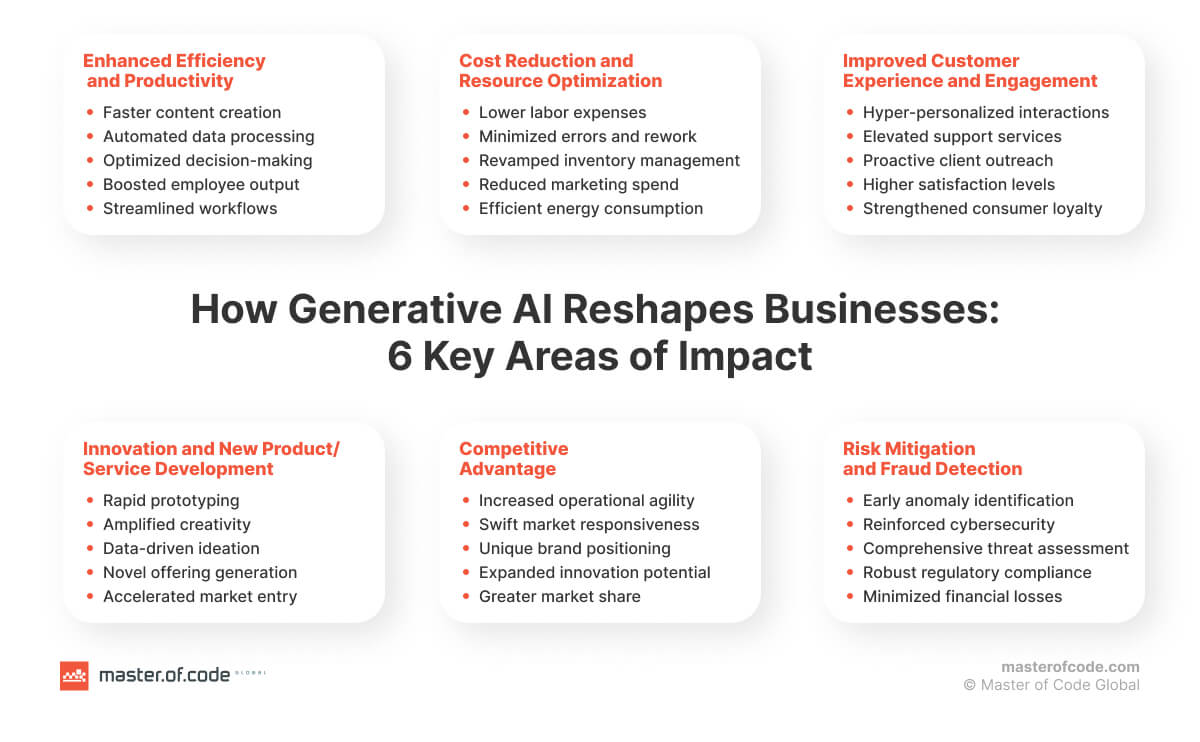
AI Stats That Prove Advantages
- Businesses incorporating GAI report average cost savings of 15.7%, making it a valuable tool for enhancing operational efficiency and resource allocation.
- Its adoption is linked to a 24.69% increase in productivity, helping teams work faster, smarter, and with greater focus across key functions.
- 74% of executives believe the benefits of Gen AI outweigh the risks. Such a positive outlook is fueled by numerous Generative AI examples across different sectors.
- Institutions using artificial intelligence report an 18% boost in customer satisfaction, productivity, and market share, with an average return of $3.50 for every $1 invested.
- 63% of organizations have experienced business growth from GAI, with 77% reporting elevated leads and client acquisition, and 71% creating new products or services.
- 70% of companies reveal grown revenue and 61% higher conversion rates.
- 45% of firms have seen doubled employee performance due to GAI, with 59% citing surged accuracy and 54% experiencing faster time to market.
- 85% of enterprises indicate escalated user engagement and 80% higher buyer satisfaction due to Generative AI insights.
- 56% of establishments register improved security posture, with 82% better able to identify threats and 71% seeing faster resolution times.
- Veteran organizations employing artificial intelligence for over three years document a 25% reduction in cost per contact, with a 30% drop for those applying Generative AI to one or two customer service use cases. These figures are further validated by real-world deployments. According to data verified through Master of Code Global’s AI Pilot Program for an Energy Sector client, facing a massive backlog of 4,300 blocked invoices per month, automating their workflows yielded immediate results. The deployed pilot solution managed to close 98.68% of conversations without human or portal redirect, automatically saving 99.35% of valid meter readings directly to SAP, while maintaining a 93% positive customer satisfaction rate.
- 78% of businesses report increased flexibility and higher service quality, while 72% see strengthened sustainability, transparency, and regulatory compliance. 52% of them witness enhanced internal efficiency and streamlined processes.
Generative AI Statistics: Return on Investment
- 50% of executives consider achieving ROI a primary success measure for intelligentization projects.
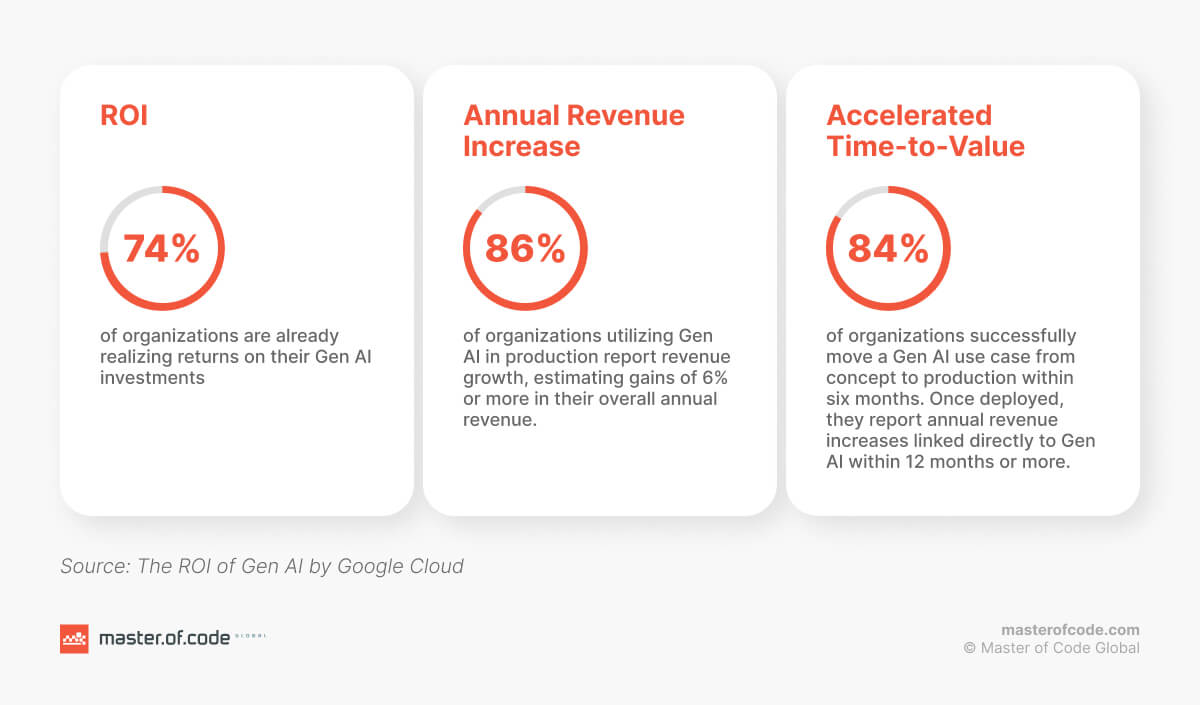
- 74% of institutions are already seeing ROI on at least one Generative AI use case, with another 30–35% expecting returns within the next 12 months.
- Current GenAI scenarios showing 26–34% ROI include customer service, productivity, sales and marketing, digital commerce, back-office processes, and manufacturing.
- 86% of companies using this intelligent technology in production report revenue growth, with an increase of 6% or more in annual income.
- 84% of organizations move an AI-based use case from concept to launch within six months, with the rise in profits reported within a year of deployment.
Risks and Challenges: Fair Gen AI Statistics
- Top Generative AI threats being addressed include hallucinations (56%), cybersecurity (53%), intellectual property issues (46%), regulatory compliance (45%), and explainability (39%).
- According to Deloitte, data privacy is the leading concern, with 72% of Generative AI users ranking it among their top three concerns and 40% listing it as their number one. Transparency follows closely, highlighted by 47% of respondents as a top-three ethical priority.
- Novice users are concerned about information security (44%) and the difficulty of integrating LLMs into processes (38%). Veteran users worry about meeting social responsibility (46%) and environmental sustainability goals (42%), as well as ensuring compliance with customer data regulations (40%).
- 79% of executives say artificial intelligence ethics is important, but fewer than 25% have implemented formal ethical practices.
- Hallucinations examples include:
- Microsoft’s travel article mistakenly listed a food bank as a destination
- A Texas A&M professor gave his class “Incomplete” grades after ChatGPT incorrectly claimed their essays were AI-generated
- Bard (now Gemini) falsely stated that the James Webb Space Telescope took the first exoplanet photo
- Bard and Bing Chat inaccurately reported a ceasefire in the Israel–Hamas conflict
What Is the Impact of Generative AI on Workplace Dynamics?
An interesting fact is that around 61.5% of companies with 11–1,000 employees are using artificial intelligence in their workflows. What’s even more compelling is that 75% of users aim to automate tasks by implementing this technology.
Most workers believe Gen AI usage can boost productivity, especially those who interact with models frequently. 82% of professionals using it weekly report increased efficiency. However, regular users are also more likely to believe GenAI could replace parts of their jobs, rising from 27% among less familiar users to 74% among weekly ones.
Generative AI is poised to reshape the workforce, with 84% of U.S. jobs facing some level of exposure to automation. In fact, nearly 1 in 10 roles are at high risk of full replacement, particularly those involving repetitive tasks or heavy data processing.
As a result, 73% of employers now consider hiring AI-skilled talent a strategic priority. Yet three out of four report that the current talent pool is too limited to meet their evolving needs, making specialized expertise in GAI both highly sought after and increasingly scarce.
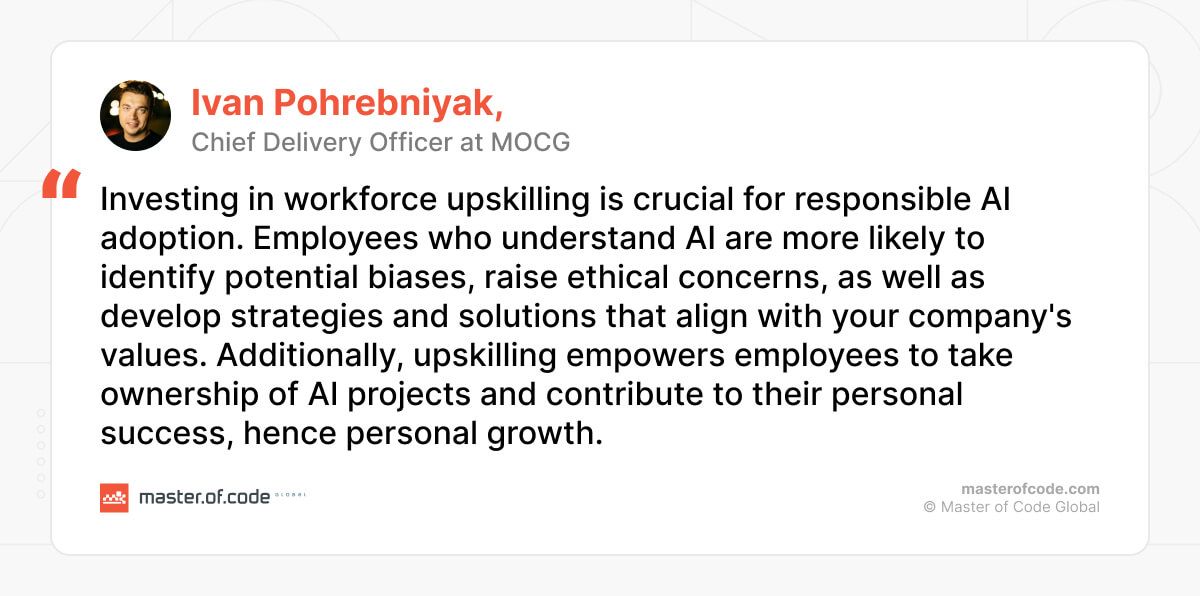
Here is a more detailed overview of the landscape, illustrated in Generative AI users statistics, as per the Work Trend Index Annual Report from Microsoft and LinkedIn:
- 75% of knowledge specialists employ AI at work, and 46% started utilizing it within the last six months.
- It allows staff to save time (90%), concentrate on important work (85%), be more creative (84%), and experience greater job fulfillment (83%).
- 79% of leaders agree their company needs smart technology to stay competitive, but 59% worry about measuring artificial intelligence’s productivity gains.
- 78% of employees bring their own intelligent tools to the workplace, with this trend even higher in small and medium-sized organizations (80%).
- 76% of personnel state they need AI skills to keep up with the competition, and 79% consider GAI will broaden their job opportunities. Yet, only 39% have received proper training, and just 25% of firms plan to offer such a Generative AI initiative this year.
- AI-experienced workers say innovative systems manage overwhelming workloads (92%), boost creativity (92%), and help focus on crucial processes (93%). These professionals are more likely to receive tailored training in prompt writing (37%), GAI use for their position (35%), and specific duties like writing or analyzing data (32%).
How Widely Is GenAI Implemented in Sales, Marketing, and Customer Service?
Marketing
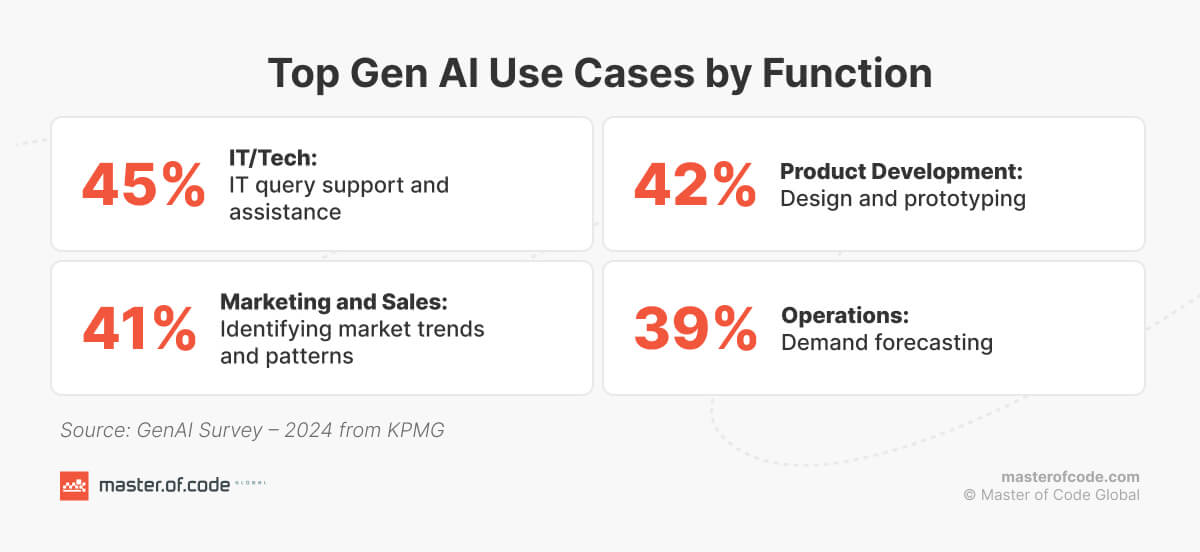
- 51% of specialists are already using or experimenting with Generative AI in marketing, with an additional 22% planning to adopt it soon. Moreover, based on the most recent statistics, 73% of marketing departments are already employing this technology.
- Professionals in this sector embrace the technology mainly for data analysis (45%), market research (40%), copywriting (27%), image generation (22%), and customer service (13%). 55% also view GAI as a leading consumer trend.
- 71% of experts expect this innovation to reduce workload, allowing more focus on strategic tasks, and predict it will save them five hours of work per week, equating to over a month per year.
- Key concerns among marketers include accuracy and quality (31%), trust (20%), skills (19%), and job security (18%). Additionally, 39% are unsure how to use GenAI safely, and 43% don’t know how to maximize its value.
- 54% believe training programs are essential for effectively employing smart tools, but 70% say their employer doesn’t yet provide such coaching.
Sales
- About one-third of salespeople surveyed said they either apply generative models or plan to do so, with 61% believing it will help them better serve their customers.
- Sellers expect artificial intelligence will transform their roles by generating sales reports (51%), essential content production (48%), and scrutinizing market metrics (47%).
- 53% of domain professionals admit they don’t know how to get the most value from this technology, while nearly half are unsure how to employ it safely (49%) or effectively (47%). Moreover, 39% are anxious about job security if they don’t adapt to utilizing LLMs.
- The primary use of Generative AI in sales is for basic content creation (82%), analyzing market data (74%), and automating personalized communications (71%).
Customer Services
- Pairing agents with virtual assistants results in a 7.7% growth in simultaneous chats handled and average savings of $4.3 million in staffing costs.
- 65% of client support leaders expect combining Generative AI with Conversational AI to boost buyer satisfaction. Currently, 44% of organizations use GAI to create test cases for training interactive agents, and 46% use it to write dialogue for these systems.
- Support teams with extensive experience in conversational solutions see a 37% higher ROI when deploying Gen AI in customer services, while less seasoned specialists achieve a 117% return on investment uplift.
- A study by Stanford and MIT shows a 13.8% increase in successfully resolved chats per hour when artificial intelligence is employed.
- 84% of executives rely on the technology for customer communication, with key goals including faster information delivery (67%), reduced wait times (62%), advanced accuracy (53%), consistent experiences (42%), tailored responses (41%), and cost savings (28%).
- Early adopters report benefits such as enriched consumer service (69%), streamlined workflows (54%), higher client satisfaction (48%), and better use of analytics (41%). Additional outcomes include increased revenue (34%), better ratings (40%), and improved team productivity (32%).
Find more AI in customer service statistics in our recent blogpost
How Is Generative AI Being Utilized in Various Industries?
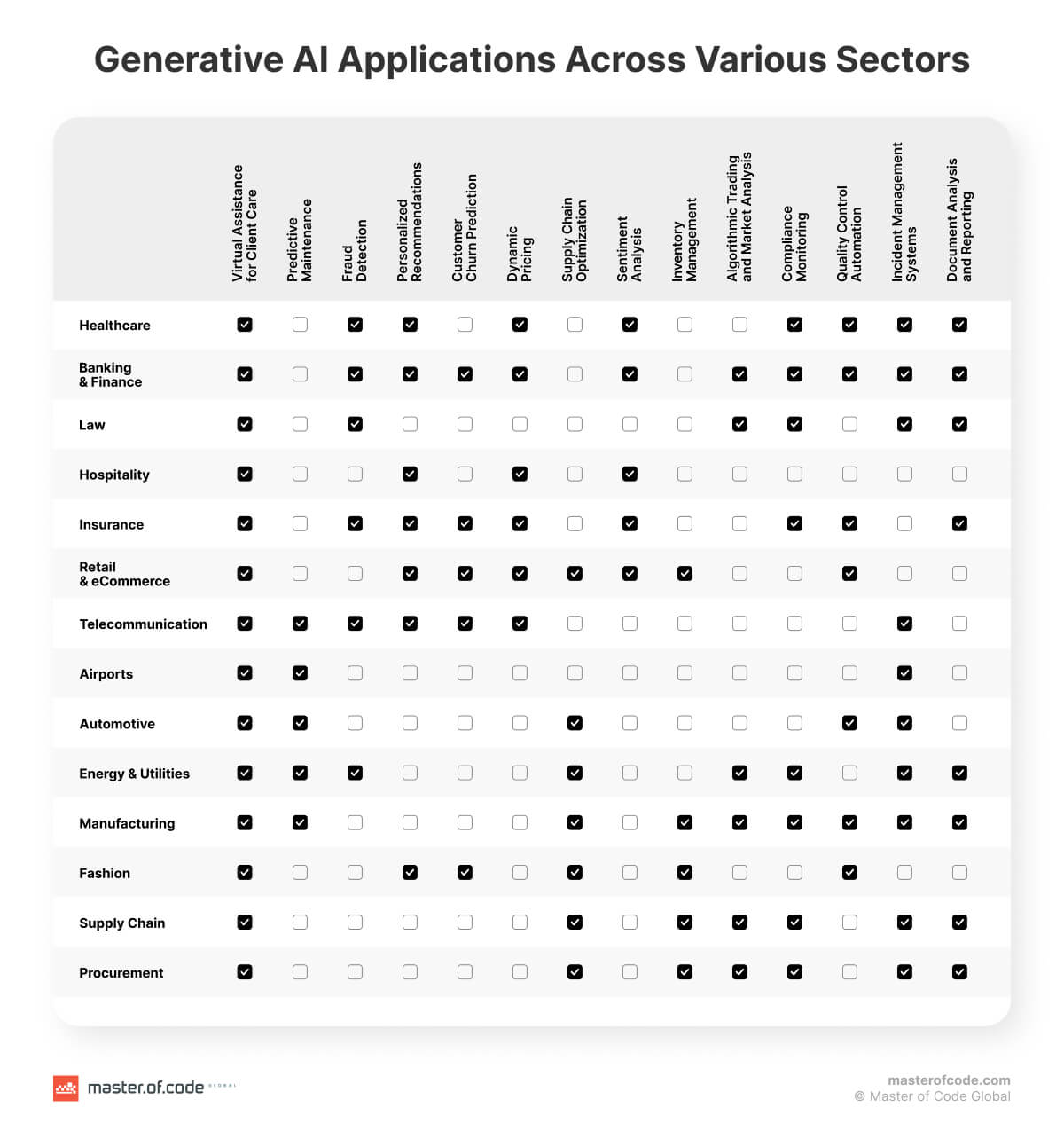
As we explore the broader impact of the technology, it’s important to examine its adoption across diverse fields. The latest Generative AI stats highlight how different sectors are integrating this innovation to enhance operations, improve customer engagement, and drive growth. Let’s take a closer look at its influence across various landscapes in detail.
Healthcare
- General adoption rate: Over 70% of healthcare organizations, including payers, providers, and tech groups, have implemented or are pursuing GenAI capabilities.
- According to Statista, only about 20% of medical organizations globally have deployed generative models in production. However, 98% of these institutions either have a strategy in place or are planning to develop one.
- 72% of healthcare executives stated that they trust artificial intelligence to automate administrative processes, allowing clinicians to dedicate more time to patient care.
- The top anticipated medical uses for Generative AI in the next year, as highlighted by Bain, include charge capture and reconciliation (39%), structuring and analyzing patient data (37%), and workflow optimization and automation (36%).
- Long-term priorities are AI predictive analytics services to incorporate, as well as risk stratification (44%), clinical decision support tools (41%), diagnostics and treatment recommendations (37%).
- The primary challenges in adopting GAI in the sector are a lack of resources (46%), lack of expertise (46%), and regulatory hurdles (33%).
- The Intake’s survey reveals the following: after evaluating AI-driven medical advice, 95% of healthcare professionals developed a more positive attitude toward it. 80% of Americans believe intelligent technology can improve care quality, lower costs, and increase access to services. 25% of people would prefer to engage with a chatbot rather than visit a therapist, and a quarter of Americans would avoid providers who refuse to implement artificial intelligence technologies.
Pharma
General adoption rate: 75% of AI-first biotech companies are substantially using GenAI in drug discovery.
Boston Consulting Group highlighted five leading Generative AI uses among such organizations:
- Faster drug molecular design: Reduces production time by 25%.
- Accelerated clinical development: Automating medical document creation cuts writing time by 30%.
- Improved quality management: Routine tasks see 20–30% performance improvement.
- Content creation and personalization: Increases revenue by 10% and lowers external costs by over 25%.
- Facilitated review processes: Boosts productivity in high-frequency tasks by up to 40%.
Illustrative cases of Generative AI’s effect in the pharmaceutical field include:
- DiffDock: Achieved a 38% success rate in molecular docking predictions, outperforming traditional methods.
- Insilico Medicine: Developed a drug candidate at 1/10 the usual cost and in 1/3 of the time, with 79% accuracy in forecasting clinical trial outcomes.
- Recursion: Used artificial intelligence to predict targets for 36 billion compounds in just a week, a process that would have taken 100,000 years with conventional techniques.
- Sanofi has enhanced drug discovery, improving target identification in immunology, oncology, and neurology by 20–30%, while accurately predicting 80% of low inventory positions, significantly boosting supply chain reliability.
Finance & Banking
- General adoption rate: More than 50% of financial services leaders report using GenAI, up from 40% the previous year.
- 77% of executives believe artificial intelligence is critical to their success. Moreover, 80% of CFOs plan to expand tech spending in the next two years, and 72% of CEOs cite AI funding as a top priority.
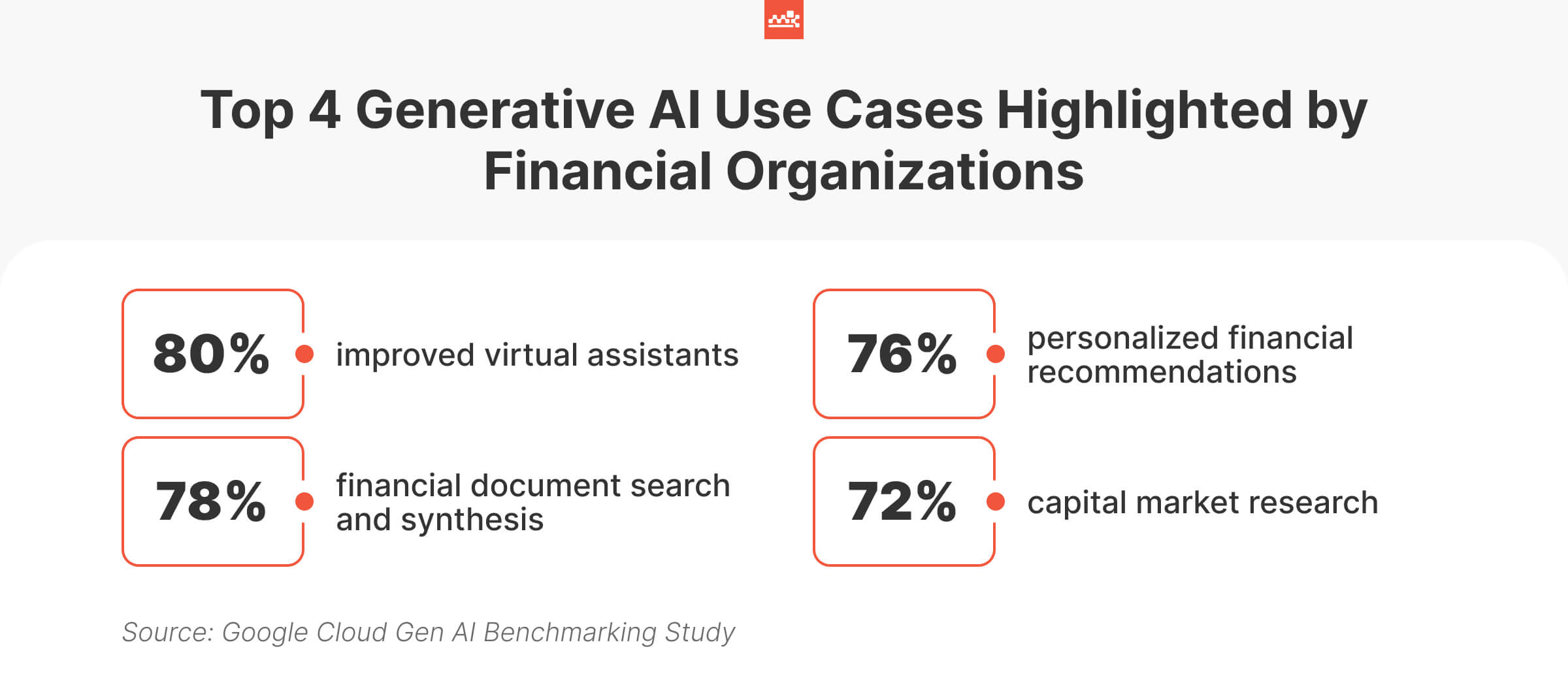
- Top Generative AI use cases in finance include improved virtual assistants (80%), financial document search (78%), personalized recommendations (76%), and capital market analysis (72%).
- 48.2% of industry leaders are investing in AI research, and 44.8% have already implemented smart solutions. Two-thirds of C-level professionals expect a 10–30% increase in revenues over the next three years.
- 40% of individuals already view the technology as a financial management tool, and over half are willing to adopt it for monetary ease. One-third of those who have tried AI trust it more than humans to manage their assets.
- 70% of decision-makers in banking consider personalization to be key to customer service, though only 14% of consumers feel banks offer excellent tailored experiences.
- Gen AI could boost productivity by 2.8% to 4.7%, adding $200 billion to $340 billion in revenue, and elevate front-office employee efficiency by 27% to 35% by 2026, potentially generating an additional $3.5 million per worker.
For a more detailed overview of the landscape, check out our latest guide to get the most out of the technology
Law
General adoption rate: 28% of law firms and 23% of corporate legal departments have adopted GenAI tools.
Based on the Wolters Kluwer Future Ready Lawyer Survey results:
- The majority of lawyers stress the importance of adopting the latest tools, and 73% expect to integrate artificial intelligence into their work this year.
- 43% of surveyed experts view the technology as an opportunity, while 25% perceive it as a potential threat in legal operations.
- 75% of professionals are ready to strategically invest in intelligent systems, with over half of law firms and departments planning to increase their investment.
- 87% of attorneys report that Generative AI in legal practices has significantly improved their daily processes.
As per Goldman Sachs:
- 44% of current legal tasks could be automated by AI.
- 85% of law agencies and 84% of legal units are set to expand their reliance on technology to boost productivity.
Travel and Hospitality
- General adoption rate: 72% of travel industry professionals have experience customizing GenAI models, while 24% report hands-on usage.
- Artificial intelligence is already influencing 30% of service professionals in the sector and is expected to impact 32% of establishments’ revenues.
- Currently valued at $632.18 million, the Generative AI market in hospitality is projected to grow to $3.58 billion by 2032.
- Based on LTIMindtree, 79% of the industry adopts GenAI to improve customer experience, 48% to streamline creative content generation, and 67% to optimize processes. Furthermore, its integration improves operational efficiency by 20–40% and boosts revenue by 5–20%.
- Skift reports that 81% of hospitality business leaders see benefits from intelligent tools, with 52% prioritizing their development and 95% confident in their positive influence on guest experiences.
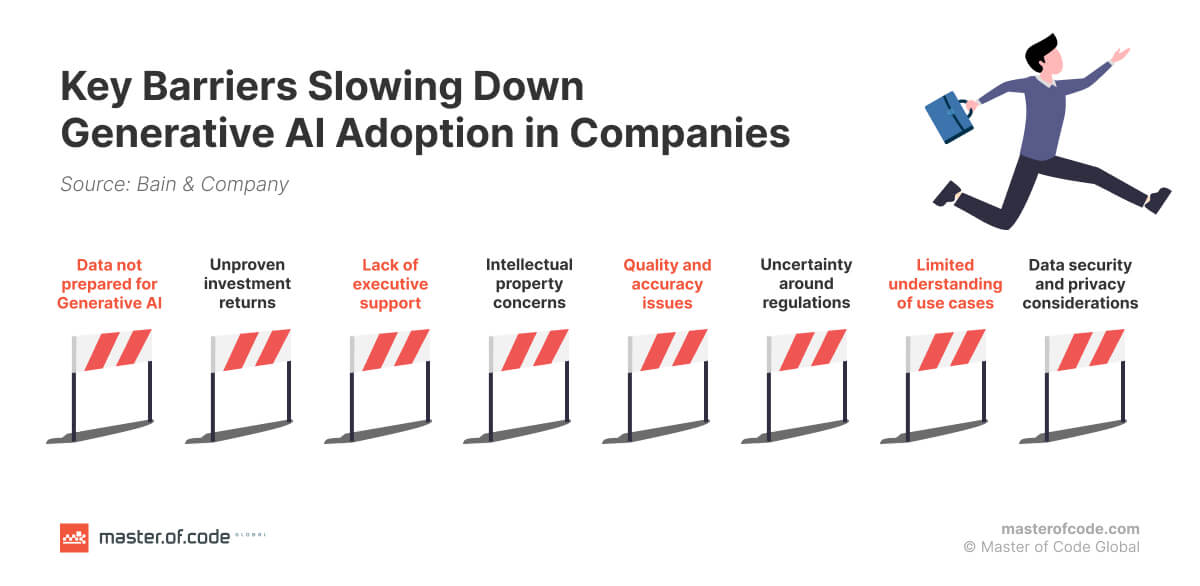
- At the same time, 72% of executives are concerned about ethical issues such as privacy loss, and 49% fear the erosion of the human touch.
Insurance
- General adoption rate: 48% of insurance companies adopted GenAI in 2025, a rise from 29% in 2024.
- The benefits include improved staff efficiency (61%), enhanced customer service (48%), cost savings (56%), and fostering growth (48%).
- Client attitudes toward this technology are positive, with 47% in the UK and 55% in the US viewing it favorably. Moreover, 44% of consumers are comfortable using chatbots for claims, and 43% prefer them for coverage applications.
- In terms of adoption, major barriers include staff training (47%) and costs (35%).
- Key functions benefiting from Generative AI in insurance are marketing and claims (54%), administration (47%), underwriting (46%), and insured onboarding (43%).
- In accordance with BCG, intelligent systems could boost support agents’ productivity by 40–60% by reducing the 35% of time agents spend retrieving information. Streamlining documentation could improve efficiency by 20–30%.
Automotive
- General adoption rate: 75% of automotive companies are experimenting with at least one GenAI use case, while the remaining 25% plan to start within a year.
- The Generative AI market in the sector, valued at $312.46 million in 2022, is expected to grow to $2.69 billion by 2032. McKinsey predicts this technology will generate $300 billion annually for the industry by 2035.
- As stated by IDC and Microsoft, 71% of organizations currently utilize intelligent systems, and an additional 22% plan to implement them within the next year.
- GAI is already impacting automotive businesses, with McKinsey reporting a 10–20% reduction in development timelines for automobile parts.
- 66% of executives believe the benefits of Generative AI outweigh the risks, and 30% of firms have dedicated teams for its integration.
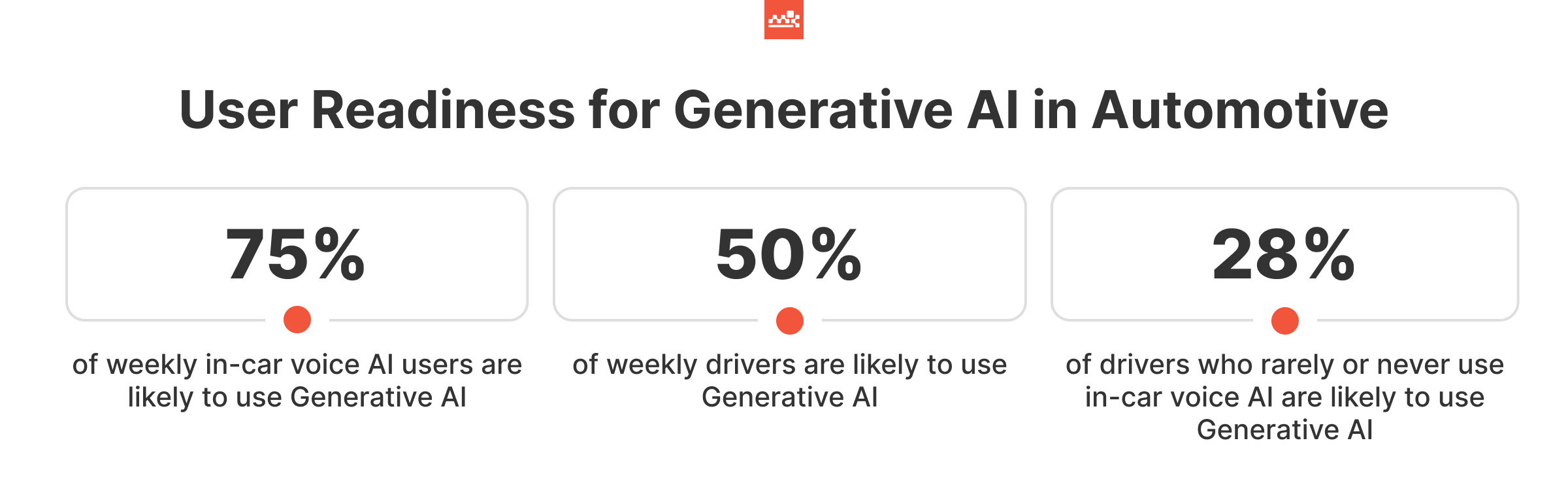
- A study of 1,008 drivers shows that 50% are interested in adding GenAI to their in-car voice assistants, rising to 75% among frequent users. Even 28% of those who rarely use such features are open to adopting them.
Retail
- General adoption rate: 42% of retailers are currently using AI, and another 34% are piloting or evaluating solutions.
- Top intelligent features for retail personalization include live search (42%), automated product recommendations (35.7%), and virtual try-ons (32.6%).
- 60% of retailers plan to adopt these technologies next year to enhance in-store and online experiences. Adoption priorities include better customer journey (59%), higher performance (49%), and cost efficiency or ROI (44%).
- Generative AI is transforming retail, with key applications in tailored suggestions (66%), trend analysis and inventory management (64%), automatic product description generation (53%), virtual try-ons (28%), and faster design and development (21%).
- As per a Salesforce report, 17% of shoppers have used artificial intelligence for purchasing inspiration, and 45% are interested in using it for shopping. Retailers are responding, with 92% increasing their investments and 59% already implementing it for personalized recommendations.
- A Stanford University study estimates AI can boost sector productivity by 2% of annual revenue, or $400 billion to $660 billion, primarily by automating repetitive tasks and allowing employees to focus on critical initiatives. Additionally, 46% of companies use the technology to control costs.
eCommerce

- General adoption rate: 78% of brands have implemented or plan to integrate AI, highlighting the industry’s dedication to innovation.
- 83% of organizations see improved chatbots as the top GenAI application in commerce.
- In fact, firms that have introduced conversational agents for communication report an average open rate of 85% and a CTR of 40%.
- Generative AI in eCommerce is forecasted to reach $2.1 billion by 2032, with a projected annual growth rate of 14.90%.
- 69% of clients are open to using artificial intelligence for enhanced shopping experiences.
- 42% of customers chose live search as the top AI personalization feature for purchase decisions, while 35.7% favor automated product recommendations based on previous behavior.
- McKinsey research shows that personalized marketing can reduce customer acquisition costs by up to 50%, boost revenues by 5–15%, and increase marketing ROI by 10–30%.
Telecom
General adoption rate: 49% of telecom organizations are adopting or assessing GenAI, with 84% planning to offer GenAI-powered customer services.
According to Generative AI Statistics from the Altman Solon and AWS Report:
- 70% of CSPs recognize the unique and significant value of the technology.
- 64% of providers view Generative AI telecom use cases as net-new rather than replacements for existing ones. Current adoption rates for tested scenarios stand at 19% and are expected to rise to 48% within the next two years.
- The most widely adopted application is customer chatbots, with 63% of respondents already using this tool.
- The main drivers for integrating artificial intelligence include increased efficiency and productivity (41%), cost savings (20%), and competitive advantage (18%).
Generative AI Trends 2026
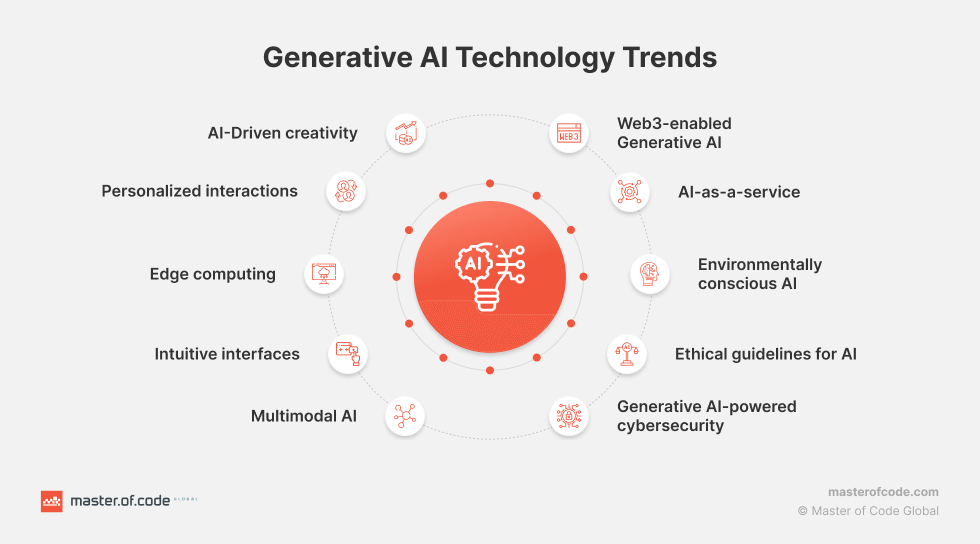
According to Capgemini, key directions include the rise of vertical AI, booming demand for synthetic data, and the widespread use of Conversational AI that anticipates user needs. Technology is also poised to reshape governance, legal frameworks, and cloud data strategies, making 2026 a pivotal year for applied intelligence across industries.
Based on insights from our team across departments, these are the top five Gen AI trends predicted by Master of Code employees that are shaping the 2026 business landscape:
- Hyper-Personalization at Scale: Generative solutions are evolving from a generic assistant into a highly customized teammate. From voice-matching assistants to tailored learning and marketing experiences, 2026 will see a sharp rise in tools that adapt in real time to individual preferences, behaviors, and tones of voice.
- Vertical & Modular AI Will Outpace Generic Systems: Businesses are shifting from off-the-shelf models to domain-specific applications fine-tuned for legal, healthcare, finance, or retail. Custom modules, test-driven prompt engineering, and mixed-model strategies such as ChatGPT, Claude, and Gemini will define enterprise usage.
- AI-Enhanced Content & Creative Production: With more accessible video, image, voice, and diagram generation, this technology is becoming a full-stack partner. Teams expect breakthroughs in brand-consistent visual creation, AI-generated ads, and multi-format outputs, streamlining both marketing and internal storytelling.
- Security, Ethics & Regulation Move Center Stage: As utilization deepens, so do concerns about data privacy, misuse, and ethical transparency. From OWASP LLM standards to federated learning and API threat modeling, 2026 will usher in stricter frameworks and business-level safeguards.
- Trustworthy AI = Competitive Edge: Companies that combine machine outputs with human oversight, explainability, and compliance will outperform those relying on black-box solutions. Confidence scores, source traceability, and visible model logic will become essential to earn trust and drive adoption.
Ethical Considerations and Regulatory Landscape
Today, it seems that adoption is moving faster than trust. While companies push ahead with deployment, people and regulators are asking harder questions about safety, accountability, and control. Key Generative AI statistics reveal a clear tension between speed and confidence—and that tension is shaping regulation on both sides of the Atlantic.
The Trust Gap: Adoption Is Outpacing Confidence
Even as Generative AI becomes part of daily work, skepticism remains high. Nearly 60% of workers worry that AI outputs are biased or simply wrong, and 73% believe Generative AI introduces new security risks. In practice, this means teams may use the tools but hesitate to rely on them fully. In many cases, those concerns trace back to unclear data sources, poorly governed GenAI inputs, and limited visibility into how models process sensitive information.
What makes this gap more concerning is how few organizations are formally addressing it. Only 13% of businesses have hired AI ethics specialists to oversee responsible use, governance, and risk mitigation. For most companies, ethical decision-making still falls to overstretched legal, IT, or product teams—often without clear ownership or established frameworks.
United States
In the US, Generative AI market regulation is being shaped primarily at the state level, and the pace is accelerating fast.
During 2025 alone, more than 1,000 AI-related bills were introduced in state legislatures, more than double the number seen the year before. Every US state, along with Puerto Rico, the Virgin Islands, and Washington, DC, considered some form of AI-focused legislation. By the end of the year, around 38 states had enacted close to 100 new AI-related measures.
The medical sector has emerged as a major pressure point. 34 states introduced more than 250 healthcare-focused AI bills, reflecting concerns around automated decision-making, diagnostics, and patient data. At the same time, privacy is no longer optional. By 2025, nearly every state had adopted data privacy and security laws that directly affect AI systems.
At the federal level, one signal stood out. The US Senate voted 99–1 to remove a proposal that would have blocked state-level AI regulation for a decade. In effect, lawmakers chose diversity of oversight over a single national pause, ensuring that AI governance in the US will remain fragmented—but active.
Europe
Europe has taken a very different approach. The EU AI Act—the world’s first comprehensive AI law—has been in force since August 2024, with enforcement ramping up through 2026. Instead of patchwork rules, the EU opted for a single framework based on risk classification, transparency, and oversight.
The penalties are designed to get attention. Companies found in violation can face fines starting at €7.5 million or 1.5% of global turnover, rising to €35 million or 7% of worldwide revenue for the most serious breaches. For large organizations, these are board-level risks, not compliance footnotes.
To support enforcement, the European AI Office will begin overseeing general-purpose AI models in August 2026, with a focus on transparency obligations, safety testing, and systemic risk mitigation.
The strictest rules apply to foundation and general-purpose models—systems with advanced computing capabilities, including those developed by major providers such as OpenAI, Google, Meta, Anthropic, and Mistral. These models fall under “systemic risk” provisions, with compliance deadlines set one year after enforcement begins.
Frequently Asked Questions
What industries are currently leading in the adoption of Generative AI?
Verticals setting the pace include healthcare (70%), finance (50%), automotive (75%), and retail (42%). Insurance (48%) and telecom (49%) are also making significant progress in implementation and practical use.
How many people use Generative AI?
Global daily users are estimated between 115 and 180 million as of early 2025. In the US, nearly 40% of adults aged 18–64 have experimented with these tools, with the highest usage among younger generations and professionals in workplace settings.
The Bottom Line
These statistics on Generative AI reveal a swiftly shifting ecosystem with substantial adoption rates and potential across industries. While challenges remain, businesses integrating this technology are reaping the rewards of enhanced efficiency, productivity, and customer satisfaction. For those eager to learn more about its capabilities in practice, Master of Code Global is ready to guide you on your intelligentization journey. Contact us today to reimagine your business and outperform set targets with GenAI at the helm.
Ready to build your own Conversational AI solution? Let’s chat!