


Telecom operators can detect a fraction-of-a-second delay anywhere in their network. They monitor latency, jitter, and uptime around the clock. But when it comes to customer conversations, the same discipline often disappears.
Every day, thousands of interactions fade out. A customer hangs up mid-hold. A billing chat stalls. A subscriber repeats their issue across channels and quits. While network uptime is measured to the decimal point, conversation breakdowns rarely make it to the executive dashboard.
The business cost is measurable. Research widely cited by Harvard Business Review shows that acquiring a new customer can cost 5 to 25 times more than retaining an existing one. When service interactions frustrate users, those economics compound quickly.
Poor support is not a minor irritant. It is a switching trigger. User experience research across telecom markets consistently shows that service failures are among the top reasons subscribers change providers. In a sector where pricing and coverage increasingly look alike, interaction quality becomes the differentiator.
This is why conversational AI in telecom cannot be treated as a chatbot add-on. It sits at the intersection of user experience, contact center operations, and revenue protection. According to the World Economic Forum, 65% of working hours can be transformed by LLMs on average, with 36% of the time susceptible to automation and 30% susceptible to augmentation.


Conversational AI in telecommunications changes how operators listen, authenticate, resolve, upsell, and retain. It reduces friction in high-volume interactions, lowers handling time, and creates structured insight from every exchange. When conversation uptime becomes as visible as network uptime, efficiency improves.
Table of Contents
Key Takeaways
- Conversational AI in telecom is a present-day competitive divide.
- Transactions are the quickest margin win (payments, AutoPay, plan/SIM flows in one thread).
- Support and sales are merging as messaging becomes a purchase path for add-ons and bundles.
- Personalization that reduces effort beats “Hi, Alex” (less repetition, smarter troubleshooting).
- RCS upgrades the same journeys with branded, interactive actions in the native inbox.
- Conversation analytics turns transcripts into signals for churn risk, drop-offs, and ops fixes.
Why Telecom Needs Conversational AI Right Now
According to the GSMA Mobile Economy Report 2024, there are more than 5.6 billion unique mobile subscribers worldwide, and mobile technologies and services contributed $6.5 trillion to global GDP in 2023.
That scale translates into billions of service interactions each month: billing disputes, plan changes, SIM activations, and device troubleshooting. These are high-frequency, operationally expensive touchpoints that directly shape customer experience. Most of these should be self-service interactions, but many still end up in queues because the tools can’t complete the action.
At the same time, revenue growth is tightening. GSMA research shows that while mobile data traffic continues to grow rapidly, ARPU growth in mature markets remains modest, even as operators invest heavily in 5G infrastructure.
The equation becomes difficult. Capital expenditure rises. Pricing pressure increases. Margins narrow. Cost-to-serve must decline without degrading service quality.
Competition also keeps getting easier for customers. The OECD Digital Economy Outlook 2024 (Volume 1) details how policy, market structure, and digital conditions continue to lower friction in switching and intensify competitive dynamics across communications markets. When changing providers feels simple, experience becomes the difference people remember.
Expectations outside telecom raise the bar inside telecom. PwC’s customer experience research found 32% of consumers will walk away from a brand they love after just one bad experience. In telecom, where problems trigger most conversations, that “one bad experience” happens fast: long waits, repetitive user authentication, or being bounced between systems.
The bigger issue is the mismatch between infrastructure and engagement. Telecom networks evolved from analog to digital to 5G. Customer engagement often still runs on fragmented tools and legacy systems, where context gets lost and customers do the work agents should not have to ask for twice.
That is why Conversational AI in telecom is showing up now as a practical move: it powers customer support automation at scale without pushing users into dead ends. It absorbs routine demand across voice assistants, provides omnichannel support, and takes pressure off contact center operations.
Six Use Cases Reshaping Telecom
Telecom conversations rarely stay “support-only.” A billing question turns into a payment. A device issue turns into an upgrade. A cancellation chat becomes a last-chance retention moment.
The six AI use cases in telecom below follow that reality on purpose: start with the transactional base, expand into commerce, deepen with personalization, add the channel that makes interactions richer (RCS), then layer in the intelligence engine (analytics). The themes behind these use cases show up across industries; the latest conversational AI trends point to the same shift toward action-based assistants.
AI-Powered Transaction Support
A customer comes in to do something simple, pay a bill, activate a SIM, change a plan, and friction shows up fast. They get routed to the wrong place, repeat authentication steps, lose context after a handoff, and abandon the task. Conversational AI in telecom keeps these tasks inside one continuous dialogue thread, so customers can complete transactions without restarting.
In our case, we partnered with a major U.S. telecom brand to scale its virtual assistant, augmenting their internal Digital AI team with strategic roadmapping and use case prioritization, conversation design, bot tuning, and ongoing optimization based on real conversation data. We also helped enable end-to-end self-service through the building blocks that make transactions work in-chat: authentication, API integrations, and event tracking for performance visibility.
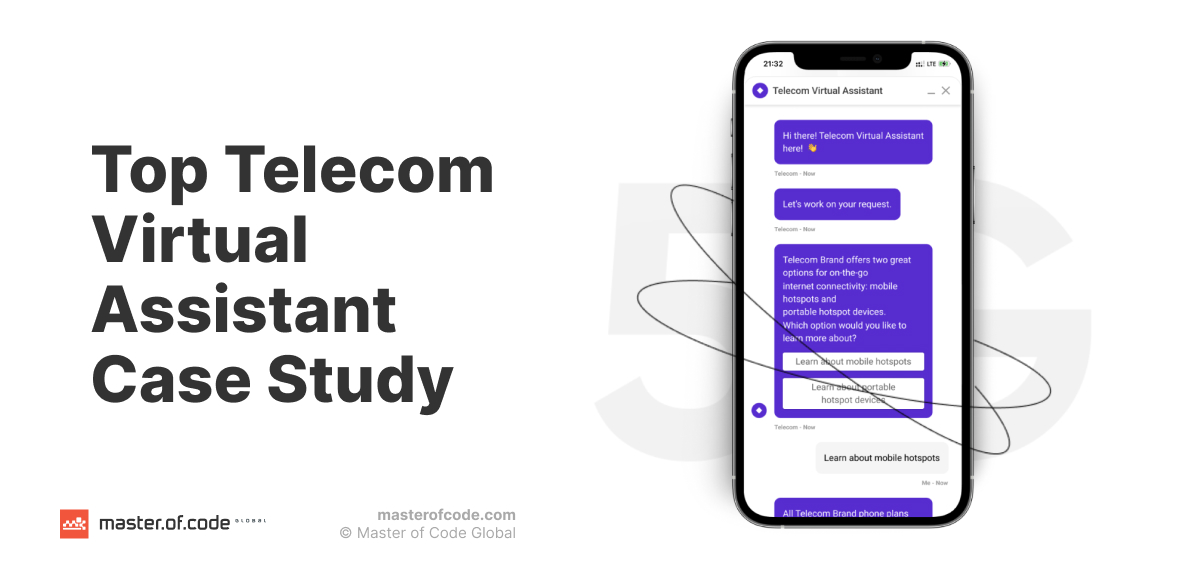
As a result, the U.S. telecom virtual assistant solution grew to 40+ use cases since May 2020 and, after 24 months in production, supported transactional flows like one-time payments, AutoPay management, and plan/add-on management, reaching 1.1M+ conversations and a 45% containment rate in one-time payment and AutoPay experiences.
Conversational Commerce in Telecom
If a customer can buy plane tickets in a few taps, why does buying a telecom bundle still feel like a scavenger hunt? Many sales journeys split across web pages, store visits, and call queues, with no single thread that carries intent forward.
Conversational commerce AI in telecom pulls discovery and decision-making into messaging. The “storefront” becomes the dialogue itself: ask what you need, compare options, pick an add-on, confirm, and move on. The telecom advantage is obvious here, they already sit inside the channels people use daily.
We’ve seen conversational commerce work at scale firsthand. In our U.S. telecom virtual assistant solution, the “add-on” journeys we built turned support chats into revenue-driving moments, enabling customers to activate and manage services like Netflix, Paramount Plus, and Device Protection without leaving the conversation. Those experiences delivered 73%, 64%, and 62% containment, respectively.
Personalization That Actually Moves the Needle
Most telecom personalization is easy to spot, and easy to ignore. A first name in an email. A generic “loyalty offer” dropped into a cancellation flow. Customers can tell when the business doesn’t understand their context.
Conversational AI for enterprise personalizes in motion. It can adjust questions based on what the client already shared, interpret natural language (“it started yesterday after the update”), and avoid wasting time on details already captured. It can also react to sentiment shifts, which matters in high-stakes moments like retention conversations. That’s where churn reduction gets real, because the offer and the tone change based on the user’s context, not a template
A telecom GenAI troubleshooting flow from our work shows what this looks like in real support. For a leading provider, we built a GenAI data-collection assistant that runs inside existing messaging channels and can be launched by a live agent with a single click.

We designed the adaptive troubleshooting dialogue to capture diagnostic signals in natural language, avoid re-asking questions the customer already answered, and guide users through targeted steps based on what the assistant learns in the moment.
On the backend, we connected the flow to agent-facing tools so the assistant can package the conversation into structured, action-ready context for handoff, paired with analytics that track containment, first-contact resolution, abandonment, handling time, and sentiment.
The outcome: customers felt heard and didn’t get dragged through repetitive steps, which translated into a reported +10 NPS points, alongside +25% more issues resolved without specialist escalation and -18% less time spent per case thanks to pre-collected, organized troubleshooting data.
RCS as a Game-Changing Channel
Telecom operators built the rails for mobile messaging, yet OTT apps took over the customer’s attention. SMS still reaches almost everyone, but it’s stuck in plain text. That makes it a weak fit for transactions, comparisons, and guided support.
RCS in telecom changes the shape of the interaction. Google’s RCS for Business materials describe verified sender profiles that display brand identity (name, colors, logo), plus interactive formats like rich cards that combine media, text, and suggested replies/actions, including carousels. RCS also works well for time-sensitive updates like outage notifications, where customers want fast status, clear next steps, and fewer calls into the contact center.
This is where earlier use cases get sharper. A plan comparison becomes visual. A payment prompt becomes an action. A troubleshooting step becomes a guided sequence. And because it runs in the phone’s native messaging app, consumers don’t have to install anything new to participate.
Conversation Analytics as a Strategic Asset
Telecom companies already have the raw material: mountains of transcripts. The missed opportunity is what happens next. Too often, conversation data stays locked in QA samples and surface-level reporting, while conversational AI in telecom can turn these interactions into actionable insights.
Advanced analytics turns language into signals. You can spot where customers drop off, which intents trigger escalations, what topics spike after an outage, where sentiment drops, and when churn intent shows up in plain words. Used well, those signals turn churn reduction into a measurable workflow.
Two examples show the difference between “having data” and using it well. While working on our telecom virtual assistant project, Master of Code Global’s team implemented custom event tracking and conversation logging as part of the build, so the solution generated structured insight alongside resolutions.
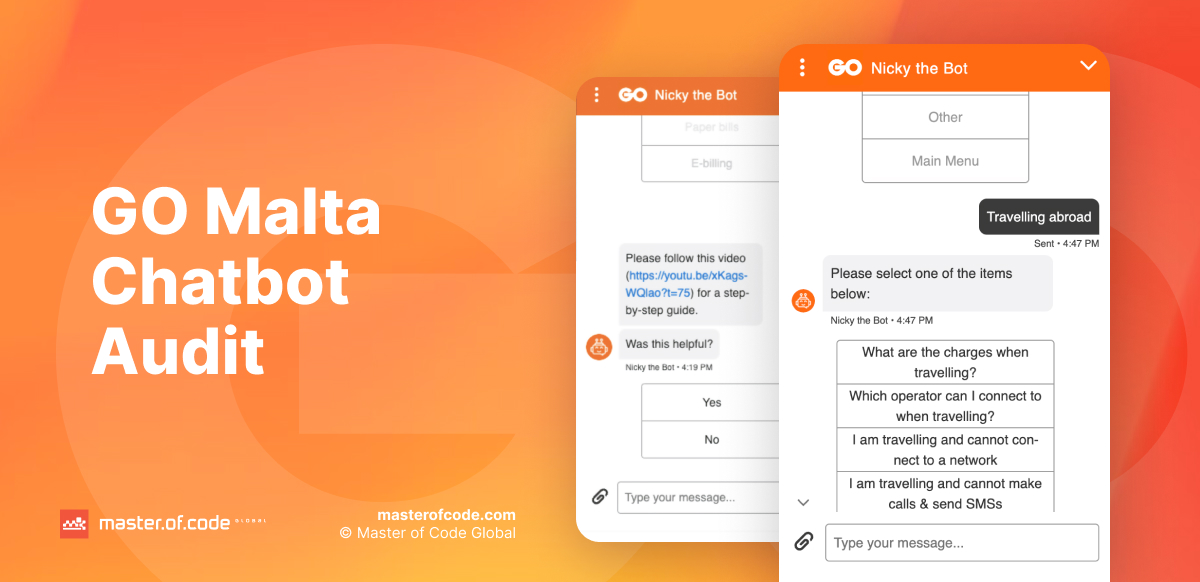
By the way, in the recent GO Malta chatbot audit, our work explicitly included an analytical data review focused on engagement rates, drop-off points, and resolution rates, alongside transcript and flow analysis. That’s what you can learn when you treat conversations like operational telemetry.
AI-Augmented Technical Support
Picture the first five minutes of a typical network troubleshooting call: “my internet is down,” “my speed dropped,” “my router keeps blinking.” The agent isn’t solving the issue yet. They’re collecting basics: restarting the router, checking the lights, confirming the address, describing the error, and trying a different device.
Customers feel stuck in a script, and agents burn time on questions they’ve asked a thousand times. In telecom, these calls spill into voice and chat assistants as well, and users expect the context to follow them.
Instead of forcing people through rigid menus, an AI agent can collect the right inputs through natural conversation, understand messy replies (“it’s been acting up since yesterday”), and guide the customer through targeted steps to fix the slow Internet or other network issues. Then it hands a structured, ready-to-act summary to a human agent, or resolves the issue without escalation when it’s straightforward.
Master of Code Global’s Gen AI Data Collection Flow case study shows this model in action for a leading telecom provider. The AI model ran inside existing messaging channels and could be launched by agents with a single click during live interactions. It also skipped already-answered questions and adapted its next steps based on the user context.
Why Custom Models Beat Off-the-Shelf Solutions
Ready-made chatbot platforms can be a smart starting point in telecom. If your goal is basic FAQ deflection, a packaged tool may help you get live quickly. The challenge shows up when you need it to work like a telecom operator, not a generic support widget.
Telecom isn’t a “single-system” business. Real customer journeys run across legacy BSS/OSS, billing, CRM, identity, device management, and network tooling. Add compliance requirements that vary by market, multilingual audiences, and product catalogs full of plan-and-add-on combinations, and the complexity stacks up fast.
This is where one-size tools often start to show limits. They may handle simple Q&A, but struggle with telecom-specific workflows and the integrations needed to keep context intact. The result is familiar: customers get broad answers, the bot can’t complete the action, and people end up in an agent queue anyway, now with extra friction added to the journey. In telecom, generic answers quietly drain operational efficiency through avoidable escalations.
Custom models take a different route. You tune them on your knowledge, your policies, and your real conversation patterns. You connect them to your stack so the assistant can actually do the work: authenticate, pull account context, run the right flow, log events, and hand off with a clean summary when needed. That’s how Сonversational AI stops being “chat” and starts behaving like operations.
Custom also doesn’t have to mean slow. With the right partner, it’s iterative: start with the highest-volume flows, launch, learn from transcripts, then expand. The difference is that you’re building a foundation you can grow, not stretching templates past what they were designed to do.
GO Malta is a good “before” example. They already had a chatbot, but it wasn’t meeting expectations: responses were inconsistent, conversational design was limited, and personalization was thin. Our AI consulting for telecommunications went beyond surface tweaks: transcript analysis, flow evaluation, NLP assessment, conversation design workshops, technical implementation review, and analytical data review to pinpoint where users dropped off and why. The output was a future-ready roadmap for GenAI integration, including a documented bot persona and tone of voice, redesigned main flows, and a detailed audit report with clear next steps.
How to Choose the Right AI Partner
Conversational AI in telecom touches billing, identity, product logic, and technical support. So partner selection comes down to execution: can they connect to your systems, handle edge cases, and keep improving after launch?
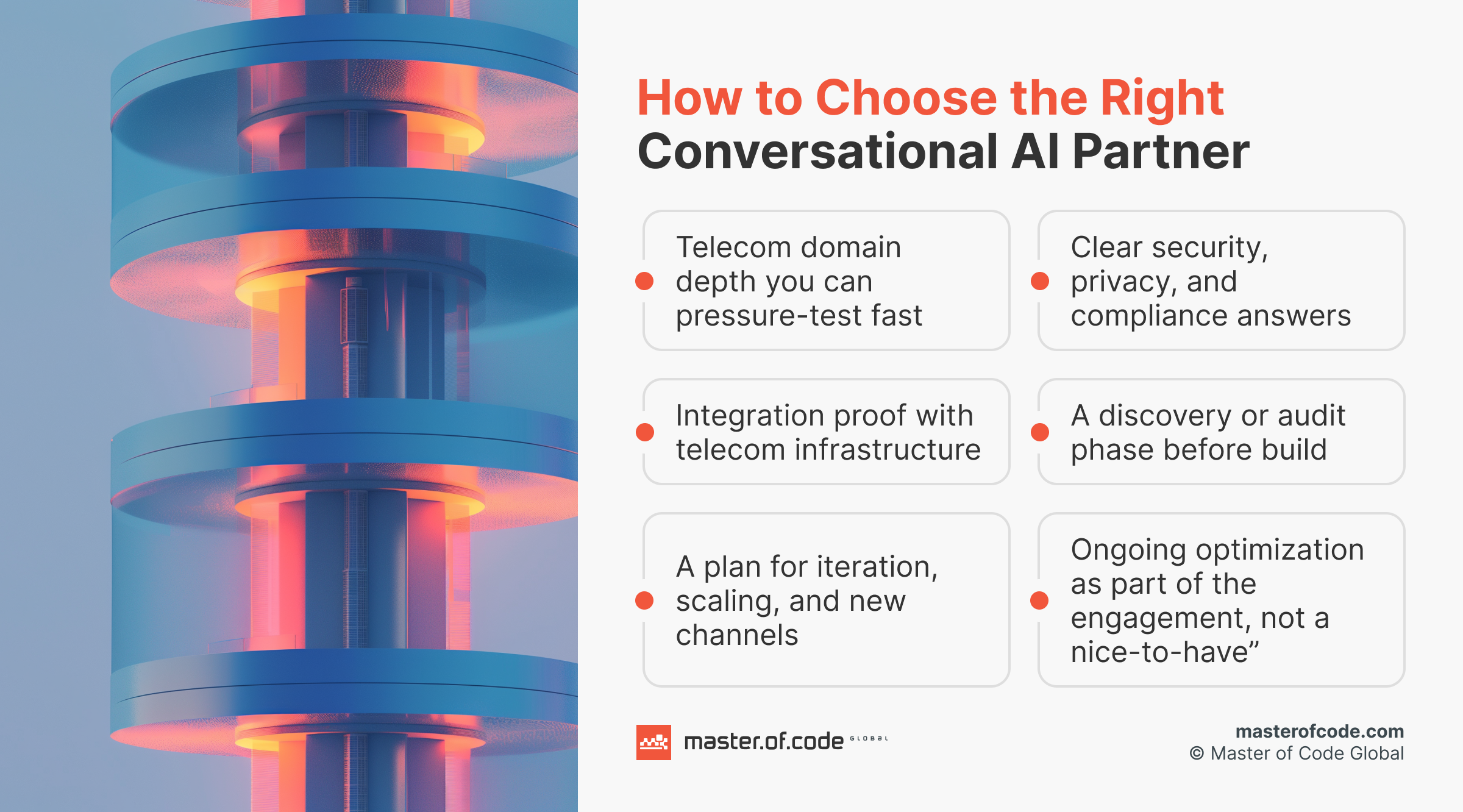
Use the checklist below to evaluate vendors quickly, even if you’re only comparing proposals.
What to look for
1) Telecom domain depth you can pressure-test fast
Ask them to walk through plan-and-add-on logic, payment arrangements, device upgrades, and customer authentication. Then push one edge case: “What happens when the customer fails verification twice?” or “What if the add-on isn’t eligible on this plan?” The right partner won’t hand-wave the messy parts.
2) Integration proof with telecom infrastructure (BSS/OSS included)
Telecom assistants live or die on integrations: BSS/OSS, billing, CRM, identity, network diagnostics, and order management. Ask what they’ve integrated before, how they handle permissions, and what the handoff looks like when a human needs to step in with full context.
A good reference point is Master of Code Global’s Telecom Virtual Assistant case study, which describes a production-scale assistant with deep transactional flows and ongoing evolution. Integration depth protects operational efficiency by keeping the assistant action-oriented rather than pushing customers into another queue.
3) A discovery or audit phase before build
Be wary of vendors who jump straight into “we’ll deploy in 2–4 weeks.” In telecom, most failures come from skipped groundwork: unclear intents, weak error handling, missing handoff rules, and flows that don’t match how customers actually ask for help.
GO Malta is a useful example of a structured audit approach (transcript analysis, flow evaluation, NLP assessment, conversation design workshops, technical implementation and analytical data reviews).
4) Clear security, privacy, and compliance answers
Ask where data is stored, what is logged, how access is controlled, and how sensitive data is masked or minimized. You want specifics: environments, retention, permissions, and review processes. If they get vague here, that’s a risk.
5) A plan for iteration, scaling, and new channels
Telecom assistants rarely stay static. New offers launch, policies change, channels expand, and customer behavior shifts. Look for partners who show how they prioritize use cases over time and how they measure what to fix next.
As an example, our Telecom Virtual Assistant case study also describes long-term partnership work, including roadmapping, use case expansion, and platform/channel evolution.
6) Ongoing optimization as part of the engagement, not a nice-to-have
Ask what happens after go-live: who reviews transcripts, how often tuning happens, and what reporting you receive. A serious partner treats optimization as a core part of the work, often supported by dedicated conversation analytics services that turn transcripts into priorities, not just dashboards.
You should also expect clear ownership for updates and expansion as part of broader conversational AI services, so the system stays aligned with changing offers, policies, and customer behavior.
Red flags to watch for
- Promises of “instant results” without discovery or transcript review;
- One-size pricing and architecture that looks identical across industries;
- No conversation design methodology beyond “intents and FAQs”;
- No post-launch plan for tuning and optimization;
- No telecom case studies beyond pilots or demos.
Conclusion
Telecom has spent decades improving network performance. The next competitive divide sits in the dialogues that shape loyalty, revenue, and reputation.
Conversational AI in telecommunications is already separating operators who absorb demand intelligently from those who keep paying for the same friction in contact center operations. In markets where pricing and coverage often converge, customer experience becomes the difference people remember. The gap widens with every high-volume interaction you handle well or lose.
The next step is strategic: pick the journeys that matter most, connect them safely into your stack, and measure what changes in containment and average handling time.
If you want to map out what a tailored Conversational AI strategy could look like for your organization, reach out to us.