


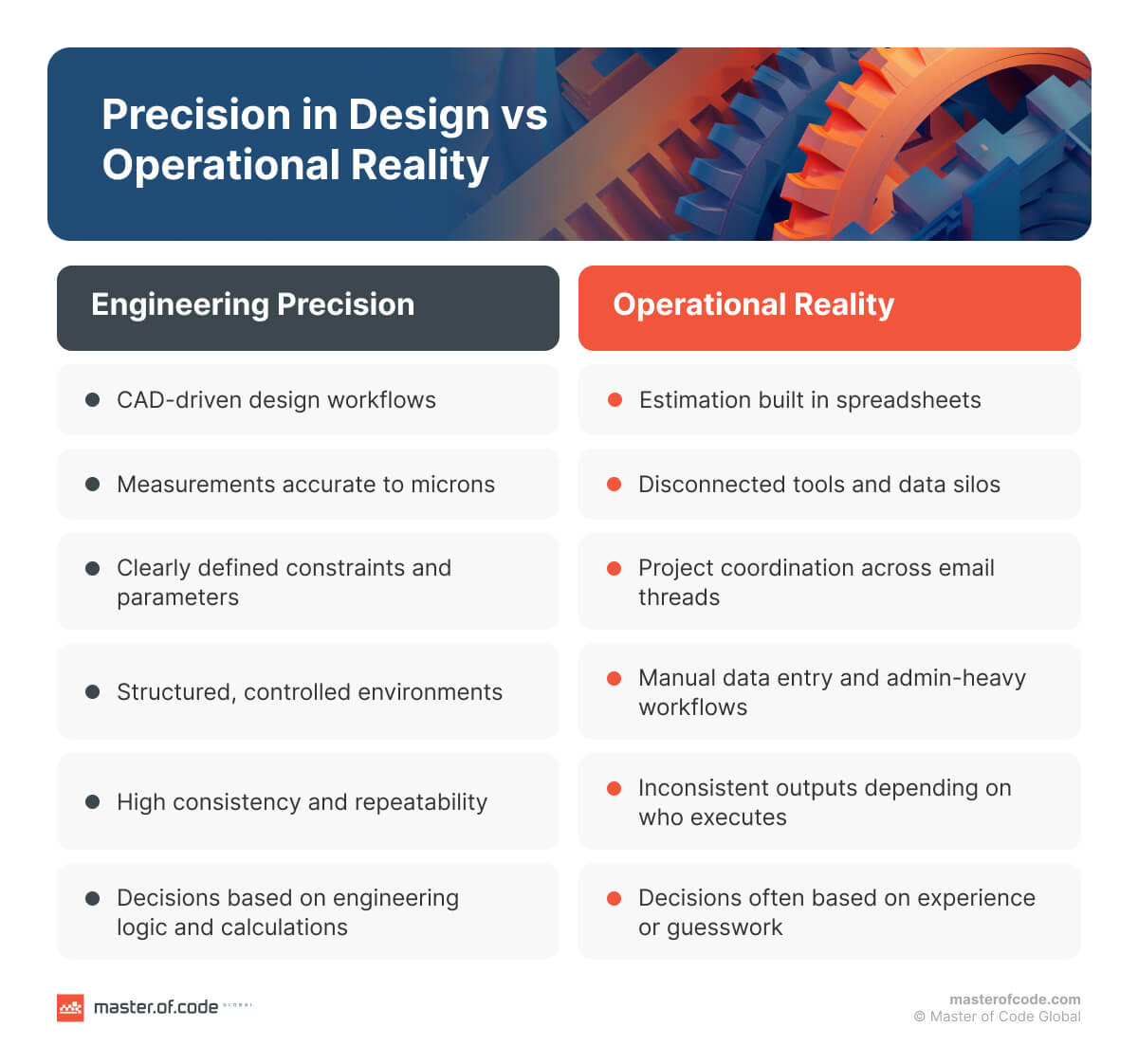
Mechanical engineering has always been a discipline built on precision. Tolerances measured in microns. Loads calculated to the decimal. And yet, step behind the curtain of most engineering firms and you’ll find a different reality – estimation done in spreadsheets, project coordination scattered across email threads, and maintenance schedules driven by gut feeling rather than data.
That gap between engineering precision and operational chaos is expensive. Missed deadlines erode margins. Manual admin buries skilled engineers in paperwork. Inaccurate cost estimates turn profitable contracts into cautionary tales. For mid-size firms in particular, these aren’t theoretical risks. They’re quite tangible.
Here’s the shift worth paying attention to: AI in mechanical engineering has moved well past the research-paper phase. It’s now embedded in production lines, design studios, and field-service operations – not as a novelty, but as infrastructure. The firms pulling ahead aren’t the ones experimenting with AI. They’re the ones deploying it where it actually hurts: estimation, scheduling, quality, and maintenance.
Table of Contents
Key Takeaways
- AI in mechanical engineering is migrating from design labs to day-to-day operations – estimation, admin, and scheduling workflows are the new adoption frontier.
- Generative design and virtual prototyping compress months of product iteration into days, without replacing the engineer’s judgment.
- AI-driven maintenance forecasting transforms equipment from a cost center into a strategic, revenue-protecting asset.
- Off-the-shelf tools can’t handle the integration complexity of field-heavy industries like HVAC and construction – custom AI development fills the gap.
- The real return isn’t in any single feature. It’s in connecting fragmented systems into one intelligent, repeatable workflow.
Why Mechanical Engineering Is Ripe for an AI Overhaul
The numbers tell a clear story. According to Fortune Business Insights, the global AI in manufacturing market was valued at $7.6 billion in 2025 and is projected to surge past $128 billion by 2034 – a compound annual growth rate of nearly 38%. Meanwhile, a 2026 Market Growth Reports analysis found that 41.9% of industrial organizations had adopted AI by 2024, up from just 16.9% in 2022 – a 25-point jump in two years. The wave isn’t coming. It arrived.
So why did mechanical engineering take longer than, say, fintech or retail to adopt artificial intelligence? The answer is in complexity. Engineering operations blend physical processes with digital design, field-service logistics with factory-floor precision. An AI model that works brilliantly for customer segmentation in eCommerce doesn’t know what to do with a load-bearing calculation or an HVAC ductwork estimate.
But that complexity is exactly what makes the opportunity so large. Mechanical engineering automation stands to eliminate entire categories of repetitive work – from manual data entry in project tracking to inconsistent cost estimation across job sites. The firms that move first build a compounding advantage in speed, accuracy, and talent retention. Manufacturing processes that once demanded weeks of human oversight can now run leaner, faster, and with fewer errors.

Where AI Delivers the Biggest Impact Today
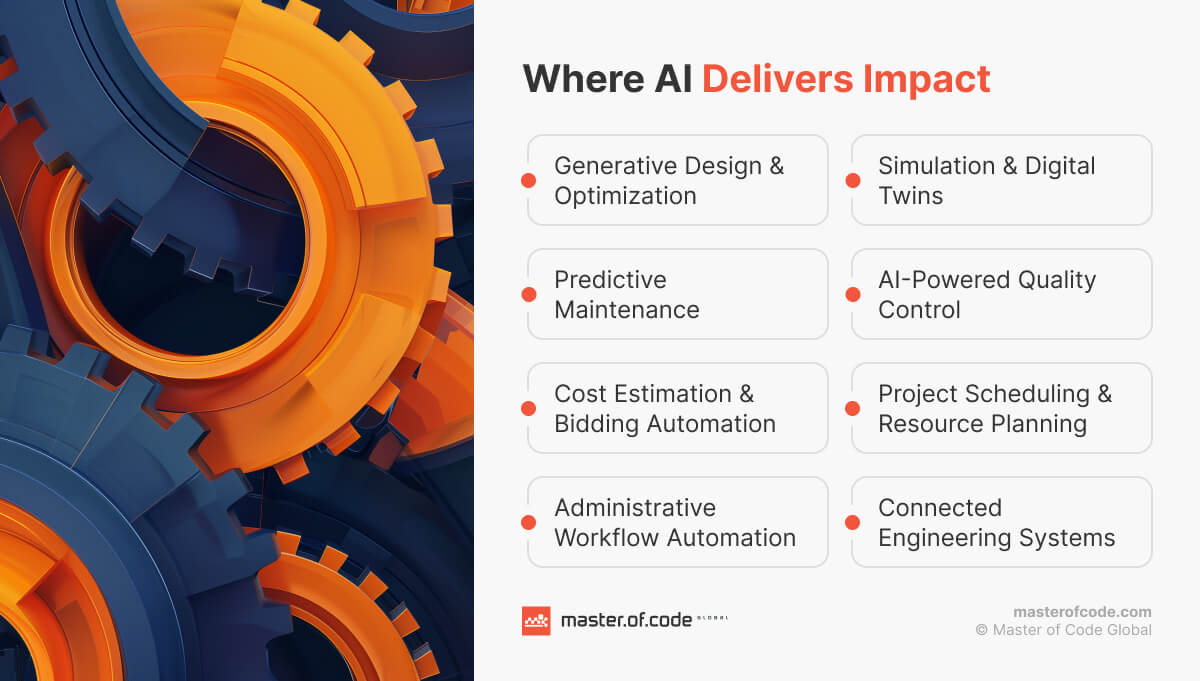
From Blank Page to Optimized Part — Generative Design in Action
Traditional design starts with a concept in an engineer’s head, moves to a CAD (computer-aided design) environment, and goes through round after round of refinement. Generative design flips that sequence. You define the constraints – material, weight limits, manufacturing method, cost ceiling – and the algorithm explores thousands of geometry variations simultaneously.
The output isn’t a single “best” design. It’s a curated set of options the engineer couldn’t have reached manually, each optimized against the stated constraints. This is AI for engineering design operating at a scale that no human team can match in raw iteration speed. Aerospace firms already use it to produce lighter structural components. Automotive manufacturers use it to cut material waste by double-digit percentages.
The business impact goes beyond the part itself. Shorter product development cycles mean faster time-to-market. Design optimization that once stretched across quarters now happens in sprints. And the engineer doesn’t disappear from the process – they become the decision-maker curating AI-generated options, not the one manually sketching each one.
Simulation and Digital Twins — Testing Without Breaking Things
Every physical prototype that fails a stress test costs money and calendar time. Simulation changes the math. Engineers can model thermal loads, fluid dynamics, and structural stress in a virtual environment, catching design flaws before a single part gets machined.
Digital twins take this further. A digital twin is a living virtual replica of a physical asset – a turbine, a building system, an entire production line – continuously updated with real-world sensor data. When a field technician adjusts an HVAC system on-site, the digital twin reflects it. When conditions shift, the twin predicts what will happen next.
For product development, this means fewer costly prototyping rounds and faster iteration. For asset-heavy industries, it means continuous performance monitoring without pulling equipment offline. The twin doesn’t replace the engineer’s expertise, but extends their peripheral vision.
Predictive Maintenance — Knowing What Breaks Before It Breaks
Unplanned downtime is one of the most expensive problems in any engineering-driven operation. A 2024 Siemens study put the total cost at $1.4 trillion annually for Fortune Global 500 companies alone – roughly 11% of their yearly revenue. AI for predictive maintenance in manufacturing attacks this head-on.
Here’s how it works: IoT sensors embedded in equipment collect vibration, temperature, pressure, and usage data in real time. Machine learning models trained on historical failure patterns analyze that stream and flag anomalies – days or weeks before a breakdown occurs. It’s the difference between replacing a bearing during a scheduled window and shutting down a production line at 2 AM on a Friday.
Predictive maintenance value isn’t speculative. It’s deployed and delivering measurable results. Machine learning in manufacturing models improves with every data cycle, becoming more accurate as they accumulate operational history. The business outcome: reduced unplanned downtime, extended asset lifespan, and maintenance budgets that actually track to reality.
That’s exactly what AI predictive analytics services are designed to deliver – models trained on your equipment data, integrated into your stack, flagging failures before your team even knows to look.
Quality Control That Doesn’t Blink
Human inspectors are skilled. They’re also inconsistent over eight-hour shifts, prone to fatigue, and limited by the speed of their eyes. AI-powered quality control changes the equation entirely. Computer vision systems inspect parts at production speed, identifying surface defects, dimensional deviations, and material inconsistencies that slip past manual inspection.
In high-volume manufacturing, even a 1% improvement in defect detection can prevent thousands of faulty units from reaching the field. Combine that with robotics-assisted sorting, and you get a QC process that scales without degrading. The result: fewer recalls, lower scrap rates, and an operational efficiency gain that compounds over every production run.
The Future of Mechanical Engineers in an AI-Driven World
Let’s address the search bar directly: will mechanical engineers be replaced by AI? No. And framing the question that way misses the point entirely.
Consider a parallel. When CAD (computer-aided design) arrived in the 1980s, it didn’t eliminate draftsmen. It made them radically more productive. The engineers who adopted it early didn’t lose their jobs – they outcompeted those who didn’t. AI follows the same arc.
Will AI replace mechanical engineers? It will replace specific tasks – the repetitive calculations, the manual data pulls, the routine inspections. But the judgment calls? The contextual decisions about material trade-offs, safety margins, and design intent? Those stay human. The real career risk is in ignoring AI adoption while competitors don’t.
The Shift Is Happening, With or Without You
That CAD parallel isn’t just an AI in mechanical engineering story – it’s playing out right now across industries you might not expect. We were recently approached by a commercial HVAC contractor out of New York, nearly two decades in business, with a straightforward ask: help us stop wasting our best people on the work that doesn’t need them. Their estimators and project managers were spending too much time on slow, repetitive administrative tasks that surrounded the actual skilled work – and they knew it was a problem they could fix.
They weren’t chasing a trend. They wanted real automation, real integrations with the tools already running their business, and a system built around how their team actually operates. Not a one-off solution either – something that would grow with them over time.
Here’s why that matters for mechanical engineers specifically: the instinct driving that contractor is the same one that should be driving every technical discipline right now. The goal of AI agents for manufacturing, construction, and engineering alike was never to replace the expertise – it was to protect it. To clear away everything that was eating into the hours that actually required human judgment, so the people with that judgment could use it more.
That’s the shift worth internalizing. Mechanical engineering automation doesn’t come for the hard parts of your job. It comes for the parts that were never really worth your time to begin with. The engineers who move first on that aren’t taking a risk – they’re buying back the hours that matter.
Read more: Generative AI in Manufacturing
Why Off-the-Shelf AI Falls Short in Engineering
The appeal of pre-built AI automation tools is obvious: faster deployment, lower upfront cost, minimal custom work. The problem is that engineering environments aren’t generic. McKinsey’s 2025 State of AI report quantifies the gap: while 78% of organizations now use AI in at least one business function, only 5.5% report that it contributes meaningfully to their bottom line. Adoption without depth doesn’t deliver returns.
A typical engineering firm operates across a stack of specialized software – design platforms, ERP systems, field-service schedulers, procurement tools, and project management suites. Off-the-shelf products connect to some of these. Rarely all. And in engineering, a disconnected system is a system that creates more manual work, not less.
Then there’s the data problem. Engineering data is deeply domain-specific. Load specifications, material property databases, site-condition variables, historical job costing – these aren’t the kind of datasets that generic models are trained on. A pre-built tool might handle basic anomaly detection, but it won’t understand why a particular pressure reading on a chiller unit matters differently in a hospital versus a warehouse.
Custom-built AI addresses both problems. Models trained on your operational data. Integrations designed for your specific tool stack. Logic that reflects your workflows, not a generic template. Custom AI development services exist precisely because the gap between what off-the-shelf can do and what engineering firms actually need remains wide.
The Competitive Edge of a Dedicated AI Partner
Deploying AI in an engineering context demands more than data science expertise. It requires a partner who understands the operational complexity of physical industries – the integration challenges, the data inconsistencies, the workflows that look simple on a whiteboard but prove messy in the field.
Master of Code Global brings 20+ years of software development experience and 1,000+ successful projects to that challenge, including work across manufacturing, energy, automotive, and other operationally complex industries. Every engagement is secured to the highest standard in line with ISO 27001 certification, and teams remain stable from kickoff to completion – zero staff turnover on active projects.
The LOFT framework – our open-source LLM-Orchestrator – accelerates delivery measurably: 43% less effort in initial setup, up to 20% budget savings when scaling, and 3x faster ongoing support. For firms that want to validate AI’s impact before committing to a full build, Master Of Code Global’s fixed-price Proof of Concept process reduces development waste by 50–70%, providing a clear signal on feasibility and ROI before the real investment begins.
From machine learning development services to end-to-end AI agent deployments, the focus stays consistent: tie every technical feature to a tangible business outcome. Because in mechanical engineering, the measure of a good system isn’t how sophisticated the model is. It’s whether the estimator gets home on time.
Your engineering operations generate more data every quarter. The question is whether that data works for you or just accumulates. Book a consultation to map your AI roadmap – and stop leaving productivity gains on the table.