



Training a defect or failure model is the easy part. Running it in a factory is harder. The model must read machine data, connect to your production systems, and prove an outcome such as less downtime. That is why serious AI development services span data engineering, integration, deployment, and monitoring.
This guide to the top AI development companies for manufacturing compares 11 partners on manufacturing evidence, integrations, and deployment fit. The useful question is which one can deliver your workflow on your existing production infrastructure.
Table of Contents
Key Takeaways
- Choose a partner for the specific manufacturing workflow you need to improve.
- Ask for a relevant client case, its deployment stage, and a measured baseline.
- Evaluate interfaces, data readiness, and the operating environment early.
- Check AOI and maintenance metrics, not just an overall accuracy claim.
- Agree on pilot acceptance, production support, and ownership before development begins.
How We Selected These AI Development Companies
The 11 companies come from an editorial shortlist of industrial AI developers. We checked each one’s public material for a manufacturing case, the custom AI engineering behind it, and disclosed industrial interfaces. We also looked for a public result and evidence of rollout, monitoring, or handover.
Case studies are self-reported, and this is not an exhaustive ranking. Unpublished capabilities are marked as not disclosed, not assumed absent. “Best for” labels are editorial judgments. Each profile tags its proof as a named client, an anonymous client, or live validation.
Manufacturing AI Development Companies at a Glance
Each company fits a different manufacturing problem, so compare them by the case closest to yours.

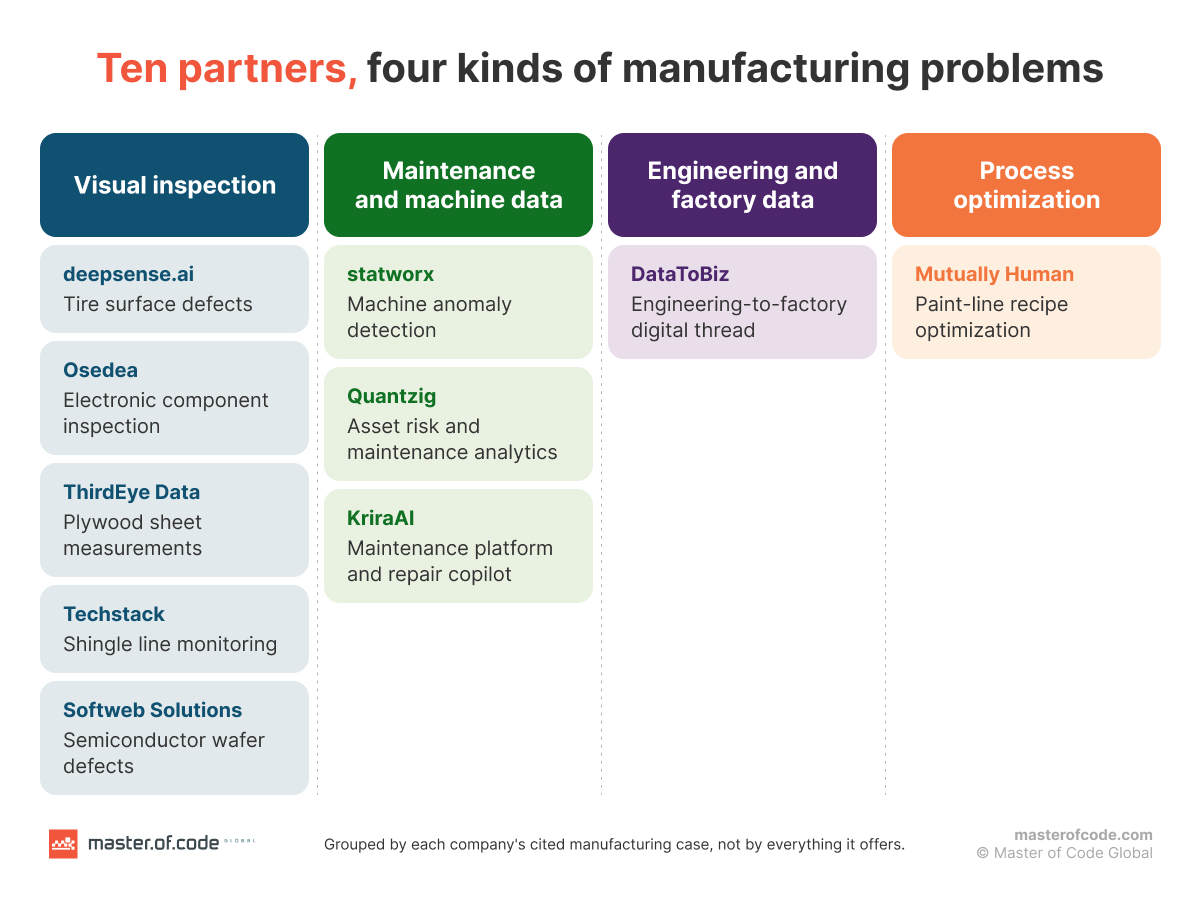
| Company | Best for | Manufacturing strengths | Key integrations | Proven manufacturing case | Client fit |
|---|---|---|---|---|---|
| Master of Code Global | Multi-plant predictive maintenance | Failure prediction, ERP-linked scheduling | SAP ERP, IoT sensors, edge | Anonymous automotive parts manufacturer | Multi-plant manufacturers |
| deepsense.ai | Tire inspection models | Defect localization, retraining | Cloud ML pipeline | Anonymous tire manufacturer | Enterprise quality teams |
| Osedea | Component inspection, ERP copilots | Traceability, MLOps | Genius ERP, GCP | Promark Electronics | Component makers, ERP providers |
| statworx | Machine anomaly models | Time-series analysis | OPC UA, existing monitoring | Health/pharma machinery, live validation | Plants with machine data |
| DataToBiz | Engineering-to-factory data | Digital thread, predictive models | ERP, MES, SCADA, Azure | Anonymous machinery manufacturer | Industrial engineering and IT teams |
| ThirdEye Data | Plywood line checks | Dimension and density alerts | Cameras, Power BI, alert circuit | Anonymous plywood manufacturer | Wood-products plants |
| Techstack | Edge vision systems | Line visibility, hardware integration | Edge application, cloud | Anonymous shingle manufacturer | Production technology teams |
| Softweb Solutions | Semiconductor inspection | Wafer defect models | Inspection-system APIs | Anonymous global chip manufacturer | Semiconductor quality teams |
| Mutually Human | Paint recipe optimization | Model-driven process adjustment | PLC interfaces | Anonymous Tier 2 automotive manufacturer | Process engineering teams |
| Quantzig | Maintenance analytics | Remaining life, asset prioritization | SCADA, CMMS, ERP | Anonymous global manufacturer | Asset-intensive industrial firms |
| KriraAI | Maintenance models and repair copilots | Anomaly detection, diagnostic retrieval | OPC UA, MQTT, work orders | Anonymous precision-components manufacturer | Multi-plant maintenance teams |
Integrations refer to the cited projects, not every ERP, MES, or controller version. All cases are vendor-published and not independently audited.
1. Master of Code Global
Best for: multi-plant predictive maintenance that updates repair schedules in your ERP.
Master of Code Global is a consulting-led AI engineering company headquartered in Winnipeg, Canada, and certified to ISO 27001. We work with manufacturers on equipment-failure prediction, production anomaly detection, and custom agents connected to ERP and CRM systems. Our team of 150+ has delivered 1,000+ projects, with an NPS of 82 and a 4.7 rating on Clutch. We are a Google Cloud and AWS partner and a member of Anthropic’s Claude Partner Network.
| Field | Details |
|---|---|
| Founded | 2004 |
| Headquarters | Winnipeg, Canada |
| Team size | 150+ |
| Best for | Multi-plant failure prediction with ERP scheduling |
| Manufacturing use cases | Equipment-failure prediction; condition monitoring; production anomaly detection; maintenance and inventory agents |
| Integrations / systems | SAP ERP; existing equipment sensors plus new IoT devices; ERP and CRM connections for agents |
| Deployment capabilities | Edge inference where latency requires it; AWS and Google Cloud partner |
| Ideal client | Multi-plant manufacturers that want the business case validated before a full build |
Key services: 4-week AI Compass Sprint, 30-day AI Pilot, custom model development, ERP and sensor integration, MLOps, and optimization.
Manufacturing proof (anonymous client): an automotive parts manufacturer with 12 facilities monitors its CNC machines, injection molders, and assembly lines. Our AI forecasts update its repair schedules in SAP.
Notable result: our platform cut unplanned equipment downtime by 67% and maintenance costs by 45%. It also raised OEE by 23% and predicts failures 30 days ahead with 92% accuracy.
Why it stands out: failure forecasts feed SAP repair scheduling automatically across 12 facilities, rather than stopping at a dashboard.
Consider if: you run several plants and need predictions to change ERP maintenance schedules. You also want a 30-day pilot before any full build.
Want to test this on one of your lines? Talk to Master of Code Global. We start with a 30-day pilot measured against your KPIs.
2. deepsense.ai
Best for: custom visual defect models for tire manufacturing, with production retraining support.
deepsense.ai is an AI development and consulting company in Warsaw, Poland, focused on computer vision for inspection. In its tire project, the team handled data, annotation, modeling, and cloud MLOps. It then trained the client to run the system.
| Field | Details |
|---|---|
| Founded | 2014 |
| Headquarters | Warsaw, Poland |
| Team size | 120 AI experts (company-reported) |
| Best for | Tire surface-defect models and retraining |
| Manufacturing use cases | Tire defect inspection; machine-health analytics; manufacturing data assistants |
| Integrations / systems | Cloud engineering and MLOps; Microsoft Fabric in a separate beverage-manufacturing project |
| Deployment capabilities | Cloud documented; edge advertised |
| Ideal client | Quality teams building in-house inspection capability |
Key services: data acquisition and annotation, visual model development, MLOps, cloud engineering, retraining enablement.
Manufacturing proof (anonymous client): a European tire manufacturer uses near-real-time, pixel-level defect detection across its product lines.
Notable result: deepsense.ai reports that its tire defect detection cut human QA cost by over 80%. It also improved detection of several complex defects.
Why it stands out: the case explicitly includes training the client to maintain and retrain its inspection models.
Consider if: your quality team needs a tailored model and a documented path to running it internally.
3. Osedea
Best for: operator-facing component inspection platforms and AI built into manufacturing ERP software.
Osedea is an AI and software engineering firm headquartered in Montréal, Canada. Its projects pair models with the operator interfaces, traceability, and MLOps that keep them usable on the floor.
| Field | Details |
|---|---|
| Founded | 2011 |
| Headquarters | Montréal, Canada |
| Team size | 51–200 (LinkedIn band) |
| Best for | Inspection applications and ERP copilots |
| Manufacturing use cases | Component inspection; inspection traceability; machinery-operator decision support; ERP knowledge assistance |
| Integrations / systems | GCP (Promark); Genius ERP and Microsoft technologies (Cortex); SQL Server (Kruger) |
| Deployment capabilities | Cloud documented in the cited cases |
| Ideal client | Component manufacturers and industrial software providers |
Key services: visual model engineering, MLOps pipelines, inspection UX, ERP assistant integration, manufacturing application development.
Manufacturing proof (named client): for Promark Electronics, Osedea combined AI inspection, human review of flagged parts, and timestamped image traceability.
Notable result: No public quantified result found.
Why it stands out: its named-client work covers production inspection and a live ERP knowledge assistant for Genius ERP.
Consider if: your project depends on operator workflows, traceability, or adding AI to an industrial software product.
4. statworx
Best for: machine anomaly detection and predictive maintenance models connected to existing industrial monitoring.
statworx is a data and AI consultancy headquartered in Frankfurt am Main, Germany. In its selected case, the model was integrated into existing monitoring and validated in live tests.
| Field | Details |
|---|---|
| Founded | 2011 |
| Headquarters | Frankfurt am Main, Germany |
| Team size | 85+ experts (company-reported) |
| Best for | Time-series anomaly and maintenance models |
| Manufacturing use cases | Machine anomaly detection; maintenance forecasting; production optimization; demand and KPI forecasting (advertised) |
| Integrations / systems | OPC UA; existing customer monitoring; Windows Server |
| Deployment capabilities | Not disclosed for the cited case |
| Ideal client | Industrial teams with sensor histories and existing monitoring |
Key services: time-series modeling, anomaly detection, failure forecasting, monitoring integration, data and AI consulting.
Manufacturing proof (anonymous client, live validation): a health and pharma-sector customer received a model integrated into its existing machine monitoring.
Notable result: No public quantified result found. The case describes less downtime without a figure.
Why it stands out: the case names its connectivity and deployment stack, including OPC UA and Windows Server.
Consider if: you need a machine-data model that works with your engineers’ existing monitoring system.
5. DataToBiz
Best for: unifying engineering and factory data in Azure before scaling predictive models.
DataToBiz is a data, AI, and BI consultancy headquartered in Mohali, India. Its machinery case pulled engineering and plant data into Azure, then added predictive models and Power BI reports.
| Field | Details |
|---|---|
| Founded | February 2018 |
| Headquarters | Mohali, India |
| Team size | 50+ data professionals (company-reported) |
| Best for | Engineering-to-factory integration and data modernization |
| Manufacturing use cases | Model-to-factory validation; equipment-failure forecasting; production dashboards; compliance traceability |
| Integrations / systems | ERP, MES, SCADA, IoT, PLM, and MBSE data; Siemens Teamcenter and IBM Rhapsody in the case context; Azure Data Factory |
| Deployment capabilities | Azure cloud |
| Ideal client | Machinery manufacturers with fragmented engineering and plant systems |
Key services: Azure data engineering, AI/ML modeling, system data integration, Power BI, data governance.
Manufacturing proof (anonymous client): a North American industrial machinery manufacturer connected its engineering models with factory data.
Notable result: DataToBiz reports unplanned equipment downtime falling from 10 to 7 hours per month.
Why it stands out: the case spans engineering and PLM context, not just a factory dashboard.
Consider if: integration and data consistency are the main barriers to operational AI in your plants.
6. ThirdEye Data
Best for: camera-based dimensional and density checks on plywood production lines.
ThirdEye Data is an AI and data engineering company headquartered in San Jose, California. In its plywood project, cameras feed a local image-processing server that warns operators when sheet measurements drift.
| Field | Details |
|---|---|
| Founded | 2010 |
| Headquarters | San Jose, California, United States |
| Team size | 51–200 (LinkedIn band) |
| Best for | Plywood sheet checks and production-floor alerts |
| Manufacturing use cases | Sheet dimension checking; core-sheet density checking; anomaly alerts during production |
| Integrations / systems | Cameras; Power BI; local electrical alert circuit (no ERP, MES, or SCADA named) |
| Deployment capabilities | On-premise server |
| Ideal client | Wood-products plants with measurable in-process quality criteria |
Key services: image processing, visual model development, anomaly detection, on-premise integration, production reporting.
Manufacturing proof (anonymous client): an Indian plywood manufacturer gets floor alerts when sheets measure out of tolerance.
Notable result: ThirdEye Data reports 85% accuracy in detecting sheets with faulty measurements. The figure covers this narrow task, not quality control as a whole.
Why it stands out: the case connects visual detections to a physical alert mechanism in the plant.
Consider if: you need a local inspection and alerting workflow tied to specific dimensional checks.
7. Techstack
Best for: custom inspection systems spanning IoT hardware, edge applications, and cloud software.
Techstack is a software engineering company headquartered in Wrocław, Poland. Its shingle project covered hardware, edge and cloud software, and the operator interface, through to a production release.
| Field | Details |
|---|---|
| Founded | 2014 |
| Headquarters | Wrocław, Poland |
| Team size | About 200 specialists (company-reported) |
| Best for | Edge-to-cloud inspection and production visibility |
| Manufacturing use cases | Shingle defect detection; production-line state tracking; solar-panel visual inspection (separate project) |
| Integrations / systems | IoT hardware kit; edge application; cloud infrastructure; operator interface (no ERP, MES, or SCADA named) |
| Deployment capabilities | Edge and cloud |
| Ideal client | Manufacturers needing a custom hardware and software system around production lines |
Key services: visual AI, embedded development, IoT integration, cloud and DevOps, operator application development.
Manufacturing proof (anonymous client): a shingle manufacturer monitors its line in near real time with a system in production.
Notable result: Techstack describes annual savings in the hundreds of thousands of dollars, without an exact figure or baseline.
Why it stands out: the documented scope covers hardware, edge software, cloud, testing, and support documentation.
Consider if: your inspection project needs embedded engineering and operational software alongside the model.
8. Softweb Solutions
Best for: AI-based semiconductor and wafer inspection integrated into existing inspection workflows.
Softweb Solutions is an Avnet company headquartered in Plano, Texas, which its website calls Dallas. Its semiconductor case combined process data with image models inside existing wafer inspection stages.
| Field | Details |
|---|---|
| Founded | 2004 |
| Headquarters | Plano, Texas, United States (Dallas area) |
| Team size | 545+ experts (company-reported) |
| Best for | Semiconductor inspection models |
| Manufacturing use cases | Wafer defect detection; equipment-health monitoring, factory connectivity, and manufacturing agents (advertised) |
| Integrations / systems | API-based integration with inspection systems; automated feedback to existing control systems (vendors unnamed) |
| Deployment capabilities | Edge AI and cloud advertised; not disclosed for the cited case |
| Ideal client | Semiconductor manufacturers modernizing established inspection workflows |
Key services: visual model engineering, data preparation, deep learning, inspection workflow integration, model validation.
Manufacturing proof (anonymous client): a global semiconductor manufacturer placed custom models into its existing wafer inspection workflows.
Notable result: Softweb reports 94.3% defect-detection accuracy. The page does not define the evaluation protocol. Read it as accuracy, not as the share of production defects caught.
Why it stands out: the case covers model development and API integration into the client’s inspection systems.
Consider if: your inspection modernization must fit existing semiconductor production processes.
9. Mutually Human
Best for: model-driven recipe and process-parameter optimization on automotive paint lines.
Mutually Human is a digital engineering firm headquartered in Grand Rapids, Michigan. Its paint-line case moved in stages, from operators reviewing recommendations to the model adjusting settings through the PLC.
| Field | Details |
|---|---|
| Founded | 2006 |
| Headquarters | Grand Rapids, Michigan, United States |
| Team size | 51–200 (LinkedIn band) |
| Best for | Paint-line recipe optimization |
| Manufacturing use cases | Paint-setting optimization; automated parameter adjustment; operator review of model recommendations |
| Integrations / systems | Direct PLC interaction; operator application (controller vendor not named) |
| Deployment capabilities | Not disclosed for the cited case |
| Ideal client | Process manufacturers with variable settings, waste, and measurable quality outcomes |
Key services: custom machine learning, feature selection, PLC integration, operator applications, staged automation.
Manufacturing proof (anonymous client): a Tier 2 automotive manufacturer first had operators validate recommended settings. Then the model began adjusting the paint line automatically.
Notable result: No public quantified result found. The case describes lower scrap, lower energy use, and better OEE without figures.
Why it stands out: the case documents a two-stage rollout from reviewed recommendations to PLC adjustments.
Consider if: you need to improve a complex process with clear operator oversight and acceptance criteria.
10. Quantzig
Best for: maintenance analytics combining asset histories, sensor data, and maintenance prioritization.
Quantzig is an AI and analytics consultancy headquartered in London, with a US office in Elmhurst. Its maintenance case consolidated industrial and maintenance data, then deployed models with prioritized dashboards.
| Field | Details |
|---|---|
| Founded | 2003 |
| Headquarters | London, United Kingdom |
| Team size | 201–500 (LinkedIn band); 150+ industry experts (company-reported) |
| Best for | Asset risk and maintenance analytics |
| Manufacturing use cases | Remaining-useful-life modeling; anomaly detection; asset-risk scoring; maintenance planning |
| Integrations / systems | SCADA, CMMS, and ERP data; InfluxDB; Power BI |
| Deployment capabilities | Azure-based data stack |
| Ideal client | Asset-intensive manufacturers consolidating operational and maintenance data |
Key services: data-platform integration, time-series analytics, failure and remaining-life modeling, risk scoring, maintenance dashboards.
Manufacturing proof (anonymous client): a global manufacturing firm integrated its industrial data and deployed maintenance models with dashboards.
Notable result: Quantzig reports monthly unplanned downtime falling from 28 to 15 hours.
Why it stands out: the approach combines SCADA, CMMS, and ERP context with risk-prioritized maintenance insights.
Consider if: your maintenance team needs one asset view and prioritized interventions drawn from fragmented systems.
11. KriraAI
Best for: a maintenance platform combining plant-level anomaly models with a repair-procedure copilot.
KriraAI is a custom AI and software engineering company headquartered in Surat, India. Its maintenance case runs latency-sensitive inference near the plant and trains models on elastic cloud GPUs.
| Field | Details |
|---|---|
| Founded | 2022 per its website; 2023 per its LinkedIn profile |
| Headquarters | Surat, India |
| Team size | 11–50 (LinkedIn band) |
| Best for | Maintenance intelligence plus diagnostic retrieval |
| Manufacturing use cases | Machine anomaly detection; remaining-life forecasting; maintenance work-order generation; repair-procedure retrieval |
| Integrations / systems | PLC and SCADA through OPC UA; legacy OPC DA gateways; MQTT; maintenance work orders |
| Deployment capabilities | Hybrid: inference near the plant, cloud GPUs for training |
| Ideal client | Discrete manufacturers connecting equipment predictions with maintenance actions |
Key services: sensor-data engineering, anomaly and remaining-life models, retrieval copilots, industrial integration, monitoring and handover.
Manufacturing proof (anonymous client): a multi-plant precision-components manufacturer runs a deployed maintenance platform with diagnostic help for technicians.
Notable result: KriraAI reports a 47% reduction in unplanned downtime over the first nine months after go-live.
Why it stands out: the case connects equipment predictions with work orders and retrieval of repair procedures.
Consider if: you want maintenance decision support and technician knowledge access in one system.
How to Evaluate Industrial Experience and Use-Case Fit
Real industrial AI experience shows in plant detail, not in a long list of industries served.
Look for Manufacturing Detail and Production Evidence
Ask for a case from a similar plant that names the vendor’s role, data, systems, rollout stage, and outcome. In predictive maintenance, ask for baseline downtime, false-alert rate, and whether work orders changed. That is where AI predictive analytics differs from a static report.
Demand Line-Specific Evidence for High-Speed AOI
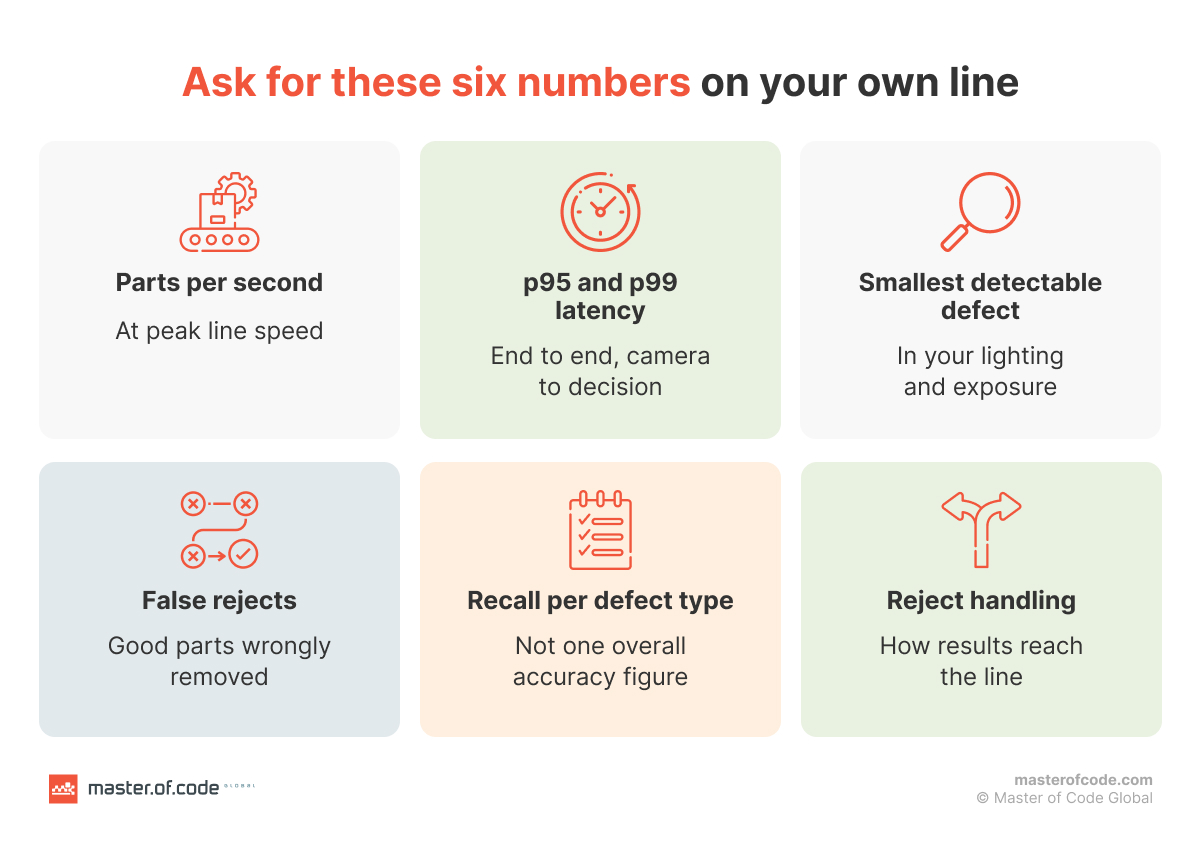
Five vendors here apply computer vision to quality inspection, but none publishes a high-speed automated optical inspection (AOI) benchmark. Ask for parts per second at peak speed, p95 latency, false rejects, and per-defect recall.

Match Copilots and Planning Projects to the Right Proof
Osedea documents an ERP knowledge assistant and KriraAI repair-procedure retrieval, but neither is an autonomous agent. Before any agentic AI development, ask which tools a copilot can call and which actions need approval. Planning projects need supply-chain evidence and often supply chain AI consulting.
How Manufacturing AI Moves Into Production
Most pilots stall on interfaces, data, and plant rules, not on the model.
Connect Legacy Systems and Fix the Data Foundation
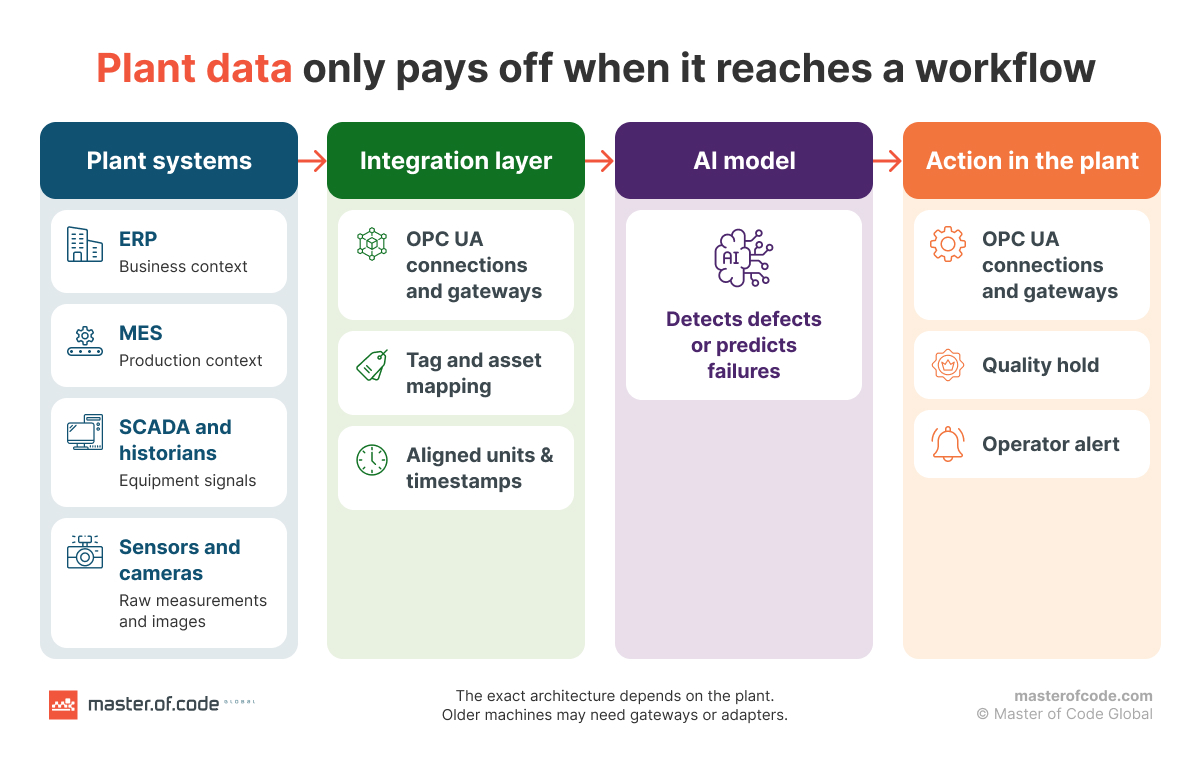
Map interfaces, tags, and asset IDs, align units and timestamps, and route outputs into a real workflow. ERP integration adds business context, MES integration production context, and SCADA integration equipment signals. OPC UA helps, but older machines may need gateways, routine work in AI integration services. Our guide to AI Data Preparation covers data gaps.

Verify Edge, On-Premise, and Disconnected Operation Separately
ThirdEye Data, Techstack, and KriraAI describe on-premise, edge, or hybrid setups, but none proves air-gapped support. Ask how updates and retraining work offline, using NIST’s SP 800-82 Rev. 3 as a reference.
Separate the PoC, Operational Pilot, and Rollout Timeline
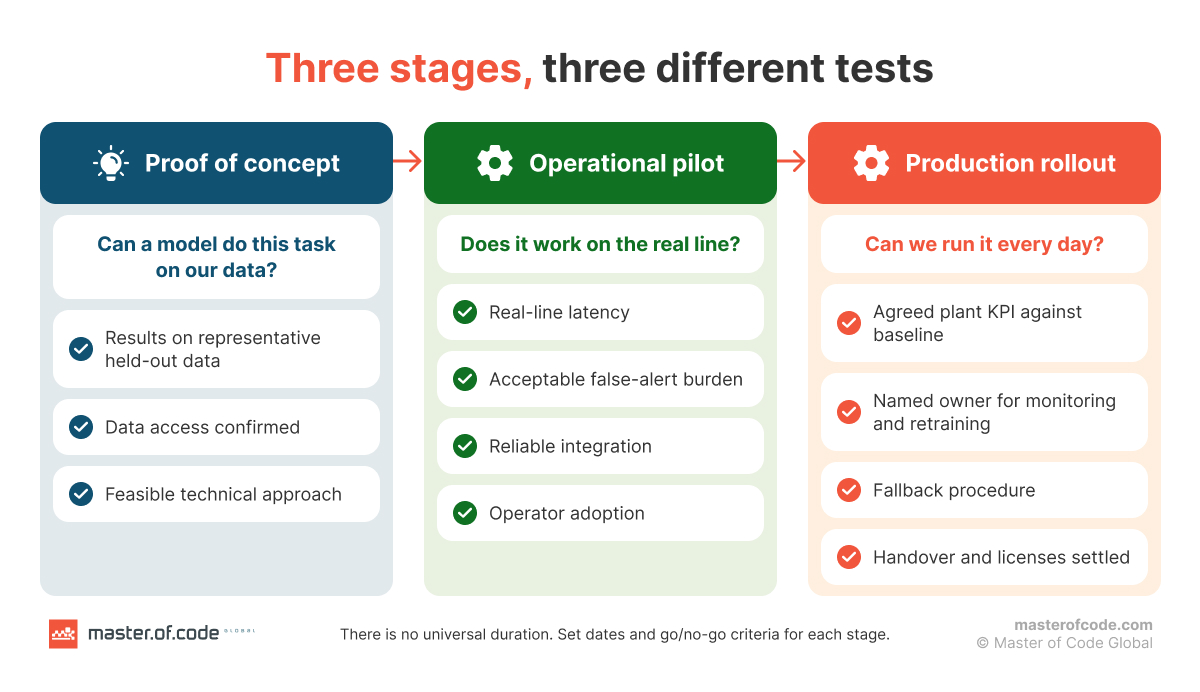
Pilot length varies. KriraAI advertises a 4–8-week visual PoC when data is ready. An AI proof of concept shows feasibility, while an operational pilot adds OT approval, shadow runs, and go/no-go KPIs.

Pricing and Ownership Questions to Settle Before Signing
Compare Commercial Scope, Not an Invented Market Price
Ask whether a vendor offers fixed-fee discovery or PoC, time and materials, a dedicated team, or outcome-linked terms. Techstack, for instance, publishes time-and-materials pricing. Ask for quotes that split data work, hardware, integration, modeling, cloud, support, and retraining. For value-share offers, ask how the baseline is measured.
Put Ownership and Handover in the Contract
The signed agreement decides who owns plant data, code, model weights, pipelines, and evaluations. KriraAI’s service FAQ gives clients project-built models, code, and datasets, but treat that as a starting point. Clarify pre-existing vendor IP and third-party licenses. Test a client-operated handover before the engagement ends.
Questions for the First Technical Screening
- Which comparable plant project can we reference?
- What did your team deliver, and is it operating today?
- Which interfaces and data gaps require new work?
- Can you meet our line-speed and deployment constraints?
- What makes the pilot pass or fail?
- Who owns operations, monitoring, retraining, and fallback?
- What do we receive at handover, and under which licenses?
Plant managers judge workflow fit and impact. CIO and OT teams assess architecture, access, support, and change management. Procurement checks scope, rights, and commercial terms.
Choose a Partner Around Your Plant’s Requirements
Before requesting proposals, document the workflow, system interfaces, baseline KPI, and deployment constraints. Then you can compare manufacturing AI solutions on equal terms. For help defining that scope, explore Master of Code Global’s manufacturing AI consulting.