



A COO has three proposals on her desk for the same AI project. One says $40,000. One says $180,000. The third says $650,000. None of them explains the gap.
The gap matters more than it looks. Pick the wrong quote and you pay for a slide deck nobody acts on, or for a build that stalls after the pilot. In June 2025, Gartner predicted that over 40% of agentic AI projects would be canceled by the end of 2027, due to escalating costs, unclear business value, or inadequate risk controls.
This guide breaks down AI consulting cost in 2026 with sourced numbers. You’ll find ranges by service, rate, and pricing model, the costs proposals leave out, and a way to compare quotes side by side. We also share budget ranges from Master of Code Global’s own AI consulting services engagements, so you can see where real projects land.
Table of Contents
Key Takeaways
- Most AI consulting engagements cost between about $7K for a readiness assessment and $500K+ for a production build.
- Senior rates run about $125–$500 per hour at boutiques and $250–$1,000+ at Big 4 and MBB (McKinsey, BCG, Bain) firms.
- At Master of Code Global, a proof of concept (PoC) typically costs $25K–$80K and takes 4–8 weeks. An AI feature or integration runs $60K–$180K over 2–4 months.
- Data readiness and integration depth move the price more than the hourly rate.
- Year-one extras can add 40–60% to the headline fee (Founders Workshop). Maintenance takes another 15–25% of the build cost each year (Dan Cumberland Labs).
- Buy in phases, with a decision point after the pilot.
AI Consulting Cost in 2026: The Short Answer
Most AI consulting engagements in 2026 cost between about $7,000 for a readiness assessment and $500,000 or more for a full production build. AI consulting rates run from about $75 per hour for a freelancer to $1,000+ per hour for a partner at a Big 4 or MBB firm.
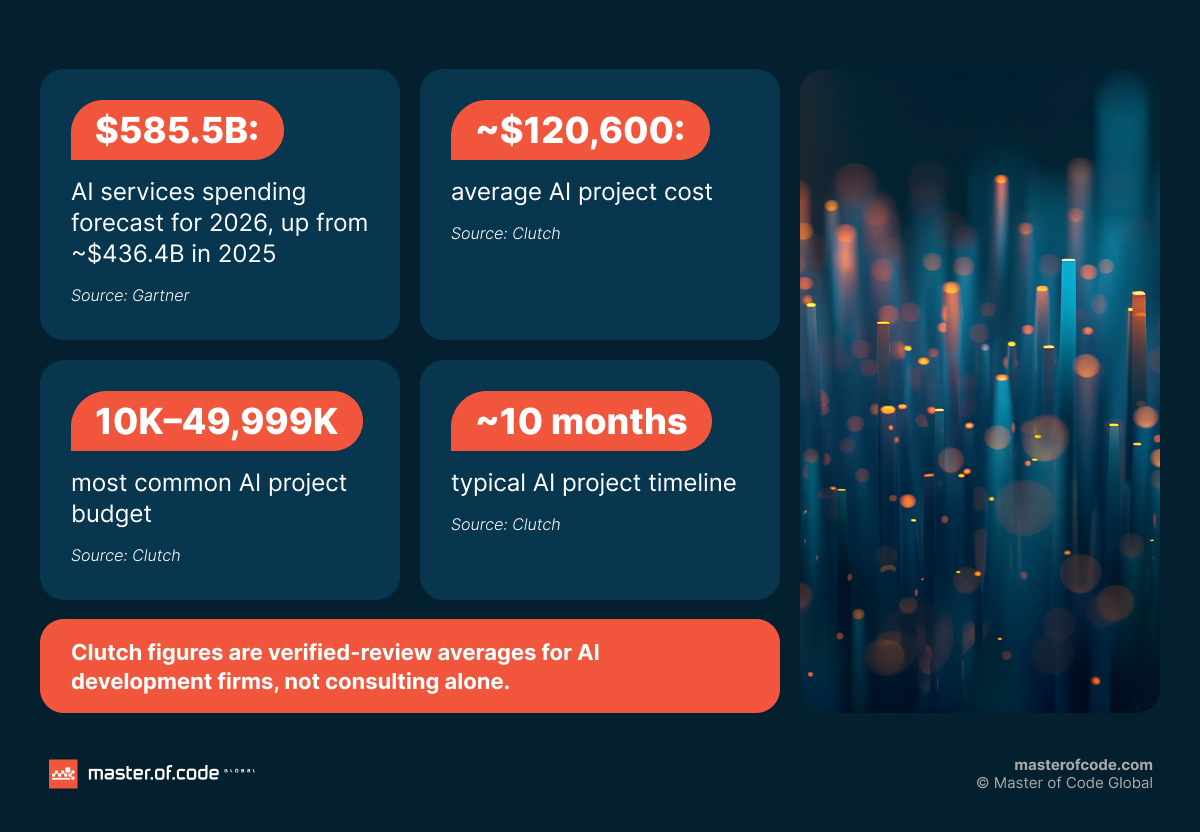
For a neutral benchmark, look at verified client reviews. Clutch’s AI pricing guide, updated in September 2026, puts the average AI project at about $120,600. The most common budget band is $10,000–$49,999, and the average project takes about 10 months. These are review averages for AI development firms, so they mix consulting with build work. Still, they show the typical cost of AI consulting engagement plus delivery for a mid-sized project.
Demand keeps senior rates high. Gartner’s September 2026 forecast puts AI services spending at $576.5 billion in 2026, up from $434 billion in 2025. Total AI spending will reach about $2.67 trillion this year.

So why do published ranges disagree so much? There are three reasons:
- They compare different tiers. A freelancer and a Big 4 partner both call themselves AI consultants.
- They price different scopes. A two-week audit and a nine-month build don’t belong in the same average.
- Many guides are vendor self-reports. That includes most of the sources in this article. We name every source, so you can check the original.
The sections below break these numbers down by rate, service, pricing model, and company size.
AI Consulting Rates by Provider Type, Seniority, and Region
Independent consultants charge about $75–$350 per hour, a boutique AI consultancy about $125–$500, and Big 4 or MBB firms $250–$1,000+. Nearshore and Eastern European firms usually bill $50–$150, and offshore teams $25–$100.
| Provider type | Typical hourly rate (USD) | Usually based in | Who does the work | Best for |
|---|---|---|---|---|
| Freelance / independent | $75–$350 | Anywhere | One specialist | A narrow task or a second opinion |
| Boutique AI consultancy | $125–$500 | US, UK, Western Europe | A small senior team | Strategy plus hands-on build for one or two use cases |
| Mid-size development and consulting firm (incl. nearshore and Eastern Europe) | $50–$150 | Eastern Europe, Latin America | A blended team of engineers, architects, and PMs | End-to-end delivery at a lower blended rate |
| Big 4 / MBB | $250–$1,000+ | Global | Partner-led teams, often large | Enterprise-wide programs with board-level visibility |
| Offshore team | $25–$100 | India, Southeast Asia | An engineering team, often with a US or EU lead | Well-specified build work |
Sources: Advisor Labs (2026), Alice Labs citing AIDOLS Research (2026), Layer3 Labs (2026), Clutch, and Accelerance. Ranges are rounded.
If these numbers look high next to Clutch’s, there’s a reason. Clutch puts the average AI firm rate at $50–$99 per hour in the US, Canada, Poland, Spain, and Mexico, and $25–$49 in Ukraine and India. That average covers reviewed development firms, where most billed hours are engineering. The boutique and Big 4 ranges above are rate cards for senior advisory work. Both sets of numbers are accurate. They measure different things.
Seniority moves the rate as much as firm type. Founders Workshop and Stack, both drawing on Leanware’s data, give these rates:
- Junior: $100–$150 per hour
- Mid-level: $150–$300 per hour
- Senior specialist: $300–$500+ per hour
Premiums stack on top. Niche specialization adds 30–50% (Alice Labs). Compressed timelines add 15–25% (Alice Labs). Regulated work (HIPAA, legal, and financial services) adds 15–40%, depending on the source (Advisor Labs, Layer3 Labs). That premium applies to total project cost, not to the hourly rate.
Region matters too. Accelerance’s 2026 data puts senior developers at $64–$76 per hour in Europe and $60–$75 in Latin America. Alice Labs says European boutiques in cities like Stockholm, Amsterdam, and Berlin run 10–20% below equivalent US tiers. Western Europe runs 50–70% above Eastern Europe (Leanware).
Finally, look at the blended team rate, not the headline one. For example, the partner on the sales call may bill $600 per hour but work 5% of the hours. What you pay depends on who does the other 95%. Ask every vendor for the rate and the planned hours per role. AI consulting rates only mean something once you know that mix.
What AI Consulting Costs by Service Type
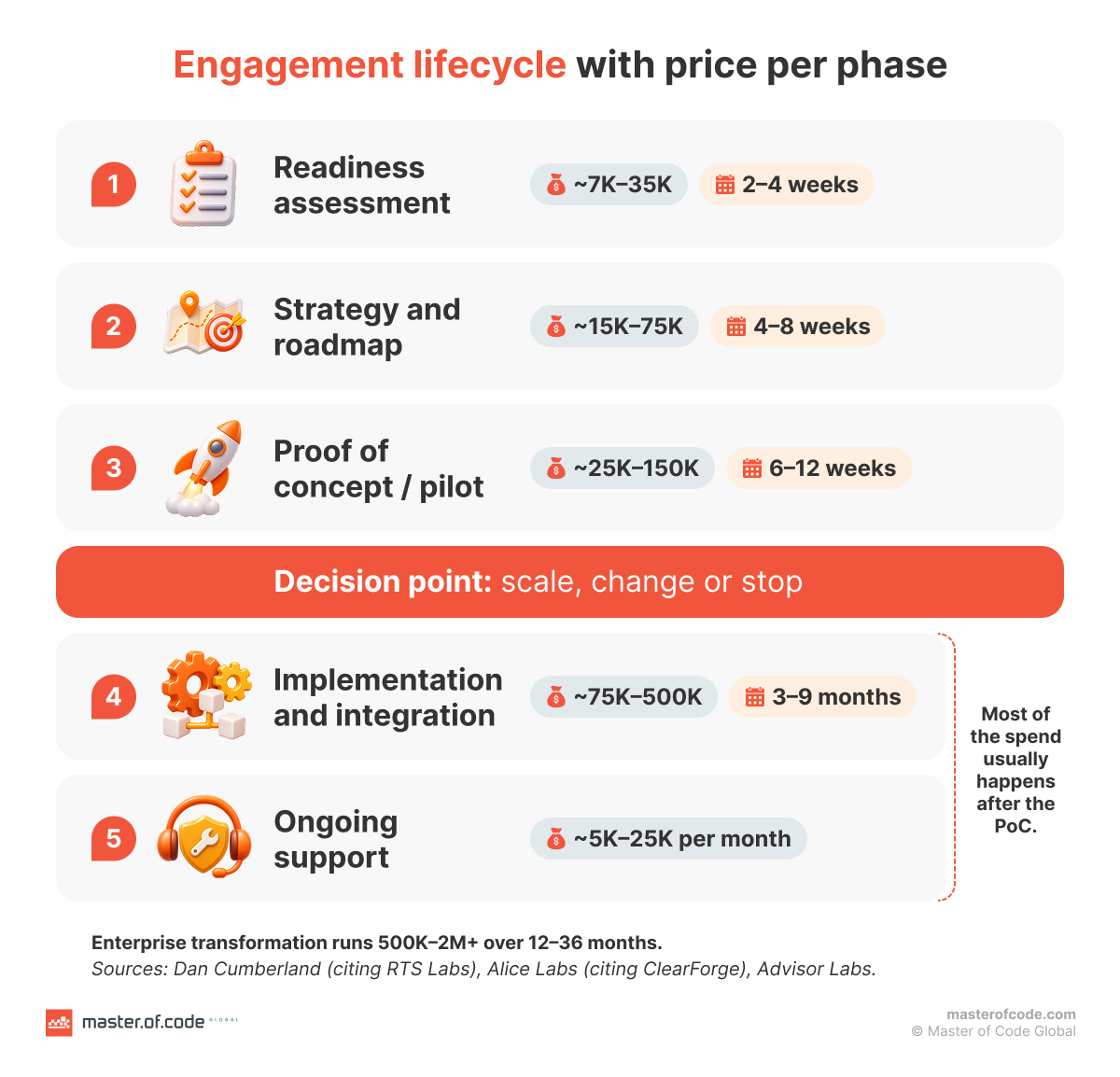
A readiness assessment costs about $7K–$35K, and a strategy roadmap $15K–$75K. A proof of concept runs $25K–$100K, and a production build $75K–$500K+, depending on scope and data.
| Service | Market range | Master of Code Global engagements | Duration | Typical deliverables |
|---|---|---|---|---|
| Readiness assessment / AI maturity assessment | $7K–$35K | Self-serve: free. Expert-facilitated: fixed fee, quoted after a short call | 2–4 weeks (ours: up to 2 weeks) | Data and systems audit, use-case shortlist, risk map |
| AI strategy and roadmap | $15K–$75K | AI Compass Sprint, fixed fee | 4–8 weeks (ours: 3–4 weeks) | Prioritized roadmap, business case |
| PoC / pilot | $25K–$100K | $25K–$80K; 30-day AI Pilot at a fixed fee | 4–12 weeks | Working prototype, success metrics, feasibility report |
| AI feature or integration | $75K–$300K+ | $60K–$180K | 2–6 months | A production feature inside your product |
| Custom ML solution | $50K–$1M+, by complexity | $120K–$400K | 3–8 months | ML pipeline with training, deployment, and monitoring |
| GenAI or AI agent platform | $250K–$650K (enterprise production phase) | $150K–$500K+ | 4–12 months | Multi-model orchestration, RAG, guardrails, integrations |
| AI cost optimization consulting | No reliable project range; retainers ~$5K–$10K/month | Scoped per audit | Varies | Infrastructure and token-cost findings, optimization roadmap |
| Ongoing support / managed AI | $5K–$15K/month (mid-market); $10K–$33K/month (enterprise) | Scoped after launch | Ongoing | Monitoring, fixes, model updates |
| Enterprise program, year 1 | ~$600K–$1.6M | Scoped per program | ~12 months | Several use cases with governance |
Market ranges: Dan Cumberland Labs (citing RTS Labs), Alice Labs (citing ClearForge), and Advisor Labs. Master of Code Global ranges come from our AI development cost guide and cover development only, not inference, maintenance, or retraining.
Why is our PoC range narrower than the market’s? We time-box a PoC to one use case and 4–8 weeks, and scope production integration as a separate phase. Many pilots priced above $100K bundle that integration work in.
The AI consulting services cost at the start of a project is small next to the build. A readiness assessment checks your data, systems, and risks before you commit. The AI strategy consulting cost for a roadmap then buys a ranked list of use cases with a business case for each.

Strategy vs. Implementation
Compare the ranges above and you’ll see that the AI implementation consulting cost usually runs 3–10 times the strategy fee. Implementation adds engineers, data work, and integration with your core platforms. A cheap strategy turns expensive when a different team has to relearn it before building. If one team covers both strategy and build, you don’t pay for that handoff twice.
What’s Included (and What Isn’t)
A fair fee should cover discovery, documentation, knowledge transfer, success metrics, and change management. Most fees exclude cloud and API usage, software licenses, and your own staff’s time. Ask for those as separate line items.
What Drives AI Consulting Cost Up or Down?
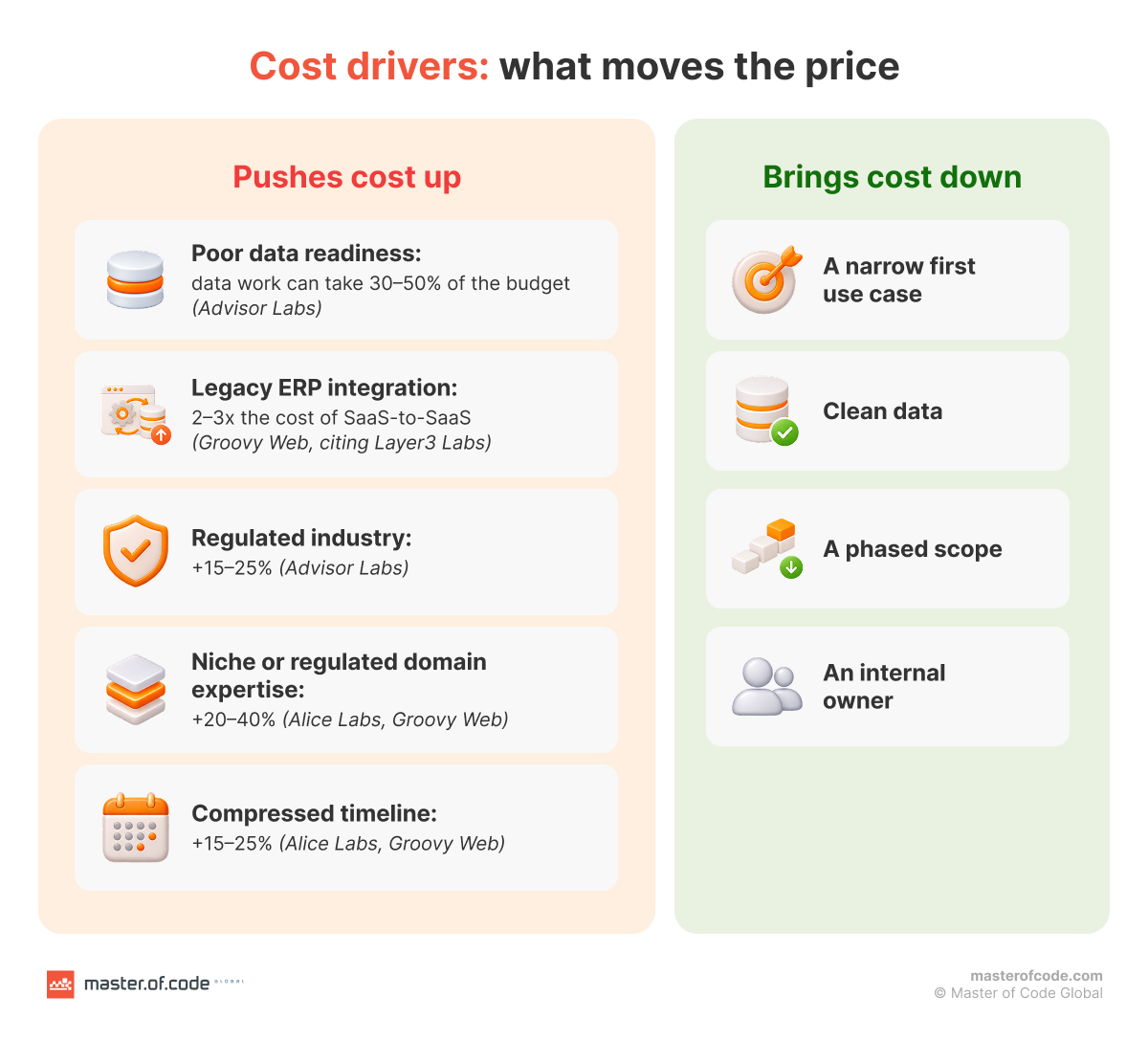
Data readiness and integration depth move the price most. Rates and seniority matter, but they rarely double a budget on their own.
Data readiness. When data is fragmented, data engineering can take 30–50% of the budget before any AI work starts (Advisor Labs). That work is easy to underestimate, because nobody sees the problem until the first model gets bad inputs. In February 2025, Gartner predicted that through 2026, organizations would abandon 60% of AI projects not supported by AI-ready data. It also found that 63% of organizations either lack or aren’t sure they have the right data management practices.
Integration depth. Connecting one SaaS tool to another is cheap. Layer3 Labs puts SaaS-to-SaaS integration at $5K–$10K, versus $15K–$25K when legacy APIs are involved.
Compliance. Regulated work, such as HIPAA, legal, or financial services, adds 15–40% to project cost, depending on the source (Advisor Labs, Layer3 Labs).
Use-case complexity. An FAQ bot that answers from one knowledge base is a small project. An agent that takes actions across your CRM, billing, and ticketing systems is a large one. Each action needs its own permissions, test cases, guardrails, and a fallback to a human. Every extra system adds integration work and another team to coordinate with.
Seniority, specialization, and urgency. The premiums from the rates section apply here: up to 50% for niche skills and 15–25% for rushed timelines.
What lowers the cost:
- A narrow first use case
- Clean, accessible data
- A phased scope with decision points
- An internal owner who can make decisions fast
An AI maturity assessment shows which of these you already have before a vendor prices the gaps.

AI Consulting Pricing Models: Hourly, Fixed Fee, Retainer, or Outcome-Based?
For most buyers, the most cost-effective setup is a hybrid. Pay a fixed fee for a defined discovery phase, then a fixed fee or time-and-materials per milestone, and a retainer once the system is live. Pure hourly billing suits early exploration. Outcome-based fees only work when the metric is measurable and the vendor controls it.
| Model | How you pay | Who carries the risk | Best when | Watch out for |
|---|---|---|---|---|
| Hourly / time-and-materials | Hours × rate, billed monthly | You | Scope is unclear, early exploration | Discovery with no end date |
| Fixed fee per phase | One price per deliverable | Vendor | Scope and exit criteria are clear | Risk padding, costly change requests |
| Retainer | $2K–$50K/month by depth; fractional AI lead ~$5K–$15K/month | Shared | The system is live or you need ongoing advice | Unused hours |
| Staff augmentation | $10K–$45K per person per month, by role | You | You manage delivery yourself | You own the outcome |
| Outcome- or value-based | 10–40% of measured value | Vendor | A clear metric the vendor controls | Disputes over what caused the result |
Sources: Dan Cumberland Labs (retainers, fractional lead, and outcome-based, citing Orient Software) and Advisor Labs (staff augmentation).
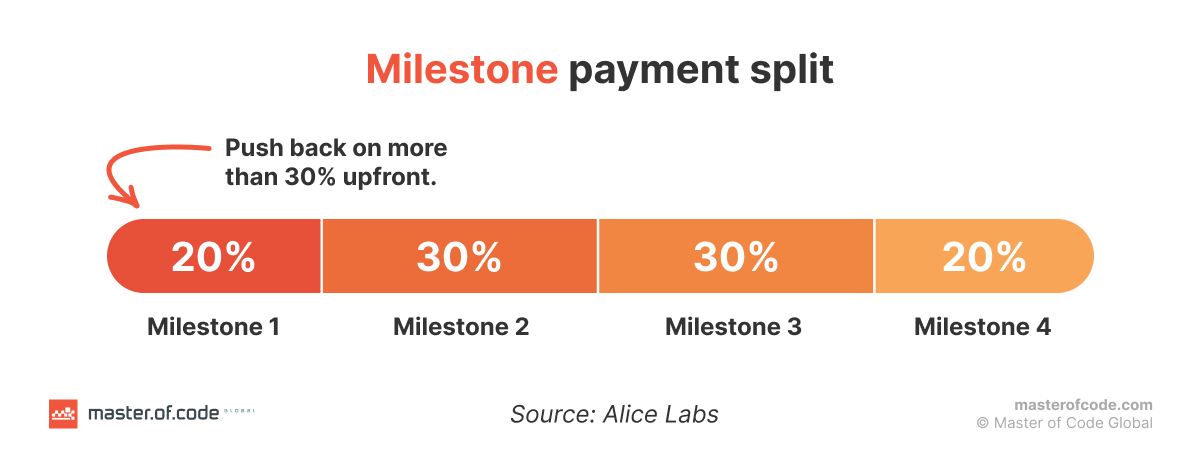
The most common AI consulting pricing strategies combine these pricing models by phase. Discovery is a fixed fee because its output is clear. The build moves to milestones, and support moves to a retainer. Alice Labs suggests a 20/30/30/20 payment split:
- 20% at signature
- 30% at roadmap sign-off
- 30% at pilot acceptance
- 20% after production and 30 days of stable operation
It also advises rejecting any structure that asks for more than 30% upfront.

Outcome-based deals look safest on paper. But they need three things to work:
- A baseline measured before the project starts
- An agreed way to attribute results
- A cap on the vendor’s share
Without them, you’ll spend the second half of the project arguing about who caused the numbers.
Mid-Market vs. Enterprise: What Budgets Actually Look Like
A mid-market company usually spends $50K–$150K in year one on its first use case. An enterprise GenAI program runs roughly $600K–$1.6M in year one.
How Much Does AI Consulting Cost for a Mid-Market Company?
For companies with 50–500 employees, Advisor Labs gives these ranges:
- Initial strategy: $15K–$50K
- First implementation: $25K–$100K
- Support: $5K–$15K per month
Dan Cumberland Labs suggests a $50K–$150K budget for year one, including hidden costs. That usually buys one or two use cases taken to production. A common split looks like this: $10K–$25K for an assessment and roadmap, $25K–$80K for a PoC, and the rest for the build and early support. Mid-market companies also have shorter decision chains, which keeps discovery short and cheap. See our AI consulting services for mid-market businesses for how we phase that work.
How Much Does Enterprise AI Consulting Cost?
Alice Labs puts a year-one enterprise GenAI program at roughly $600K to $1.6M. That covers discovery, a pilot, production, scaling with governance, and managed operations. The enterprise AI strategy consulting cost sits at the top of the strategy range. Alice Labs prices discovery and readiness at $25K–$75K. Many stakeholders and functions take part.
Some estimates go far higher. In July 2024, Gartner put the cost of GenAI deployment approaches for business-model transformation at $5 million to $20 million. That figure covers the full deployment approach, not consulting fees. Enterprise budgets grow because they include governance, security review, and multi-country rollout. Large companies also run several pilots at once. They need shared platforms, model monitoring, and one AI policy for every business unit. Those pieces cost money before the first use case reaches production, but they make the second and third use cases much cheaper.
Hidden Costs That Don’t Show Up in the Proposal
The consulting fee is often only part of year one. Founders Workshop says total year-one cost routinely runs 40–60% higher than the headline number. Treat that as one firm’s estimate, but plan for the hidden costs below.
- Model and API usage. It scales with traffic. A pilot with 100 requests a month costs almost nothing to run. The same tool at 100,000 requests can cost thousands each month. Our AI development cost guide shows how to estimate it.
- Hosting and monitoring. Budget $1K–$5K per month for cloud compute and model monitoring after launch (Advisor Labs).
- Tool seats. Microsoft 365 Copilot for enterprise costs $30 per user per month, paid yearly. Microsoft 365 Copilot Business for SMBs lists at $21 per user per month. Both sit on top of a qualifying Microsoft 365 license.
- Security and legal review. Penetration tests, data protection assessments, and contract reviews often sit outside the consulting scope. In regulated industries, they can delay launch by weeks.
- Internal staff time. Your subject matter experts, IT, and security teams will spend hours on workshops, testing, and reviews.
- Training and change management. Plan for $5K–$25K (Advisor Labs) to $10K–$30K (Dan Cumberland Labs).
- Scope creep. Founders Workshop shows how unplanned work beyond a defined roadmap can turn a $30,000 engagement into $55,000.
- Vendor lock-in. If the stack is proprietary, leaving costs money. A platform-agnostic partner keeps that exit cheap. Here’s how to avoid LLM vendor lock-in from the start.
Ongoing maintenance is the biggest line after launch. Dan Cumberland Labs, citing SmartDev, puts it at 15–25% of the implementation cost per year. Founders Workshop says 15–20%. Our AI development cost guide puts maintenance at 10–25% of overall project expenses. A support retainer of $5K–$15K per month for mid-market teams usually covers this maintenance, so budget for one or the other, not both. Good AI consulting pricing shows these costs up front.
How to Estimate the Total AI Consulting Cost of Your Project
Add four numbers: the phase fees (assessment, PoC, and build), year-one run costs, your internal team’s time, and a 15–25% contingency.

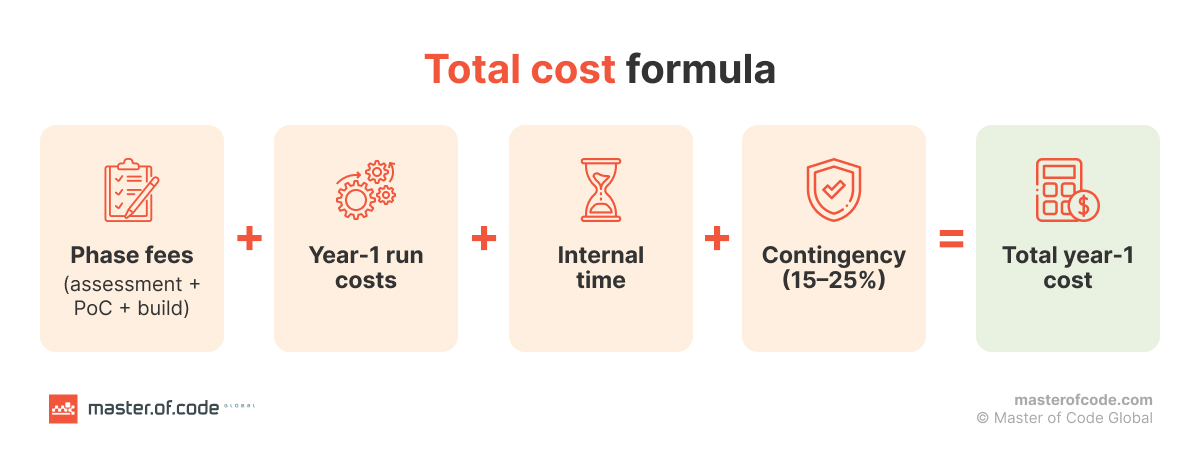
Here’s an illustrative example for a mid-market company with one use case. It uses numbers from the lower half of the ranges above.
| Item | Year 1 | Year 2 |
|---|---|---|
| Readiness assessment | $10,000 | – |
| PoC | $40,000 | – |
| Production build | $80,000 | – |
| Run costs (hosting, monitoring, model usage at ~$3K/month) | $18,000 (6 months live) | $36,000 |
| Maintenance and support | $8,000 | $16,000 |
| Internal staff time | $25,000 | $10,000 |
| Training and change management | $10,000 | – |
| Contingency (20%) | $38,000 | $12,000 |
| Total | $229,000 | $74,000 |
Illustrative only. Maintenance and support is priced at about 20% of the build cost per year. A monthly support retainer would usually replace this line, not add to it. Your numbers will depend on data, integrations, and traffic.
To build your own version, start with the mid-point of each range. Move to the high end if your data is fragmented, the use case touches legacy systems, or you work in a regulated industry. Move to the low end if a readiness assessment has already confirmed clean data and simple integrations.
Look at where the money goes. The assessment and PoC take about a fifth of year one. Most of the spend comes after the pilot proves the idea. That’s why the move from AI pilot to production needs its own budget line, not a hopeful extension of the pilot.
AI Consulting Company or In-House AI Team: Which Costs Less?
For the first one or two use cases, a consulting partner usually costs less and ships faster. An in-house team wins once AI is core to your product and the roadmap runs for years.
Start with salaries. The US Bureau of Labor Statistics puts median pay for data scientists at $120,230 (May 2025), before benefits. Advisor Labs puts a senior ML engineer at $150K–$250K a year with salary and benefits, plus recruiting and ramp-up time. A minimum viable team needs an ML engineer, a data engineer, an MLOps engineer, and a lead. That passes $500K a year quickly.
Hiring also takes time. Every month a role stays open is a month the roadmap waits, and new hires need time to learn your data and systems.
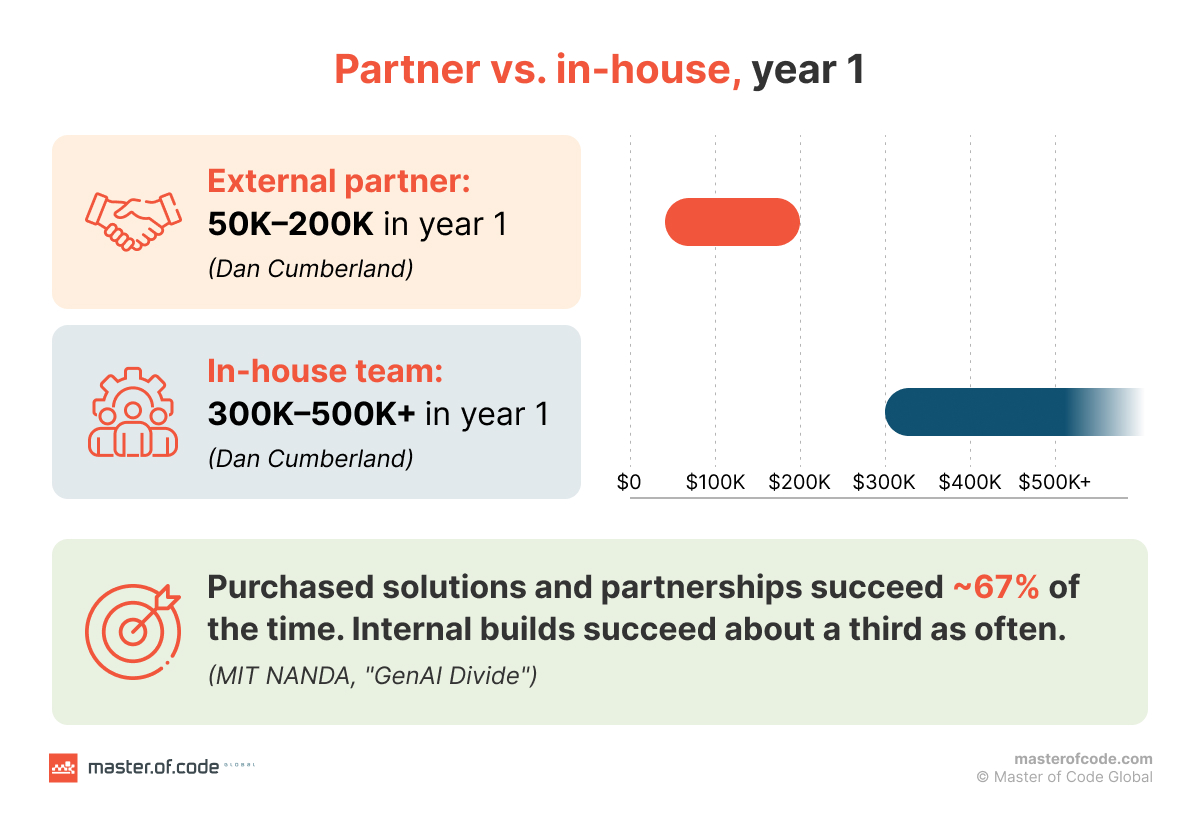
Dan Cumberland Labs compares year-one costs this way:
- External consultant: $50K–$200K
- In-house team: $300K–$500K+
- Hybrid model: $100K–$250K
Success rates point the same way. MIT NANDA’s report, The GenAI Divide: State of AI in Business 2025, found that external partnerships reached deployment about 67% of the time. Internal builds reached it about 33% of the time. The authors note the gap may partly reflect differences in organizational capability, not only the build-or-buy choice.

The hybrid path often works best. A partner builds the first use cases while your team learns alongside them. Then the partner hands over code, documentation, and runbooks, and your team takes over. You pay for outside expertise when you need it most and build internal skills on a working system.
In-house wins in three cases: AI is the product, you plan several new use cases a year, or your own data is your main edge. Run the math. Say a partner costs $150K a year and an internal team $500K. The team pays off only if it delivers over three times the work.
How to Calculate the ROI of AI Consulting
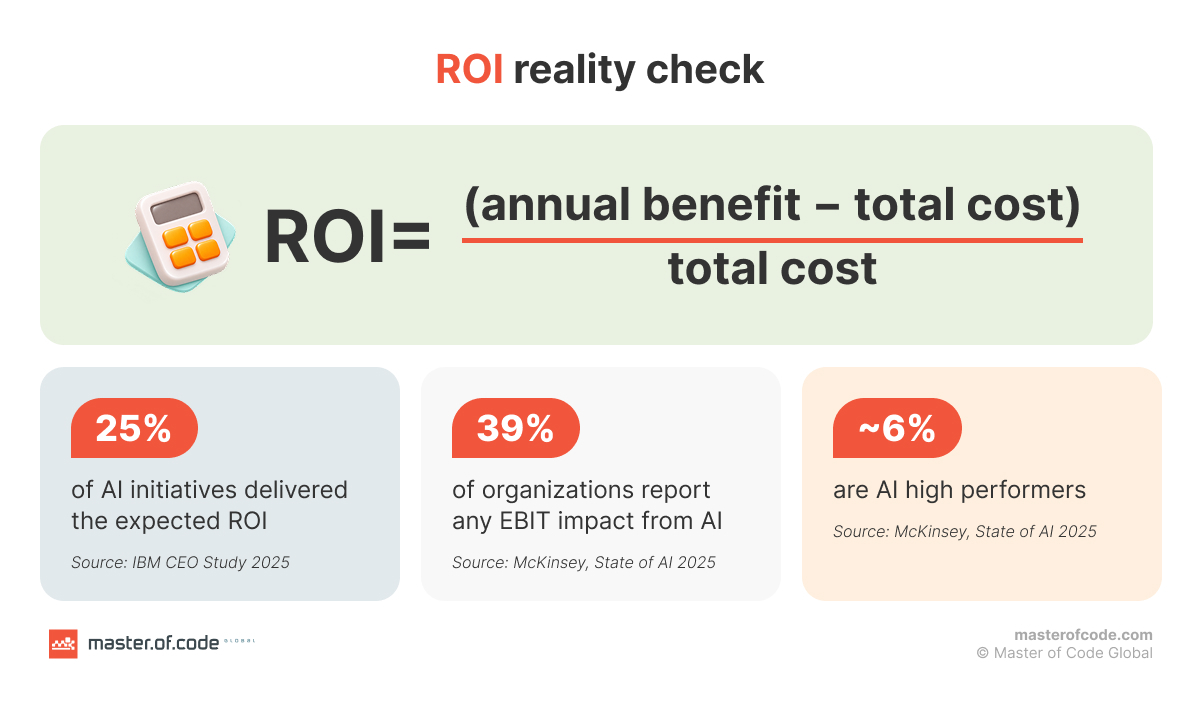
Use this formula: ROI = (annual benefit − total cost) ÷ total cost. Total cost must include run costs, not just the consulting fee.
Here’s a hypothetical example. A support team of 20 agents uses an AI assistant that saves each agent 5 hours a week. That’s 100 hours a week, or 4,800 hours over 48 working weeks. At a loaded cost of $45 per hour, the benefit is $216,000 a year. If year-one total cost is $150,000, ROI is ($216,000 − $150,000) ÷ $150,000 = 44%. In year two, with only $60,000 in run and support costs, ROI rises to 260%.
Two rules make the calculation honest. Measure the baseline before the project starts, because you can’t prove time saved without knowing the time spent. And count adoption: a tool that saves 5 hours a week saves nothing for agents who don’t use it.
Real results are often lower than such models predict. In IBM’s 2025 CEO Study, CEOs said only 25% of AI initiatives had delivered the expected ROI, and only 16% had scaled enterprise-wide. McKinsey’s State of AI in 2026 found that 37% of respondents attribute at least some EBIT impact to AI. High performers remain about 6% of respondents.

Strategy-only work has no ROI by itself. Its value is avoiding the wrong build. As Advisor Labs puts it, a $20,000 strategy engagement can stop you from spending $200,000 on the wrong project. Judge the AI strategy consulting cost against the size of the mistake it prevents. Our guide on how to measure AI ROI covers the metrics in more detail.
The cheapest way to get real ROI data is a time-boxed pilot. Master of Code Global’s AI Pilot delivers a working Proof of Value you can test with real users in 30 days, with KPIs agreed upfront.
How to Compare AI Consulting Proposals Side by Side
Compare scope per phase, the blended rate, and run costs before you compare totals. A low headline price often hides a vague scope or missing run costs.
Start by putting every proposal into the same table: phases, hours by role, rates, run costs, and exclusions. Vendors structure quotes differently, so a $90K proposal can include more work than a $120K one. Once the numbers sit side by side, the real differences show up.
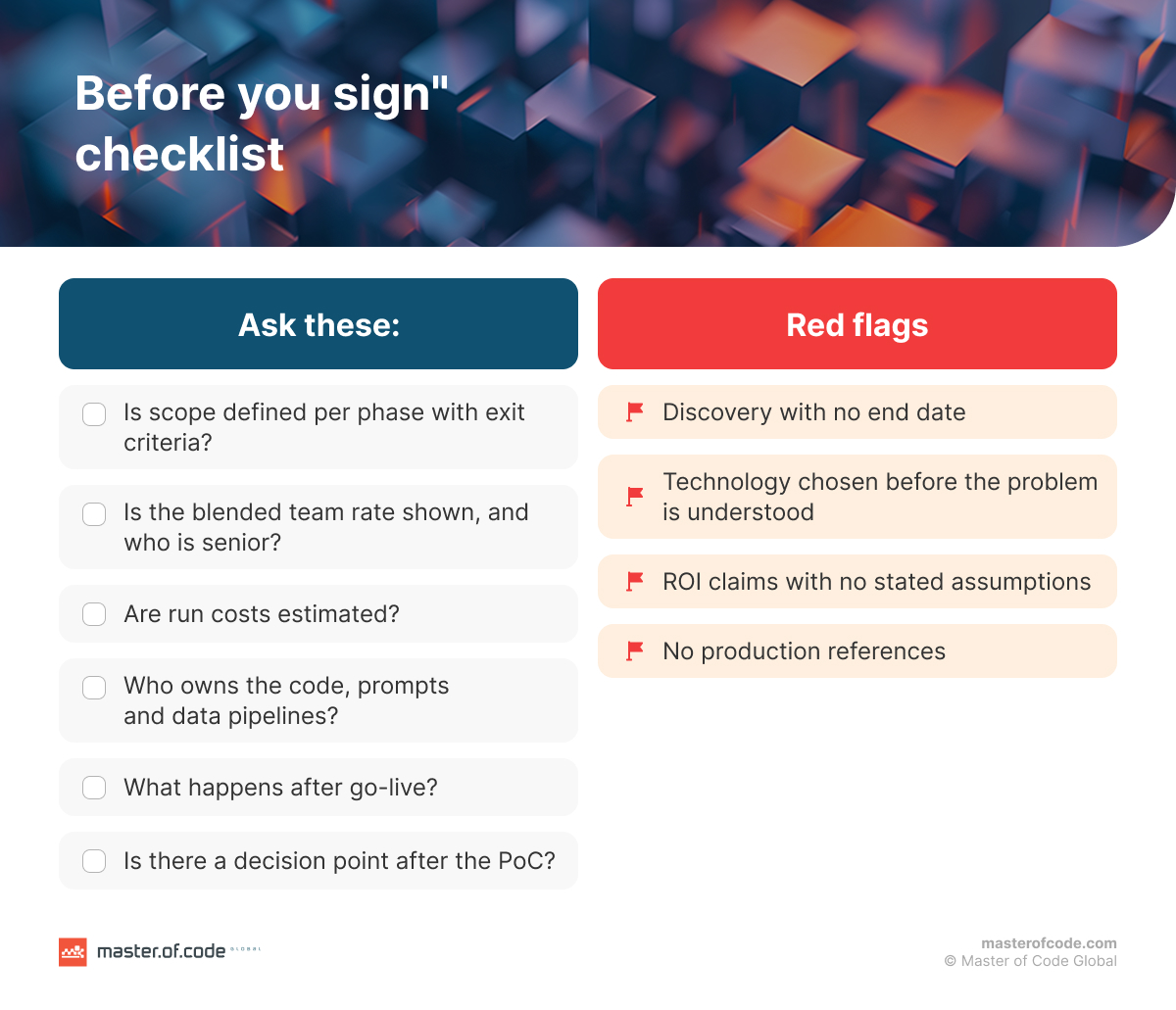
Ask these questions of every proposal:
- Is the scope defined per phase, with exit criteria?
- Is the blended team rate shown, and who on the team is senior?
- How many hours will senior people actually spend on the project?
- Are run costs (hosting, model usage, monitoring) estimated?
- Who owns the code, prompts, and data pipelines?
- What happens after go-live, and what does support cost?
- Is there a decision point after the PoC?
Watch for these red flags:
- Discovery with no end date
- A technology chosen before anyone understands the problem
- ROI claims with no stated assumptions
- No production references

A good partner will also tell you when not to build. Master of Code Global has turned clients away after Discovery when the numbers didn’t work. That costs a vendor revenue in the short term. It saves the client far more.
Once you’ve chosen a partner, negotiate the structure as well as the price. Tie payments to milestones. Ask for a discount on multi-month retainers or phased programs, which Alice Labs puts at 10–20% below equivalent hourly rates. Add phase gates so you can stop after any stage. Transparent AI consulting pricing and a clear AI consulting services cost per phase make proposals easy to compare.
What Real AI Consulting Engagements Deliver
Three of our engagements show what each kind of AI consulting buys: a company-wide transformation, a cost-focused architecture audit, and a long-term implementation partnership.
Zipify AI Transformation. Zipify builds Shopify apps, and its flagship product is over 10 years old. Routine features took a month or more to ship. We ran a company-wide AI development upgrade with a standard AI toolset and spec-driven development with human sign-off. We also set up a senior “Zipify Labs” team. The result: 12x faster time to a working prototype, up to 4x faster delivery of some features, and 1 week to ship a feature estimated at 3+ months. Here, the return on consulting showed up as delivery speed across the whole product team.
AI Architecture Audit. A UK asset manager’s GenAI assistant was straining under 40% yearly portfolio growth. API response times climbed above 3 seconds, and storage costs tripled in six months. We ran an architecture, security, and compliance audit. It identified 87% performance improvement potential and 8 critical security vulnerabilities. It also projected a 3x capacity increase and a possible 45% reduction in operational costs. This is what AI cost optimization consulting looks like in practice: a fixed-scope audit that shows where the money leaks before you scale.
Global Energy Leader AI Implementation Partnership. A multinational energy provider wanted to move AI in customer support beyond experiments. We worked as an embedded implementation team with ongoing optimization. One of the solutions now handles 98.68% of customer conversations without human support or portal redirection. It holds a 93% customer satisfaction score and processes data automatically with a 99.35% success rate. This is the ongoing partnership model: a retainer that keeps improving a live system.
FAQs
Is AI consulting worth it for a small business?
Yes, if you start small. A readiness check or a short pilot on one use case shows whether AI pays off before you spend more. Small businesses get the most value from narrow, high-volume tasks like support, scheduling, or document processing. Skip big strategy programs.
How long does a typical AI consulting engagement take?
Assessments take 2–4 weeks, and strategy roadmaps 4–8 weeks. A PoC or pilot runs 4–12 weeks. Production builds take 2–12 months, depending on integrations. Clutch reports an average of about 10 months for AI development projects.
Can we start with a small engagement before committing to a full project?
Yes, and you should. Start with a free self-serve AI maturity assessment or a 30-day AI Pilot with KPIs agreed upfront. Then decide on a full build with real data in hand.
How can we reduce AI consulting pricing without cutting quality?
Narrow the first use case, clean your data before the build starts, and buy in phases with decision points. Assign an internal owner who can make decisions fast. These steps lower the price more than haggling over the hourly rate does. Reusing existing tools and platforms, instead of custom-building everything, also helps.
Conclusion
AI consulting cost depends less on the hourly rate than on scope, data readiness, and what happens after the PoC. A $40K quote and a $650K quote can both be fair. They usually describe different work.
Budget for the full lifecycle: assessment, pilot, build, run costs, and maintenance. Add a contingency for scope changes. Buy in phases, and keep a decision point after each one. That way, you only pay for the next stage once the last one has proved its value.