



Hello, everyone trying to make logistics run a little smarter. If you’re here, you probably don’t need another article telling you AI is “transforming logistics.” So we’ll skip that part.
You already have enough technology. The harder question is whether it helps your people act faster when a shipment is delayed, a driver reports an issue, or a customer needs an answer now.
That is the practical case for Conversational AI for logistics. In this article, we’ll show where it can retrieve real-time information, complete operational tasks, and support faster decisions. We’ll also look at what has to work behind the scenes for those results to hold up in real operations.
And if you’re already exploring a use case and have questions, get in touch with our team. We’ll be happy to talk it through.
Table of Contents
Key Takeaways
- Conversational AI in logistics can do more than return information. It can retrieve operational data, trigger approved workflows, and help teams interpret complex information for faster decisions.
- The most practical use cases fall into three levels: ASK, ACT, and ADVISE. They range from shipment tracking and employee information access to delivery changes, driver workflows, exception prioritization, and inventory analysis.
- The conversational interface is only one part of the system. Reliable results depend on connections to TMS, WMS, CRM, fleet platforms, carrier APIs, and other operational sources.
- Business value comes from improving existing logistics outcomes. These include faster information access, fewer manual handoffs, quicker exception resolution, better self-service, and more consistent use of operational data.
- Voice and text fit different workflows. Voice works well for hands-free and time-sensitive interactions. Text is better suited to detailed information, documents, links, and conversations users may need to revisit. This shift toward more connected and action-oriented experiences also appears across broader Conversational AI trends.
What Does Conversational AI Mean in Logistics?
Think of Conversational AI as a translator between people and the systems already running the operation.
Instead of clicking through menus, users can say what they need in natural language. A virtual assistant interprets the request, keeps track of the context, retrieves approved data, and returns an answer. Connect it to the right tools, and it can also trigger a workflow or complete an authorized action.

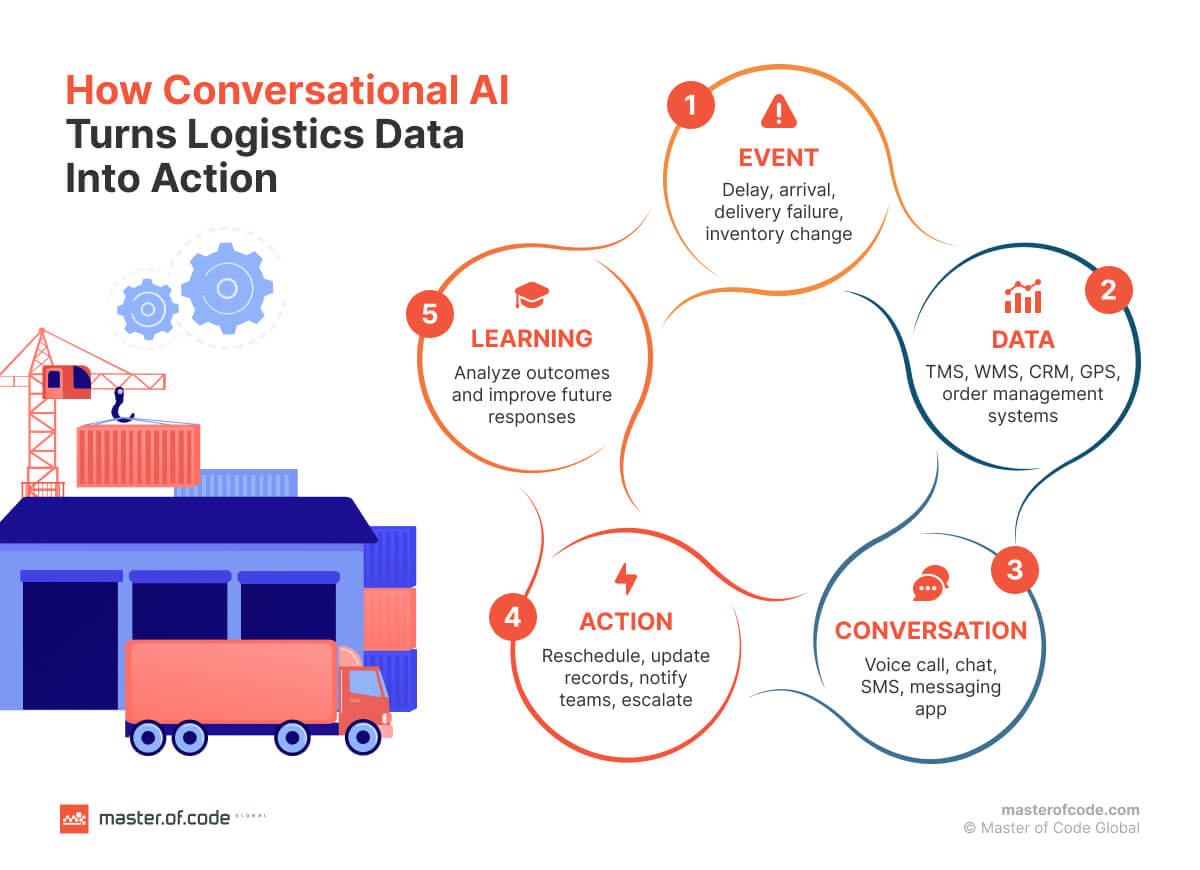
That is also what separates Conversational AI from traditional IVR and rule-based assistants. Those systems usually depend on predefined menus, intents, keywords, or scripted dialogues. Conversational AI can interpret more flexible natural language, maintain context across turns, retrieve live data, and support actions that are not limited to a fixed decision tree.
Why is this becoming more relevant now? Because logistics companies have already invested heavily in technology, yet connecting it all remains difficult. In PwC’s 2026 survey, 89% of supply chain leaders said their tech investments hadn’t fully delivered the expected results. 87% mentioned poor data quality had affected value from digital initiatives.
Descartes found that just 19% of shippers and 15% of logistics service providers use AI at scale. Data quality and integration complexity remain among the biggest barriers.
So, adding another isolated tool isn’t particularly interesting. Giving people an easier way to reach existing data, connect systems, and get work done is.
For the rest of the article, we’ll group the most practical Conversational AI use cases in logistics into three levels:
- Ask: retrieve the information you need.
- Act: complete or trigger a task.
- Advise: analyze what is happening and support the next decision.
Let’s start with the simplest one: asking.
Level 1. ASK: Give People Faster Access to Logistics Information
Logistics creates a huge number of questions that don’t really require a decision. Someone simply needs the right information from the right place.
That’s why ASK is often the easiest entry point for Conversational AI. The assistant is helping people reach information that already exists without bouncing between portals, systems, emails, and support teams.
There is plenty of demand for that. Descartes’ Transportation Management Benchmark Survey found that 67% of logistics service providers already use AI for real-time visibility and tracking.
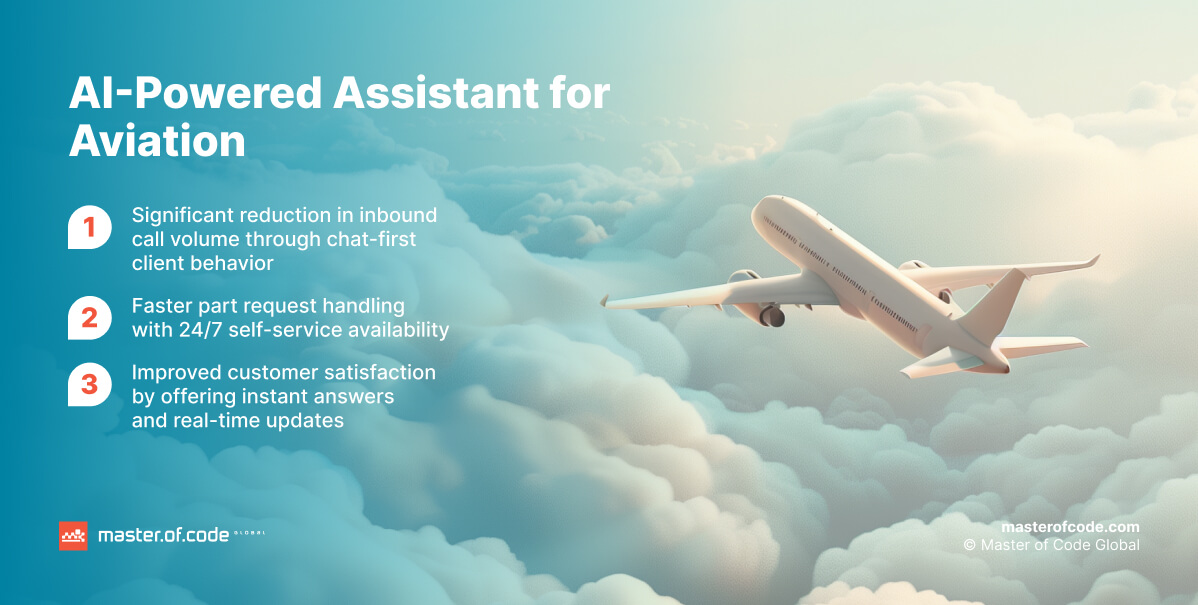
We’ve seen the same need in aviation logistics. For a U.S. aircraft parts supplier, Master of Code Global built a multi-layered AI assistant. It helps airline customers check inventory availability, track order fulfillment and delivery, and get answers about shipping times and part compatibility. Available across web, SMS, and voice, it gives users 24/7 access to information, while reducing inbound call volume.

Shipment Status and ETA
A basic assistant retrieves the latest status. A better one can answer the next question too:
“Why is it delayed?“
That requires more context. It may need shipment events, carrier information, the latest estimated time of arrival, or an exception recorded along the route. Conversational AI explains what approved operational data says instead of asking a language model to invent the most plausible answer.
DTDC handles this at considerable scale. The provider receives more than 400,000 customer queries per month, including tracking requests, serviceability checks, and shipping rates. Its DIVA 2.0 assistant connects directly to DTDC APIs for current consignment data. It achieved 93% response accuracy, while 51.4% of consignment inquiries did not result in a support ticket during the measured three-month period.
Quotes, Documentation, and Logistics Information
Freight forwarders and third-party logistics (3PL) providers deal with questions spread across systems, documents, rate tools, and knowledge bases. Conversational access can make it easier to find things such as:
- shipment docs and proof of delivery;
- delivery or service requirements;
- customs and product information;
- shipping rates from approved pricing sources;
- service availability and contact details.
DHL Global Forwarding’s myDHLi platform is a good example. Its Gen AI-powered assistant lets users ask about shipment status, contact information, and other logistics questions. The platform provides access to quotes, transport modes, emissions data, exceptions, timestamps, and locations. DHL says myDHLi serves 20,000+ customers and more than 450,000 shipments tracked per month. It’s the scale at which conversational access can sit alongside traditional logistics tools.
Internal Employee Access
The same problem exists inside logistics companies. Dispatchers, warehouse teams, and account managers may all need answers about drivers, orders, shipments, and other day-to-day activities.
Instead of learning where every piece of information lives, employees get one conversational entry point. What they see depends on their role and permissions, so each person can reach the data they need without exposing restricted knowledge.
UPS is already applying that idea to customer-care operations. The company says its teams now receive AI-powered real-time shipment insights to resolve inquiries faster. Moreover, clients in more than 20 countries will have access to answers through digital and voice interfaces.
Technically, ASK is also simpler than the levels coming next because it usually requires read access rather than permission to change operational records. The sources behind it may include a Transportation Management System (TMS), Warehouse Management System (WMS), Order Management System (OMS), Customer Relationship Management (CRM) platform, carrier APIs, or an approved knowledge base.
At this level, metrics you track to measure ROI may include answer accuracy, information retrieval time, self-service completion, response time, escalation rate, and repetitive-contact volume.

Level 2. ACT: Turn Conversations Into Logistics Workflows
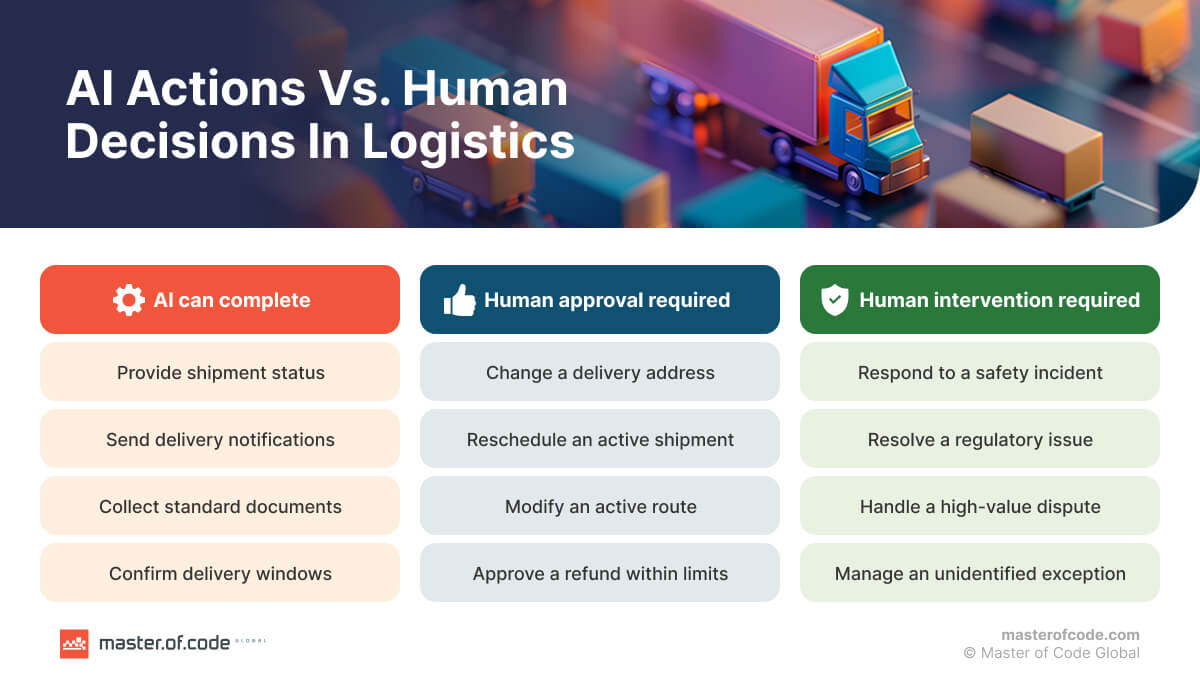
At ACT, intelligent technology stops being read-only. It understands what someone wants, checks the relevant data and business rules, and triggers an approved action in another system.
There is plenty of room for this kind of automation. Accenture estimates that Generative AI could affect 43% of working hours across end-to-end supply chain activities. These estimates show how much work involves repeatable information processing and coordination.
We’ve seen the same shift from answering to acting in our own work. For a North American food-services brand, we upgraded an existing solution so customers could request refunds without waiting for an employee. The assistant collects details, applies the company’s rules, and determines the next step. Agent escalations dropped by 42–66%, while improvements to the refund process generated $10.2 million in savings.
Delivery Changes and Exception Handling
- A customer reports a problem.
- An employee checks the order, looks up available options, updates the delivery record, and confirms what happens next.
Artificial intelligence can connect those steps. It offers permitted alternatives, captures the customer’s choice, and writes the update back to the delivery system. Address corrections, rescheduling, redirection, or new instructions can all follow the same path. Anything outside approved rules goes to a person.
GLS Spain already uses Conversational AI this way across WhatsApp and other channels. Recipients can change a delivery address, redirect a parcel to a pickup point, or check its status without human assistance. The company reports nearly 300,000 conversations and around a 45% reduction in customer-service workload since implementation.
Booking and Shipment Management
It often starts with unstructured information: an email with a load tender, a request for a quote, or details for a pickup appointment. Someone then has to interpret the message and enter the right information into operational systems.
A digital assistant can handle that translation layer. It extracts the relevant details, checks what is missing, connects them to the correct workflow, and creates or updates the record. The user can stay in a familiar natural-language channel while the work behind it becomes structured.
C.H. Robinson applies this model to freight operations. Its AI processes emailed load tenders into around 5,500 shipment orders per day in about 90 seconds. It also handles roughly 3,000 pickup and delivery appointment requests daily across more than 26,000 locations, usually within 60 seconds.
The interface here is email rather than live chat, but the principle is the same: understand a natural-language request and carry the task forward instead of simply replying to it.
Driver and Dispatcher Workflows
This one is another strong candidate because much of it is repetitive, time-sensitive, and still handled by phone.
A voice assistant can confirm dispatch, collect pickup or delivery updates, ask about a delay, or capture proof-of-delivery information. It then turns the conversation into structured data and updates the TMS. Unclear or high-risk cases remain with the operations team.
A recent example comes from Truckstop, which introduced a voice agent designed for carriers working on the road. Drivers can use it to search available loads, assess rate competitiveness, and start broker negotiations while driving. The tool is built around hands-free access to freight tasks that would otherwise require stopping, typing, or calling someone.
For voice workflows like these, response speed matters too. A capable assistant still feels broken if every exchange comes with an awkward delay. We cover that engineering challenge separately in our guide on voice AI latency.
ACT also changes the technical requirements. Reading a delivery record is one thing; modifying it is another. The assistant now needs appropriate permissions, validation steps, and an audit trail showing exactly what was changed and why.
The metrics should change too. Useful ROI measures include workflow completion rate, processing time, manual touches, exception resolution time, human handoffs, and errors or rework.
For a broader look at how similar capabilities are being applied across the sector, see our research on Generative AI in transportation and logistics.
And if you’re considering which operational workflow is ready to move from manual conversation to automated action, talk it through with our team. We can help you identify where automation makes sense, and where keeping a person in the loop is still the better call.

Level 3. ADVISE: Use Conversation as an Interface to Logistics Decisions
A planner may have hundreds of late shipments on a dashboard. An operations manager can see carrier performance by lane. A warehouse team knows inventory is getting tight. What they actually need is an answer to: “What deserves my attention first, and why?“
We’ve worked with the same problem from another operational angle. For a U.S. energy company, Master of Code Global developed an AI-powered data reconciliation tool. Instead of manually investigating mismatched readings, users receive natural-language explanations of discrepancies. It’s supported by checks such as geofence matching and load-type validation.
The logistics equivalent is similar: surface the issue, explain what is driving it, and help the team see where attention is needed first.
Exception Prioritization
A dashboard can tell you that 200 shipments are late. It doesn’t automatically tell you which five could hurt a strategic account, cause detention costs, or disrupt production.
Conversational analytics can add that layer. The system can compare shipment history, business rules, carrier data, and current events, then explain which exceptions deserve attention first.
A global pharmaceutical manufacturer applied a similar model to supply chain risk management. Its AI platform brings together data from planning, procurement, logistics, and external risk sources, then lets teams query that information in natural language.
The system can flag at-risk suppliers and sites, show which materials or products may be affected, estimate revenue exposure, and suggest alternative sites or materials. The company reduced decision-cycle time by more than 95% and assessed, triaged, and escalated over 1,500 risk events through the platform.
Carrier and Network Analysis
The conversational layer interprets the question, queries the relevant data, and turns the result into an explanation, table, chart, or follow-up analysis. This is where conversational analytics services fit naturally. Complex operational data becomes easier to work with, even for people who don’t normally use analytics tools.
For example, Dow uses an AI-powered freight agent that lets employees “dialogue with the data.” They can investigate freight rates, accrued costs, invoice charges, and potential billing discrepancies. The system helps teams identify hidden losses in minutes rather than weeks or months. Dow expects the broader freight-audit initiative to save millions of dollars in shipping costs during its first year.
Inventory and Warehouse Decision Support
Warehouse decisions create a similar problem at a different speed. Teams need to watch inventory risk, fulfillment progress, labor, exceptions, and incoming demand at the same time.
Here, an AI assistant can surface an issue and explain its operational meaning:
“Which inventory risks could affect tomorrow’s orders?“
GXO built that concept into GXO IQ, its AI-powered logistics platform. Its interactive assistant, GIL, provides a single view across order fulfillment, exceptions, and inventory risks, answering questions and translating complex operational signals into recommendations. GXO says the wider platform processes more than 200 million operational signals per day across its data layer.
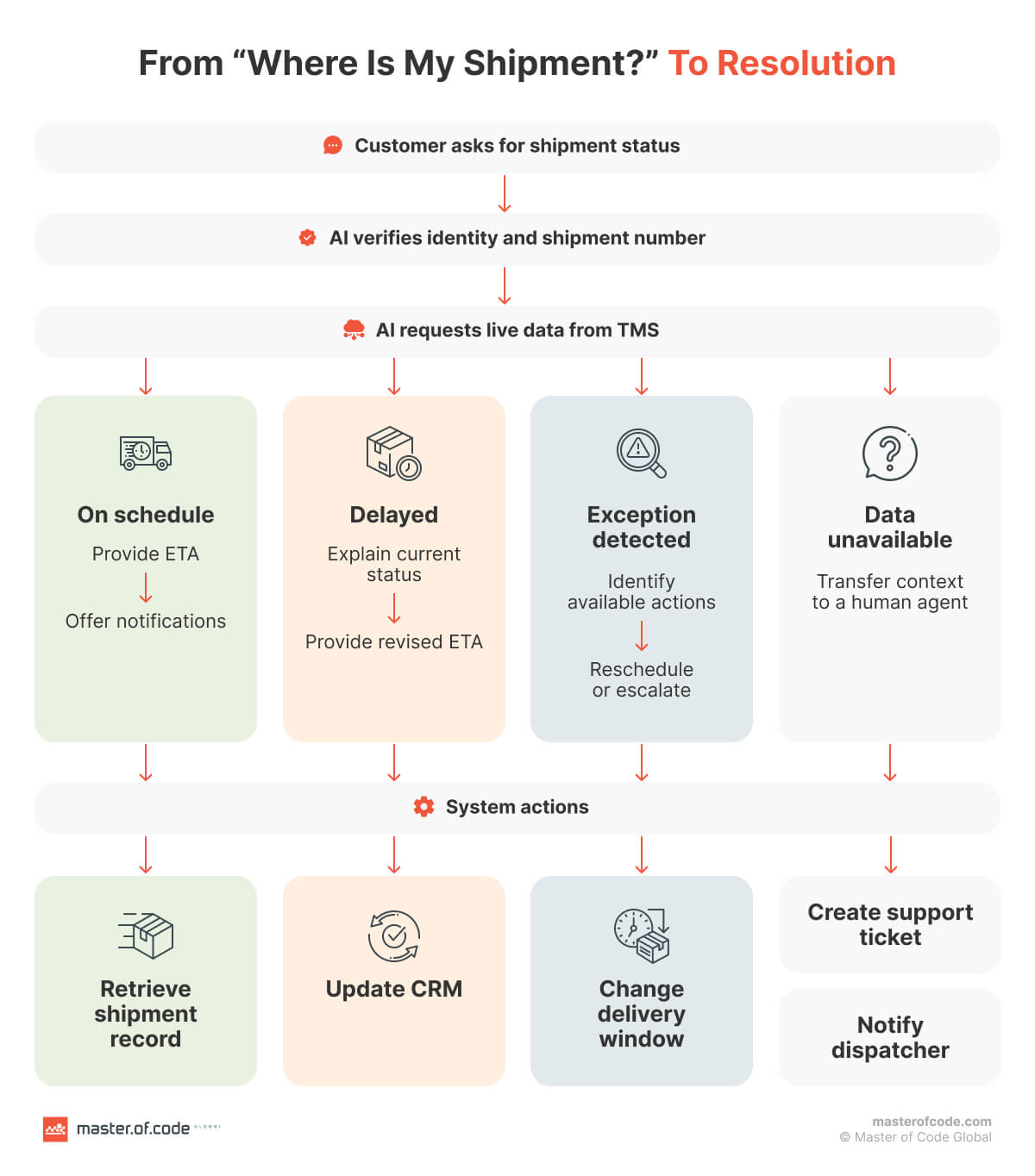
ADVISE doesn’t have to mean handing the decision over to AI. For higher-impact choices, the better role may be to surface the signal, explain the reasoning, and let an experienced operator make the call.
That also changes what success looks like. Useful measures include time-to-insight, reporting effort, exception identification time, recommendation acceptance, and the operational result after a recommendation is used.
ASK makes information easier to reach. ACT moves work forward. ADVISE helps people decide what should happen next.
Where the Business Value of Conversational AI Really Comes From
The significance of Conversational AI services isn’t in building another intelligent interface. It’s in improving an operational outcome that already matters.
The Third-Party Logistics Study found that 40% of shippers and 37% of 3PLs expect the greatest AI return from service-level improvements. Another 34% of shippers and 39% of 3PLs point to better data accuracy.
Financial impact is showing up too. According to the Stanford AI Index, among organizations using Generative AI in supply chain, 61% reported cost decreases, and 67% reported revenue increases. Most improvements were relatively modest, so the business case still depends on choosing the right process and measuring it properly.
Other benefits can show up before the financial impact does. Faster access to information, fewer manual handoffs, quicker exception resolution, better self-service, and more consistent use of approved data can all improve day-to-day logistics performance.
The value delivered depends on the use case, but the common theme is reducing the time and effort between a question, a decision, and the next operational action.
And none of that happens at the conversational layer alone.
Conversational AI Integrations for Logistics: TMS, WMS, and CRM
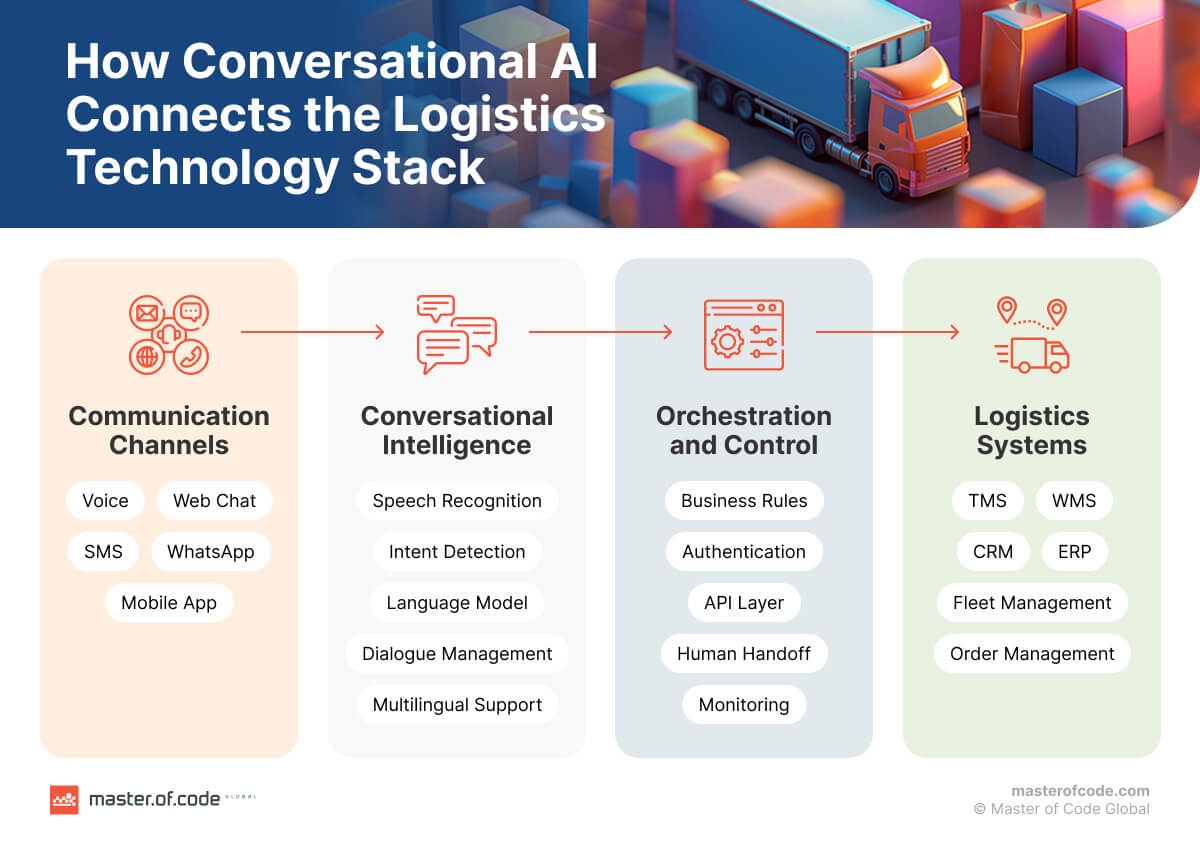
Behind an assistant, several pieces have to work together:
- Channels and identity: web, messaging, email, or voice, plus knowing who is asking and what they are allowed to access.
- Grounding and operational data: approved knowledge and live information from systems such as TMS, WMS, CRM, fleet platforms, and carrier APIs.
- Workflow connections: integrations that let the assistant retrieve data or, when permitted, update records and trigger actions.
- Guardrails and monitoring: permissions, validation, escalation paths, audit trails, and analytics to catch failures and measure outcomes.
In practice, Conversational AI usually connects to logistics systems through APIs, middleware, webhooks, or other integration services. The assistant can retrieve
- shipment and carrier data from a TMS,
- inventory and order notifications from a WMS,
- account context from a CRM,
- or vehicle and trip data from fleet and telematics platforms.
Where the underlying system supports it, authorized integrations can also write data back or trigger approved workflows. The TMS, WMS, CRM, and other operational platforms remain the systems of record; the conversational layer provides a natural-language interface to the data and actions they expose.

How to Get Started With Conversational AI for Logistics
Start with one repetitive question, workflow, or decision where the business impact is clear. Next, define the outcome you want to improve and the KPIs you’ll use to measure it.
With that target in place, the subsequent question is whether your data, integrations, security requirements, and internal processes can actually support the use case. If there is still significant uncertainty, a focused AI pilot can help you test it without committing to a full-scale implementation. The goal is to produce a working solution that real users can try and that you can measure against the business goals set upfront.
Those results should determine what happens next. Review the analytics, user feedback, technical findings, and expected return. Based on those, decide whether the solution needs refinement, is ready for the next product phase, or doesn’t justify further investment.
That same mindset should guide partner selection. Look for a team that will help you narrow the use case, validate feasibility and value first, and only then plan for scale. They should also be able to work with your existing logistics stack, handle enterprise integrations and access controls, design for failure and human escalation, and measure performance after launch.
If you’re comparing potential vendors, read our guide to AI development companies in logistics and supply chain for a broader look at available options.
If you’re deciding where that starting point could be in your operation, our supply chain AI consulting team can help you pressure-test the idea before you invest in a larger build.
FAQ
When Should Logistics Companies Use Voice vs. Chat-Based Conversational AI?
Use voice for hands-free or time-sensitive workflows, such as driver updates, dispatch coordination, and phone-based service. Use text when users need links, documents, detailed information, or an interaction they may return to later. Many logistics operations use both depending on the workflow.
How Much Does Conversational AI for Logistics Cost to Implement?
As a rough benchmark, a focused pilot may cost 25K–80K, while a production-ready AI integration often falls around 60K–180K. Complex enterprise deployments with multiple systems, workflows, and higher security requirements can exceed $500K.
Voice can increase the budget further. Custom voice implementations typically range from $25K to $300K+, depending on integrations, call volume, compliance, and architecture. See our voice AI development costs guide for a detailed breakdown.