


The oil and gas industry is at a critical juncture. For decades, it has driven the global economy, fueling progress and prosperity. Yet today, it faces a series of immense challenges that threaten to disrupt the status quo. Price volatility, aging infrastructure, and increasingly stringent regulations are squeezing margins and pushing companies to their limits. Meanwhile, the call for sustainability grows louder, demanding a shift toward cleaner, more responsible practices.
In response, traditional optimization strategies, while effective in their time, are no longer enough. The industry’s reliance on outdated methods and reactive measures can no longer keep pace with the rapid changes in the market. Enter data – the new oil, the lifeblood of the modern energy landscape. But without the right tools, it remains untapped potential.
Generative AI in oil and gas presents an opportunity to bridge the gap between today’s challenges and tomorrow’s solutions. The question is no longer about its future potential, but how it can deliver measurable improvements right now. How can AI use cases in oil and gas empower companies to unlock efficiency, reliability, and profitability in real-time, not years down the road? This is the core question driving the industry forward, and the answer is already taking shape.
- Proven ROI Across the Value Chain: Artificial intelligence use cases in oil and gas are delivering measurable results — from ADNOC’s $500 million in additional value generated through 30+ AI tools to up to 20% reductions in production and maintenance costs — across upstream, midstream, and downstream operations.
- Six Dimensions of Impact: AI use cases in oil and gas reshape performance through better decision-making, cost reduction, environmental protection, competitive advantage, enhanced stakeholder experience, and continuous innovation — and these benefits compound across the entire value chain.
- Real Barriers, Clear Paths Forward: Only 45% of oil and gas professionals currently use AI in their work, cultural resistance and legacy system integration remain significant obstacles, but each has a proven mitigation strategy — from structured PoCs that reduce development waste by up to 70% to cross-functional teams that turn field skeptics into advocates.
- From Pilots to Production: With the global oil and gas AI market projected to grow from $7.6 billion in 2025 to over $25 billion by 2034, the industry has moved past experimentation. Custom AI for oil and gas solutions tailored to your unique operational data and KPIs deliver deeper insights and stronger returns than generic tools — but scaling them requires simultaneous investment in people, processes, data, and technology, led by executives who tie every initiative to specific business outcomes.
Table of Contents
Why AI Adoption in the Oil and Gas Industry Is Accelerating
The momentum behind AI use cases in oil and gas is undeniable. Today, over 75% of major energy companies are already using digital platforms across parts of their value chain – from exploration and drilling to refining and distribution. Market forecasts also paint a compelling picture: the global oil and gas AI market is projected to grow from roughly $7.6 billion in 2025 to over $25 billion by 2034, expanding at a double-digit CAGR as companies seek smarter, data-driven operations.
This shift isn’t confined to pilot projects any longer. What started as exploratory use cases is rapidly scaling into production-grade AI in oil and gas industry deployments. Advanced analytics and machine learning are now embedded in core business processes that deliver measurable impact: real-time predictive maintenance, reservoir modeling, digital twins of physical assets, and automated decision support systems are examples of solutions moving out of labs and into live operations.
Industry leaders are signaling their commitment loudly and clearly. Shell, BP, ExxonMobil, and other major players are investing strategically in Generative AI in the energy and utilities sector to improve equipment reliability, optimize asset performance, and accelerate sustainability efforts.
The growing adoption of AI in oil and gas reflects a mindset shift across the sector: this tech is no longer an experimental future play – it’s a competitive necessity today. Firms that integrate artificial intelligence into their operational DNA gain a decisive edge in efficiency, resilience, and profitability.

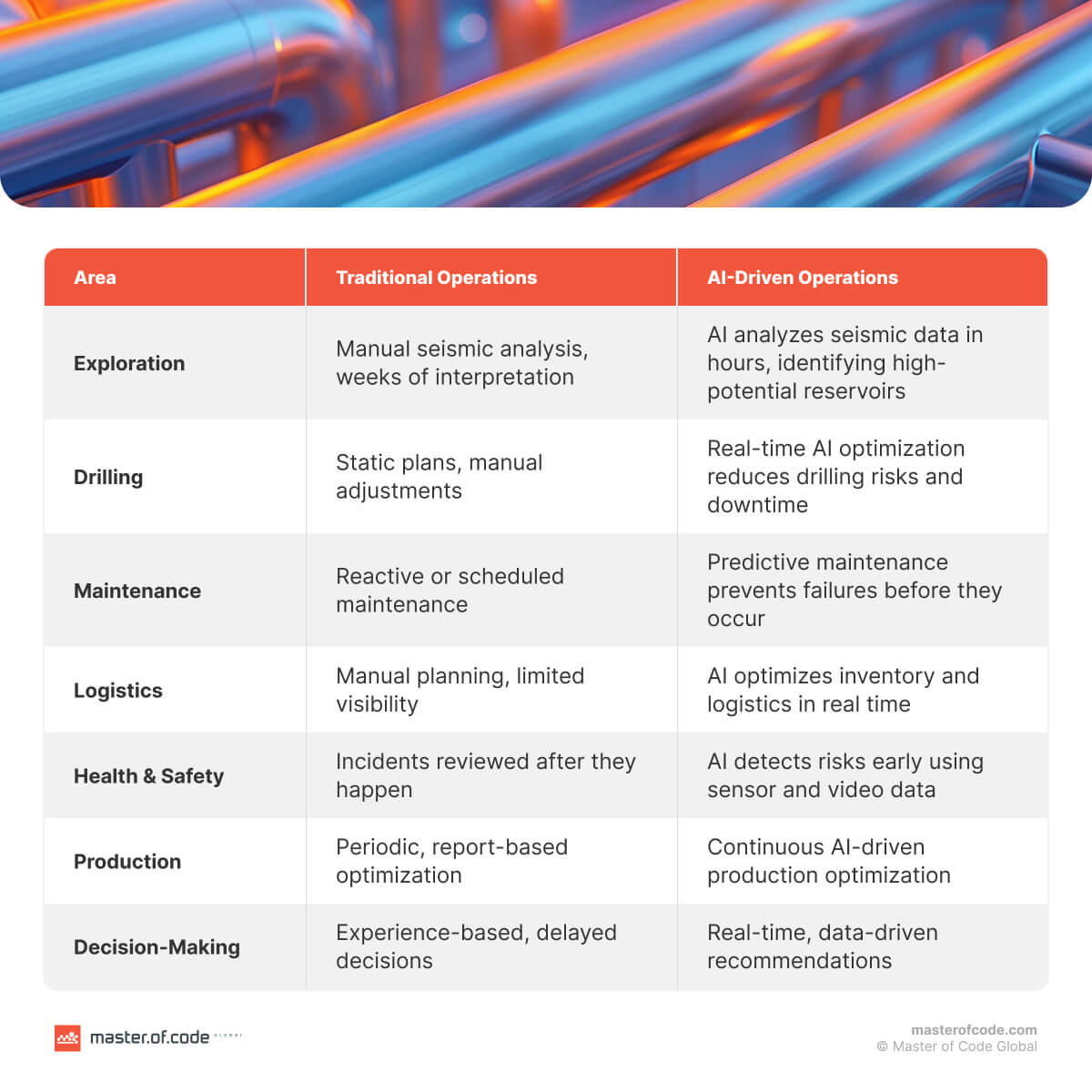
AI’s Advantageous Role in Advancing the Oil and Gas Sector
The real question isn’t whether artificial intelligence works in oil and gas. It does. The question is where it hits hardest, and how quickly you can capture that value before your competitors do.
Across the industry, the role of AI in oil and gas operations is reshaping six critical dimensions of performance. Each one compounds the others. Together, they represent a structural shift in how energy companies operate, compete, and grow.
Better Decision-Making
For decades, oil and gas executives made billion-dollar decisions based on weekly reports — spreadsheets assembled by the time the data was already stale. AI changes the tempo entirely.
Predictive analytics and digital twins now process sensor feeds, geological models, and market signals simultaneously, delivering real-time operational intelligence. Instead of reacting to what happened last Tuesday, your teams respond to what’s happening right now — and what’s likely to happen tomorrow.
The impact is tangible. ADNOC integrated over 30 AI tools for oil and gas industry operations across its full value chain and generated $500 million in additional value in a single year. That value didn’t come from a single breakthrough. It came from hundreds of faster, smarter decisions made daily — from the control room to the boardroom.
The shift is not incremental. When your reservoir engineers can test multiple extraction scenarios in minutes instead of weeks, you don’t just save time. You fundamentally change the quality of every choice downstream.
Cost Reduction
Margins in oil and gas are under constant pressure. Intelligentization relieves it where it matters most — on the assets that cost millions to maintain and more to replace.
Predictive maintenance alone accounted for 37.6% of AI spending across the sector in 2025, and the reason is straightforward: it works. Anomaly-detection models identify equipment degradation before failure, aligning repair windows with logistics schedules rather than emergency shutdowns. The result? Up to 50% fewer tool failures and significantly lower maintenance costs across field facilities.
Furthermore, AI-driven process automation trims waste from drilling operations, supply chain logistics, and energy consumption. Digital applications for workflow optimization can reduce production and upkeep expenses by up to 20% — savings that flow directly to your bottom line on high-cost assets.
Environmental Protection
Regulatory pressure is mounting. ESG expectations are tightening. And the penalties for non-compliance keep climbing.
AI gives you a way to stay ahead of all three.
ADNOC’s Emission X tool gathers historic and real-time data from hundreds of operational sources to predict emission origins up to five years in advance, allowing operators to act before problems materialize. Across its operations, ADNOC’s AI suite helped prevent up to 1 million tonnes of CO₂ emissions between 2022 and 2023 — equivalent to removing 200,000 gasoline-powered cars from the road.
HSE (Health, Safety, and Environment) compliance is also emerging as the fastest-growing AI application in the sector, with a projected CAGR of 14.34%. Computer vision systems now monitor PPE compliance, detect safety hazards, and track valve positions with sub-second latency — addressing regulatory mandates that once required armies of manual inspectors.
Competitive Advantage
When every operator has access to the same rigs, the same geological surveys, and the same global pricing data, what separates the leaders from the laggards? How you use what you know.
Generic, off-the-shelf AI models in oil and gas offer a quick start. They recognize broad patterns and handle standardized datasets adequately. But oil and gas data is anything but standardized — your sensor configurations, geological conditions, and operational workflows are unique to your fields. Custom-trained AI, tailored to your specific KPIs and data environment, delivers the deeper inference that moves the needle.
Enhanced Customer Experience
Oil and gas may not be retail, but your stakeholders are still people who expect fast, accurate, and frictionless interactions.
Intelligent conversational interfaces and natural-language analytics are changing how information flows between the office and the field. Instead of waiting for an analyst to pull a report, a field supervisor can ask a question in plain language and receive an answer in seconds. Instead of routing a partner inquiry through three departments, an intelligent assistant handles it on the first contact.
Every hour an engineer spends chasing down a report is an hour not spent solving a field problem. Every partner inquiry that bounces between three departments erodes trust. AI removes that friction — and the hours, errors, and missed handoffs that come with it. When the people who rely on timely data actually get it without bottlenecks, the entire operation moves faster.
The companies getting this right are building AI-driven self-service layers that reduce dependency on specialized analysts and accelerate decision cycles at every level of the organization.
Innovation and Continuous Improvement
Deploy AI once, and you get a tool. Keep feeding it operational data, and you get a compounding asset.
Every barrel produced, every sensor reading captured, every maintenance event logged feeds back into models that get sharper over time. Digital twins don’t just simulate your current operations — they evolve with them, learning from each intervention to recommend increasingly precise optimizations.
What began as pilot projects and proofs of concept is scaling into production-grade systems embedded in core business processes. The organizations that treat AI as a continuous capability will define the next era of energy leadership.
The advantages above don’t operate in isolation. Better decisions reduce costs. Lower emissions strengthen your competitive position. Faster innovation improves every stakeholder experience. And when these forces compound across your entire value chain, the impact dwarfs any individual use case.
Major Challenges of Deploying AI Solutions in the Oil and Gas Sector
AI solutions for the oil gas industry profitability is proven, but deploying them comes with real obstacles. The barriers below stall pilots, drain budgets, and turn promising initiatives into abandoned projects. Each one, however, has a clear path through.
Cultural Resistance
The challenge: Oil and gas runs on decades of institutional knowledge. Experienced operators and engineers have honed their judgment through years in the field, and many view AI as a threat to that expertise rather than an amplification of it.
According to the 2026 GETI report, only about 45% of oil and gas professionals currently use artificial intelligence in their work — a sharp increase from prior years, yet still lagging behind other industries. When the people closest to operations distrust the tools, adoption stalls regardless of what the technology can do.
The path forward: Start with problems your teams already feel. Predictive maintenance that saves a drilling crew from an unplanned midnight shutdown earns trust faster than any training seminar. Involve field operators in design from day one — their domain knowledge makes models smarter, and their participation turns skeptics into advocates.
Frame AI as a copilot, not a replacement: the machine processes ten thousand sensor readings per second so the engineer can focus on the decisions that actually require human judgment.
Regulatory Compliance
The challenge: Few industries face tighter regulatory scrutiny. Environmental reporting, safety standards, emissions targets, and cross-border operational rules create a compliance landscape that varies by jurisdiction and shifts with every legislative cycle.
Layering AI into this environment raises uncomfortable questions:
- Who is accountable when an algorithm recommends a course of action that violates a regulation?
- How do you audit a model’s reasoning for a regulator who needs to see the logic?
The path forward: Treat compliance as a design constraint, not an afterthought. Build explainability into every model — regulators need to understand how decisions are made, and so do your internal teams.
AI can monitor emissions, track PPE usage, and flag safety anomalies with consistency no human inspection team can match. The key is working with partners who understand regulated industries and can architect governance into the solution from the first sprint.
Cybersecurity Risks
The challenge: Every deployment expands your attack surface. Connecting sensors, SCADA systems, and operational technology to cloud-based AI platforms creates new entry points for cyberattacks — and in oil and gas, a breach doesn’t just compromise data.
It can shut down pipelines, disable safety systems, or trigger environmental disasters. The cybersecurity market for oil and gas reached $5.75 billion in 2025 and is projected to double by 2033, reflecting how seriously the industry takes this risk.
The path forward: Security cannot be bolted on after deployment. It belongs in the architecture from the start — encryption at rest and in transit, zero-trust access models, continuous anomaly monitoring, and regular penetration testing. Deploying AI for oil and gas infrastructure demands partners who hold recognized certifications like ISO 27001, which ensures audited security processes across every project.
Segment your smart systems from critical OT (Operational Technology) networks so that a compromised analytics layer cannot cascade into operational infrastructure. And invest in cybersecurity training for field teams, because the broadest attack surface is often the human one.
High Initial Investment
The challenge: AI infrastructure, data pipelines, specialized hardware, and talent all carry substantial upfront costs. For mid-market operators already managing thin margins, committing seven figures to a technology that might take 18 months to prove ROI is a hard sell in the boardroom.
High implementation costs remain one of the primary factors limiting AI adoption across the oil and gas market, encompassing everything from data management infrastructure to system integration and ongoing support.
The path forward: Don’t boil the ocean. Start with a single high-impact use case — predictive maintenance on your most expensive rotating equipment, or automated scheduling for your highest-volume field operations.
A structured Proof of Concept (PoC) validates the business case before full commitment, reducing development waste by 50–70%, as per our research, and giving stakeholders a concrete ROI model to rally around. Once one initiative delivers documented savings, funding for the next becomes a conversation about scaling a proven asset, not betting on an experiment.
Talent Shortage
The challenge: AI implementation in oil and gas industry environments demands a rare combination: data science fluency and operational domain expertise. Finding people who can build a neural network and understand wellbore dynamics is extraordinarily difficult. Engineering and technical operations roles remain the hardest positions to fill in the sector, and the competition for professionals who bridge AI and energy gets fiercer every quarter.
The path forward: Build from both directions. Upskill your existing engineers and operators — they already have the domain knowledge that takes years to develop, and modern tools are increasingly accessible to non-specialists. Simultaneously, partner with a company offering custom AI development services that bring production-grade engineering capability without requiring you to hire a full data science team internally.
Create cross-functional teams that pair field operators with data engineers, so each side learns the other’s language. The goal is building internal literacy while leveraging external expertise for the heavy technical lifting.
Integration with Existing Systems
The challenge: The average oil and gas operation runs on layers of legacy technology: SCADA systems from the 1990s, proprietary ERP platforms, multiple CRMs accumulated through acquisitions, and field hardware that communicates in formats no modern API was designed for.
IT/OT integration without replacing core systems like SAP or SCADA was among the biggest technology priorities for oil and gas in 2025, because ripping out infrastructure mid-operation isn’t an option when downtime costs thousands per minute.
The path forward: Wrap, don’t replace. Modern AI architectures can sit on top of legacy systems through middleware, APIs, and edge computing layers that ingest data without demanding a full platform overhaul. Prioritize integration depth when selecting a partner — the ability to connect cleanly to your FSM platform, IoT sensors, CRM, and dispatch tools without disrupting live operations is where most implementations either accelerate or stall.
A partner who has navigated legacy system complexity before will save you months of rework and avoid the false starts that come from underestimating how tangled decades of infrastructure become.
Data Quality
The challenge: Intelligent models are only as reliable as the data they consume. In oil and gas, that data has often grown wild over decades, inconsistent formats across fields, sensor readings riddled with gaps, knowledge bases mixing PDFs with screenshots and tribal knowledge.
Gartner predicts that through 2026, organizations will abandon 60% of projects that lack AI-ready data. And “clean data” is only the starting line, AI-ready data needs to be semantically structured, contextually enriched, and aligned with specific business use cases.
The path forward: Treat data preparation as a continuous operational capability, not a one-time cleanup project. Build dedicated pipelines that ingest, structure, validate, and enrich your data on an ongoing basis. Invest in metadata management and governance frameworks that keep your information accurate as products update, policies shift, and new field conditions emerge.
The organizations that get this right build a compounding advantage: every new model performs better from day one because the foundation beneath it keeps improving. Those who skip this step keep rebuilding on sand.
3 Key Steps to Unlocking the Full Potential of AI for Oil and Gas Companies
1. The Leadership Team Must Believe in AI
Projects that start in the IT department and stay there tend to die there. Sustained investment requires executive sponsors who treat intelligentization as an operational strategy, not a tech experiment. Tie every initiative to a specific business KPI before approving it. “Reduce unplanned downtime by 30%” is a mandate. “Explore AI opportunities” is a budget line that evaporates at the next quarterly review.
2. Scaling AI Means Expanding People, Processes, Data, and Technology
A successful pilot proves the concept. Scaling it proves the organization. That requires simultaneous investment across four dimensions:
- People: cross-functional teams pairing domain experts with data engineers.
- Processes: workflows redesigned to act on AI outputs, not just receive them.
- Data: pipelines that feed models with clean, governed, continuously updated information.
- Technology: production-grade infrastructure with edge computing, cloud orchestration, and integration layers that connect to existing SCADA, ERP, and field systems. Neglect any one, and the other three underperform.
3. The Importance of Culture Change in Scaling AI
You can deploy the most sophisticated system in the industry. If your field teams don’t trust it, they’ll work around it.
Engineers who participate in designing advanced tools adopt them. Those who have tools imposed on them resist. Run pilots where front-line workers see direct benefit – a predictive alert that prevents a 3 AM callout, a scheduling fix that eliminates dead time. Small wins build credibility faster than executive memos. And create space for AI to be wrong: teams that feel safe flagging bad recommendations accelerate model improvement with every iteration.
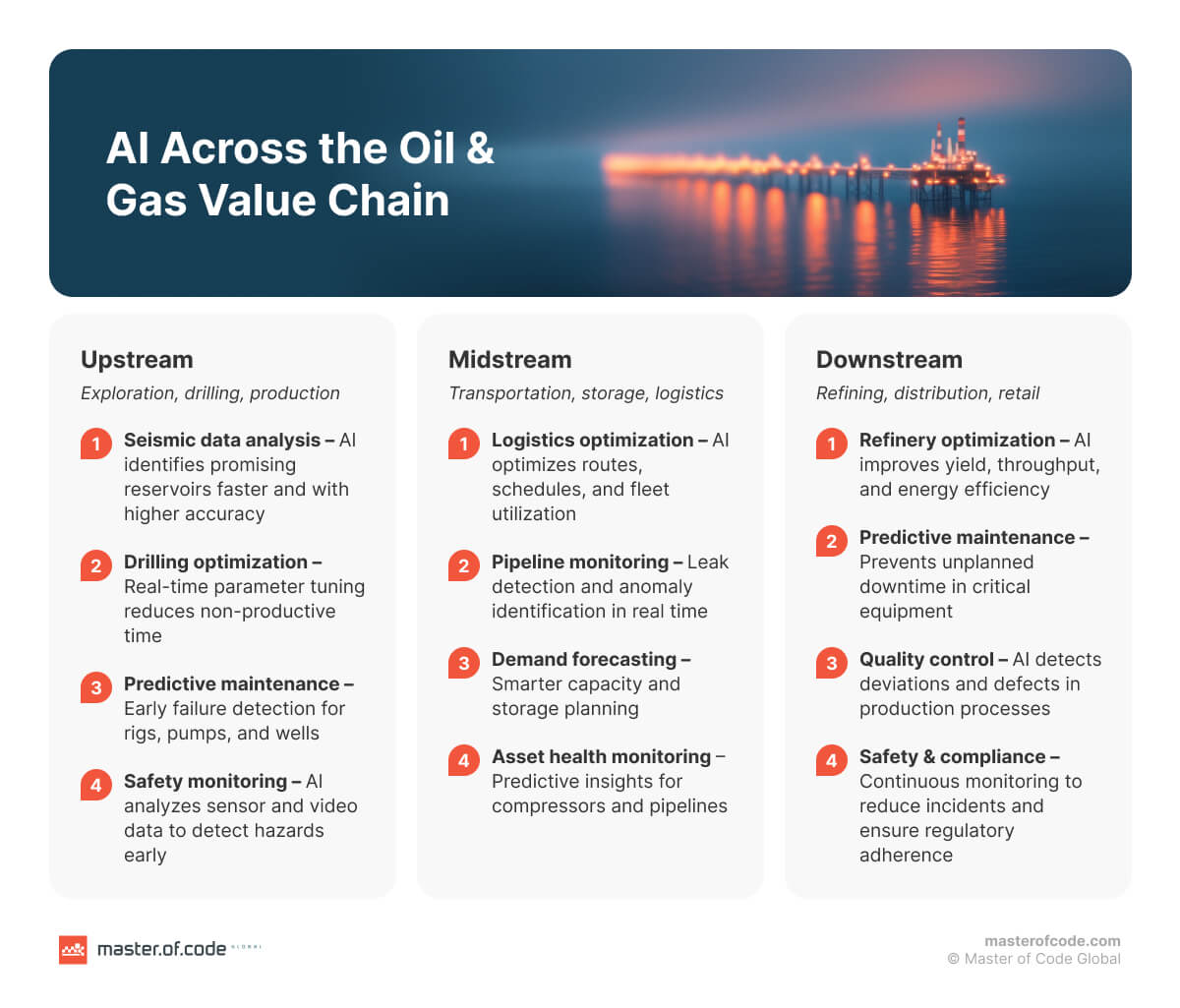
How is AI Transforming Oil and Gas Industry? Top Use Cases
Upstream (Exploration & Production)
- Seismic Analysis and Exploration. Machine learning models process terabytes of 3D seismic imagery in hours — work that once consumed months of manual interpretation. By training on thousands of historical wells and geological datasets, these models identify hydrocarbon-bearing structures with far greater accuracy, reducing dry-hole risk and cutting appraisal costs before a single drill bit turns.
- Reservoir Modeling and Simulation. Living digital twins integrate real-time sensor data with historical archives to simulate reservoir behavior dynamically. These systems self-correct as new measurements arrive, predicting depletion patterns, water breakthrough timing, and enhanced recovery potential, turning static geological assumptions into adaptive, continuously improving models.
- Drilling Optimization and Automation. AI-powered drilling advisors monitor bit torque, string vibration, mud composition, and downhole pressure in real time, adjusting parameters to minimize non-productive time. Companies using digital drilling advisors have reduced drilling time by 10–15% while lowering the risk of costly incidents like kicks or blowouts.
- Production Optimization. Intelligent agents ingest data from wellhead sensors to continuously adjust pressure, flow rates, and temperature. This dynamic control maintains ideal production conditions even as field variables shift, improving yield and energy efficiency without manual intervention.
- Autonomous Operations (Smart Fields). Smart field platforms autonomously manage unmanned well pads, optimizing flow rates, detecting leaks, and adjusting operations based on changing conditions. Centralized remote operations centers, like those BP and Equinor run in the North Sea, oversee entire offshore assets through AI algorithms that detect deviations and trigger corrective actions with minimal on-site personnel.
Midstream (Transportation & Storage)
- Real-Time Monitoring and Pipeline Integrity. GenAI models process continuous feeds from IoT sensors and drones to detect corrosion, micro-leaks, and structural anomalies across thousands of pipeline miles. Computer vision and edge computing flag issues before they escalate — reducing inspection costs and preventing the kind of environmental incidents that end careers and crater stock prices.
- Supply Chain and Logistics Optimization. AI forecasts demand fluctuations, optimizes shipping routes, and manages fleet utilization to reduce idle time and fuel consumption. Expert supply chain AI consulting helps firms identify where logistics improvements will deliver the fastest payback. In an industry where these costs run into billions annually, even single-digit percentage improvements in routing efficiency translate to material savings.
- Risk Management and Scenario Modeling. Predictive models simulate disruption scenarios — geopolitical events, weather patterns, equipment failures, demand shocks — so operators can stress-test their supply chains before crises arrive. The shift: from reactive damage control to proactive preparation.
Downstream (Refining & Marketing)
- Refinery and Process Optimization. AI in downstream oil and gas focuses on squeezing margin from every barrel processed and every liter sold. The application of artificial intelligence in refinery operations fine-tunes parameters in real time. Small percentage gains in throughput or energy efficiency compound into significant margin improvements when applied across facilities processing hundreds of thousands of barrels daily.
- Demand Forecasting and Market Intelligence. Machine learning analyzes historical sales data, economic indicators, weather patterns, and regional consumption trends to forecast product demand with precision that traditional statistical methods cannot match. Accurate demand signals reduce overproduction, minimize storage costs, and keep inventory aligned with actual market needs.
- Energy Trading and Price Forecasting. ML models process market signals, weather data, geopolitical risk indicators, and supply metrics to uncover hidden pricing patterns. These models anticipate market fluctuations that human analysts would catch too late to act on — giving trading desks a measurable edge.
- Retail and Customer Analytics. AI segments end consumers, personalizes pricing strategies, and identifies purchasing patterns across fuel station networks and lubricant distribution channels. Predictive models optimize promotional timing and product placement, turning downstream retail from a volume game into a margin game.
Common Cross-Sector Applications
- Predictive Maintenance and Asset Reliability. Anomaly-detection models identify equipment degradation before failure, aligning maintenance with logistics schedules rather than emergency shutdowns. Predictive maintenance accounted for 37.6% of all AI spending in oil and gas in 2025, because the ROI is immediate and measurable.
- Safety, Environmental Monitoring, and Emissions Control. Computer vision monitors PPE compliance and detects hazards on rigs and platforms. IoT-integrated AI tracks methane leaks and emissions in real time.
- Oil Spill Detection and Response. AI-powered satellite imagery and drone surveillance identify spills within minutes, not hours. Automated systems classify spill severity, model drift patterns based on current and weather data, and trigger response protocols — shrinking the window between detection and containment.
- Regulatory Compliance and Reporting. Large language models automate the generation of regulatory filings, environmental reports, and operational documentation. What once required teams of specialists assembling data across multiple systems now happens in a fraction of the time, with fewer errors and a complete audit trail.
- Data Management and Integration. Artificial intelligence unifies fragmented data across SCADA, ERP, CRM, and field systems into coherent, queryable datasets. Given that Gartner predicts 60% of AI projects will be abandoned due to data that isn’t AI-ready, the ability to structure and govern operational data is foundational. Every other use case on this list depends on it.
- Robotic Process Automation (RPA). RPA handles repetitive, rule-based tasks freeing skilled workers for higher-value activities. In shut-in scenarios, RPA significantly reduces downtime and minimizes human error during restart procedures.
- Copilots and Decision Support Systems. Natural-language interfaces let engineers, operators, and managers query complex operational data conversationally; no SQL, no analyst bottleneck. A Conversational Data Analysis Tool built for a major US energy leader transformed raw databases into interactive insights accessible to non-technical users, accelerating decisions at every level of the organization.
These artificial intelligence use cases in oil and gas share a common thread: they replace guesswork with data-driven precision and reactive workflows with proactive intelligence. The companies capturing the most value connect use cases across the value chain so that upstream insights inform midstream logistics, and downstream demand signals sharpen production planning.
Real-World Examples of AI in the Oil and Gas Industry
Leading AI development companies in oil and gas are building AI solutions for oil and gas that go far beyond pilot-stage experiments. Here is how the major operators are deploying AI at scale.
- Shell uses AI and broader digitalization to improve efficiency, safety, and emissions performance across operations. The company highlights applications such as predictive maintenance, shipping optimization, and digital twins, showing how technology can move from isolated pilots into day-to-day asset management.
- BP applies it in upstream operations to predict equipment failures, optimize drilling, and support remote operations. The company also points to digital twins of offshore assets, which help teams monitor platform conditions and improve decisions without relying only on on-site intervention.
- ExxonMobil is using AI in drilling and refinery operations. Its proprietary drilling advisory system in Guyana uses artificial intelligence to determine optimal drilling parameters and support closed-loop automation, while smart technologies in refining help reduce emissions and improve energy efficiency.
- Chevron describes artificial intelligence as a tool for smarter decisions, stronger efficiency, and more reliable energy delivery. The company says it is using AI both inside its operations and in power-related initiatives tied to rising data center demand, which reflects a wider shift toward AI-supported production and infrastructure planning.
Our Work: AI Solutions Built for Energy Operations
Agentic AI-Powered Data Discrepancy Reconciliation Tool for a US Energy Leader
Master of Code Global developed an AI-powered web application for a US-based energy company to automate the detection and explanation of inconsistencies between water and oil readings. Instead of relying on slow manual reconciliation, the tool identifies discrepancies automatically and uses natural-language explanations to help teams understand the likely cause faster.
What This Solution Improved
The platform combined automated discrepancy detection with secure role-based access, scheduled Snowflake data ingestion, and proactive email alerts. For the client, this meant less manual work, fewer reporting errors, and faster resolution of operational issues. It is a strong example of AI in oil and gas improving data accuracy, streamlining workflows, and supporting better operational decision-making.
The Future of Oil and Gas with AI
Oil and gas in the AI era is shifting from isolated pilots to core operational infrastructure. The next phase is less about experimenting with single tools and more about connecting AI across production, maintenance, emissions, and decision-making workflows.
The International Energy Agency notes that oil and gas companies are already among the earliest and most compute-intensive adopters of advanced digital technologies, with artificial intelligence now used in subsurface data processing, reservoir simulation, remote operations, predictive maintenance, leak detection, compliance, and automation.
What comes next is likely to center on a few high-impact changes:
- More autonomous operations. Operators are moving toward AI-supported plants and field assets that can monitor conditions, recommend interventions, and automate routine adjustments with less manual oversight. McKinsey describes this direction as a path toward autonomous operations, supported by digital twins and step-by-step automation.
- Stronger predictive decision-making. AI will continue improving how companies forecast equipment failures, optimize drilling and production, and manage asset performance in real time. As these models become more deeply integrated into everyday workflows, the value will come from faster, more confident decisions rather than from dashboards alone.
- Greater pressure on emissions and compliance. Future adoption will not be driven only by productivity. It will also be pushed by tighter expectations around methane detection, regulatory reporting, and lower-carbon operations. AI is increasingly positioned as a practical tool for leak detection, compliance monitoring, and carbon-intensity reduction.
- A bigger role in energy system planning. Oil and gas companies are not operating in isolation anymore. They are part of a broader, more digital energy system shaped by electrification, grid pressure, LNG demand, and fast-rising data center consumption. Deloitte’s 2025 outlook points to growing natural gas demand tied to data centers by the end of the decade, while the IEA frames AI as both a new source of energy demand and a tool for optimizing energy supply and infrastructure.
- Competitive advantage through integration, not adoption alone. In the near future, the winners will not simply be the companies using technology. They will be the ones who connect it to clean data, operational systems, and clear business outcomes. That means moving beyond PoCs toward scalable architectures, governance, and measurable ROI. This aligns with the broader industry direction toward capital discipline combined with targeted investment in new technologies.
The Competitive Edge of Partnering with Us
When you’re choosing Master of Code Global, you’re gaining a trusted ally with over 20 years of proven engineering expertise across complex, high-regulation industries like oil and gas. Our capabilities in Conversational AI, predictive analytics, GenAI, and agentic systems empower your business with smarter decisions, greater efficiency, and measurable growth.
Powered by our LOFT Framework, an open-source LLM-Orchestrator, we accelerate the entire AI lifecycle, achieving 43% less setup effort, 3x faster support, and up to 20% budget savings. To validate ideas before scaling, our fixed-price AI Proof of Concept (PoC) reduces development waste by up to 70% and sets a clear, confident direction.
With ISO 27001–certified security and a delivery model built on stability, you’ll work with the same experts from kickoff to completion. This reliability, backed by our partnerships with Tom Ford, Electronic Arts, and T-Mobile, and recognition as a Top AI Consulting Company and Infobip’s Technology Partner of the Year, ensures every project delivers impact.
Choose a partner who understands your challenges, and has the framework, discipline, and insight to turn them into long-term competitive advantage. Let’s power your transformation together. With our expertise in AI-driven solutions, we’re ready to help you unlock new efficiencies and drive measurable growth.
Take the next step: schedule a consultation or get your AI readiness audit today to see how we can tailor technology to elevate your business. Let’s turn your potential into success.
FAQs
How can AI for oil and gas help in refinery optimization?
Artificial intelligence monitors and adjusts refining parameters in real time, reacting to process variability faster than any human operator. The practical impact: higher throughput from the same equipment, lower energy costs per barrel, and fewer off-spec product batches.
When applied across a facility processing hundreds of thousands of barrels daily, even fractional efficiency gains translate to millions in annual margin improvement. AI also connects refinery operations to downstream demand signals, so production schedules align with what the market actually needs rather than what last month’s forecast predicted.
How does AI for oil and gas companies help a smart refinery?
A smart refinery layers AI across its entire operational stack. Digital twins simulate the plant in real time, letting engineers test process changes virtually before committing to physical adjustments. Predictive maintenance models flag compressor or heat exchanger degradation weeks before failure, replacing emergency shutdowns with planned interventions.
Computer vision monitors safety compliance and equipment condition across the facility continuously. And AI-driven energy management balances power consumption across units to minimize waste. The difference between a conventional refinery and a smart one comes down to response time: one reacts to problems after they surface, the other anticipates and prevents them.
What is artificial intelligence in oil and gas?
AI in oil and gas refers to machine learning models, natural-language processing, computer vision, and autonomous decision systems applied across exploration, production, transportation, refining, and distribution.
In practice, that means algorithms analyzing seismic data to find drilling targets, sensors feeding predictive models that prevent equipment failures, digital twins simulating reservoir behavior, and conversational interfaces giving field teams instant access to operational insights.
The technology spans the full value chain, and its core function is consistent: converting the massive volumes of data this industry generates into faster, more accurate decisions.
How are computers useful in the petroleum industry?
Computing has been central to petroleum operations for decades — running seismic simulations, managing SCADA systems, and modeling reservoir behavior. What has changed is the scale and intelligence of what these systems can do. Modern AI-powered computing processes sensor data from thousands of assets simultaneously, identifies patterns that human analysts would miss, and executes adjustments in real time.
Edge computing brings processing power directly to offshore platforms and remote well sites where connectivity is limited. Cloud platforms enable centralized operations centers that oversee entire field portfolios from a single dashboard. The shift is from computers as record-keepers to computers as active decision participants — monitoring, predicting, and optimizing across every operational layer.