



You’ve probably seen a hundred and one articles on how to choose an AI implementation company, or simply asked ChatGPT to recommend a few. We did not want to add another “10 things to look for in an AI vendor” checklist to the pile.
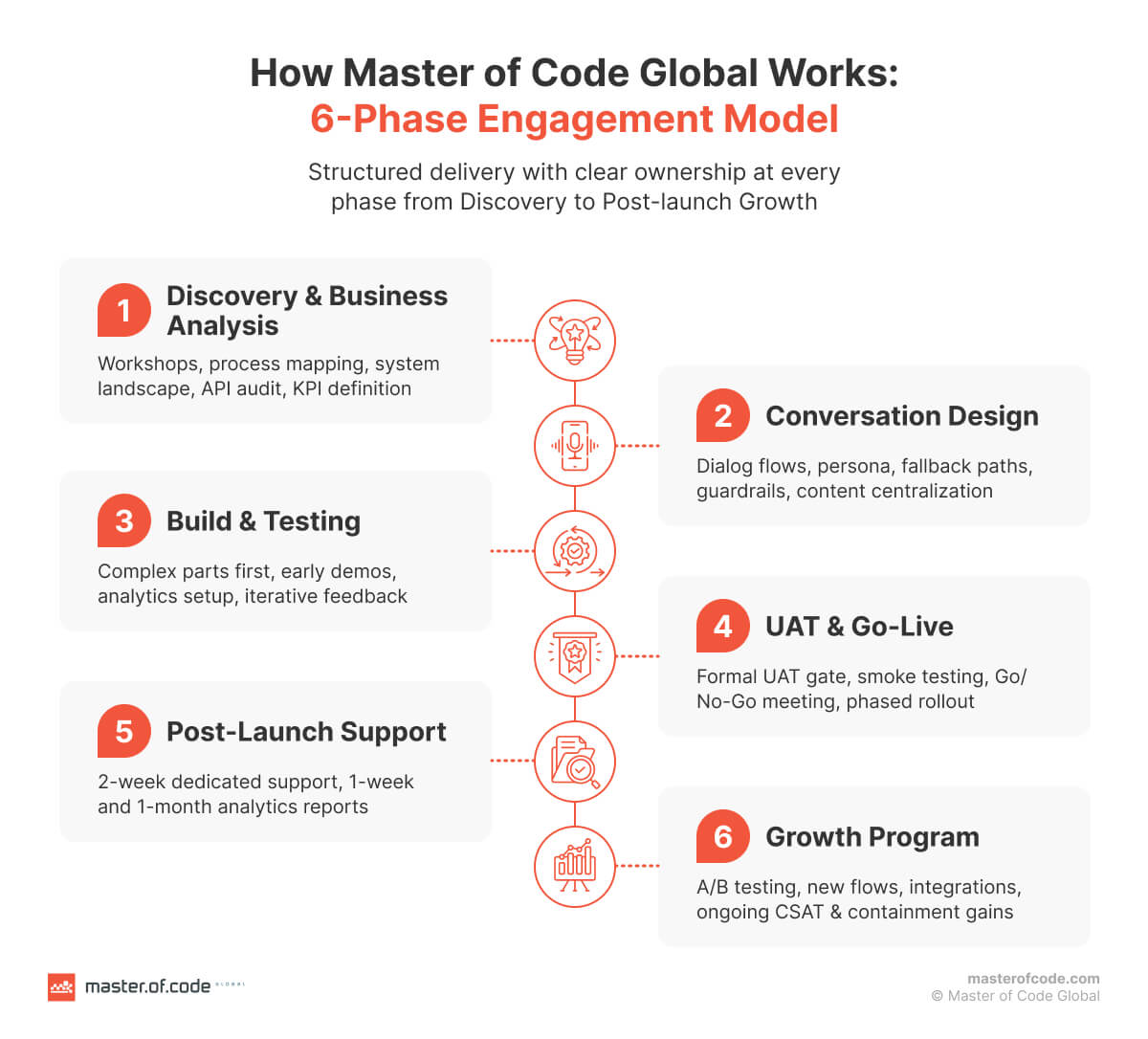
So we decided to approach it from the other direction: show what a good partner actually does throughout an AI transformation. From Discovery and data readiness to pilots, workflow redesign, adoption, and scaling, each stage reveals what capabilities really matter and which questions are worth asking.
If you want more than generic selection tips and would rather see how to choose an AI implementation partner for retail based on the realities of implementation, welcome aboard. And if you already have a use case, pilot, or transformation challenge in mind, contact us to discuss what the next practical step could look like.
Table of Contents
Key Takeaways
- Before vendor selection: A good partner should help you clarify the business outcome, challenge the initial use case, and define what is actually worth validating.
- During Discovery: Map the real workflow, involve the people who run it, surface hidden dependencies, and assess organizational readiness.
- For the data foundation: Identify the minimum data, integrations, permissions, and institutional knowledge the use case needs instead of pushing a broad data overhaul.
- During the pilot: Define success before building, test with real data and users, measure business value, and be prepared to recommend revise, scale, or stop.
- During implementation: Redesign the end-to-end workflow around AI, define human and AI responsibilities, and avoid creating new tools, handoffs, or bottlenecks.
- For adoption: Help establish business and technical ownership, support role-specific training, address resistance, and measure actual usage rather than deployment alone.
- At scale: Monitor quality, cost, risk, autonomy, external dependencies, and reuse so the solution remains reliable and economical as it expands.

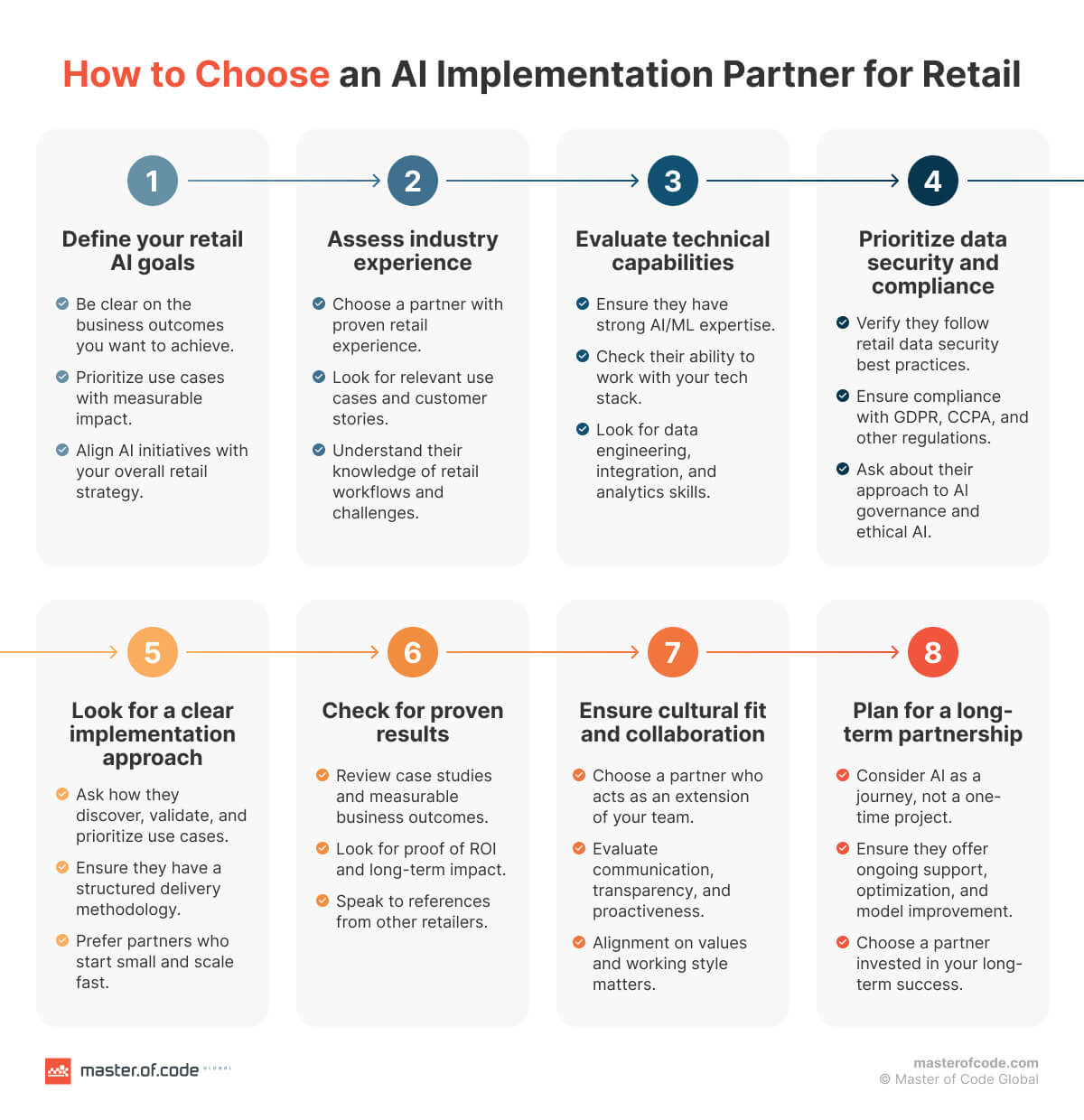
1. AI Transformation in Retail Starts Before Vendor Selection
A common thing in articles about AI transformation in retail is straightforward: identify a use case, evaluate vendors, choose a solution, run a pilot, and scale it.
The problem is that vendor selection is not where the transformation starts. By the time you are comparing platforms or implementation companies, you may already have assumed that:
- the right business problem has been chosen;
- AI is the right way to solve it;
- the process is ready to change;
- the necessary data is available;
- the organization is prepared to adopt a different way of working.
Any of those assumptions can be wrong.
So before building a shortlist, do the homework inside your own business. You do not need a finished AI strategy or a detailed technical specification. You need enough understanding of your current situation to know what deserves deeper investigation.
Olga Hrom, Chief Delivery Officer at Master of Code Global, puts it this way:
Forget the technical structure for a moment. Think about what you are ready, as an organization, to delegate to AI and which areas you want to validate with an AI pilot. If you want to do this quickly and well, you have to prepare on your side too, and it helps to have an external partner so you don’t get tunnel vision inside your own company.
Start With What Should Change
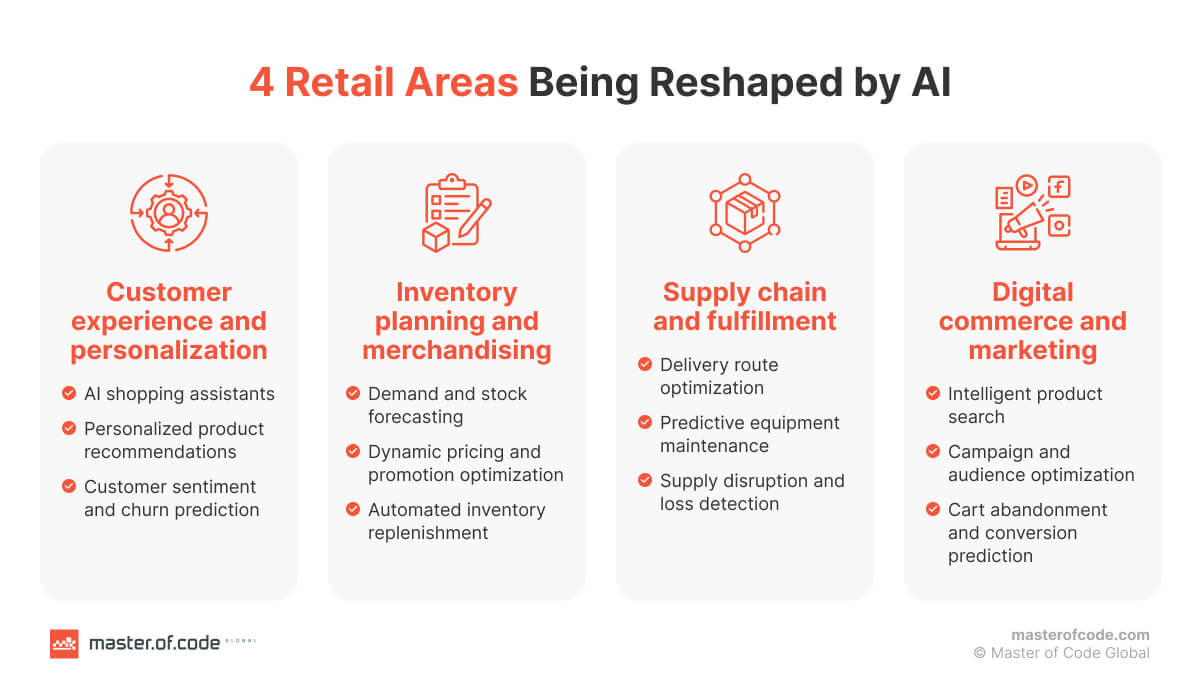
A retailer can usually identify dozens of possible applications: demand forecasting, inventory management, personalized recommendations, customer service, merchandising, pricing, or supply chain efficiency.
Ask yourself a practical question: What should work differently in the business if this initiative succeeds?
For example:
- Should planners make decisions faster or with better forecast accuracy?
- Should store or support teams spend less time searching for information?
- Should marketers be able to test more personalization ideas without adding more manual work?
This keeps the discussion tied to an outcome rather than a feature.
It also helps separate two different reasons for using AI. One is efficiency: reducing manual work, cost, or cycle time. The other is opportunity: doing something that was previously too slow, expensive, or difficult to do at scale.
Both matter. As our CEO Dmytro Gritsenko noted when discussing AI transformation:
Efficiency is easier to start with, but opportunity still has to be an active track. Efficiency alone creates pressure; opportunity creates a promise for a better future.
Do Not Assume the First Use Case Is the Right One
We increasingly see companies arrive with detailed BRDs generated or refined with AI. That is useful. It makes ideas easier to discuss and can save several early scoping sessions.
But a structured document can also give an untested idea more certainty than it deserves. The goal is to avoid building most of it before there is evidence that it should be built at all.
The same principle sits behind our retail AI consulting. Rather than prioritizing a use case because it sounds impressive, we look at business impact alongside data readiness, tech complexity, organizational readiness, and time to value.
Look at the Process, Not Just the AI Feature
Zipify provides a useful example.
The company had already adopted AI tools. But usage varied by person, the development process had accumulated legacy habits, and new ideas could take months to reach customers.
So the transformation focused on how work happened around the technology.
The team standardized tooling, introduced spec-driven development and human review points, extended AI into QA, research, support, and design, and created a smaller team built for rapid experimentation. The results included 12x faster time to a working prototype and up to 4x faster delivery for some features.
The lesson is that AI transformation often changes the operating process, not simply the tool used inside it.
What Your Homework Should Produce
Before going deep into technology or choosing an AI implementation partner, you should at least be able to frame:
- The outcome: what needs to improve and how you will recognize improvement.
- The workflow: how the process works today, including the people, systems, decisions, and handoffs involved.
- The boundary: what AI may recommend, generate, decide, or execute, and where human approval is still needed.
- The assumptions: what you believe about the available data, integrations, costs, risks, and user behavior.
- The people affected: who will have to use the new workflow, approve it, support it, or change how they work.
- The first evidence you need: what a pilot or proof of concept (POC) must demonstrate before further investment makes sense.
You do not need perfect answers. In fact, a good Discovery process exists to test them.

2. Discovery: Learn How the Business Actually Works
Once you have a direction, the next step is checking whether your understanding of the business matches reality.
Leadership can usually explain the goal, like reducing service costs. What leadership often cannot see is every exception, workaround, handoff, spreadsheet, approval, and undocumented decision that keeps that process running day to day.
In retail, those details matter. You cannot redesign a workflow with AI until you understand the workflow you have. Below, we show how AI Compass Sprint, our Discovery framework, uncovers those hidden process realities.
Talk to the People Who Run the Process, Not Only the People Sponsoring AI
In our AI Discovery work, we typically look at the same process from different perspectives:
- Executive sponsors: What outcome matters? What budget and authority exist? What would make the initiative successful?
- Department and team leads: How is the process supposed to work? Where are the main bottlenecks?
- Operations and frontline teams: How does it actually work when an order is delayed, data is missing, a customer asks an unusual question, or a promotion does not fit the standard flow?
- IT and data teams: Which systems are involved? Where does the data live? What can be integrated, and what constraints already exist?
This can change what gets built.
In one enterprise AI transformation, our client arrived with a well-prepared and already prioritized list of use cases. Once we went through operations business unit by business unit, the solution that had not been placed at the top of the list produced the strongest value. It addressed a frequent, practical problem for the people doing the work, while some of the more visible ideas were less important in daily operations.
Map the Full Workflow, Not the Task You Want to Automate
Suppose a retailer wants an AI agent to handle order-status questions.
At first glance, the process seems obvious: Customer asks → AI checks order → AI responds.
Discovery may show something closer to this: Customer asks → order status is checked → warehouse and carrier updates are added → refund and loyalty rules are applied → complex cases go to a human agent.
Now the initiative is no longer simply “build a chatbot.” It involves data access, system integration, business rules, exception handling, permissions, and decisions about what AI is allowed to do.
The same principle applies elsewhere in retail. This is why Discovery should follow the end-to-end business or customer journey, not one isolated task.
Check Readiness at the Same Time
Process mapping often reveals another issue: the use case may be good, but the organization is not ready to implement it yet.
That readiness isn’t just technology. We look across areas such as:
- AI strategy and leadership commitment;
- data readiness;
- existing AI in production;
- team skills and AI literacy;
- technology and infrastructure;
- governance and responsible AI;
- operational processes and measurement.
For example, a recommendation system might have a strong business case but depend on customer and product data that cannot currently be connected reliably. An AI agent might be technically feasible but require access to information that security policies do not yet allow it to use.
Discovery is where those blockers should surface, not halfway through implementation.
What You Should Have at the End of Discovery
Discovery should leave you with something more useful than workshop notes.
You should understand:
- which processes are genuinely worth changing;
- where the business value is and how it will be measured;
- which teams, systems, and data sources are involved;
- what dependencies or risks could block implementation;
- which AI use cases should come first and which should wait;
- what the organization needs to fix before scaling them.
That becomes the basis for an AI adoption strategy and a realistic implementation sequence. In our framework, use cases are then scored against business impact and implementation effort, including data readiness, technical complexity, and time to first value.
3. Build the Data Foundation the Use Case Actually Needs
Discovery tells you what data the use case depends on, where it lives, and what condition it is in. The next step is making that data usable.
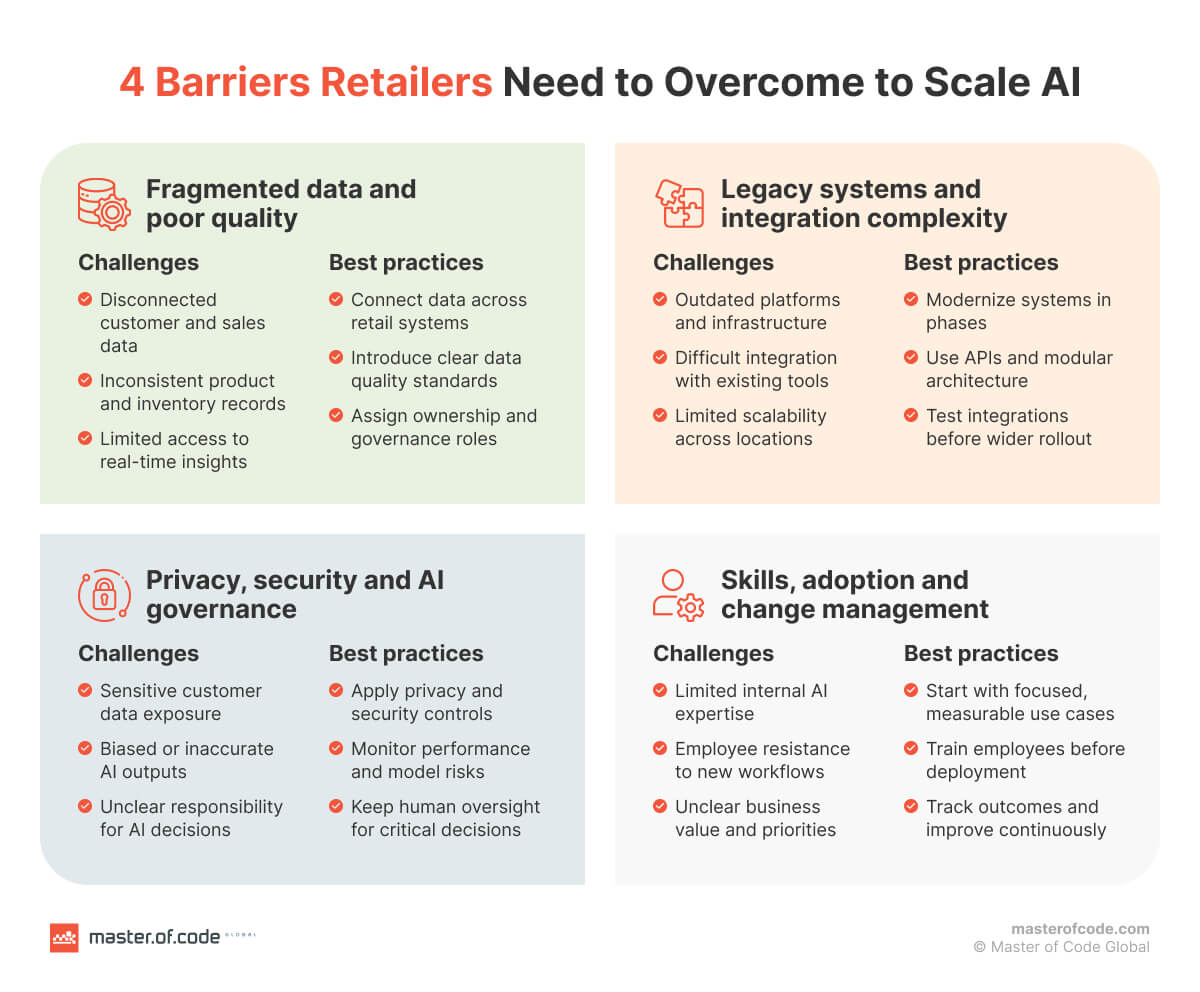
A retailer may already have rich data. But those records may be spread across ecommerce platforms, POS systems, CRM, ERP, warehouse tools, spreadsheets, and third-party providers. Different systems may use different identifiers, refresh at different speeds, or disagree about the same customer or order.
So the reasonable question is not:
“Do we have the data?”
It is:
“Can AI reliably access the right data, at the right moment, for the decision we want it to support?”
Start With the Use Case, Not a Company-Wide Data Cleanup
Work backwards from the use case you decided to pursue during Discovery. For example, an AI assistant handling an order problem might need:
- order details;
- fulfillment information;
- carrier status;
- payment and refund information;
- current inventory if a replacement is possible;
- customer or loyalty data;
- current service policies.
The first data foundation should therefore be as broad as necessary for the use case, but no broader than you can justify.
That keeps the transformation tied to business value rather than turning “AI readiness” into an open-ended infrastructure project. By the way, you can check your maturity score here for free.
“The Data Is There” Often Means “Somebody Knows Where It Is”
We saw this in an AI transformation for a retail personalization platform.
They wanted to scale expertise that was being delivered manually by specialists who advised retail marketers on which experiments to run and how to configure them. At the beginning, the assumption was that the necessary data already existed.
Once the team started working through it, the situation was more complicated:
- some information existed but was stored somewhere other than expected;
- some needed to be calculated;
- some was already being processed elsewhere, but not everyone involved knew that;
- and part of the knowledge was not stored in a system at all. It lived with experienced employees.
The first implementation phase therefore involved building a structured data foundation in Snowflake, bringing information together, and preparing it for later AI use. Data engineering and data science became a significant part of what had initially looked like an AI functionality project.
This is an important trend to expect.
People can compensate for weak data architecture in ways AI cannot. An employee may know which dashboard is outdated, whom to ask when two systems disagree, or which spreadsheet contains the “real” number. Until that knowledge is made explicit, an AI system does not have the same context.
That is why institutional knowledge should be treated as part of the data foundation too. If AI depends on expert judgment, you need to capture what people check before making a decision, which information they trust, when they override the system, and which cases still require human involvement. This is partly a knowledge engineering task, and partly an adoption challenge, since employees may be hesitant to document expertise that AI could later automate or scale.
Integration Is Part of the AI Product
Once the data is identified, the next question is how the algorithm will reach it. That is why integration with ERP/POS/ecommerce should be designed early.
A model can perform extremely well against a clean test dataset and still fail in production because:
- the necessary API is too slow;
- data arrives hours later than the decision requires;
- permissions prevent the AI from accessing one critical source;
- customer IDs do not match between systems;
- the AI can retrieve information but cannot write an approved action back;
- or employees have to leave their normal workflow and open another application to use it.
In many cases, the best solution is an AI capability embedded into the system employees already use. This is where AI integration services become part of the transformation rather than a separate technical task.
Data Readiness Also Means Permission to Use the Data
Technical access is only half the problem. You also need to establish whether the data should be used by AI at all, and under what conditions.
That includes:
- personally identifiable information;
- customer and employee data;
- commercially sensitive information;
- third-party data;
- access permissions;
- retention rules;
- model and infrastructure providers;
- audit requirements.
In our recent project for a retail personalization platform, the AI functionality could not simply be enabled for every customer once development was ready. Their customers wanted to understand how their data would be used with AI, and additional legal arrangements were needed before a broader rollout.
That is why data security and compliance, GDPR / CCPA compliance, and data privacy protection need to be considered while the data foundation is being designed. Master of Code Global, for example, operates under ISO 27001-certified processes, and our delivery approach includes security review and human checkpoints.
Eventually, when choosing an AI implementation partner, look for a team that treats data readiness as part of the use case, not as a separate prerequisite for your IT team to solve. They should be able to
- trace the data the workflow actually needs,
- uncover gaps and undocumented knowledge,
- design the necessary integrations,
- address permissions and governance early, and
- see the difference between a data issue that blocks the use case and one that can wait.
If a partner assumes “the data is there” or recommends a broad cleanup before understanding the use case, that is worth questioning.
4. Pilot: Prove the Value Before You Scale
Once the workflow, data, and main dependencies are understood, you still do not know whether the AI initiative deserves a full production investment.
That is what the pilot is for.
POC can show that a technical approach works. A practical AI pilot tests whether the solution works with your real data, inside the real workflow, for the people who are expected to use it, and against a result the business actually cares about.
The question changes from:
“Can we build this?”
to:
“Is this worth taking further?”
That distinction matters because AI can perform well in a controlled demonstration and still fail as a business solution. A successful demo is evidence of feasibility. It is not yet evidence of value.
Define the Decision Before You Build the Pilot
Before development starts, agree on what you need to learn from the pilot project. That means establishing a baseline and a small number of success criteria that determine what happens next.
You may need to measure:
- Business impact: conversion, cost per interaction, forecast accuracy, resolution time, revenue per session, stock availability, or another business KPI.
- AI performance: accuracy, quality, hallucination rate, or successful task completion.
- User behavior: whether employees or customers actually use the capability and where they abandon it.
- Human involvement: how often AI needs review, correction, escalation, or approval.
This is why our AI Pilot approach is built around a Proof of Value rather than stopping at technical feasibility. The solution is instrumented against agreed KPIs so the outcome is a decision backed by data: move forward, change direction, run another controlled test, or stop.
And a pilot that tells you “no” can still be useful. The expensive mistake is not discovering that an idea does not work. It is discovering that after months of production development. As Olga Grom notes:
I think pilots should be treated as a strategy. Without pilots, there will be no innovation, no lessons learned, and no practical experience of implementing AI accumulating inside the company. But a pilot has to stay a pilot: you should not put all features into it or disrupt all your processes. It should be one small step at a time.
The pilot should also resemble the real workflow. A customer service assistant should be tested on actual order and policy scenarios. A merchandising assistant should be evaluated against approval rules, commercial constraints, and the way marketers actually work.
Use the pilot to determine the right level of automation. In our retail personalization platform engagement, AI could gather context, prefill fields, and prepare a draft experiment, but the marketer still reviewed and launched it. Automation should expand because the evidence supports it, not because autonomy was the original ambition.
Plan “What Happens Next?” Before the Pilot Starts
A surprisingly important question is: If the pilot works, what happens the following week?
Pilots often stall because this was never decided. Before starting, clarify:
- Who will review the results?
- Which metrics determine a go/no-go decision?
- What gaps must be closed before production?
- Who owns the next budget?
- Will the existing architecture support scale, or was part of the pilot intentionally temporary?
- What additional security, testing, integration, or legal work will production require?
- Who will own the solution after launch?
Our own pilot framework includes improvement recommendations and the architecture for the next product phase. This way, a positive result does not lead back to another round of starting from scratch.
Zipify’s fast-iteration model applies the same principle on the product side: start with a hypothesis, build something quickly, put a person in the loop, and prove the idea before allowing it to grow into a product. You can test more hypotheses without treating every idea as a major product commitment.
What You Should Know at the End
A well-run pilot should leave you with clear answers:
- Does the use case create enough business value?
- Does AI perform reliably enough for the intended workflow?
- What level of human oversight is actually required?
- Do employees or customers use it as expected?
- What does operating it cost?
- Which technical, legal, security, or data gaps remain?
- What needs to change before production?
- Should you scale, revise, or stop?
Those answers also tell you something about an AI implementation partner for retail. A strong partner should define success before development starts, test the solution in a realistic workflow, measure business value alongside AI performance, and plan the path to production from day one. Just as importantly, they should be willing to recommend scale, revise, or stop based on the evidence, rather than treating every successful demo as a reason to keep building.
If the evidence supports moving forward, the job changes again. You are no longer proving an AI idea. You are putting it into the way the business actually operates. That is where the move from AI pilot to production begins. If you’re at that point, talk to our team about the next step.
5. Implementation: Redesign the Workflow Around AI
A pilot proves that an AI use case can create value. Implementation is where you decide how that value becomes part of everyday work. This is a different problem from building the model or agent.
If AI sits in a separate tool that employees have to remember to open, copy information into, check, and then copy the result back into their normal system, the technology may work while the transformation does not.
The practical question is:
Where should AI sit inside the workflow, and what should happen before and after it acts?

Do Not Add AI on Top of the Old Process
A common first instinct is to preserve the existing workflow and add an AI step.
For example:
- Old process: employee researches information → makes a decision → enters it into the system.
- AI-enabled version: employee opens an AI tool → asks it for help → reviews the answer → returns to the original system → completes the same process.
There may still be some efficiency gain, but you have also added another interface and another handoff.
A more useful implementation asks whether the workflow itself can change:
Data and context are retrieved automatically → AI prepares a recommendation or action → a person reviews only what requires judgment → the result flows back into the operational system.
The exact balance will differ by use case. The important part is that you redesign around what AI can now do instead of inserting AI into every old step unchanged.
Dmytro Gritsenko describes this as putting AI in the loop:
I would look at it this way: AI in the loop. The main work is still coordinated and integrated into the company by a person, but at every stage of how that person produces the result, AI should be in the loop.
The idea is not to automate everything immediately. It is to examine each part of a workflow and decide where AI makes the most impact.
Decide What AI Does and What People Still Own
For every workflow, make the boundary explicit.
AI might:
- retrieve and combine information;
- summarize a customer or situation;
- generate a draft;
- recommend the next action;
- identify anomalies;
- rank options;
- execute low-risk actions;
- escalate uncertain or high-impact cases.
People might still:
- approve actions with financial or customer impact;
- handle unusual exceptions;
- apply judgment where context is incomplete;
- review low-confidence outputs;
- take responsibility for the final decision.
The goal is to remove unnecessary work without removing necessary judgment.
That boundary can also change over time. If the system performs reliably across thousands of low-risk cases, some approvals may eventually become unnecessary. Higher-risk actions may continue to require review.
Do Not Automate One Step Without Looking at What Comes Next
Automating one visible task can simply push work further down the process.
For example, if AI lets a merchandising team produce 10 times more campaign ideas but the approval team can still review only five per week, you have moved the bottleneck rather than removed it.
So during implementation, measure the whole workflow, not only the AI step.
Ask:
- What happens immediately before AI acts?
- What happens immediately after?
- Where does a person still have to wait?
- Does AI create more work somewhere else?
- Has the decision moved, or only the task?
- Can the output flow directly into the next system?
- What new exceptions has AI introduced?
- Which old steps are no longer necessary?
Whenever possible, implementation should also reduce the number of places employees need to work. This sounds like a UX decision, but it has a direct effect on adoption. Every extra step you ask users to take becomes another reason not to use the AI.
Build Feedback Into the Workflow
Production AI also needs a way to learn from what happens after its output.
Suppose an associate repeatedly rejects a certain recommendation. A marketer consistently rewrites one type of generated offer. A support agent changes the same answer every time a particular exception appears.
Those corrections are useful signals.
A production workflow should therefore capture things such as:
- whether an AI recommendation was accepted or rejected;
- what the user changed;
- which cases were escalated;
- where confidence was low;
- what outcome followed the AI-assisted decision;
- whether performance changes over time.
This turns AI from a static feature into something the business can evaluate and improve.
What You Should Have After Implementation
Before a validated pilot becomes a scaled production system, you should be clear on:
- where AI enters and exits each workflow;
- which actions it can take independently;
- where human judgment remains required;
- how outputs move between existing systems;
- what exceptions and fallbacks look like;
- how decisions and changes are logged;
- how user feedback is captured;
- how the end-to-end workflow will be measured.
This is another an important test of an AI implementation partner for retail. The question is whether the team can integrate it into your processes without creating new bottlenecks or forcing people to work around the technology.
And even a well-designed workflow will not change the business if people do not use it. That makes adoption, ownership, and organizational change the next part of the transformation.
6. Adoption: Make the Organization Ready to Use What You Built
The technology works, the pilot produced good results, but teams do not use the new workflow consistently. Ownership becomes unclear, or individual business units have very different levels of interest and readiness.
Adoption is not the last step after implementation. It is part of implementation.
Olga Hrom describes the problem this way:
The biggest challenge in scaling AI is not costs or prioritization. It is the people in your organization. At the organizational level, you have to look at where AI is needed, where you should not put AI at all, and which units are ready to work with it.
Getting the technology into production is only one part of that change.
Give the Initiative Business and Technical Ownership
Companies often try to solve AI ownership by appointing one senior person. That can help, but one owner may not be enough.
A business leader can understand the commercial goal, users, KPIs, and operational constraints but lack the authority or technical depth to resolve architecture and integration blockers. A technical leader may be able to drive implementation but be further away from how people actually work and why they resist a change.
We have seen both situations.
Olga’s view from AI transformation work is that the more useful model is often close cooperation:
I see the solution as collaboration between a technical owner and a business owner. If we look at AI strategy, success is in a very close connection between the business leader and the technology leader. Maybe the point is to solve the collaboration problem rather than the ownership problem.
The responsibilities should still be clear.
The business side needs to own questions such as:
- Are people actually using the solution?
- Is the workflow improving?
- Are the expected KPIs moving?
- Which business rules or priorities need to change?
- Is the initiative still worth funding?
The technical side needs to own reliability, integrations, data, security, architecture, monitoring, and the technical work required to keep improving the system.
Build Adoption Through Visible Results
A successful pilot does not create adoption automatically. In one enterprise AI transformation, business units moved at very different speeds despite leadership support and dedicated funding. The difference often came down to whether teams were actively involved in launching, measuring, and deciding what happened next. Simply handing over a finished pilot was not enough.
What helped was making successful AI work visible across the organization. When other teams could see a working solution, it was easier for them to recognize where the same capability could help them. That creates pull instead of relying only on a central team to push AI into the business. For omnichannel retail with multiple brands, regions, or operating units, sharing results, lessons, and reusable components can help successful use cases spread without every team starting from zero.
Onboarding and Training Should Be About the New Workflow
Employees do not necessarily need a course on how large language models work. They need to understand:
- what AI now does in their workflow;
- what it does not do;
- when they should trust the output;
- when they should challenge it;
- how to correct or escalate a result;
- what data they can and cannot provide;
- and what they remain accountable for.
Zipify provides a practical example.
AI had already been adopted by the engineering organization, but proficiency was uneven. Some engineers used the tools deeply while others got much less value from the same technology. The transformation therefore included a standardized toolset, shared practices, custom agents and skills, and a common baseline for how AI was used across the team.
The goal was to make AI use consistent enough to change delivery performance and build a data-driven culture.
Watch for Resistance That the Technology Itself Creates
Some resistance is also rational.
In the retail personalization platform project, the company wanted to encode specialist knowledge into AI so that expertise could scale beyond a human concierge model. The specialists whose knowledge was needed for that transformation were also the people whose work could change most because of it. That created an obvious conflict of interest.
You may encounter similar reactions. Do not dismiss this simply as “resistance to change.” Ask what people are actually concerned about:
- Is the AI making their role harder?
- Are they expected to review more output than before?
- Do they believe the recommendations are poor?
- Are responsibilities becoming unclear?
- Are they worried about how performance will be measured?
- Do they understand how their role changes if the system succeeds?
The answer may require coaching. It may require a workflow change. It may require clearer communication from leadership. Sometimes it means the AI itself needs improvement through AI training services.
If adoption starts to stall, explore the reasons why AI transformations fail and what may be getting in the way.
7. Scale and Operate: Treat AI as a Production System
Once people are using AI in real workflows, the questions change again. In production, you need to know whether it keeps working as volumes grow, data changes, models change, and more teams depend on it.
That is where scalability becomes more than infrastructure capacity. Scaling, as a part of AI consulting, means making the solution repeatable, observable, economical, and safe to change.
Keep Measuring the Business Result After Launch
The KPI used for the pilot should not disappear once the solution reaches production.
If an AI support agent was approved because it reduced handling time, keep tracking handling time. If a merchandising assistant was expected to increase the number of useful experiments, measure that.
Production metrics usually need several layers:
- Business: revenue, conversion, cost, resolution time, forecast accuracy, productivity, or whatever justified the investment.
- Usage: adoption, task completion, abandonment, escalation, and acceptance of recommendations.
- AI quality: accuracy, groundedness, failure patterns, or task-specific evaluations.
- Technical: latency, uptime, integration errors, token or inference usage.
- Risk: unsafe responses, policy violations, unexpected access attempts, or cases requiring human intervention.
This is why our consulting model treats AI Optimization as a separate stage after delivery: the goal is to keep improving performance, cost, and the solution itself rather than assuming launch is the end of the work.
Expect Performance to Change
The underlying data may change. Product catalogs evolve. Customer behavior shifts. Policies are updated. A model provider releases a new version. New use cases introduce contexts the original evaluations never covered.
So production AI needs continuous evaluation, not only conventional software monitoring. The practical response is to maintain a benchmark that reflects the business situations and rerun it when something significant changes.
For more mature AI delivery environments, that can become part of the deployment process itself: model changes are evaluated before reaching production, versions are tracked, rollback is possible, and production monitoring looks for performance drift. That is also how our AI SDLC framework approaches reliable delivery.
Watch the Economics at Real Volume
Before scaling, calculate the total cost of ownership (TCO) rather than looking only at model or licensing fees. Include:
- model and API consumption;
- cloud infrastructure;
- data storage and processing;
- third-party platforms;
- monitoring and evaluation;
- human review or escalation;
- maintenance and support;
- integration work;
- security and compliance;
- future model or platform changes.
Then relate those costs to the business metric you are trying to improve. A more expensive model may make sense if it substantially increases conversion or reduces costly escalations. A cheaper model may be preferable for high-volume, low-risk tasks. Some workflows may benefit from several models, using the more capable option only when the task requires it. This is why AI ROI should continue to be measured after deployment.
Scale for Control and Reuse
As AI moves into production, scale should mean more than giving AI more autonomy. Start with supervised actions, evaluations, guardrails, and human approval where consequences matter. Let low-risk actions become more autonomous only when production evidence supports it. The goal is not maximum autonomy, but the right autonomy for the risk involved.
At the same time, avoid letting every team build its own isolated version. Reuse common data and knowledge layers, permissions, model access, evaluations, guardrails, monitoring, and integration patterns where possible. That reduces duplication and makes it easier to extend successful capabilities across brands, teams, or use cases.
You should also understand the external dependencies behind the system, including model providers, cloud services, APIs, orchestration tools, and third-party data. Ask what happens if pricing changes, a provider goes down, or you need to switch models. Platform-agnostic architecture is valuable because it keeps the business process from becoming too dependent on one component that may change faster than the business does.
Define Production Responsibility Clearly
By this stage, there should be no ambiguity about what happens when something goes wrong. For customer-facing or business-critical AI, clarify:
- who monitors the system;
- who responds to incidents;
- who owns model and prompt changes;
- who approves updates;
- what requires escalation;
- how quickly critical problems must be addressed;
- who maintains integrations;
- what the client team owns versus what the external partner owns.
A good long-term setup should reduce unnecessary dependency. Documentation, runbooks, training, and knowledge transfer should allow your own teams to understand and extend what has been built. Moreover, if an external partner remains involved after launch, the service level agreement (SLA) should clearly define ongoing support expectations.
Scaling Usually Happens in Waves
You also do not need to take one successful use case and deploy it everywhere immediately. A more practical path is: prove one workflow → stabilize it → extend the capability → reuse what works → add the next workflow or business unit.
That may mean moving from one brand to several, one market to another, one support process to adjacent processes, or one AI capability to several parts of the customer journey. The transformation therefore does not really have a final “scale” moment. It becomes a cycle of measuring, improving, extending, and deciding what deserves to come next.
What a Good AI Implementation Partner for Retail Should Actually Do
By this point, the criteria for retail AI vendor selection.
You are not only hiring someone to build a feature. You may need help deciding what is worth changing, understanding the workflow, preparing data, validating the case, integrating the solution, supporting adoption, and keeping it reliable after launch.
A valid vendor evaluation framework is to test candidates against the transformation stages you will actually have to go through.
| What to evaluate | What to ask | What a strong answer looks like | What should make you cautious |
|---|---|---|---|
| Business judgment | How do you decide whether our proposed use case is worth building? | They ask about the outcome, baseline, users, process, data, and economics before settling on a solution. | They move straight from your brief to an estimate. |
| Discovery | Who will you need to speak with before defining the solution? | Business owners, people running the workflow, IT/data, and security or legal where relevant. | Discovery happens only with the executive sponsor or IT. |
| Retail and product context | How would you approach this use case in our specific environment? | They connect the use case to customer journeys, operations, integrations, exceptions, and actual user behavior. | They rely mainly on generic retail AI use cases or platform demos. |
| Data and integrations | How will you verify whether our data is actually ready? | They map required sources, ownership, quality, permissions, latency, and integration with ERP/POS/ecommerce before making architecture assumptions. | “Your data team can prepare that for us.” |
| Validation | What exactly will the pilot prove? | Clear baseline, business KPIs, AI performance measures, real-user testing, costs, and agreed go/no-go criteria. | The pilot is considered successful because the model works. |
| Production engineering | What changes between the pilot and production? | They can explain monitoring, evaluations, security, failure handling, scalability, architecture, and support. | Production is described as simply “deploying the POC.” |
| Adoption and scale | What happens after the system goes live? | They consider workflow changes, ownership, training, usage metrics, optimization, and knowledge transfer. | The engagement effectively ends at deployment. |
This is also where due diligence should become more concrete.
Look for Evidence of the Work You Will Actually Need
A long client list is useful, but it does not tell you whether the company has solved a problem similar to yours. Ask for examples that match at least some of these dimensions:
- a comparable business model or retail environment;
- similar data and integration complexity;
- customer-facing versus internal AI;
- similar scale or transaction volume;
- a comparable level of regulatory or security risk.
Our own retail industry expertise includes long-running product development for Zipify and work across brands like Tom Ford, La Mer, and Burberry. The more relevant lesson from that experience is that industry knowledge becomes valuable when it changes the questions asked during implementation. It should help the team identify dependencies and user behavior earlier.
If you want to go deeper on evaluating technical experience specifically, our guide on how to choose an AI development company covers that side in more detail.
Check Whether the Partner Can Challenge You
An implementation company has a financial incentive to build what you request. A good partner should still be prepared to tell you:
- the scope is too large for the first stage;
- your preferred use case is not the strongest one;
- the data foundation is not ready;
- the expected benefit does not justify the cost;
- or the initiative should stop.
Our own Discovery approach explicitly evaluates business value alongside technical feasibility, and our consulting materials include a recommendation to stop when the evidence does not support further investment.

Be Careful With Platform-First Recommendations
A partner may have preferred technologies. That is normal. The concern is when the technology appears to be decided before your requirements are understood.
Ask why a particular platform is being recommended and what alternatives were considered. The answer should relate to your infrastructure, data, use case, budget, security requirements, expected volume, and internal capabilities.
At Master of Code Global, for example, our platform-agnostic approach comes partly from having deployed solutions across more than 15 Conversational AI platforms. The practical value is not the number itself. It is being able to compare options based on previous implementation experience rather than having every problem lead to the same platform.
Decide What Kind of Relationship You Need
Not every project requires a long-term partnership. If you need a narrow integration and already have strong internal AI capabilities, a specialized implementation team may be enough.
A broader transformation is different. Context accumulates over time: why a use case was selected, what failed in the pilot, which data exceptions were found, why architectural decisions were made, and how individual business units responded. Frequent handoffs can lose that context.
Our consulting-led engineering model deliberately keeps strategy and implementation connected, and our longer engagements include knowledge transfer so the client’s internal team can eventually maintain and extend what has been built.
For retail AI vendor selection, ask about both sides of that relationship: Will they stay long enough to help you operate what they build? And will they leave you able to operate it without them?
A healthy answer should cover both.
Ready to build a shortlist? We reviewed AI development companies in retail to compare their capabilities and the types of projects they can handle.
In the End…
You do not need a partner who simply knows how to build an AI feature. You need one who can help you decide what is worth building, test it against reality, fit it into the way your business actually works, and stay useful when the pilot is over.
That is the main point of this guide. The best way to choose an AI implementation partner for retail is to look at the transformation you need to go through and ask whether the team in front of you can support it end to end.
If you are already exploring where AI could create value in your retail business, our team can help you assess the opportunity, validate the right use case, and define the next practical step. Talk to Master of Code Global about strategic guidance for your retail AI transformation.