


A twenty-year-old system does not automatically need replacing. One company may need to break apart a monolith. Another may only need to move its database. A third may keep the core application and create APIs or an AI layer around it.
The legacy system modernization case studies below were selected because they represent different triggers, industries, architectures, and decisions. These legacy system modernization examples show what initiated each project, which approach the company chose, how it sequenced migration, and what remained unchanged.
They also reveal measurable business and technical results. Most importantly, they show which decisions other enterprises can copy and which only worked within a specific context.
If you’re looking for a reliable partner for your legacy system modernization project, contact Master of Code Global.
Table of Contents
Key Takeaways
- Modernization does not automatically mean rebuilding every system component. A cloud migration can support modernization, but it cannot remove architectural constraints by itself.
- Moving from a monolithic architecture to microservices works best when ownership changes too.
- Incremental delivery generally exposes fewer operational risks than a big-bang rewrite.
- AI readiness often depends on better data access and integrations, not a new core platform.
- Strong programs measure business outcomes alongside infrastructure and engineering improvements.
What Usually Triggers a Legacy Modernization Project?
Most projects begin when a constraint affects business performance. Technical debt slows delivery. Infrastructure or licensing becomes too expensive. End-of-life technology creates security risks. Fragile dependencies cause outages, while old languages make it harder to find engineers.
Growth creates other triggers. A legacy application may not support higher volumes, new markets, or additional services. Disconnected data blocks analytics and integrations. Even a stable platform becomes a barrier when it cannot connect safely to automation or AI.

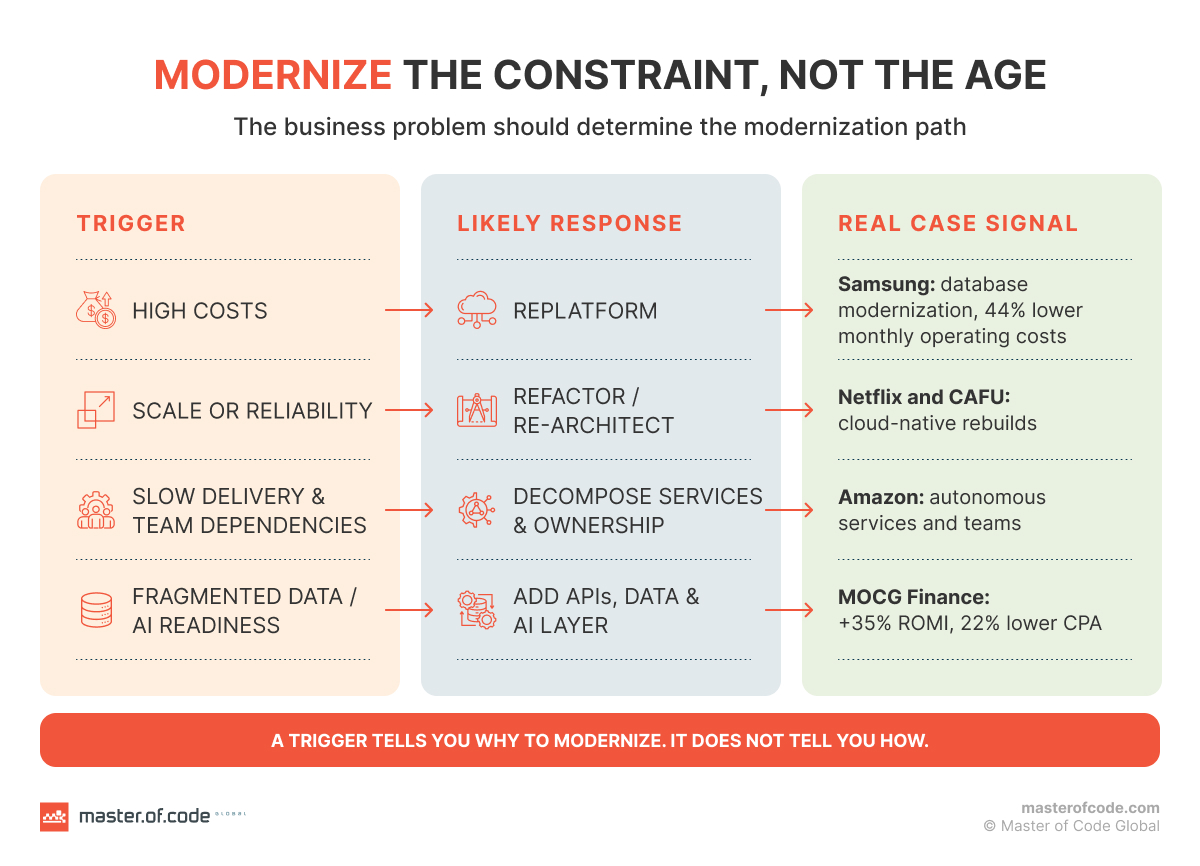
A digital transformation program may expose these limits without identifying the right response.
The important distinction is simple: a trigger tells you why to modernize, but it does not tell you how. A scalability problem may require re-architecture. High infrastructure costs may only justify replatforming. Fragmented data may call for an API or integration layer without replacing the original system.
A technical audit separates symptoms from root causes before application modernization begins. It maps dependencies, security gaps, performance limits, and priorities.
Legacy Modernization Case Studies at a Glance
The cases below connect each business trigger to the selected approach.
| Case | Trigger | Approach | What Was Not Done | Main Result |
|---|---|---|---|---|
| Amazon | Growing architecture and organizational complexity | Monolith decomposition and autonomous services | Technology was not changed without team structure | Greater autonomy and faster innovation |
| Netflix | Major outage and inability to scale | Full cloud-native rebuild | No simple lift-and-shift | Global scale and availability approaching four nines |
| Meliá Hotels | 20+ year COBOL mainframe | Incremental migration and selective re-architecture | No big-bang rewrite | 60% lower compute costs and 75% faster time to market |
| Samsung | Oracle architecture difficult and costly to scale | Database modernization and migration toward microservices | Source databases stayed live during migration | 44% lower monthly operating costs |
| CAFU | Monolith slowing product and engineering growth | Cloud microservices and containers | No disruptive cutover | 100%+ engineering productivity improvement |
| Zipify | Legacy workflows slowing a decade-old product | AI-first SDLC and a dedicated rapid product team | The established product was not rewritten | 12x faster prototyping and up to 4x faster feature delivery |
| Energy | Manual reconciliation across operational data | Standalone AI layer and integrations | Core operational systems were not replaced | Substantially less manual reconciliation |
| Finance | Fragmented business data | API and data layer first, Agentic AI second | AI was not added before fixing data access | +35% ROMI and 22% lower CPA |
| Healthcare | Knowledge bottleneck in regulated workflows | RAG and AI integrated with existing systems | Compliant infrastructure was not discarded | 3x faster diagnostic decision support in POC testing |
The first five are traditional infrastructure and application modernization cases. The next three show a newer pattern: modernizing access to existing systems and data so enterprises can add AI without replacing business-critical platforms. Zipify’s AI transformation represents a third category. The company modernized how teams build and maintain a legacy product while keeping the product itself operational.
5 Real-World Legacy System Modernization Case Studies
1. Amazon: The Architecture Changed, but So Did Team Ownership
Trigger. As Amazon expanded, its architecture and organization became tightly coupled. Teams struggled to make decisions and launch improvements quickly.
Strategy. Amazon decomposed its monolithic architecture into standalone services. Smaller “two-pizza teams” received single-threaded ownership across development, testing, operations, and iteration.
What Amazon did not do. It did not treat microservices as technology alone. Team structure changed with system boundaries. Autonomous services gained clearer decisions, fewer handoffs, end-to-end accountability, and independent CI/CD practices.
Lesson. Application modernization is partly an organizational design problem. A service is not independent when releases still require coordination across several teams. Amazon changed ownership so teams could use the architecture’s autonomy.
2. Netflix: Rebuilding for Cloud Instead of Moving the Existing Problem
Trigger. In 2008, a major database corruption stopped Netflix from shipping DVDs for three days. The incident showed that vertically scaled single points of failure could not support the company’s future.
Strategy. During a seven-year Netflix cloud migration, the company moved to AWS. It rebuilt virtually all its technology, replaced its monolith with hundreds of services, adopted distributed data stores, and introduced continuous delivery.
What Netflix did not do. It explicitly rejected a simple forklift migration. Moving unchanged systems would have carried the data center’s problems and limitations into AWS.
Results. Streaming membership grew eightfold. Netflix could add thousands of virtual servers and petabytes of storage within minutes. Availability approached its four-nines target.
Lesson. Cloud migration and modernization are not synonymous. Rehosting changes the location without removing internal constraints. Netflix rebuilt because reliability and global growth required a cloud-native model.
3. Meliá Hotels: Incremental Modernization Beat a Big-Bang Rewrite
Trigger. Meliá Hotels had used a COBOL-based mainframe reservation system for over 20 years. Changes affected the wider environment, transaction costs were rising, and relevant engineers were scarce. The platform handled bookings, inventory, loyalty, and tour-operator contracts, making abrupt replacement risky.
Strategy. Meliá used a mixed modernization strategy. It rebuilt high-load processes as services and converted others to Java. The team containerized modules, migrated them from lower to higher criticality, and replicated data continuously. The source database remained operational.
This was not simply “COBOL to microservices.” The AWS account documents selective rebuilding, code conversion, data migration, and staged risk controls.
Results. AWS reports 60% lower compute costs, 75% faster time to market, 99.99% availability, and response time falling from 234 ms to 160 ms. Daily availability requests nearly doubled to 50 million.
Lesson. One program may need several migration patterns. Meliá rebuilt where scale created value and converted code where speed mattered more.
4. Samsung: Modernizing a Database Without Taking 1.1 Billion Accounts Offline
Trigger. Samsung Account’s Oracle-based architecture had become difficult and expensive to scale. The platform served 1.1 billion accounts and processed about 80,000 requests each second. That made business continuity a central design requirement.
Strategy. Samsung moved from central Oracle databases toward a service-based architecture. AWS Database Migration Service replicated changes while sources remained live. Migration proceeded region by region across Europe, China, and the United States.
What Samsung did not do. It avoided one global cutover. Each regional wave limited the failure impact and informed the next stage.
Results. The Samsung database migration finished within 18 months with minimal disruption. Afterward, 90% of the latency was below 60 ms. Samsung reported 44% monthly operational cost savings, excluding additional legacy licensing expenses.
Lesson. Continuity should shape architecture and sequencing from the beginning.
5. CAFU: Modernizing When the Monolith Starts Slowing the Business
Trigger. CAFU’s monolithic stack became harder to extend across new services and markets. Small changes required system-wide analysis, while some endpoints took five seconds to load.
Strategy. CAFU 2.0 moved to containerized services and managed infrastructure. Its continuously operating platform required near-zero migration downtime.
Results. Engineering productivity increased by more than 100%. Latency for some endpoints fell by over 50%, and infrastructure spending declined by around 30%. CAFU also eliminated third-party support expenses worth another 20% to 30%. Availability reached as high as 99.99%, with virtually no production downtime reported after launch.
Lesson. CAFU also reduced engineering cost per shipped feature, connecting architecture directly to product economics.
3 AI-Era Modernization Examples from Master of Code Global
These legacy modernization examples differ from traditional mainframe-to-cloud migrations. They show how companies can keep useful platforms while improving the way data, workflows, and AI interact with them.
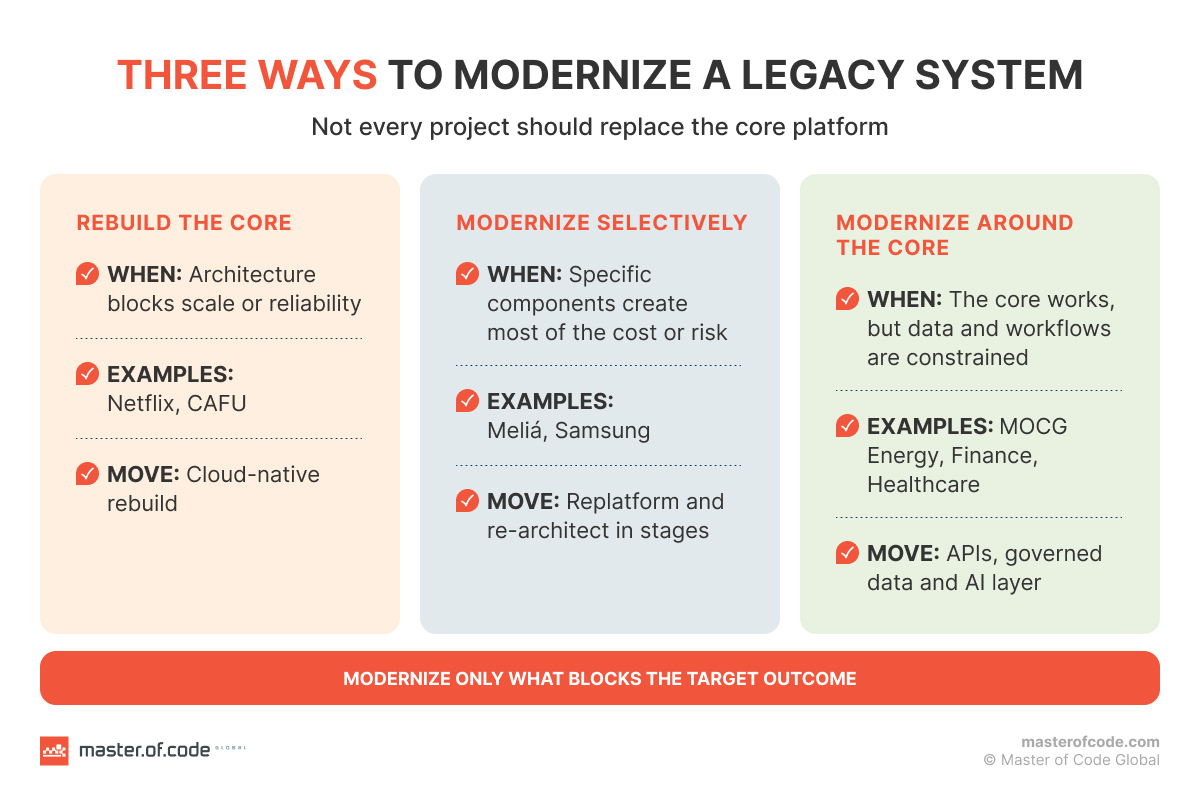
Energy: Add an Intelligence Layer Instead of Replacing the Core
An energy company manually reconciled discrepancies across operational data. Replacing every source platform would have expanded the scope without improving the workflow.
Master of Code Global created a standalone Agentic AI data reconciliation tool. It ingests Snowflake data, applies deterministic rules, and uses GPT-4o-mini to explain exceptions. The Azure application includes role-based access, notifications, and integrations.
The result was substantially less reconciliation time, dependable reporting, and a scalable foundation. Modernization can target a workflow around existing systems. Companies can first expose and govern data, as explained in how to prepare legacy systems for AI integration.
Financial Services: Fix the Data Layer Before Adding Agentic AI
A mid-sized lender wanted to explore AI. Its assessment revealed a more immediate constraint: advertising, CRM, and lending data existed in separate silos. Teams manually combined partial reports.
Master of Code Global connected the systems through APIs and built a common analytics architecture. After establishing reliable CPA and ROMI, the team added an Agentic AI revenue assistant.
Within six months, the client recorded a 35% increase in ROMI and a 22% reduction in CPA. Teams saved more than 15 hours each week and identified high-performing initiatives 40% faster.
Sometimes the right first AI project is not AI. Modernizing access to data can produce immediate value while creating a reliable foundation for intelligent tools.
Healthcare: Modernize Around Regulatory Constraints
A healthcare organization needed specialized medical knowledge within existing workflows without weakening compliance.
Master of Code Global designed an AI-powered clinical decision support system. The team compared three models, connected medical guidelines through retrieval-augmented generation, and planned certified-system integrations. The architecture supported cloud or on-premises deployment, PHI protection, and HIPAA controls.
POC testing demonstrated three times faster diagnostic decision support. The case also projects 300% ROI within 24 months through efficiency and training savings.
The lesson is industry-specific. In healthcare, interoperability, traceability, and preserved controls can matter more than maximum migration speed.
What Amazon and Netflix Actually Teach About Monolith Modernization
Amazon and Netflix are often reduced to the same story: both replaced a monolith with services. Yet their starting constraints and operating changes were different.
| Amazon | Netflix | |
|---|---|---|
| Primary constraint | Organizational and architectural coupling | Reliability and scale |
| Starting point | Large, tightly coupled commerce architecture | Data center monolith and centralized infrastructure |
| Core move | Decompose services and ownership | Rebuild cloud-native |
| Organizational change | Two-pizza autonomous teams | Loosely coupled DevOps teams |
| Migration philosophy | Align services with ownership | Avoid forklift migration |
| Main lesson | Architecture follows team boundaries | Cloud value requires an architectural change |
The broader lesson is that microservices are not the objective. Independent change is. Amazon aligned service boundaries with accountable teams. Netflix removed centralized infrastructure, release coordination, and provisioning constraints. Copying their architecture without understanding those operating changes can create a distributed system that still depends on centralized decisions.
For some enterprises, a modular monolith with clear boundaries may deliver enough independence. The right target is the smallest architectural change that removes the business constraint.
How to Choose Between the 7 Rs of Modernization Using These Cases
AWS defines the 7 Rs of modernization as Retire, Retain, Rehost, Relocate, Repurchase, Replatform, and Refactor or Re-architect. The value of this model is not memorizing definitions. It is matching each workload to the least disruptive approach that still reaches the intended outcome.
| Strategy | Choose When | Evidence from the Cases |
|---|---|---|
| Retain | The core remains useful, or dependencies require a delay | energy pattern: improve the workflow around existing data |
| Retire | Functionality has no ongoing business value | Remove it instead of funding unnecessary work |
| Rehost | An urgent infrastructure exit matters more than architecture | Useful as an initial migration wave |
| Relocate | Virtualized workloads can move mostly unchanged | Infrastructure-first transfer with limited application change |
| Repurchase | Commodity software creates no strategic differentiation | Replace custom ownership with a suitable SaaS product |
| Replatform | Infrastructure or platform technology is the main constraint | Samsung’s database modernization |
| Refactor or Re-architect | Architecture blocks scale, resilience, or independent releases | Amazon, Netflix, CAFU, and selected Meliá components |
A company rarely chooses one R for everything. A portfolio does. Workloads differ in value, complexity, dependencies, and risk, so the same program may retain one platform, replatform its database, and refactor a high-growth customer journey.
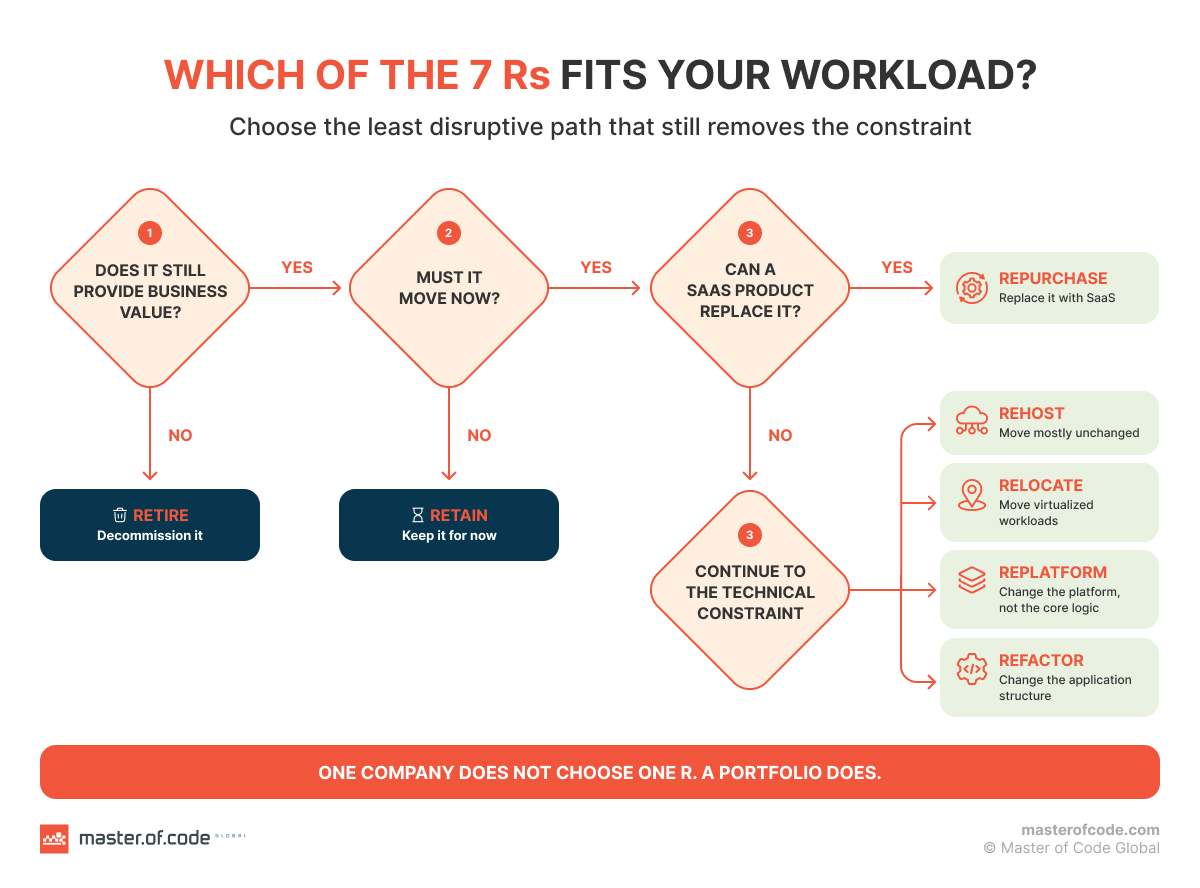
Map dependencies before assigning migration waves. For a practical sequence that starts with business constraints, use this legacy modernization roadmap for SMBs.
What Challenges Show Up Repeatedly in Real Modernization Projects?
Business continuity
Samsung kept source databases operating during replication. CAFU is designed for near-zero downtime. Both treated uninterrupted service as an architectural input.
Hidden dependencies
A legacy application can contain relationships that surface only when components separate. Dependency mapping, traffic analysis, and rollback plans should begin before cutover.
Skills and organizational change
Netflix had to build new systems and learn new skills. Amazon adjusted ownership alongside architecture. New platforms create limited value if operating responsibilities remain unclear.
Big-bang risk
Meliá rejected an immediate full rewrite. Incremental waves let the company validate performance, rehearse runbooks, and preserve business operations.
Moving technical debt instead of eliminating it
Netflix provides the clearest warning. Moving unchanged workloads to cloud infrastructure can preserve the same limitations while introducing a new cost model. Teams must distinguish debt that blocks the target outcome from old code that still works reliably.
What KPIs Should You Use to Measure Modernization Success?
No single metric proves success. A useful scorecard combines technology performance with a business outcome that justified the investment.
1. Financial
Track infrastructure and licensing costs, maintenance hours, total cost of ownership, and verified cost savings. Compare ongoing costs after stabilization, not only during migration.
2. Engineering
Measure deployment frequency, lead time for changes, engineering hours per feature, release failure rate, and CI/CD cycle time. These indicators show whether teams can change the system more independently.
3. Reliability
Monitor uptime, incident frequency, recovery time, rollback success, and production error rates. Availability improvements should not conceal slower recovery or more failed releases.
4. Performance and Scale
Track response time, requests per second, peak capacity, and scalability under realistic demand. Baselines should use the same journeys and load profiles before and after migration.
5. Business
Measure time to market, revenue or conversion impact, employee hours saved, customer experience, AI adoption readiness, and ROI. These metrics connect system changes to organizational value.
The cases illustrate this balance. Meliá measured cost, availability, response time, and release speed. CAFU tracked productivity and latency. Samsung monitored operating costs and latency. The finance case measured ROMI, CPA, and hours saved.
Define at least one technical KPI and one business KPI before work begins. Otherwise, a project can finish its migration plan without proving that it removed the original constraint.
What These Legacy System Modernization Examples Tell Us About AI
AI appears in modernization programs in two distinct roles.
AI for modernization
Generative AI can help teams understand undocumented code, produce documentation, generate tests, analyze dependencies, and assist with refactoring or code translation. These uses can reduce discovery effort, but the generated output still requires technical review, security controls, and validation against real system behavior.
Modernization for AI
This direction is often more important. Before deploying AI, an organization may need APIs around old systems, governed data access, unified identity controls, modern integration pipelines, and observability. Adding a model before these foundations exist can create unreliable outputs or expose data inappropriately.
The financial services case demonstrates the sequence. An AI-readiness initiative exposed data fragmentation as the first problem, so the integration layer came before the agent.
Companies can assess that sequence through an AI roadmap sprint, review the technical prerequisites in preparing legacy systems for AI integration, and validate one bounded use case through an AI pilot.
Lessons Enterprises Can Take From These Case Studies
Across these legacy modernization examples, six lessons apply beyond any single industry or architecture.
- Modernize the constraint, not the age. An old system can remain valuable when it is stable, secure, and capable of supporting the target outcome.
- Do not assume cloud equals modernization. Netflix changed both architecture and operations. A new hosting location alone would not have solved its reliability problem.
- Mix strategies when necessary. Meliá combined code conversion, selective re-architecture, containers, and data migration within one modernization strategy.
- Sequence change around business continuity. Samsung and CAFU designed the transition around uninterrupted customer service.
- Change ownership when changing architecture. Amazon’s case shows why independent services require accountable teams and clear decision rights.
- Include AI readiness in the modernization roadmap. APIs, governed data, and integration work may need to precede GenAI development.
Enterprises that need external support can compare delivery models, technical strengths, and relevant experience in this overview of legacy system modernization companies.
Conclusion
The strongest legacy system modernization case studies do not point to one winning architecture. Amazon changed architecture and ownership. Netflix rebuilt instead of lifting and shifting. Meliá mixed approaches. Samsung moved a critical database gradually. CAFU removed a scaling constraint. Master of Code Global’s cases show another option: modernize integrations and workflows around systems that still serve the business.
Start with the constraint and the measurable outcome. Then determine how much of the system actually needs to change.
If the biggest unknown is whether your architecture can support the next stage of automation or AI, begin with a technical audit or an AI consulting engagement.
Discover how Master of Code Global can help enhance your customer’s experience and boost sales growth.