



What should happen when an AI tutor realizes a learner is struggling before they ask for help? Or when a university system spots signs of disengagement and can act before that student disappears from the course?
That’s where AI agents in education become interesting. They can move from answering questions to deciding what should happen next: adapting a lesson, triggering outreach, coordinating a workflow, or bringing in a person.
The opportunity is significant, but so is the responsibility. After working on EdTech products ourselves, we’ve learned that the hardest part isn’t making an agent more autonomous. It’s deciding what it should do, for whom, and where it should stop.
Read on to see where AI agents are already creating value across education, what real-world implementations can teach us, and how to approach your own project responsibly.
Already exploring an agentic AI use case for your education product or institution? Get in touch with our team to discuss what makes sense to build and how.

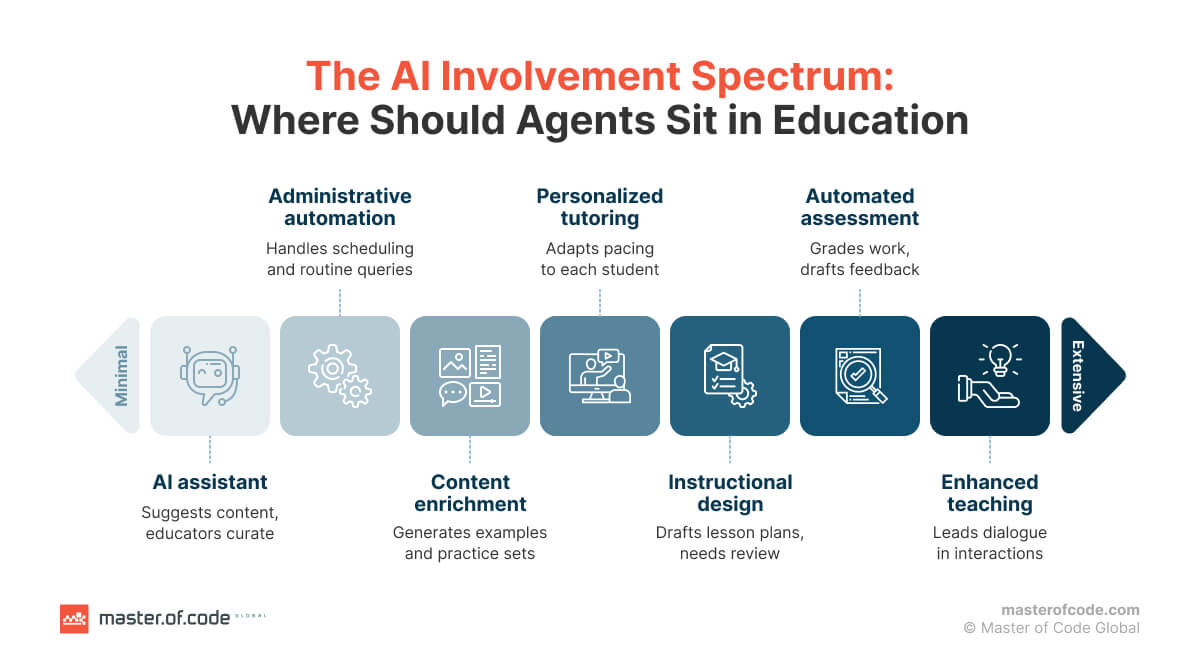
Table of Contents
Key Takeaways
- AI agents can serve very different roles across education: personalized tutors for learners, copilots for teachers, support for admissions and advising, and automation for administrative processes.
- Real-world examples from Nord Anglia Education, Khan Academy, Georgia Institute of Technology, Flinders University, Indian Institute of Science, & University of Arizona show how AI is being applied to reflection, tutoring, instruction, academic support, outreach, and professional learning.
- AI agents in education learning workflows can connect information with action, such as identifying a struggling learner, preparing personalized outreach, coordinating scheduling, or routing a case to the right person.
- More autonomous doesn’t automatically mean better. Grading, wellbeing, admissions, academic integrity, and other sensitive decisions require clearly defined boundaries and human oversight.
- Successful implementation starts with a focused pilot and measurable outcome. Institutions then need to address integrations, evaluation, privacy, governance, and production reliability before expanding an agent’s responsibilities.
- The next phase is moving toward more adaptive, context-aware agents connected to education systems. That creates opportunities for earlier intervention and better retention, while making control over data and actions increasingly important.
What Are AI Agents in Education?
AI agents in education are systems designed to pursue a goal and take actions toward it with a degree of autonomy. Instead of waiting for a single prompt and producing a single response, an agent can assess a request, decide what needs to happen next, use connected tools or data, and complete a series of steps.
Imagine a student who has missed several assignments. A standard chatbot might answer when they ask, “What homework do I have?” An AI agent could recognize the missing work, check upcoming deadlines, prioritize tasks, suggest a realistic study plan, send reminders, and adjust that plan as assignments are completed.
That ability to act is what separates an agent from many familiar forms of education AI.
| Technology | What It Typically Does | Example |
|---|---|---|
| Traditional AI | Analyzes data or makes predictions based on predefined tasks | Identifies students who may need additional academic support |
| Chatbot | Responds to questions through a conversational interface | Answers questions about courses, deadlines, or school policies |
| Generative AI | Creates new content from a prompt | Generates a lesson plan, quiz, explanation, or study notes |
| AI agent | Works toward a goal, makes decisions, and takes actions across connected systems | Builds a study plan, checks progress, schedules activities, and adapts the next steps |
The lines aren’t always perfectly clean. A chatbot may use Generative AI, while an AI agent may communicate through a chat interface. An agent may also rely on an LLM to interpret requests and generate responses. What matters is what the system is allowed to do after it understands the request.
In education, that opens up a much wider set of possibilities. An agent might work directly with a learner, assist a teacher, support admissions staff, or handle administrative workflows. But autonomy alone doesn’t make any of these experiences useful.
From our EdTech work, we’ve learned to ask a different question early: who is this agent actually for?
A five-year-old learning to read, a university student choosing courses, and a teacher managing 30 learners may all benefit from AI. They won’t benefit from the same experience, though. Their goals, motivations, interfaces, and expectations are very different.
That’s why the most useful way to examine AI agents in education is through the people using them.
Why Institutions Are Investing in AI Agents: Benefits and Use Cases
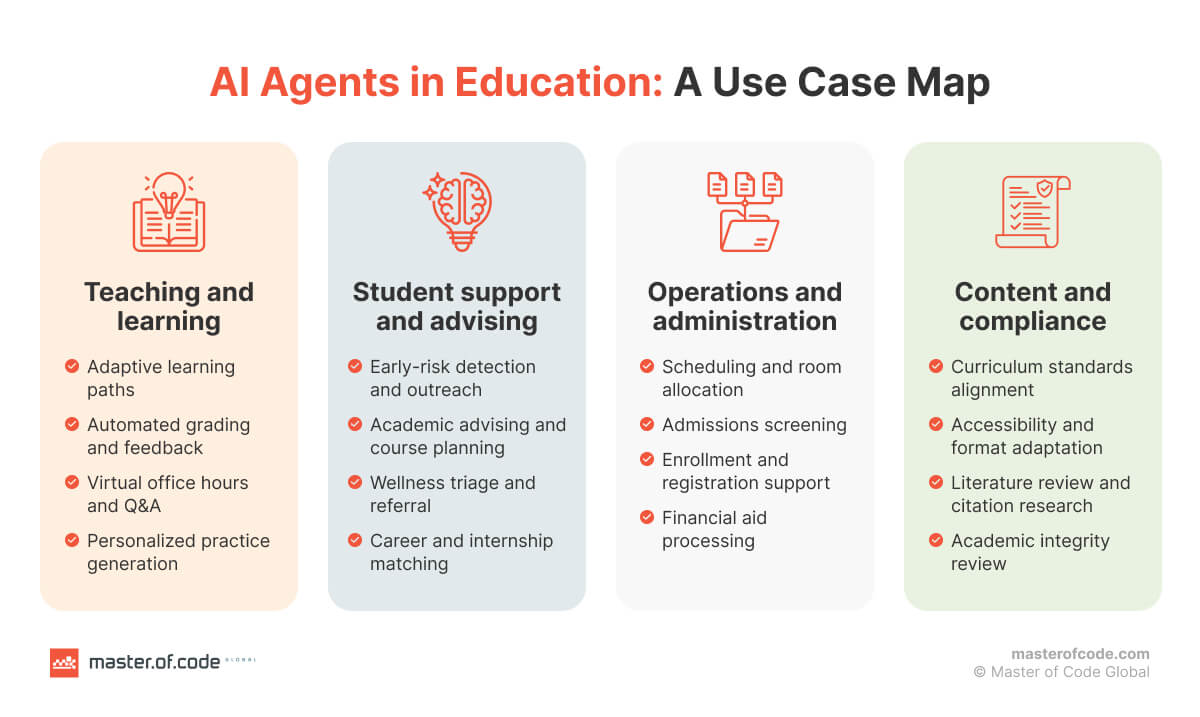
Schools and universities are under pressure from two sides. Staff spend their days on routine requests, teachers lose hours to prep and feedback, and students often get help only after they’ve already fallen behind. AI agents go after exactly that. They take the repetitive coordination off people’s plates, catch struggling learners while there’s still time to step in, and give each learner support that fits where they actually are. What that looks like depends on who the agent is built for, so let’s take it one audience at a time.
For Learners: Personalization Is More Than Changing the Content
Learners rarely struggle for the same reason. The problem may be:
- gaps in prerequisite knowledge;
- a pace that is too fast or too slow;
- limited individual feedback;
- declining motivation;
- reluctance to ask for clarification.
AI agents for student support in education can respond to those signals as they appear. Depending on the learner, it may:
- adjust difficulty and pace;
- explain the same concept another way;
- offer hints before revealing an answer;
- generate targeted practice for weak areas;
- provide on-demand tutoring and route wellbeing-related requests to appropriate human support;
- revisit a topic when performance suggests it hasn’t stuck.
There is promising evidence for this approach. In a randomized Harvard study, students using a carefully designed AI tutor achieved more than twice the median learning gains of the active-learning classroom group. Their median time on task was 49 minutes versus 60 minutes allocated to classroom learning.
The tutor was deliberately designed around pedagogical principles such as scaffolding, active engagement, timely feedback, and self-paced learning. Giving someone faster answers isn’t personalized education. Knowing when to explain, challenge, hint, or wait is much closer to it.

For Teachers: Give Time Back Without Giving Up Control
For educators, the pressure often comes from the work surrounding instruction:
- adapting the same material for different abilities;
- preparing exercises, assessments, and lesson plans;
- reviewing large volumes of student work;
- spotting patterns across individual performance;
- handling routine documentation and communication.
Here, AI agents in education teaching could act as copilots. They may:
- generate exercises aligned with the current lesson and learner level;
- prepare differentiated versions of existing materials;
- draft feedback using teacher-defined assessment criteria;
- flag recurring misconceptions across assignments;
- summarize progress before a teacher plans the next lesson.
The time-saving potential is already visible. In a Gallup survey of 2,232 U.S. public K-12 teachers, weekly AI users estimated saving 5.9 hours per week. Among teachers using AI for specific tasks, 80% said it saved time preparing to teach, while 79% reported savings on grading or feedback.
But an agent shouldn’t become an invisible decision-maker. It can surface patterns, draft materials, and recommend next steps. The teacher still needs to judge whether those outputs make pedagogical sense for the people in the room.
For Higher Education: Connect the Dots Across the Student Journey
Universities face problems not limited to one department:
- prospective applicants abandon complex enrollment processes;
- advisors manage more cases than they can follow closely;
- warning signs of disengagement sit across separate systems;
- students miss deadlines for registration, financial aid, or coursework;
- support is often reactive, arriving after someone asks for it.
AI agents in higher education could connect these signals and act earlier. Depending on the institution, they may:
- guide applicants through admissions and enrollment;
- answer policy questions using approved university knowledge;
- monitor agreed indicators of disengagement and trigger proactive outreach;
- coordinate advising appointments, reminders, and follow-ups;
- assist researchers with literature discovery, evidence synthesis, and repetitive tasks;
- route complex or sensitive cases to the right staff member.
The appetite is already there. In a higher education survey, 80% of administrators cited efficiency and productivity as motivations for adopting AI. 83% expected increased use of predictive models for student success.
For us, the interesting part is what happens after prediction. Knowing that someone may disengage has limited value on its own. An agent can turn that signal into a timely, appropriate next action, provided the institution has clearly defined when people should take over.
For Administration: Move Routine Requests Without Creating Another Queue
Education administration involves thousands of small transactions. Many of those still require manual coordination:
- processing forms and enrollment documents;
- answering repetitive policy and program questions;
- coordinating scheduling across staff, rooms, and learners;
- checking whether applications contain missing information;
- moving requests between departments and systems.
AI agents fit these workflows because they can do more than answer the initial question. An agent may:
- collect required information and validate whether a submission is complete;
- retrieve answers from approved institutional sources;
- update records across connected systems;
- coordinate scheduling and send reminders;
- route exceptions to staff with the relevant context attached.
This is also where the distinction between an agent and Conversational AI in education becomes practical. A conversational interface may tell someone which document is missing. An agent could identify the missing document, request it, check the new submission, update the application, and notify the appropriate team.
The benefit is less manual handoff between routine steps. Staff spend less time moving information from one place to another, while exceptions that actually require judgment reach a person sooner.
7 Real-World AI Agents in Education Examples
After working on several EdTech projects, Olga Hrom noticed a pattern that has shaped how we think about AI in education: technology is rarely what determines whether a product succeeds.
We have seen products where the AI works as expected, yet learners still disengage. A technically stronger model doesn’t necessarily fix that. Often, the harder questions are about teaching methodology, motivation, and how well the product understands the person using it.
That is why the following AI agents in education use cases and examples are interesting. Each starts with a specific problem rather than with AI for its own sake. And their results show something equally important: there is no single formula for a successful agent.
Nord Anglia Education
Reflection was already part of the learning process at Nord Anglia Education. The challenge was depth. Students needed prompts that made them examine their reasoning, while teachers needed visibility into that thinking without manually reviewing every interaction.
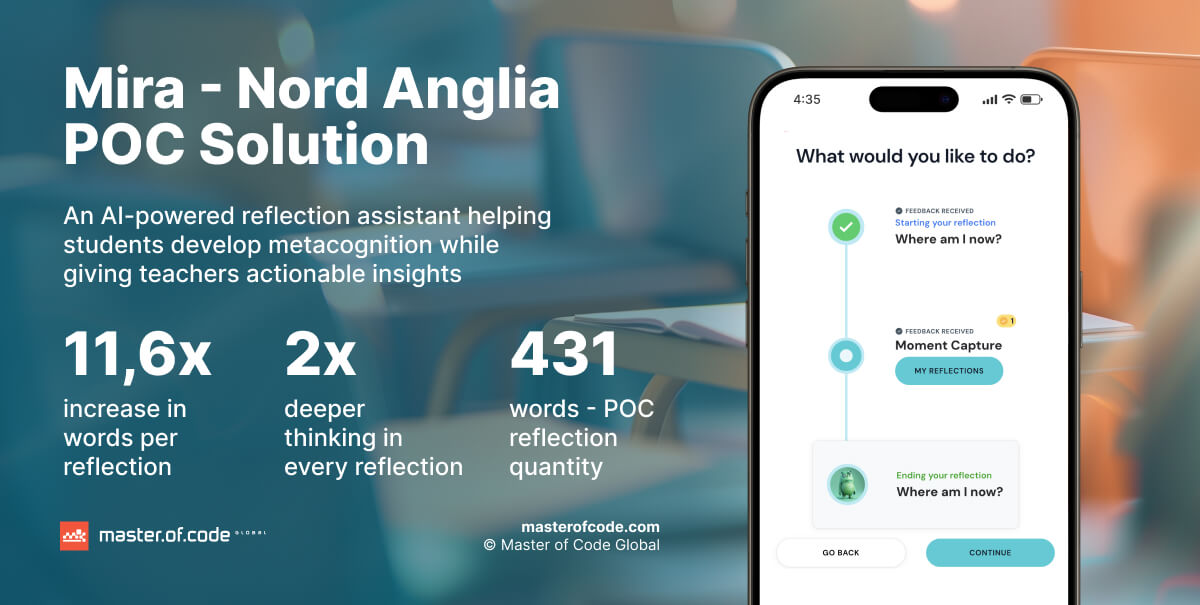
We built Mira to adapt its questions to each response and guide learners through deeper reflection. It also analyzes conversations for metacognitive indicators and prepares insights and draft feedback for teachers to review.
During the pilot, students wrote 11.6x more words per reflection and demonstrated 2x deeper thinking compared with the traditional reflection tool. Mira also scored highest across all seven measured metacognitive indicators.

Global Professional Association
Another project brought a different problem: supporting a large professional community as inquiry volumes grew. The association’s legacy setup struggled with personalization, routing, and language variations that traditional NLU did not always understand well.
We introduced digital messaging, intelligent routing, a virtual assistant, and GenAI support for human agents. The resulting experience has handled more than 1.5 million interactions, while webchat volume increased by approximately 25%.
The result shows how AI can absorb growing support volumes while keeping access to information and human assistance manageable for a large learning community.
Khan Academy
A tutor has limited room to personalize when it sees only the question directly in front of it. Khan Academy tested whether Khanmigo could make better tutoring decisions. It received structured information about recent attempts, skill levels, and prerequisite progress.
Adding recent problem-solving history improved next-item correctness by 3.4% across 608,000 tutoring threads. Combining structured learning-history signals increased next-item correctness by 6.1%. The results connect personalization to something concrete: giving the tutor the right context before it decides how to respond.
Georgia Institute of Technology
Individual Socratic discussion can reveal whether a learner actually understands an idea. Still, it’s difficult to reproduce across a large class. Georgia Tech’s Socratic Mind was designed to make that kind of dialogue more scalable.
Instead of stopping once a learner reaches an answer, the system asks them to explain and defend their reasoning. The research found significant quiz-performance gains among students who engaged with the tool.
A particularly strong effect was observed among lower-performing learners. Participants also reported improvements in problem-solving, critical thinking, and self-reflection.
Flinders University
Students often need guidance while preparing an assessment. Unfortunately, individual support isn’t available whenever someone gets stuck. Flinders University tested personalized academic agents across education, psychology, social work, and sport courses to address that gap.
The pilot involved 139 undergraduate students. After using the agents, participants reported significant improvements in their perceptions of learning and success. The agents also had an intentional boundary: they supported students as they prepared assessments rather than completing the work for them.
Indian Institute of Science
Researchers at the Indian Institute of Science explored a different problem: whether an AI agent could take responsibility for part of the instructional experience without removing the human educator.
An LLM-driven Instructor Agent became the primary instructional interface during parts of a graduate Cloud Computing course. Students used it to explore concepts, clarify questions, and pursue lines of inquiry during live sessions. The instructor retained responsibility for course structure and question-and-answer sessions.
Rather than automating the entire teaching role, the setup divided responsibilities between the agent and educator. That makes human involvement part of the design instead of a fallback when the AI cannot handle something.
University of Arizona
Student-success coaches at Arizona Online manage large, distributed caseloads. The information that suggests someone needs attention may already exist, but it can sit across learning, CRM, and enrollment systems.
The pilot brought those signals into the coaches’ workflow. Configured triggers surface cases such as declining GPAs, negative progress reports, or enrollment holds. Trainers can review the consolidated history, prepare personalized outreach, send it, and record the interaction.
The pilot produced a 32-fold increase in outreach productivity. Coaches can proactively reach more learners while increasing student response rates. Instead of automating the relationship, the workflow reduces the work required to identify who may need attention and why.
Risks of AI Agents in Education and How to Implement Them Responsibly
The examples above also show why implementing an education agent shouldn’t begin with a long list of features. Before deciding what the system can do, define who it serves, what problem it should solve, and what success looks like for that person.
For a learner, that might mean stronger understanding or more consistent practice. For a teacher, it could be less time spent preparing materials. For an advisor, success may mean identifying people who need attention earlier.
From our experience, a controlled pilot is usually more useful than trying to build the complete system immediately. Give the agent one clearly defined job, test it with a small user group, and watch how people actually interact with it. Do learners follow its guidance? Do teachers trust its recommendations? Where do they ignore it, work around it, or ask for human support?
These behaviors often reveal requirements that aren’t obvious during planning. They also give teams a baseline for AI agent evaluation before expanding the agent’s responsibilities.

Decide Where Autonomy Should Stop
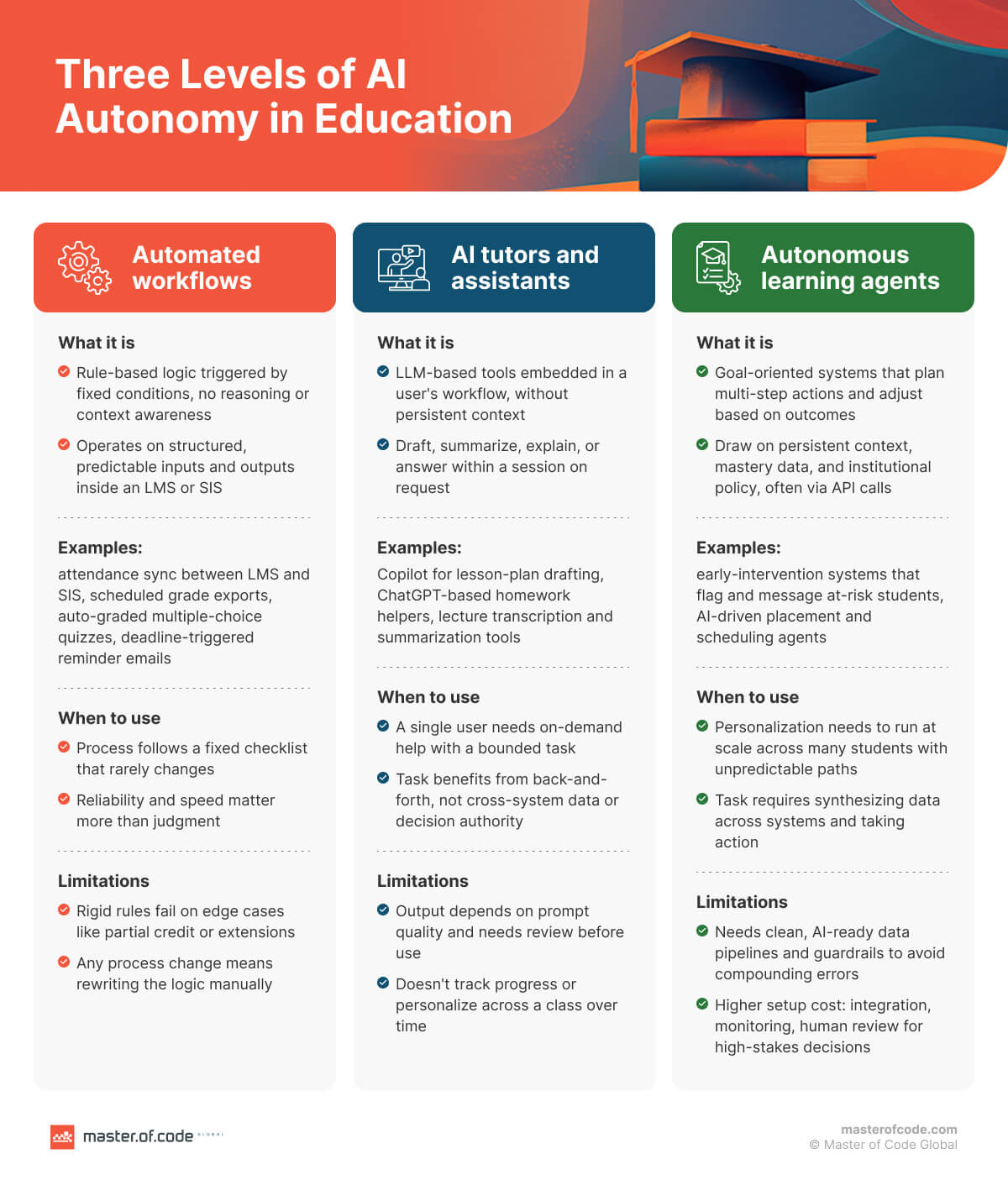
The Flinders and IISc examples illustrate an important design decision: an education agent doesn’t need maximum autonomy to be useful.
Before deployment, define which actions it may take independently, which require confirmation, and which must remain human decisions. Giving practice hints is very different from assigning a grade. Reminding someone about a deadline carries less risk than changing their academic record.
The same principle applies to student wellbeing, disciplinary decisions, admissions, and other sensitive situations. Human oversight should be designed into the workflow, not added only when something goes wrong.
Treat Student Data as Part of the Product Design
Personalization depends on context, but every additional source creates another data decision. An agent may have access to grades, attendance, conversations, behavioral signals, or information about learning difficulties.
Teams therefore need to decide what information the agent genuinely needs, who can access it, how long it is retained, and whether it should influence automated actions. These choices should be made before connecting every available system simply because integration is possible.
The same scrutiny applies to bias. If historical data reflects unequal access, assessment patterns, or institutional decisions, an agent can carry those patterns into recommendations and interventions.
Plan for Wrong Answers, Regulation, and Security
An agent can be confidently wrong, and that might become a wrong grade, a missed deadline, or bad advice to a student. Ground the agent in approved institutional sources, and have people review anything that affects a learner’s record. Rules matter too. Depending on where you operate, FERPA, GDPR, and the EU AI Act may apply, and education is one of the areas the EU AI Act treats as high-risk. Finally, an agent connected to several systems is a bigger security target, so give it access only to what its job requires.
Also read the guide on Shadow AI agent risk mitigation to deal with unapproved agent use and reduce the security, data, and governance risks it creates.
Protect Learning, Not Just Accuracy
An agent can produce a correct answer and still create the wrong educational outcome.
If it completes an assignment instead of guiding the learner, removes productive struggle, or becomes the default source for every decision, convenience can work against learning. Academic integrity policies matter, but product behavior matters too. Flinders’ decision to limit its agents to assessment support is a good example: the boundary was part of the experience.
This is why our education AI consulting work starts with the learning or operational problem rather than the model. The strongest implementation isn’t necessarily the one that gives an agent the most freedom. It is the one where technology, methodology, guardrails, and human responsibility support the same outcome.
What’s Next?
Several AI agents in education trends are already taking shape.
- Agents are becoming more adaptive, using learning history and progress to personalize what happens next.
- They are moving from standalone conversations toward connected workflows. They can work across learning platforms, student systems, and other approved tools.
- At the same time, institutions are putting more emphasis on governance, privacy, and human oversight as these systems gain access to more data and actions.
For leaders, the question is becoming less about whether AI belongs in education and more about where greater autonomy creates enough value to justify greater responsibility. Looking at what education AI companies are building can provide useful reference points. Nevertheless, the right experience still depends on the institution, its learners, and its educational model.
The examples we’ve explored point to the same lesson Olga Hrom has seen in our EdTech work: better technology doesn’t automatically produce better education. The agent needs the right methodology, context, boundaries, and human involvement around it.
If you’re exploring where technology could fit into your education product or institution, our agentic AI consulting services can help turn that question into a practical roadmap. Get in touch, and let’s explore what the right agentic experience could look like for your users.
Frequently Asked Questions
How Do Educational Institutions Measure the ROI of AI Agents?
Measure against the problem it was introduced to solve. For operational use cases, track processing time, support volume, staff hours saved, and cost per interaction. For learning use cases, track completion, engagement, learning gains, and successful interventions. Set a baseline before launch. For example, if an agent handles enrollment paperwork, record how many staff hours each application takes today, then compare that figure during the pilot and after rollout.
For a more detailed framework, see our guide to measuring AI ROI.
How Do AI Agents Integrate With Existing Education Systems?
They usually connect to learning management systems, student information systems, CRMs, knowledge bases, scheduling tools, and communication channels through APIs or approved integration layers. The hard part is rarely the connection itself. Older systems may have limited APIs, and the same student can look different in each one, so data needs cleaning and matching before an agent can rely on it. Start with the one or two systems the pilot actually needs, and give the agent access only to what its role requires.
How Can Schools and Universities Move From AI Pilot to Production?
Pilot should validate the use case, user behavior, and measurable outcome. Moving to production requires additional work around reliability, security, permissions, monitoring, integrations, cost, and governance. Scale gradually, evaluate performance continuously, and expand the agent’s responsibilities only after its behavior is reliable under real-world conditions.
For the technical and operational steps, see our guide from AI pilot to production.
How Do You Choose an AI Agent Development Partner for Education?
Look for a team with experience in both agentic AI development services and education product design. They should be able to validate the use case, design the architecture and integrations, define evaluation criteria, establish human oversight, and address security and data governance. Just as importantly, a good partner should be willing to say when an AI agent isn’t the right solution, when a simpler approach would work better, or when the risks outweigh the expected value.