


Here’s a scenario happening across board rooms: a meeting ends with a clear directive: show meaningful AI progress this quarter. The CEO and CTO now have two paths. One is hiring engineers, data scientists, and an MLOps lead. The other is bringing in an external team that can start immediately.
This decision affects burn rate, time to market, and control over proprietary systems. It also determines whether AI becomes a lasting internal capability.
Stanford’s 2026 AI Index reports that organizational AI adoption reached 88%. Yet hiring has become harder: ManpowerGroup found that AI skills became the world’s most difficult capabilities to source, while 72% of employers reported hiring difficulty.
This guide compares an in-house AI team vs outsourcing using a practical framework. It covers costs, hiring, IP, delivery risk, and the situations where each model makes sense. Feel like your company will need external delivery capacity? We at Master of Code Global can assess the use case and take it through implementation — drop us a line.

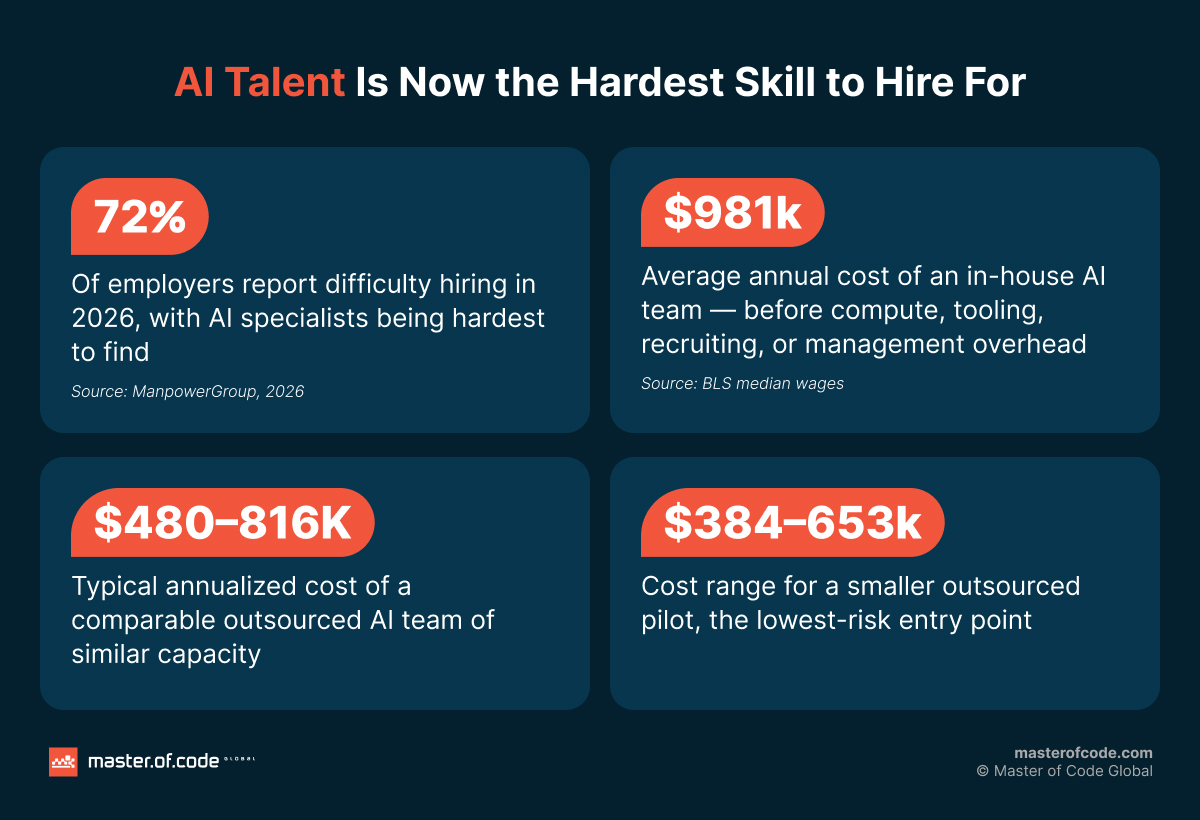
Table of Contents
Key Takeaways
- A lean six-person U.S. AI team can approach $1 million in annual compensation before cloud infrastructure, recruiting, software, and executive oversight.
- Outsourcing usually reduces ramp-up time and fixed headcount, but it requires clear contracts, technical oversight, and an exit plan.
- In-house development provides closer control when AI is central to the product, sensitive data is a case, or proprietary technology creates a long-term moat.
- The decision is not permanent. A hybrid model can validate the business case externally before the company commits to permanent hires.
- Compare expected business value against the total cost of ownership (TCO), not just salaries or vendor fees.
Cost Comparison Between an In-House & Outsourced AI Teams
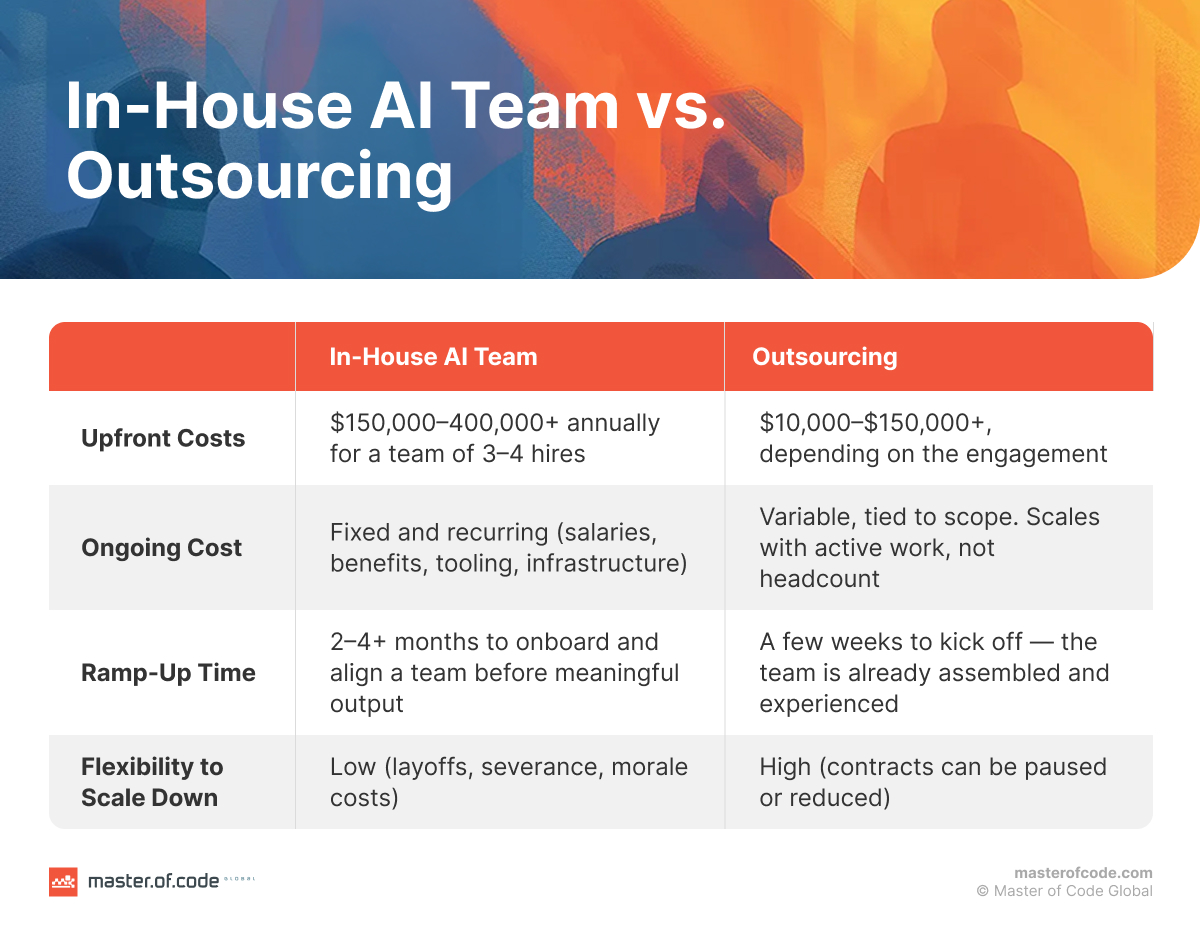
A fair comparison includes people, infrastructure, recruitment, management, and changing direction.
Annual Cost of an In-House AI Team
Consider two AI/ML engineers, two data scientists, one MLOps engineer, and one technical lead. BLS national medians are $133,080 for software developers, $112,590 for data scientists, and $171,200 for computer and information systems managers.
Top-industry medians reach $149,990, $128,020, and $196,060, respectively. Software-developer pay is used as a proxy for AI/ML and MLOps engineering.
The compensation range applies a conservative 23.3% payroll load. Current BLS data shows benefits represent 30.1% of total private-industry compensation, so actual totals may be higher before tooling.
That excludes recruiting, observability, data platforms, model APIs, GPU capacity, security reviews, and management. The in-house AI team cost can therefore reach $1.1–$1.4 million before measurable value.
Annual Cost of Outsourcing AI Development
External delivery costs vary substantially by scope, team composition, and engagement model. Public benchmarks for Master of Code Global list a minimum project size of $25,000+ and hourly rates of $50–$99, while verified Clutch reviews most commonly fall within the $50,000–$199,999 project range.
These are budgeting ranges, not quotes. Data readiness requires a plan for how to prepare legacy systems for AI integration. Review AI MVP cost drivers or AI PoC development services.
The cost of AI development matters relative to the outcome. A $150,000 pilot that prevents a $1 million hiring mistake may be efficient; a cheaper prototype that cannot reach production is not.
Is the Decision Just About the Money?
No. The two real trade-offs are speed and control.
An external team can begin with an established delivery process, reusable infrastructure, and specialists who have already shipped similar systems. That can shorten the time to market, especially when internal hiring has not started. IBM previously found that limited AI skills and expertise were the leading deployment barrier for 33% of surveyed enterprises.
An internal team provides closer control over prioritization, architecture, and daily decisions. That matters when models, data pipelines, evaluation logic, or training methods are central to the company’s competitive advantage.
Contracts determine what control actually means. Clear IP ownership clauses should assign custom code, model configurations, prompts, evaluation assets, and documentation to the client. Agreements should also explain whether vendor accelerators remain vendor property and whether any shared code enters the system. Without that clarity, a company may pay for development without fully controlling what it needs to maintain the product.
The same applies to proprietary datasets. The contract should specify where data is processed, which subprocessors can access it, how long logs are retained, and what happens when the engagement ends.
When It Makes Sense to Outsource
Outsourcing is reasonable when the business constraint is capacity, speed, or access to specialized skills rather than a desire to avoid responsibility.
You Need a PoC or MVP Fast
A board deadline, investor milestone, or competitive launch creates a delivery problem. Hiring four specialists before testing the use case adds months and fixed cost. An external team can run discovery, validate data, build the first workflow, and test whether users adopt it.
An AI Compass Sprint can help narrow competing use cases before engineering begins. The goal is not to build quickly at any cost. It is to avoid staffing a long-term team around an assumption that has not been tested.
The Use Case Is Established
A support chatbot, document-processing workflow, recommendation engine, or internal knowledge assistant rarely requires every component to be invented from zero. A partner with relevant implementation patterns can focus effort on integrations, safeguards, and the parts unique to the company.
This is where proven domain expertise matters. A healthcare assistant and a retail recommendation engine may use similar model families, but they need different evaluation criteria, escalation paths, and risk controls.
Internal AI Expertise Is Missing
Hiring difficulty is not theoretical. ManpowerGroup’s 2026 survey found that AI skills had overtaken engineering and traditional IT as the hardest capabilities to find globally.
A company can hire AI engineers, assemble an AI managed dedicated team, or use project delivery while leaders develop the ability to govern the work.
AI Is a Tool, Not the Core Product
A logistics company may need route optimization; a retailer, recommendations; a healthcare provider, document automation. AI supports the operating model, but is not the product customers buy. A permanent research-grade organization may distract from the company’s core advantage.
A Startup Must Protect Runway
A startup may need progress before its next raise. A scoped pilot protects the runway and produces evidence before permanent senior hires are added.
This is also a reason to compare custom AI solutions vs off-the-shelf vs hybrid. Not every problem needs custom development.
To evaluate an external path, contact Master of Code Global to discuss the use case, constraints, and expected business result.
When It Makes Sense to Build an In-House AI Team
Internal development makes sense when AI capability must compound inside the company over the years.
You Can Fund the Team Beyond the First Release
A realistic budget is not only six salaries. It includes recruitment, retention, infrastructure, governance, testing, and replacement risk. A company should be prepared to support at least $1 million annually for a lean U.S. team and more for senior specialists or high-cost markets.
New hires also need time to learn the systems, data, customers, and internal decisions.
The Product Is AI-Native
For an AI-native SaaS platform, the model behavior may be the product. Evaluation methods, feedback loops, proprietary data, and performance improvements directly affect revenue and defensibility.
In that situation, outsourcing the entire technical core can separate product strategy from daily engineering decisions. External specialists can still support specific workstreams, but ownership of the roadmap should stay close to the company.
Data Sensitivity Creates Material Exposure
FinTech, HealthTech, insurance, and other regulated environments may decide that external access adds unacceptable risk. The relevant question is not whether vendors can sign an NDA. It is whether the organization can prove appropriate data security and compliance across environments, logs, model providers, and subcontractors.
Regulated companies can still outsource, but need strict access controls, isolated infrastructure, audit rights, and clear incident responsibilities.
Proprietary AI Is the Competitive Moat
A company building unique pricing logic, scientific models, fraud detection, or specialized industrial intelligence may need its intellectual property to accumulate internally. The closer the AI capability is to the reason customers choose the product, the stronger the case for internal ownership.
Who to Hire for an In-House AI Team
A small team needs distinct ownership to avoid gaps between experimentation and production.
AI/ML engineer. This role builds model-powered features, inference services, and integrations. The engineer turns model behavior into usable software.
Data scientist. This role explores data, builds baselines, selects metrics, and tests whether the model improves the business process rather than an irrelevant technical score.
MLOps engineer. This person owns deployment, monitoring, versioning, and reliable operations, including latency, drift, costs, and failures.
AI team lead. The lead translates business priorities into architecture, reviews technical choices, manages dependencies, and explains risks.
The product may also require data engineering, product management, security, or subject specialists. A technical audit for AI platforms can identify gaps before hiring.
Is It Either/Or?
No. A hybrid model is often the practical starting point.
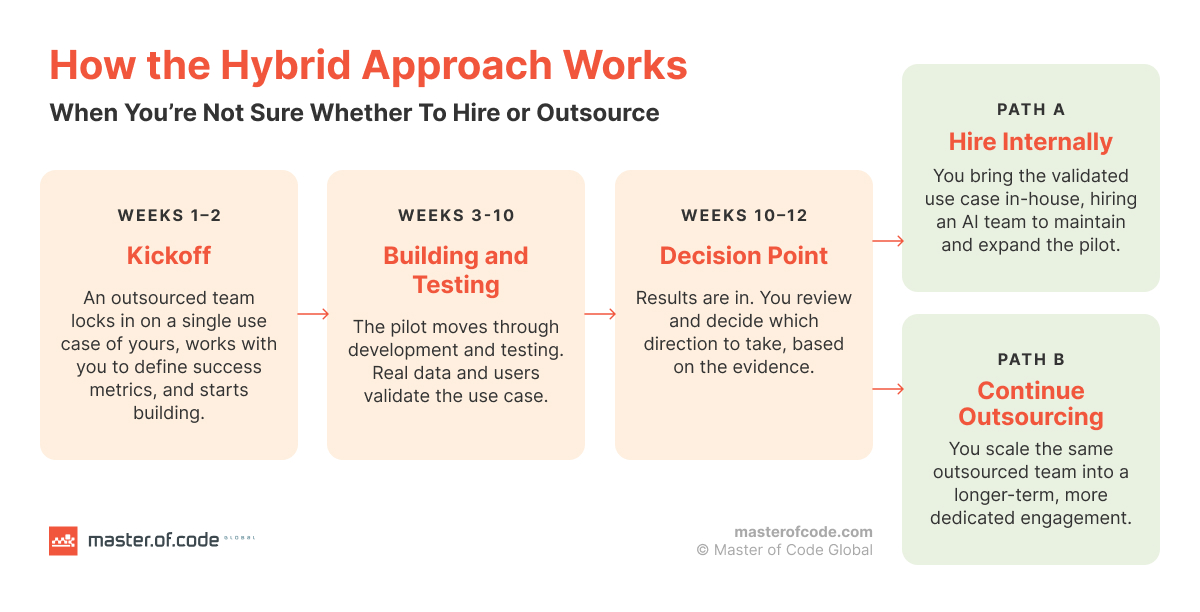
One path begins with an outsourced pilot. The partner validates feasibility, integrates initial data, and measures use. The company then hires internally, continues the partnership, or stops.
Master of Code Global’s AI Pilot is designed around this staged decision. It can establish whether the use case is technically viable, useful to the business, and ready for full implementation before permanent headcount is added.
This model is especially useful for startups. The company can test a proof of concept (PoC) without immediately carrying six senior salaries. If the pilot works, internal hires can take over product ownership while the external team supports architecture, delivery, or specialized work.
A successful transition requires planned knowledge transfer. Documentation, infrastructure access, runbooks, code walkthroughs, decision records, and model evaluation assets should be delivered throughout the engagement, not assembled during the final week.
The strongest hybrid model defines which capabilities stay external, which move inside, and who owns technical decisions.
Risks of Both Approaches
The reasons why AI transformations fail often sit outside the model itself. Neither approach removes risk.
In-House Risks
Slow ramp-up. Recruiting can delay the first release while competitors continue shipping.
Key-person dependency. A small team may rely heavily on one lead or MLOps engineer. Their departure can stall delivery and operations.
Cost of a bad hire. A poor technical decision at the lead level can affect architecture, hiring, and vendor choices for years.
Technology bets that fail. Internal teams can become attached to a model, framework, or platform because they invested time in it. That makes course correction politically and financially harder.
Outsourcing Risks
Knowledge leaves with the contract. Weak documentation creates operational dependence after delivery.
Less day-to-day control. Leadership cannot manage external engineers exactly like employees. Priorities must be translated through agreed processes.
Process misalignment. A technically capable partner may still struggle with the company’s approvals, release standards, or product culture.
Vendor dependency. Proprietary tooling, undocumented architecture, or inaccessible infrastructure can create vendor lock-in.
Controls include transparent repositories, client-owned cloud accounts, measurable acceptance criteria, documented decisions, and a transition plan. Review how to choose an AI development company before signing.
How to Decide — For CEOs and CTOs
For build vs buy AI: how to decide, start with direct questions:
- Is AI central to the product’s competitive moat or a supporting capability?
- Can we fund the team for two years, not only the first release?
- Do we have a technical leader who can evaluate candidates or vendor work?
- What business result must be demonstrated within six months?
- Can our current data support that result?
- How damaging would a three-to-six-month hiring delay be?
- Must external engineers access regulated or highly sensitive information?
- Which assets must remain under our exclusive control?
- Can we operate and improve the system after the initial build?
- What is our exit plan if the first approach does not work?
Compare the return against the total cost of ownership (TCO), including failed recruitment, idle infrastructure, maintenance, management, transition, and delay.
The right model is the one that delivers the required business outcome at an acceptable level of cost and risk. That may be internal hiring, one of the established AI outsourcing companies, or a staged combination.
How to Choose a Vendor to Outsource Your AI Development
Evaluate how the vendor works when requirements are incomplete, and model behavior is uncertain.
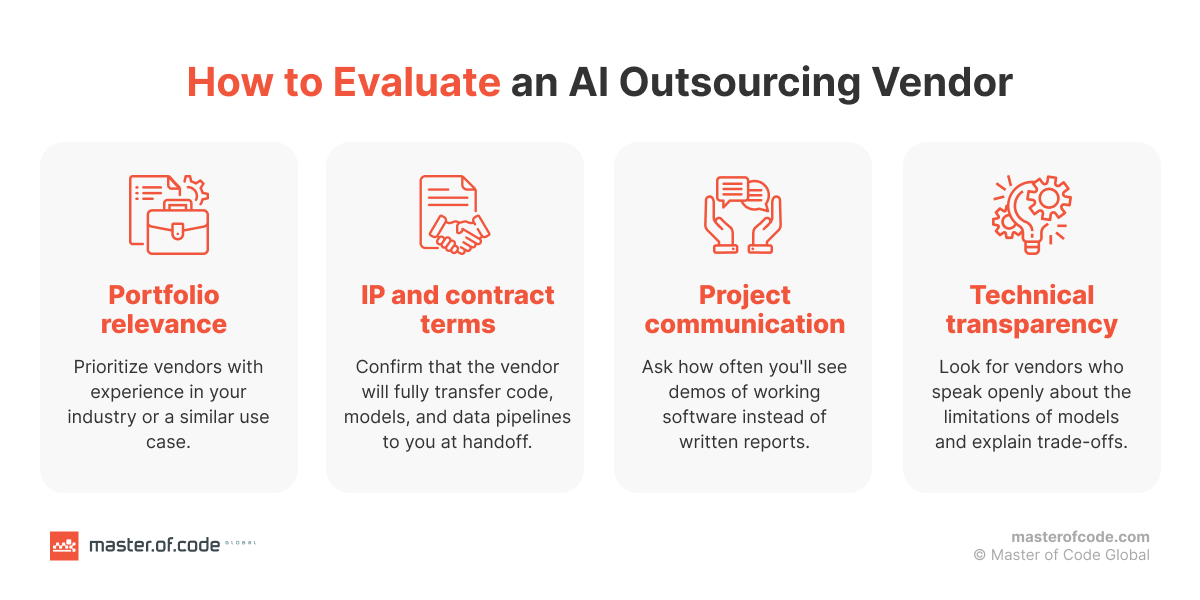
Portfolio relevance. Look for systems with similar data, users, integrations, and risk. Industry logos matter less than evidence that the team solved a comparable delivery problem.
Contract and IP terms. Confirm ownership of custom code, data transformations, prompts, evaluation sets, and documentation. Clarify the status of reusable vendor components.
Technical transparency. The client should have repository access, architecture visibility, cost reporting, and clear model-evaluation criteria. Avoid black-box delivery.
Communication cadence. Require demonstrations, decision logs, risk reporting, and access to technical leads.
Production readiness. Ask about monitoring, security, model changes, fallback behavior, and optimization. A prototype is not an operable product.
Transition plan. Define documentation, training, infrastructure ownership, and support after launch before development begins.
AI consulting can help define the use case before vendor selection. For delivery support, reach out to Master of Code Global with the target outcome, current systems, and constraints.
Stories of Companies That Outsourced AI
Luxury Escapes
Luxury Escapes needed a better channel for personalized travel offers because email and conventional retargeting produced limited engagement. Master of Code Global built a Messenger chatbot that helped users discover deals and supported retargeting campaigns. The assistant delivered a conversion rate three times higher than the website, generated more than $300,000 in its first 90 days, and achieved an 89% reply rate for retargeting messages.
Aveda
Aveda wanted to increase awareness and bookings for complimentary in-store services. The outsourced team created a conversational booking experience that replaced a multi-field process with guided scheduling. The system generated 6,918 bookings, achieved a 33% conversion rate across an 11-step flow, and increased total bookings by 87% after launch.
BloomsyBox
BloomsyBox wanted a differentiated Mother’s Day campaign that combined engagement with personalized gift messages. Master of Code Global and Infobip developed a generative AI experience with a quiz and custom greeting-card generation. Sixty percent of engaged users completed the quiz, 38% used generative AI for a personalized card, and 78% of winners claimed their prize.
B2B Lending Company
A North American lending company initially requested an AI-readiness assessment. The work exposed fragmented marketing, CRM, and lending data, so the engagement expanded into an integrated analytics platform with an agentic AI assistant. Within six months, the company recorded a 35% increase in marketing ROI, reduced acquisition cost by 22%, and freed more than 15 hours of manual reporting work each week.
FAQs
What Costs More: An In-House AI Team or Outsourcing?
A permanent U.S. team usually has the higher fixed commitment. A lean six-person model can exceed $1 million before infrastructure and recruitment. Outsourcing can cost less for a defined project, but a long-running senior team remains substantial. The relevant AI development cost is the full lifecycle cost of the business result.
Which Approach Has More Risk?
In-house risk centers on hiring, retention, architecture, and payroll. Outsourcing risk centers on contracts, dependency, communication, and retained knowledge.
Is It Either In-House or Outsourced?
No. Companies may validate externally, then hire internal owners, or keep a small internal product group while a partner supplies capacity.
How Do You Build an In-House AI Team?
Start with a technical lead. Add AI/ML engineering, data science, and MLOps around the first use case. Define ownership, metrics, production requirements, and governance before scaling.
How Do You Choose an AI Outsourcing Vendor?
Prioritize relevant evidence, clear contracts, transparent engineering, production operations, and a transition plan. The vendor should explain limitations, not only demonstrate outputs.
Conclusion
The in-house AI team vs outsourcing decision should match the company’s current stage, budget, and risk tolerance. It is not a permanent identity.
Internal teams make sense when AI is the product, sensitive data requires close control, or proprietary capability must compound inside the company. Outsourcing makes sense when the company needs speed, scarce skills, or a controlled way to test value before adding fixed headcount.
A staged approach can also change over time. Start externally, build evidence, and bring ownership inside. Or retain a core internal group while a partner supplies specialized delivery capacity and scalability.
The final comparison is not vendor fees versus salaries. It is expected business value versus the full cost, delay, and risk of reaching it. To explore an outsourced route, contact Master of Code Global to discuss the use case and implementation path.
Discover how Master of Code Global can help enhance your customer’s experience and boost sales growth.