



Most finance teams that automate invoice processing do it to cut costs and reduce manual work. Those are valid goals, and GenAI delivers on both. But organizations that stop there are leaving the more significant value on the table.
When data moves accurately and in real time, it stops being an administrative output and becomes financial intelligence. The same AI layer that extracts invoice fields and routes approvals can tell treasury which payment obligations are due in the next 10 days, which early payment discounts are worth capturing given current liquidity, and where in the AP cycle cash is being held up unnecessarily. That is a different category of value than faster processing, and it is what separates organizations using artificial intelligence to maintain the status quo from those using it to actively manage working capital.
This article covers how Generative AI for invoice processing functions at a technical level, what it makes possible operationally, and how the cash flow outcomes that most AP automation discussions overlook are actually the most compelling reason to invest. It also addresses what integration realistically involves, because the gap between a working implementation and a stalled one almost always comes down to decisions made before a single invoice is processed.
If you are evaluating whether Generative AI is the right fit for your AP workflow, this is a practical starting point.
Table of Contents
Key Takeaways
- Generative AI for invoice processing isn’t just about automation. Unlike OCR or rules-based tools, LLM-powered systems reason through exceptions, handle variable formats, and improve without requiring constant manual intervention.
- The operational gains are measurable, but not the end goal. Faster cycle times and lower processing costs create the conditions for something more valuable: real-time visibility into cash obligations and the ability to act on it.
- AP automation becomes a cash flow strategy when the data is reliable. Dynamic discounting, predictive payment scheduling, and working capital optimization all depend on data that moves fast enough and accurately enough to inform financial decisions.
- Integration determines whether the AI holds up in production. The quality of ERP connectivity, vendor master data, and system architecture at the design stage directly affects whether the implementation delivers at scale or requires significant rework.
- Scope drives results. GenAI implementations that target specific, well-understood failure points in the AP workflow consistently outperform broad automation deployments that lack a defined problem to solve.
__________________
- AP – Accounts Payable
- ERP – Enterprise Resource Planning
- OCR – Optical Character Recognition
- NLP – Natural Language Processing
- LLM – Large Language Model
- PO – Purchase Order
- VAT – Value Added Tax
- EDI – Electronic Data Interchange
- CFO – Chief Financial Officer
- P2P – Procure to Pay
Why Invoice Processing Is Still Broken
Accounts payable teams process thousands of invoices every month. In most organizations, the workflow still depends on people opening emails, keying data into ERP fields, and chasing approvals manually. The problem is not a lack of effort. It is that the process was designed for a paper-based world and has never been fundamentally rebuilt.

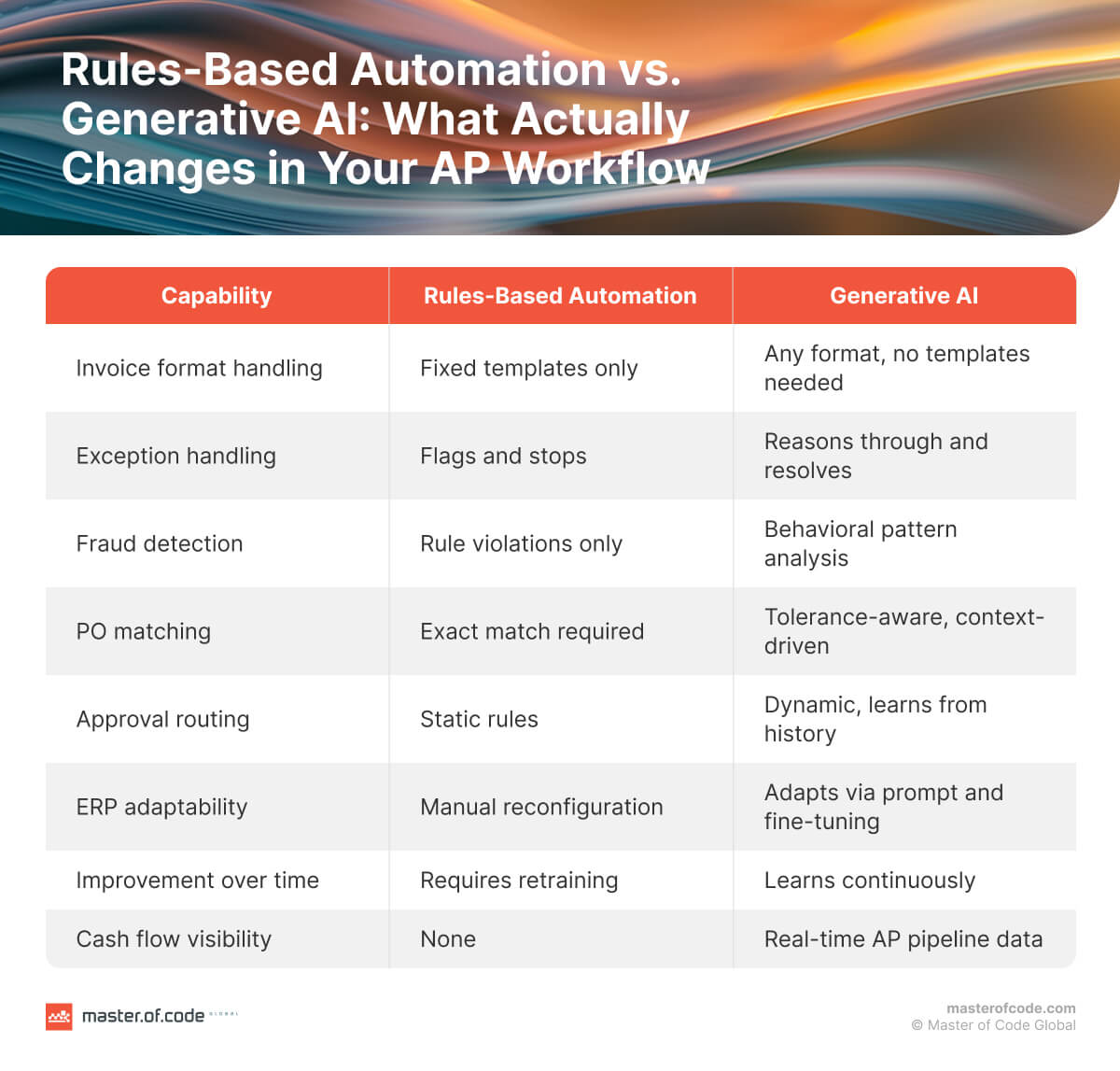
The numbers reflect this directly. According to Ardent Partners’ AP Metrics That Matter 2025 report, the average cost to process a single invoice is $9.40. The best-in-class teams that have embraced automation have brought that figure down to $2.78. On cycle time, the same report puts the average at 9.2 days. That gap between where most teams operate and where the best performers sit translates directly into supplier friction, missed early payment discounts, and forecasting gaps that compound across the quarter.
Traditional automation tools helped at the margins. Template-based OCR could scan a known layout. Rules engines could flag obvious duplicates. But both approaches break the moment something changes: a new vendor format, an invoice with missing fields, a line item described differently than expected. Every exception lands back with a human. Ardent Partners found that 53% of AP professionals cite invoice exceptions as their single biggest operational challenge, and exception rates across average teams still run at 14%.
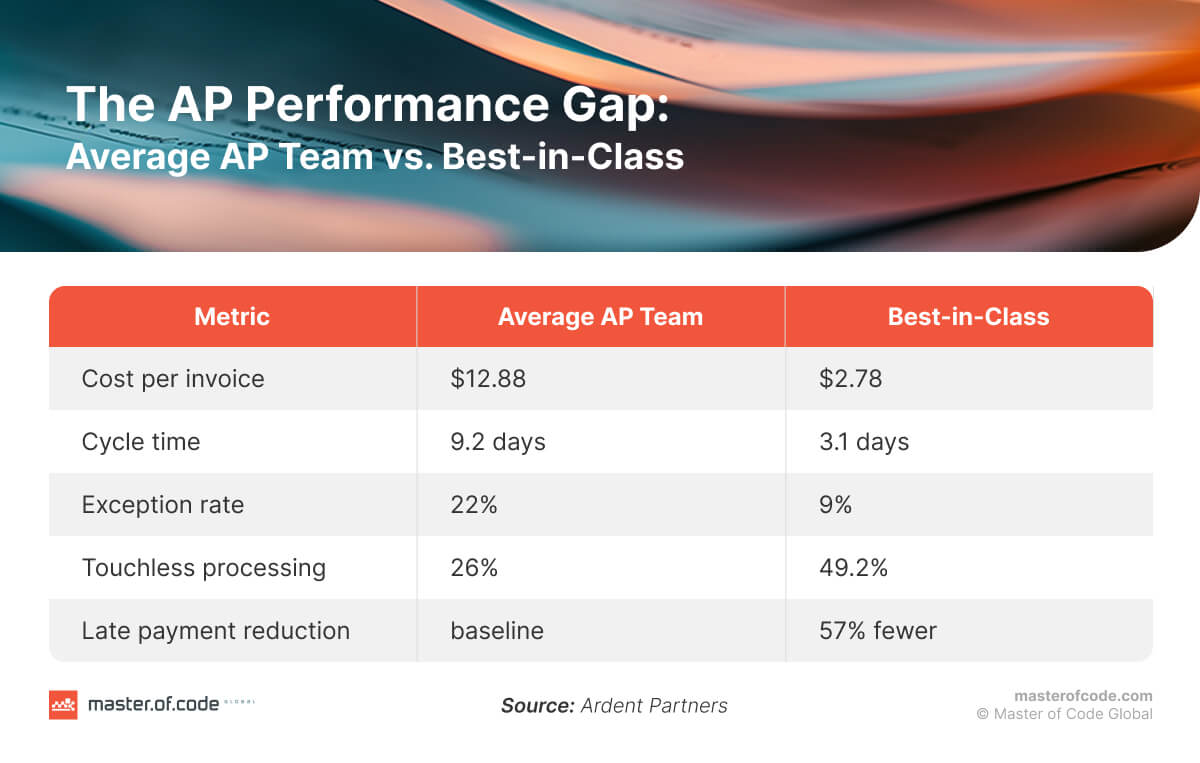
AI invoice processing changes the baseline. Rather than matching statements to fixed templates, such systems learn from large volumes of data and handle variability without manual intervention. The shift from rule-based to AI-driven AP is not incremental. For finance teams exploring Generative AI in accounts payable, it is the difference between managing exceptions constantly and only seeing the ones that genuinely need judgment.
What Generative AI Actually Does in Invoice Automation
Most tools marketed as AI invoice processing are, in practice, a combination of OCR and rules-based validation with a modern interface layered on top. They can read a PDF, pull structured fields, and check totals. What they cannot do is reason. It’s a gap that sits at the center of most AI use cases in financial services, where data volume is high, and exception handling is costly.
When an invoice arrives with an unusual line item description, a partial PO reference, or a vendor name that does not exactly match the approved supplier list, a rules-based system flags it as an exception and stops. A human then resolves it manually.
Generative AI introduces a different capability: contextual understanding. An LLM-powered system does not just pattern-match against known fields. It interprets meaning, infers relationships between data points, and makes decisions the way a trained AP analyst would. That distinction matters enormously at scale.
OCR and NLP as the Foundation
OCR invoice processing remains the entry point for any automated AP workflow. It converts scanned documents, PDFs, and image files into machine-readable text, making the data available for downstream processing. Modern OCR handles varied fonts, layouts, and mixed formats with reasonable accuracy.
NLP invoice extraction builds on that foundation by interpreting what the extracted text actually means. Where OCR reads the words, NLP understands them. It recognizes that “Amount Due,” “Total Payable,” and “Balance Owing” all refer to the same field. It can parse payment terms written in plain language, extract line item context from unstructured descriptions, and process invoices across multiple languages without requiring separate templates for each. Together, OCR and NLP handle the ingestion and interpretation layer that every downstream AI capability depends on.
Where LLMs Change the Game
LLM invoice automation operates at a level above extraction. Large language models bring reasoning capability that neither OCR nor traditional NLP provides.
Consider a few scenarios that break conventional tools but are handled naturally by an LLM-powered system.
- An invoice references a purchase order by an internal project code rather than a PO number.
- A vendor submits a consolidated invoice covering multiple delivery receipts across different cost centers.
- A line item description is written in shorthand that only makes sense in the context of a supplier relationship.
In each case, a rules engine raises an exception. An LLM reasons through the available context, matches the intent to the corresponding records, and routes the request correctly without human intervention.
LLMs also improve without retraining on fixed datasets. They adapt to new formats, new vendors, and changing business rules through prompt configuration and fine-tuning rather than requiring a complete model rebuild every time something changes in the AP environment. For organizations that manage hundreds of suppliers across multiple regions, that adaptability is the difference between a system that works at implementation and one that continues working six months later.

Core Use Cases: From Capture to Cash Flow
Generative AI does not replace the accounts payable workflow. It operates across each stage of it, handling the work that previously required human judgment at every handoff point. The result is a process where people intervene by exception rather than by default.
Intelligent Data Capture
The first point of failure in most AP workflows is ingestion. Invoices arrive as scanned PDFs, email attachments, EDI files, and increasingly as images from mobile submissions. Each format requires different handling, and any format that the system does not recognize becomes a manual task.
Invoice data capture AI eliminates the format dependency. Rather than relying on preconfigured templates that break when a vendor changes their layout, AI-powered capture learns field locations and data relationships across formats. It extracts vendor details, line items, tax codes, currency, payment terms, and PO references from documents it has never seen before, with accuracy that improves over time. For organizations receiving invoices from hundreds of suppliers, this removes the single largest source of manual touchpoints before processing has even begun.
3-Way PO Matching at Scale
Three-way matching, which reconciles an invoice against its corresponding purchase order and goods receipt, is where a large share of AP exceptions originates. Discrepancies in quantity, unit price, or delivery terms trigger holds that can take days to resolve and directly delay payment.
AI invoice matching handles the straightforward matches automatically and, more importantly, reasons through the ones that would otherwise require human review. 3-way PO matching AI can identify that a quantity discrepancy is within an approved tolerance, that a price difference reflects a contracted discount tier, or that a partial delivery receipt explains an invoice that does not match the original PO in full. These are judgment calls that rule engines cannot make. The practical effect is a significant reduction in the exception queue without reducing the accuracy of the matching process.
Automated Approval Workflows
Once an invoice is validated and matched, it needs to reach the right approver. In most organizations, approval routing is where cycle time is lost. Invoices sit in inboxes, get forwarded incorrectly, or wait on approvers who are out of office, with no intelligent handling of any of those scenarios.
Automated invoice approval workflow powered by GenAI goes beyond static routing rules. It learns approval patterns from historical data, predicts the correct approver based on the type, cost center, and spend category, and escalates automatically when an approval is overdue. It can also flag statements that fall outside normal parameters for a given vendor or cost center before they reach the approver, giving decision-makers better information rather than just faster routing.
Fraud Detection That Reasons, Not Just Flags
Invoice fraud, including duplicate submissions, vendor impersonation, and inflated billing, costs organizations significantly. Plus, it’s difficult to catch with rule-based systems because sophisticated fraud is designed specifically to pass standard checks.
AI-powered fraud detection for invoices works differently. Rather than checking requests against a fixed list of rules, it builds a behavioral model of each vendor relationship: typical amounts, billing frequency, line item patterns, and payment timing. When an invoice deviates from that established pattern, the system flags it with context, not just an alert.
A duplicate submitted under a slightly different vendor name, a billing amount that has increased incrementally across several cycles, or a new bank account on a long-standing vendor record are all signals that a reasoning-capable system can surface and prioritize for review. That’s a capability that extends across the broader domain of Generative AI in accounting.
The Cash Flow Payoff Beyond Faster Approvals
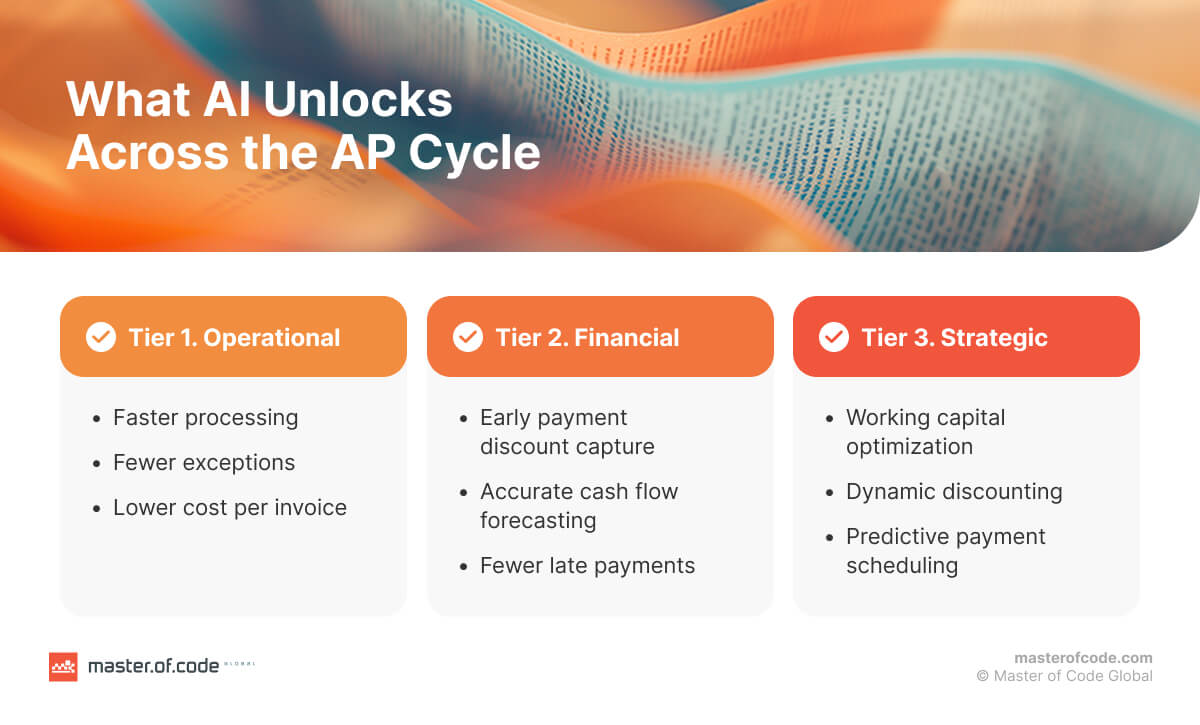
Most organizations measure the success of AI invoice automation by efficiency metrics: processing cost, cycle time, exception rate. Those are valid starting points, but they capture only the operational layer of what GenAI makes possible. The deeper value is financial.
When invoices move faster, and AP data becomes reliable in real time, the finance function gains something it rarely has: accurate, timely visibility into cash obligations. That visibility is the foundation for active cash flow management, not just faster approvals.
Dynamic Discounting and Early Payment Capture
Suppliers routinely offer early payment discounts. For large organizations processing significant invoice volumes, those discounts represent material savings. The problem is that most AP teams cannot consistently meet early payment windows because their approval cycles are too slow. Furthermore, their cash position visibility is too limited to make confident early payment decisions.
Dynamic discounting AI solves both sides of that equation. Invoice processing automation and faster approvals create the operational speed needed to act within discount windows. At the same time, AI-driven cash flow visibility allows treasury and AP teams to evaluate each early payment opportunity against current liquidity. This way, they identify which discounts are worth capturing and which should be passed in favor of preserving working capital.
The decision moves from a manual, case-by-case judgment to a data-driven process that runs continuously across the full portfolio. It’s part of a broader shift in how Generative AI for payments is reshaping working capital management.
Predictive Payment Scheduling
This one uses the data generated across the AP workflow to forecast cash outflows with significantly more accuracy than traditional methods. Rather than relying on static payment terms and historical averages, AI models factor in arrival patterns, approval cycle times, vendor payment preferences, and contractual due dates to produce a rolling forecast of payment obligations.
For CFOs and treasury teams, this means cash flow projections that reflect actual AP pipeline data rather than approximations. It reduces the frequency of surprise payment clusters at month end, improves coordination between AP and treasury on funding decisions, and creates a more stable foundation for short-term borrowing and investment decisions. The invoice, which was previously just a cost to be processed, becomes a data point in a live financial model.
Cash Flow Optimization Across the AP Cycle
Taken together, the capabilities above enable something that goes beyond process improvement. Cash flow optimization AI gives finance teams the ability to treat accounts payable as a strategic lever rather than an administrative function.
Organizations can use AP data to time payments in ways that support working capital targets, negotiate better terms with suppliers based on demonstrated payment performance, and identify patterns in spend that would otherwise only be visible in quarterly reporting. A finance team with real-time AP intelligence can make decisions about payment timing, supplier financing programs, and cash deployment that were previously only available to organizations with dedicated treasury operations. For mid-market companies in particular, this closes a capability gap that has historically been reserved for enterprises with large finance teams.

Integrating GenAI Into Your AP Stack
Deploying Generative AI for invoice processing is not a standalone implementation. It connects to systems that already exist, including ERP platforms, procurement tools, vendor master data, and approval workflows. How well the AI performs in production depends heavily on how cleanly it integrates with those systems. Understanding what that integration work actually involves is what separates a successful rollout from a project that works in a demo and stalls in reality.
ERP and Accounts Payable Software Connectivity
ERP invoice integration is the most critical connection point. The AI layer needs to read from and write to the ERP in real time: pulling vendor master data and PO records to validate invoices, and posting approved ones back to the correct ledger accounts without manual re-entry. For organizations running SAP, Oracle, or Microsoft Dynamics, this integration is well-documented and achievable. Still, it requires:
- careful mapping of data fields,
- handling of edge cases in the vendor master, and
- alignment on how exceptions are surfaced and resolved within the existing ERP workflow.
Accounts payable AI software that sits outside the ERP as a processing layer rather than a native module introduces an additional consideration: data latency. If the AI system and the ERP are not exchanging data in real time, the matching and approval logic operates on information that may already be out of date. This is a solvable problem, but it needs to be scoped explicitly at the integration design stage rather than treated as a default. It is where structured Generative AI integration services make the difference between a clean deployment and one that requires significant rework.
Beyond the ERP, AI invoice automation connects to document management systems for archiving, banking platforms for payment execution, and in many cases tax compliance tools for VAT and withholding validation. AI accounts payable implementations that account for these touchpoints from the start avoid the rework that comes from discovering downstream dependencies mid-deployment.
Procure-to-Pay as the Bigger Picture
Processing does not happen in isolation. It is the downstream end of a procurement cycle that begins with a purchase requisition, moves through PO creation and supplier fulfillment, and concludes with payment. Procure to pay automation works best when the AI layer has visibility into the full cycle rather than just the invoice itself.
When the system can see the original purchase requisition, matching becomes more accurate and exceptions become easier to resolve. Approval routing can be informed by the original requester, the budget owner, and the contract terms rather than just the amount. Spend analysis becomes more meaningful because the data connects purchasing intent to actual payment.
For organizations evaluating invoice processing automation scope, the question worth asking early is “where in the procurement cycle does our data quality break down, and how far upstream does the AI need visibility to fix it?” The answer to that question determines whether the implementation delivers incremental efficiency or a genuine transformation of the AP function.
How Master of Code Global Approaches AI Invoice Automation
Most organizations dealing with an invoice automation challenge are not starting from zero. They have an ERP, some existing AP tooling, and a backlog of exceptions that their current setup cannot resolve without human intervention. The question is rarely whether to automate. It is where the current process breaks down and what kind of AI layer will actually hold up in production.
Before any model is selected or integrated, our Generative AI consulting services begin with mapping the workflow as it actually runs:
- where data quality degrades, where approval cycles stall,
- where the ERP integration creates gaps rather than closing them.
That mapping determines the architecture, not the other way around.
For finance teams at an earlier stage of evaluation, including those assessing readiness across their broader finance function, our work covers the full scope of Generative AI for invoice processing: from initial diagnostics through to production deployment.
The implementation scope typically spans three layers.
- The first is data readiness: ensuring that vendor master data, PO records, and historical invoice data are clean enough for a system to reason against.
- The second is the AI layer itself, which works best when scoped to specific failure points in the existing workflow rather than deployed as a broad replacement.
- The third is integration, connecting the AI layer to the ERP and downstream systems in a way that holds up under real transaction volumes, not just in controlled testing.
Teams ready to move from assessment to build can explore our Generative AI development services. The implementations that deliver lasting results share one characteristic: the AI is scoped to solve a specific, well-understood problem in the AP workflow, not deployed as a general-purpose automation layer and left to prove its value later.
If you are evaluating where GenAI fits in your AP workflow, we are happy to start with a focused conversation about your current process. Contact us to set up a consultation.