



A single piping project can eat 40–60 hours of engineering time before a PE stamps anything. Two specialist roles, sequential handoffs, iterative markups, and a stack of PDF inputs – that’s the standard workflow across most EPC firms and process plants today. It works. It’s just slow and expensive.
AI in mechanical piping design is changing that. Not by removing engineers from the process, but by eliminating the manual steps that consume most of their time.
The pressure to move faster is real. Engineering firms deal with unfilled roles, tighter margins, and clients who expect faster delivery without compromising code compliance or safety. AI in piping engineering addresses those pressures at the workflow level, where the hours actually go.
This article walks through where AI in piping design delivers measurable results today: from pipe stress analysis and automated pipe routing to P&ID digitization and predictive maintenance, and what it actually takes to build systems that work in production. Before diving into the technology, though, it’s worth starting with a few real examples. Not the polished kind with round numbers, but the kind we’ve actually built.
Table of Contents
Key Takeaways
- AI automates the most time-consuming steps in piping workflows: routing, stress analysis, support selection, material specification, and drawing generation, cutting project hours significantly without removing PE oversight.
- Predictive maintenance and pipe integrity assessment use machine learning to catch degradation before it becomes a failure, reducing unplanned downtime in chemical and petrochemical plants.
- P&ID digitization unlocks decades of locked-up engineering data, enabling hazard identification, digital twin development, and AI-powered plant search.
- AI in piping engineering works best when it integrates into existing toolchains rather than asking teams to migrate to new platforms.
- Custom AI built on domain-specific data consistently outperforms general-purpose tools for compliance-sensitive outputs under ASME B31.1/B31.3 and related standards.
Real Examples Before the Theory
Most articles on AI in engineering skip straight to the capabilities list. We’re going the other way, starting with three projects that our partners and we built, because the specifics are more useful than the abstractions.
Building a Pipe Stress Design AI
We are currently working with a licensed PE firm operating in oil and gas, chemical processing, and industrial manufacturing. Their core problem was simple: the pipe stress design workflow was too labor-intensive to scale.
Their current workflow runs through three sequential stages: a pipe designer routes piping in 3d design software and exports geometry, a pipe stress engineer manually inputs parameters from PDFs and spreadsheets, runs iterative stress analyses, and marks up routing changes, then the designer reworks the model based on those redlines.
The system we’re building automates the loop. It ingests piping geometry from files and drawings, takes in engineering parameters, runs iterative stress analysis for ASME B31.1/B31.3 compliance, optimizes pipe routing, and outputs a 2D drawing package ready for PE review, plus a 3D model.
One of the harder technical problems here is multi-modal input. Many client projects arrive as PDF-only drawings, no CAD files. Vendor support catalogues are the same. The AI has to reconstruct piping geometry from flat PDFs using document intelligence and image understanding, and do it with engineering-grade accuracy.
This is just the starting point, as it has the clearest ROI and feeds everything downstream.

A CAD-Integrated Generative Design Engine
The client needed to modernize metal part design by adding a generative design tool to standard CAD workflows. It should handle manufacturing constraints and help engineers actually adopt metal 3D printing in practice.
We extended Live Parts technology directly into CAD. The system uses morphogenetic simulation to automatically generate lightweight, high-strength geometries from user-defined constraints.
The result is an industry-leading simulation extension now used in manufacturing, automotive, oil and gas, consumer electronics, and medical. What it illustrates for AI in piping design is a key principle: AI that extends the engineer’s existing environment gets adopted. AI that asks them to migrate to something new usually doesn’t.
A Smart AutoCAD Toolkit for Precision Fabrication
A client needed to expand AutoCAD into a specialized design environment for tent and awning structures, eliminating manual calculations, managing seal allowances accurately, and improving material efficiency across standard and custom designs.
We built it as a seamless AutoCAD plugin. It combines predefined shapes with custom geometry tools, automatically generates segmented cutting patterns with correct allowances, and optimizes material layout to reduce waste. The output goes straight to fabrication.
The piping parallel is direct. Geometry interpretation, constraint-based optimization, code-compliant output, CAD-native integration – those are the same building blocks. The engineering domain is different; the architecture is the same.

Where AI in Mechanical Piping Design Is Applied
Automated Pipe Routing and Clash Detection
Finding a valid pipe route through a dense industrial plant means satisfying a lot of constraints at once:
- Minimum bends and total pipe length;
- No interference with structural elements or other disciplines;
- Thermal expansion clearances;
- Maintenance access requirements;
- Cost-efficient support placement.
Manual routing means an experienced designer working through those constraints over days. AI treats it as a search problem. Given a plant model, from a 3D modelling environment like SP3D or Plant3D, or reconstructed from point cloud data via laser scanning, the system generates routing candidates, scores them, and returns options ranked for engineer review.
Clash detection runs in parallel. Interference between piping systems, structural steel, and equipment gets flagged before fabrication, not during construction, where fixing it costs orders of magnitude more.
Pipe Stress Analysis
This is where AI in mechanical piping design saves the most time per project. The manual workflow has a Pipe Stress Engineer translating geometry and parameters from multiple PDFs and spreadsheets into AutoPIPE or Caesar II, running iterations to find a compliant configuration, and generating results for PE review. That cycle is the biggest time sink in most projects.
AI replaces the preparation and iteration. The system ingests geometry and parameters, checks compliance against the applicable ASME B31.1 or B31.3 code edition, evaluates support types and locations, and returns a configuration that meets code while minimizing material cost. Outputs include the support load table, routing recommendations, and a 2D drawing package.
Predictive Maintenance and Pipe Integrity Assessment
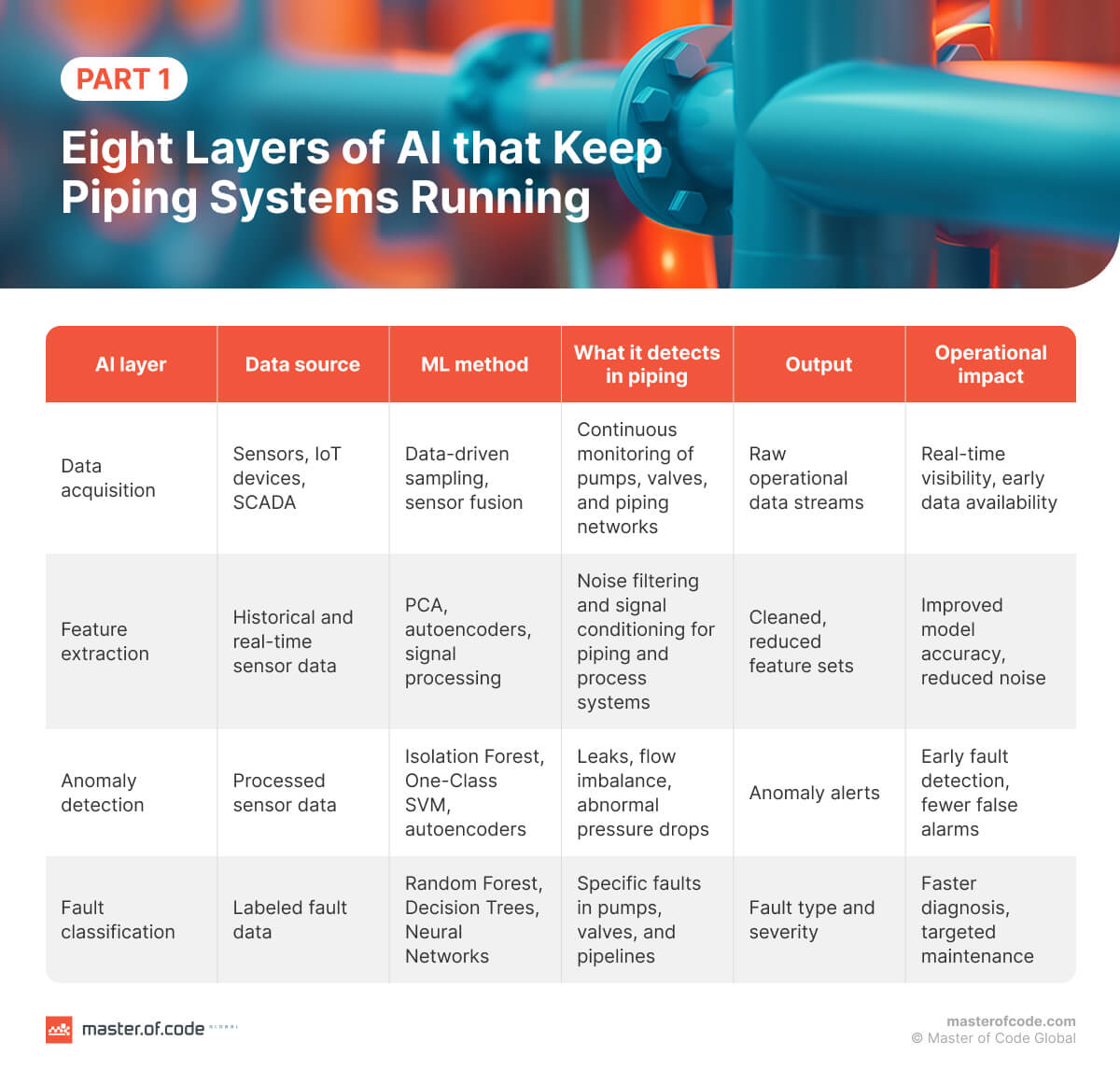
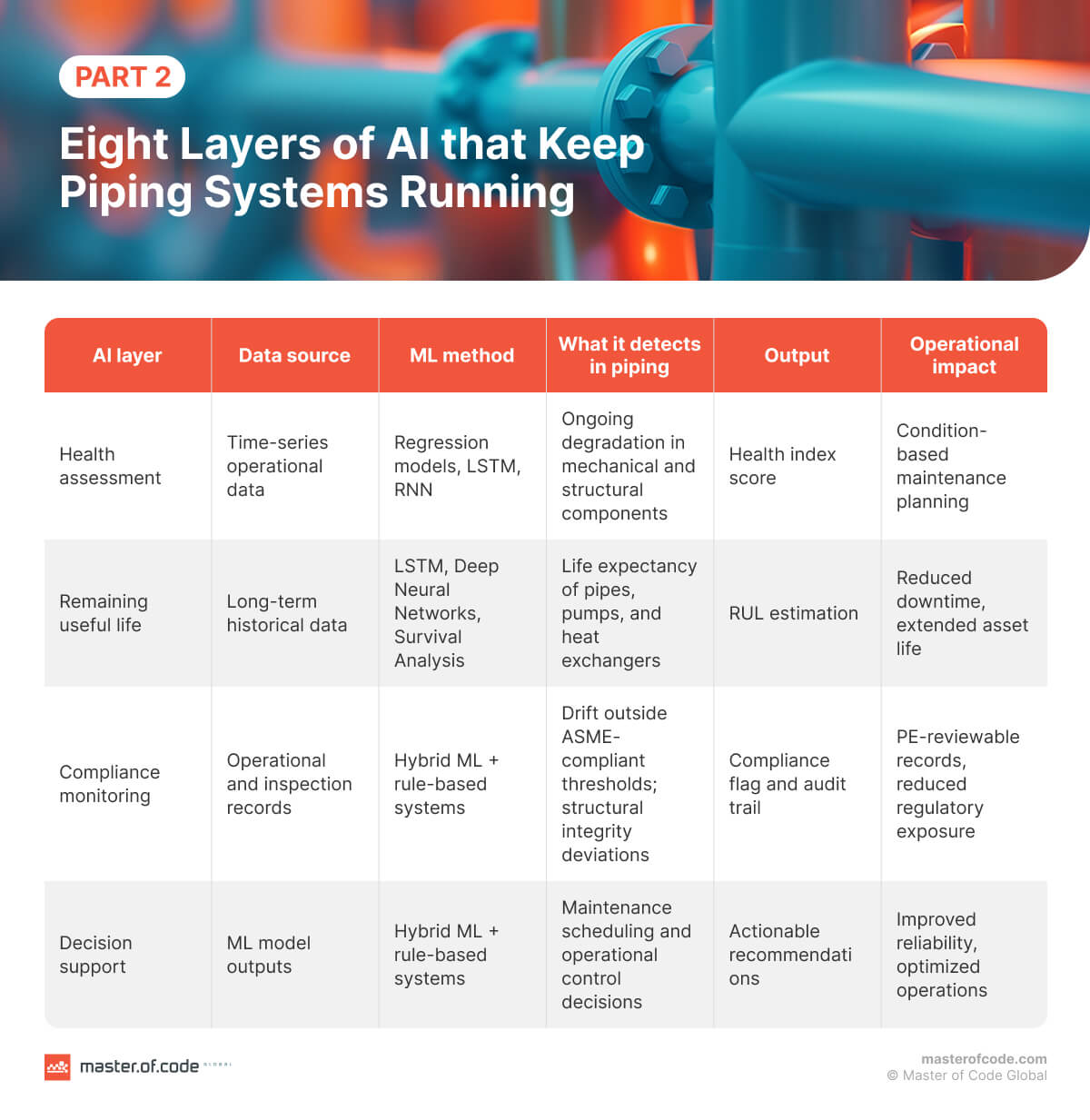
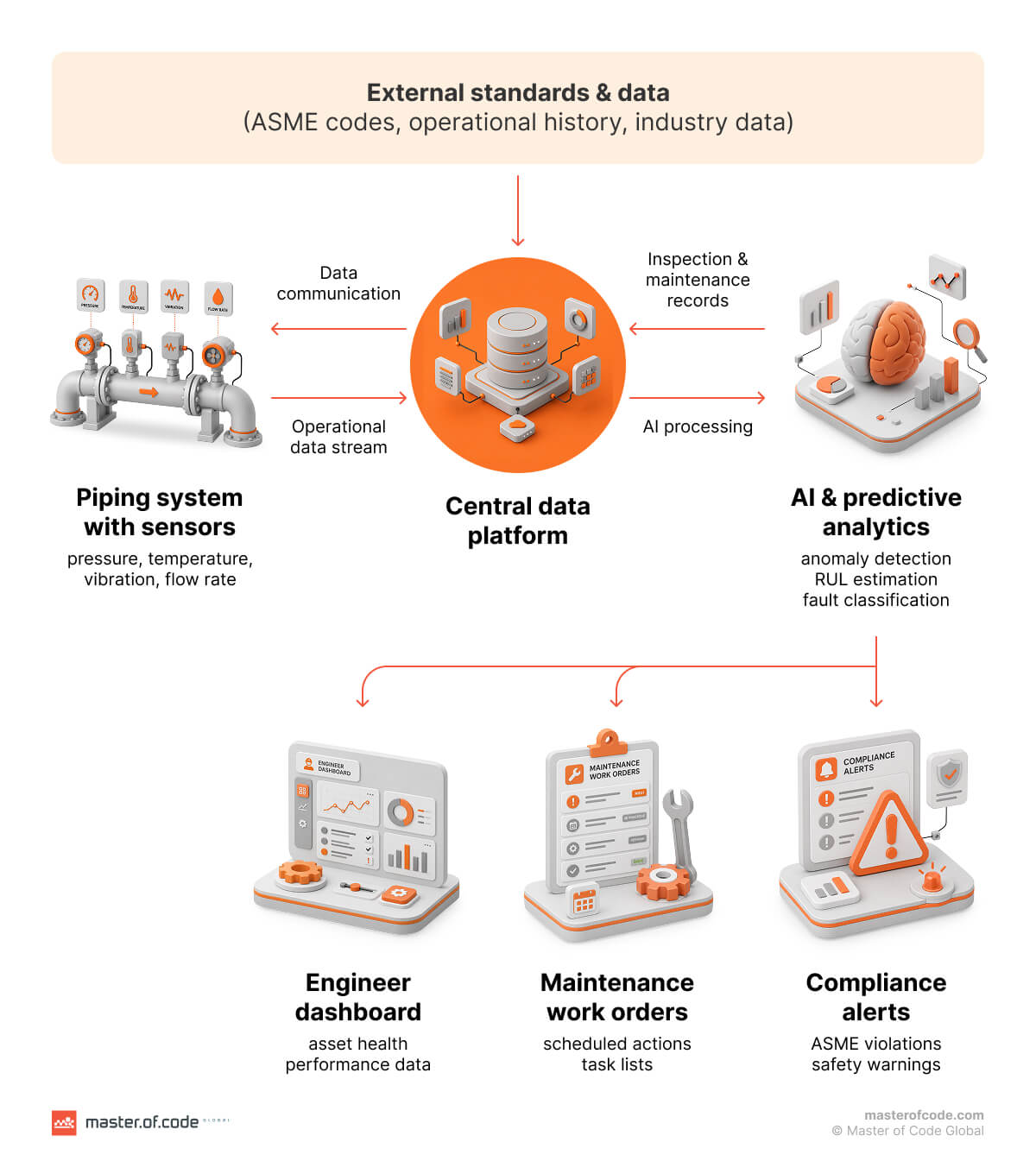
In operating plants, AI shifts from design-time optimization to operational risk management. Predictive maintenance solutions powered by machine learning analyze sensor data against historical failure patterns to forecast degradation before it becomes a failure.
For piping systems specifically, this means corrosion monitoring, wall thickness reduction tracking, and fatigue accumulation in high-cycle lines. These are the mechanisms behind most unplanned shutdowns in chemical and petrochemical plants. A pipeline integrity assessment model can flag problem sections before they hit the scheduled inspection cycle, cutting emergency repair costs and unplanned downtime.

Material Selection and Automated Pipe Sizing
In large petrochemical plants with hundreds of process lines, material selection is a volume problem. Mapping pressure, temperature, fluid chemistry, and corrosion conditions to appropriate pipe materials for every line is time-consuming when done manually.
AI trained on business-specific databases recommends pipe materials and grades for given conditions. It can also flag high-risk combinations, like hydrogen service lines where embrittlement requirements apply, that a generalist might not catch.
Machine learning consulting for material selection works best when the training data covers the full range of plant operating conditions the system will encounter in production.
Automated pipe sizing follows the same logic. Given flow requirements, pressure drop limits, and available pipe schedules, the system returns a sizing recommendation without the engineer manually running hydraulic calculations for each line.
P&ID Digitization
In most facilities, those documents exist as PDFs or paper drawings. P&ID digitization converts them into structured data: equipment items, instruments, lines, valves, and connections, all tagged and linked.
Once digitized, that data becomes usable in ways a flat PDF never was:
- Hazard identification and HAZOP studies can reference accurate, searchable plant topology instead of having engineers trace connections through scanned drawings.
- Digital twin development gets a data foundation that mirrors the actual plant configuration.
- AI-powered plant search can answer questions like “find all pressure relief devices in this process unit” or “list every line carrying hydrogen” in seconds.
The accuracy challenge is real: P&IDs contain hundreds of symbols, including non-standard ones that vary by engineering firm. Document intelligence systems trained on domain-specific datasets get there, but the system needs to flag low-confidence extractions for human review.
Isometric Drawing Automation and 3D Modelling
Isometric drawing automation generates fabrication-ready pipe isometrics directly from 3D models. When the model is kept accurate, this step drops from days of manual drafting to hours, and the output goes straight to the shop.
3D modelling itself benefits from AI at several stages: geometry reconstruction from point cloud data captured by laser scanning, interference checking during active design, and automated takeoff and material list generation from the finished model. For brownfield expansions and retrofits, point cloud data is what replaces the manual as-built survey, making those projects significantly faster and cheaper to start.
Hazard Identification and Structural Integrity
AI in piping engineering can support hazard identification by analyzing process conditions, plant topology, and historical incident data to surface risk scenarios that structured HAZOP reviews might deprioritize. This matters most in petrochemical environments where consequence scenarios are complex, and the cost of a missed hazard is high.
Structural integrity assessment uses machine learning to evaluate fatigue accumulation and remaining useful life in pressure-bearing components. Combined with live sensor data from predictive maintenance systems, this produces a continuously updated structural integrity picture.
How AI in Mechanical Piping Design Reduces Cost and Risk
The cost case works at three levels:
- Labor efficiency. Automating pipe routing, pipe stress analysis, automated pipe sizing, and isometric drawing automation cuts engineering hours per project directly. The PE review remains, but the work presented for review is faster to produce and has fewer defects.
- Iteration cost. Each back-and-forth cycle between routing and stress analysis consumes hours and creates version control problems. AI systems that run compliance checks against routing candidates in a single pass reduce iterations before the PE sees anything.
- Downstream risk. A clash caught in 3D modelling costs a comment in a review. The same clash found during construction costs a shutdown, a rework crew, and a delay. A corrosion failure in a live plant carries production loss, regulatory exposure, and safety consequences. AI for predictive maintenance treats downstream risk as something to manage systematically.
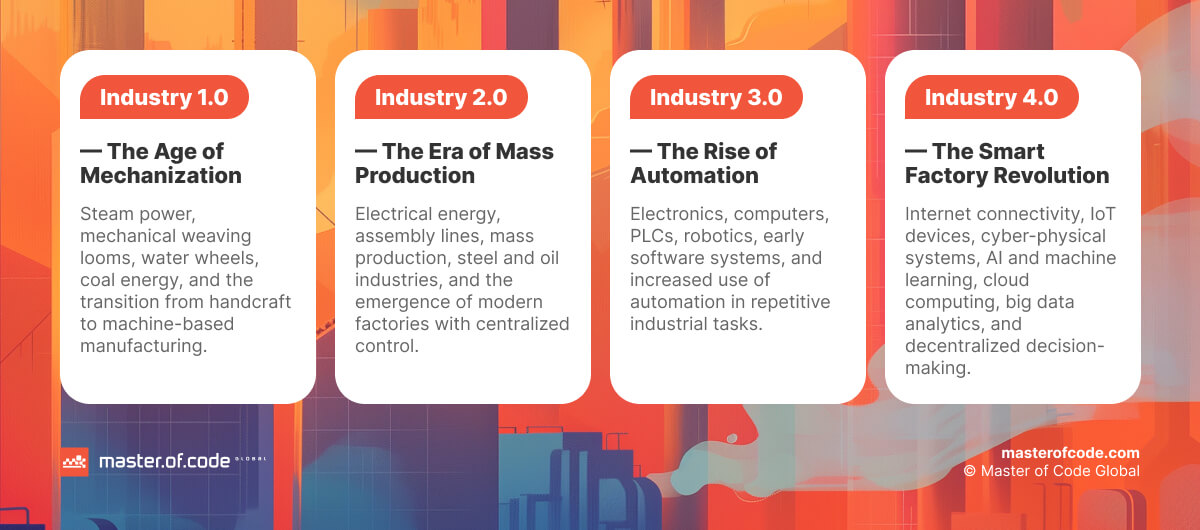
Industry 4.0 positions AI in piping design within a broader operational intelligence architecture where piping systems are monitored in real time, maintained proactively, and optimized based on live operational efficiency data.
Measuring AI ROI across all three levels is what makes the business case credible to finance teams and plant managers, not just engineering leads.

What It Actually Takes to Implement
Data Quality Comes First
Intelligent systems for piping engineering are only as good as the data behind them. For custom builds, AI data preparation is the foundational investment: cleaning historical project data, standardizing input formats, and building the validated ground truth that the model will be checked against.
The multi-modal input challenge is especially relevant here. P&ID digitization and PDF-based geometry reconstruction require document intelligence that can handle non-standard symbols, inconsistent drawing conventions, and degraded scan quality.
PE Liability Doesn’t Change
AI in piping design doesn’t change who owns the design. A licensed PE seals it. The AI produces a reviewable output; the PE validates it. That boundary shapes how these systems need to be scoped and how outputs need to be structured.
In practice, this means auditability is non-negotiable. The system has to show its work: which loads were applied, which code edition was used, which support types were evaluated, and why the selected configuration is compliant. That reasoning chain is what makes the output professionally usable, and what gives the PE confidence to stake their license on it.
Integrate Into What Engineers Already Use
Piping engineering firms run on established tool stacks: AutoPIPE, Caesar II, AutoCAD, SP3D, Plant3D, and Navisworks. Thankfully, AI integration services that embed new capabilities as plugins, automated data feeds, or API-connected preprocessing layers deliver faster adoption with less disruption. The engineer’s workflow changes as little as possible; the slow steps just run faster or run automatically.
Build for the Domain, Not the General Case
Custom AI for oil and gas is designed around the sector’s specific requirements: multi-code compliance, safety-critical output standards, integration with OT/IT data streams, and deployment in regulated environments. The upfront cost of custom development reflects the accuracy and auditability bar that general-purpose tools can’t clear. Understanding what AI in oil and gas can realistically deliver and where the implementation risk sits is the starting point for any firm evaluating this seriously.
Getting Started
The AI applications in this article aren’t experimental. Pipe routing optimization, pipe stress analysis automation, P&ID digitization, and predictive maintenance systems are in production use across petrochemical and process engineering environments. What separates firms that capture value from those that run failed pilots is implementation discipline: clean training data, domain-specific system design, tool integration, and outputs that a PE can actually review and approve.
If you’re evaluating where AI fits in your piping engineering operation, the right starting point is a clear look at where engineering hours are going and what accuracy the output needs to hit. We can help you work through both. Let’s talk.