



Gartner expects more than 40% of agentic AI projects to be canceled by the end of 2027. The reasons it gives are rising costs, unclear business value, and weak risk controls (Gartner). Many of those projects fail on budget before they fail on technology.
Even large companies struggle to see what agents cost. A KPMG survey of 204 large US companies found that only 26% see their AI running costs in real time. Just 36% have put controls on token spend (KPMG).
This guide sets out what AI agent development cost looks like in 2026. You’ll see realistic ranges from PoC to production, the factors that push a quote up or down, and the math for running costs, TCO, and payback. Have a use case in mind already? Our AI agent development team can scope it with you.
Table of Contents
Key Takeaways
- A PoC can cost about $15K–$40K. A production agent with RAG runs $45K–$100K, and regulated or multi-agent systems start around $180K.
- Integrations and data preparation take the biggest share of the build.
- Budget 15–20% of the build cost per year for maintenance.
- Track cost per completed task, not just token spend.
- Start with a 30-day pilot to validate value before the full build.
How Much Does AI Agent Development Cost in 2026?
Most agents cost between $15K and $350K to build. Where yours lands depends on how far you take it: a proof of concept, a narrow production agent, or an enterprise system with several agents and strict compliance.
| Stage | Scope | Cost | Timeline |
|---|---|---|---|
| PoC / AI pilot | 1 use case, sandbox or limited users, 0–1 integration | $15K–$40K | 4–8 weeks |
| Narrow production agent | 1 workflow, existing model API, 1–2 integrations | $20K–$45K | 6–10 weeks |
| Agent with RAG | Knowledge base, 2–4 integrations | $45K–$100K | 10–16 weeks |
| Advanced agentic system | Multi-step tool use, approvals, voice, 5+ integrations | $100K–$200K | 4–7 months |
| Regulated or enterprise multi-agent | HIPAA, GDPR, or SOC 2; several agents; fine-tuning | $180K–$350K+ | 6–12+ months |
Source: Master of Code Global project data (AI MVP cost).
Each stage answers a different question. A PoC shows the idea works in a sandbox. An MVP serves real users on one or two workflows. A production agent adds integrations, evals, guardrails, monitoring, security, and SLAs. That is why production often costs 3–5 times as much as a PoC.
Keep your budget realistic. Under $30K–$40K usually buys a PoC or a discovery phase, not an MVP. Our guide to the agentic AI PoC walks through what that first phase should prove.
The jump from pilot to deployment is where most projects stall. Deloitte found that only 25% of companies have moved 40% or more of their AI pilots into production (Deloitte). So treat any AI agent development cost estimate as two numbers: what it costs to prove the idea, and what it costs to run it for real users.
AI Agent Development Cost Breakdown by Phase
Integrations and data preparation take 40% of a typical build. Here is the AI agent development cost breakdown for a sample $60K agent:
| Phase | Share | Amount |
|---|---|---|
| Discovery | 8% | $4,800 |
| UX and conversation design | 10% | $6,000 |
| Data preparation | 15% | $9,000 |
| AI and RAG engineering | 22% | $13,200 |
| Backend and integrations | 25% | $15,000 |
| QA, evals, and security | 12% | $7,200 |
| DevOps and deployment | 8% | $4,800 |
Source: Master of Code Global project data.
What each phase buys:
- Discovery: use case, success metrics, and a scoped backlog.
- UX and conversation design: flows, tone, fallbacks, and handoff rules.
- Data preparation: clean, chunked, and permissioned content the agent can trust.
- AI and RAG engineering: prompts, tools, retrieval, and model routing.
- Backend and integrations: connections to your CRM, ERP, and internal APIs.
- QA, evals, and security: test sets, red-teaming, and access controls.
- DevOps and deployment: hosting, CI/CD, monitoring, and rollout.
What Drives Custom AI Agent Development Cost?
Six factors decide most of your custom AI agent development cost. Each one below comes with its likely effect on the budget.
Autonomy level
The more an agent does on its own, the more it costs to build safely. Agents usually climb four steps:
- Read: the agent finds and summarizes information.
- Recommend: it suggests the next action to a person.
- Act with approval: it takes the action once someone signs off.
- Act on its own: it completes the task without a human in the loop.

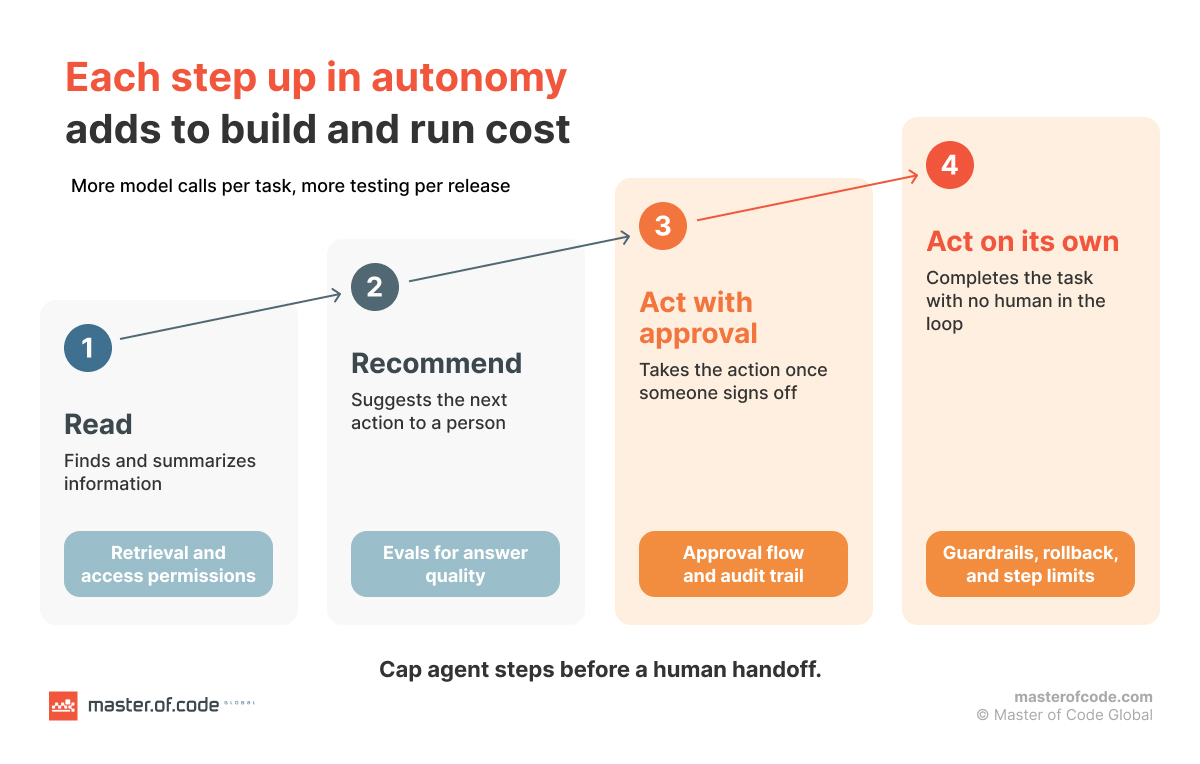
Each step up adds guardrails, rollback logic, audit trails, and testing. The autonomy level also drives running costs. Every turn of the agent’s loop is another model call, so autonomy works like a budget dial (see the economics of agentic AI). Cap the number of steps before the agent hands off to a person.
Buyers are cautious here too. Capgemini found that trust in fully autonomous agents fell from 43% to 27% in one year (Capgemini).
Cost impact: each step up the ladder adds testing and control work to the build and more model calls to every task.
Single agent vs. multi-agent systems
Multi-agent systems add orchestration, contracts between agents, more evals, and many more tokens. Expect roughly 1.5–2 times the build cost of a single-agent workflow.
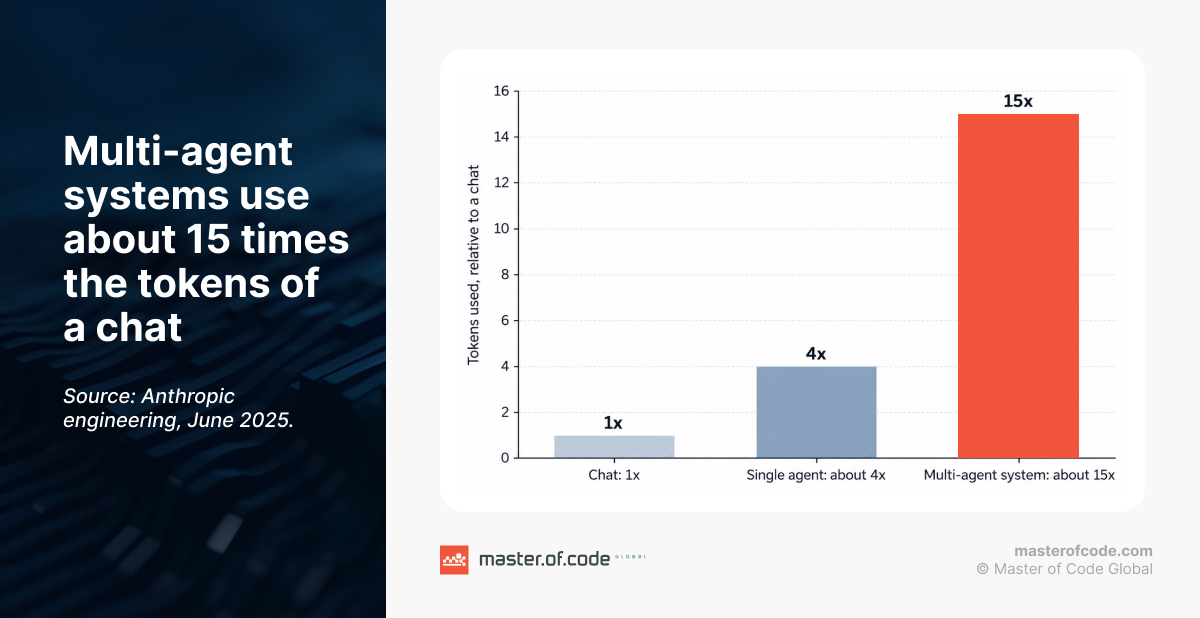
Running costs grow faster. Anthropic measured that agents use about 4 times the tokens of a chat, and multi-agent systems about 15 times (Anthropic).

More agents don’t always mean better results. Google Research found that multi-agent setups lowered performance by 39–70% on sequential tasks. Yet they improved results by 81% on parallel finance tasks (Google Research). In another study, multi-agent frameworks failed on 41–86.7% of traces (Cemri et al., NeurIPS 2025).
The rule is simple: use several agents only when the work splits into parallel tasks. Adoption is growing anyway. Among large US companies, the share orchestrating multiple agents doubled from 9% to 18% (KPMG).
Cost impact: 1.5–2x the build, and up to 15x the token spend of a chat.
Integrations with CRM, ERP, APIs, and legacy systems
Integrations usually take 20–30% of the build. In our sample split above, they take 25%. Here is what each connection typically adds:
| System | Typical add-on |
|---|---|
| Modern CRM with a clean API | $3K–$8K |
| ERP | $8K–$20K |
| Legacy system without APIs (middleware, RPA, data sync) | $15K–$40K+ |
Source: Master of Code Global delivery estimates.
The price moves with API quality, authentication (SSO or OAuth), read vs. write access, data mapping, and rate limits. Write access costs more because every action needs checks and rollback.
For example, our AI voice agent for real estate connects to HubSpot, Salesforce, and calendar sync. Our AI integration services team handles this layer.
Cost impact: $3K–$40K+ per system.
Data preparation, RAG, and knowledge base
Data preparation and knowledge base work usually take 15–30% of the initial spend. That covers cleaning documents, chunking, embeddings, a vector database, access permissions, and pipelines that keep content fresh.
Skipping it is expensive. Gartner says that through 2026, organizations will abandon 60% of AI projects that lack AI-ready data (Gartner). Only 6% of companies say their data is fully AI-ready (Dun & Bradstreet).
The payoff is real. In our projects, well-structured knowledge bases raised containment by 20–30% and CSAT by 10–20%. Our guide to AI data preparation explains how.
Cost impact: 15–30% of the build.
Evaluation, testing, guardrails, and reliability
Budget 10–15% of the build for evaluation. That pays for eval sets, LLM-as-judge runs, red-teaming, regression suites, and observability.
Many teams skip this step. LangChain surveyed 1,340 practitioners in November and December 2025. Only 52% ran offline evals and 37% ran online evals. Quality was the top blocker to production, named by 32% (LangChain).
Evals also pay off after launch. Agents we launched at 20% containment reached 60%+ after one focused improvement sprint. We keep review at roughly 80% automated and 20% human. Read more in our guide to AI agent evaluation.
Cost impact: 10–15% of the build.
Security, access controls, and compliance
Security work includes role-based access, PII redaction, prompt-injection defenses, audit logs, private hosting, and HIPAA, GDPR, or SOC 2 work. Regulated builds start around $180K.
The risks justify the spend. IBM found that 13% of organizations reported breaches of AI models or apps, and 97% of those lacked AI access controls (IBM). Prompt-injection incidents cost $5.89M on average (IBM).
In the EU, high-risk AI rules apply from December 2, 2027, for stand-alone high-risk systems. High-risk AI built into products follows on August 2, 2028 (Regulation (EU) 2026/1744). Breaking those rules can cost up to €15M or 3% of global annual turnover, whichever is higher (AI Act, Article 99).
Compliance can be built in from the start. Our HIPAA-compliant AI health companion finished its pilot with zero compliance incidents.
Cost impact: regulated builds start around $180K.
Monthly Operating Costs: Tokens, Hosting, and Tools
A live agent costs anywhere from $150 to $15,000+ a month to run. The total depends mostly on task volume and autonomy.
| Item | Typical monthly cost |
|---|---|
| LLM API and token usage | $100–$5,000+ |
| Hosting and infrastructure | $100–$2,000+ |
| Vector database | $50–$1,000 |
| Monitoring and observability | $40–$1,000 |
| Total: assisted agent | $150–$600 |
| Total: semi-autonomous agent | $1,200–$5,500 |
| Total: fully autonomous multi-agent system | $7,000–$15,000+ |
Source: Master of Code Global delivery estimates. Vector database and observability floors reflect published minimums from Pinecone ($50/month on Standard) and LangSmith ($39 per seat/month on Plus).
To build your own estimate, add up every line:
Monthly OPEX = inference + embeddings and vector DB + hosting + tools and APIs + observability + evals + human review + support
Token usage grows with every step, retry, and extra page of context. That is why cheaper tokens don’t guarantee a cheaper agent. Gartner expects inference cost per agentic workflow to rise more than fivefold through 2028, even as token prices fall (Gartner).
The right ceiling depends on who uses the agent. An internal agent can justify about $1.50 per interaction. An agent answering anonymous site visitors should stay under $0.02 per query. We break this down in the economics of agentic AI.
How Model Choice Shapes Total Cost of Ownership
Model choice is the biggest lever on your total cost of ownership (TCO) after the build itself. Here are current API prices per 1 million tokens:
| Model | Input | Output |
|---|---|---|
| OpenAI GPT-6 Astra | $10.00 | $50.00 |
| Anthropic Claude Opus 5.5 | $4.00 | $20.00 |
| OpenAI GPT-6.1 Sol | $2.00 | $10.00 |
| Google Gemini 3.1 Pro Preview (≤200K) | $2.00 | $12.00 |
| Google Gemini 3.1 Flash-Lite | $0.25 | $1.50 |
| Anthropic Claude Haiku 5.5 | $0.10 | $0.50 |
| OpenAI GPT-6 Luna | $0.10 | $0.50 |
Prices as of October 2026. Batch APIs cut them by about 50%.
Within one vendor’s lineup, the flagship’s output price is 8x to 100x that of its smallest model. So route simple steps to small models and keep frontier models for hard reasoning. Speed matters too: a small tuned model that answers in 400 ms often serves users better than a flagship that takes 6 seconds.
Prices also fall fast. Epoch AI found that the price of reaching a given level of performance drops 9x to 900x a year, depending on the task (Epoch AI). Design your agent so you can swap models without a rebuild.
Cheaper tokens won’t fix every cost problem, though. Gartner predicts that by 2030, GenAI cost per customer-service resolution will exceed $3, more than many offshore human agents cost (Gartner). Plan TCO over three years:
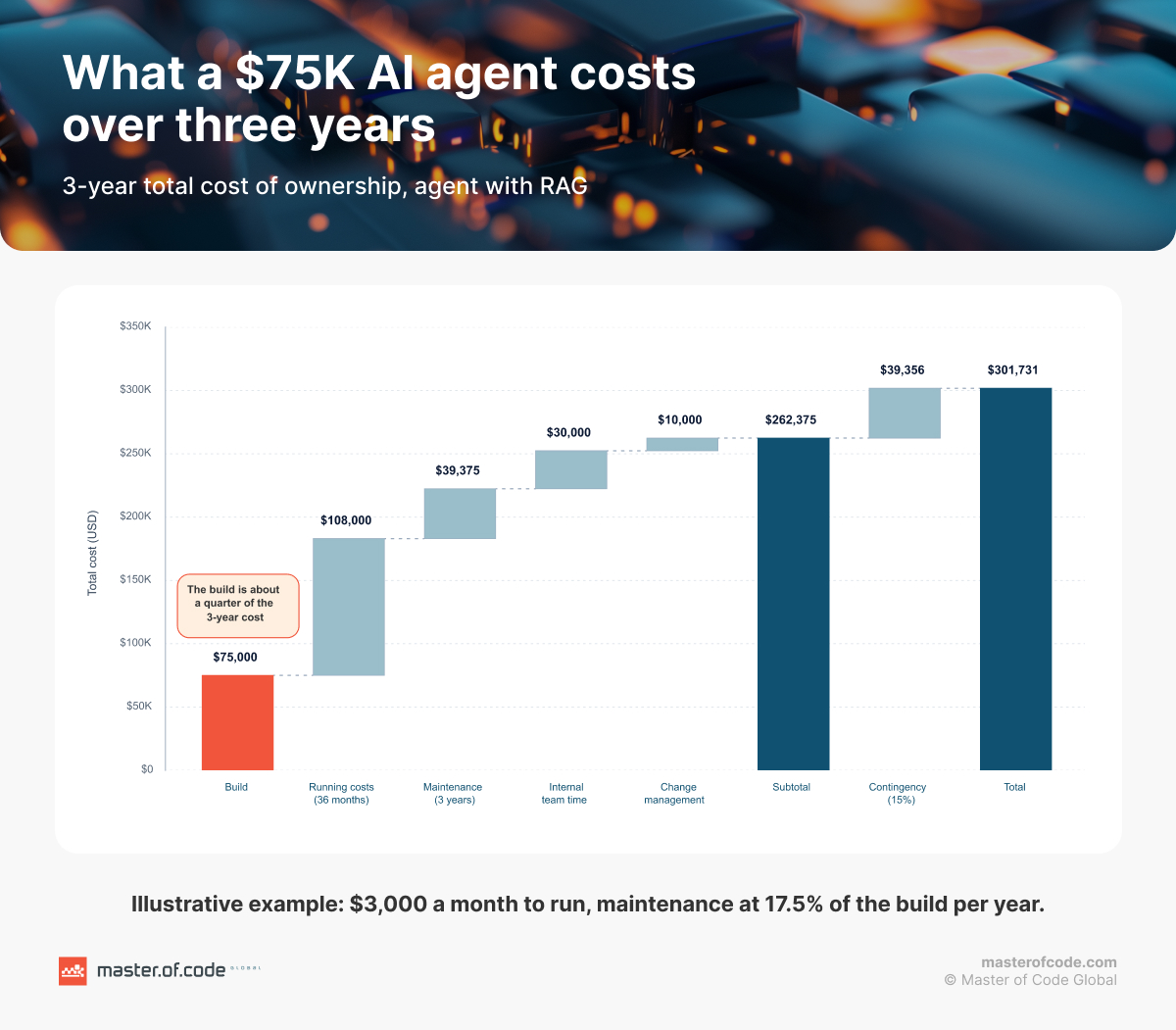
3-year TCO = build + 36 × monthly OPEX + 3 × annual maintenance + internal team time + change management + 10–20% contingency
Take an agent with RAG that costs $75K to build and $3K a month to run. Add $13.1K a year in maintenance, $30K of internal team time, and $10K for change management. That’s $262K over three years, or about $302K with a 15% contingency.

Maintenance and Support After Launch
Plan to spend 15–20% of the build cost on maintenance every year. On a $75K agent, that’s $11K–$15K a year.
Set aside another 10–15% of the build for the first 60–90 days after launch. Real users will find gaps no test set caught, and you’ll want budget ready to fix them.
Ongoing maintenance covers:
- prompt and model updates when vendors release or retire models;
- knowledge base refreshes as products and policies change;
- eval regression runs after every change;
- fixes when connected APIs change;
- monitoring of latency, cost, and errors.
A simple rhythm works well. Check latency, cost, and errors weekly. Review goal completion monthly. Run a full regression suite every quarter. Our AI agent evaluation guide shows how to set this up.
Hidden Costs That Push AI Agent Projects Over Budget
Most budget overruns come from costs nobody listed in the quote. Watch for these:
- Runaway loops and retries: an agent stuck in a loop keeps calling the model and keeps billing you.
- Context bloat: long histories and large documents raise the cost of every call.
- Human review time: someone has to check the cases the agent flags.
- Change management and training: staff need time to learn new workflows.
- Vendor price changes: model and SaaS prices can rise as well as fall.
- Compliance audits: regulated industries need regular reviews.
- Model deprecations: a retired model means new prompts and new tests.
- Observability tools: tracing and logging carry their own subscriptions.
- Scope creep: “one more integration” adds up fast.
- Late data cleanup: messy data found mid-project can delay the build by weeks.
These costs are hard to see without the right tools. Among large US companies, 35% name AI cost management as a barrier (KPMG). Set per-task cost budgets and alerts from day one.
Not sure what your agent will cost? Validate it in a 30-day AI Pilot with a fixed budget.
Why AI Agent Development Quotes Vary So Widely
Quotes for a mid-level agent range from about $20K to $150K. Five things explain most of the gap.
- What counts as an agent. Some vendors sell a chatbot with a new label. Gartner estimates that only about 130 of the thousands of agentic AI vendors are real (Gartner).
- PoC vs. production scope. A demo and a production system are different products.
- What’s included. Evals, security, and integrations are often left out of low quotes.
- Team location and seniority. Freelance machine learning experts on Upwork charge $50–$200 an hour (Upwork). AI engineers on UK contracts earn a median £600 a day (IT Jobs Watch). Senior developers in Europe cost $64–$76 an hour, according to outsourcing advisor Accelerance (Accelerance).
- Pricing model. A fixed price includes a risk buffer; time and materials shifts the risk to you.
To compare quotes like for like, ask each vendor:
- Is this a PoC, an MVP, or a production system?
- Which integrations are included, and with read or write access?
- How will you test and evaluate the agent, and is that in the price?
- What will it cost per month to run at our expected volume?
- What does maintenance cost after launch?
Build vs. Buy vs. Partner
Buy when a ready-made agent covers your use case. Build when the agent is your competitive edge. Partner when you need custom logic fast but don’t have an AI team.
| Option | Upfront cost | Running cost | Time to value | Control | Best when |
|---|---|---|---|---|---|
| Buy (SaaS agent) | Low | Per action or outcome | Weeks | Low | A common use case where the vendor covers ~80% of needs |
| Build in-house | Highest: an AI team costs $250K+ a year | Your own infrastructure and tokens | 6–12 months | Full | The agent is a core differentiator and you have AI talent |
| Partner (custom build) | See the cost-by-stage table above | See the operating cost table above | 30-day pilot, then weeks to months | High; you own the IP | You need custom logic and integrations fast |
SaaS agents now charge per unit of work. Salesforce Agentforce uses Flex Credits at $0.10 per action, with $2-per-conversation pricing still on offer. Intercom Fin charges $0.99 per resolution. In-house salaries add up fast: the US median for computer and information research scientists is $140,300 a year (BLS).
Most companies now buy. Menlo Ventures found that 76% of AI use cases are bought rather than built, up from 53% in 2024. An MIT NANDA study, reported by Fortune, found that bought tools and partnerships succeed about 67% of the time. Internal builds succeed only a third as often.
Our rule: if a vendor covers about 80% of your needs, integrate it. Build where the agent sets you apart. Partner when you want speed and still need control. Read more in our guide to build vs. buy AI solutions.
What Your Internal Team Needs to Contribute
Even with a partner, your team puts in real hours. Plan for these roles:
| Role | What they do |
|---|---|
| Executive sponsor | Sets goals, clears blockers, owns the budget |
| Product owner (0.3–0.5 FTE) | Makes daily decisions and accepts the work |
| Subject matter experts | Explain workflows and help build eval sets |
| IT and integration owner | Grants system access and reviews connections |
| Security and legal reviewer | Approves data handling and compliance |
| Data owner | Supplies and approves knowledge sources |
| Pilot users | Test the agent and give feedback |
Size affects speed. An MIT NANDA study, reported by Virtualization Review, found that mid-market companies take about 90 days to go from pilot to full rollout. Large enterprises take nine months or more.
Your team’s time is a real cost. Count it in your TCO.
How to Calculate ROI, Payback, and Cost per Completed Task
Judge an agent by what it costs per successful task, not per conversation. Then compare that number with what the same task costs when a person does it.
| Metric | Formula | Example |
|---|---|---|
| Inference per task | (input tokens × input rate + output tokens × output rate) × model calls | GPT-6.1 Sol at $2/$10 per 1M tokens: 6 calls × (3K input + 500 output tokens) = $0.066 |
| Human review per task | Cost per reviewed task × share of tasks reviewed | $2.50 × 10% = $0.25 per task |
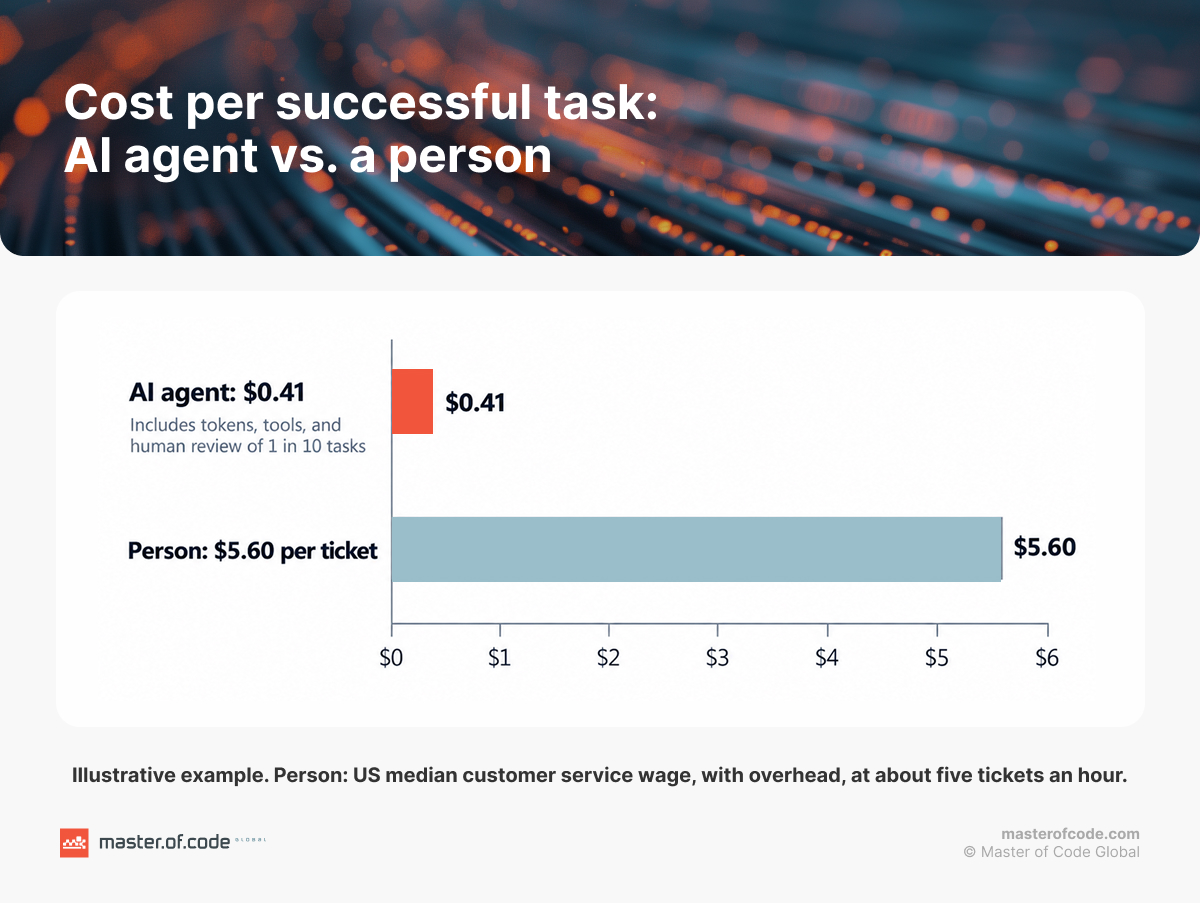
| Cost per successful task | Total cost per task ÷ success rate | ($0.066 tokens + $0.01 tools + $0.25 human review) ÷ 0.8 ≈ $0.41 |
| Payback period | Build cost ÷ (monthly savings − monthly OPEX) | $120K ÷ ($18K − $4K) ≈ 8.6 months |
| Year-1 ROI | (Annual benefit − annual cost) ÷ annual cost | ($216K − $168K) ÷ $168K ≈ 29% |
Illustrative figures. Year-1 cost = $120K build + 12 months × $4K OPEX.
In this example, the agent completes a task for about $0.41. A person handling the same ticket costs about $5.60, based on the US median customer service wage of $21.53 an hour (BLS), a 1.3x loaded-cost factor, and about five tickets an hour.

Don’t expect every project to pay back in months. Google Cloud found that 88% of agentic AI early adopters see ROI on at least one use case (Google Cloud). Yet only 28% of companies report broad or strong ROI (Dun & Bradstreet). Deloitte found that most companies reach satisfactory ROI on a typical AI use case in two to four years, compared with 7–12 months for typical tech investments (Deloitte).
The upside is large where volume is high. Gartner predicts that by 2029, agentic AI will resolve 80% of common customer service issues on its own and cut operating costs by 30% (Gartner).
Our clients see similar results. Zipify cut operating costs by 30% with an agent assist tool. Our real estate voice agent lowered the cost per qualified lead by 45%. For a fuller framework, see our guide to AI ROI.
How to Reduce AI Agent Development Cost Without Losing Reliability
You can cut cost without cutting corners. These steps lower spend and still keep the agent ready for production.
- Start small. Pick one high-volume workflow and test it in a 30-day pilot with a fixed budget.
- Use existing model APIs first. Fine-tune only when prompts and retrieval can’t reach your quality bar.
- Route by task. Send simple steps to cheap models and save frontier models for reasoning.
- Cut repeat costs. Cache prompts and use batch APIs, which cost about 50% less.
- Cap token usage. Limit agent steps and set a cost budget per task, so loops can’t run away.
- Reuse connectors. Use MCP servers and existing APIs instead of building every integration from scratch.
- Build eval sets early. Tests written on day one prevent expensive rework later.
- Phase integrations. Connect the systems you need for launch first and add the rest after deployment.
Our AI Pilot follows this approach. In 30 days, a team of 4–5 experts delivers a working tool, tests it with real users, and measures it against your KPIs.
Conclusion: How Master of Code Global Can Help
An agent’s real price is build plus run plus maintain. The build gets the attention, but three years of tokens, hosting, reviews, and updates can cost as much or more. The best way to judge an agent is by what it costs per completed task, compared with how you handle that task today.
Start with a fixed-budget AI Pilot to prove the value before you commit to a full build. When you’re ready to scale, our AI agent development services cover the whole path, from discovery and architecture to evals, guardrails, and deployment.
Get a custom AI agent development cost estimate for your use case. Talk to our team and we’ll map out your AI agent development cost from pilot to production.