



Everyone says AI is a transformation, not a mere technology. But what does that actually mean? It turns out very few business leaders understand how it happens, what it requires, or why it’s even necessary in the first place.
Most companies implement one or two use cases and start calling themselves AI-powered. That’s a stretch. Being truly AI-driven means something different: your whole system runs on artificial intelligence, from how you collect and structure data, through how your teams work, all the way to your CRM and customer-facing tools.
That kind of shift is hard to pull off, and the reasons why AI transformations fail are numerous, like scattered tools mistaken for a strategy, no one accountable for the results, and data that isn’t ready for the job, each requiring its own fix. That’s exactly what this article is about. Dmytro Hrytsenko, CEO of Master of Code Global, and Olga Hrom, its Chief Delivery Officer, identified 10 problems they’ve seen firsthand and share them here, along with what it actually takes to avoid each one.
By the way, if you need a hand figuring out where your organization stands, our team is here for that conversation.

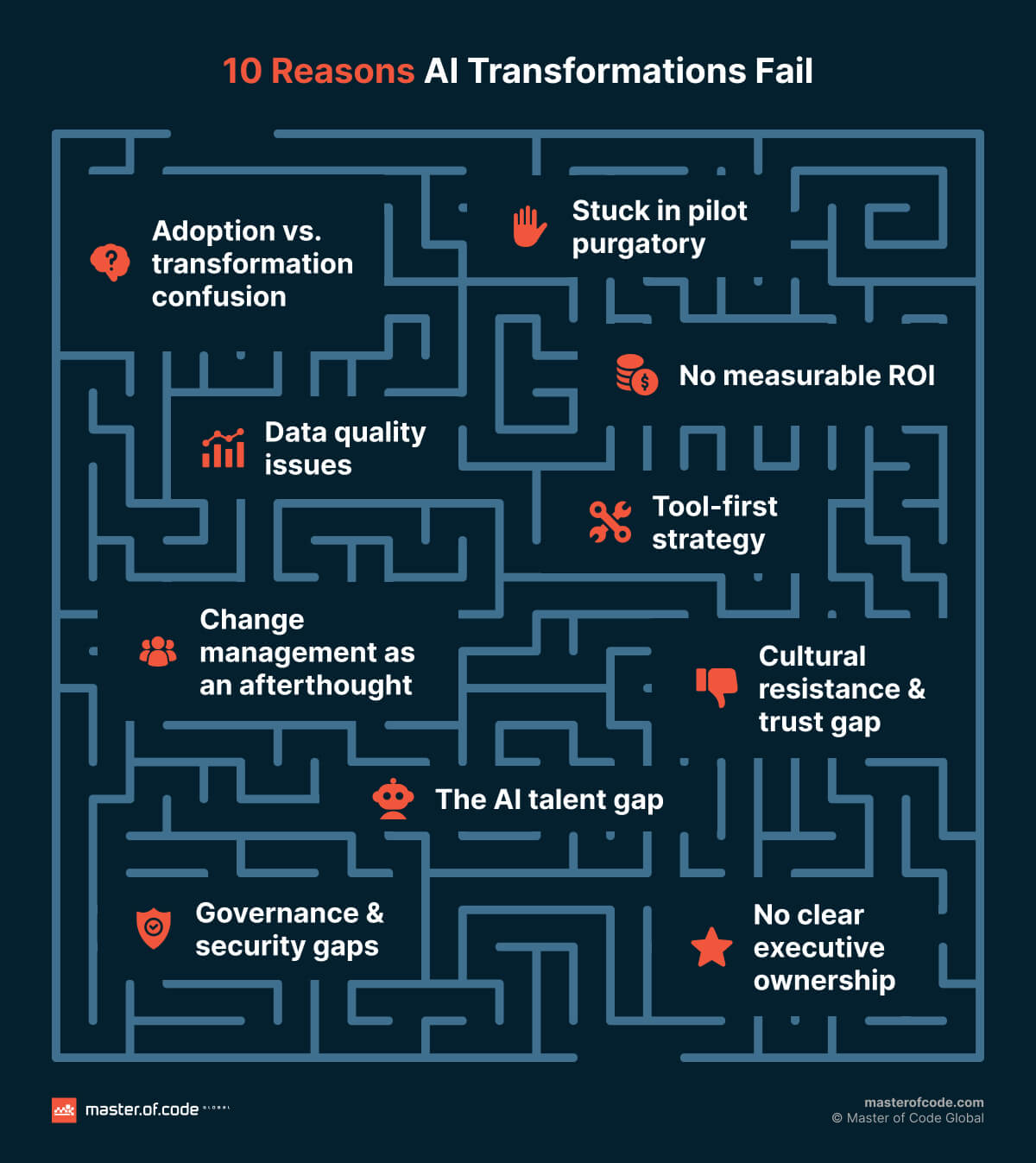
Table of Contents
Key Takeaways
- AI transformation means redesigning how your business actually operates, not adding a chatbot or automation script on top of existing processes.
- Most companies stop at isolated tools and call it transformation anyway, which is why so few see real financial returns.
- Strategy problems: adoption confused with transformation, pilots with no clear success metrics, and unit economics calculated only after the budget is spent.
- People problems: change management treated as a one-time event, low employee trust and buy-in, a shortage of AI-savvy domain experts, and no single leader accountable for both the business case and the delivery.
- Data and infrastructure problems: ungoverned or unclean data, tools bought before the workflow is defined, and security frameworks built after issues surface instead of before.
Problem #1: AI Adoption vs AI Transformation Confusion
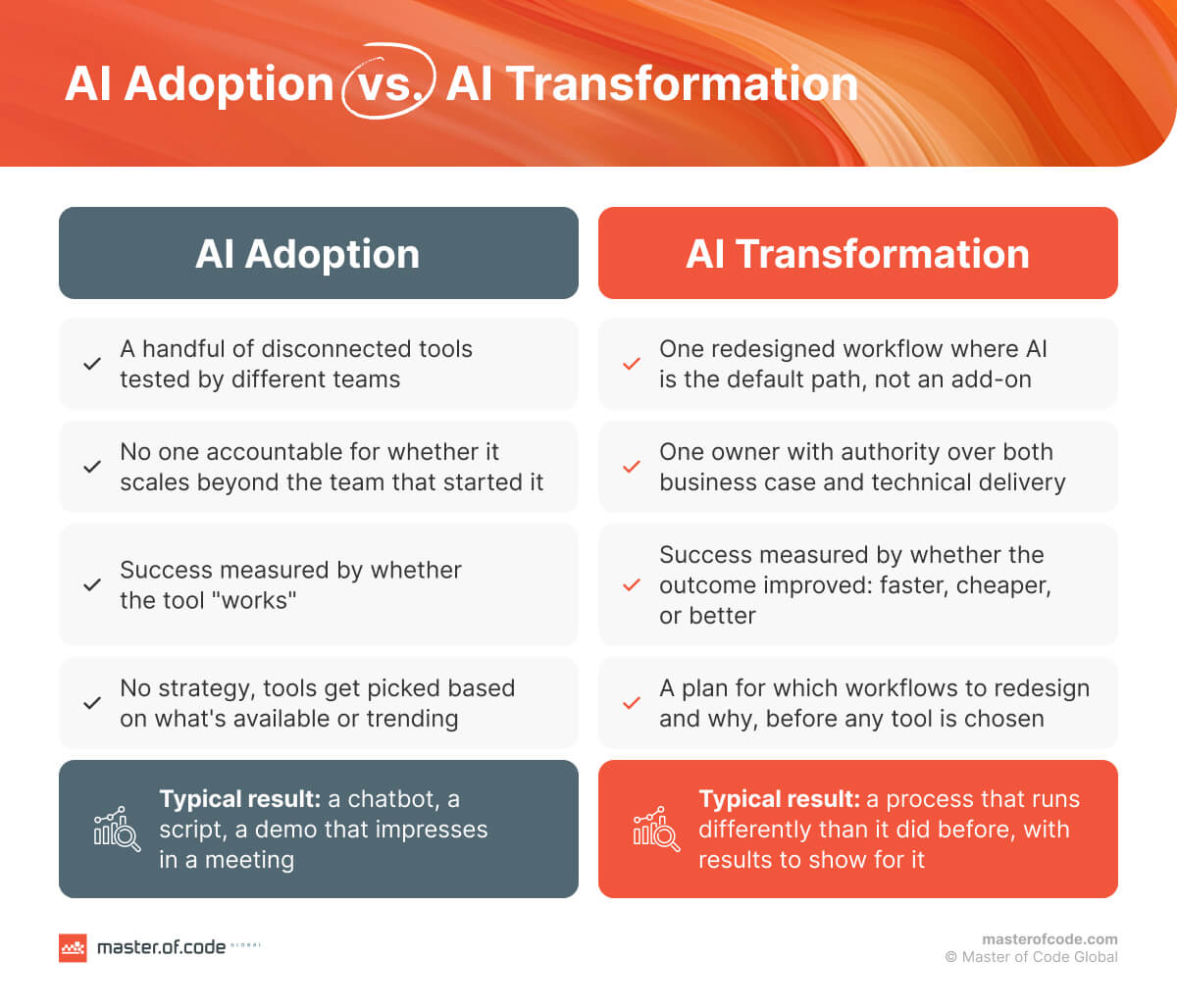
Ask ten companies if they’re doing AI, and nine will say yes. Ask what that means, and the answers collapse into the same handful of things: a chatbot on the website, an internal tool that summarizes meetings, maybe a script that drafts marketing copy. That’s adoption, not transformation, and treating them as the same thing is one of the most common reasons why AI transformations fail.
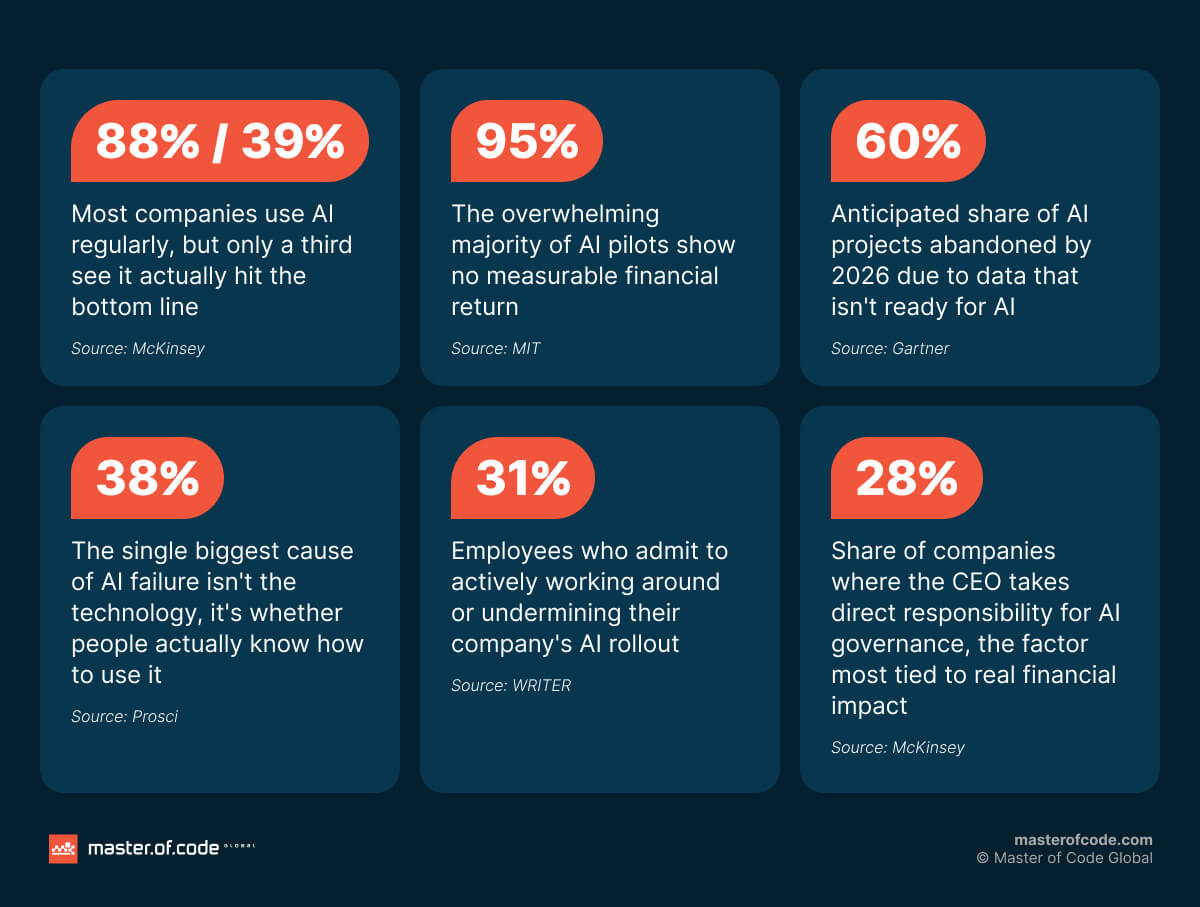
McKinsey’s survey puts a number on the gap: 88% of organizations now use artificial intelligence regularly, but only 39% report any EBIT impact at the enterprise level.
The difference comes down to scope and ownership. Adoption typically looks like:
- A handful of disconnected tools tested by different teams, with no shared strategy behind them.
- Success measured by whether a tool “works,” not by any tie to a business outcome.
- No one accountable for whether the initiative scales beyond the team that started it.
Transformation asks a different question entirely: not “where can we bolt on a tool,” but which workflows should be redesigned so AI is the default path, not a side experiment. Dmytro Hrytsenko draws the line clearly:
The real question is whether you’re actually building your AI transformation strategy, or whether you’re just launching agents quickly. If you want to become an AI-first organization, you have to approach it as a strategy, and that’s a different kind of work entirely. You need to understand not just the technology and a few small workflows, but the people, the structure, the skills, and the processes that all of this has to plug into.
Getting this distinction right from the start shapes everything that follows, from how to implement AI in business to how a single use case either dead-ends or becomes the first step of something bigger. It’s also the same instinct behind why so many AI startups fail: mistaking a working feature for a working business.
How to fix this problem: Don’t start by listing tools. Instead, name one workflow you’re willing to fully rewire, not just automate. McKinsey’s research backs this up directly: high performers are three times more likely to redesign workflows end-to-end. Pick one process, commit to rebuilding it rather than bolting tech onto it, and treat that as the pilot for what transformation actually means at your company.

Problem #2: Stuck in AI Pilot Purgatory
Search “AI pilot,” and most of what comes back is bad news: pilots that launch with fanfare, run for a few months, and quietly disappear. Gartner data confirms it’s real: by the end of 2025, at least 50% of GenAI projects have witnessed proof of concept (PoC) abandonment, driven by poor data quality, inadequate risk controls, escalating costs, or unclear business value. This is what AI pilot purgatory looks like from the outside: a company that’s neither committed to scaling nor willing to admit the experiment didn’t work.
MIT’s 2025 research paints the same picture from a different angle: only 5% of pilots produce measurable financial return, with the rest stuck somewhere between “still testing” and “quietly shelved.”
Olga Hrom argues the framing itself is the problem:
Statistically, most pilots fail, and that gets written about a lot. But it’s the same story with startups: everyone kept saying 90% of startups fail, and people still look at the successful ones and keep building. Without pilots, you don’t get innovation, you don’t get lessons learned, and a company never builds up real practical experience of implementing AI.
AI pilots stuck in purgatory usually share the same traits:
- No predefined exit criteria. Nobody agreed in advance what “this worked” or “this didn’t” would actually mean.
- No owner for the next decision. The pilot ends, and no one is responsible for deciding whether to scale, pivot, or kill it.
- Scope creep during the pilot itself. Teams try to cram a full product’s worth of features into what was supposed to be a fast, cheap test.
This is exactly what Master of Code Global’s own AI Pilot is built to prevent. Every one starts by defining the specific business KPIs it needs to hit, before any building begins, and ends with an analytics setup that measures the result against those KPIs. The pilot also closes with a clear next step: an improvement recommendations report and a defined architecture for the following phase, so the decision to scale, adjust, or stop is deliberate.
How to fix this problem: Define the pilot’s success metrics and its “what happens next” decision point before you write a single line of code. Treat the pilot as a genuine AI Pilot, a deliberately narrow, fast, cheap way to validate one specific business assumption, rather than a shrunken version of the final product. That distinction is also what determines whether a pilot has any real shot at becoming production software, which is exactly the gap covered in the from AI pilot to production article.
Problem #3: No Measurable ROI or Broken Unit Economics
A pilot can clear every technical hurdle, reach production, and still fail, simply because nobody ran the math on what it costs to operate. BCG found that only about 5% of companies create substantial AI value at scale, while 60% generate no material value despite meaningful spending. The gap between “it works” and “it’s worth it” is where a lot of investment quietly disappears.
Part of this is a token economics problem that only shows up after launch. Once real users start sending messy, unexpected, high-volume requests, the same product can burn through tokens far faster than expected.
Part of it is simpler than that: teams confuse an impressive output with something users will actually pay for. Olga Hrom puts it directly:
We see this confusion between the output of the product and the actual value it creates a lot. Something gets generated, some reports, some analysis, some recommendations, and it all looks impressive. But the users pay for value, not for output. That’s the illusion a lot of teams fall for.
The pattern tends to show up in a few specific ways:
- Infrastructure and token costs were never modeled against the actual usage volume.
- The “impressive demo” and “the profitable product” were treated as the same milestone.
- No one asked what the cost is to resolve a single case or query, so the unit economics only get tested after the budget is already committed.
How to fix this problem: Model your cost-per-outcome, not just your build cost, before you scale past the pilot. Just as important, evaluate which functions genuinely need intelligentization and which ones it’s simply the wrong tool for. If that calculation isn’t something your team does today, it’s worth building into your AI ROI tracking from day one, not retrofitting it after the budget’s already spent on AI PoC development.
Curious what a proof of concept actually proves? AI proof of concept breaks it down.
Problem #4: Data Quality Issues
Every failure conversation eventually circles back to the same root cause. Gartner confirms it directly: through 2026, organizations will abandon 60% of projects unsupported by AI-ready data, and 63% either don’t have, or aren’t sure they have, the right data management practices for AI in the first place.
Olga Hrom ties this directly to how the underlying processes are built:
An AI solution is a reflection of how your processes are already built. If your data is scattered, inconsistent, or nobody actually owns it, you can’t just layer such a solution on top of that and expect it to work.
In practice, the data problems that sink initiatives tend to fall into a short, recognizable list:
- Fragmented data spread across systems that were never designed to talk to each other.
- No governance framework defining who owns the data, how it’s classified, or how clean it needs to be before AI can rely on it.
- Inconsistent or outdated records that the business has quietly worked around for years, but that an intelligent system takes at face value.
How to fix this problem: Audit your data quality and structure before scoping the project. Your organization should confidently answer where key data lives, how consistent it is, or who’s accountable for keeping it that way. Otherwise, that’s the real starting point, and it’s exactly the groundwork covered in AI data preparation.
Problem #5: Tool-First Strategy Instead of Workflow Redesign
The fastest way to get an AI project moving is to buy a tool and start experimenting. It’s also one of the most reliable ways to end up with expensive infrastructure and nothing to show for it. McKinsey shows the appetite is there: 23% of organizations are already scaling agentic AI systems, and another 39% are experimenting with agents. But scaling a tool and redesigning a workflow around it are two very different projects, and most companies only do the first one.
Procurement happens before the problem is defined. Leadership sees competitors deploying AI, budget gets approved, and a tool gets bought, with the workflow it’s meant to improve left exactly as it was. The tool gets bolted onto the existing process instead of the process getting rebuilt around what the tool can actually do.
Dmytro Hrytsenko frames the question every team should be asking before signing off on a new tool:
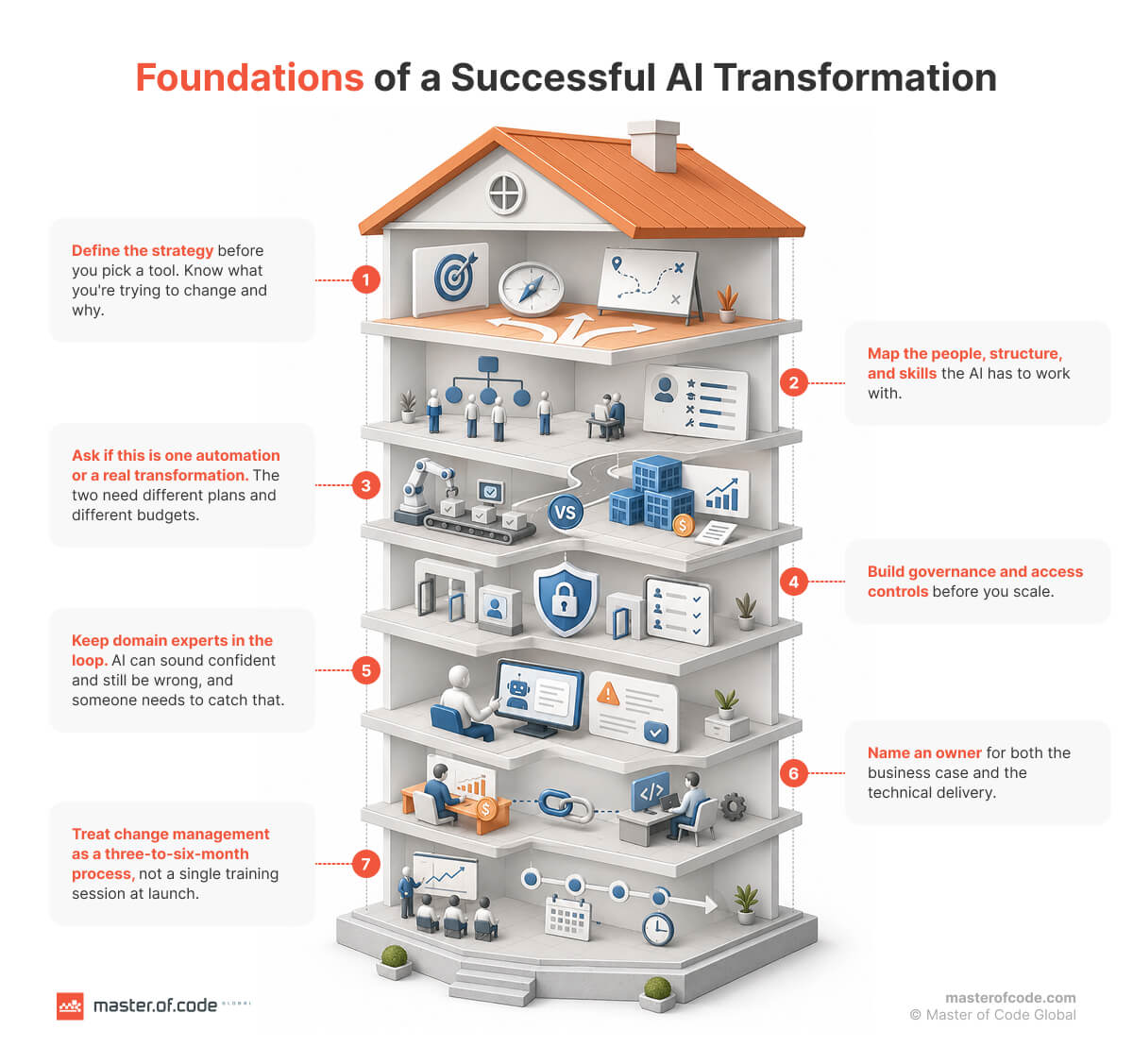
Is this actually an AI-first transformation, or is this just one automation? What’s the strategy behind it? How do you make sure you’re actually, systemically, using the best of what AI can do for your organization?
A tool-first approach tends to leave a few telltale signs behind:
- The workflow looks identical to how it worked before intelligentization, just with one manual step replaced by a prompt.
- Success is measured by whether the tool “works,” not by whether the redesigned process is faster, cheaper, or better for the people using it.
- Admitting the tool isn’t delivering becomes politically costly, since undoing a visible investment feels riskier than quietly maintaining it.
How to fix this problem: Before evaluating any tool, map out the end-to-end workflow you’d redesign if AI didn’t exist as a constraint, then work backward to where AI actually earns its place in that redesign. That sequencing, problem and process first, tool second, is what separates a real transformation initiative from an expensive automation experiment, and it’s exactly the kind of structured evaluation our AI Compass Sprint is built to run. If you’d rather talk it through with someone first, reach out and we’ll help you map it out.

Problem #6: Change Management Treated as an Afterthought
Most rollouts get budgeted and staffed like a software deployment: pick a launch date, train people once, move on. Prosci’s research on 1,107 professionals shows why that approach keeps failing. User proficiency, not technology, is the single largest barrier to AI adoption, accounting for 38% of all reported implementation difficulties, more than double the 16% attributed to purely technical issues. The same study found human factors overall account for 56 to 64% of challenges. The tools are fine, but the rollout around them isn’t.
The instinct to treat AI like a one-time IT launch rather than an ongoing change program is exactly what Olga Hrom sees going wrong most often:
There has to be someone in the leadership team who is essentially the change manager for this whole process. You need to understand what the problem actually is, specifically enough to know what you want to change, how you’ll coordinate that process, and how you’ll measure that the change has actually happened. This needs to be looked at as a real implementation of something new, not just a one-time IT project.
How to fix this problem: Assign a change owner before launch, someone accountable specifically for adoption, not delivery, and give them a way to measure behavior change. Budget for training as an ongoing three-to-six-month process, not a single onboarding session, since that’s roughly how long real behavioral adoption takes to stick.
Problem #7: Cultural Resistance and the Trust Gap
Leadership can approve the budget, buy the tool, and mandate the rollout, and still lose. WRITER’s survey found that 31% of employees admit to actively sabotaging their company’s AI strategy, refusing to use approved tools, quietly discarding LLM outputs, or working around the rollout entirely. That number isn’t a technology problem. It’s a trust gap.
Olga Hrom has seen this pattern often enough to consider cultural transformation the real constraint, not the tooling:
We see that people, and the culture of the organization, are actually the biggest blocker to implementing AI effectively. AI isn’t a tool anymore, for me, it’s part of the organizational flow and organizational design. When we talk about AI, we need to be thinking about organizational design, not technology, not tools, and a lot of companies simply aren’t ready for that on the design side.
The trust gap tends to show up in a few recognizable ways:
- AI gets introduced as a mandate rather than a genuine opportunity, and employees respond to the mandate, not the technology.
- Rollout communication focuses on efficiency and cost savings, which employees correctly read as a signal about their own job security.
- Resistance goes underground rather than disappearing, showing up as quiet non-use, low-quality inputs, or workarounds rather than open pushback.
How to fix this problem: Lead the rollout with a specific, credible answer to “what does this make possible for me” for your average employee and repeat it consistently rather than leaning on a mandate. If leadership can’t articulate that answer honestly, and isn’t visibly using AI in their own work to back it up, that’s a signal the strategy isn’t ready to launch yet, and it’s exactly the kind of alignment work that belongs in an enterprise AI strategy before rollout, not after resistance shows up.
Problem #8: The AI Talent Gap
Companies keep buying capability without building the judgment to use it. Deloitte found that insufficient worker skills are now the single biggest barrier to integrating AI into existing workflows, ahead of budget, technology limitations, or leadership skepticism. On top of that, 84% of organizations still haven’t redesigned jobs or workflows around intelligent capabilities. This means most companies are trying to close a skills gap on top of a structure that was never built to use those skills.
In practice, the AI talent gap tends to show up as one of a few distinct problems:
- Domain experts get sidelined in favor of speed, right when their judgment is most needed to catch what the model gets wrong.
- Tech fluency is treated as a technical skill limited to engineering teams, rather than a capability every function needs.
- Teams mistake operating a tool for understanding the problem it’s solving, which is exactly what produces confident, wrong output.
How to fix this problem: Pair every initiative with the domain experts who already understand the process being changed; don’t sideline them for speed. If building that internal bench takes longer than your timeline allows, an AI managed dedicated team fills the gap without forcing a rushed, under-qualified hire. Curious how that model actually works in practice? We’re happy to walk you through it.
Problem #9: Governance and Security Gaps
AI adoption is outpacing the oversight built to control it, and the gap is expensive. IBM found that 13% of organizations reported breaches of their models or applications, and 97% of those breached had no proper AI access controls in place. Moreover, 60% of organizations either lack governance policies entirely or are still developing them.
Governance gaps rarely start as a security failure. They begin when:
- Agents get deployed faster than you define access controls, since launching is easy and governance takes deliberate design.
- No one owns governance specifically, so accountability splits across IT, legal, and whichever team built the tool.
- Audits happen rarely, if at all, meaning issues surface only after a breach or compliance review forces the question.
How to fix this problem: Build the access-control and audit framework before scaling past a single agent or pilot. If you don’t have visibility into what’s already running unsupervised across your organization, a technical audit for AI platforms is the fastest way to find out before a regulator or breach does it for you.

Problem #10: No Clear Executive Ownership
Even a well-designed initiative can stall for a reason that has nothing to do with data, tools, or workflows: nobody with real authority is actually accountable for it. Only 28% of organizations report their CEO takes direct responsibility for AI governance, and that CEO oversight is the single factor most correlated with EBIT impact at larger companies. High performers are three times more likely than their peers to say senior leadership genuinely demonstrates ownership, not just sponsorship in name.
The pattern that derails ownership isn’t usually a lack of interest from leadership. It’s a split between business ownership and technical ownership, where the person accountable for the strategy can’t actually direct the people building it. Olga Hrom has watched this play out from both sides:
I see this as a fundamental problem between business ownership and technical ownership. Very often the owner is more business-oriented; they understand the strategy, the use cases, the metrics, but they don’t have the technical piece, and they can’t push the technical implementation team when it’s lagging. And when the technical implementation is lagging, the business owner can’t do anything about it.
How to fix this problem: Name one person with authority over both the business case and the technical delivery, not two co-owners who each control half the picture. If no single internal leader can credibly hold both sides, pair them formally, one accountable for outcomes, one for delivery, with an explicit, shared decision-making process rather than an implicit hope that they’ll sort it out.
FAQs
Why do AI pilots fail to move into production?
Most stall for the same reason: nobody defined what “ready for production” actually meant. Without predefined exit criteria, a clear next-phase decision, and someone accountable for making that call, a pilot has no natural path forward, so it either gets quietly extended indefinitely or abandoned once the initial budget runs out.
Why do AI projects fail?
The reasons cluster around a handful of repeat offenders: unclear ownership, data that isn’t ready for AI to rely on, workflows left unchanged around a new tool, and change management treated as a single training session instead of an ongoing process. Most AI projects that fail were organizationally unprepared for what the technology actually required.
How long does it take to see ROI from an AI transformation?
It depends heavily on scope, but rushing this timeline is itself a common failure mode. A properly scoped pilot, with defined success metrics and business KPIs set before building starts, can validate a specific use case within about a month. Full-scale transformation, redesigned workflows, trained teams, and measurable enterprise impact, typically takes considerably longer, and companies that expect instant results tend to abandon otherwise viable initiatives too early.
Can a small or mid-sized business run an AI transformation, or is this only for large enterprises?
Company size changes the scope, not the underlying requirements. A smaller business still needs a defined problem, clean data, an accountable owner, and a change plan, just applied to a narrower set of workflows. In some ways, smaller organizations have an advantage: fewer layers of ownership to align and faster decision-making once the fundamentals are in place.
Wrapping Up
None of these ten problems are really about technology. Models keep getting better, cheaper, and easier to deploy, and the failure rate hasn’t moved with them. What separates the small number of companies seeing real returns from everyone else is whether they treated AI as a business transformation from the start, with an owner, a strategy, and a plan for the people who’d actually have to change how they work, or whether they treated it as a tool to bolt onto what already existed.
That distinction sounds simple. In practice, it’s the hardest part of the whole undertaking, harder than any model choice or technical architecture decision. Dmytro Hrytsenko and Olga Hrom have watched these same ten patterns play out across dozens of client engagements, and the fix is rarely more AI. It’s usually more clarity: about the problem being solved, who owns solving it, and what success actually looks like before the first pilot ever launches.
If you recognize your organization in one or more of these problems, get in touch with our team. We’ll walk through where your AI initiative actually stands and what it would take to move it forward.