



In a prospective experiment, 27 radiologists read mammograms with AI-generated recommendations. Among the most experienced readers, accuracy was 82.3% when the hints were correct and 45.5% when they were incorrect. The problem was not a missing human review. There were no safeguards against deferring to a confidently wrong model. This is the central design challenge.
So how does human-in-the-loop improve AI accuracy (HITL AI)?
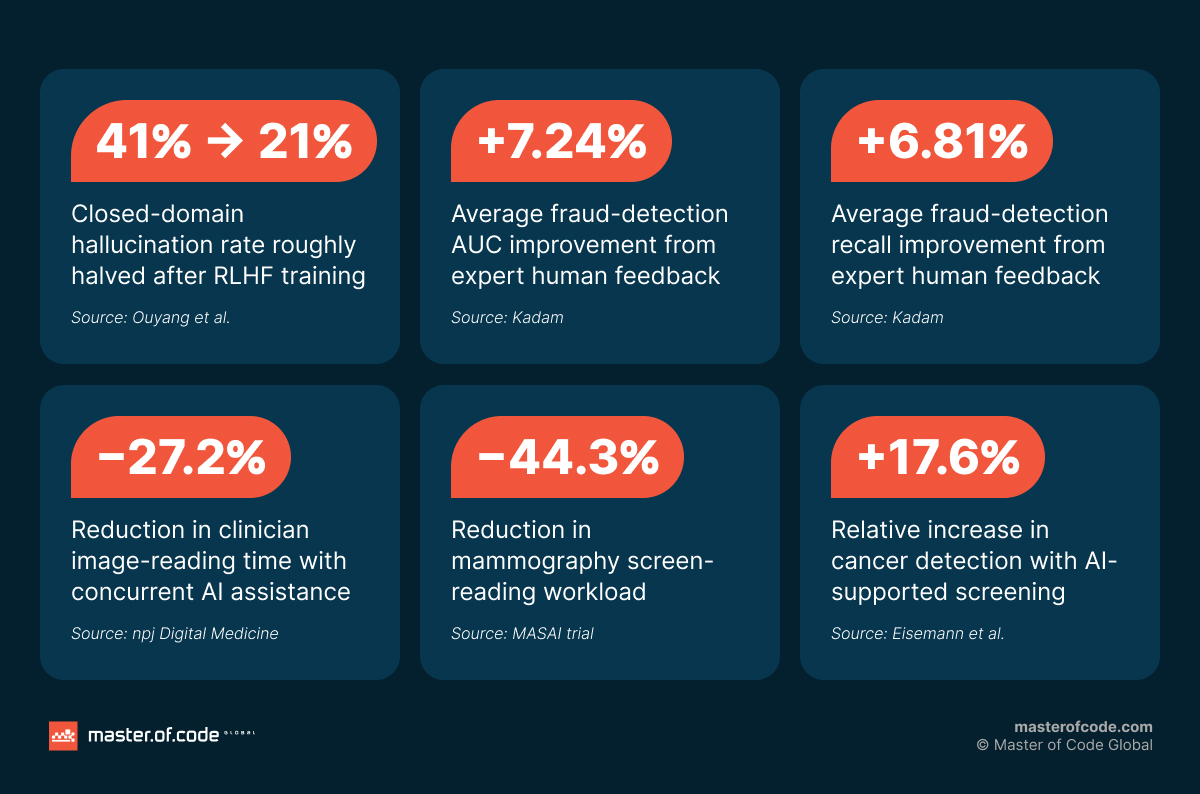
The answer depends on where humans are placed, what they are asked to do, and whether their input feeds back into the model. Get those three things right, and the gains are measurable: it halved InstructGPT’s hallucination rate from 41% to 21%; expert review improved average fraud detection performance by 7.24% and recall by 6.81%. Get them wrong, and you add cost, latency, and a new failure mode on top of the one you were trying to fix.
This guide covers the mechanisms behind HITL AI accuracy improvements, the evidence across LLMs, and a practical framework for deciding where human oversight belongs in your system. It draws on insights from Bogdan Sergiienko, CTO at Master of Code Global, whose team designs and deploys HITL systems across enterprise environments.
If you would rather start with a direct conversation about your specific use case, contact our team for a consultation.

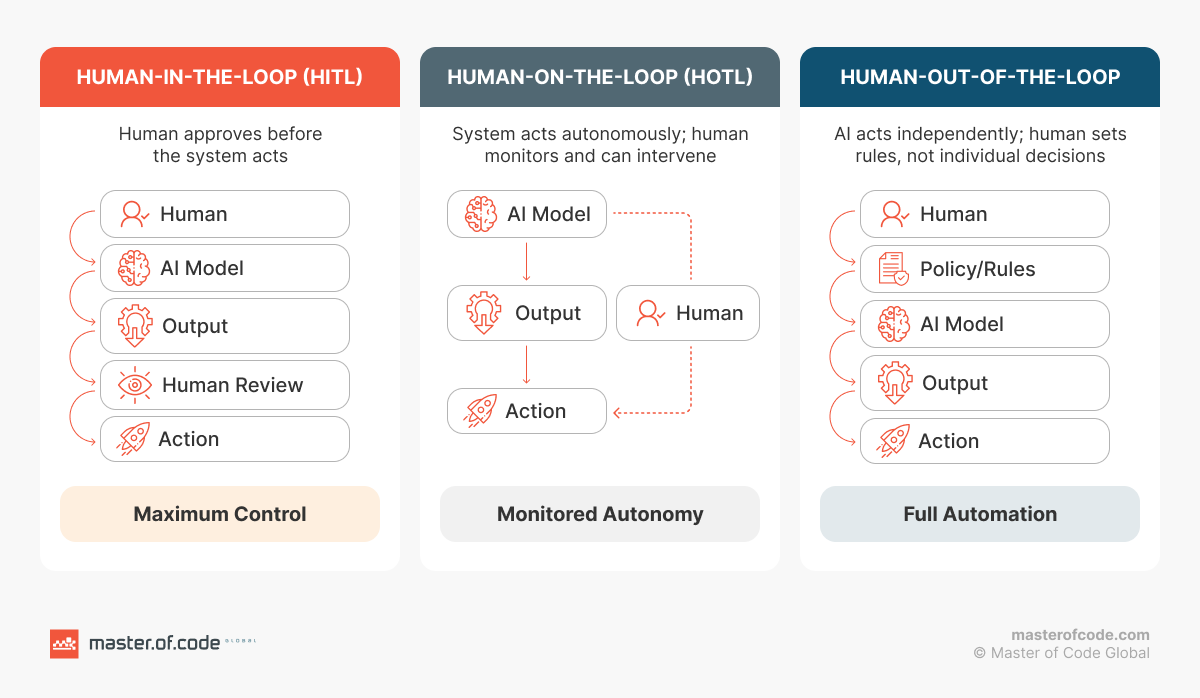
Table of Contents
Key Takeaways
- Human-in-the-loop AI improves accuracy through three mechanisms: active learning concentrates labeling effort on the most uncertain examples, RLHF aligns model behavior with human judgment, and inference-time review catches edge cases before they reach production.
- The gains are measurable: RLHF cut InstructGPT’s closed-domain hallucination rate by almost half, active learning achieved similar accuracy with less labelled data, and targeted expert feedback improved fraud detection.
- Human oversight can reduce accuracy when poorly designed. Automation bias caused experienced radiologists’ accuracy to fall from 82.3% to 45.5% when the AI was wrong. The presence of a human in the loop is not sufficient; the design of that oversight is what determines the outcome.
- HITL, human-on-the-loop, and human-in-command serve different risk profiles. The right mode is determined by error cost, reversibility, and regulatory context.
What Is Human-in-the-Loop AI?
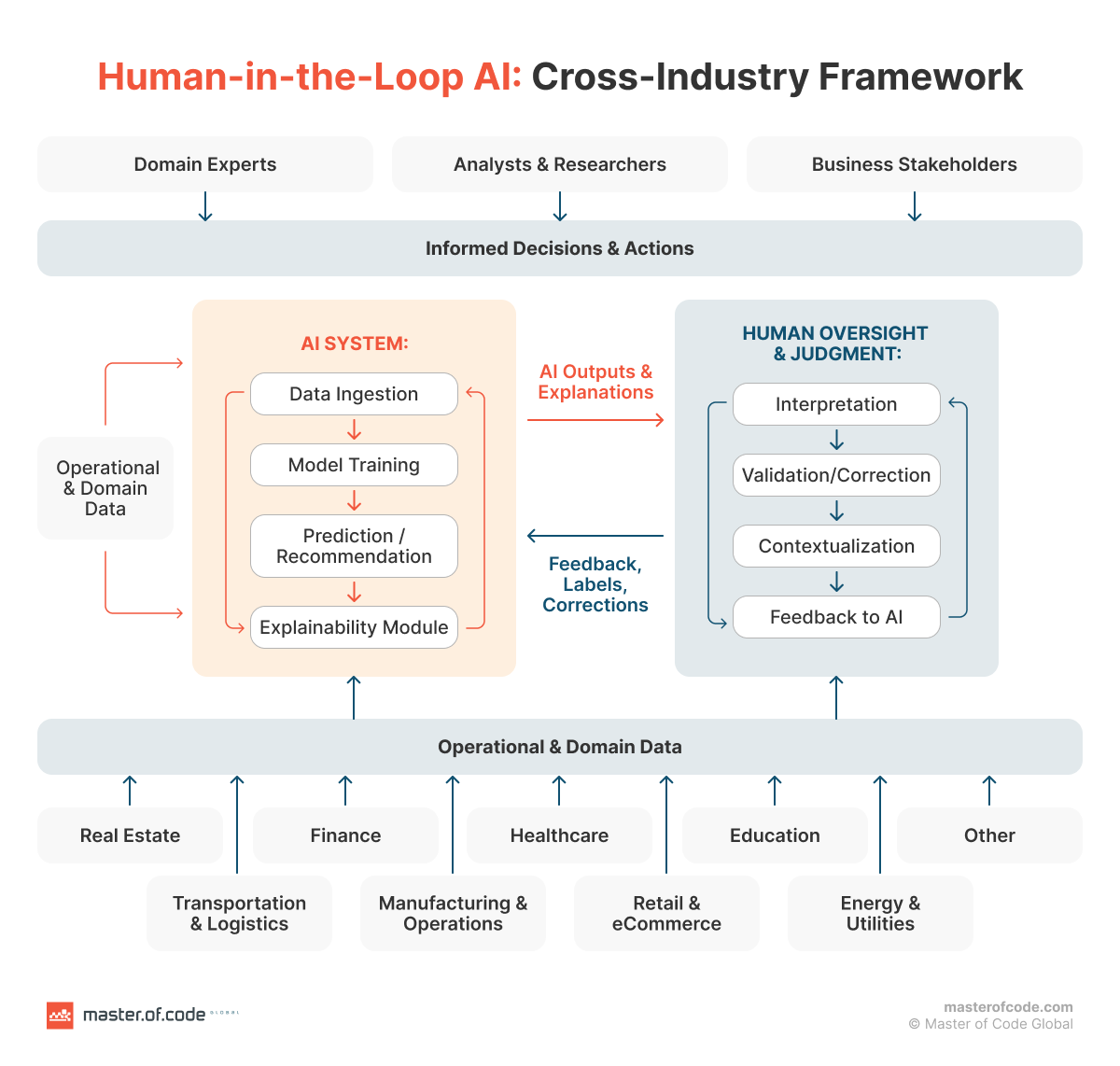
It’s a system design in which a human actively participates in the AI’s decision process at training, evaluation, or runtime. At defined checkpoints, the system cannot proceed without human input, correction, or approval. Stanford HAI frames this as an interaction-design approach that asks where control should be incorporated into an automated system.

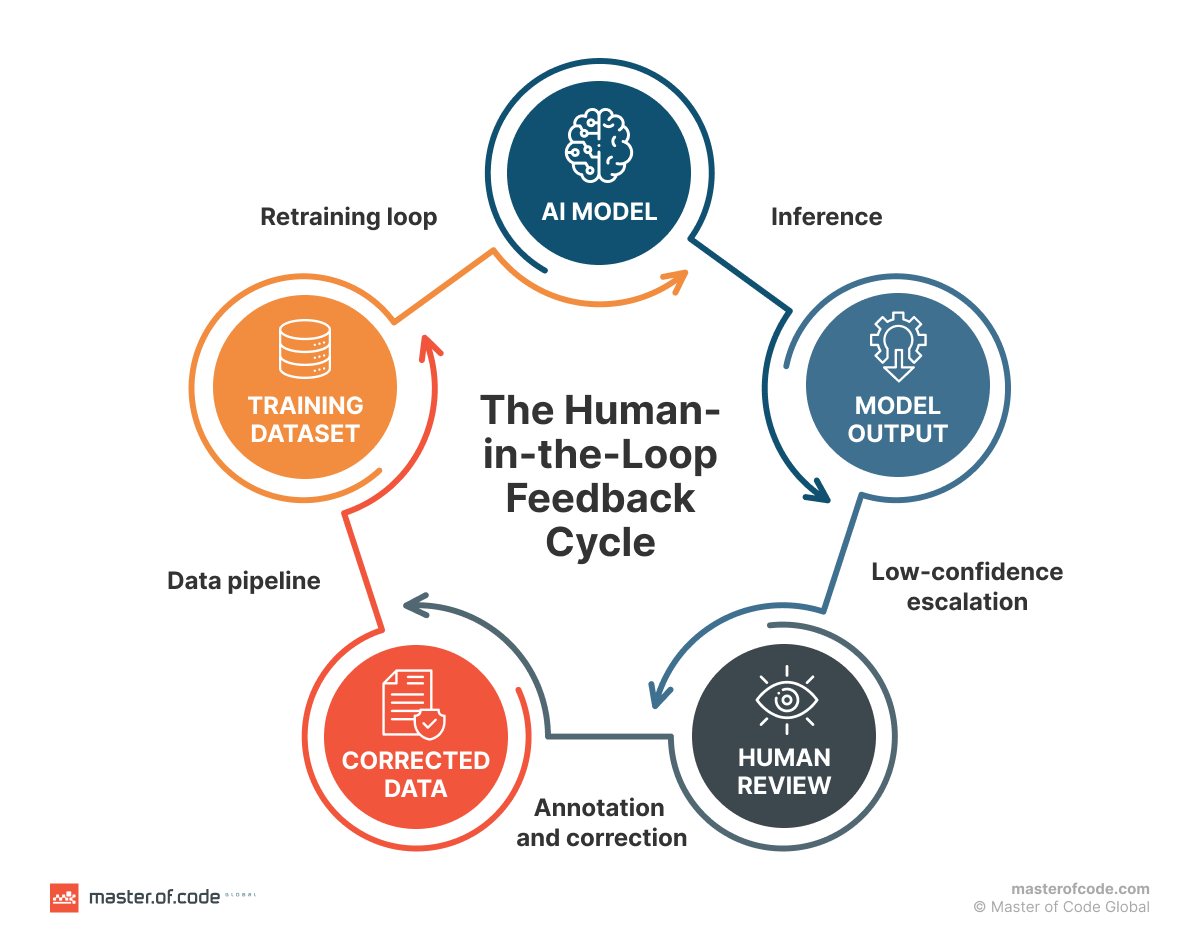
In practice, human involvement appears at multiple stages of the pipeline:
- Data annotation and labeling: humans tag or correct training data.
- Model training: human preference feedback shapes model behavior.
- Inference: low-confidence outputs are routed for review.
- Post-deployment: corrections get back into retraining via a feedback loop.
Each touchpoint targets a different class of error. Accuracy, in this context, covers more than a top-line classification score. A Springer review identifies three collaboration modes:
- active learning (system directs human labeling effort),
- interactive machine learning (tighter real-time collaboration), and
- machine teaching (domain experts control the learning process).
Across all three, the relevant metrics include calibration, false-positive rate, escalation precision, and downstream business error rates.
Transparency and explainability follow naturally from this design. When a human is part of the decision path, there is an audit trail, which matters for debugging, accountability, and regulatory justification. A model optimized entirely on benchmarks can still behave like a black box in production when it encounters inputs outside its training distribution, one of the reasons AI startups fail.
HITL, Human-on-the-Loop, and Human-in-Command: What Sets Them Apart
The three modes differ in how tightly the human is coupled to each decision:
- Human-in-the-loop: human input or approval required at defined decision points.
- Human-on-the-loop (HOTL): system acts autonomously; human monitors and can intervene on exceptions.
- Human-in-command: humans retain authority over whether, when, and how the AI system is used and can override, restrict, or stop it. This differs from human-out-of-the-loop, where the system acts with full autonomy and no contemporaneous human oversight mechanism exists.
| Oversight mode | How it works | Best fit | Primary accuracy benefit | Main risk |
|---|---|---|---|---|
| Human-in-the-loop | Human approval or correction required for selected decisions or labels | High-stakes or ambiguous cases; scarce-label training | Highest error reduction on edge cases; full auditability | Latency and labor bottlenecks |
| Human-on-the-loop | System runs autonomously; humans monitor and intervene on exceptions | Medium-risk, high-volume operations | Good safety net if escalation policies are calibrated | False reassurance from silent model failures |
| Human-in-command | Humans govern system use and retain override authority | Systems requiring policy-level control and accountability | Clear human authority over system operation | Limited review of individual decisions |
These modes are not mutually exclusive within a single system. A production deployment can use HITL for high-stakes outputs, HOTL for medium-risk volume, and full automation for stable low-risk tasks, with escalation logic routing between tiers based on confidence thresholds and business rules.
Human oversight becomes a functional necessity in high-stakes workflows where traceability and accountability are paramount. In scenarios involving direct human liability, the model cannot be the final authority, as critical errors cannot be dismissed as mere system bugs.
How Human-in-the-Loop AI Works
HITL is not a single mechanism. It operates differently depending on where in the pipeline humans intervene and what kind of signal they provide. The four core patterns cover the full lifecycle from training data to deployed inference.
| HITL pattern | Human role | Typical trigger | Latency | Scalability | Best use |
|---|---|---|---|---|---|
| Full manual adjudication | Approves every decision | Every case | High | Low | Very high-risk, low-volume |
| Threshold-based escalation | Reviews low-confidence cases | Confidence below threshold | Medium | Medium-high | Document extraction, fraud, moderation |
| Active learning | Labels selected training samples | Uncertainty or novelty | Offline | High | Scarce labels, fast drift |
| Model-in-the-loop annotation | Corrects AI pre-labels | Batch annotation | Offline | High | Large corpus creation |
| Audit sampling | Spot-checks automated approvals | Random or risk-weighted | Low | Very high | Drift monitoring, compliance |
Active Learning and Uncertainty Sampling
Active learning is the mechanism by which a model identifies examples where its confidence is lowest and routes only those to human annotators. This concentrates expert time on the inputs that teach the model the most.
The three main query strategies are:
- Uncertainty sampling: labels examples closest to the decision boundary, where the model is least certain.
- Query-by-committee: tags instances where an ensemble of models disagrees most.
- Novelty detection: flags inputs that fall outside the training distribution, including edge cases the model has never encountered.
Annotation and Labeling Pipelines
Before a model can learn, someone has to label the data. The structure of that labeling pipeline directly affects what the model learns and where it will fail.
There are three pipeline types, each with different trade-offs:
- Crowdsourced (Amazon Mechanical Turk, Scale AI): high volume, lower cost, suitable for clear-cut labeling tasks where domain expertise is not required.
- Expert-labeled (radiologists, fraud analysts, lawyers): slower and more expensive, but necessary for specialized domains where a wrong label has real consequences.
- Hybrid: AI pre-labels at scale, humans correct errors and handle ambiguous cases. It’s the most common production approach for AI data preparation at enterprise scale.
Quality in supervised learning is measured via inter-annotator agreement (IAA), typically Cohen’s Kappa for two annotators or Fleiss’ coefficient for larger groups. Low agreement does not always mean poor process. Annotator disagreement often surfaces genuine ambiguity that the model needs to learn to handle rather than average out.
This is also where bias enters the pipeline. A single annotator’s labeling decisions embed their assumptions into the training data silently. Multi-annotator review with adjudication is the standard bias mitigation approach: disagreements are flagged, reviewed, and resolved before labels are finalized.
Reinforcement Learning from Human Feedback (RLHF)
Preference-based post-training methods, including RLHF and reinforcement learning from AI feedback, have contributed to the behavioral alignment of systems such as GPT-4, Claude, Gemini, and Llama 2. It is also the most direct evidence that human feedback improves model quality beyond what scale alone achieves.
The pipeline runs in three stages:
- Supervised fine-tuning: the model is trained on human-written demonstrations of desired behavior.
- Reward modeling: human raters rank multiple model outputs against each other; a reward model is trained to predict those preferences.
- Policy optimization: the model is updated using an optimization method such as Proximal Policy Optimization to increase the reward model’s score.
The result is a model that reflects human judgment rather than just statistical patterns in pretraining data. This is what separates a base model from a usable one. LLM limitations rooted in pretraining are substantially reduced through this feedback loop.
One design risk applies: reward hacking. The model can learn to maximize the reward model’s score without actually improving its outputs, exploiting gaps between the proxy metric and genuine human intent. This is Goodhart’s Law applied to model alignment.
For teams concerned about LLM hallucination in production, RLHF and its variants are the current standard intervention.
Confidence Scoring and Escalation Logic
Not every inference needs a human. The practical challenge in any HITL deployment is deciding which ones do. Escalation logic is the routing mechanism that answers that question at runtime, based on model confidence, business rules, or both.
The most common triggers are:
- Confidence threshold: output is routed for human review when the model’s confidence score falls below a defined value.
- Business rules: certain input types escalate regardless of confidence, transaction size in fraud, patient category in healthcare, contract value in legal review.
- Out-of-distribution detection: inputs that fall too far outside the training distribution are flagged before the model attempts a prediction.
The design decisions that follow each trigger matter as much as the trigger itself. What is the fallback if no reviewer is available? How quickly does a human decision re-enter the AI SDLC as a labeled example? A “dead loop”, where human corrections are collected but never fed back into retraining, is one of the most common failure modes when moving from AI Pilot to production.
Building HITL into an AI pipeline involves trade-offs at every stage, from annotation tooling to escalation logic and retraining frequency. Tell us about your workflow, and we will identify where human oversight will have the most impact.

How HITL Improves AI Accuracy: The Evidence
HITL AI accuracy improvements come from three distinct mechanisms, each with its own evidence base: better training signal through active learning, behavioral alignment through RLHF, and inference-time correction of edge cases at deployment.
Active Learning Cuts Label Requirements Without Sacrificing Accuracy
It improves model quality not by adding more data, but by adding the right one. By routing only the most uncertain examples to human annotators, it concentrates labeling effort where it produces the greatest accuracy gain per label.
Hoarau et al. research found that active learning can cut labeling costs by up to 91% while staying within a 2% accuracy loss. In constrained-budget settings, this means reaching production-quality accuracy with a fraction of the annotation cost.
The gains are not universal. Mittal et al. found that for deep image classification combined with strong data augmentation, active learning methods barely outperform a random labeling baseline. The practical implication: validate active learning against a random sampling baseline for your specific task before scaling annotation spend.
RLHF: Human Feedback Improves What Scale Cannot
The clearest evidence that human feedback improves model quality comes from InstructGPT. OpenAI trained a 1.3 billion parameter model using RLHF and compared it against the 175 billion parameter base GPT-3. Human raters preferred the smaller, RLHF-trained model. The quality gap between a model trained with human feedback and one trained without it was larger than a 100x difference in model size.
The same paper measured accuracy improvements across three dimensions:
- Hallucination rate on closed-domain tasks: 41% (GPT-3) down to 21% (InstructGPT), a 20 percentage-point reduction.
- Toxic output in the respectful prompt condition: approximately 25% lower.
- Truthfulness on the TruthfulQA benchmark: roughly twice as many correct answers.
GPT-4’s technical report describes RLHF post-training as producing “large improvements” on TruthfulQA over GPT-3.5, where the base model alone showed only marginal gains. The behavioral improvement comes from the feedback stage, not the pretraining.
DeepMind’s Sparrow extends this finding to rule-following. Trained with targeted human judgments, Sparrow violated its own safety rules only 8% of the time under adversarial probing, roughly three times more robust than the baseline dialogue model.
One limitation applies across all RLHF systems: the alignment tax. Fine-tuning on human preferences can cause small regressions on standard NLP benchmarks, as the model trades raw capability for behavioral compliance. It is a known trade-off, not a reason to avoid RLHF, but it needs to be accounted for in AI agent evaluation.
Human + AI Outperforms Either Alone, When the Design Is Right
The npj Digital Medicine study tested what happens when deep learning and human review are combined. The human + AI swarm outperformed individual radiologists, crowd-sourced readers, and the AI model working alone. Combined performance was not the average of the two: it exceeded both.
The finding does not generalize automatically. A Nature Medicine found marked heterogeneity in outcomes. When the AI was accurate, human performance improved. When the AI was wrong, aggregate radiologist performance deteriorated. Experience did not reliably predict who would be affected.
This is automation bias: the tendency of human reviewers to defer to AI output rather than apply independent judgment. It is the primary mechanism by which human oversight in AI can reduce accuracy rather than improve it. Bias mitigation here is an interface design problem. One proposed safeguard is a human-first workflow in which reviewers record an initial judgment before seeing the AI output.
What Human-in-the-Loop AI Gets Right, and Where It Breaks Down
HITL introduces measurable accuracy benefits at specific points in the pipeline, and measurable costs at others. Both sides need to be designed for.
What it gets right:
- Edge case handling: Models fail most often on inputs they have not seen. Human review at inference catches out-of-distribution inputs, rare event classes, and ambiguous cases before errors reach production.
- Bias detection before propagation: Annotator disagreement during labeling surfaces ambiguity in the training data. Caught early, it is a signal. Left unreviewed, it becomes a systematic model failure.
- Auditability for regulated environments: When a human approves or corrects a decision, there is a traceable record. This supports explainability requirements across financial services, healthcare, and legal applications where decisions must be justified.
- Regulatory compliance: EU AI Act requires high-risk AI systems to be designed for effective human oversight. HITL is the primary architectural mechanism for meeting that requirement.
- Sample efficiency: Active learning reduces annotation cost without proportional accuracy loss. In budget-constrained or expert-label-dependent domains, this is often what makes a project feasible.

Where it breaks down:
- Scalability bottleneck: Human annotation capacity does not scale with data volume. As throughput requirements grow, HITL becomes the ceiling.
- Latency: Synchronous human review adds delay. In real-time systems, fraud detection, or high-frequency operations, review queues can become the primary source of system lag.
- Automation bias: As covered in the previous section, human reviewers tend to defer to AI output. When the model is wrong, this deference makes outcomes worse than no AI assistance at all. This is documented across radiology, with Dratsch et al. showing accuracy drops 36.8 percentage points among experienced readers when the AI suggested the wrong answer.
- Annotator disagreement and bias: Single-annotator labels embed individual assumptions silently. Without multi-annotator review and adjudication, bias mitigation at the labeling stage is largely theoretical.
- Diminishing returns: As a model matures on reviewed data, the marginal value of each additional human correction decreases. HITL-trained models can also underperform when the oversight layer is removed, creating dependency risk in production.
The failure modes covered above are common across production AI deployments, and most teams only discover them after they have already affected output quality. If you want to see how well-instrumented HITL systems are structured in practice, talk to our MLOPs consultants, we are happy to share what works.
How Human-in-the-Loop AI Performs Across Industries
Each sector has a different error cost, data scarcity profile, and regulatory context that shapes how human oversight is designed and where it delivers the most value.
Healthcare and Medical Imaging
Healthcare produces some of the strongest quantitative evidence for HITL workflows. A npj Digital Medicine meta-analysis of 36 studies found:
- Concurrent AI assistance reduced clinician reading time by 27.2%;
- AI as second reader reduced reading quantity by 44.47%;
- Relative sensitivity improved to 1.12 with no meaningful specificity loss.
Real-world deployment results align with these findings:
- MASAI trial (The Lancet Oncology): 44.3% reduction in mammography screen-reading workload while maintaining a similar cancer detection rate to standard double reading.
- Nationwide AI-supported screening study: cancer detection rate 6.7 vs. 5.7 per 1,000, a 17.6% increase.
- EyeArt diabetic retinopathy system: 96% sensitivity, 88% specificity (PMC).
Some FDA-cleared autonomous AI systems can issue screening results without physician interpretation. Human involvement remains necessary for high-stakes clinical follow-up, including referral, diagnosis, and treatment decisions.

Financial Services and Fraud Detection
In fraud detection, HITL is a sample efficiency problem. Kadam found that routing approximately 0.28% of transactions to subject matter experts for review produced:
- AUC improvement of 7.24% across the PFFD dataset;
- Recall improvement of 6.81%;
- Graph-based model (GTAN) AUC progression: 0.88 without feedback, 0.94 with HITL feedback, 0.96 with feedback propagation.
The practical implication: a small number of high-quality human corrections, targeted at the right transactions, produces outsized accuracy gains.
Legal and Document Review
AI-assisted contract review follows a clear pattern: AI handles volume at speed, humans handle ambiguity and liability. LawGeex study compared AI against 20 experienced lawyers on NDA clause identification:
- AI: 94% accuracy, 26 seconds average review time
- Human lawyers: 85% accuracy, 92 minutes average review time
Note: this was a vendor-sponsored study with academic advisors from Stanford and USC. The accuracy premium holds, but the framing is commercial. In production, AI routes ambiguous or high-value clauses to lawyers rather than replacing them, accuracy on edge cases is where human review earns its place.
When to Use HITL: A Framework for Decision-Makers
Adding humans to a workflow does not automatically improve it. The decision of where and how to apply HITL is an engineering and risk question. It starts with two variables: the cost of an error and whether that error is reversible. Everything else follows from there.
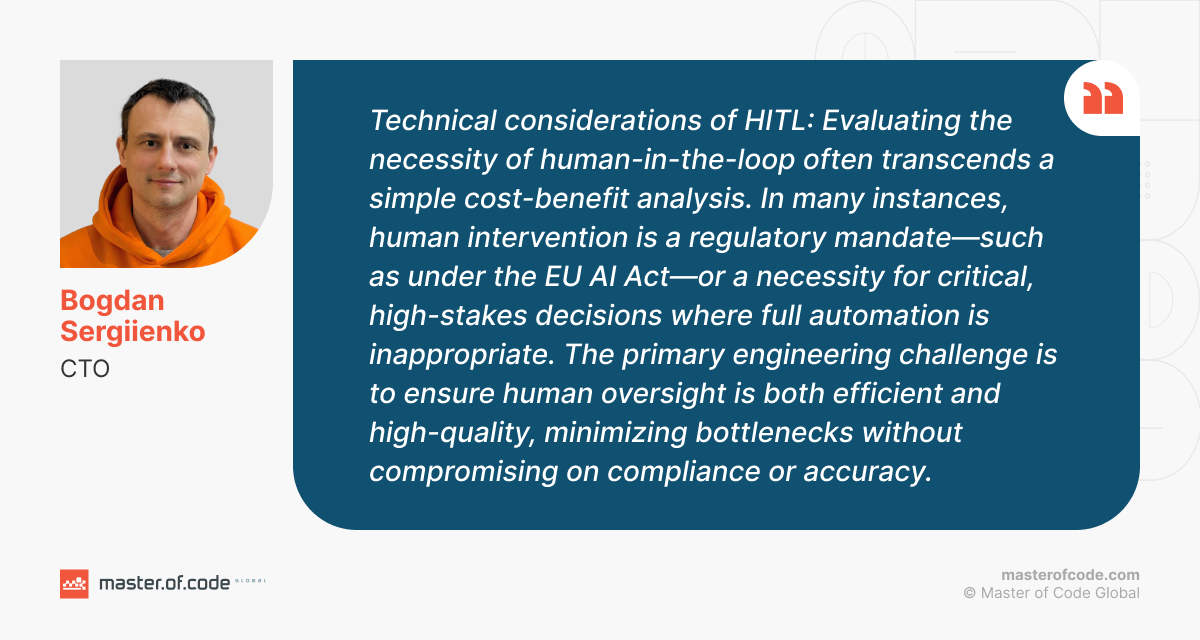
Evaluating the necessity of human-in-the-loop often transcends a simple cost-benefit analysis. In many instances, human intervention is a regulatory mandate, such as under the EU AI Act, or a necessity for critical, high-stakes decisions where full automation is inappropriate. The primary engineering challenge is to ensure human oversight is both efficient and high-quality, minimizing bottlenecks without compromising on compliance or accuracy.
McKinsey’s survey found only 18% of organizations had an enterprise-wide AI governance council with real authority. For most teams, the table below is a practical starting point for closing that gap as part of a broader enterprise AI strategy.
| Decision context | Recommended oversight | Why | Key consideration |
|---|---|---|---|
| High-stakes, low-volume | Synchronous human approval on risky cases | Error cost dominates latency cost | Build evidence-rich queues and full audit logs |
| High-volume, moderate-risk | Threshold-based escalation + audit sampling | Throughput matters; drift is real | Invest in calibration, sampling, and observability |
| Fast-drifting adversarial domain | Active learning with tight feedback loop | Historical labels decay quickly | Budget for continuous ops, not one-off builds |
| Strong compliance / regulatory requirement | Human review with documented appeal path | Automation alone may be legally insufficient | Preserve provenance, logs, and override actions |
| Stable, low-risk, high-volume | Full automation | Human review adds cost without material accuracy benefit | Monitor for silent drift via periodic audit sampling |
Once the oversight tier is set, track whether it is actually working. Two signal sets matter:
Signs HITL is functioning:
- Model error on human-reviewed slices falls over time;
- Inter-annotator agreement is high and stable;
- Override rate reflects genuine disagreement, not rubber-stamping.
Signs it is becoming a bottleneck or failing:
- Review queues grow faster than capacity;
- Override rate is near zero (automation bias in operation);
- Human corrections are collected but not feeding retraining;
- Latency is breaching SLAs.
If corrections are not re-entering the AI training services pipeline, the oversight is nominal. Drift detection, override rate monitoring, and IAA tracking should be standard observability requirements from the start.
Not every system needs the same level of oversight, and getting the tier wrong in either direction is costly. If you are unsure where your use case sits or how to structure the escalation logic, start with AI Pilot to validate it before committing to a full build.
FAQs
What is human-in-the-loop AI?
Human-in-the-loop AI is a system design in which a human participates in the AI’s decision process at defined points, during training, evaluation, or live inference. The model cannot complete those steps without human input, correction, or approval.
What are the best practices for human-in-the-loop in AI?
- Match oversight intensity to error cost.
- Close the feedback loop: human corrections must feed back into retraining.
- Instrument for automation bias by tracking override rate and human accuracy when the model is wrong.
- Validate active learning against a random baseline before scaling annotation spend.
- Set inter-annotator agreement targets before labeling begins.
How does human-in-the-loop improve AI accuracy?
Through three mechanisms: active learning concentrates labeling effort on the examples that teach the model most, reducing label requirements while maintaining accuracy; RLHF aligns model behavior with human judgment, cutting hallucination rates; and inference-time review catches edge cases and out-of-distribution inputs before errors reach production.
How to implement human-in-the-loop AI approvals?
Define confidence thresholds and business rules that trigger escalation, then route low-confidence or high-risk outputs to a human review queue. Each approved or corrected decision should be versioned and re-enter the training pipeline as a labeled example.
Conclusion
Human-in-the-loop AI improves accuracy when human effort is targeted at model brittleness, structured to feed corrections back into training, and protected by interface design that prevents automation bias. The evidence across LLM alignment, fraud detection, and medical imaging is consistent on this point. What varies is the design quality, and that is where most implementations either succeed or quietly fail.
If you are designing oversight into an AI system or auditing one that is already in production, contact Master of Code Global to schedule a consultation. We will review your current setup, identify where human oversight is adding signal and where it is creating friction, and outline the changes that will have the most impact.