


If you are a business owner, a Chief Innovation Officer, or an asset manager, your firm likely completed its core digitalization strategy years ago. You use best-in-class CRMs, your listings are cloud-hosted, and your transaction documents are often e-signed.
Yet, despite this extensive technology stack, the pursuit of exponential growth – the true velocity of deals, the hyper-accuracy of forecasting, and the seamless tailoring of the client experience – remains agonizingly slow. The reason is simple: the industry is currently stalled at the Digital Plateau.
Current PropTech is fundamentally optimized for processing and storage, not for creation. This design limitation introduces a costly bottleneck: data translation.
Consider the drain on your executive resources:
- Due Diligence Lag: Analysts waste days manually summarizing key risks from 500-page lease portfolios, slowing transaction velocity and increasing risk exposure.
- Non-Scalable Content: Generating distinct, customized investment memos for ten different institutional investor profiles is a manual, high-cost burden on your top talent.
- Market Inflexibility: Your marketing timeline is dictated by the slow, expensive process of outsourced staging or visualization, not the speed of market opportunity.
Your core systems are effective at speeding up clerical transactions, but they are paralyzed when asked to generate proprietary assets and foresight.
This is the strategic paradox. Deloitte’s survey confirms that 72% of owners and investors are funding AI solutions. Yet, over 60% admit that legacy technology still blocks successful adoption. The ambition is high, but the infrastructure is holding back the execution.
The executive mandate is to move from reactive analysis to proactive creation. Your siloed history is valuable, but Generative AI in real estate unlocks its full potential, transforming your institutional knowledge into actionable hyper-foresight (what will happen and what can be created).
To understand the magnitude of this shift and the cost of delaying, we must dissect the specific, high-ROI applications that are already changing the sector’s value chain, from automated marketing to deep investment analysis.
Table of Contents
What Is Generative AI in the Real Estate Industry?
Let’s forget about the white papers and the academic definitions. The distinction is simple:
- Predictive AI (ML) is your Calculator, as it crunches history to forecast market risk or asset valuation.
- GenAI, on the other hand, is your Creator. It takes those raw data points and, in a flash, crafts the proprietary outputs you need: custom staging renders, executive-ready due diligence summaries, or precise investment memo narratives tailored to a specific fund.
You can compare this to the Chief Innovation Officer in code. GenAI in real estate doesn’t only process data; it transforms your siloed institutional knowledge into polished, client-facing outputs. This liberates your highest-paid talent to focus on negotiation and closing, not content synthesis.
Do you think this shift is a future trend? No, it’s already a capital priority right now. North America is leading, commanding over 56% of the global PropTech market share, demonstrating concentrated investment velocity. More critically, over 64% of this spending targets the software segment. This confirms that executives are prioritizing embedding such proprietary intelligence engines directly into their existing enterprise systems. But the wave isn’t limited to just housing either. Commercial and industrial sectors are stepping up their GenAI commitment, recognizing its immediate, complex value in areas like lease administration and large-scale asset management.
For measurable executive ROI, generative technology provides two non-negotiable advantages:
- Velocity: We’re talking about eliminating creative and administrative friction to aggressively shrink Time-to-Market and Time-to-Decision. This capability gives your asset managers transaction speeds and market responsiveness that manual, legacy competitors simply cannot replicate.
- Conversion: This is Hyper-Personalization at scale. GenAI ensures every client touchpoint is uniquely tailored. From the property visual and localized copy to the investment narrative, models are driving deep engagement and measurably tightening the lead-to-client funnel.
Implementing GenAI for real estate processes isn’t about chasing minor efficiency gains; it’s about architecting a proprietary execution advantage to ensure your firm’s sustained competitive position.

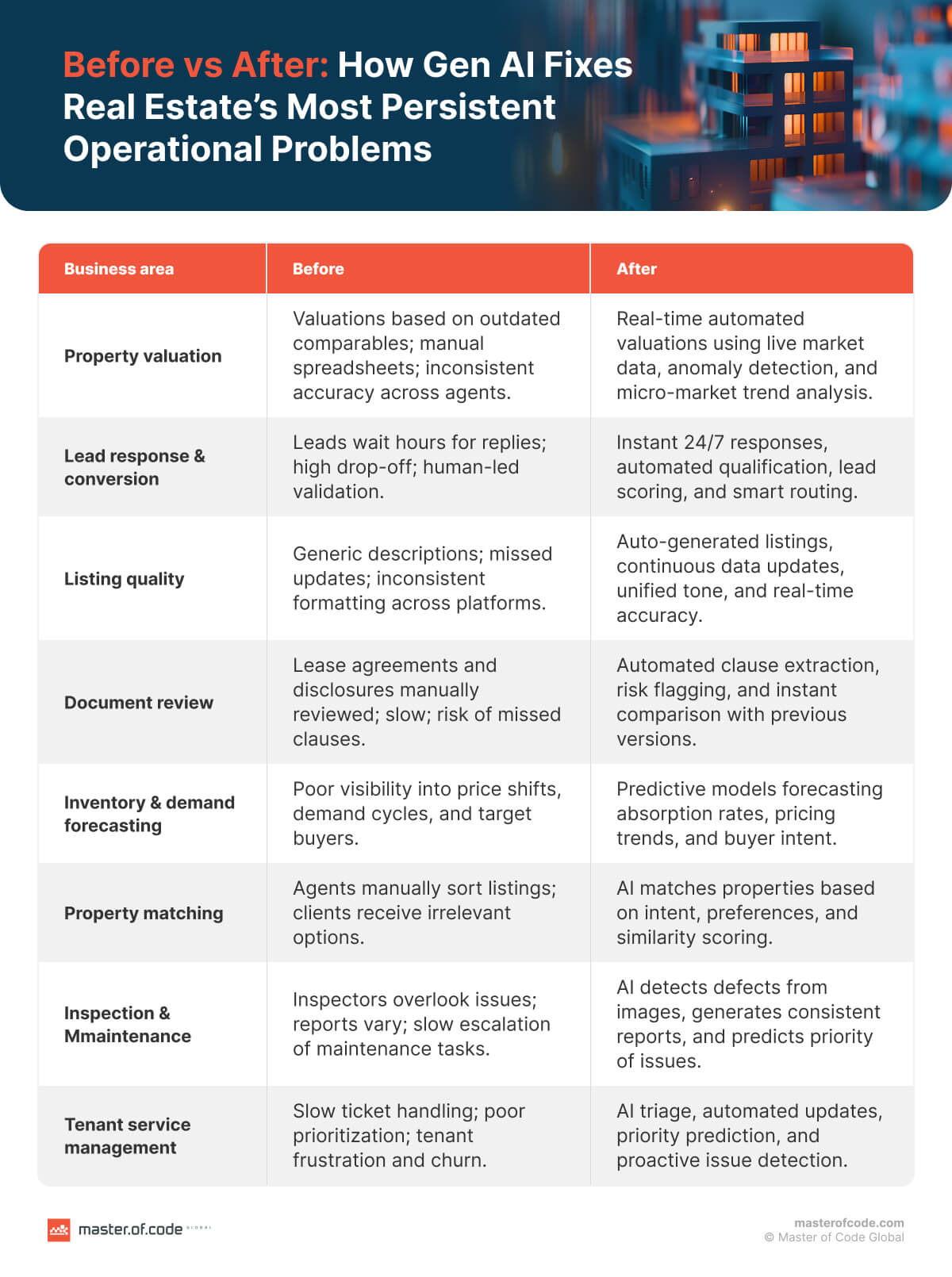
Real Estate’s Most Impacted Areas by Generative AI and Their ROI Benefits
Innovative tech is not a portfolio option. So, you should treat it as a mandatory operational upgrade designed to eliminate specific, costly bottlenecks. 100+ executives surveyed by DealPath are demanding and projecting significant gains from this technology. They anticipate:
- 61% faster deal evaluation and closing;
- 61% increased operational efficiency;
- 50% more accurate underwriting;
- 43% higher deal velocity.
Let’s discover how Generative AI applications in real estate may deliver these results by fundamentally restructuring five core functions.
Lead Generation and Client Engagement
The Friction Point: Your highest-paid talents are wasting critical hours on manual triage, sifting through high-volume, low-intent leads. This inefficiency delays interaction with your most valuable prospects.
The Solution: AI automatically segments clients based on subtle behavioral data, then instantly delivers hyper-personalized property recommendations. Furthermore, advanced virtual assistants handle the initial grind, autonomously pre-qualifying intent and scheduling high-priority follow-ups.
The Payoff: By automating the low-value administrative work with GenAI real estate tools, you maximize agent capacity. Your sales force focuses entirely on closing, which directly reduces marketing expenditure on unqualified leads and measurably boosts conversion rates.
Marketing Content and Campaigns
The Friction Point: Scaling quality content – SEO copy, high-impact blogs, and email campaigns – across hundreds of listings while maintaining consistent brand voice and local market relevance creates a severe production bottleneck.
The Solution: Smart models can generate relevant real estate content, acting as a flexible production engine. It automates high-volume asset creation: property descriptions tailored for specific buyer segments, localized social media updates, and virtual tour scripts. Crucially, this content is continuously optimized based on real-time engagement data, ensuring every asset hits the target.
The Payoff: Your teams deliver exponentially more targeted, high-quality assets instantly. This drastically slashes content production overhead and accelerates sales velocity, ensuring your listings are market-ready the moment the acquisition closes.
Property Valuations and Smart Pricing
The Friction Point: Traditional AVMs and retrospective data introduce subjectivity and errors. This leads to suboptimal pricing, prolonged time on market, and missed opportunities in volatile or fast-moving submarkets.
The Solution: Generative AI in real estate synthesizes a proprietary mix of current market data, evolving economic trends, and, critically, your firm’s proprietary transaction history to generate dynamic property valuations. This system constantly adjusts pricing for optimal yield and speed.
The Payoff: Data-driven pricing minimizes time on market and ensures maximum yield realization. This delivers a critical competitive advantage in both negotiating acquisitions and establishing listing price credibility.
Customer Support and Communication
The Friction Point: Your firm’s professionals are frequently diverted from strategic work (negotiation, relationship building) to answer repetitive inquiries about property details, availability, or transaction status. This administrative drain slows the core business.
The Solution: AI real estate chatbots, trained specifically on your internal policies and FAQs, provide instant, 24/7 responsiveness. They accurately handle routine customer communications, from property specifics to appointment scheduling, resolving basic issues without human intervention.
The Payoff: Higher client satisfaction scores and a direct, measurable reduction in support staffing overhead.
Contract and Document Automation
The Friction Point: Manual contract drafting and paper review is time-consuming, inherently error-prone, and introduces significant compliance risk, unnecessarily extending transaction cycles.
The Solution: With Generative AI in real estate in place, you can automate the drafting of first-pass contracts, leases, and disclosures, ensuring immediate regulatory compliance and precise tailoring to specific terms. It simultaneously acts as a digital auditor, instantly scanning processed documents for discrepancies or missing clauses before they become legal liabilities.
The Payoff: Deals move forward with higher integrity and speed, eliminating manual friction. This structural acceleration directly contributes to the higher deal velocity across the company.
Generative AI Use Cases in Real Estate
The discussion now moves from anticipated ROI to tactical execution. For industry leaders, current statistics confirm the highest-value applications: 67% of firms are focused on automated document analysis, 61% on portfolio monitoring, 56% on investment memo creation, and 49% on extracting data from offering memorandums and flyers. These are the core areas where innovative technology is already restructuring workflows and delivering proprietary advantages.
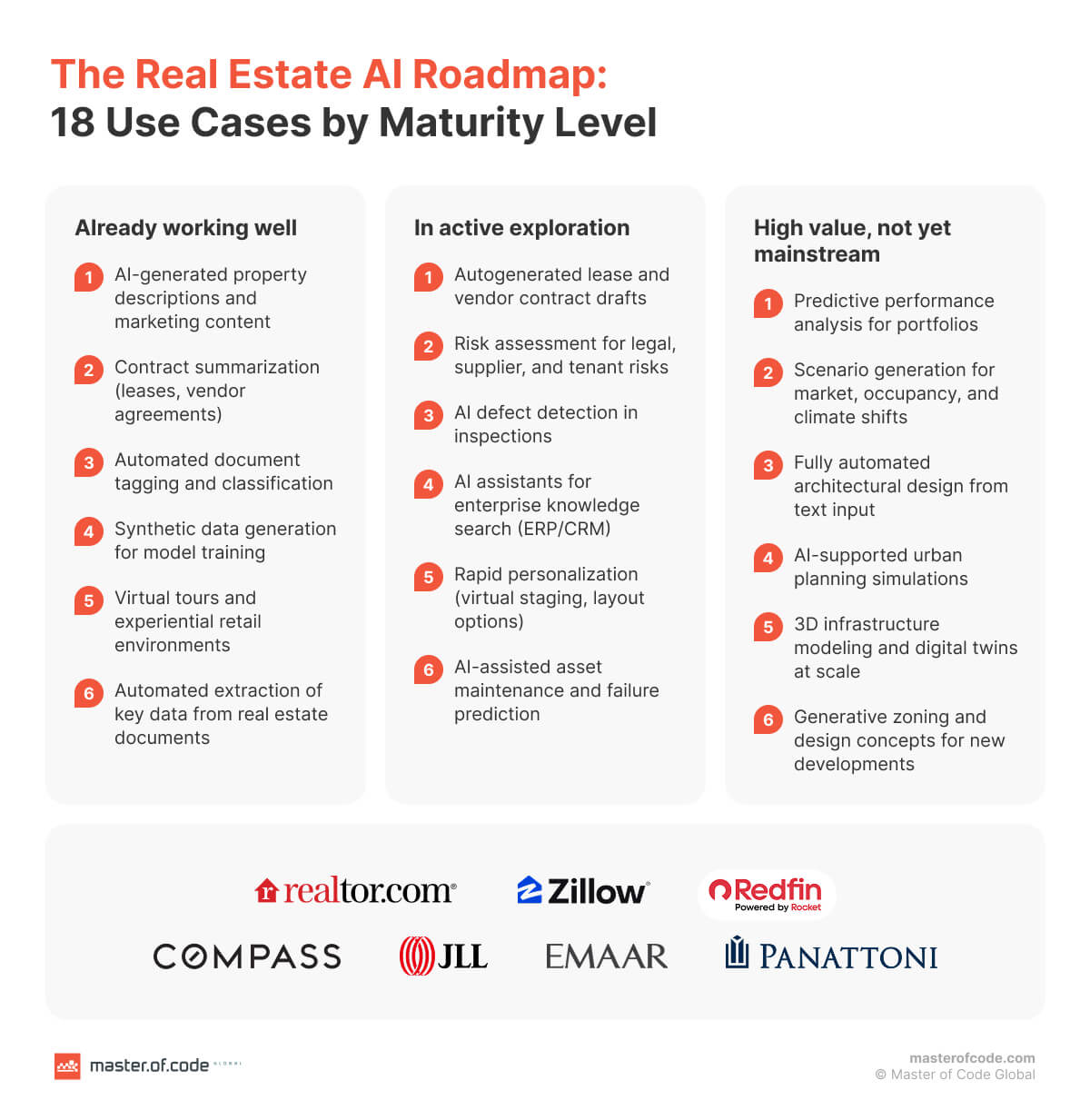
Text-Generative AI Use Cases
Automated Property Descriptions & Listings
Manually-written texts often consume valuable agent or marketing time, resulting in standardized copy that lacks creative differentiation and SEO power. GenAI bypasses this by crafting compelling, unique narratives based on key features, hyper-local market insights, and target buyer profile. The result is instantaneous consistency and maximum online visibility, which significantly increases listing speed and improves the initial customer experience.
Personalized Property Recommendations
Buyers are usually overwhelmed by choice and struggle to find properties that genuinely match their needs. Generative AI in commercial real estate addresses this by analyzing deep purchase preferences, detailed past search behavior, and external factors (like localized economic conditions). It then synthesizes these inputs to suggest highly relevant properties, accompanied by tailored rationales. This approach reduces lead churn and measurably increases buyer satisfaction, driving higher conversion rates.
Automated Market Analysis Reports
The traditional market analysis process is notoriously time-consuming, often delivering reports that are outdated the moment they are printed. AI tools eliminate this lag by outputting complex, up-to-the-minute market trend reports. These documents synthesize vast amounts of structured and unstructured data, providing actionable insights into property values, demand forecasts, and investment opportunities tailored to specific submarkets.
Customer Support & AI-Powered Communication
Handling the continuous stream of repetitive questions, FAQs, and basic administrative inquiries consumes valuable agent bandwidth. Conversational AI for real estate provides instant, accurate, 24/7 responses to questions about listings, processes, and services. The value is clear: reduced client service costs, near-instant response times, and superior engagement.
Image-Generative AI Use Cases
Virtual Staging for Properties
Traditional physical or outsourced digital staging is a major expense and a constraint on time-to-market. AI generates sophisticated virtual staging images of properties, enhancing visual appeal at a fraction of the cost. This functionality accelerates property turnover by allowing properties to be marketed immediately, boosting online listings and attracting higher initial views.
Property Visualization & Floor Plan Generation
A buyer’s inability to see a space’s potential – especially for vacant lots or properties needing renovation – is a significant barrier to sale. The AI solution is to create high-quality, 3D renderings and virtual walkthroughs. A key feature is the ability to instantly generate property layouts and visualizations based on simple sketches or architectural parameters. This dramatically improves remote buying experiences and provides a clearer understanding of objects’ potential, accelerating the decision cycle. These are just early applications of Generative AI in design and planning that allow developers to rapidly prototype conceptual spaces.
Image Enhancement and Restoration
Low-quality or older photos in listings diminish buyer interest and erode credibility. With AI in place, you can upgrade property images to high-quality standards, leveraging advanced algorithms to repair low-resolution, poorly lit, or aged photographs. This ensures a professional online presence, guarantees a better first impression, and drives higher engagement rates on all listings, particularly for legacy portfolios. The strategic use of AI generated real estate images fosters brand consistency and visual appeal at scale.
Predictive & Decision AI Use Cases
Portfolio Optimization
This area is often under-optimized due to the sheer complexity and manual nature of analysis. Intelligent models assess market trends, property performance, risk exposure, and growth potential to offer data-driven recommendations on which assets to acquire, dispose of, or reposition. This way, you can increase portfolio profitability, significantly mitigating risk, and establishing a clear strategic vision for GenAI in real estate investments.
Smart Pricing Recommendations
It still happens that incorrect price tags lead to extended time on the market, necessitating painful cost cuts or lost yield. AI tools dynamically recommend the most competitive pricing based on real-time market conditions, detailed competitor analysis, and demand patterns synthesized from a vast data corpus. This ensures optimized property pricing, accelerates sales cycles, and maximizes revenue realization. Furthermore, the use of AI to generate virtual tours from static photos is enhancing pre-qualification, so only high-intent buyers physically visit the property.
Automated Property Valuation Models (AVM)
Manual property appraisals are inherently subjective and slow. AI-powered AVMs provide dynamic, high-fidelity valuations by considering current market data, historical trends, comparable sales, and local zoning specifics. This delivers more accurate pricing, faster appraisals, and improved decision-making authority for investment committees and senior partners.
Profitability of Generative AI in Commercial Real Estate (CRE)
CRE operates at a scale of complexity and capital fundamentally different from residential. The primary drivers for success here are mitigating significant risk, administering intricate legal documents, and ensuring long-term asset stability. For executives, GenAI is the specialized instrument for mastering this institutional complexity.
AI for Tenant Lifecycle Management
In CRE, attrition is often the greatest unbudgeted expense. GenAI provides a sophisticated defense by transforming every tenant interaction into predictive intelligence. By analyzing a massive corpus of unstructured text, like maintenance logs, client service records, and leasing queries, the AI constructs powerful models to forecast which consumers are likely to vacate.
With 40% of firms prioritizing rent roll and lease extraction and interpretation, the system can instantly generate personalized, optimized proposals for lease renewals or targeted building improvements. This way, you safeguard critical, long-term cash flow and significantly boost retention rates.
Operational Excellence and Space Efficiency
Asset managers require continuous, high-fidelity insight into physical assets to maximize financial outcomes. Generative AI in commercial real estate supplies exactly this visibility:
- Portfolio Oversight: With 61% of institutional users focused on portfolio performance and monitoring, GenAI synthesizes input from every source. Financial models, internal metrics, and building sensors – everything will be structured into a clear, ongoing efficiency narrative. This facilitates the immediate identification of underperforming assets across a vast holdings array without relying on delayed periodic reports.
- Real-Time Space Utilization: Integrating with IoT and access management systems, AI transcends simple vacancy statistics to analyze movement flow and underused areas within a property. This intelligence helps managers execute fast, data-backed decisions on optimizing floor plans, dynamically adjusting rental tariffs, and reducing empty units by adapting the configuration to proven tenant needs.
Investment Velocity and Due Diligence
The pace and precision of the acquisition cycle dictate successful transaction outcomes and manage enormous exposure. Here is how Generative AI in real estate sector delivers accelerated, scrutinized deal preparation:
- Document Intelligence: Complexity is the single biggest impediment. With 67% of companies prioritizing document deep diving and 49% focused on offering memorandum (OM) extraction, GenAI is deployed to parse thousands of pages of legal, financial, and environmental materials. It instantly extracts crucial commercial terms, risk provisions, and legal irregularities at speed. This dramatically lowers external counsel fees and secures superior data accuracy for financial forecasting.
- Accelerated Underwriting: AI tools use this verified material to speed up the entire transaction timetable. The same DealPath’s survey shows that 56% of companies automate investment memo creation, guaranteeing reports are polished and structurally consistent. When coupled with proactive deal opportunity scoring (37% priority) and AI-recommended comparables (43% priority), this ensures your investment groups concentrate exclusively on high-likelihood prospects.
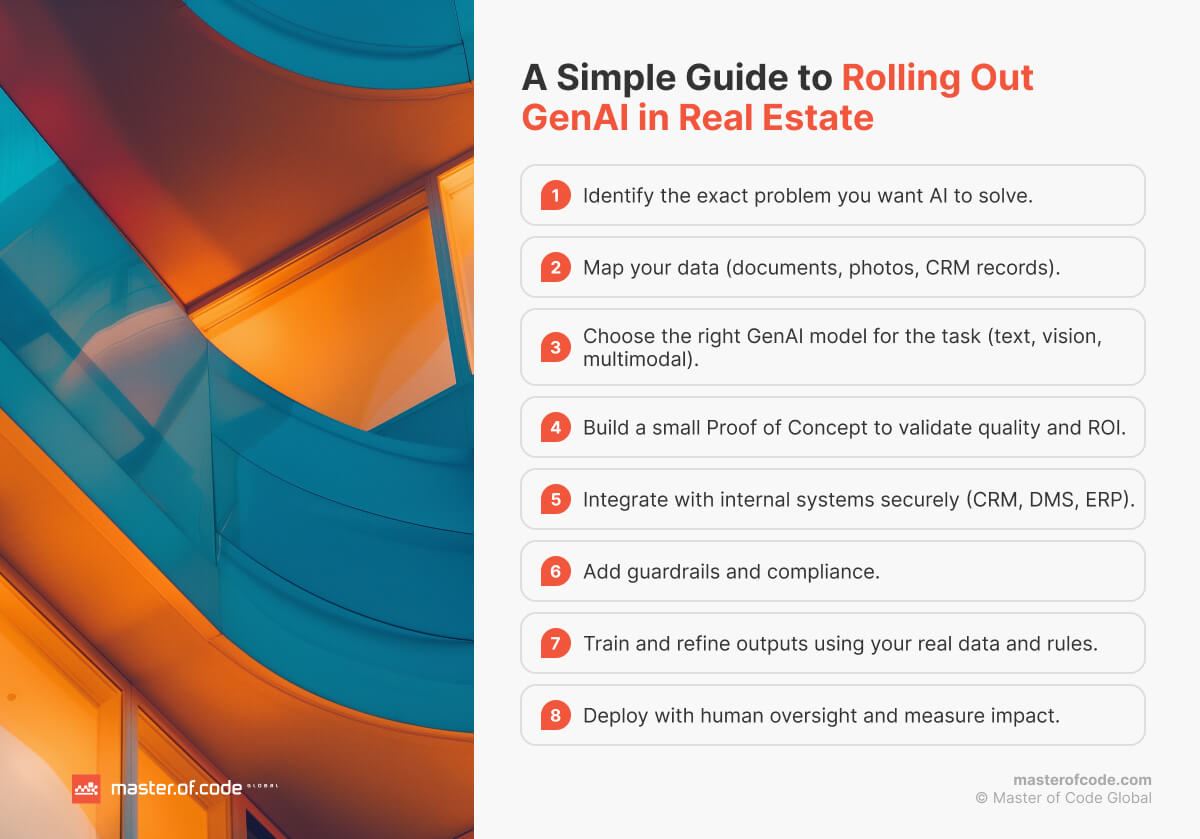
The Future of Generative AI in Real Estate: Long-Term Value
We’ve covered the quick wins – the immediate efficiency bump. But the real game isn’t about shaving minutes off a task. It’s all about building a self-aware, constantly optimizing enterprise. This next phase defines who leads the market ten years from now, establishing a proprietary, sustainable long-term asset.
Data-Driven Decision-Making
This is where the strategy gets truly sharp: achieving prescriptive intelligence. The AI will no longer only flag a predicted rise in commercial vacancies. The model will instantly output the full counter-attack plan, including a tailored leasing pitch, the necessary budget reallocation, and a revised financial mode. So, everything is ready to be executed before the trend even hits your bottom line.
This fusion of forecasting with practical solution creation is the backbone of a successful GenAI strategy for real estate, helping your team move with undeniable speed and certainty on every deal and every asset.
The Rise of AI-Powered Smart Buildings
Forget the old “smart home” gadgets. We’re talking about intelligent, self-managing assets. The combination of Generative AI and IoT means buildings aren’t just sending data but writing their own reports. They process the messy, continuous sensor information, such as from boiler performance logs or security door access, and generate precise, plain-language operational summaries.
This means the building itself flags a subtle failure pattern and forecasts the exact CAPEX needed next quarter. It optimizes energy, tightens security protocols, and anticipates tenant issues, leading directly to lower operational expenses and a rock-solid foundation for tenant retention.
Continuous Learning and Adaptation
This is the ultimate competitive advantage: the self-improving loop you own. The more your custom-built models process your firm’s proprietary data, the smarter and more accurate those models become, specifically for your portfolio. Everything counts: each lease reviewed, property layout generated, or a successful acquisition finalized.
This continuous adaptation allows your AI solution to gain unique intelligence every quarter, creating a competitive moat that those using generic, public models simply can’t cross. And finally, getting the governance right around the ethical use of GenAI real estate guarantees those outputs are unbiased and legally compliant. That integrity is just as vital as speed for earning and keeping investor trust.
Why Choose Us? The Master of Code Global Advantage
The innovation opportunity is clear, but so is the gap: while 100% of institutional investors plan to adopt Generative AI in real estate, 93% of firms face significant barriers. They include expertise deficits, data compliance issues and many more. All this actively stalls progress. In the same research, your peers cite the core roadblocks:
- Lack of internal expertise (43%);
- Regulatory concerns (42%);
- Decentralized data (36%).
Being a trusted GenAI development company, we built our entire partnership model to dismantle these structural problems. Our specialized expertise in real estate AI consulting is precisely how we eliminate those internal knowledge gaps and regulatory concerns upfront. Master of Code Global understands that speed and budget matter most. Thus, we eliminate the costly, time-sucking initial phase by starting with a strategic, fixed-price Proof of Concept (POC). This collaborative step alone reduces potential development waste by 50% to 70%.
We then accelerate the build using our proprietary LOFT (LLM-Orchestrator framework), which delivers 43% less setup effort and ensures 20% budget savings as you scale. This approach guarantees rapid execution without the financial surprises common in custom builds.
For trust and compliance, we provide certainty, backed by ISO 27001 security certification. Our team focuses entirely on tangible outcomes. For example, our track record proves we can deliver results like a 15x revenue increase or tripling conversion rates by tying every technical feature to your core business goals. We solve the complexity so you can focus on the growth.
Let’s begin today with a confidential AI Readiness Assessment to build a concise plan for GenAI implementation in a real estate company. Alternatively, gain immediate assurance and prove ROI by starting with a fixed-price AI Proof of Concept (PoC) to validate the technology on your proprietary data before full deployment.