



Every enterprise has a document problem. Invoices sit in inboxes. Contracts pile up in shared drives. Medical records arrive as scanned PDFs, insurance claims as handwritten forms. The data is there, buried in formats that rule-based systems cannot reliably read and that human teams cannot process fast enough.
For years, OCR (optical character recognition) and RPA (robotic process automation) were the default answer. They work reasonably well on structured, predictable docs. They break down on everything else, and most real-world documentation falls into that category.
That gap is exactly where Generative AI for document processing is having its most immediate impact. Large language models do not need rigid templates. They read context, handle variation, extract meaning from unstructured text, and plug into existing workflows at a scale and accuracy that manual processes and legacy automation cannot match.
This article breaks down how the technology works, where it delivers the clearest business value, and what implementation decisions actually determine whether a deployment succeeds or stalls. For business leaders evaluating document automation, it offers a practical frame for understanding what GenAI changes, what it does not, and how to scope a deployment that moves from pilot to production.
Table of Contents
Key Takeaways
- Generative AI for document processing is replacing template-based automation by enabling algorithms to read context, handle variation, and extract data from unstructured files without fixed rules or manual configuration.
- Large language models process papers the way a person would, understanding that different terms across vendor formats refer to the same field, which makes them effective on complex, inconsistent documents.
- High-volume workflows like invoice processing, contract review, medical records, and regulatory filings are already seeing production-level results, with intelligent document processing times cut by up to 80% and accuracy reaching 99% in mature deployments.
- The benefits of Generative AI in document workflows: scalability, compliance confidence, and cost reduction are all achievable, but only when data readiness, exception handling, and integration are treated as design requirements, not afterthoughts.

What Is Generative AI for Document Processing?
Intelligent document processing (IDP) refers to the use of artificial intelligence to automatically extract, classify, and structure data from files, whether digital, scanned, or handwritten. Generative AI adds a layer of contextual understanding that earlier approaches lack.
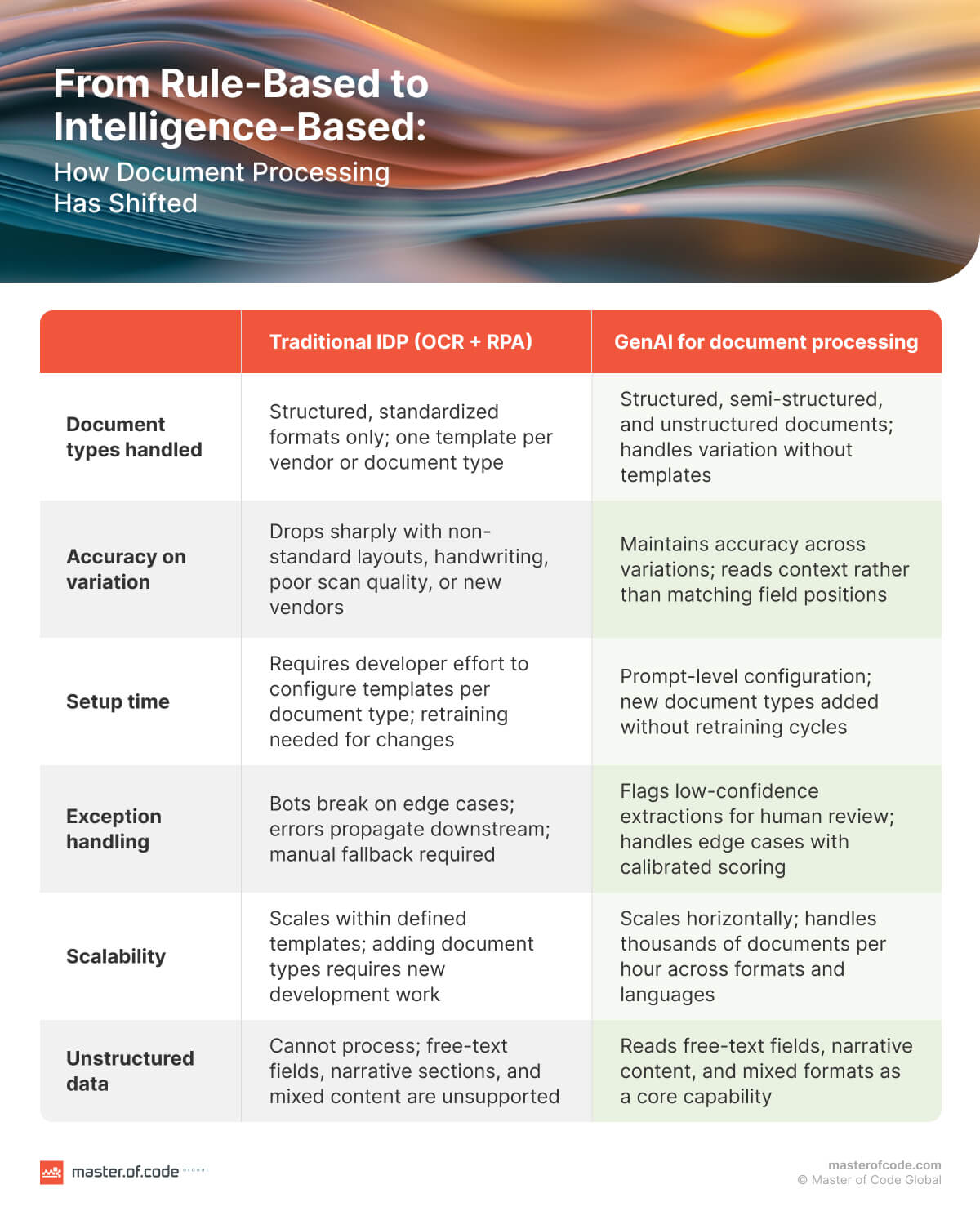
Traditional IDP relied on a combination of OCR (optical character recognition) to convert images into machine-readable text and rules or ML models to extract specific fields. That pipeline works for standardized papers. It fails on edge cases: a contract with an unusual layout, an invoice from a new vendor, a medical chart with inconsistent formatting.
Large language models change the pipeline fundamentally. Instead of matching a field to a template position, an LLM reads the document the way a person would, understanding that “Amount Due,” “Total Payable,” and “Balance Owing” all mean the same thing. It handles variations without retraining. It can summarize, classify, and route files in a single pass.
This is what separates automated document processing powered by GenAI from earlier automation layers. It is not a better version of OCR. It is a different category of capability.
Real-World Example: How Master of Code Global Built an AI-Powered Contract Review Tool
To understand what Generative AI for document processing looks like in practice, consider how Master of Code Global applied it internally.
Bottleneck: each agreement required 2 to 4 hours of manual legal scrutiny, and as deal volume grew, inconsistencies across reviews began creating compliance exposure. Different reviewers flagged different risks, with no standardized coverage across areas like indemnification, jurisdiction, or auto-renewal clauses.
The solution: AI-powered Legal Advisor Tool, a privacy-first contract analysis pipeline that delivers a structured risk report in under 60 seconds. The architecture is designed around the core constraints of text processing in legal contexts: speed, consistency, and strict control over sensitive data.

The pipeline works in several steps.
- Uploaded contracts (PDF or DOCX, single file or batch up to 20) are first passed through a PII anonymization layer: spaCy NER combined with regex patterns strips all personally identifiable information, including names, emails, financial figures, and addresses, replacing them with deterministic tokens held in memory only.
- The anonymized text is then analyzed by Gemini against 12 configurable risk criteria, with clause-level references for each finding.
- Finally, results are de-anonymized and packaged into a structured report with Green, Yellow, and Red risk ratings, an executive summary, identified red flags, and AI-generated negotiation guidance, including suggested counter-language.
The results across 50+ deals analyzed internally:
- contract review time reduced by 2 to 4x compared to the manual-only process,
- GDPR compliance gaps surfaced across new client agreements, and
- new negotiation opportunities identified that manual review had not flagged.
This is a concrete example of what well-scoped automated document processing looks like when the architecture matches the use case: narrow input type (contracts), defined risk criteria, privacy-by-design, and human review preserved for final decisions.
Why Traditional Approaches Hit a Ceiling
OCR, combined with RPA, was the standard answer to document automation for the better part of a decade. It produced real gains in high-volume, low-variation workflows: standardized invoice processing, form digitization, and similar tasks. But the ceiling is well-documented.
OCR limitations are primarily structural. It converts images to text accurately on clean, typed records, but accuracy drops sharply with handwriting, non-standard fonts, poor scan quality, and layouts that include tables, diagrams, or mixed content.
RPA amplifies rather than solves those limits. When OCR produces incorrect output, RPA bots process the error downstream, the classic “bad data in, bad data out” problem. Both technologies are brittle by design: they depend on consistency, and real-world papers are inconsistent.
The deeper issue is that most enterprise unstructured data never gets processed at all. According to MIT Sloan, an estimated 80 to 90% of enterprise data is unstructured, hidden in PDFs, emails, images, and scanned files that template-based systems cannot interpret. This is not an edge case. It is the majority of the volume that most organizations deal with.
Explore the wider landscape of Generative AI use cases to understand where document processing fits alongside other enterprise applications.
How Generative AI Handles Documents
The shift from template-based to intelligence-based data extraction requires a different architecture. Modern GenAI file pipelines combine several components, each addressing a separate layer of the problem.
OCR and Pre-Processing
Optical character recognition remains the entry point for scanned or image-based papers. It converts raw images into machine-readable text. Modern OCR is fast and accurate on typed input. Nevertheless, it still produces output that requires interpretation: column structures, merged cells, and handwritten annotations all require a processing layer that OCR alone cannot provide.
Document Classification
Document classification is the step where an LLM identifies type (invoice, contract, patient intake form, insurance claim, shipping manifest) before routing it to the appropriate extraction workflow. Classification at this level handles variations that rule-based systems cannot:
- a vendor who formats invoices differently from the standard,
- a contract that includes an attached rider,
- a form submitted in an unexpected language.
Contextual Data Extraction
AI-powered data extraction is where LLMs deliver the most visible value. Rather than looking for a specific field at a specific position, the algorithm understands that “Invoice Number,” “Ref:,” and “Document ID” may all refer to the same field across different vendor templates. It extracts meaning, not position.
This contextual capability extends to complex structures: nested tables, conditional clauses in contracts, multi-page medical records where relevant information is distributed across sections. It also handles unstructured data inputs that have no consistent schema at all, including free-text fields, narrative sections, and handwritten notes.
Workflow Routing and Automation
Workflow automation closes the loop. Once data is extracted and structured, LLM-powered agents can
- route it to downstream systems (ERP, CRM, claims management platforms),
- trigger follow-up actions,
- flag anomalies, and
- escalate exceptions to human reviewers.
The result is a document automation pipeline that handles most volume without manual intervention, while preserving human oversight for the cases that need it.
Core Use Cases of Generative AI for Document Processing
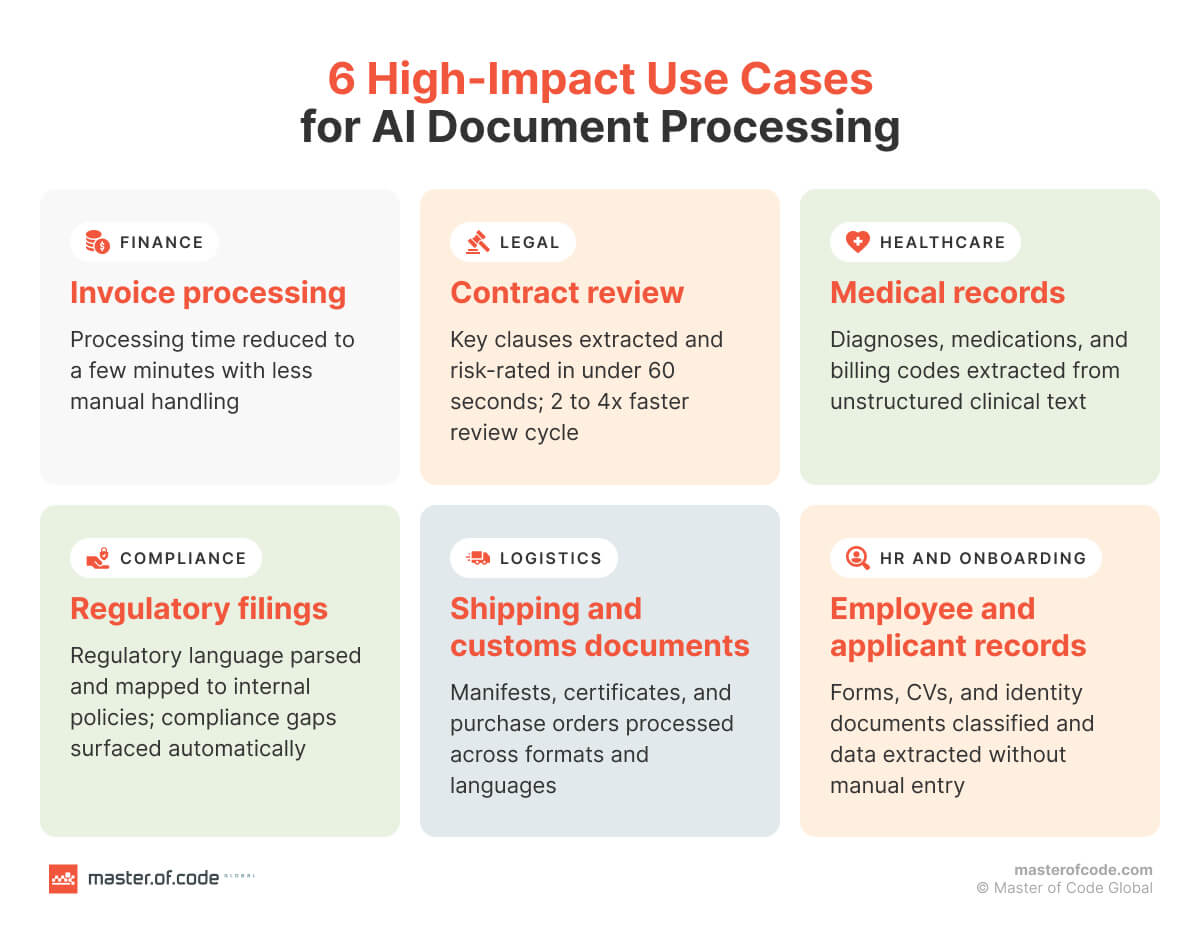
The benefits of Generative AI in document workflows are easiest to see in specific, high-volume business contexts. The following use cases represent areas where deployment is already in production, with reported results.

Invoice Processing
Invoice processing is the most common entry point for enterprise document automation. Accounts payable teams handle thousands of invoices monthly, often from hundreds of different vendors with different formats, languages, and data structures.
Generative AI eliminates the need for per-vendor template configuration. It reads invoices in any format, extracts key fields (vendor name, invoice number, line items, totals, payment terms), validates against purchase orders, and flags discrepancies.
Contract Review and Extraction
Legal and procurement teams spend significant time locating specific clauses, extracting obligations, and identifying risk language in contracts. An LLM can review a 100-page agreement and extract renewal dates, liability caps, termination clauses, and jurisdiction requirements in seconds, flagging language that deviates from standard templates.
Medical Records and Healthcare Documentation
Healthcare is among the most document-intensive industries, with patient records, lab results, insurance forms, and clinical notes all requiring processing. Natural language processing and LLMs can extract diagnoses, medications, treatment histories, and billing codes from unstructured medical text, while maintaining the accuracy thresholds required for clinical and compliance applications.
Regulatory and Compliance Records
Financial services and insurance organizations process large volumes of regulatory filings, KYC documents, and claims that require both extraction and interpretation. Generative AI can parse regulatory language, map requirements to internal policies, and identify gaps, reducing the human review time required for compliance workflows.
Key Business Benefits
Deploying Generative AI for document processing at scale produces measurable outcomes across cost, speed, and accuracy, not just incremental improvements on existing baselines.
- Speed: Straight-through processing rates of 60 to 70% are typical in mature deployments, meaning the majority of files require no human review. Peak processing at 10,000 papers per hour is achievable on modern platforms.
- Accuracy: Natural language processing helps minimize manual errors by up to 90% and can reach approximately 99% extraction accuracy.
- Cost reduction: Removing manual data entry from high-volume workflows directly reduces headcount dependency in back-office functions. Organizations processing thousands of documents daily can reallocate staff from data entry to exception handling and higher-value work.
- Scalability: LLM-based pipelines scale horizontally. Adding new types or vendor formats requires prompt-level configuration rather than developer effort and retraining cycles.
- Compliance confidence: Human-in-the-loop design with confidence scoring ensures that uncertain extractions are flagged before entering downstream systems, maintaining auditability without sacrificing automation rates.
See a broader overview of Generative AI examples across enterprise functions to understand how document automation fits into wider AI deployment strategies.
What to Get Right Before You Deploy
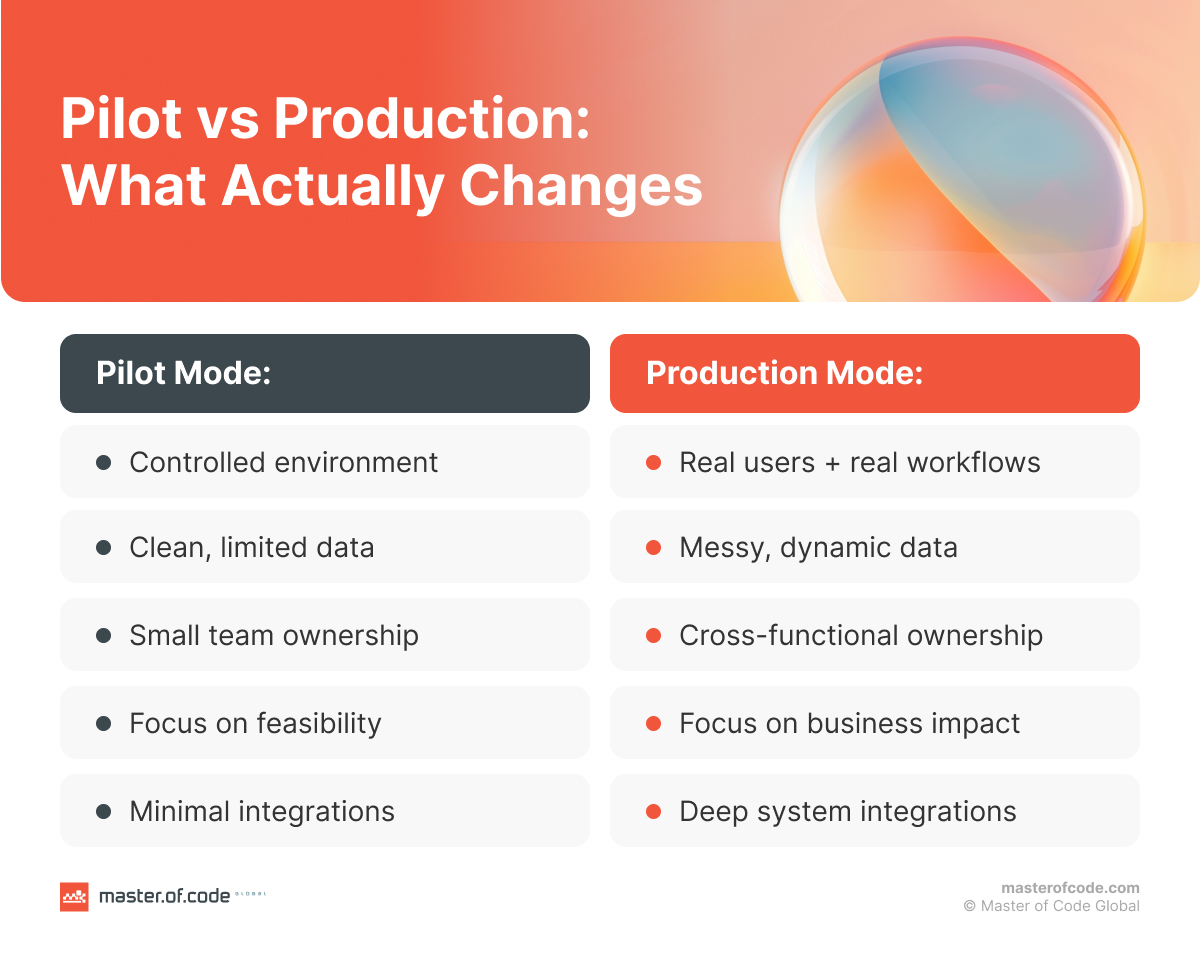
The intelligent document processing market is projected to reach USD 71.46 billion by 2035, with 72% of enterprises reporting active investment in AI automation. But that adoption level sits alongside a cautionary data point: according to the MIT Sloan Management Review report, 95% of AI enterprise pilots did not deliver expected value or stalled before scaling.
The failure mode is rarely the model. It is the conditions around the model: incomplete data, inconsistent quality, and insufficient process design before deployment.

Human-in-the-Loop Design
Generative AI extraction systems should include calibrated confidence scoring, flagging outputs where the model is uncertain, and routing them to human review. This is not a limitation; it is a design principle. Systems that include structured exception handling maintain accuracy at scale in a way that fully automated pipelines cannot.
Staged Rollout
Starting with high-volume, well-defined file types allows organizations to validate accuracy, measure straight-through processing rates, and refine prompts before expanding to more complex categories. Our team recommends this approach: build the proof of concept on a narrow use case, then scale.
Data Readiness
Unstructured data quality is the first constraint to assess. Documents with poor scan quality, inconsistent formatting, or missing fields produce unreliable extraction outputs regardless of model capability. Organizations that invest in assessing information quality, process maturity, and governance gaps before deployment consistently outperform those that start with model selection.
Master of Code Global CEO Dmytro Hrytsenko highlights the importance of data readiness:
Every company is governed by its data. Before you can build anything reliable on top of AI, you need to understand what data exists, where it lives, and how it connects.
Integration with Existing Systems
Workflow automation value is only realized when extracted data flows into the systems that use it. ERP integration for invoice data, CRM updates from contract terms, and EMR population from medical records are all integration points that require planning before deployment. LLM-based document pipelines are more flexible than template-based predecessors, but the architecture still needs to be designed as part of a broader Generative AI integration service.
How Master of Code Global Approaches Document Automation
For organizations evaluating where and how to deploy Generative AI for document processing, the starting question is not which model to use. It is whether the workflow, the data, and the integration points are ready to support automation at scale.
Master of Code Global works with organizations across financial services, healthcare, and enterprise operations to design and deploy AI document pipelines that fit existing infrastructure. That includes identifying the file types where LLM-based extraction produces the strongest ROI, designing human-in-the-loop review flows for compliance-sensitive workflows, and integrating extraction outputs into downstream systems without requiring teams to rebuild core processes.
For organizations that need clarity before they commit, we offer Generative AI consulting services. The team starts with an AI maturity assessment across seven dimensions, giving your team an objective baseline and a clear picture of where the gaps are. From there, the engagement moves through process mapping, use case prioritization, and a sequenced roadmap with a 90-day activation plan, covering everything needed to move from a well-scoped pilot to production.
For teams that have already made the architecture decisions and are ready to build custom document automation tooling, Generative AI development services support the technical implementation from start to launch. The engagement starts with an AI Pilot: a contained, time-boxed build that validates the business case before full investment. Once the pilot proves value, the team moves into full product development, covering pipeline architecture, model fine-tuning, system integration, and production deployment. This sequencing keeps early costs low and ensures every technical decision is grounded in real-world results.
The right starting point depends on where you are today. Talk to our consultants about which fits your situation.