


You have an AI-powered project in mind. Maybe it’s a new agentic product, an internal automation, or the next step after a successful pilot. You start talking to vendors, and when budget discussions begin, you’re introduced to several engagement models. Fixed price. Time & Material. Managed dedicated team. Each one sounds reasonable on the surface, but each leads to different outcomes in terms of budget control, delivery speed, and long-term reliability.
To help you make sense of this choice, we sat down with Olga Grom, our Chief Delivery Officer, and broke it down from a field-tested perspective. In this article, we’ll explain how each engagement model works, where the hidden trade-offs are, how costs are formed, and why managed dedicated teams often become the most effective option for building and scaling AI solutions.
The goal is simple: give you enough context to make a smarter, more confident decision.
Table of Contents
Key Takeaway
- AI delivery outcomes depend more on the engagement model than on the technology itself. The right model determines how well teams adapt to uncertainty, change, and real-world constraints.
- Fixed price, time & material, and managed dedicated teams optimize for different trade-offs. Budget predictability, flexibility, and ownership cannot all be maximized at the same time.
- AI projects benefit from continuity and accumulated context. Stable teams reduce knowledge loss, speed up decision-making, and improve long-term delivery quality.
- Managed dedicated teams are best suited for AI initiatives that evolve over time. They support iteration, learning, and shared responsibility beyond initial build and launch.
- Choosing the right model early reduces delivery risk and hidden costs later. This is where AI strategy consulting services help align engagement structure with business goals, not just project scope.
Use a practical decision guide to see when custom, off-the-shelf, or hybrid AI solutions work best and how each choice impacts cost, speed, and scalability.

Why AI Development Changes the Way Projects Are Delivered
At a high level, artificial intelligence projects may look similar to traditional software initiatives. You still plan, build, test, and release. But once execution starts, the differences become clear, and they have a direct impact on how the work should be organized and delivered.
#1 Differentiator: Uncertainty
Unlike classic software, complex intelligent solutions are rarely fully defined upfront. Early assumptions often change once the system interacts with real data, real users, or real business constraints. As a result:
- Initial requirements tend to evolve during development.
- Some ideas that look promising early on need to be adjusted or dropped.
- Iteration is not a phase; it’s the normal way of working.
#2 Differentiator: Dependence on Real-World Context
In traditional projects, once a feature is implemented, its behavior is largely predictable. In artificial intelligence, many critical decisions can only be made after the system is exposed to real data, real users, and real operating conditions. Teams typically move forward by:
- Evaluating actual behavior rather than relying only on initial assumptions.
- Adjusting approaches once outputs are observed in real scenarios.
- Making delivery decisions based on how the solution performs in practice, not just in controlled tests.
#3 Differentiator: The Importance of Continuity
AI development depends heavily on shared context, both technical and business. When people rotate frequently or work across too many initiatives:
- Teams spend time re-explaining decisions instead of moving forward.
- Knowledge gets lost between handovers.
- Lack of clear ownership starts to affect quality and speed.
This kind of work requires deep focus. When contributors are spread thin across multiple projects, context switching becomes a real cost, especially in complex AI initiatives where understanding data, behavior, and business logic takes time to build.
Taken together, these factors don’t make AI projects chaotic. But they do make them less compatible with rigid, upfront planning. Such initiatives work best when there’s room to adapt, fast feedback loops, and stable teams that can accumulate knowledge gradually.
That’s why the engagement model matters so much. The way collaboration is structured can either support these realities or quietly work against them. Next, let’s look at the three most common approaches and how each one performs in an artificial intelligence context.
Three Strategic Models for AI Project Delivery
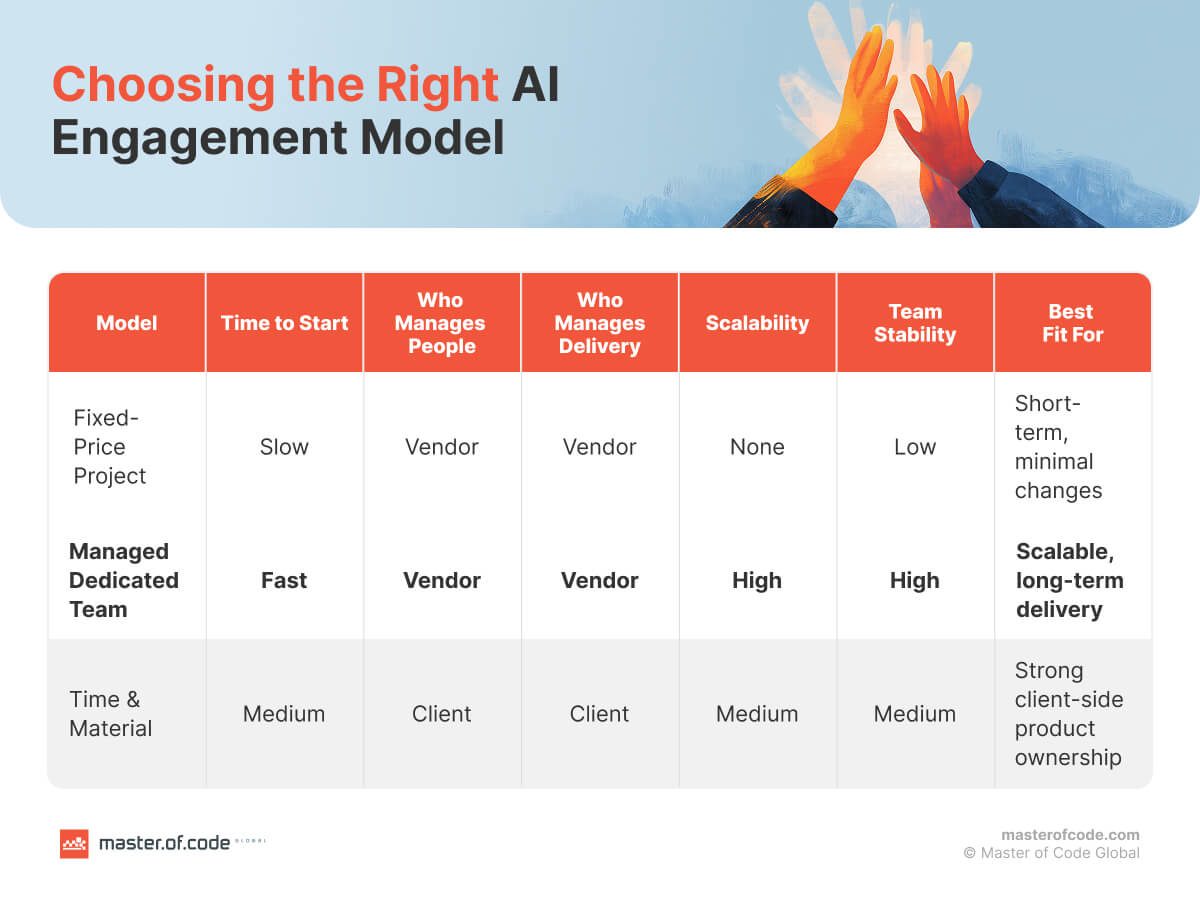
Once you move from idea to execution, most vendors will propose one of three engagement models. On paper, they all seem viable. In practice, each one optimizes for very different priorities, and those differences matter much more in AI projects than in traditional software development.
Below is a clear, practical breakdown of how each model works, what it’s best suited for, and where its limitations usually appear.

Fixed Price
This one means the scope, timeline, and budget are agreed on upfront. The vendor commits to delivering a predefined set of features for a predefined cost.
Key characteristics:
- Scope is locked early.
- Changes require formal change requests.
- Budget predictability is high.
- Most delivery and estimation risk sits on the vendor’s side.
When it works best:
- The scope is very well understood and unlikely to change.
- The project is relatively small or straightforward. These could also be a Discovery, an AI PoC, or a pilot project.
- The goal is to reduce financial uncertainty, even at the cost of flexibility.
Where it struggles:
AI projects rarely stay within a perfectly defined scope. As soon as assumptions shift — data quality, model behavior, evaluation criteria, or integration constraints — the fixed structure can slow decision-making and make changes expensive.
To compensate for this uncertainty, fixed-price contracts almost always include a contingency buffer. In practice, this buffer often adds around 30% to the upfront cost of implementing AI, and can be higher depending on project complexity and risk profile. The client gains predictability, but pays for it in advance.
Time & Material
With this one, you pay for the actual time spent by the team. The scope can evolve as the project progresses, and priorities are adjusted along the way.
Key characteristics:
- High flexibility;
- Transparent reporting on time and progress.
- The budget is forecasted, not guaranteed.
- Most prioritization and budget control decisions sit on the client’s side.
When it works best:
- Requirements are expected to change.
- The client can act as a strong product owner or assign one to the team.
- Flexibility is more important than strict budget predictability.
Where it can become challenging:
While this model supports iteration, it also shifts more responsibility to the client. Without active involvement and clear prioritization, budgets can drift, and decision fatigue can slow progress, especially in longer initiatives.
Dedicated Team
In this case, you commit to a specific team that works exclusively on your project. Instead of paying per task or feature, you invest in a stable, long-term team setup.
Key characteristics:
- Stable team composition;
- Predictable monthly costs;
- Shared responsibility for planning and delivery;
- Requires forward-looking workload planning.
When it works best:
- The initiative is expected to run for several months or longer.
- AI is part of a broader program, not a one-off experiment.
- Continuity, speed, and accumulated context matter.
- The organization is ready to plan work at least one month ahead.
Why it stands out:
AI implementation in business benefits from teams that stay close to the problem over time. With a dedicated team, knowledge compounds instead of resetting, and the delivery model naturally supports iteration, learning, and long-term ownership. Which is why dedicated teams are often used as the foundation for AI implementation partnerships rather than short-term execution.
The partnership between Glia and Master of Code Global illustrates this approach. Over more than five years, the collaboration expanded from consulting into professional services, team augmentation, and MVP feature development. During that time, Master of Code Global became Glia’s primary external engineering vendor and delivered over 25 projects across four engagement models.
This continuity is why dedicated teams often become the foundation of AI implementation partnerships rather than a resource for short-term execution.
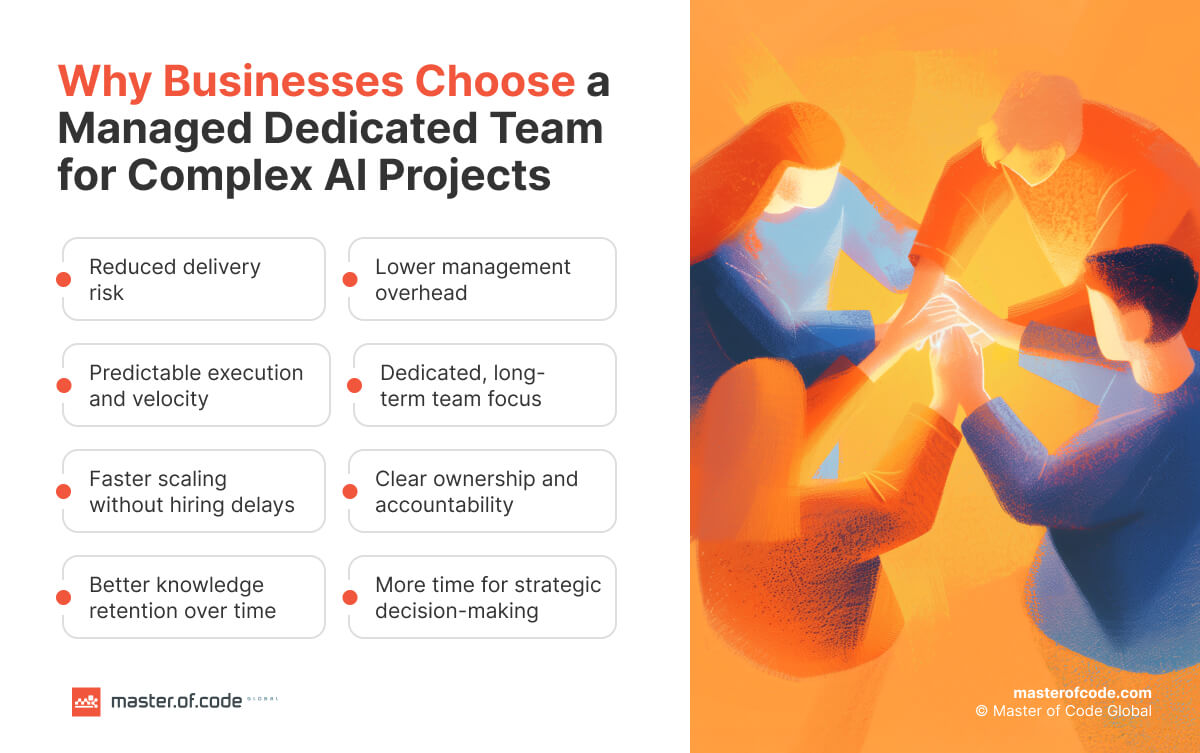
None of these models is universally “right” or “wrong.” Each one reflects a different trade-off between flexibility, cost control, and responsibility. However, once AI projects move beyond short experiments, those trade-offs become more visible.
In the next section, let’s explore how these three differ from a cost perspective.
Price and Budget Considerations: What Actually Drives the Numbers
When vendors propose different engagement models for an AI project, the scope of work often stays the same, but the budget changes significantly. This isn’t because the work itself is different, but because each model prices uncertainty, responsibility, and risk differently.
There are three core principles to keep in mind.
First, fixed-price projects must always include a contingency and change buffer. This buffer exists to protect the vendor from uncertainty, scope changes, and estimation risk — all of which are common in artificial intelligence. As Olga Grom explains, this is not a hidden surcharge but a standard market practice when the vendor takes full delivery risk upfront:
“All the risks — underestimation, changes, unknowns — sit on the vendor. That’s why fixed price is always the most expensive option at the start. You’re paying for predictability.”
In practice, this buffer can raise the total cost by 30% or more, and in some cases even higher, depending on complexity and ambiguity. The client benefits from budget predictability, but pays for that predictability upfront.
Second, in time & material, the key variable is the balance between the hourly rate and the number of hours. There is usually a forecasted budget, but no built-in contingency on the vendor side. All decisions about scope changes and budget usage sit with the client.
Third, a dedicated team model must include a built-in business incentive that is different from the other two. In practice, this incentive usually appears as a lower effective hourly rate when the client commits to a team for a longer period, starting from three months.
To make this difference more tangible, let’s look at a simple, fully theoretical example.
- We have a level of effort of 1000 hours of development for project X. The billed blended hourly rate is $75/hr.
Fixed price:
- 1,000 × $75 = $75,000 (30% contingency buffer)
Total: $97,500
Time & Material:
- 1,000 × $75
Total: $75,000 (forecasted and tied to time-boxed deliverables)
Dedicated team:
- 2 developers for 3 months
- $8,000 per developer per month
- Total: $48,000
(Each developer works ~160 hours/month, ~960 hours total, at an effective ~$50/hour)
This example illustrates why, for AI initiatives that run longer than a few months, dedicated teams often become the most cost-efficient option, while still preserving flexibility and continuity.
How Managed Dedicated Teams Are Run in Real AI Projects
At Master of Code Global, a managed dedicated team is not treated as a staffing shortcut or a variation of time & material. It is a distinct model with its own structure, responsibilities, and planning logic.
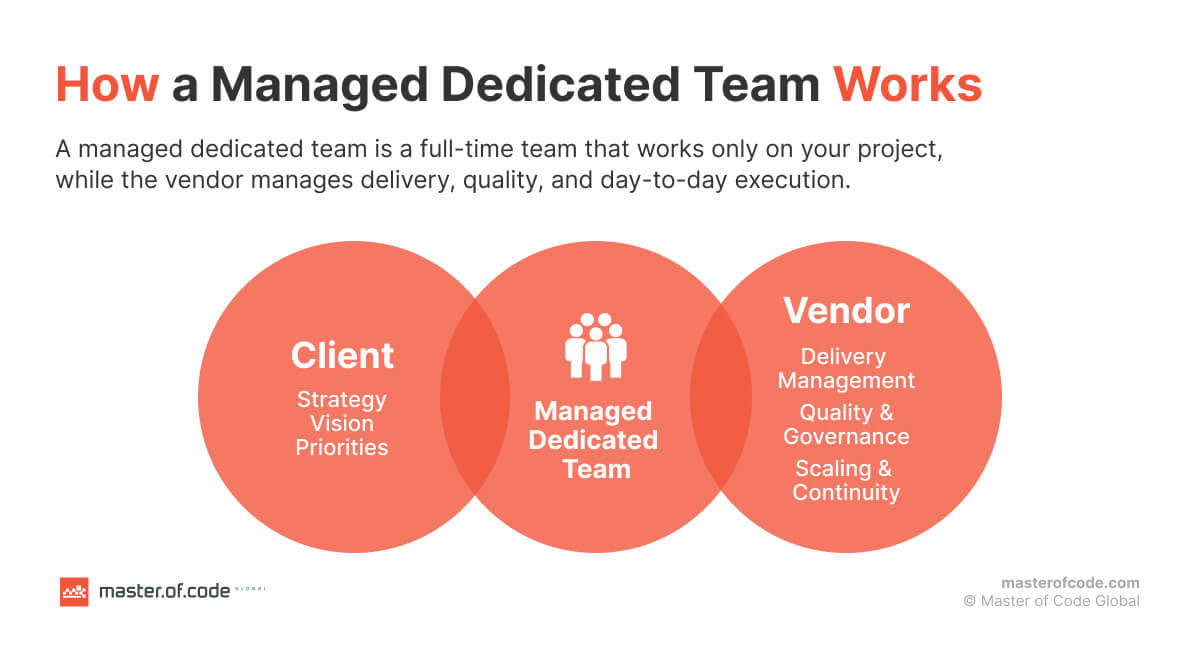
First, it’s important to clarify what this model represents. A managed dedicated team is a type of long-term collaboration, not only a project format. The client does not buy a fixed scope or a set of hours. Instead, they commit to a defined team that works full-time on their initiative for an agreed period, typically starting from three months, with a defined scope of the deliverables they have committed to. This commitment allows the team to stay focused, accumulate context, and operate as an extension of the client’s organization rather than an external executor.
The process usually starts with a recommendation. Based on the nature of the project, its expected duration, and the level of uncertainty, we advise which engagement model makes the most sense. This recommendation is made independently of the budget discussion, because the delivery model is not only a financial decision. As Olga Grom explains, the delivery model decision comes first because it shapes everything that follows:
“I usually recommend the engagement model before we even talk about budget. It’s not just a financial choice — it directly affects speed, quality, and how realistic success will be.”
Once the dedicated team model is agreed upon, we define the team composition and monthly projection. The contract always includes:
- the expected team structure;
- a month-by-month projection;
- clear rules for billing, reporting, and changes.
This gives the client transparency and predictability while preserving flexibility.
The core team is built around continuity and deep focus. For AI projects, it typically includes:
- a Solution Lead responsible for technical direction and overall quality;
- a Project Manager who helps manage scope, priorities, and budget, and often acts as a proxy product owner;
- AI engineers and developers working full-time on the project;
- QA to ensure quality as the solution evolves.
Depending on the type of application, additional core roles may be included, such as a Conversation Designer for conversational systems. These roles are part of the team because they require deep immersion in the product and domain.
At the same time, not every role needs to be dedicated full-time. Some specialists—such as DevOps, UX designers, or niche subject-matter experts—are often added on a time & material basis when needed. This hybrid approach allows the core team to remain stable while keeping flexibility around roles that are difficult to plan far in advance.
Team selection is also part of the model. For dedicated teams, we always share CVs with the client, and when needed, arrange intro calls or interviews. This is especially common in enterprise engagements or longer-term partnerships. The goal is not only technical fit, but also alignment in communication style and expectations.
Operationally, the team works in monthly delivery cycles. At the end of each month, progress is reviewed, and the plan for the next month is validated or adjusted. The team can work more hours if needed, but not fewer than agreed, which ensures predictability for both sides. This structure allows the client to gradually adapt the team size and focus as the project evolves.
Finally, this model is designed for long-term collaboration. Many AI initiatives start as pilots or MVPs and later evolve into broader programs. A managed dedicated team supports this transition by preserving knowledge, documentation, and decision history inside the same team, rather than resetting context with every new phase.
In the End
Choosing an engagement model for AI development is ultimately a decision about ownership, adaptability, and how your organization handles uncertainty. Fixed price, time & material, and managed dedicated teams can all work. Still, they support very different ways of building, learning, and scaling.
As intelligentization initiatives move beyond pilots, continuity and shared responsibility start to matter more than rigid scope or short-term cost comparisons. That’s where managed dedicated teams often provide a practical advantage. They allow knowledge to compound, decisions to evolve, and delivery to stay aligned with real business needs.
If you’re starting an AI project and want help deciding what model fits your goals, constraints, and maturity level, our team can support you through AI strategy consulting and hands-on delivery. We’re happy to help you assess options, pressure-test assumptions, and choose an approach that works in practice.