


Warehouses are being asked to move faster without becoming more expensive to run. eCommerce growth has increased SKU variety, delivery promises are tighter, and labor planning is harder to control. Yet many operations still depend on fixed rules, manual exception handling, and disconnected reports that explain problems after they have already hit service levels. Managers can see the pressure clearly, but they often lack systems that can translate that pressure into immediate operational choices.
That gap is exactly where AI is starting to matter. It is no longer only an enhancement inside warehouse management systems. In stronger deployments, it becomes the operating logic that predicts demand, assigns work, detects errors, and adjusts processes while the operation is still moving.
The business case for AI in warehouse operations is not about replacing every existing system. It is about making warehouse decisions more adaptive, measurable, and connected to real constraints. Instead of asking teams to manually interpret every signal, AI helps turn those signals into prioritized actions.
This article breaks down where the technology pays off, which applications already have verified benefit data, and how leaders can choose a practical starting point for implementation.
Table of Contents
Key Takeaways
- AI changes warehouse decisions from static rules to adaptive operating logic.
- Forecasting and inventory models create value when they update continuously.
- Robotics and vision systems improve fulfillment, where speed and accuracy break first.
- Maintenance and labor planning matter because capacity losses compound quickly.
- Implementation should start with one high-value use case, not a full-stack rebuild.
What AI in Warehouse Operations Actually Changes
Warehouse management has historically struggled with one thing: adapting to variability as it happens. Traditional WMS logic is good at enforcing processes. It can tell teams where stock sits, which orders need picking, and which rules apply to replenishment. It can also preserve discipline across shifts by keeping standard workflows consistent.
But most of that logic is configured in advance and depends on humans to adjust when demand, labor, stock, or equipment conditions shift. AI in warehouse management changes the role of software from recordkeeping to decision support. Instead of only following fixed rules, models recognize patterns across orders, movement data, item velocity, equipment signals, and worker activity. That makes the warehouse less reactive and more responsive. It also makes operational efficiency easier to measure because decisions are linked to the signals that triggered them.
Two mechanisms matter most operationally. Machine learning in manufacturing and logistics helps models learn from historical and live patterns, then improve forecasts, slotting, routing, and maintenance decisions. Computer vision helps systems interpret physical reality: what was picked, what arrived, what is damaged, and what should be flagged before shipment.
The next step is agentic AI. Gartner named agentic AI one of the top supply chain technology trends for 2025, describing systems that autonomously execute decisions in supply chain operations. In April 2026, Gartner also forecast that SCM software with agentic capabilities would grow from less than $2 billion in 2025 to $53 billion in spend by 2030, with 60% of enterprises using SCM software expected to adopt agentic features by then.
That is the direction of the stack: from dashboards, to recommendations, to controlled execution.
Core Applications of AI in Warehouse Management
This technology creates the most value when it is tied to specific operational bottlenecks. The use cases below are the areas where delays, errors, and wasted capacity usually become visible first.

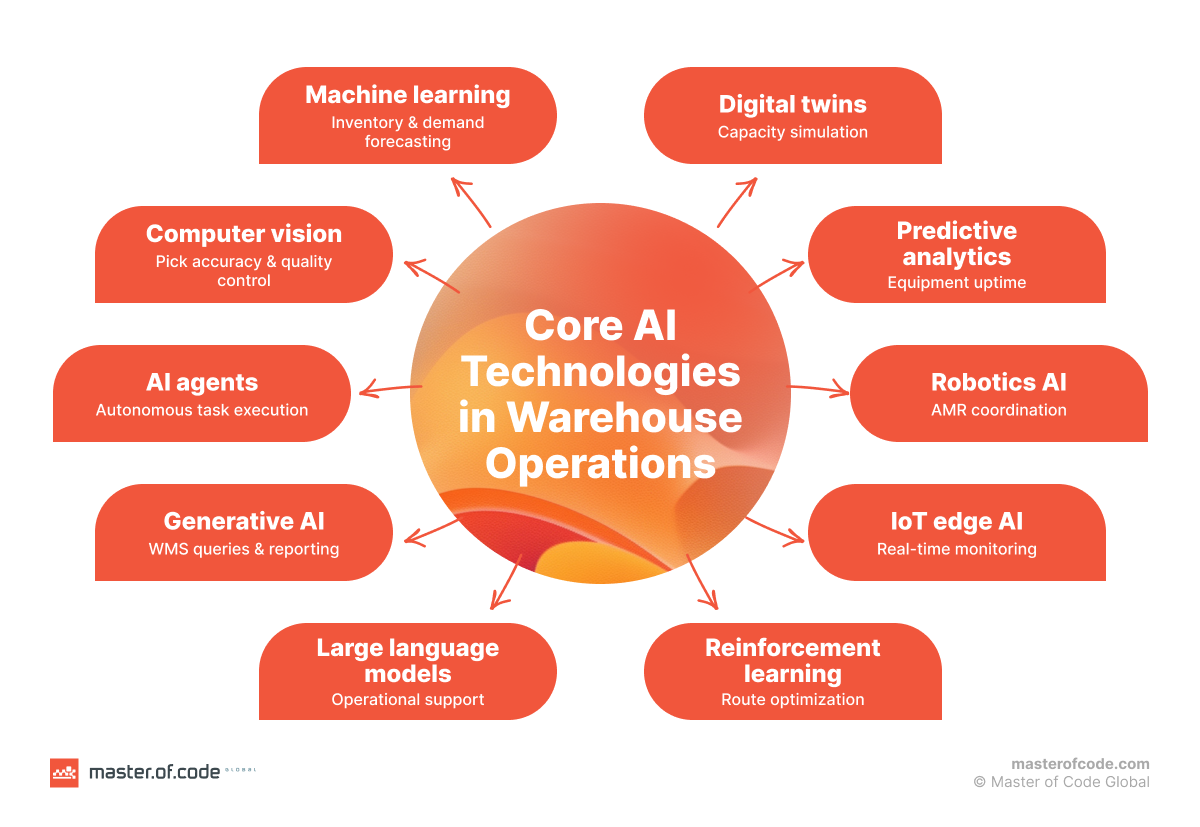
AI-Driven Inventory Management and Demand Forecasting
The problem starts when planning models treat demand as more stable than it really is. Static forecasts often miss sudden sales spikes, regional shifts, promotional effects, or supplier delays. The result is familiar: too much slow-moving stock in one area, too little fast-moving stock in another, and unnecessary emergency replenishment.
AI improves planning by segmenting demand dynamically. Models can update forecasts using sales history, seasonality, lead times, promotions, channel data, and external signals. Machine learning models can also detect patterns that are too granular for rule-based planning, such as location-specific demand shifts or promotion effects by SKU cluster. Demand forecasting becomes a continuous process rather than a quarterly planning exercise.
This directly improves inventory management because the warehouse can position stock closer to expected demand. It also gives planners a real-time view of where risk is forming before service levels fall. Teams can identify products at risk of stockout or overstock earlier. When forecasting accuracy improves, replenishment becomes less reactive, and warehouse space is used more intelligently.
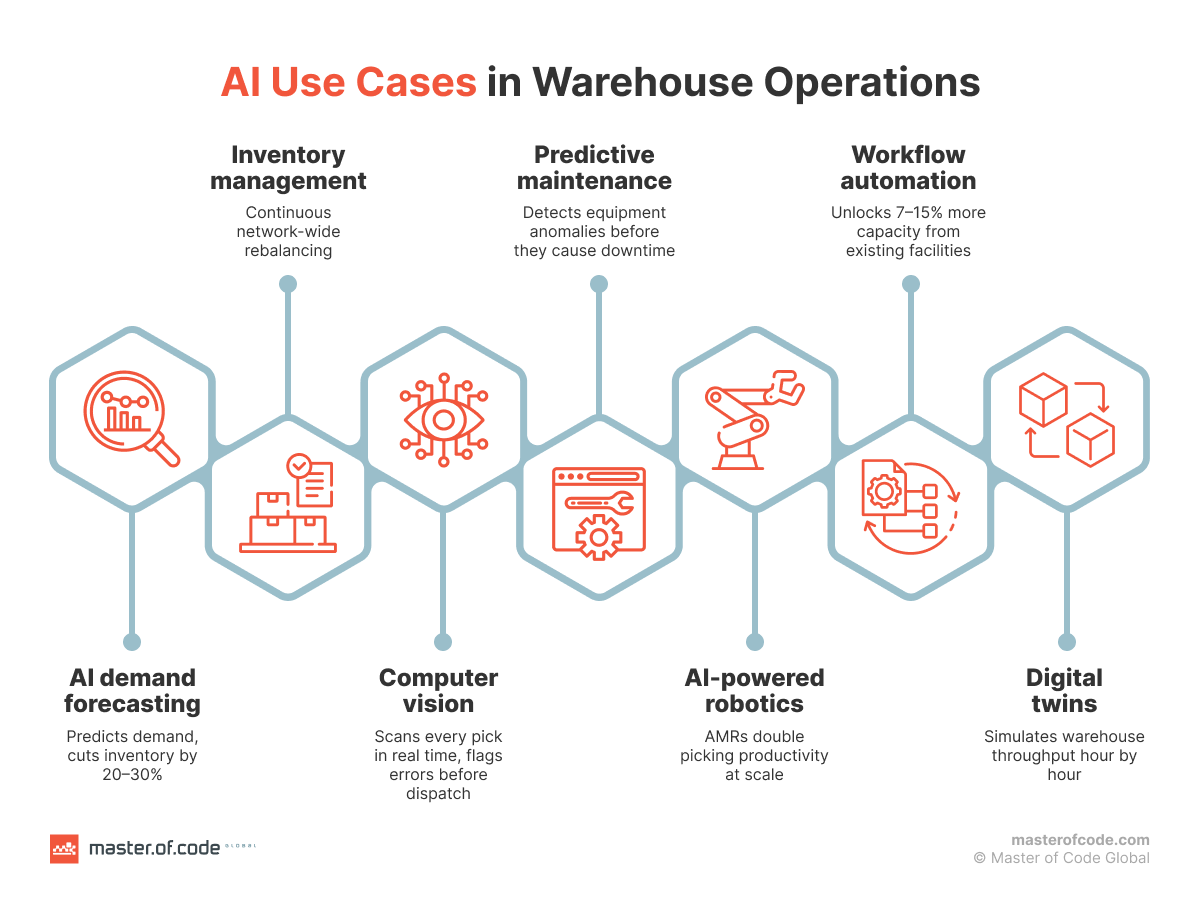
For companies evaluating this layer, AI predictive analytics services can help connect planning data with operational execution. In fact, McKinsey estimates that AI-enabled distribution operations can reduce inventory by 20–30%, while Gartner predicts that 70% of large organizations will adopt AI-based supply chain forecasting by 2030.
AI Robotics and Automated Order Fulfillment
The pressure point in fulfillment is not only labor availability. It is the growing complexity of high-SKU picking, where travel time, item variability, and order batching create bottlenecks. Traditional automation works well for predictable flows, but many warehouses handle product mixes that change too quickly for fixed layouts. The challenge is keeping throughput high without forcing every item into the same physical path.
AI-powered robots solve different parts of this problem. Autonomous mobile robots move through the warehouse using dynamically optimized routes. They reduce walking time and bring work to people more efficiently. Robotic picking arms handle a different task: identifying, grasping, and placing items that may vary in size, shape, packaging, or position.
Those arms often rely on computer vision and reinforcement learning to improve handling over time. That matters in environments where product variety makes conventional equipment too rigid. The goal is not full autonomy everywhere. It is targeted automation where repeatable physical work slows order fulfillment. These systems can also improve safety by reducing unnecessary walking, lifting, and congestion around busy picking areas.
A Performance Health reported that AMR deployment reduced aisle walking time by 69%, from 25 seconds to 7.7 seconds per pick line. That is a practical signal of how warehouse robotics can convert movement reduction into fulfillment capacity.
Computer Vision for Pick Accuracy and Quality Control
Mis-picks and mislabeled shipments are expensive because the cost appears in several places at once. The warehouse spends time fixing the error, customer support handles the complaint, and the business may pay for returns, replacements, or lost loyalty.
Vision systems help by checking work while it is still inside the operation. Cameras can scan items during pick and pack, compare labels against order data, and flag out-of-spec products before they leave the building. This creates a quality gate inside the workflow instead of relying only on random checks or manual audits. In more advanced setups, the system can alert a supervisor immediately and route the item for correction before the parcel is sealed.
The same logic applies to inbound receiving. A system can verify whether arriving goods match the purchase order, identify visible damage, and surface discrepancies earlier. For high-volume facilities, better accuracy is not a small process improvement. It can protect delivery promises, reduce avoidable transportation movements, and improve the customer experience without adding another inspection team.
Predictive Maintenance and Equipment Uptime
A conveyor stoppage or sorter outage can disrupt the whole day. The problem is not only the repair cost. It is the pileup of delayed orders, reassigned labor, missed cutoffs, and productivity loss across connected workflows.
AI predictive maintenance uses sensor and equipment data to spot anomaly patterns before failure occurs. Vibration, temperature, pressure, power consumption, and operational cycle data can all signal early deterioration. Models detect when behavior starts drifting from normal ranges, allowing scheduled intervention instead of emergency repair.
For a deeper look at AI predictive maintenance in industrial settings, manufacturing examples show the same principle at work. BMW’s Regensburg plant uses AI-supported smart maintenance to monitor conveyor technology. BMW reported that the system avoids more than 500 minutes of vehicle assembly disruption per year at that plant alone.
Less downtime means more predictable throughput. It also gives operations teams more control over when maintenance actually happens. That control is critical because downtime rarely stays isolated; it usually spreads into packing, staging, and shipping schedules.
Workflow Automation and Labor Optimization
Labor is often the largest and least predictable warehouse variable. Absenteeism, shift gaps, late inbound deliveries, order surges, and misallocated effort can all reduce capacity. A warehouse may have enough people on site and still place them in the wrong zones at the wrong time. That mismatch reduces efficiency even when the headcount looks sufficient on paper.
AI workflow automation helps by adjusting work allocation based on live conditions. Dynamic task assignment routes workers and AMRs according to order volume, location data, priority, and current congestion. Slotting models continuously reposition items based on pick frequency, which reduces travel time and makes popular SKUs easier to reach.
Labor forecasting adds another layer. By combining historical demand, seasonality, promotion calendars, and attendance patterns, teams can plan staffing before peaks arrive. This supports better shift design, reduces last-minute overtime, and gives supervisors a clearer view of where capacity will be tight before the shift begins.
The emerging change is that AI agents can start executing adjustments, not only recommending them. With the right controls, an agent can rebalance tasks, trigger replenishment, escalate exceptions, or update slotting rules within approved limits. For companies exploring this direction, AI agent development should start with narrow workflows where rules, data, and permissions are clear.
McKinsey estimates that AI-powered warehousing tools can unlock 7–15% additional capacity in existing networks. ActivTrak also found that 72% of logistics employees used AI tools in 2024, the highest adoption rate across the industries studied.
Benefits of AI in Warehouse Operations
Benefits appear when AI is applied to the operational layer where the constraint actually exists. A forecasting model will not fix poor picking logic. A robot will not solve bad replenishment. The strongest business case connects each use case to a measurable warehouse outcome. Decision-makers should ask which metric changes if the model works: capacity, pick rate, stock availability, labor utilization, or service reliability.
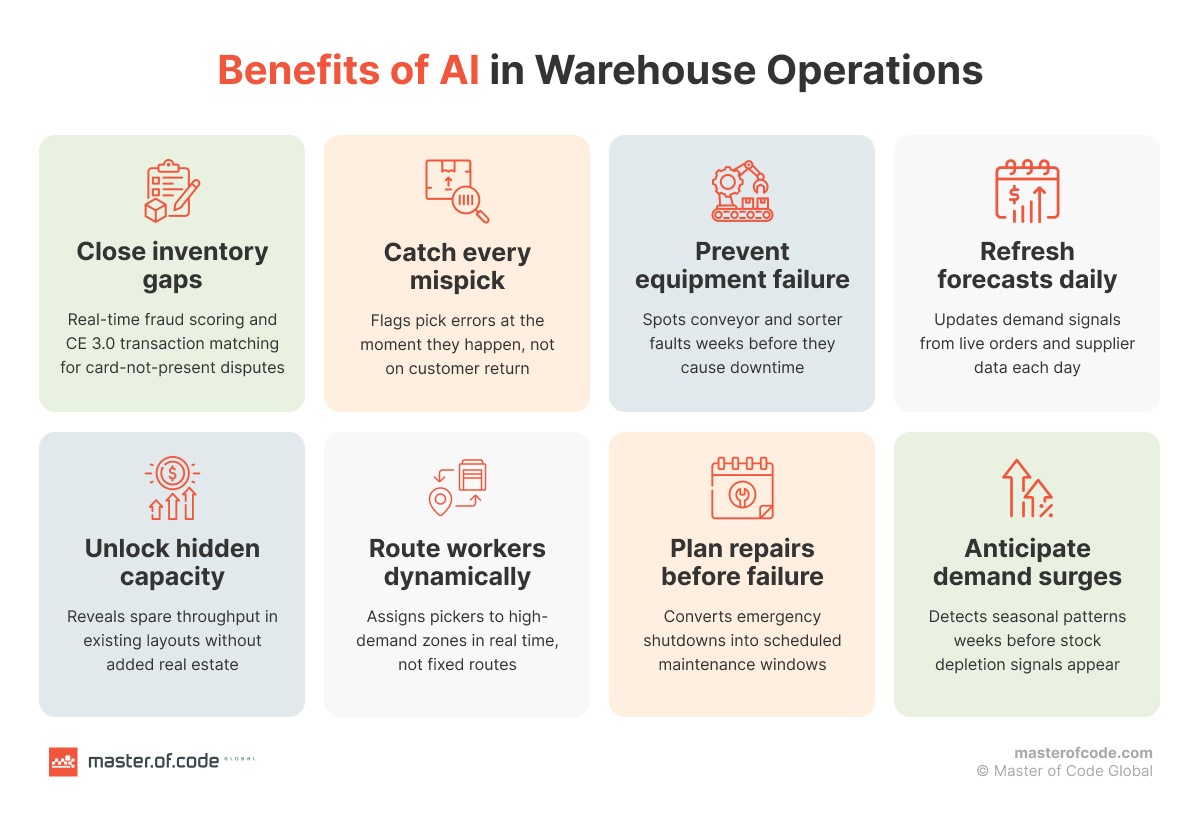
- Cost reduction. AI helps reduce wasted labor, excess stock, rush shipments, emergency repairs, and manual rework. McKinsey estimates that AI-enabled distribution operations can cut logistics costs by 5–20%. For leaders building the business case, AI cost reduction should be tied to specific operational levers, not broad transformation claims. This keeps investment decisions grounded in controllable warehouse economics.
- Inventory efficiency. Better forecasting and replenishment reduce overstock and stockout risk. McKinsey’s 20–30% inventory reduction estimate shows why this layer is often a strong starting point. It improves cash flow, warehouse space usage, and service reliability.
- Order accuracy. Vision checks and AI-supported exception detection catch errors before they become returns or customer complaints. This is especially useful in high-volume fulfillment, where small error rates scale into high operational costs. More accurate picks also reduce rework for supervisors and support teams. The value compounds when fewer errors reach transportation, returns, and customer service.
- Equipment uptime. Predictive models give teams more warning before critical assets fail. BMW’s conveyor example shows how anomaly detection can prevent hundreds of minutes of disruption annually. In warehouse environments, the same logic applies to conveyors, forklifts, sorters, lifts, and automated storage systems. The financial impact comes from preventing disruption before it cascades across the building.
- Workforce productivity. AI can assign tasks, plan labor, and reduce unnecessary travel. McKinsey’s estimate of 7–15% additional warehouse capacity highlights why optimization may be cheaper than adding space. Accenture also found that companies with the most mature supply chains are 23% more profitable than peers, and those leaders are much more likely to use AI and generative AI widely across supply chain functions.
Real-World Results: Warehouse AI in Practice
The clearest way to evaluate AI is through operational results. These examples show different forms of warehouse intelligence: conversational access to inventory, autonomous exception handling, robotic fulfillment, and connected forecasting.
Master of Code Global: aviation parts sourcing. A US-based aviation supplier needed to reduce call volume and help airline teams source critical parts faster. Master of Code Global built an AI-powered parts bot for aviation that supports inventory lookup, order tracking, FAQs, and voice-to-chat transition across web, voice, and SMS channels. The result was faster part request handling, 24/7 self-service availability, and lower pressure on support teams handling urgent aircraft-related requests. For warehouse and aftermarket teams, the same pattern applies when customers or field teams need quick access to stock, order status, and product information.
Master of Code Global: data discrepancy reconciliation. A US energy company struggled with manual reconciliation across operational readings. Master of Code Global developed an Agentic AI-powered data discrepancy reconciliation tool that detects inconsistencies, visualizes differences, and explains them in plain language. While not a warehouse case, the mechanism is relevant: agentic systems can reduce manual investigation time when teams need to compare operational data across sources and resolve exceptions faster. Similar logic can support cycle count discrepancies, inbound mismatches, and shipment data conflicts.
DHL Supply Chain: robotic fulfillment scale. DHL Supply Chain reached a 500 million picks milestone using autonomous mobile robots across warehouse operations. The company reported that the first 10 million picks took 2.5 years, while the last 100 million took only 154 days. DHL described the milestone as evidence of improved productivity, accuracy, and employee ergonomics from human-robot collaboration. The speed of the later milestones also shows how repeatable fulfillment models can scale after the operating pattern is proven.
Unilever: connected forecasting and replenishment. Unilever developed an AI-powered customer connectivity model for collaborative planning, forecasting, and replenishment. The system runs more than 13 billion computations per day and integrates forecast and actual sales data between Unilever and retail partners. In its Walmart Mexico pilot, Unilever reported above 98% on-shelf availability, reduced inventory, and an estimated 30% reduction in manual forecasting effort.
How to Implement AI in Warehouse Operations
The implementation question should not start with “Which tool should we buy?” It should start with “Which warehouse constraint is expensive enough to fix first?” That framing prevents teams from buying capabilities that look impressive but do not change daily performance. Many AI programs underperform because they begin as platform selections instead of operational decisions.
First, assess and prioritize. Choose one or two use cases with measurable value and manageable integration risk. Good starting points often include demand planning, slotting, pick verification, equipment monitoring, or task assignment. Avoid launching five pilots at once. A focused use case makes it easier to prove value and win internal trust. It also makes training, governance, and change management easier for supervisors and frontline teams.
Second, build the data and technology foundation. AI systems are only as useful as the data they can access. WMS data, order history, SKU attributes, labor records, sensor feeds, equipment logs, real-time data, and integration quality all matter. This is also where broader Generative AI in supply chain work becomes relevant, especially when teams want natural-language access to operational data.
Third, decide whether to build or integrate. Off-the-shelf WMS AI can cover common warehouse patterns. That may be enough for standard facilities with clean processes and common workflows. But custom models become more useful when the operation has proprietary SKU logic, private-label demand curves, unusual picking constraints, custom approval rules, or disconnected legacy systems.
A custom AI development company can help design models around those real constraints instead of forcing the warehouse into generic software behavior. This does not mean building everything from scratch. It means deciding which layer should be configured, integrated, or custom-built. In many cases, the best architecture combines existing WMS capabilities with custom models, APIs, and decision rules around the highest-value constraints.
The readiness gap is the real blocker. McKinsey found that about 95% of distributors are exploring AI use cases, but fewer than 10% have an AI roadmap and prioritized deployment use cases. The constraint is no longer technology access. It is the readiness to operationalize it.
What’s Next?
The data, use cases, and deployment infrastructure already exist. AI is not a distant warehouse capability anymore. The difference is whether a company can connect the technology to the right bottleneck, the right data, and the right decision owner. That connection is what turns experimentation into operational change.
AI in warehouse operations should start where the cost of inaction is visible: excess stock, missed cutoffs, slow picks, equipment disruption, manual exception handling, or weak labor planning. From there, the path becomes much clearer. Start narrow, prove value, and expand only when the workflow is ready. The best roadmap is not the most ambitious one on paper. It is the one your teams can actually run, trust, and improve.
If the challenge is figuring out where to start, what to build, and what to integrate, an AI consulting services engagement can map data readiness before committing to a deployment stack.
Discover how Master of Code Global can help enhance your customer’s experience and boost sales growth.